
Home      Discussion      Topics      Dictionary      Almanac
Signup       Login
Giant Leopard Moth

Giant Leopard Moth

Overview
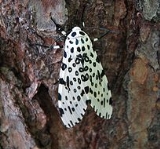
The Giant Leopard Moth or Eyed Tiger Moth (Hypercompe scribonia) is a moth
Moth
A moth is an insect closely related to the butterfly, both being of the order Lepidoptera. Moths form the majority of this order; there are thought to be 150,000 to 250,000 different species of moth , with thousands of species yet to be described...

 of the family Arctiidae
Arctiidae
Arctiidae is a large and diverse family of moths with around 11,000 species found all over the world, including 6,000 neotropical species. This family includes the groups commonly known as tiger moths , which usually have bright colours, footmen , lichen moths and wasp moths...

. It is distributed throughout the Southern and Eastern United States
United States
The United States of America is a federal constitutional republic comprising fifty states and a federal district...

 from New England to Mexico
Mexico
The United Mexican States , commonly known as Mexico , is a federal constitutional republic in North America. It is bordered on the north by the United States; on the south and west by the Pacific Ocean; on the southeast by Guatemala, Belize, and the Caribbean Sea; and on the east by the Gulf of...

. The obsolete name Ecpantheria scribonia is still occasionally encountered.
Discussion
Ask a question about 'Giant Leopard Moth'
Start a new discussion about 'Giant Leopard Moth'
Answer questions from other users
Full Discussion Forum
 
Unanswered Questions
Recent Discussions
Encyclopedia
The Giant Leopard Moth or Eyed Tiger Moth (Hypercompe scribonia) is a moth
Moth
A moth is an insect closely related to the butterfly, both being of the order Lepidoptera. Moths form the majority of this order; there are thought to be 150,000 to 250,000 different species of moth , with thousands of species yet to be described...

 of the family Arctiidae
Arctiidae
Arctiidae is a large and diverse family of moths with around 11,000 species found all over the world, including 6,000 neotropical species. This family includes the groups commonly known as tiger moths , which usually have bright colours, footmen , lichen moths and wasp moths...

. It is distributed throughout the Southern and Eastern United States
United States
The United States of America is a federal constitutional republic comprising fifty states and a federal district...

 from New England to Mexico
Mexico
The United Mexican States , commonly known as Mexico , is a federal constitutional republic in North America. It is bordered on the north by the United States; on the south and west by the Pacific Ocean; on the southeast by Guatemala, Belize, and the Caribbean Sea; and on the east by the Gulf of...

. The obsolete name Ecpantheria scribonia is still occasionally encountered.

This species has a wingspan
Wingspan
The wingspan of an airplane or a bird, is the distance from one wingtip to the other wingtip. For example, the Boeing 777 has a wingspan of about ; and a Wandering Albatross caught in 1965 had a wingspan of , the official record for a living bird.The term wingspan, more technically extent, is...

 of 3 inches (nearly 8 cm). The wings of this moth are bright white with a pattern of neat black blotches, some solid and some hollow. The abdomen is dark blue with orange markings, the male has a narrow yellow line on the sides. Its legs have black and white bands. Adult moths are strictly nocturnal and do not generally fly before nightfall (Fullard & Napoleone 2001).

The caterpillar
Caterpillar
Caterpillars are the larval form of members of the order Lepidoptera . They are mostly herbivorous in food habit, although some species are insectivorous. Caterpillars are voracious feeders and many of them are considered to be pests in agriculture...

 is of the "Woolly Bear
Woolly bear
Woolly bear can mean:*The hairy caterpillars of the Arctiidae family of moths*The larva of the varied carpet beetle*A type of thermal undersuit used with drysuits for applications such as scuba diving...

" kind, with a thick coat of black bristles (setae) and red or orange colored bands between its segments which become conspicuous when caterpillar rolls into a ball for defense.

Recorded food plants


The caterpillar eats a variety of broad-leaf plants such as broadleaf plantains
Plantago
Plantago is a genus of about 200 species of small, inconspicuous plants commonly called plantains. They share this name with the very dissimilar plantain, a kind of banana. Most are herbaceous plants, though a few are subshrubs growing to 60 cm tall. The leaves are sessile, but have a narrow...

, dandelions and violet
Violet (plant)
Viola is a genus of flowering plants in the violet family Violaceae, with around 400–500 species distributed around the world. Most species are found in the temperate Northern Hemisphere; however, viola species are also found in widely divergent areas such as Hawaii, Australasia, and the Andes in...

s:
  • Bougainvillea
    Bougainvillea
    Bougainvillea is a genus of flowering plants native to South America from Brazil west to Peru and south to southern Argentina . Different authors accept between four and 18 species in the genus...

  • Brassica
    Brassica
    Brassica is a genus of plants in the mustard family . The members of the genus may be collectively known either as cabbages, or as mustards...

  • Brugmansia
    Brugmansia
    Brugmansia is a genus of seven species of flowering plants in the family Solanaceae, native to subtropical regions of South America, along the Andes from Colombia to northern Chile, and also in southeastern Brazil. They are known as Angel's Trumpets, sharing that name with the closely related genus...

     (angel trumpet)
  • Cannabis
    Cannabis
    Cannabis is a genus of flowering plants that includes three putative species, Cannabis sativa, Cannabis indica, and Cannabis ruderalis. These three taxa are indigenous to Central Asia, and South Asia. Cannabis has long been used for fibre , for seed and seed oils, for medicinal purposes, and as a...

  • Citrus
    Citrus
    Citrus is a common term and genus of flowering plants in the rue family, Rutaceae. Citrus is believed to have originated in the part of Southeast Asia bordered by Northeastern India, Myanmar and the Yunnan province of China...

  • Euphorbia
  • Helianthus
    Helianthus
    Helianthus L. is a genus of plants comprising 52 species in the Asteraceae family, all of which are native to North America, with some species Helianthus L. is a genus of plants comprising 52 species in the Asteraceae family, all of which are native to North America, with some species Helianthus...

     (sunflowers)
  • Lonicera (honeysuckles)
  • Magnolia
    Magnolia
    Magnolia is a large genus of about 210 flowering plant species in the subfamily Magnolioideae of the family Magnoliaceae. It is named after French botanist Pierre Magnol....

  • Morus
    Morus
    Morus may refer to:* Morus , a genus of trees* Morus , a genus of seabird in the family Sulidae* Thomas Morus, alias Thomas More, a philosopher...

     (Mulberry Tree)
  • Musa (bananas/plantains)
  • "Paulownia
    Paulownia
    Paulownia is a genus of from 6 to 17 species of plants in the monogeneric family Paulowniaceae, related to and sometimes included in the Scrophulariaceae. They are native to much of China, south to northern Laos and Vietnam, and long cultivated elsewhere in eastern Asia, notably in Japan and Korea...

    " (Empress Tree)
  • Persea
    Persea
    Persea is a genus of about 150 species of evergreen trees belonging to the laurel family, Lauraceae. The best-known member of the genus is the avocado, P. americana, widely cultivated in subtropical regions for its large, edible fruit.-Overview:...

  • Phytolacca
  • Plantago
    Plantago
    Plantago is a genus of about 200 species of small, inconspicuous plants commonly called plantains. They share this name with the very dissimilar plantain, a kind of banana. Most are herbaceous plants, though a few are subshrubs growing to 60 cm tall. The leaves are sessile, but have a narrow...

  • Pyrostegia
  • Ricinus
  • Robinia
    Robinia
    Robinia is a genus of flowering plants in the family Fabaceae, subfamily Faboideae, native to North America and northern Mexico. Commonly known as "locusts", they are deciduous trees and shrubs growing 4-25 m tall. The leaves are pinnate with 7-21 oval leaflets. The flowers are white or pink, in...

  • Salix (willows)
  • Lilac
    Lilac
    Syringa is a genus of about 20–25 species of flowering woody plants in the olive family , native to woodland and scrub from southeastern Europe to eastern Asia, and widely and commonly cultivated in temperate areas elsewhere....

  • Taraxacum
    Taraxacum
    Taraxacum is a large genus of flowering plants in the family Asteraceae. They are native to Eurasia and North America, and two species, T. officinale and T. erythrospermum, are found as weeds worldwide. Both species are edible in their entirety...

     (dandelions)
  • Viola
    Violet (plant)
    Viola is a genus of flowering plants in the violet family Violaceae, with around 400–500 species distributed around the world. Most species are found in the temperate Northern Hemisphere; however, viola species are also found in widely divergent areas such as Hawaii, Australasia, and the Andes in...

  • Ocimum basilicum (Basil)
  • Lettuce
    Lettuce
    Lettuce is a temperate annual or biennial plant of the daisy family Asteraceae. It is most often grown as a leaf vegetable. It is eaten either raw, notably in salads, sandwiches, hamburgers, tacos, and many other dishes, or cooked, as in Chinese cuisine in which the stem becomes just as important...


  • External links