

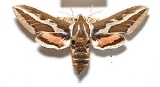
Hyles tithymali

Encyclopedia
Hyles tithymali is a moth
of the family Sphingidae
. It is found in North Africa
, the Canary Islands
, Madeira
, some islands in the Mediterranean Sea
and in the mountains in Jemen.
 The length of the forewings is 45-85 mm.
The larvae feed on Euphorbia.
It is thought that Hyles tithymali had a much larger range in Europe
, but has been pushed further south after the cooling ca. 3600 years ago. Its place has been taken over by Hyles euphorbiae
, which is more resistant to the cold. Because of this, many isolated populations exist today, many of which have developed to distinct subspecies.
Hyles tithymali sammuti and Hyles tithymali cretica are sometimes treated as a full species.
Moth
A moth is an insect closely related to the butterfly, both being of the order Lepidoptera. Moths form the majority of this order; there are thought to be 150,000 to 250,000 different species of moth , with thousands of species yet to be described...
of the family Sphingidae
Sphingidae
Sphingidae is a family of moths , commonly known as hawk moths, sphinx moths and hornworms, that includes about 1,200 species . It is best represented in the tropics but there are species in every region . They are moderate to large in size and are distinguished among moths for their rapid,...
. It is found in North Africa
North Africa
North Africa or Northern Africa is the northernmost region of the African continent, linked by the Sahara to Sub-Saharan Africa. Geopolitically, the United Nations definition of Northern Africa includes eight countries or territories; Algeria, Egypt, Libya, Morocco, South Sudan, Sudan, Tunisia, and...
, the Canary Islands
Canary Islands
The Canary Islands , also known as the Canaries , is a Spanish archipelago located just off the northwest coast of mainland Africa, 100 km west of the border between Morocco and the Western Sahara. The Canaries are a Spanish autonomous community and an outermost region of the European Union...
, Madeira
Madeira
Madeira is a Portuguese archipelago that lies between and , just under 400 km north of Tenerife, Canary Islands, in the north Atlantic Ocean and an outermost region of the European Union...
, some islands in the Mediterranean Sea
Mediterranean Sea
The Mediterranean Sea is a sea connected to the Atlantic Ocean surrounded by the Mediterranean region and almost completely enclosed by land: on the north by Anatolia and Europe, on the south by North Africa, and on the east by the Levant...
and in the mountains in Jemen.
The larvae feed on Euphorbia.
It is thought that Hyles tithymali had a much larger range in Europe
Europe
Europe is, by convention, one of the world's seven continents. Comprising the westernmost peninsula of Eurasia, Europe is generally 'divided' from Asia to its east by the watershed divides of the Ural and Caucasus Mountains, the Ural River, the Caspian and Black Seas, and the waterways connecting...
, but has been pushed further south after the cooling ca. 3600 years ago. Its place has been taken over by Hyles euphorbiae
Hyles euphorbiae
The Spurge Hawk-moth is a European moth of the family Sphingidae. This hawk moth is used as an agent of biological pest control against the noxious weed known as leafy spurge , but usually only in conjunction with other agents...
, which is more resistant to the cold. Because of this, many isolated populations exist today, many of which have developed to distinct subspecies.
Subspecies
The following subspecies are recognised:- H. t. tithymali (Boisduval, 1834)
- H. t. mauretanica (Staudinger, 1871) (North Africa)
- H. t. deserticola (Staudinger, 1901) (North Africa)
- H. t. gecki (de Freina, 1991) (Madeira)
- H. t. phaelipae (Gil-T. & Gil-Uceda, 2007)
- H. t. himyarensis (Meerman, 1988) (Yemen)
- H. t. cretica (Eitschberger, Danner & Surholt, 1998) (Greece)
- H. t. sammutiHyles sammutiHyles sammuti is a moth of the Sphingidae family. Kitching & Cadiou treat it as a valid species, while Pittaway treat it as a subspecies of Hyles tithymali, seeing the larvae are very similar to Hyles tithymali mauretanica. Based on studies of the Mitochondrial DNA, Hyles sammuti probably...
(Eitschberger, Danner & Surholt, 1998)
Hyles tithymali sammuti and Hyles tithymali cretica are sometimes treated as a full species.