

Falcon 1

Encyclopedia
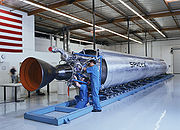
The Falcon 1 is a partially reusable launch system designed and manufactured by SpaceX
, a space transportation company in Hawthorne
, California. The two-stage-to-orbit
rocket
uses LOX
/RP-1
for both stages, the first powered by a single Merlin
engine and the second powered by a single Kestrel
engine. It was designed by SpaceX from the ground up and is the first successfully liquid-propelled orbital launch vehicle developed with private funding.
The Falcon 1 achieved orbit on its fourth attempt
, on 28 September 2008, with a mass simulator as a payload. On 14 July 2009, Falcon 1 successfully delivered the Malaysian RazakSAT
satellite to orbit on SpaceX's first commercial launch (fifth launch overall). Following its fifth launch, the Falcon 1 was retired in favour of an enhanced variant, the Falcon 1e
.
 According to SpaceX, the Falcon 1 is designed to minimize price per launch for low-Earth-orbit
satellite
s, increase reliability, and optimize flight environment and time to launch. It is also intended to verify components and structural design concepts that will be reused in the Falcon 9
.
aluminum alloy
. It employs a common bulkhead between the LOX and RP-1 tanks, as well as flight pressure stabilization. It can be transported safely without pressurization (like the heavier Delta II
isogrid design) but gains additional strength when pressurized for flight (like the Atlas II
, which could not be transported unpressurized). The resulting design has the highest propellant mass fraction of any current first stage. The parachute system, built by Irvin Parachute Corporation, uses a high-speed drogue chute and a main chute.
alloy. The helium
pressurization system pumps propellant to the engine, supplies pressurized gas for the attitude control thrusters, and is used for zero-g propellant accumulation prior to engine restart. The Kestrel
engine includes a titanium heat exchanger to pass waste heat to the helium, thereby greatly extending its work capacity. The pressure tanks are made by Arde corporation and are the same as those used in the Delta IV
. They consist of an inconel
shell wrapped by a composite
.
to a water landing and be recovered for reuse but this has not yet been demonstrated. The second stage is not designed to be reusable.
The second stage Kestrel engine burns for about six minutes, inserting the payload into a low Earth orbit. It is capable of multiple restarts.
While the development of Falcon 1 was privately funded, the first two Falcon 1 launches were purchased by the United States Department of Defense
under a program that evaluates new US launch vehicles suitable for use by DARPA.
As of the summer of 2010, the SpaceX website states that the Falcon 1 has been replaced by the Falcon 1e, with an "open and fixed" price of $10.9 million.
using the SpaceX launch facility on Omelek Island
and range facilities of the Reagan Test Site. All upcoming Falcon 1 flights shown on the SpaceX manifest are also planned for Kwajalein. Other launch sites which have been discussed for Falcon 1 flights include:
making it the first privately funded and developed liquid-propellent rocket to reach orbit. The fifth launch was its first commercial flight, and placed RazakSAT
into low Earth orbit
.
As part of a US$15 million contract, Falcon 1 was to carry the TacSat-1
in 2005. By late May 2005, SpaceX was ready to launch TacSat-1 from Vandenberg, but the Air Force did not want the launch to occur until the final Titan 4 flew from nearby SLC 4E. Subsequent and repeated delays due to Falcon 1 launch failures delayed TacSat-1's launch. After TacSat-2
was launched on an Orbital Sciences Minotaur I
on December 16, 2006, the Department of Defense re-evaluated the need for launching TacSat-1. In August 2007, the Department of Defense canceled the planned launch of TacSat-1 because all of the TacSat objectives had been met.
SpaceX
Space Exploration Technologies Corporation, or more popularly and informally known as SpaceX, is an American space transport company that operates out of Hawthorne, California...
, a space transportation company in Hawthorne
Hawthorne, California
Hawthorne is a city in southwestern Los Angeles County, California. The city at the 2010 census had a population of 84,293, up from 84,112 at the 2000 census.-Geography:...
, California. The two-stage-to-orbit
Two-stage-to-orbit
A two-stage-to-orbit launch vehicle is a spacecraft in which two distinct stages provide propulsion consecutively in order to achieve orbital velocity...
rocket
Rocket
A rocket is a missile, spacecraft, aircraft or other vehicle which obtains thrust from a rocket engine. In all rockets, the exhaust is formed entirely from propellants carried within the rocket before use. Rocket engines work by action and reaction...
uses LOX
Liquid oxygen
Liquid oxygen — abbreviated LOx, LOX or Lox in the aerospace, submarine and gas industries — is one of the physical forms of elemental oxygen.-Physical properties:...
/RP-1
RP-1
RP-1 is a highly refined form of kerosene outwardly similar to jet fuel, used as a rocket fuel. Although having a lower specific impulse than liquid hydrogen , RP-1 is cheaper, can be stored at room temperature, is far less of an explosive hazard and is far denser...
for both stages, the first powered by a single Merlin
Merlin (rocket engine)
Merlin is a rocket engine developed by SpaceX for use on its Falcon 1 and Falcon 9 rockets. Merlin uses RP-1 and liquid oxygen as propellants in a gas-generator power cycle...
engine and the second powered by a single Kestrel
Kestrel (rocket engine)
The Kestrel engine is an LOX/RP-1 pressure-fed rocket engine. The Kestrel engine was developed by SpaceX for upper stage use on the Falcon 1 rocket....
engine. It was designed by SpaceX from the ground up and is the first successfully liquid-propelled orbital launch vehicle developed with private funding.
The Falcon 1 achieved orbit on its fourth attempt
Falcon 1 Flight 4
Ratsat, was a 165-kilogram non-functional boilerplate spacecraft used as a mass simulator on the fourth flight of the Falcon 1 rocket. The non-functional payload was carried due to the Falcon 1 having failed on all of the three previous launches...
, on 28 September 2008, with a mass simulator as a payload. On 14 July 2009, Falcon 1 successfully delivered the Malaysian RazakSAT
RazakSAT
RazakSAT is a Malaysian satellite carrying a high-resolution camera. It was launched into low Earth orbit by a Falcon 1 rocket on July 14, 2009. It was placed into a near-equatorial orbit that presents many imaging opportunities for the equatorial region.It weighs over three times a much as...
satellite to orbit on SpaceX's first commercial launch (fifth launch overall). Following its fifth launch, the Falcon 1 was retired in favour of an enhanced variant, the Falcon 1e
Falcon 1e
The Falcon 1e is an American small partially reusable launch system which is being developed by SpaceX. It will replace the Falcon 1, which was retired in 2009 following five launches, two of which were successful. The Falcon 1e consists of a new first stage, the same second stage used on the...
.
Design
Low Earth orbit
A low Earth orbit is generally defined as an orbit within the locus extending from the Earth’s surface up to an altitude of 2,000 km...
satellite
Satellite
In the context of spaceflight, a satellite is an object which has been placed into orbit by human endeavour. Such objects are sometimes called artificial satellites to distinguish them from natural satellites such as the Moon....
s, increase reliability, and optimize flight environment and time to launch. It is also intended to verify components and structural design concepts that will be reused in the Falcon 9
Falcon 9
Falcon 9 is a rocket-powered spaceflight launch system designed and manufactured by SpaceX. Both stages of its two-stage-to-orbit vehicle use liquid oxygen and rocket-grade kerosene propellants...
.
First stage
The first stage is made from friction-stir-weldedFriction stir welding
Friction-stir welding is a solid-state joining process and is used for applications where the original metal characteristics must remain unchanged as far as possible...
aluminum alloy
Alloy
An alloy is a mixture or metallic solid solution composed of two or more elements. Complete solid solution alloys give single solid phase microstructure, while partial solutions give two or more phases that may or may not be homogeneous in distribution, depending on thermal history...
. It employs a common bulkhead between the LOX and RP-1 tanks, as well as flight pressure stabilization. It can be transported safely without pressurization (like the heavier Delta II
Delta II
Delta II was an American space launch system, originally designed and built by McDonnell Douglas. Delta II is part of the Delta rocket family and was in service from 1989 until November 1, 2011...
isogrid design) but gains additional strength when pressurized for flight (like the Atlas II
Atlas II
Atlas II was a member of the Atlas family of launch vehicles, which evolved from the successful Atlas missile program of the 1950s. Atlas II was the last Atlas to use a three engine, "stage-and-a-half" design: two of its three engines were jettisoned during ascent, but its fuel tanks and other...
, which could not be transported unpressurized). The resulting design has the highest propellant mass fraction of any current first stage. The parachute system, built by Irvin Parachute Corporation, uses a high-speed drogue chute and a main chute.
Second stage
The second stage tanks are built with a cryogenic-compatible aluminum–lithiumLithium
Lithium is a soft, silver-white metal that belongs to the alkali metal group of chemical elements. It is represented by the symbol Li, and it has the atomic number 3. Under standard conditions it is the lightest metal and the least dense solid element. Like all alkali metals, lithium is highly...
alloy. The helium
Helium
Helium is the chemical element with atomic number 2 and an atomic weight of 4.002602, which is represented by the symbol He. It is a colorless, odorless, tasteless, non-toxic, inert, monatomic gas that heads the noble gas group in the periodic table...
pressurization system pumps propellant to the engine, supplies pressurized gas for the attitude control thrusters, and is used for zero-g propellant accumulation prior to engine restart. The Kestrel
Kestrel (rocket engine)
The Kestrel engine is an LOX/RP-1 pressure-fed rocket engine. The Kestrel engine was developed by SpaceX for upper stage use on the Falcon 1 rocket....
engine includes a titanium heat exchanger to pass waste heat to the helium, thereby greatly extending its work capacity. The pressure tanks are made by Arde corporation and are the same as those used in the Delta IV
Delta IV rocket
Delta IV is an active expendable launch system in the Delta rocket family. Delta IV uses rockets designed by Boeing's Integrated Defense Systems division and built in the United Launch Alliance facility in Decatur, Alabama. Final assembly is completed at the launch site by ULA...
. They consist of an inconel
Inconel
Inconel is a registered trademark of Special Metals Corporation that refers to a family of austenitic nickel-chromium-based superalloys. Inconel alloys are typically used in high temperature applications. It is often referred to in English as "Inco"...
shell wrapped by a composite
Composite material
Composite materials, often shortened to composites or called composition materials, are engineered or naturally occurring materials made from two or more constituent materials with significantly different physical or chemical properties which remain separate and distinct at the macroscopic or...
.
Reusability
It is planned that the first stage will return by parachuteParachute
A parachute is a device used to slow the motion of an object through an atmosphere by creating drag, or in the case of ram-air parachutes, aerodynamic lift. Parachutes are usually made out of light, strong cloth, originally silk, now most commonly nylon...
to a water landing and be recovered for reuse but this has not yet been demonstrated. The second stage is not designed to be reusable.
Operation
At launch, the first stage engine (Merlin) is ignited and throttled to full power while the launcher is restrained and all systems are verified by the flight computer. If the systems are operating correctly, the rocket is released and clears the tower in about seven seconds. The first-stage burn lasts about 2:49 minutes. Stage separation is accomplished with explosive bolts and a pneumatically actuated pusher system.The second stage Kestrel engine burns for about six minutes, inserting the payload into a low Earth orbit. It is capable of multiple restarts.
Private funding
The Falcon 1 rocket was developed with private funding. The only other orbital launch vehicle to be privately funded and developed is the Pegasus, first launched in 1990; however, it requires a large aircraft as its first stage. If recovery and reuse of the first stage is accomplished, Falcon 1 will become the second partially-reusable orbital rocket, and the first such to be developed without public funding.While the development of Falcon 1 was privately funded, the first two Falcon 1 launches were purchased by the United States Department of Defense
United States Department of Defense
The United States Department of Defense is the U.S...
under a program that evaluates new US launch vehicles suitable for use by DARPA.
Pricing
SpaceX is one of the few launch system operators that publishes its launch prices, which are quoted as being the same for all customers. In 2005 Falcon 1 was advertised as costing $5.9 million ($6.4 million when adjusted for inflation in 2009). In 2006 until 2007 the quoted price of the rocket when operational was $6.7 million. In late 2009 SpaceX announced new prices for the Falcon 1 and 1e at $7 million and $8.5 million respectively, with small discounts available for multi-launch contracts.As of the summer of 2010, the SpaceX website states that the Falcon 1 has been replaced by the Falcon 1e, with an "open and fixed" price of $10.9 million.
Launch sites
All flights have been launched from Kwajalein AtollKwajalein
Kwajalein Atoll , is part of the Republic of the Marshall Islands . The southernmost and largest island in the atoll is named Kwajalein Island. English-speaking residents of the U.S...
using the SpaceX launch facility on Omelek Island
Omelek Island
Omelek Island is part of the Kwajalein Atoll in the Republic of the Marshall Islands. It is controlled by the United States military under a long-term lease and is part of the Ronald Reagan Ballistic Missile Defense Test Site.-Geography:The Island is about in size...
and range facilities of the Reagan Test Site. All upcoming Falcon 1 flights shown on the SpaceX manifest are also planned for Kwajalein. Other launch sites which have been discussed for Falcon 1 flights include:
- Vandenberg Air Force BaseVandenberg Air Force BaseVandenberg Air Force Base is a United States Air Force Base, located approximately northwest of Lompoc, California. It is under the jurisdiction of the 30th Space Wing, Air Force Space Command ....
Space Launch Complex 3WVandenberg AFB Space Launch Complex 3Space Launch Complex 3 is a launch site at Vandenberg Air Force Base that has been used by Atlas and Thor rockets. It was built in the early 1960s and consists of two pads, SLC-3E and SLC-3W . The East-West coastline at Vandenberg allows SLC-3 to launch over-ocean polar trajectories that avoid...
. According to Elon Musk, SpaceX may be evicted from Vandenberg because of safety concerns expressed by United Launch AllianceUnited Launch AllianceUnited Launch Alliance is a joint venture of Lockheed Martin and Boeing. ULA was formed in December 2006 by combining the teams at these companies which provide spacecraft launch services to the government of the United States. U.S...
, which launches the Atlas VAtlas VAtlas V is an active expendable launch system in the Atlas rocket family. Atlas V was formerly operated by Lockheed Martin, and is now operated by the Lockheed Martin-Boeing joint venture United Launch Alliance...
rocket from neighboring site SLC-3EVandenberg AFB Space Launch Complex 3Space Launch Complex 3 is a launch site at Vandenberg Air Force Base that has been used by Atlas and Thor rockets. It was built in the early 1960s and consists of two pads, SLC-3E and SLC-3W . The East-West coastline at Vandenberg allows SLC-3 to launch over-ocean polar trajectories that avoid...
.
- Cape Canaveral Air Force StationCape Canaveral Air Force StationCape Canaveral Air Force Station is an installation of the United States Air Force Space Command's 45th Space Wing, headquartered at nearby Patrick Air Force Base. Located on Cape Canaveral in the state of Florida, CCAFS is the primary launch head of America's Eastern Range with four launch pads...
Space Launch Complex 40.
Variants
| Falcon 1 Versions | Merlin A; 2006–2007 | Merlin C; 2007–2009 | Falcon 1e; 2010 |
|---|---|---|---|
| Stage 1 | 1 × Merlin 1A | 1 × Merlin 1C | 1 × Merlin 1C |
| Stage 2 | 1 × Kestrel Kestrel (rocket engine) The Kestrel engine is an LOX/RP-1 pressure-fed rocket engine. The Kestrel engine was developed by SpaceX for upper stage use on the Falcon 1 rocket.... |
1 × Kestrel | 1 × Kestrel |
| Height (max; m) |
21.3 | 22.25 | 26.83 |
| Diameter (m) |
1.7 | 1.7 | 1.7 |
| Initial thrust (kN) |
318 | 343 | 454 |
| Takeoff weight (tonne Tonne The tonne, known as the metric ton in the US , often put pleonastically as "metric tonne" to avoid confusion with ton, is a metric system unit of mass equal to 1000 kilograms. The tonne is not an International System of Units unit, but is accepted for use with the SI... s) |
27.2 | 33.23 | 38.56 |
| Fairing diameter (Inner; m) |
1.5 | 1.5 | 1.71 |
| Payload (LEO Low Earth orbit A low Earth orbit is generally defined as an orbit within the locus extending from the Earth’s surface up to an altitude of 2,000 km... 185 KM; kg) |
570 (less to SSO Sun-synchronous orbit A Sun-synchronous orbit is a geocentric orbit which combines altitude and inclination in such a way that an object on that orbit ascends or descends over any given point of the Earth's surface at the same local mean solar time. The surface illumination angle will be nearly the same every time... ) |
450 (less to SSO) | 1,010 (430 to SSO) |
| Payload (GTO Geostationary transfer orbit A geosynchronous transfer orbit or geostationary transfer orbit is a Hohmann transfer orbit used to reach geosynchronous or geostationary orbit.... ; kg) |
— | — | — |
| Price (Mil. USD United States dollar The United States dollar , also referred to as the American dollar, is the official currency of the United States of America. It is divided into 100 smaller units called cents or pennies.... ) |
6.7 | 7 | 10.9 |
| minimal Price/kg (LEO Low Earth orbit A low Earth orbit is generally defined as an orbit within the locus extending from the Earth’s surface up to an altitude of 2,000 km... 185 KM; USD United States dollar The United States dollar , also referred to as the American dollar, is the official currency of the United States of America. It is divided into 100 smaller units called cents or pennies.... ) |
11,754 | 15,556 | 10,800 (25,348 to SSO) |
| minimal Price/kg (GTO Geostationary transfer orbit A geosynchronous transfer orbit or geostationary transfer orbit is a Hohmann transfer orbit used to reach geosynchronous or geostationary orbit.... ; USD United States dollar The United States dollar , also referred to as the American dollar, is the official currency of the United States of America. It is divided into 100 smaller units called cents or pennies.... ) |
— | — | — |
| Success ratio (successful/total) |
0/2 | 2/3 | — |
Launch history
As of 2009, the Falcon 1 has made five launches. The first three failed, however the subsequent two flights were successful, the first successful launchFalcon 1 Flight 4
Ratsat, was a 165-kilogram non-functional boilerplate spacecraft used as a mass simulator on the fourth flight of the Falcon 1 rocket. The non-functional payload was carried due to the Falcon 1 having failed on all of the three previous launches...
making it the first privately funded and developed liquid-propellent rocket to reach orbit. The fifth launch was its first commercial flight, and placed RazakSAT
RazakSAT
RazakSAT is a Malaysian satellite carrying a high-resolution camera. It was launched into low Earth orbit by a Falcon 1 rocket on July 14, 2009. It was placed into a near-equatorial orbit that presents many imaging opportunities for the equatorial region.It weighs over three times a much as...
into low Earth orbit
Low Earth orbit
A low Earth orbit is generally defined as an orbit within the locus extending from the Earth’s surface up to an altitude of 2,000 km...
.
As part of a US$15 million contract, Falcon 1 was to carry the TacSat-1
TacSat-1
TacSat-1 is an experimental satellite built by the Naval Research Laboratory on behalf of the United States Department of Defense Office of Force Transformation . The second satellite in the series, TacSat-2, has already been launched. It is the planned payload of the sixth launch of the SpaceX...
in 2005. By late May 2005, SpaceX was ready to launch TacSat-1 from Vandenberg, but the Air Force did not want the launch to occur until the final Titan 4 flew from nearby SLC 4E. Subsequent and repeated delays due to Falcon 1 launch failures delayed TacSat-1's launch. After TacSat-2
TacSat-2
TacSat-2 is an experimental satellite built by the USAF's Air Force Research Laboratory with an operational life expected to be not more than one year as part of the 'Advanced Concept Technology Demonstration' program.-Purpose:The TacSat series of experimental spacecraft are designed to allow...
was launched on an Orbital Sciences Minotaur I
Minotaur I
The Minotaur I, or just Minotaur is an American expendable launch system derived from the Minuteman II missile. It is used to launch small satellites for the US Government, and is a member of the Minotaur family of rockets produced by Orbital Sciences Corporation.Minotaur I rockets consist of the...
on December 16, 2006, the Department of Defense re-evaluated the need for launching TacSat-1. In August 2007, the Department of Defense canceled the planned launch of TacSat-1 because all of the TacSat objectives had been met.