
Optical tweezers are scientific instruments that use a highly focused
laserA laser is a device that emits light through a process of optical amplification based on the stimulated emission of photons. The term "laser" originated as an acronym for Light Amplification by Stimulated Emission of Radiation...
beam to provide an attractive or repulsive force (typically on the order of piconewtons), depending on the
refractive indexIn optics the refractive index or index of refraction of a substance or medium is a measure of the speed of light in that medium. It is expressed as a ratio of the speed of light in vacuum relative to that in the considered medium....
mismatch to physically hold and move microscopic
dielectricA dielectric is an electrical insulator that can be polarized by an applied electric field. When a dielectric is placed in an electric field, electric charges do not flow through the material, as in a conductor, but only slightly shift from their average equilibrium positions causing dielectric...
objects. Optical tweezers have been particularly successful in studying a variety of biological systems in recent years.
History and development
The detection of optical scattering and gradient forces on micrometer sized particles was first reported in 1970 by
Arthur AshkinArthur Ashkin is a retired scientist who worked at Bell Laboratories and Lucent Technologies. He has started his work on manipulation of microparticles with laser light in the late 60s which has resulted in the invention of optical tweezers in 1986. He has pioneered the optical trapping process...
, a scientist working at
Bell LabsBell Laboratories is the research and development subsidiary of the French-owned Alcatel-Lucent and previously of the American Telephone & Telegraph Company , half-owned through its Western Electric manufacturing subsidiary.Bell Laboratories operates its...
. Years later, Ashkin and colleagues reported the first observation of what is now commonly referred to as an optical tweezers: a tightly focused beam of light capable of holding microscopic particles stable in three dimensions.
One of the authors of this seminal 1986 paper, United States Secretary of Energy
Steven ChuSteven Chu is an American physicist and the 12th United States Secretary of Energy. Chu is known for his research at Bell Labs in cooling and trapping of atoms with laser light, which won him the Nobel Prize in Physics in 1997, along with his scientific colleagues Claude Cohen-Tannoudji and...
, would go on to use optical tweezing in his work on
coolingLaser cooling refers to the number of techniques in which atomic and molecular samples are cooled through the interaction with one or more laser light fields...
and trapping neutral atoms. This research earned Chu the 1997 Nobel Prize in Physics along with
Claude Cohen-TannoudjiClaude Cohen-Tannoudji is a French physicist and Nobel Laureate. He shared the 1997 Nobel Prize in Physics with Steven Chu and William Daniel Phillips for research in methods of laser cooling and trapping atoms...
and William D. Phillips. In an interview, Steven Chu described how Ashkin had first envisioned optical tweezing as a method for trapping atoms. Ashkin was able to trap larger particles (10 to 10,000 nanometers in diameter) but it fell to Chu to extend these techniques to the trapping of neutral atoms (0.1 nanometers in diameter) utilizing resonant laser light and a magnetic gradient trap (cf.
Magneto-optical trapA magneto-optical trap is a device that uses both laser cooling with magneto-optical trapping in order to produce samples of cold, trapped, neutral atoms at temperatures as low as several microkelvins, two or three times the recoil limit.By combining the small momentum of a single photon with a...
).
In the late 1980s,
Arthur AshkinArthur Ashkin is a retired scientist who worked at Bell Laboratories and Lucent Technologies. He has started his work on manipulation of microparticles with laser light in the late 60s which has resulted in the invention of optical tweezers in 1986. He has pioneered the optical trapping process...
and Joseph M. Dziedzic demonstrated the first application of the technology to the biological sciences, using it to trap an individual
tobacco mosaic virusTobacco mosaic virus is a positive-sense single stranded RNA virus that infects plants, especially tobacco and other members of the family Solanaceae. The infection causes characteristic patterns on the leaves . TMV was the first virus to be discovered...
and
Escherichia coliEscherichia coli is a Gram-negative, rod-shaped bacterium that is commonly found in the lower intestine of warm-blooded organisms . Most E. coli strains are harmless, but some serotypes can cause serious food poisoning in humans, and are occasionally responsible for product recalls...
bacterium. Throughout the 1990s and afterwards, researchers like
Carlos BustamanteCarlos José Bustamante is an American scientist. He is a member of the National Academy of Sciences.-Biography:Bustamante is an HHMI investigator and professor of molecular and cell biology, physics, and chemistry at the University of California, Berkeley, a position he has held since 1998. He...
, James Spudich, and
Steven BlockDr. Steven M. Block is a professor at Stanford University with a joint appointment in the departments of Biological Sciences and Applied Physics. In addition, he is a member of the scientific advisory group JASON, a senior fellow of Stanford's Freeman Spogli Institute for International Studies,...
pioneered the use of optical trap
force spectroscopyForce spectroscopy is a dynamic analytical technique that allows the study of the mechanical properties of single polymer molecules or proteins, or individual chemical bonds. It is performed by pulling on the system under scrutiny with controlled forces...
to characterize molecular-scale biological motors. These
molecular motorsMolecular motors are biological molecular machines that are the essential agents of movement in living organisms. Generally speaking, a motor may be defined as a device that consumes energy in one form and converts it into motion or mechanical work; for example, many protein-based molecular motors...
are ubiquitous in biology, and are responsible for locomotion and mechanical action within the cell. Optical traps allowed these
biophysicistsBiophysics is an interdisciplinary science that uses the methods of physical science to study biological systems. Studies included under the branches of biophysics span all levels of biological organization, from the molecular scale to whole organisms and ecosystems...
to observe the forces and dynamics of nanoscale motors at the
single-moleculeA single-molecule experiment investigates the properties of an individual molecule that can be distinguished for the purpose of an experiment or analysis. Single-molecule studies may be contrasted with measurements on an ensemble or bulk collection of molecules, where the individual behavior can...
level; optical trap force-spectroscopy has since led to greater understanding of the stochastic nature of these force-generating molecules.
Optical tweezers have proven useful in other areas of biology as well. For instance, in 2003 the techniques of optical tweezers were applied in the field of cell sorting; by creating a large optical intensity pattern over the sample area, cells can be sorted by their intrinsic optical characteristics. Optical tweezers have also been used to probe the
cytoskeletonThe cytoskeleton is a cellular "scaffolding" or "skeleton" contained within a cell's cytoplasm and is made out of protein. The cytoskeleton is present in all cells; it was once thought to be unique to eukaryotes, but recent research has identified the prokaryotic cytoskeleton...
, measure the visco-elastic properties of biopolymers, and study cell motility.
Researchers have also worked to convert optical tweezers from large, complex instruments to smaller, simpler ones, for use by those with smaller research budgets.
Physics of optical tweezers
General description
Optical tweezers are capable of manipulating nanometer and micrometer-sized
dielectricA dielectric is an electrical insulator that can be polarized by an applied electric field. When a dielectric is placed in an electric field, electric charges do not flow through the material, as in a conductor, but only slightly shift from their average equilibrium positions causing dielectric...
particles by exerting extremely small forces via a highly focused
laserA laser is a device that emits light through a process of optical amplification based on the stimulated emission of photons. The term "laser" originated as an acronym for Light Amplification by Stimulated Emission of Radiation...
beam. The beam is typically focused by sending it through a
microscope objectiveIn an optical instrument, the objective is the optical element that gathers light from the object being observed and focuses the light rays to produce a real image. Objectives can be single lenses or mirrors, or combinations of several optical elements. They are used in microscopes, telescopes,...
. The narrowest point of the focused beam, known as the beam waist, contains a very strong
electric fieldIn physics, an electric field surrounds electrically charged particles and time-varying magnetic fields. The electric field depicts the force exerted on other electrically charged objects by the electrically charged particle the field is surrounding...
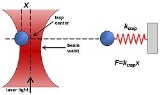
gradient. It turns out that dielectric particles are attracted along the gradient to the region of strongest electric field, which is the center of the beam. The laser light also tends to apply a force on particles in the beam along the direction of beam propagation. It is easy to understand why if one considers light to be a group of particles, each impinging on the tiny dielectric particle in its path. This is known as the scattering force and results in the particle being displaced slightly downstream from the exact position of the beam waist, as seen in the figure.
Optical traps are very sensitive instruments and are capable of the manipulation and detection of sub-nanometer displacements for sub-micrometre dielectric particles. For this reason, they are often used to manipulate and study single molecules by interacting with a bead that has been attached to that molecule.
DNADeoxyribonucleic acid is a nucleic acid that contains the genetic instructions used in the development and functioning of all known living organisms . The DNA segments that carry this genetic information are called genes, but other DNA sequences have structural purposes, or are involved in...
and the proteins and enzymes that interact with it are commonly studied in this way.
For quantitative scientific measurements, most optical traps are operated in such a way that the dielectric particle rarely moves far from the trap center. The reason for this is that the force applied to the particle is linear with respect to its displacement from the center of the trap as long as the displacement is small. In this way, an optical trap can be compared to a simple spring, which follows
Hooke's lawIn mechanics, and physics, Hooke's law of elasticity is an approximation that states that the extension of a spring is in direct proportion with the load applied to it. Many materials obey this law as long as the load does not exceed the material's elastic limit. Materials for which Hooke's law...
.
Detailed view of optical tweezers
Proper explanation of optical trapping behavior depends upon the size of the trapped particle relative to the wavelength of light used to trap it. In cases where the dimensions of the particle are much greater than the wavelength, a simple ray optics treatment is sufficient. If the wavelength of light far exceeds the particle dimensions, the particles can be treated as electric dipoles in an electric field. For optical trapping of dielectric objects of dimensions within an order of magnitude of the trapping beam wavelength, the only accurate models involve the treatment of either time dependent or time harmonic maxwell equations using appropriate boundary conditions.
The ray optics approach
In cases where the diameter of a trapped particle is significantly greater than the wavelength of light, the trapping phenomenon can be explained using ray optics. As shown in the figure, individual rays of light emitted from the laser will be
refractedRefraction is the change in direction of a wave due to a change in its speed. It is essentially a surface phenomenon . The phenomenon is mainly in governance to the law of conservation of energy. The proper explanation would be that due to change of medium, the phase velocity of the wave is changed...
as it enters and exits the dielectric bead. As a result, the ray will exit in a direction different from which it originated. Since light has a
momentumIn classical mechanics, linear momentum or translational momentum is the product of the mass and velocity of an object...
associated with it, this change in direction indicates that its momentum has changed. Due to
Newton's third lawNewton's laws of motion are three physical laws that form the basis for classical mechanics. They describe the relationship between the forces acting on a body and its motion due to those forces...
, there should be an equal and opposite momentum change on the particle.
Most optical traps operate with a
Gaussian beamIn optics, a Gaussian beam is a beam of electromagnetic radiation whose transverse electric field and intensity distributions are well approximated by Gaussian functions. Many lasers emit beams that approximate a Gaussian profile, in which case the laser is said to be operating on the fundamental...
(TEM
00 mode) profile intensity. In this case, if the particle is displaced from the center of the beam, as in the right part of the figure, the particle has a net force returning it to the center of the trap because more intense beams impart a larger momentum change towards the center of the trap than less intense beams, which impart a smaller momentum change away from the trap center. The net momentum change, or force, returns the particle to the trap center.
If the particle is located at the center of the beam, then individual rays of light are refracting through the particle symmetrically, resulting in no net lateral force. The net force in this case is along the axial direction of the trap, which cancels out the scattering force of the laser light. The cancellation of this axial gradient force with the scattering force is what causes the bead to be stably trapped slightly downstream of the beam waist.
The standard tweezers works with the trapping laser propagated in the
direction of gravity and the inverted tweezers works against gravity.
The electric dipole approximation
In cases where the diameter of a trapped particle is significantly smaller than the wavelength of light, the conditions for
Rayleigh scatteringRayleigh scattering, named after the British physicist Lord Rayleigh, is the elastic scattering of light or other electromagnetic radiation by particles much smaller than the wavelength of the light. The particles may be individual atoms or molecules. It can occur when light travels through...
are satisfied and the particle can be treated as a point
dipoleIn physics, there are several kinds of dipoles:*An electric dipole is a separation of positive and negative charges. The simplest example of this is a pair of electric charges of equal magnitude but opposite sign, separated by some distance. A permanent electric dipole is called an electret.*A...
in an inhomogenous
electromagnetic fieldAn electromagnetic field is a physical field produced by moving electrically charged objects. It affects the behavior of charged objects in the vicinity of the field. The electromagnetic field extends indefinitely throughout space and describes the electromagnetic interaction...
. The force applied on a single charge in an electromagnetic field is known as the
Lorentz forceIn physics, the Lorentz force is the force on a point charge due to electromagnetic fields. It is given by the following equation in terms of the electric and magnetic fields:...
,
-

The force on the dipole can be calculated by substituting two terms for the electric field in the equation above, one for each charge. The polarization of a dipole is

where

is the distance between the two charges. For a point dipole, the distance is
infinitesimalInfinitesimals have been used to express the idea of objects so small that there is no way to see them or to measure them. The word infinitesimal comes from a 17th century Modern Latin coinage infinitesimus, which originally referred to the "infinite-th" item in a series.In common speech, an...
,

Taking into account that the two charges have opposite signs, the force takes the form
-

Notice that the
cancel out. Multiplying through by the charge,
, converts position,
, into polarization,
,
-

where in the second equality, it has been assumed that the dielectric particle is linear (i.e.
).
In the final steps, two equalities will be used: (1) A Vector Analysis Equality, (2) One of Maxwell's EquationsFaraday's law of induction dates from the 1830s, and is a basic law of electromagnetism relating to the operating principles of transformers, inductors, and many types of electrical motors and generators...
.
-
-


First, the vector equality will be inserted for the first term in the force equation above. Maxwell's equation will be substituted in for the second term in the vector equality. Then the two terms which contain time derivatives can be combined into a single term.
-

The second term in the last equality is the time derivative of a quantity that is related through a multiplicative constant to the Poynting vectorIn physics, the Poynting vector can be thought of as representing the directional energy flux density of an electromagnetic field. It is named after its inventor John Henry Poynting. Oliver Heaviside and Nikolay Umov independently co-invented the Poynting vector...
, which describes the power per unit area passing through a surface. Since the power of the laser is constant when sampling over frequencies much shorter than the frequency of the laser's light ~1014 Hz, the derivative of this term averages to zero and the force can be written as
-

The square of the magnitude of the electric field is equal to the intensity of the beam as a function of position. Therefore, the result indicates that the force on the dielectric particle, when treated as a point dipole, is proportional to the gradient along the intensity of the beam. In other words, the gradient force described here tends to attract the particle to the region of highest intensity. In reality, the scattering force of the light works against the gradient force in the axial direction of the trap, resulting in an equilibrium position that is displaced slightly downstream of the intensity maximum. Under the Rayleigh approximation, we can write the scattering force as
-

Since the scattering is isotropic, the net momentum is transferred in the forward direction. On the quantum level, we picture this as incident photons all traveling in the forward direction and being scattered isotropically. By conservation of momentum, the sphere must accumulate the photons' original momenta, causing a forward force.
Experimental design, construction and operation
The most basic optical tweezer setup will likely include the following components: a laser (usually Nd:YAGNd:YAG is a crystal that is used as a lasing medium for solid-state lasers. The dopant, triply ionized neodymium, typically replaces yttrium in the crystal structure of the yttrium aluminium garnet , since they are of similar size...
), a beam expander, some optics used to steer the beam location in the sample plane, a microscope objectiveIn an optical instrument, the objective is the optical element that gathers light from the object being observed and focuses the light rays to produce a real image. Objectives can be single lenses or mirrors, or combinations of several optical elements. They are used in microscopes, telescopes,...
and condenser to create the trap in the sample plane, a position detector (e.g. quadrant photodiodeA photodiode is a type of photodetector capable of converting light into either current or voltage, depending upon the mode of operation.The common, traditional solar cell used to generateelectric solar power is a large area photodiode....
) to measure beam displacements and a microscope illumination source coupled to a CCD camera.
An Nd:YAG laser (1064 nm wavelength) is a common choice of laser for working with biological specimens. This is because such specimens (being mostly water) have a low absorption coefficient at this wavelength. A low absorption is advisable so as to minimise damage to the biological material, sometimes referred to as opticutionOpticution is the term given to the damaging beyond viability of biological samples that are manipulated via optical traps, most commonly optical tweezers. The term was coined by Arthur Ashkin, who developed optical tweezers at Bell Labs in the 1970s and 80s...
. Perhaps the most important consideration in optical tweezer design is the choice of the objective. A stable trap requires that the gradient force, which is dependent upon the numerical aperture (NA)In optics, the numerical aperture of an optical system is a dimensionless number that characterizes the range of angles over which the system can accept or emit light. By incorporating index of refraction in its definition, NA has the property that it is constant for a beam as it goes from one...
of the objective, be greater than the scattering force. Suitable objectives typically have an NA between 1.2 and 1.4.
While alternatives are available, perhaps the simplest method for position detection involves imaging the trapping laser exiting the sample chamber onto a quadrant photodiode. Lateral deflections of the beam are measured similarly to how it is done using atomic force microscopy (AFM)Atomic force microscopy or scanning force microscopy is a very high-resolution type of scanning probe microscopy, with demonstrated resolution on the order of fractions of a nanometer, more than 1000 times better than the optical diffraction limit...
.
Expanding the beam emitted from the laser to fill the apertureIn optics, an aperture is a hole or an opening through which light travels. More specifically, the aperture of an optical system is the opening that determines the cone angle of a bundle of rays that come to a focus in the image plane. The aperture determines how collimated the admitted rays are,...
of the objective will result in a tighter, diffraction-limited spot. While lateral translation of the trap relative to the sample can be accomplished by translation of the microscope slide, most tweezer setups have additional optics designed to translate the beam to give an extra degree of translational freedom. This can be done by translating the first of the two lenses labelled as "Beam Steering" in the figure. For example, translation of that lens in the lateral plane will result in a laterally deflected beam from what is drawn in the figure. If the distance between the beam steering lenses and the objective are chosen properly, this will correspond to a similar deflection before entering the objective and a resulting lateral translation in the sample plane. The position of the beam waist, that is the focus of the optical trap, can be adjusted by an axial displacement of the initial lens. Such an axial displacement causes the beam to diverge or converge slightly, the end result of which is an axially displaced position of the beam waist in the sample chamber.
Visualization of the sample plane is usually accomplished through illumination via a separate light source coupled into the optical path in the opposite direction using dichroic mirrorsA dichroic filter, thin-film filter, or interference filter is a very accurate color filter used to selectively pass light of a small range of colors while reflecting other colors. By comparison, dichroic mirrors and dichroic reflectors tend to be characterized by the color of light that they...
. This light is incident on a CCD camera and can be viewed on an external monitor or used for tracking the trapped particle position via video trackingVideo tracking is the process of locating a moving object over time using a camera. It has a variety of uses, some of which are: human-computer interaction, security and surveillance, video communication and compression, augmented reality, traffic control, medical imaging and video editing...
.
Optical tweezers based on alternate laser beam modes
The majority of optical tweezers make use of conventional TEM00 Gaussian beamsA transverse mode of a beam of electromagnetic radiation is a particular electromagnetic field pattern of radiation measured in a plane perpendicular to the propagation direction of the beam...
. However a number of other beam types have been used to trap particles, including high order laser beams i.e. Hermite Gaussian beam (TEMxy), Laguerre-Gaussian (LG) beams (TEMpl) and Bessel beamA Bessel beam is a field of electromagnetic, acoustic or even gravitational radiation whose amplitude is described by a Bessel function of the first kind. A true Bessel beam is non-diffractive. This means that as it propagates, it does not diffract and spread out; this is in contrast to the usual...
s.
Optical tweezers based on Laguerre-Gaussian beams have the unique capability of trapping particles that are optically reflective and absorptive. Laguerre-Gaussian beams also possess a well-defined orbital angular momentum that can rotate particles. This is accomplished without external mechanical or electrical steering of the beam.
Both zero and higher order Bessel Beams also possess a unique tweezing ability. They can trap and rotate multiple particles that are millimeters apart and even around obstacles.
Micromachines can be driven by these unique optical beams due to their intrinsic rotating mechanism due to the spinIn quantum mechanics and particle physics, spin is a fundamental characteristic property of elementary particles, composite particles , and atomic nuclei.It is worth noting that the intrinsic property of subatomic particles called spin and discussed in this article, is related in some small ways,...
and orbital angular momentumIn physics, angular momentum, moment of momentum, or rotational momentum is a conserved vector quantity that can be used to describe the overall state of a physical system...
of light.
Multiplexed optical tweezers
A typical setup uses one laser to create one or two traps. More complex optical tweezing operations can be achieved either by time-sharing a single laser beam among several optical tweezers or by diffractively splitting the beam into multiple traps. With acousto-optic deflectors or galvanometerA galvanometer is a type of ammeter: an instrument for detecting and measuring electric current. It is an analog electromechanical transducer that produces a rotary deflection of some type of pointer in response to electric current flowing through its coil in a magnetic field. .Galvanometers were...
-driven mirrors, a single laser beam can be shared among hundreds of optical tweezers in the focal plane, or else spread into an extended one-dimensional trap. Specially designed diffractive optical elements can divide a single input beam into hundreds of continuously illuminated traps in arbitrary three-dimensional configurations. The trap-forming hologram also can specify the mode structure of each trap individually, thereby creating arrays of optical vortices, optical tweezers, and holographic line traps, for example. When implemented with a spatial light modulatorA spatial light modulator is an object that imposes some form of spatially-varying modulation on a beam of light. A simple example is an overhead projector transparency. Usually when the phrase SLM is used, it means that the transparency can be controlled by a computer. In the 1980s, large SLMs...
, such holographic optical traps also can move objects in three dimensions.
Optical traps based on single mode optical fibers
The standard fiber optical trap relies on the same principle as the optical trapping, but with the Gaussian laser beam delivered through an Optical fiberAn optical fiber is a flexible, transparent fiber made of a pure glass not much wider than a human hair. It functions as a waveguide, or "light pipe", to transmit light between the two ends of the fiber. The field of applied science and engineering concerned with the design and application of...
. If one end of the optical fiber is moulded into a lensA lens is an optical device with perfect or approximate axial symmetry which transmits and refracts light, converging or diverging the beam. A simple lens consists of a single optical element...
-like facet, the nearly gaussian beam carried by a single mode standard fiber will be focussed at some distance from the fiber tip. The effective Numerical Aperture of such assembly is usually not enough to allow for a full 3D optical trap but only for a 2D trap (optical trapping and manipulation of objects will be possible only when, e.g., they are in contact with a surface ).
A true 3D optical trapping based on a single fiber, with a trapping point which is not in nearly contact with the fiber tip, has been realized based on a not-standard annular-core fiber arrangement and a total-internal-reflection geometry.
On the other hand, if the ends of the fiber are not moulded, the laser exiting the fiber will be diverging and thus a stable optical trap can only be realised by balancing the gradient and the scattering force from two opposing ends of the fiber. The gradient force will trap the particles the transverse direction, while the axialAxial may mean:* Along the same line as an axis of rotation in geometry* A type of modal frame in music* One of several anatomical directions in an animal body* Axial age, the period from 800 to 200 BC in China, India and the western world...
optical force comes from the scattering force of the two counter propagating beams emerging from the two fibers. The equilibrium z-position of such a trapped bead is where the two scattering forces equal each other. This work was pioneered by A. Constable et al., Opt. Lett. 18,1867 (1993), and followed by J.Guck et al., Phys. Rev. Lett. 84, 5451 (2000), who made use of this technique to stretch microparticles. By manipulating the input power into the two ends of the fiber, there will be an increase of a "optical stretching" that can be used to measure viscoelastic properties of cells, with sensitivity sufficient to distinguish between different individual cytoskeletal phenotypes. i.e. human erythrocytes and mouse fibroblasts. A recent test has seen great success in differentiating cancerous cells from non-cancerous ones from the two opposed, non-focused laser beams.
Multimode fiber-based traps for advanced manipulation
While earlier version of fiber-based laser traps exclusively used single mode beams, M. Kreysing and colleagues recently showed that the careful excitation of further optical modes in a short piece of optical fiber allows the realization of non-trivial trapping geometries. By this the researchers were able to orient various human cell types (individual cells and clusters) on a microscope. The main advantage of the so-called "optical cell rotator" technology over standard optical tweezers is the decoupling of trapping from imaging optics. This, its modular design, and the high compatibility of divergent laser traps with biological material indicates the great potential of this new generation of laser traps in medical research and life science.
Optical tweezers in a 'landscape' (cell sorting)
One of the more common cell-sorting systems makes use of flow cytometry through fluorescent imaging. In this method, a suspension of biologic cells is sorted into two or more containers, based upon specific fluorescent characteristics of each cell during an assisted flow. By using an electrical charge that the cell is "trapped" in, the cells are then sorted based on the fluorescence intensity measurements. The sorting process is undertaken by an electrostatic deflection system that diverts cells into containers based upon their charge.
In the optically actuated sorting process, the cells are flowed through into an optical landscape i.e. 2D or 3D optical lattices. Without any induced electrical charge, the cells would sort based on their intrinsic refractive index properties and can be re-configurability for dynamic sorting. An optical lattice can be created using diffractive optics and optical elements.
On the other hand, K. Ladavac et al. used a spatial light modulator to project an intensity pattern to enable the optical sorting process. K. Xiao and D. G. Grier applied holographic video microscopy to demonstrate that this technique can sort colloidal spheres with part-per-thousand resolution for size and refractive index.
The main mechanism for sorting is the arrangement of the optical lattice points. As the cell flow through the optical lattice, there are forces due to the particles drag force that is competing directly with the optical gradient force (See Physics of optical tweezers) from the optical lattice point. By shifting the arrangement of the optical lattice point, there is a preferred optical path where the optical forces are dominant and biased. With the aid of the flow of the cells, there is a resultant force that is directed along that preferred optical path. Hence, there is a relationship of the flow rate with the optical gradient force. By adjusting the two forces, one will be able to obtain a good optical sorting efficiency.
Competition of the forces in the sorting environment need fine tuning to succeed in high efficient optical sorting. The need is mainly with regards to the balance of the forces; drag force due to fluid flow and optical gradient force due to arrangement of intensity spot.
Scientists at the University of St. Andrews have received considerable funding from the UK Engineering and Physical Sciences Research CouncilThe Engineering and Physical Sciences Research Council is a British Research Council that provides government funding for grants to undertake research and postgraduate degrees in engineering and the physical sciences , mainly to universities in the United Kingdom...
(EPSRC) for an optical sorting machine. This new technology could rival the conventional fluorescence-activated cell sorting.
Optical tweezers based on evanescent fields
An evanescentEvanescent may refer to:* Evanescent , a class of skin lesions* "Evanescent" , a song by Vamps* Evanescent wave, a term applied to electromagnetic waves that decay exponentially...
field is a residue optical fieldThe optical field is a term used in physics and vector calculus to designate the electric field shown as E in the electromagnetic wave equation which can be derived from Maxwell's Equations...
that "leaks" during total internal reflectionTotal internal reflection is an optical phenomenon that happens when a ray of light strikes a medium boundary at an angle larger than a particular critical angle with respect to the normal to the surface. If the refractive index is lower on the other side of the boundary and the incident angle is...
. This "leaking" of light fades off at an exponential rate. The evanescent field has found a number of applications in nanometer resolution imaging (microscopy); optical micromanipulation (optical tweezers) are becoming ever more relevant in research.
In optical tweezers, a continuous evanescent field can be created when light is propagating through an optical waveguide (multiple total internal reflectionTotal internal reflection is an optical phenomenon that happens when a ray of light strikes a medium boundary at an angle larger than a particular critical angle with respect to the normal to the surface. If the refractive index is lower on the other side of the boundary and the incident angle is...
). The resulting evanescent field has a directional sense and will propel microparticles along its propagating path. This work was first pioneered by S. Kawata and T. Sugiura, in 1992, who showed that the field can be coupled to the particles in proximity on the order of 100 nanometers.
This direct coupling of the field is treated as a type of photon tunnelling across the gap from prism to microparticles. The result is a directional optical propelling force.
A recent updated version of the evanescent field optical tweezers makes use of extended optical landscape patterns to simultaneously guide a large number of particles into a preferred direction without using a waveguideA waveguide is a structure which guides waves, such as electromagnetic waves or sound waves. There are different types of waveguides for each type of wave...
. It is termed as Lensless Optical Trapping (“LOT”). The orderly movement of the particles is aided by the introduction of Ronchi RulingA Ronchi Ruling, also called a Ronchi grating is a constant-interval bar and space square wave optical target that has a high edge definition and contrast ratio. Ronchi rulings are commonly manufactured through photolithographic deposition of chrome on glass or optical substrates. Ronchi rulings...
that creates well-defined optical potential wells (replacing the waveguide). This means that particles are propelled by the evanescent field while being trapped by the linear bright fringes. At the moment, there are scientists working on focused evanescent fields as well.
Another approach that has been recently proposed makes use of surface plasmons, which is an enhanced evanescent wave localized at a metal/dielectric interface. The enhanced force field experienced by colloidal particles exposed to surface plasmons
at a flat metal/dielectric interface has been for the first time measured using a photonic force microscope, the total force magnitude being found 40 times stronger compared to a normal evanescent wave. By patterning the surface with gold microscopic islands it is possible to have selective and parallel trapping in these islands. The forces of the latter optical tweezers lie in the femtonewton range.
Optical tweezers: an indirect approach
Ming Wu, a UC BerkeleyThe University of California, Berkeley , is a teaching and research university established in 1868 and located in Berkeley, California, USA...
Professor of electrical engineering and computer sciences invented the new optoelectronic tweezers.
Wu transformed the optical energy from low powered light emitting diodes (LED) into electrical energy via a photoconductive surface. The idea is to allow the LED to switch on and off the photoconductive material via its fine projection. As the optical pattern can be easily transformable through optical projection, this method allows a high flexibility of switching different optical landscapes.
The manipulation/tweezing process is done by the variations between the electric field actuated by the light pattern. The particles will be either attracted or repelled from the actuated point due to the its induced electrical dipole. Particles suspended in a liquid will be susceptible to the electrical field gradient, this is known as dielectrophoresisDielectrophoresis is a phenomenon in which a force is exerted on a dielectric particle when it is subjected to a non-uniform electric field. This force does not require the particle to be charged. All particles exhibit dielectrophoretic activity in the presence of electric fields...
.
One clear advantage is that the electrical conductivity is different between different kinds of cells. Living cells have a lower conductive medium while the dead ones have minimum or no conductive medium. The system may be able to manipulate roughly 10,000 cells or particles at the same time.
See comments by Professor Kishan Dholakia on this new technique, K. Dholakia, Nature Materials 4, 579–580 (01 Aug 2005) News and Views.
"The system was able to move live E. coli bacteria and 20-micrometre-wide particles, using an optical power output of less than 10 microwatts. This is one-hundred-thousandth of the power needed for [direct] optical tweezers".
Optical binding
When a cluster of microparticles are trapped within a monochromatic laser beam, the organization of the microparticles within the optical trapping is heavily dependent on the redistributing of the optical trapping forces amongst the microparticles. This redistribution of light forces amongst the cluster microparticles provides a new force equilibrium on the cluster as a whole. As such we can say that the cluster of microparticles are somewhat bound together by light. One of the first evidence of optical binding was reported by Michael M. Burns, Jean-Marc Fournier, and Jene A. Golovchenko .
External links
Reviews of optical tweezers
Web resources
Multimedia links