
A
micrometer sometimes known as a
micrometer screw gauge, is a device incorporating a calibrated
screwA screw, or bolt, is a type of fastener characterized by a helical ridge, known as an external thread or just thread, wrapped around a cylinder. Some screw threads are designed to mate with a complementary thread, known as an internal thread, often in the form of a nut or an object that has the...
used widely for precise measurement of small distances in
mechanical engineeringMechanical engineering is a discipline of engineering that applies the principles of physics and materials science for analysis, design, manufacturing, and maintenance of mechanical systems. It is the branch of engineering that involves the production and usage of heat and mechanical power for the...
and
machiningConventional machining is a form of subtractive manufacturing, in which a collection of material-working processes utilizing power-driven machine tools, such as saws, lathes, milling machines, and drill presses, are used with a sharp cutting tool to physical remove material to achieve a desired...
as well as most mechanical trades, along with other
metrologicalMetrology is the science of measurement. Metrology includes all theoretical and practical aspects of measurement. The word comes from Greek μέτρον , "measure" + "λόγος" , amongst others meaning "speech, oration, discourse, quote, study, calculation, reason"...
instruments such as dial, vernier, and digital calipers. Micrometers are often, but not always, in the form of
caliperA caliper is a device used to measure the distance between two opposing sides of an object. A caliper can be as simple as a compass with inward or outward-facing points...
s.
Colloquially the word
micrometer is often shortened to
mike /ˈmaɪk/ .
History of the device and its name
The word
micrometer is a neoclassical coinage from Greek
micros, "small", and
metron, "measure". The
Merriam-Webster Collegiate Dictionary says that English got it from French and that its first known appearance in English writing was in 1670. Neither the metre nor the
micrometreA micrometer , is by definition 1×10⁻⁶ of a meter .In plain English, it means one-millionth of a meter . Its unit symbol in the International System of Units is μm...
nor the micrometer (device) as we know them today existed at that time. However, humans of that time did have much need for, and interest in, the ability to measure small things, and small differences; the word no doubt was coined in reference to this endeavor, even if it did not refer specifically to its present-day senses.
The first ever micrometric screw was invented by
William GascoigneWilliam Gascoigne was an English astronomer, mathematician and maker of scientific instruments from Middleton near Leeds who invented the micrometer...
in the 17th century, as an enhancement of the vernier; it was used in a telescope to measure angular distances between stars.
Henry MaudslayHenry Maudslay was a British machine tool innovator, tool and die maker, and inventor. He is considered a founding father of machine tool technology.-Early life:...
built a bench micrometer in the early 19th century that was jocularly nicknamed "the Lord Chancellor" among his staff because it was the final judge on measurement
accuracy and precisionIn the fields of science, engineering, industry and statistics, the accuracy of a measurement system is the degree of closeness of measurements of a quantity to that quantity's actual value. The precision of a measurement system, also called reproducibility or repeatability, is the degree to which...
in the firm's work.
The first documented development of handheld micrometer-screw
caliperA caliper is a device used to measure the distance between two opposing sides of an object. A caliper can be as simple as a compass with inward or outward-facing points...
s was by Jean Laurent Palmer of
ParisParis is the capital and largest city in France, situated on the river Seine, in northern France, at the heart of the Île-de-France region...
in 1848; the device is therefore often called
palmer in French, and
tornillo de Palmer ("Palmer screw") in Spanish. (Those languages also use the
micrometer cognates:
micromètre, micrómetro.) The micrometer caliper was introduced to the mass market in anglophone countries by
Brown & SharpeBrown & Sharpe is a division of Hexagon Metrology, Inc., a multinational corporation focused mainly on metrological tools and technology. During the 19th and 20th centuries, Brown & Sharpe was one of the most well-known and influential firms in the machine tool industry...
in 1867, allowing the penetration of the instrument's use into the average machine shop. Brown & Sharpe were inspired by several earlier devices, one of them being Palmer's design. In 1888 Edward Williams Morley added to the precision of micrometric measurements and proved their accuracy in a complex series of experiments.
The culture of
toolroomThe term toolroom can refer to three related concepts. The concepts have evolved over the past two centuries as technology itself has evolved.- Storing tools :...
accuracy and precision, which started with
interchangeabilityInterchangeable parts are parts that are, for practical purposes, identical. They are made to specifications that ensure that they are so nearly identical that they will fit into any device of the same type. One such part can freely replace another, without any custom fitting...
pioneers including Gribeauval,
TousardLouis de Tousard was a French artillerist who served in the American Continental Army under La Fayette, and later was given a US commission...
,
NorthSimeon North was a Middletown, Connecticut, gun manufacturer, who developed one of America's first milling machines in 1818 and played an important role in the development of interchangeable parts manufacturing.North was born in Berlin, Connecticut, into a prosperous family able to provide all...
, Hall,
WhitneyEli Whitney was an American inventor best known for inventing the cotton gin. This was one of the key inventions of the Industrial Revolution and shaped the economy of the Antebellum South...
, and
ColtSamuel Colt was an American inventor and industrialist. He was the founder of Colt's Patent Fire-Arms Manufacturing Company , and is widely credited with popularizing the revolver. Colt's innovative contributions to the weapons industry have been described by arms historian James E...
, and continued through leaders such as Maudslay, Palmer,
WhitworthSir Joseph Whitworth, 1st Baronet was an English engineer, entrepreneur, inventor and philanthropist. In 1841, he devised the British Standard Whitworth system, which created an accepted standard for screw threads...
, Brown, Sharpe, Pratt,
WhitneyAmos Whitney was a mechanical engineer and Connecticut inventor.Born in Biddeford, Maine, in 1860 he partnered with Francis Pratt to organize the Pratt & Whitney company to manufacture machine tools, tools for the makers of sewing machines, and gun making machinery for use by the Union Army...
,
LelandHenry Martyn Leland was a machinist, inventor, engineer and automotive entrepreneur who founded the two premier American luxury marques, Cadillac and Lincoln. Retrieved December 30, 2008....
, and others, grew during the
Machine AgeThe Machine Age is a term associated mostly with the early 20th century, sometimes also including the late 19th century. An approximate dating would be about 1880 to 1945. Considered to be at a peak in the time between the first and second world wars, it forms a late part of the Industrial Age...
to become an important part of combining
applied scienceApplied science is the application of scientific knowledge transferred into a physical environment. Examples include testing a theoretical model through the use of formal science or solving a practical problem through the use of natural science....
with
technologyTechnology is the making, usage, and knowledge of tools, machines, techniques, crafts, systems or methods of organization in order to solve a problem or perform a specific function. It can also refer to the collection of such tools, machinery, and procedures. The word technology comes ;...
. Beginning in the early 20th century, one could no longer truly master
tool and die makingTool and die makers are workers in the manufacturing industry who make jigs, fixtures, dies, molds, machine tools, cutting tools , gauges, and other tools used in manufacturing processes...
,
machine toolA machine tool is a machine, typically powered other than by human muscle , used to make manufactured parts in various ways that include cutting or certain other kinds of deformation...
building, or
engineeringEngineering is the discipline, art, skill and profession of acquiring and applying scientific, mathematical, economic, social, and practical knowledge, in order to design and build structures, machines, devices, systems, materials and processes that safely realize improvements to the lives of...
without some knowledge of the science of metrology, as well as the sciences of chemistry and physics (for
metallurgyMetallurgy is a domain of materials science that studies the physical and chemical behavior of metallic elements, their intermetallic compounds, and their mixtures, which are called alloys. It is also the technology of metals: the way in which science is applied to their practical use...
,
kinematicsKinematics is the branch of classical mechanics that describes the motion of bodies and systems without consideration of the forces that cause the motion....
/
dynamicsIn the field of physics, the study of the causes of motion and changes in motion is dynamics. In other words the study of forces and why objects are in motion. Dynamics includes the study of the effect of torques on motion...
, and quality).
Basic types
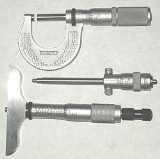
The topmost image shows the three most common types of micrometer; the names are based on their application:
- Outside micrometer (aka micrometer caliper), typically used to measure wires, spheres, shafts and blocks.
- Inside micrometer, used to measure the diameter of holes.
- Depth micrometer, measures depths of slots and steps.
Specialized types
Each type of micrometer caliper can be fitted with specialized anvils and spindle tips for particular measuring tasks. For example, the anvil may be shaped in the form of a segment of
screw threadA screw thread, often shortened to thread, is a helical structure used to convert between rotational and linear movement or force. A screw thread is a ridge wrapped around a cylinder or cone in the form of a helix, with the former being called a straight thread and the latter called a tapered thread...
, in the form of a v-block, or in the form of a large disc.
- Universal micrometer sets come with interchangeable anvils, such as flat, spherical, spline, disk, blade, point, and knife-edge. The term universal micrometer may also refer to a type of micrometer whose frame has modular components, allowing one micrometer to function as outside mic, depth mic, step mic, etc. (often known by the brand names Mul-T-Anvil and Uni-Mike).
- Blade micrometers have a matching set of narrow tips (blades). They allow, for example, the measuring of a narrow o-ring groove
An O-ring, also known as a packing, or a toric joint, is a mechanical gasket in the shape of a torus; it is a loop of elastomer with a disc-shaped cross-section, designed to be seated in a groove and compressed during assembly between two or more parts, creating a seal at the interface.The O-ring...
.
- Pitch-diameter micrometers (aka thread mics) have a matching set of thread-shaped tips for measuring the pitch diameter of screw threads.
- Limit mics have two anvils and two spindles, and are used like a snap gauge. The part being checked must pass through the first gap and must stop at the second gap in order to be within specification. The two gaps accurately reflect the top and bottom of the tolerance range.
- Bore micrometer, typically a three-anvil head on a micrometer base used to accurately measure inside diameters.
- Tube micrometers have a cylindrical anvil positioned perpendicularly to a spindle and is used to measure the thickness of tubes.
- Micrometer stops micrometer heads that are mounted on the table of a manual milling machine, bedways of a lathe, or other machine tool, in place of simple stops. They help the operator to position the table or carriage precisely. Stops can also be used to actuate kickout mechanisms or limit switches to halt an automatic feed system.
- Ball micrometers have ball-shaped (spherical
A sphere is a perfectly round geometrical object in three-dimensional space, such as the shape of a round ball. Like a circle in two dimensions, a perfect sphere is completely symmetrical around its center, with all points on the surface lying the same distance r from the center point...
) anvils. They may have one flat and one ball anvil, in which case they are used for measuring tube wall thickness, distance of a hole to an edge, and other distances where one anvil must be placed against a rounded surface. They differ in application from tube micrometers in that they may be used to measure against rounded surfaces which are not tubes, but the ball anvil may also not be able to fit into smaller tubes as easily as a tube micrometer. Ball micrometers with a pair of balls can be used when single-tangential-point contact is desired on both sides. The most common example is in measuring the pitch diameter of screw threads (which is also done with conical anvils or the 3-wire method, the latter of which uses similar geometry as the pair-of-balls approach).
- Bench micrometers are tools for inspection
An inspection is, most generally, an organized examination or formal evaluation exercise. In engineering activities inspection involves the measurements, tests, and gauges applied to certain characteristics in regard to an object or activity...
use whose accuracy and precisionIn the fields of science, engineering, industry and statistics, the accuracy of a measurement system is the degree of closeness of measurements of a quantity to that quantity's actual value. The precision of a measurement system, also called reproducibility or repeatability, is the degree to which...
are around half a micrometre (20 millionths of an inch, "a fifth of a tenth" in machinist jargon) and whose repeatabilityRepeatability or test-retest reliability is the variation in measurements if they would have been taken by a single person or instrument on the same item and under the same conditions. A less-than-perfect test-retest reliability causes test-retest variability. Such variability can be caused by, for...
is around a quarter micrometre ("a tenth of a tenth"). An example is the Pratt & WhitneyPratt & Whitney Measurement Systems is a multinational corporation that specializes in producing high-precision measuring instruments and systems.-History:...
Supermicrometer brand.
- Digit mics are the type with mechanical digits that roll over.
- Digital mics are the type that uses an encoder to detect the distance and displays the result on a digital screen.
- V mics are outside mics with a small V-block for an anvil. They are useful for measuring the diameter of a circle from three points evenly spaced around it (versus the two points of a standard outside micrometer). An example of when this is necessary is measuring the diameter of 3-flute endmills and twist drills.
Operating principles
Micrometers use the principle of a screw to amplify small distances that are too small to measure directly into large rotations of the screw that are big enough to read from a scale. The accuracy of a micrometer derives from the accuracy of the thread-form that is at its heart. The basic operating principles of a micrometer are as follows:
- The amount of rotation of an accurately made screw can be directly and precisely correlated to a certain amount of axial movement (and vice versa), through the constant known as the screw's lead (/ˈliːd/). A screw's lead is the distance it moves forward axially with one complete turn (360°
A degree , usually denoted by ° , is a measurement of plane angle, representing 1⁄360 of a full rotation; one degree is equivalent to π/180 radians...
). (In most threads [that is, in all single-start threads], lead and pitch refer to essentially the same concept.)
- With an appropriate lead and major diameter of the screw, a given amount of axial movement will be amplified in the resulting circumferential movement.
For example, if the lead of a screw is 1 mm, but the major diameter (here, outer diameter) is 10 mm, then the circumference of the screw is 10π, or about 31.4 mm. Therefore, an axial movement of 1 mm is amplified (magnified) to a circumferential movement of 31.4 mm. This amplification allows a small difference in the sizes of two similar measured objects to correlate to a larger difference in the position of a micrometer's thimble.
In older micrometers the position of the thimble is read directly from scale markings on the thimble and shaft. A
vernier scaleA vernier scale is an additional scale which allows a distance or angle measurement to be read more precisely than directly reading a uniformly-divided straight or circular measurement scale...
is usually included, which allows the position to be read to a fraction of the smallest scale mark. In newer digital micrometers, an electronic readout displays the length digitally on an LCD display on the instrument. There also exist mechanical-digit versions, like the style of car
odometerAn odometer or odograph is an instrument that indicates distance traveled by a vehicle, such as a bicycle or automobile. The device may be electronic, mechanical, or a combination of the two. The word derives from the Greek words hodós and métron...
s where the numbers "roll over".
Parts
A micrometer is composed of:
Frame: The C-shaped body that holds the anvil and barrel in constant relation to each other. It is thick because it needs to minimize flexion, expansion, and contraction, which would distort the measurement.
The frame is heavy and consequently has a high thermal mass, to prevent substantial heating up by the holding hand/fingers. It is often covered by insulating plastic plates which further reduce heat transference.
Explanation: if you hold the frame long enough so that it heats up by 10°C, then the increase in length of any 10 cm linear piece of steel is of magnitude 1/100 mm. For micrometers this is their typical accuracy range.
Micrometers typically have a specified temperature at which the measurement is correct (often 20°C [68°F], which is generally considered "
room temperature-Comfort levels:The American Society of Heating, Refrigerating and Air-Conditioning Engineers has listings for suggested temperatures and air flow rates in different types of buildings and different environmental circumstances. For example, a single office in a building has an occupancy ratio per...
" in a room with
HVACHVAC refers to technology of indoor or automotive environmental comfort. HVAC system design is a major subdiscipline of mechanical engineering, based on the principles of thermodynamics, fluid mechanics, and heat transfer...
).
ToolroomThe term toolroom can refer to three related concepts. The concepts have evolved over the past two centuries as technology itself has evolved.- Storing tools :...
s are generally kept at 20°C [68°F].
Anvil: The shiny part that the spindle moves toward, and that the sample rests against.
Sleeve / barrel / stock: The stationary round part with the linear scale on it. Sometimes vernier markings.
Lock nut / lock-ring / thimble lock: The knurled part (or lever) that one can tighten to hold the spindle stationary, such as when momentarily holding a measurement.
Screw: (not seen) The heart of the micrometer, as explained under "Operating principles". It is inside the barrel. (No wonder that the usual name for the device in German is
Messschraube, literally "measuring screw".)
Spindle: The shiny cylindrical part that the thimble causes to move toward the anvil.
Thimble: The part that one's thumb turns. Graduated markings.
Ratchet stop: (not shown in illustration) Device on end of handle that limits applied pressure by slipping at a calibrated torque.
Inch system
The spindle of an inch-system micrometer has 40 threads per inch, so that one turn moves the spindle axially 0.025 inch (1 ÷ 40 = 0.025), equal to the distance between two graduations on the frame. The 25 graduations on the thimble allow
the 0.025 inch to be further divided, so that turning the thimble through one division moves the spindle axially 0.001 inch (0.025 ÷ 25 = 0.001). Thus, the reading is given by the number of whole divisions that are visible on the scale of the frame, multiplied by 25 (the number of thousandths of an inch that each division represents), plus the number of that division on the thimble which coincides with the axial zero line on the frame. The result will be the diameter expressed in thousandths of an inch. As the numbers 1, 2, 3, etc., appear below every fourth sub-division on the frame, indicating hundreds of thousandths, the reading can easily be taken mentally.
Suppose the thimble were screwed out so that graduation 2, and three additional sub-divisions, were visible (as shown in the image), and that graduation 1 on the thimble coincided with the axial line on the frame. The reading then would be 0.2000 + 0.075 + 0.001, or .276 inch.
Metric system
The spindle of an ordinary metric micrometer has 2 threads per millimetre, and thus one complete revolution moves the spindle through a distance of 0.5 millimetre. The longitudinal line on the frame is graduated with 1 millimetre divisions and 0.5 millimetre subdivisions. The thimble has 50 graduations, each being 0.01 millimetre (one-hundredth of a millimetre). Thus, the reading is given by the number of millimetre divisions visible on the scale of the sleeve plus the particular division on the thimble which coincides with the axial line on the sleeve.
Suppose that the thimble were screwed out so that graduation 5, and one additional 0.5 subdivision were visible (as shown in the image), and that graduation 28 on the thimble coincided with the axial line on the sleeve. The reading then would be 5.00 + 0.5 + 0.28 = 5.78 mm.
Vernier
Some micrometers are provided with a vernier scale on the sleeve in addition to the regular graduations. These permit measurements within 0.001 millimetre to be made on metric micrometers, or 0.0001 inches on inch-system micrometers.
The additional digit of these micrometers is obtained by finding the line on the sleeve vernier scale which exactly coincides with one on the thimble. The number of this coinciding vernier line represents the additional digit.
Thus, the reading for metric micrometers of this type is the number of whole millimetres (if any) and the number of hundredths of a millimetre, as with an ordinary micrometer, and the number of thousandths of a millimetre given by the coinciding vernier line on the sleeve vernier scale.
For example, a measurement of 5.783 millimetres would be obtained by reading 5.5 millimetres on the sleeve, and then adding 0.28 millimetre as determined by the thimble. The vernier would then be used to read the 0.003 (as shown in the image).
Inch micrometers are read in a similar fashion.
Note: 0.01 millimetre = 0.000393 inch, and 0.002 millimetre = 0.000078 inch (78 millionths) or alternatively, 0.0001 inch = 0.00254 millimetres. Therefore, metric micrometers provide smaller measuring increments than comparable inch unit micrometers—the smallest graduation of an ordinary inch reading micrometer is 0.001 inch; the vernier type has graduations down to 0.0001 inch (0.00254 mm). When using either a metric or inch micrometer, without a vernier, smaller readings than those graduated may of course be obtained by visual interpolation between graduations.
Torque repeatability via torque-limiting ratchets or sleeves
An additional feature of many micrometers is the inclusion of a torque-limiting device on the thimble—either a spring-loaded ratchet or a friction sleeve. Without this device, workers may overtighten the micrometer on the work, causing the mechanical advantage of the screw to squeeze the material or tighten the screw threads, giving an inaccurate measurement. However, with a thimble that will ratchet or friction slip at a certain torque, the micrometer will not continue to advance once sufficient resistance is encountered. This results in greater accuracy and repeatability of measurements—most especially for low-skilled or semi-skilled workers, who may not have developed the light, consistent touch of a skilled user.
Testing and calibration
A standard ordinary one-inch micrometer has readout divisions of .001 inch and a rated accuracy of +/- .0001 inch ("one tenth", in machinist parlance).
Both the measuring instrument and the object being measured should be at room temperature for an accurate measurement; dirt, abuse, and operator skill are the main sources of error.
The accuracy of micrometers is checked by using them to measure
gauge blocksA gauge block is a precision ground and lapped length measuring standard...
, rods, or similar standards whose lengths are precisely and accurately known. If the gauge block is known to be 0.7500" ± .00005" ("seven-fifty plus or minus fifty millionths", that is, "seven hundred fifty thou plus or minus half a tenth"), then the micrometer should measure it as 0.7500". If the micrometer measures 0.7516", then it is out of calibration.
Calibration can also include the condition of the tips (flat and parallel), any ratchet, and linearity of the scale. Calibration would record the error at approx 5 points along the scale. Only one can be adjusted to zero. Flatness and parallelism are typically measured with a gage called an optical flat, a disc of glass or plastic ground with extreme accuracy to have flat, parallel faces, which allows light bands to be counted when the micrometer's anvil and spindle are against it, revealing their amount of geometric inaccuracy.
Commercial machine shops, especially those that do certain categories of work (military or commercial aerospace, nuclear power industry, and others), are required by various
standards organizationA standards organization, standards body, standards developing organization , or standards setting organization is any organization whose primary activities are developing, coordinating, promulgating, revising, amending, reissuing, interpreting, or otherwise producing technical standards that are...
s (such as
ISOThe International Organization for Standardization , widely known as ISO, is an international standard-setting body composed of representatives from various national standards organizations. Founded on February 23, 1947, the organization promulgates worldwide proprietary, industrial and commercial...
,
ANSIThe American National Standards Institute is a private non-profit organization that oversees the development of voluntary consensus standards for products, services, processes, systems, and personnel in the United States. The organization also coordinates U.S. standards with international...
,
ASMEThe American Society of Mechanical Engineers is a professional body, specifically an engineering society, focused on mechanical engineering....
,
ASTMASTM International, known until 2001 as the American Society for Testing and Materials , is an international standards organization that develops and publishes voluntary consensus technical standards for a wide range of materials, products, systems, and services...
,
SAESAE International is an organization for engineering professionals in the aerospace, automotive, and commercial vehicle industries. The Society is a standards development organization for the engineering of powered vehicles of all kinds, including cars, trucks, boats, aircraft, and others.SAE...
, AIA, the U.S. military, and others) to calibrate micrometers and other gages on a schedule (often annually), to affix a label to each gage that gives it an ID number and a calibration expiration date, to keep a record of all the gages by ID number, and to specify in inspection reports which gage was used for a particular measurement.
Not all calibration is an affair for metrology labs. A micrometer can be calibrated on-site anytime, at least in the most basic and important way (if not comprehensively), by measuring a high-grade gage block and adjusting to match. Even gages that are calibrated annually and within their expiration timeframe should be checked this way every month or two, if they are used daily. They usually will check out OK as needing no adjustment.
The accuracy of the gauge blocks themselves is traceable through a chain of comparisons back to a master standard such as the
international prototype meterThe metre was originally defined as one ten-millionth of the distance between the North Pole and the equator at the longitude of Paris. Because of the difficulty of reproducing this measurement, a platinum bar nominally of that length was constructed in 1799 and housed in the Archives de la...
. This bar of metal, like the international prototype kilogram, is maintained under controlled conditions at the
International Bureau of Weights and MeasuresThe International Bureau of Weights and Measures , is an international standards organisation, one of three such organisations established to maintain the International System of Units under the terms of the Metre Convention...
headquarters in France, which is one of the principal measurement standards laboratories of the world. These master standards have extreme-accuracy regional copies (kept in the national laboratories of various countries, such as NIST), and metrological equipment makes the chain of comparisons. Because the definition of the meter is now based on a light wavelength, the international prototype meter is not quite as indispensable as it once was. But such master gauges are still important for calibrating and certifying metrological equipment. Equipment described as "NIST traceable" means that its comparison against master gages, and their comparison against others, can be traced back through a chain of documentation to equipment in the NIST labs. Maintaining this degree of traceability requires some expense, which is why NIST-traceable equipment is more expensive than non-NIST-traceable. But applications needing the highest degree of quality control mandate the cost.
Zero error
Zero error is the reading when the jaws are closed. It is the calibration error of the device - often caused by knocks or overstrains.
The way to use a micrometer with zero error is to use the formula
'actual reading = main scale + micro scale - (zero error)'.
Positive zero error refers to the fact that when the jaws of the micrometer are just closed, the reading is a positive reading away from the actual reading of 0.00mm. If the reading is 0.15mm, the zero error is referred to as +0.15mm.
Negative zero error refers to the fact that when the jaws of the micrometer are just closed, the reading is a negative reading away from the actual reading of 0.00mm. If the reading is -0.09mm, the zero error is referred to as -0.09mm.
External links