
All Topics  
Carbon nanotube


   Email Print
   Bookmark   Link


Carbon nanotube


Carbon nanotubes (CNTs) are allotropes of carbon
Allotropes of carbon

This is a list of the allotropes of carbon....
 with a nanostructure that can have a length-to-diameter ratio of up to 28,000,000:1, which is significantly larger than any other material.


Discussion
Ask a question about 'Carbon nanotube'
Start a new discussion about 'Carbon nanotube'
Answer questions from other users
Full Discussion Forum


Recent Posts


Encyclopedia


Types of Carbon Nanotubes
Kohlenstoffnanoroehre Animation


Carbon nanotubes (CNTs) are allotropes of carbon
Allotropes of carbon

This is a list of the allotropes of carbon....
 with a nanostructure that can have a length-to-diameter ratio of up to 28,000,000:1, which is significantly larger than any other material. These cylindrical carbon
Carbon

Carbon is a chemical element with chemical symbol C and atomic number 6. As a member of group 14 on the periodic table, it is nonmetallic and tetravalence?making four electrons available to form covalent bond chemical bonds....
 molecule
Molecule

In chemistry, a molecule is defined as a sufficiently stable, electric charge neutral group of at least two atoms in a definite arrangement held together by very strong chemical bonds....
s have novel properties
Chemical property

A chemical property is any of a material's properties that becomes evident during a chemical reaction; that is, any quality that can be established only by changing a substance's Chemical substance....
 that make them potentially useful in many applications in nanotechnology
Nanotechnology

Nanotechnology, shortened to "Nanotech", is the study of the control of matter on an atomic and molecular scale. Generally nanotechnology deals with structures of the size 100 nanometers or smaller, and involves developing materials or devices within that size....
, electronics
Electronics

Electronics refers to the flow of charge through nonmetal electrical conductor , whereas electrical refers to the flow of charge through metal electrical conductor....
, optics
Optics

Optics is the study of the behavior and properties of light including its optical phenomena with matter and its imaging by optical instruments....
 and other fields of materials science
Materials science

Materials science or materials engineering is an interdisciplinary field involving the properties of matter and its applications to various areas of science and engineering....
, as well as potential uses in architectural
Architecture

The term architecture can refer to a process, a profession or documentation.As a process, architecture is the activity of designing and construction buildings and other physical structures by a person or a computer, primarily to provide shelter....
 fields. They exhibit extraordinary strength and unique electrical
Electricity

Electricity is a general term that encompasses a variety of phenomena resulting from the presence and flow of electric charge. These include many easily recognizable phenomena such as lightning and static electricity, but in addition, less familiar concepts such as the electromagnetic field and electromagnetic induction....
 properties, and are efficient conductors of heat
Heat conduction

Heat conduction or thermal conduction is the spontaneous heat transfer through matter, from a region of higher temperature to a region of lower temperature, and acts to equalize temperature differences....
. Their final usage, however, may be limited by their potential toxicity.

Nanotubes are members of the fullerene
Fullerene

Fullerene are a family of carbon Allotropy, molecules composed entirely of carbon, in the form of a hollow sphere, ellipsoid, cylinder , or plane....
 structural family, which also includes the spherical buckyballs. The ends of a nanotube might be capped with a hemisphere of the buckyball structure. Their name is derived from their size, since the diameter of a nanotube is on the order of a few nanometers (approximately 1/50,000th of the width of a human hair), while they can be up to several millimeters in length (as of 2008). Nanotubes are categorized as single-walled nanotubes (SWNTs) and multi-walled nanotubes (MWNTs).

The nature of the bonding of a nanotube is described by applied quantum chemistry
Quantum chemistry

Quantum chemistry is a branch of theoretical chemistry, which applies quantum mechanics and quantum field theory to address issues and problems in chemistry....
, specifically, orbital hybridization. The chemical bonding of nanotubes is composed entirely of sp2 bonds, similar to those of graphite
Graphite

The mineral graphite is one of the allotropes of carbon. It was named by Abraham Gottlob Werner in 1789 from the Greek language ??afe?? : "to draw/write", for its use in pencils, where it is commonly called lead, as distinguished from the actual metallic element lead....
. This bonding structure, which is stronger than the sp3 bonds
Orbital hybridisation

In chemistry, hybridisation or hybridization is the concept of mixing atomic orbitals to form new hybrid orbitals suitable for the qualitative description of atomic bonding properties....
 found in diamond
Diamond

In mineralogy, diamond is the Allotropes of carbon where the carbon atoms are arranged in an isometric-hexoctahedral crystal lattice. After graphite, diamond is the second most stable form of carbon....
s, provides the molecules with their unique strength. Nanotubes naturally align themselves into "ropes" held together by Van der Waals force
Van der Waals force

In physical chemistry, the van der Waals force , named after The Netherlands scientist Johannes Diderik van der Waals, is the attractive or repulsive force between molecules other than those due to covalent bonds or to the electrostatic interaction of ions with one another or with neutral molecules....
s. Under high pressure, nanotubes can merge together, trading some sp² bonds for sp³ bonds, giving the possibility of producing strong, unlimited-length wires through high-pressure nanotube linking.

Types of carbon nanotubes and related structures


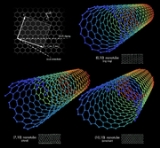
Single-walled


image:Carbon_nanotube_armchair_povray.PNG | armchair (n, n) image:Carbon_nanorim_armchair_povray.PNG | the chiral vector is bent, while the translation vector stays straight image:Carbon_nanoribbon_povray.PNG | graphene nanoribbon image:Carbon_nanorim_zigzag_povray.PNG | the chiral vector is bent, while the translation vector stays straight image:Carbon_nanotube_zigzag_povray.PNG | zigzag (n,0) image:Carbon_nanotube_chiral_povray.PNG | chiral (n, m) image:Carbon_nanorim_chiral_povray.PNG | n and m can be counted at the end of the tube image:Carbon_nanoribbon_chiral_povray.PNG | graphene nanoribbon

Cntnames
Most single-walled nanotubes (SWNT) have a diameter of close to 1 nanometer, with a tube length that can be many thousands of times longer. The structure of an SWNT can be conceptualized by wrapping a one-atom-thick layer of graphite called graphene into a seamless cylinder. The way the graphene sheet is wrapped is represented by a pair of indices (n,m) called the chiral vector. The integers n and m denote the number of unit vectors along two directions in the honeycomb crystal lattice of graphene. If m=0, the nanotubes are called "zigzag". If n=m, the nanotubes are called "armchair". Otherwise, they are called "chiral".

Single-walled nanotubes are an important variety of carbon nanotube because they exhibit electric properties that are not shared by the multi-walled carbon nanotube (MWNT) variants. Single-walled nanotubes are the most likely candidate for miniaturizing electronics beyond the micro electromechanical scale currently used in electronics. The most basic building block of these systems is the electric wire, and SWNTs can be excellent conductors. One useful application of SWNTs is in the development of the first intramolecular field effect transistors (FET). Production of the first intramolecular logic gate
Logic gate

A logic gate performs a logical operation on one or more logic inputs and produces a single logic output. The logic normally performed is Boolean logic and is most commonly found in digital circuits....
 using SWNT FETs has recently become possible as well. To create a logic gate you must have both a p-FET and an n-FET. Because SWNTs are p-FETs when exposed to oxygen and n-FETs otherwise, it is possible to protect half of an SWNT from oxygen exposure, while exposing the other half to oxygen. This results in a single SWNT that acts as a NOT logic gate with both p and n-type FETs within the same molecule.

Single-walled nanotubes are still very expensive to produce, around $1500 per gram as of 2000, and the development of more affordable synthesis techniques is vital to the future of carbon nanotechnology. If cheaper means of synthesis cannot be discovered, it would make it financially impossible to apply this technology to commercial-scale applications. Several suppliers offer as-produced arc discharge SWNTs for ~$50–100 per gram as of 2007.

Multi-walled

Multi-walled nanotubes (MWNT) consist of multiple layers of graphite rolled in on themselves to form a tube shape. There are two models which can be used to describe the structures of multi-walled nanotubes. In the Russian Doll
Matryoshka doll

A matryoshka doll, a Babushka doll or a Russian nested doll, also called a stacking doll, is a set of dolls of decreasing sizes placed one inside the other....
 model, sheets of graphite are arranged in concentric cylinders, e.g. a (0,8) single-walled nanotube (SWNT) within a larger (0,10) single-walled nanotube. In the Parchment
Scroll (parchment)

A scroll is a roll of papyrus, parchment, or paper which has been written, drawn or painted upon for the purpose of transmitting information or using as a decoration....
 model, a single sheet of graphite is rolled in around itself, resembling a scroll of parchment or a rolled newspaper. The interlayer distance in multi-walled nanotubes is close to the distance between graphene layers in graphite, approximately 3.3 Å (330 pm).

The special place of double-walled carbon nanotubes (DWNT) must be emphasized here because their morphology and properties are similar to SWNT but their resistance to chemicals is significantly improved. This is especially important when functionalization
Surface functionalization

Surface functionalization introduces chemical functional groups to a surface. This way, functional materials can be designed from substrates with standard bulk material properties....
 is required (this means grafting of chemical functions at the surface of the nanotubes) to add new properties to the CNT. In the case of SWNT, covalent functionalization will break some C=C double bonds, leaving "holes" in the structure on the nanotube and thus modifying both its mechanical and electrical properties. In the case of DWNT, only the outer wall is modified. DWNT synthesis on the gram-scale was first proposed in 2003 by the CCVD technique, from the selective reduction of oxide solutions in methane and hydrogen.

Fullerite

Fullerites are the solid-state manifestations of fullerenes and related compounds and materials. Being highly incompressible
Physical compression

Physical compression is the result of the subjection of a material to compressive stress, resulting in reduction of volume. The opposite of compression is tension ....
 nanotube forms, polymerized single-walled nanotubes (P-SWNT) are a class of fullerites and are comparable to diamond
Diamond

In mineralogy, diamond is the Allotropes of carbon where the carbon atoms are arranged in an isometric-hexoctahedral crystal lattice. After graphite, diamond is the second most stable form of carbon....
 in terms of hardness. However, due to the way that nanotubes intertwine, P-SWNTs do not have the corresponding crystal lattice that makes it possible to cut diamonds neatly. This same structure results in a less brittle
Brittle

A material is brittle if it is liable to fracture when subjected to stress . That is, it has little tendency to deform before fracture. This fracture absorbs relatively little energy, even in materials of high Strength of materials, and usually makes a snapping sound....
 material, as any impact that the structure sustains is spread across the material.

Torus

A nanotorus is a theoretically described carbon nanotube bent into a torus
Torus

In geometry, a torus is a surface of revolution generated by revolving a circle in three dimensional space about an axis coplanar with the circle, which does not touch the circle....
 (doughnut shape). Nanotori have many unique properties, such as magnetic moments 1000 times larger than previously expected for certain specific radii. Properties such as magnetic moment
Magnetic moment

In physics, astronomy, chemistry, and electrical engineering, the term magnetic moment of a system usually refers to its magnetic dipole moment, and is a measure of the strength of the system's net Magnetism....
, thermal stability etc. vary widely depending on radius of the torus and radius of the tube.

Nanobud

Carbon nanobud
Carbon nanobud

In nanotechnology, carbon nanobuds form a material which combines two previously discovered allotropes of carbon: carbon nanotubes and fullerenes....
s are a newly created material combining two previously discovered allotropes of carbon; carbon nanotubes and fullerenes. In this new material fullerene-like "buds" are covalently bonded to the outer sidewalls of the underlying carbon nanotube. This hybrid material has useful properties of both fullerenes and carbon nanotubes. In particular, they have been found to be exceptionally good field emitters. In composite materials, the attached fullerene molecules may function as molecular anchors preventing slipping of the nanotubes, thus improving the composite’s mechanical properties.

Properties


Strength

Carbon nanotubes are the strongest and stiffest materials yet discovered in terms of tensile strength
Tensile strength

Tensile strength , or is the Stress at which a material breaks or permanently deforms. Tensile strength is an Intensive and extensive properties and, consequently, does not depend on the size of the test specimen....
 and elastic modulus
Elastic modulus

An elastic modulus, or modulus of elasticity, is the mathematical description of an object or substance's tendency to be deformed elastically when a force is applied to it....
 respectively. This strength results from the covalent sp² bonds formed between the individual carbon atoms. In 2000, a multi-walled carbon nanotube was tested to have a tensile strength of 63 gigapascals
Pascal (unit)

The pascal is the SI derived unit of pressure, stress , Young's modulus and tensile strength. It is a measure of force per unit area i.e. equivalent to one newton per square meter or one joule per cubic meter....
 (GPa). (This, for illustration, translates into the ability to endure weight of 6300 kg on a cable with cross-section of 1 mm
MM

MM or variations may refer to:...
2.) Since carbon nanotubes have a low density for a solid of 1.3-1.4 g•cm−3, its specific strength
Specific strength

The specific strength is a material's Strength of materials divided by its density. It is also known as the strength-to-weight ratio or strength/weight ratio....
 of up to 48,000 kN•m•kg−1 is the best of known materials, compared to high-carbon steel's 154 kN•m•kg−1.

Under excessive tensile strain, the tubes will undergo plastic deformation
Deformation

In materials science, deformation is a change in the shape or size of an object due to an applied force . This can be a result of tensile strength forces, compressive strength forces, Simple shear, bending or torsion ....
, which means the deformation is permanent. This deformation begins at strains of approximately 5% and can increase the maximum strain the tubes undergo before fracture by releasing strain energy.

CNTs are not nearly as strong under compression. Because of their hollow structure and high aspect ratio, they tend to undergo buckling
Buckling

In engineering, buckling is a structural failure characterized by a sudden failure of a structural member subjected to high compressive stresses, where the actual compressive stress at the point of failure is less than the ultimate compressive stresses that the material is capable of withstanding....
 when placed under compressive, torsional or bending stress.

EExperimental observation

TTheoretical prediction

The above discussion referred to axial properties of the nanotube, whereas simple geometrical considerations suggest that carbon nanotubes should be much softer in the radial direction than along the tube axis. Indeed, TEM observation of radial elasticity suggested that even the van der Waals forces can deform two adjacent nanotubes. Nanoindentation experiments, performed by several groups on multiwalled carbon nanotubes, , indicated Young's modulus of the order of several GPa confirming that CNTs are indeed rather soft in the radial direction.

Kinetic

Multi-walled nanotubes, multiple concentric nanotubes precisely nested within one another, exhibit a striking telescoping property whereby an inner nanotube core may slide, almost without friction, within its outer nanotube shell thus creating an atomically perfect linear or rotational bearing. This is one of the first true examples of molecular nanotechnology
Molecular nanotechnology

Molecular nanotechnology is the concept of engineering functional mechanical systems at the molecular scale. An equivalent definition would be "machines at the molecular scale designed and built atom-by-atom"....
, the precise positioning of atoms to create useful machines. Already this property has been utilized to create the world's smallest rotational motor
Synthetic molecular motors

Synthetic molecular motors are molecular machines capable of rotation under energy input. Although the term "molecular motor" has traditionally referred to a naturally occurring protein that induces motion, some groups also use the term when referring to non-biological, non-peptide synthetic motors....
. Future applications such as a gigahertz mechanical oscillator are also envisaged.

Electrical

Because of the symmetry and unique electronic structure of graphene, the structure of a nanotube strongly affects its electrical properties. For a given (n,m) nanotube, if n = m, the nanotube is metallic; if n - m is a multiple of 3, then the nanotube is semiconducting with a very small band gap, otherwise the nanotube is a moderate semiconductor
Semiconductor

A semiconductor is a material that has electrical conductivity between those of a Electrical conductor and an electrical insulation; it can vary over that wide range either permanently or dynamically....
. Thus all armchair (n=m) nanotubes are metallic, and nanotubes (5,0), (6,4), (9,1), etc. are semiconducting. In theory, metallic nanotubes can carry an electrical current density of 4×10⁹ A/cm2 which is more than 1,000 times greater than metals such as copper
Copper

Copper is a chemical element with the symbol Cu and atomic number 29.It is a ductile metal with very high thermal and electrical conductivity....
.

Thermal

All nanotubes are expected to be very good thermal conductors along the tube, exhibiting a property known as "ballistic conduction
Ballistic conduction

Ballistic conduction is the unimpeded flow of charge carrying particles over relatively high distances in a material. Normally, transport of electrons is dominated by scattering events, which relax the carrier momentum in an effort to bring the conducting material to equilibrium....
," but good insulators laterally to the tube axis. It is predicted that carbon nanotubes will be able to transmit up to 6000 watt
WATT

WATT is a radio station broadcasting a News radio-Talk radio-Sports radio format. Licensed to Cadillac, Michigan, it first began broadcasting in 1945....
s per meter per Kelvin
Kelvin

The kelvin is a Units of measurement of temperature and is one of the seven SI base units. The Kelvin scale is a Thermodynamic temperature scale where absolute zero, the theoretical absence of all thermal energy, is zero ....
 at room temperature; compare this to copper, a metal well-known for its good thermal conductivity
Thermal conductivity

In physics, thermal conductivity, , is the List of materials properties of a material that indicates its ability to conduct heat. It appears primarily in Heat conduction#Fourier's law for heat conduction....
, which transmits 385 watts per meter per K. The temperature stability of carbon nanotubes is estimated to be up to 2800oC in vacuum
Vacuum

A vacuum is a volume of space that is essentially empty of matter, such that its gaseous pressure is much less than atmospheric pressure. The word comes from the Latin term for "empty," but in reality, no volume of space can ever be perfectly empty....
 and about 750oC in air.

Defects

As with any material, the existence of a crystallographic defect
Crystallographic defect

Crystalline solids have a very regular atomic structure: that is, the local positions of atoms with respect to each other are repeated at the atomic scale....
 affects the material properties. Defects can occur in the form of atomic vacancies
Vacancy

In crystallography, a vacancy is a type of point defect in a crystal.Crystals inherently possess imperfections, often referred to as 'crystalline defects'....
. High levels of such defects can lower the tensile strength by up to 85%. Another form of carbon nanotube defect is the Stone Wales defect
Stone Wales defect

The Stone Wales defect is a crystallographic defect that occurs on carbon nanotubes and is thought to have important implications for nanotube's mechanical properties....
, which creates a pentagon and heptagon pair by rearrangement of the bonds. Because of the very small structure of CNTs, the tensile strength of the tube is dependent on its weakest segment in a similar manner to a chain, where the strength of the weakest link becomes the maximum strength of the chain.

Crystallographic defects also affect the tube's electrical properties. A common result is lowered conductivity through the defective region of the tube. A defect in armchair-type tubes (which can conduct electricity) can cause the surrounding region to become semiconducting, and single monoatomic vacancies induce magnetic properties.

Crystallographic defects strongly affect the tube's thermal properties. Such defects lead to phonon
Phonon

In physics, a phonon is a quantum mode of vibration occurring in a rigid crystal structure, such as the atomic lattice of a solid. The study of phonons is an important part of solid state physics, because phonons play a major role in many of the physical properties of solids, including a material's thermal conductivity and electrical conduc...
 scattering, which in turn increases the relaxation rate of the phonons. This reduces the mean free path
Mean free path

In physics the mean free path of a particle is the average distance covered by a particle between subsequent impacts....
 and reduces the thermal conductivity of nanotube structures. Phonon transport simulations indicate that substitutional defects such as nitrogen or boron will primarily lead to scattering of high-frequency optical phonons. However, larger-scale defects such as Stone Wales defect
Stone Wales defect

The Stone Wales defect is a crystallographic defect that occurs on carbon nanotubes and is thought to have important implications for nanotube's mechanical properties....
s cause phonon scattering over a wide range of frequencies, leading to a greater reduction in thermal conductivity.

One-Dimensional Transport

Due to their nanoscale dimensions, electron transport in carbon nanotubes will take place through quantum effects and will only propagate along the axis of the tube. Because of this special transport property, carbon nanotubes are frequently referred to as “one-dimensional” in scientific articles.

Toxicity

Determining the toxicity of carbon nanotubes has been one of the most pressing questions in Nanotechnology. Unfortunately such research has only just begun and the data are still fragmentary and subject to criticism. Preliminary results highlight the difficulties in evaluating the toxicity of this heterogeneous material. Parameters such as structure, size distribution
Frequency distribution

In statistics, a frequency statistical distribution is a tabulation of the values that one or more variables take in a Sampling ....
, surface area
Surface area

Surface area is how much exposed area an object has. It is expressed in square units. If an object has flat Face , its surface area can be calculated by adding together the areas of its faces....
, surface chemistry, surface charge
Surface charge

Surface charge is the electric charge present at an Interface , for instance on the surface of a semiconductor material, or for example, on the surface of a protein in water....
, and agglomeration
Agglomeration

In the study of human settlements, an agglomeration is an extended city or town area comprising the built-up area of a central place and any suburbs linked by continuous urban area....
 state as well as purity of the samples, have considerable impact on the reactivity
Reactivity

Reactivity refers to the Reaction rate at which a chemical substance tends to undergo a chemical reaction in time. In pure chemical compounds, reactivity is regulated by the physical properties of the sample....
 of carbon nanotubes. However, available data clearly show that, under some conditions, nanotubes can cross membrane barriers, which suggests that if raw materials reach the organs they can induce harmful effects such as inflammatory and fibrotic reactions.

A study led by Alexandra Porter from the University of Cambridge
University of Cambridge

The University of Cambridge , located in Cambridge, England, is the List of oldest universities in continuous operation university in the Anglosphere....
 shows that CNTs can enter human cells and accumulate in the cytoplasm
Cytoplasm

The cytoplasm is the part of a Cell that is enclosed within the plasma membrane. In eukaryote cells the cytoplasm contains organelles, such as mitochondrion, that are filled with liquid kept separate from the rest of the cytoplasm by biological membranes....
, causing cell death.

Results of rodent studies collectively show that regardless of the process by which CNTs were synthesized and the types and amounts of metals they contained, CNTs were capable of producing inflammation
Inflammation

Inflammation is the complex biological response of Blood vessel tissues to harmful stimuli, such as pathogens, damaged cells, or irritants. It is a protective attempt by the organism to remove the injurious stimuli as well as initiate the healing process for the tissue....
, epithelioid granulomas
Granuloma

A granuloma is a medical term for a ball-like collection of immune cells trying to destroy a foreign substance. It represents a special type of inflammatory reaction common to a wide variety of diseases, both infectious and non-infectious....
 (microscopic nodules), fibrosis
Fibrosis

Fibrosis is the formation or development of excess fibrous connective tissue in an organ or tissue as a reparative or reactive process, as opposed to a formation of fibrous tissue as a normal constituent of an organ or tissue....
, and biochemical/toxicological changes in the lungs. Comparative toxicity studies in which mice were given equal weights of test materials showed that SWCNTs were more toxic than quartz
Quartz

Quartz is the most abundant mineral in the Earth's continental crust . It is made up of a Crystal structure of silica tetrahedra. Quartz has a hardness of 7 on the Mohs scale and a density of 2.65 g/cm?....
, which is considered a serious occupational health hazard when chronically inhaled. As a control, ultrafine carbon black
Carbon black

Carbon black is a material produced by the incomplete combustion of heavy petroleum products such as FCC tar, coal tar, ethylene cracking tar, and a small amount from vegetable oil....
 was shown to produce minimal lung responses.

The needle-like fiber shape of CNTs, similar to asbestos fibers, raises fears that widespread use of carbon nanotubes may lead to mesothelioma
Mesothelioma

Mesothelioma is a form of cancer that is almost always caused by previous exposure to asbestos. In this disease, malignant Cell develop in the mesothelium, a protective lining that covers most of the body's internal organs....
, cancer of the lining of the lungs often caused by exposure to asbestos. A recently-published pilot study supports this prediction. Scientists exposed the mesothelial lining
Lining

Lining may refer to:*Brake lining*Product lining*Antonio Lining*Li Ning...
 of the body cavity of mice, as a surrogate for the mesothelial lining of the chest cavity, to long multiwalled carbon nanotubes and observed asbestos-like, length-dependent, pathogenic behavior which included inflammation and formation of lesions known as granulomas. Authors of the study conclude:
"This is of considerable importance, because research and business communities continue to invest heavily in carbon nanotubes for a wide range of products under the assumption that they are no more hazardous than graphite. Our results suggest the need for further research and great caution before introducing such products into the market if long-term harm is to be avoided."
According to co-author Dr. Andrew Maynard:
"This study is exactly the kind of strategic, highly focused research needed to ensure the safe and responsible development of nanotechnology. It looks at a specific nanoscale material expected to have widespread commercial applications and asks specific questions about a specific health hazard. Even though scientists have been raising concerns about the safety of long, thin carbon nanotubes for over a decade, none of the research needs in the current U.S. federal nanotechnology environment, health and safety risk research strategy address this question."


Although further research is required, results presented today clearly demonstrate that, under certain conditions, especially those involving chronic exposure, carbon nanotubes can pose a serious risk to human health.

Synthesis

Techniques have been developed to produce nanotubes in sizeable quantities, including arc discharge
Electric arc

An electric arc is an electrical breakdown of a gas which produces an ongoing Plasma Electrostatic discharge, resulting from a current flowing through normally Electrical conductance media such as air....
, laser ablation
Laser ablation

Laser ablation is the process of removing material from a solid surface by irradiating it with a laser beam. At low laser flux, the material is heated by the absorbed laser energy and evaporation or sublimation....
, high pressure carbon monoxide (HiPCO), and chemical vapor deposition
Chemical vapor deposition

Chemical vapor deposition is a chemical process used to produce high-purity, high-performance solid materials. The process is often used in the semiconductor industry to produce thin films....
 (CVD). Most of these processes take place in vacuum or with process gases. CVD growth of CNTs can occur in vacuum or at atmospheric pressure. Large quantities of nanotubes can be synthesized by these methods; advances in catalysis and continuous growth processes are making CNTs more commercially viable.

Arc discharge

Nanotubes were observed in 1991 in the carbon soot of graphite electrode
Electrode

An electrode is an electrical conductor used to make contact with a nonmetallic part of a Electronic circuit . The word was coined by the scientist Michael Faraday from the Greek language words elektron and hodos, a way....
s during an arc discharge, by using a current of 100 amps
Ampere

The ampere is the International System of Units unit of electric current. The ampere, in practice often shortened to amp, is an SI base unit, and is named after Andr?-Marie Amp?re, one of the main discoverers of electromagnetism....
, that was intended to produce fullerenes. However the first macroscopic
Macroscopic

Macroscopic is a word commonly used to describe physics objects that are measurement and observation by the naked eye. When applied to phenomena and abstract objects, it describes existence in the world as we perceive it....
 production of carbon nanotubes was made in 1992 by two researchers at NEC's Fundamental Research Laboratory. The method used was the same as in 1991. During this process, the carbon contained in the negative electrode sublimates because of the high discharge temperatures. Because nanotubes were initially discovered using this technique, it has been the most widely-used method of nanotube synthesis.

The yield for this method is up to 30 percent by weight and it produces both single- and multi-walled nanotubes with lengths of up to 50 micrometers.

Laser ablation

In the laser ablation process, a pulsed laser vaporizes a graphite target in a high-temperature reactor while an inert gas
Inert gas

An inert gas is any gas that is not reactive with elements.Like the noble gases an inert gas is not necessarily elemental and are often compound gases....
 is bled into the chamber. Nanotubes develop on the cooler surfaces of the reactor as the vaporized carbon condenses. A water-cooled surface may be included in the system to collect the nanotubes.

This process was developed by Dr. Richard Smalley
Richard Smalley

Richard Errett Smalley was the Gene and Norman Hackerman Professor of Chemistry and a Professor of Physics and Astronomy at Rice University, in Houston, Texas....
 and co-workers at Rice University
Rice University

William Marsh Rice University is a private university research university located in Houston, Texas, Texas, United States. The campus is located near the Houston Museum District and adjacent to the Texas Medical Center....
, who at the time of the discovery of carbon nanotubes, were blasting metals with a laser to produce various metal molecules. When they heard of the existence of nanotubes they replaced the metals with graphite to create multi-walled carbon nanotubes. Later that year the team used a composite of graphite and metal catalyst particles (the best yield was from a cobalt
Cobalt

Cobalt is a hard, lustrous, grey metal, a chemical element with symbol Co and atomic number 27. Although cobalt-based colors and pigments have been used since ancient times, and miners have long used the name kobold ore for some minerals, cobalt was only discovered in 1735 by Georg Brandt....
 and nickel
Nickel

Nickel is a chemical element, with the chemical symbol Ni and atomic number 28. It is a silvery-white lustrous metal with a slight golden tinge....
 mixture) to synthesize single-walled carbon nanotubes.

The laser ablation method yields around 70% and produces primarily single-walled carbon nanotubes with a controllable diameter determined by the reaction temperature
Temperature

In physics, temperature is a physical property of a Physical system that underlies the common notions of hot and cold; something that feels hotter generally has the greater temperature....
. However, it is more expensive than either arc discharge or chemical vapor deposition.

Chemical vapor deposition (CVD)

Pict0111
The catalytic vapor phase deposition of carbon was first reported in 1959, but it was not until 1993 that carbon nanotubes were formed by this process. In 2007, researchers at the University of Cincinnati
University of Cincinnati

The University of Cincinnati is a coeducational public university research university in Cincinnati, Ohio, Ohio, part of the University System of Ohio....
 (UC) developed a process to grow aligned carbon nanotube arrays of 18 mm length on a FirstNano ET3000 carbon nanotube growth system.

During CVD, a substrate is prepared with a layer of metal catalyst particles, most commonly nickel, cobalt, iron
Iron

Iron is a chemical element with the symbol Fe and atomic number 26. Iron is a Group 8 element and period 4 element. Iron is lustrous and silvery in color....
, or a combination. The metal nanoparticles can also be produced by other ways, including reduction of oxides or oxides solid solutions. The diameters of the nanotubes that are to be grown are related to the size of the metal particles. This can be controlled by patterned (or masked) deposition of the metal, annealing, or by plasma etching of a metal layer. The substrate is heated to approximately 700°C. To initiate the growth of nanotubes, two gases are bled into the reactor: a process gas (such as ammonia
Ammonia

Ammonia is a chemical compound with the chemical formula nitrogenhydrogen. It is normally encountered as a gas with a characteristic pungent odor....
, nitrogen
Nitrogen

Nitrogen is a chemical element that has the symbol N and atomic number 7 and atomic mass 14.00674?. Elemental nitrogen is a colorless, odorless, tasteless and mostly inert diatomic gas at standard conditions, constituting 78% by volume of Earth's atmosphere....
 or hydrogen
Hydrogen

Hydrogen is the chemical element with atomic number 1. It is represented by the chemical symbol H. At standard temperature and pressure, hydrogen is a colorless, odorless, nonmetallic, tasteless, highly combustion and explosive Diatomic molecule gas with the molecular formula H2....
) and a carbon-containing gas (such as acetylene
Acetylene

Acetylene is the chemical compound with the symbol carbonhydrogen. It is the simplest alkyne.As an alkyne, acetylene is Saturation because its two carbon atoms are Chemical bond together in a triple bond....
, ethylene
Ethylene

Ethylene is the chemical compound with the formula C2H4. It is the simplest alkene. Because it contains a carbon-carbon double bond, ethylene is called an unsaturated hydrocarbon or an olefin....
, ethanol
Ethanol

Ethanol, also called ethyl alcohol, pure alcohol, grain alcohol, or drinking alcohol, is a volatility , flammable, colorless liquid....
 or methane
Methane

Methane is a chemical compound with the molecular formula . It is the simplest alkane, and the principal component of natural gas. Methane's bond angles are 109.5 degrees....
). Nanotubes grow at the sites of the metal catalyst; the carbon-containing gas is broken apart at the surface of the catalyst particle, and the carbon is transported to the edges of the particle, where it forms the nanotubes. This mechanism is still being studied. The catalyst particles can stay at the tips of the growing nanotube during the growth process, or remain at the nanotube base, depending on the adhesion between the catalyst particle and the substrate.

CVD is a common method for the commercial production of carbon nanotubes. For this purpose, the metal nanoparticles are mixed with a catalyst support such as MgO or Al2O3 to increase the surface area for higher yield of the catalytic reaction of the carbon feedstock with the metal particles. One issue in this synthesis route is the removal of the catalyst support via an acid treatment, which sometimes could destroy the original structure of the carbon nanotubes. However, alternative catalyst supports that are soluble in water have proven effective for nanotube growth.

If a plasma
Plasma (physics)

In physics and chemistry, plasma is a partially ionized gas, in which a certain proportion of electrons are free rather than being bound to an atom or molecule....
 is generated by the application of a strong electric field during the growth process (plasma enhanced chemical vapor deposition*), then the nanotube growth will follow the direction of the electric field. By adjusting the geometry of the reactor it is possible to synthesize vertically aligned carbon nanotubes (i.e., perpendicular to the substrate), a morphology that has been of interest to researchers interested in the electron emission from nanotubes. Without the plasma, the resulting nanotubes are often randomly oriented. Under certain reaction conditions, even in the absence of a plasma, closely spaced nanotubes will maintain a vertical growth direction resulting in a dense array of tubes resembling a carpet or forest.

Of the various means for nanotube synthesis, CVD shows the most promise for industrial-scale deposition, because of its price/unit ratio, and because CVD is capable of growing nanotubes directly on a desired substrate, whereas the nanotubes must be collected in the other growth techniques. The growth sites are controllable by careful deposition of the catalyst. In 2007, a team from Meijo University
Meijo University

is a private university in Japan with campuses at Tempaku-ku, Nagoya, Aichi Prefecture and Kani, Gifu. The predecessor of the school was founded in 1926, and it was chartered as a university in 1949....
 demonstrated a high-efficiency CVD technique for growing carbon nanotubes from camphor
Camphor

Camphor is a waxy, white or transparent solid with a strong, aromatic odor. It is a terpenoid with the chemical formula carbon10hydrogen16oxygen....
. Researchers at Rice University, until recently led by the late Dr. Richard Smalley, have concentrated upon finding methods to produce large, pure amounts of particular types of nanotubes. Their approach grows long fibers from many small seeds cut from a single nanotube; all of the resulting fibers were found to be of the same diameter as the original nanotube and are expected to be of the same type as the original nanotube. Further characterization of the resulting nanotubes and improvements in yield and length of grown tubes are needed.

CVD growth of multi-walled nanotubes is used by several companies to produce materials on the ton scale, including NanoLab, Bayer
Bayer

Bayer Aktiengesellschaft is a Germany chemical industry and pharmaceutical company founded in Barmen, Germany in 1863. Today it is headquartered in Leverkusen, North Rhine-Westphalia, Germany....
, Arkema
Arkema

The Arkema Group was created in October 2004 from the reorganization of Total?s Chemicals branch. It has three business segments: Vinyl Products, Industrial Chemicals, and Performance Products....
, Nanocyl, Nanothinx, Hyperion Catalysis, Mitsui
Mitsui

is one of the largest corporate Conglomerate_ in Japan and one of the largest publicly traded companies in the world....
, and Showa Denko
Showa Denko

is a leading Japanese chemical engineering firm.Formed in 1939 by the merger of Nihon Electrical Industries and Showa Fertilizers, Showa Denko K.K....
.

Natural, incidental, and controlled flame environments

Fullerene
Fullerene

Fullerene are a family of carbon Allotropy, molecules composed entirely of carbon, in the form of a hollow sphere, ellipsoid, cylinder , or plane....
s and carbon nanotubes are not necessarily products of high-tech laboratories; they are commonly formed in such mundane places as ordinary flame
Flame

A flame is the visible part of a fire. It is caused by a highly exothermic reaction taking place in a thin zone. If a fire is hot enough to ionize the gaseous components, it can become a Plasma ....
s, produced by burning methane, ethylene, and benzene, and they have been found in soot
Soot

Soot is a general term that refers to impure carbon particles resulting from the incomplete combustion of a hydrocarbon. It is more properly restricted to the product of the gas-phase combustion process but is commonly extended to include the residual pyrolyzed fuel particles such as cenospheres, charred wood, petroleum coke, etc....
 from both indoor and outdoor air. However, these naturally occurring varieties can be highly irregular in size and quality because the environment in which they are produced is often highly uncontrolled. Thus, although they can be used in some applications, they can lack in the high degree of uniformity necessary to meet many needs of both research and industry. Recent efforts have focused on producing more uniform carbon nanotubes in controlled flame environments. of Westwood, Massachusetts, is producing flame synthesized single-walled carbon nanotubes. This method has promise for large-scale, low-cost nanotube synthesis, though it must compete with rapidly developing large scale CVD production.

Potential and current applications


See also, for last current applications: Timeline of carbon nanotubes
Timeline of carbon nanotubes

Chronology of carbon nanotubes:...


Louie Nanotube
The strength and flexibility of carbon nanotubes makes them of potential use in controlling other nanoscale structures, which suggests they will have an important role in nanotechnology
Nanotechnology

Nanotechnology, shortened to "Nanotech", is the study of the control of matter on an atomic and molecular scale. Generally nanotechnology deals with structures of the size 100 nanometers or smaller, and involves developing materials or devices within that size....
 engineering. The highest tensile strength an individual multi-walled carbon nanotube has been tested to be is 63 GPa.

A 2006 study published in Nature
Nature (journal)

Nature is a prominent scientific journal, first published on 4 November 1869. Although most scientific journals are now highly specialized, Nature is one of the few journals, along with other weekly journals such as Science and Proceedings of the National Academy of Sciences, that still publishes original research articles ac...
 determined that some carbon nanotubes are present in Damascus steel
Damascus steel

Damascus steel is a hot-forging steel used in Middle Eastern swordmaking from about 1100 to 1700 AD. Damascus swords were of legendary sharpness and strength, and were apocryphally claimed to be able to cut through lesser quality European swords and even rock....
, possibly helping to account for the legendary strength of the (almost ancient) swords made of it.

Structural

Because of the carbon nanotube's superior mechanical properties, many structures have been proposed ranging from everyday items like clothes and sports gear to combat jackets and space elevator
Space elevator

A space elevator is a proposed structure designed to transport material from a Astronomical object's surface into space. Many variants have been proposed, all of which involve traveling along a fixed structure instead of using rocket powered space launch....
s. However, the space elevator
Space elevator

A space elevator is a proposed structure designed to transport material from a Astronomical object's surface into space. Many variants have been proposed, all of which involve traveling along a fixed structure instead of using rocket powered space launch....
 will require further efforts in refining carbon nanotube technology, as the practical tensile strength of carbon nanotubes can still be greatly improved.

For perspective, outstanding breakthroughs have already been made. Pioneering work led by Ray H. Baughman at the NanoTech Institute has shown that single and multi-walled nanotubes can produce materials with toughness unmatched in the man-made and natural worlds.

Recent research by James D. Iverson and Brad C. Edwards has revealed the possibility of cross-linking CNT molecules prior to incorporation in a polymer matrix to form a super high strength composite material. This CNT composite could have a tensile strength on the order of 20 million psi (138 GPa, for 106 MN•m•kg−1), potentially revolutionizing many aspects of engineering design where low weight and high strength are required.

In electrical circuits

Carbon nanotubes have many properties—from their unique dimensions to an unusual current conduction
Electrical conduction

Electrical conduction is the movement of electric charge particles through a transmission medium . The movement of charge constitutes an Current ....
 mechanism—that make them ideal components of electrical circuits. For example, they have shown to exhibit strong electron-phonon resonances, which indicate that under certain direct current (DC) bias and doping conditions their current and the average electron velocity, as well as the electron concentration on the tube oscillate at terahertz frequencies. These resonances can be used to make terahertz sources or sensors.

Nanotube based transistor
Transistor

In electronics, a transistor is a semiconductor device commonly used to Electronic amplifier or switch Electronics signals. A transistor is made of a solid piece of a semiconductor material, with at least three terminals for connection to an external circuit....
s have been made that operate at room temperature and that are capable of digital switching using a single electron.

One major obstacle to realization of nanotubes has been the lack of technology for mass production. However, in 2001 IBM researchers demonstrated how nanotube transistors can be grown in bulk, somewhat like silicon transistors. Their process is called "constructive destruction" which includes the automatic destruction of defective nanotubes on the wafer
Wafer (electronics)

A wafer is a thin slice of semiconductor material, such as a silicon crystal, used in the Semiconductor fabrication of integrated circuit and other microdevices....
.

The IBM process has been developed further and single-chip wafers with over ten billion correctly aligned nanotube junctions have been created. In addition it has been demonstrated that incorrectly aligned nanotubes can be removed automatically using standard photolithography
Photolithography

Photolithography is a process used in microfabrication to selectively remove parts of a thin film . It uses light to transfer a geometric pattern from a photomask to a light-sensitive chemical on the substrate....
 equipment.

The first nanotube integrated memory circuit was made in 2004. One of the main challenges has been regulating the conductivity of nanotubes. Depending on subtle surface features a nanotube may act as a plain conductor
Electrical conductor

In science and Electrical engineering, an electrical conductor is a material which contains movable electric charges. In metallic conductors, such as copper or aluminum, the movable charged particles are electrons ....
 or as a semiconductor. A fully automated method has however been developed to remove non-semiconductor tubes.

Most recently, collaborating American and Chinese researchers at Duke University and Peking University announced a new CVD recipe involving a combination of ethanol and methanol gases and quartz substrates resulting in horizontally aligned arrays of 95-98% semiconducting nanotubes. This is considered a large step towards the ultimate goal of producing perfectly aligned, 100% semiconducting carbon nanotubes for mass production of electronic devices.

Another way to make carbon nanotube transistors has been to use random networks of them. By doing so one averages all of their electrical differences and one can produce devices in large scale at the wafer level. This approach was first patented by Nanomix Inc.(date of original application June 2002 ). It was first published in the academic literature by the United States Naval Research Laboratory
United States Naval Research Laboratory

The United States Naval Research Laboratory is the corporate research laboratory for the United States Navy and the United States Marine Corps and conducts a broad program of scientific research and advanced development....
 in 2003 through independent research work. This approach also enabled Nanomix to make the first transistor on a flexible and transparent substrate.

Nanotubes are usually grown on nanoparticles of magnetic metal (Fe, Co), which facilitates production of electronic (spintronic) devices. In particular control of current through a field-effect transistor by magnetic field has been demonstrated in such a single-tube nanostructure.

As a vessel for drug delivery

The nanotube’s versatile structure allows it to be used for a variety of tasks in and around the body. Although often seen especially in cancer-related incidents, the carbon nanotube is often used as a vessel for transporting drugs into the body. The nanotube application potentially allows for the drug dosage to be lowered by localizing its distribution. The nanotube commonly carries the drug one of two ways: the drug can be attached to the side or trailed behind, or the drug can actually be placed inside the nanotube. Both of these methods are effective for the delivery and distribution of drugs inside the body.

Current applications

They are used as bulk nanotubes, which is a mass of rather unorganized fragments of nanotubes. Bulk nanotube materials may never achieve a tensile strength similar to that of individual tubes, but such composites may nevertheless yield strengths sufficient for many applications. Bulk carbon nanotubes have already been used as composite fibers in polymers to improve the mechanical, thermal and electrical properties of the bulk product.

Easton-Bell Sports, Inc.

Easton-Bell Sports, Inc. is a group of companies producing sporting equipment for hockey, football, baseball, softball, bicycling, motorsports, archery and other sports....
 have been in partnership with Zyvex, using CNT technology in a number of their bicycle
Bicycle

The bicycle, bike, or cycle is a pedal-driven, human-powered transport with two bicycle wheel attached to a bicycle frame, one behind the other....
 components - including flat and riser handlebars, cranks, forks, seatposts, stems and aero bars.

Solar cells

Solar cells developed at NJIT use a carbon nanotube complex, formed by a mixture of carbon nanotubes and carbon buckyballs (known as fullerene
Fullerene

Fullerene are a family of carbon Allotropy, molecules composed entirely of carbon, in the form of a hollow sphere, ellipsoid, cylinder , or plane....
s) to form snake-like structures. Buckyballs trap electrons, although they can't make electrons flow. Add sunlight to excite the polymer
Polymer

A polymer is a large molecule composed of repeating structural units typically connected by covalent chemical bonds. While polymer in popular usage suggests plastic, the term actually refers to a large class of natural and synthetic materials with a variety of properties....
s, and the buckyballs will grab the electrons. Nanotubes, behaving like copper wires, will then be able to make the electrons or current flow.

Ultracapacitors

MIT Laboratory for Elecromagnetic and Electronic Systems
MIT Computer Science and Artificial Intelligence Laboratory

MIT Computer Science and Artificial Intelligence Laboratory is a research laboratory at the Massachusetts Institute of Technology formed by the 2003 merger of the Laboratory for Computer Science and Artificial Intelligence Laboratory....
 uses nanotubes to improve ultracapacitors. The activated charcoal used in conventional ultracapacitors has many small hollow spaces of various size, which create together a large surface to store electric charge. But as charge is quantized into elementary charges, i.e. electrons, and each such elementary charge needs a minimum space, a significant fraction of the electrode surface is not available for storage because the hollow spaces are not compatible with the charge's requirements. With a nanotube electrode the spaces may be tailored to size - few too large or too small - and consequently the capacity should be increased considerably.

Other applications

Carbon nanotubes have been implemented in nanoelectromechanical systems, including mechanical memory elements (NRAM being developed by Nantero Inc.
Nantero

Nantero is a technology company based in Woburn, Massachusetts dedicated to developing a new form of NVRAM, which they call Nano-RAM. It was founded in 2000 by Greg Schmergel, Thomas Rueckes, and Brent M. Segal....
) and nanoscale electric motors (see Nanomotor
Nanomotor

A nanomotor is a molecular device capable of converting energy into movement. It can typically generate forces on the order of newton.A proposed branch of research is the integration of molecular motor proteins found in living cells into molecular motors implanted in artificial devices....
).

Carbon nanotubes have been proposed as a possible gene delivery vehicle and for use in combination with radiofrequency fields to destroy cancer cells.

In May 2005, Nanomix Inc placed on the market a hydrogen sensor which integrated carbon nanotubes on a silicon platform. Since then Nanomix has been patenting many such sensor applications such as in the field of carbon dioxide, nitrous oxide, glucose, DNA detection etc.

Eikos Inc
Eikos

Eikos, Inc is a technology company based in Franklin, Massachusetts that is developing transparent, electrically conductive carbon nanotube films and nanotube inks for transparent conductive coatings....
 of Franklin, Massachusetts
Franklin, Massachusetts

The Town of Franklin is a city in Norfolk County, Massachusetts, Massachusetts, United States. The population was 29,560 at the 2000 census. In 2007, "Family Circle" Magazine named Franklin one of the top ten towns in the country in which to raise a family....
 and Unidym Inc. of Silicon Valley
Silicon Valley

Silicon Valley is the South Bay of the San Francisco Bay Area in Northern California, United States. The term originally referred to the region's large number of Integrated circuit innovators and manufacturers, but eventually came to refer to all the high-tech businesses in the area; it is now generally used as a metonym for the high-tech s...
, California are developing transparent, electrically conductive films of carbon nanotubes to replace indium tin oxide
Indium tin oxide

Indium tin oxide is a solid solution of indium oxide and tin oxide , typically 90% In2O3, 10% SnO2 by weight....
 (ITO). Carbon nanotube films are substantially more mechanically robust than ITO films, making them ideal for high-reliability touchscreen
Touchscreen

A touchscreen is a display which can detect the presence and location of a touch within the display area. The term generally refers to touch or contact to the display of the device by a finger or hand....
s and flexible displays. Printable water-based inks of carbon nanotubes are desired to enable the production of these films to replace ITO. Nanotube films show promise for use in displays for computers, cell phones, PDA
Personal digital assistant

A personal digital assistant is a handheld computer, also known as a palmtop computer. Newer PDAs also have both color screens and audio capabilities, enabling them to be used as mobile phones, , web browsers, or portable media players....
s, and ATM
Automated teller machine

An automated teller machine is a computerized telecommunications device that provides the customers of a financial institution with access to financial transactions in a public space without the need for a human clerk or bank teller....
s.

A nanoradio
Nanoradio

A nanoradio is a radio receiver or transmitter constructed on a nanometer scale. Currently only receivers have been developed and they are structured around a carbon nanotube....
, a radio receiver consisting of a single nanotube, was demonstrated in 2007.

In 2008 it was shown that a sheet of nanotubes can operate as a loudspeaker if an alternating current is applied. The sound is not produced through vibration but thermoacoustically.

Carbon nanotubes are said to have the strength of diamond, and research is being made into weaving them into clothes to create stab-proof and bulletproof clothing. The nanotubes would effectively stop the bullet from penetrating the body, although the bullet's kinetic energy would likely cause broken bones and internal bleeding.

A flywheel
Flywheel

A flywheel is a mechanical device with significant moment of inertia used as a storage device for rotational energy. Flywheels resist changes in their rotational speed, which helps steady the rotation of the shaft when a fluctuating torque is exerted on it by its power source such as a piston-based engine, or when the load placed on it is...
 made of carbon nanotubes could be spun at extremely high velocity on a floating magnetic axis, and potentially store energy at a density
Energy density

Energy density is the amount of energy stored in a given system or region of space per unit volume, or per unit mass, depending on the context, although the latter is more formally specific energy ....
 approaching that of conventional fossil fuels. Since energy can be added to and removed from flywheels very efficiently in the form of electricity, this might offer a way of storing electricity
Grid energy storage

Grid energy storage is used to manage the flow of electricity in a grid . For large-scale load levelling on an interconnected electrical system, electric power generation send low value off-peak excess electricity over the electric power transmission to energy storage that become energy producers when electricity demand is greater....
, making the electrical grid more efficient and variable power suppliers (like wind turbines) more useful in meeting energy needs. The practicality of this depends heavily upon the cost of making massive, unbroken nanotube structures, and their failure rate under stress.

Rheological
Rheology

Rheology is the study of the flow of matter: mainly liquids but also soft solids or solids under conditions in which they flow rather than deform elastically....
 properties can also be shown very effectively by carbon nanotubes.

Nitrogen-doped carbon nanotubes may replace platinum
Platinum

Platinum is a chemical element with the chemical symbol Pt and an atomic number of 78. Its name is derived from the Spanish term platina del Pinto, which is literally translated into "little silver of the Pinto River." It is in Group 10 of the periodic table of elements....
 catalysts used to reduce oxygen in fuel cell
Fuel cell

A fuel cell is an Electrochemistry conversion device. It produces electricity from fuel and an Oxidizing agent , which react in the presence of an electrolyte....
s. A forest of vertically-aligned nanotubes can reduce oxygen in alkaline solution more effectively than platinum, which has been used in such applications since the 1960s. The nanotubes have the added benefit of not being subject to carbon monoxide poisoning.

Regulation

In October 2008, the Department of Toxic Substances Control (DTSC), within the California Environmental Protection Agency
California Environmental Protection Agency

The California Environmental Protection Agency is a state Cabinet -level agency within the government of California. Cal/EPA is composed of six departments, boards and offices responsible for Natural environment research, regulating and administering the state's environmental protection programs, and fulfilling hazardous waste cleanup....
 announced its intent to request information regarding analytical test methods, fate and transport in the environment, and other relevant information from manufacturers of carbon nanotubes. The term "manufacturers” includes persons and businesses that produce nanotubes in California, or import carbon nanotubes into California for sale. This information request is meant to identify information gaps and to develop information about carbon nanotubes.

DTSC is exercising its authority under California Health and Safety Code, Chapter 699, sections 57018-57020. These sections were added as a result of the adoption of . They are intended to make information on the fate and transport, detection and analysis, and other information on chemicals more available. The law places the responsibility to provide this information to the Department on those who manufacture or import the chemicals.

DTSC anticipates issuing a formal information request letter in January 2009. Interested individuals are encouraged to visit their website for the latest up-to-date information at http://www.dtsc.ca.gov/TechnologyDevelopment/Nanotechnology/index.cfm.

Discovery

A 2006 editorial written by Marc Monthioux and Vladimir Kuznetsov in the journal Carbon described the interesting and often misstated origin of the carbon nanotube. A large percentage of academic and popular literature attributes the discovery of hollow, nanometer-size tubes composed of graphitic carbon to Sumio Iijima
Sumio Iijima

Sumio Iijima is a Japanese physicist, often cited as the discoverer of carbon nanotubes. Although carbon nanotubes had been observed prior to his "discovery", Iijima's 1991 paper generated unprecedented interest in the carbon nanostructures and has since fueled intense research in the area of nanotechnology....
 of NEC
NEC

is a Japan multinational corporation IT company headquartered in Minato, Tokyo, Japan. NEC, part of the Sumitomo Group, provides information technology and network solutions to business enterprises, communications services providers and government....
 in 1991.

In 1952 L. V. Radushkevich and V. M. Lukyanovich published clear images of 50 nanometer diameter tubes made of carbon in the Soviet Journal of Physical Chemistry. This discovery was largely unnoticed, as the article was published in the Russian language, and Western scientists' access to Soviet press was limited during the Cold War
Cold War

The Cold War was the continuing state of conflict, tension and competition that existed between a number of world powers, including the United States, the Soviet Union, People's Republic of China, France, United Kingdom and those countries' respective allies from the mid-1940s to the early 1990s....
. It is likely that carbon nanotubes were produced before this date, but the invention of the transmission electron microscope (TEM) allowed direct visualization of these structures.

Carbon nanotubes have been produced and observed under a variety of conditions prior to 1991. A paper by Oberlin, Endo, and Koyama published in 1976 clearly showed hollow carbon fibers with nanometer-scale diameters using a vapor-growth technique. Additionally, the authors show a TEM image of a nanotube consisting of a single wall of graphene. Later, Endo has referred to this image as a single-walled nanotube.

In 1979 John Abrahamson presented evidence of carbon nanotubes at the 14th Biennial Conference of Carbon at Pennsylvania State University
Pennsylvania State University

The Pennsylvania State University is a Commonwealth System of Higher Education, Land-grant university, space grant college public research university located in State College, PA, Pennsylvania, United States....
. The conference paper described carbon nanotubes as carbon fibers which were produced on carbon anodes during arc discharge. A characterization of these fibers was given as well as hypotheses for their growth in a nitrogen atmosphere at low pressures.

In 1981 a group of Soviet scientists published the results of chemical and structural characterization of carbon nanoparticles produced by a thermocatalytical disproportionation of carbon monoxide. Using TEM images and XRD
X-ray scattering techniques

X-ray scattering techniques are a family of non-destructive analytical scientific technique which reveal information about the crystallography structure, chemical composition, and physical properties of materials and thin films....
 patterns, the authors suggested that their “carbon multi-layer tubular crystals” were formed by rolling graphene layers into cylinders. They speculated that by rolling graphene layers into a cylinder, many different arrangements of graphene hexagonal nets are possible. They suggested two possibilities of such arrangements: circular arrangement (armchair nanotube) and a spiral, helical arrangement (chiral tube).

In 1987, Howard G. Tennent of Hyperion Catalysis was issued a U.S. patent for the production of "cylindrical discrete carbon fibrils" with a "constant diameter between about 3.5 and about 70 nanometers…, length 10² times the diameter, and an outer region of multiple essentially continuous layers of ordered carbon atoms and a distinct inner core…."

Iijima's discovery of multi-walled carbon nanotubes in the insoluble material of arc-burned graphite rods in 1991 and Mintmire, Dunlap, and White's independent prediction that if single-walled carbon nanotubes could be made, then they would exhibit remarkable conducting properties in 1992 helped create the initial buzz that is now associated with carbon nanotubes. Nanotube research accelerated greatly following the independent discoveries by Bethune at IBM and Iijima at NEC of single-walled carbon nanotubes and methods to specifically produce them by adding transition-metal catalysts to the carbon in an arc discharge. The arc discharge technique was well-known to produce the famed Buckminster fullerene on a preparative scale, and these results appeared to extend the run of accidental discoveries relating to fullerenes. The original observation of fullerenes in mass spectrometry was not anticipated, and the first mass-production technique by Krätschmer and Huffman was used for several years before realizing that it produced fullerenes.

The discovery of nanotubes remains a contentious issue, especially because several scientists involved in the research could be likely candidates for the Nobel Prize. Many believe that Iijima's report in 1991 is of particular importance because it brought carbon nanotubes into the awareness of the scientific community as a whole. See the reference for a review of the history of the discovery of carbon nanotubes.

Similar to the matter of nanotube discovery is the question of what is the thinnest possible carbon nanotube. Possible candidates are: Nanotubes of about 0.40 nm diameter have been reported in 2000 (on the same page of the journal Nature
Nature (journal)

Nature is a prominent scientific journal, first published on 4 November 1869. Although most scientific journals are now highly specialized, Nature is one of the few journals, along with other weekly journals such as Science and Proceedings of the National Academy of Sciences, that still publishes original research articles ac...
; however, they are not free standing, but enclosed in zeolite crystals or are innermost shells of the multi-wall nanotubes. Later, inner shells of MWNTs of only 0.3 nm in diameter have been reported. The thinnest free-standing nanotube, by September 2003, has diameter of 0.43 nm.

See also

  • Allotropes of carbon
    Allotropes of carbon

    This is a list of the allotropes of carbon....
  • Boron nitride nanotube
    Boron nitride

    Boron nitride is a binary compound, consisting of equal numbers of boron and nitrogen atoms. Its empirical formula is therefore BN. Boron nitride is isoelectronic with carbon and, like carbon, boron nitrides exists as various Polymorphism , one of which is analogous to diamond and one analogous to graphite....
  • Carbon nanotubes in photovoltaics
    Carbon nanotubes in photovoltaics

    Organic photovoltaic devices are fabricated from thin films of organic semiconductors, such as polymers and small-molecule compounds, and are typically on the order of 100 nm thick....
  • Nanoflower
    Nanoflower

    A nanoflower, in chemistry, refers to a compound of certain elements that results in formations which in microscopic view resemble flowers or, in some cases, trees that are called nanobouquets or nanotrees....
  • Graphene
    Graphene

    Graphene is a one-atom-thick planar sheet of sp2 bond carbon atoms that are densely packed in a honeycomb crystal lattice. It can be viewed as an chicken wire made of carbon atoms and their bonds....
  • Buckypaper
    Buckypaper

    Buckypaper is a thin sheet made from an aggregate of carbon nanotubes. The nanotubes are approximately 50,000 times thinner than a human hair. Originally, it was fabricated as a way to handle carbon nanotubes, but in 2008 is being studied and developed into applications by several research groups, showing promise as a building material for ae...
  • Graphene oxide paper
    Graphene Oxide Paper

    Graphene Oxide Paper is a composite material with stiffness and Strength of materials that "could be" superior to all other materials, with the exception of diamond....
  • Optical properties of carbon nanotubes
    Optical properties of carbon nanotubes

    Within materials science, the optical properties of carbon nanotubes refer specifically to the absorption spectroscopy, photoluminescence, and Raman spectroscopy of carbon nanotubes....
  • Organic electronics
    Organic electronics

    Organic electronics, plastic electronics or polymer electronics, is a branch of electronics that deals with Electrical Conductor polymers, plastics, or molecule....
  • Selective chemistry of SWNT
    Selective chemistry of SWNT

    Single walled nano tubes Structure and Reactivity Reactivity of the fullerene molecules with respect to addition chemistries is strongly dependent on the curvature of the carbon framework....
  • Potential applications of carbon nanotubes
    Potential applications of carbon nanotubes

    The potential applications of carbon nanotubes are varied. Carbon nanotubes, a type of fullerene, have potential in fields such as nanotechnology, electronics, optics, materials science, and architecture....
  • Colossal carbon tube
    Colossal carbon tube

    Colossal carbon tubes are a tubular form of carbon. In contrast to the carbon nanotubes , colossal carbon tubes have much larger diameters ranging between 40 and 100 ?m....


Free-download reviews


External links

  • image gallery with carbon nanotubes
  • : a collection of nanotechnology articles, most on nanotubes
  • : from issue 6 of Nano Magazine which focused solely on Carbon Nanotubes
  • , CNET
    CNET

    CNET Networks, Inc. was a mass media corporation based in San Francisco, California, United States. The company was co-founded in 1993 by Halsey Minor and Shelby Bonnie....
  • . Last updated 2007.07.08
  • , Nature 2006.
  • .


List of Carbon Nanotube Suppliers

Though many obstacles exist in the scaling-up of carbon nanotube production, some corporations and institutions have made progress toward that goal:

Molecular modeling software for carbon nanotubes

  • CoNTub v1.0
    CoNTub

    CoNTub is software written in Java which runs on Microsoft Windows, Mac OS X, Linux and Unix Operating systems. It is the first implementation of an algorithm for generating the 3D structure of two arbitrary connected carbon nanotubes by means of one defect or disclination ....