

Siberian Intervention

Encyclopedia
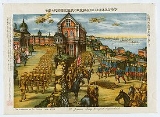
The , or the Siberian Expedition, of 1918–1922 was the dispatch of troops of the Entente powers to the Russian Maritime Provinces
as part of a larger effort by the western powers and Japan
to support White Russian
forces against the Bolshevik
Red Army
during the Russian Civil War
. The Imperial Japanese Army
continued to occupy Siberia even after other Allied forces had withdrawn in 1920.
of 1917, the new Bolshevik
government signed a separate peace
with Germany
. The collapse of the Russian front presented a tremendous problem to the Entente
powers, since not only did it allow Germany to shift troops and war material from its eastern front to the west, but it also made it possible for Germany to secure the huge stockpiles of supplies that had been accumulating at Murmansk
, Arkhangelsk
and Vladivostok
. In addition, the 50,000 man Czech Legion, fighting on the side of the Allies, was now behind enemy-lines, and was attempting to fight its way out through the east to Vladivostok along the Bolshevik-held Trans-Siberian Railway
.
Faced with these concerns, Great Britain
and France
decided to militarily intervene in the Russian Civil War against the Bolshevik government. They had three objectives that they hoped to achieve:
Severely short of troops, the British and French requested that the United States
provide troops for both the North Russia Campaign
and the Siberian Campaign. In July 1918, against the advice of the War Department
, President Wilson
agreed to send 5,000 U.S. troops as the American North Russia Expeditionary Force (aka the Polar Bear Expedition
) and 10,000 U.S. troops as the American Expeditionary Force Siberia
. In the same month, the Beiyang government
of the Republic of China
accepted an invitation by the White movement and sent 2,000 troops by August. The Chinese later occupied Outer Mongolia
and Tuva
and sent a battalion to the North Russian Campaign as part of their anti-Bolshevik efforts.
.
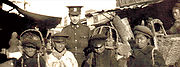 The Canadian Siberian Expeditionary Force, commanded by Major General James H. Elmsley and authorised in August 1918, was sent to Vladivostok to bolster the allied presence there. Composed of 4,192 soldiers, the force returned to Canada between April and June 1919. During this time, the Canadians saw little fighting, with fewer than 100 troops proceeding "up country" to Omsk, to serve as administrative staff for 1,500 British troops aiding the White Russian government of Admiral Alexander Kolchak. Most Canadians remained in Vladivostok, undertaking routine drill and policing duties in the volatile port city.
troops, supported by 2,500 ex-Italian POWs, who had fought in the Austro-Hungarian Army, enrolled in the Legione Redenta.
The Italians played a small but important role during the intervention, fighting together with the Czechoslovak Legion
and other allied forces using heavily armed and armoured train
s to control large sections of the Siberian railway.
The main areas of operation were the Irkutsk
, Harbin
and Vladivostok
regions.
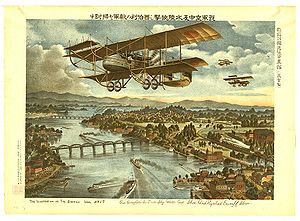 The Japanese were initially asked by the French in 1917, to intervene in Russia but declined the request. However, the army general staff later came to view the Tsarist collapse as an opportunity to free Japan from any future threat from Russia by detaching Siberia and forming an independent buffer state.
The Japanese government in the beginning refused to undertake such an expedition and it was not until the following year that events were set in motion that led to a change in this policy.
In July 1918, President Wilson asked the Japanese government to supply 7,000 troops as part of an international coalition of 25,000 troops, including an American expeditionary force
, planned to support the rescue of the Czech Legion and recurring of wartime supplies. After heated debate in the Diet
, the administration of Prime Minister
Terauchi Masatake
agreed to send 12,000 troops, but under the command of Japan, rather than as part of an international coalition.
Once the political decision had been reached, the Imperial Japanese Army
took over full control under Chief of Staff Yui Mitsue and extensive planning for the expedition was conducted.
and eventually totaled 7,950 officers and enlisted men. The AEF Siberia included the U.S. Army's 27th
and 31st Infantry Regiments, plus large numbers of volunteers from the 13th
and 62nd Infantry Regiments
along with a few from the 12th Infantry Regiment.
Although General Graves did not arrive in Siberia until September 4, 1918, the first 3,000 American troops disembarked in Vladivostok between August 15 and August 21, 1918. They were quickly assigned guard duty along segments of the railway between Vladivostok and Nikolsk-Ussuriski in the north.
Unlike his Allied counterparts, General Graves believed their mission in Siberia was to provide protection for American-supplied property and to help the Czechoslovak Legions
evacuate Russia, and that it did not include fighting against the Bolsheviks. Repeatedly calling for restraint, Graves often clashed with commanders of British
, French
and Japan
ese forces, who wanted the Americans to take a more active part in the military intervention in Siberia.
and in Siberia
east of the city of Chita.
In the summer of 1918 onwards, the Japanese army lent its support to White Russian elements; the 5th infantry division
and the Japanese-backed Special Manchurian Detachment of Grigory Semyonov took control over Transbaikalia and founded a short-lived White Transbaikalia
government.
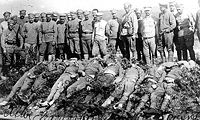 With the end of the war in Europe the allies decided to support the anti-Bolshevik White forces and effectively intervene in the Russian Civil War. Allied army support was given to Admiral Kolchak's White government at Omsk
while the Japanese continued to support Kolchak's rivals in Grigory Semyonov
and Ivan Kalmykov. In the Summer of 1919, the White regime in Siberia collapsed, after the capture and execution of Admiral Kolchak
by the Red Army.
In June 1920, the Americans, British and the remaining allied coalition partners withdrew from Vladivostok
. The evacuation of the Czech Legion was also carried out in the same year.
However, the Japanese decided to stay, primarily due to fears of the spread of communism
so close to Japan, and the Japanese controlled Korea
and Manchuria
. The Japanese were forced to sign the Gongota Agreement of 1920
in order to evacuate their troops peacefully from Transbaikal. It meant an unavoidable end to Grigory Semyonov
's regime in October 1920.
The Japanese army provided military support to the Japanese-backed Provisional Priamur Government based in Vladivostok against the Moscow
-backed Far Eastern Republic
. The continued Japanese presence concerned the United States, which suspected that Japan had territorial designs on Siberia and the Russian Far East. Subjected to intense diplomatic pressure by the United States and Great Britain, and facing increasing domestic opposition due to the economic and human cost, the administration of Prime Minister Kato Tomosaburo
withdrew the Japanese forces in October 1922.
, after the Red Army eventually emerged victorious from the Russian Civil War. The intervention tore Japan's wartime unity to shreds, leading to the army and government being involved in bitter controversy and renewed faction strife in the army itself.
Japanese casualties from the Siberian Expedition included some 5,000 dead from combat or illness, and the expenses incurred were in excess of 900 million yen.
Primorsky Krai
Primorsky Krai , informally known as Primorye , is a federal subject of Russia . Primorsky means "maritime" in Russian, hence the region is sometimes referred to as Maritime Province or Maritime Territory. Its administrative center is in the city of Vladivostok...
as part of a larger effort by the western powers and Japan
Allied Intervention in the Russian Civil War
The Allied intervention was a multi-national military expedition launched in 1918 during World War I which continued into the Russian Civil War. Its operations included forces from 14 nations and were conducted over a vast territory...
to support White Russian
White movement
The White movement and its military arm the White Army - known as the White Guard or the Whites - was a loose confederation of Anti-Communist forces.The movement comprised one of the politico-military Russian forces who fought...
forces against the Bolshevik
Bolshevik
The Bolsheviks, originally also Bolshevists , derived from bol'shinstvo, "majority") were a faction of the Marxist Russian Social Democratic Labour Party which split apart from the Menshevik faction at the Second Party Congress in 1903....
Red Army
Red Army
The Workers' and Peasants' Red Army started out as the Soviet Union's revolutionary communist combat groups during the Russian Civil War of 1918-1922. It grew into the national army of the Soviet Union. By the 1930s the Red Army was among the largest armies in history.The "Red Army" name refers to...
during the Russian Civil War
Russian Civil War
The Russian Civil War was a multi-party war that occurred within the former Russian Empire after the Russian provisional government collapsed to the Soviets, under the domination of the Bolshevik party. Soviet forces first assumed power in Petrograd The Russian Civil War (1917–1923) was a...
. The Imperial Japanese Army
Imperial Japanese Army
-Foundation:During the Meiji Restoration, the military forces loyal to the Emperor were samurai drawn primarily from the loyalist feudal domains of Satsuma and Chōshū...
continued to occupy Siberia even after other Allied forces had withdrawn in 1920.
Background
Following the Russian October RevolutionOctober Revolution
The October Revolution , also known as the Great October Socialist Revolution , Red October, the October Uprising or the Bolshevik Revolution, was a political revolution and a part of the Russian Revolution of 1917...
of 1917, the new Bolshevik
Bolshevik
The Bolsheviks, originally also Bolshevists , derived from bol'shinstvo, "majority") were a faction of the Marxist Russian Social Democratic Labour Party which split apart from the Menshevik faction at the Second Party Congress in 1903....
government signed a separate peace
Separate peace
The phrase "separate peace" refers to a nation's agreement to cease military hostilities with another, even though the former country had previously entered into a military alliance with other states that remain at war with the latter country...
with Germany
Germany
Germany , officially the Federal Republic of Germany , is a federal parliamentary republic in Europe. The country consists of 16 states while the capital and largest city is Berlin. Germany covers an area of 357,021 km2 and has a largely temperate seasonal climate...
. The collapse of the Russian front presented a tremendous problem to the Entente
Triple Entente
The Triple Entente was the name given to the alliance among Britain, France and Russia after the signing of the Anglo-Russian Entente in 1907....
powers, since not only did it allow Germany to shift troops and war material from its eastern front to the west, but it also made it possible for Germany to secure the huge stockpiles of supplies that had been accumulating at Murmansk
Murmansk
Murmansk is a city and the administrative center of Murmansk Oblast, Russia. It serves as a seaport and is located in the extreme northwest part of Russia, on the Kola Bay, from the Barents Sea on the northern shore of the Kola Peninsula, not far from Russia's borders with Norway and Finland...
, Arkhangelsk
Arkhangelsk
Arkhangelsk , formerly known as Archangel in English, is a city and the administrative center of Arkhangelsk Oblast, Russia. It lies on both banks of the Northern Dvina River near its exit into the White Sea in the north of European Russia. The city spreads for over along the banks of the river...
and Vladivostok
Vladivostok
The city is located in the southern extremity of Muravyov-Amursky Peninsula, which is about 30 km long and approximately 12 km wide.The highest point is Mount Kholodilnik, the height of which is 257 m...
. In addition, the 50,000 man Czech Legion, fighting on the side of the Allies, was now behind enemy-lines, and was attempting to fight its way out through the east to Vladivostok along the Bolshevik-held Trans-Siberian Railway
Trans-Siberian Railway
The Trans-Siberian Railway is a network of railways connecting Moscow with the Russian Far East and the Sea of Japan. It is the longest railway in the world...
.
Faced with these concerns, Great Britain
Great Britain
Great Britain or Britain is an island situated to the northwest of Continental Europe. It is the ninth largest island in the world, and the largest European island, as well as the largest of the British Isles...
and France
France
The French Republic , The French Republic , The French Republic , (commonly known as France , is a unitary semi-presidential republic in Western Europe with several overseas territories and islands located on other continents and in the Indian, Pacific, and Atlantic oceans. Metropolitan France...
decided to militarily intervene in the Russian Civil War against the Bolshevik government. They had three objectives that they hoped to achieve:
- prevent the Allied war material stockpiles in Russia from falling into German or Bolshevik hands
- help the Czech LegionCzechoslovak LegionsThe Czechoslovak Legions were volunteer armed forces composed predominantly of Czechs and Slovaks fighting together with the Entente powers during World War I...
and return it to the European front - resurrect the Eastern FrontEastern Front (World War I)The Eastern Front was a theatre of war during World War I in Central and, primarily, Eastern Europe. The term is in contrast to the Western Front. Despite the geographical separation, the events in the two theatres strongly influenced each other...
by installing a White RussianWhite movementThe White movement and its military arm the White Army - known as the White Guard or the Whites - was a loose confederation of Anti-Communist forces.The movement comprised one of the politico-military Russian forces who fought...
backed government.
Severely short of troops, the British and French requested that the United States
United States
The United States of America is a federal constitutional republic comprising fifty states and a federal district...
provide troops for both the North Russia Campaign
North Russia Campaign
The North Russia Intervention, also known as the Northern Russian Expedition, was part of the Allied Intervention in Russia after the October Revolution. The intervention brought about the involvement of foreign troops in the Russian Civil War on the side of the White movement...
and the Siberian Campaign. In July 1918, against the advice of the War Department
United States Department of War
The United States Department of War, also called the War Department , was the United States Cabinet department originally responsible for the operation and maintenance of the United States Army...
, President Wilson
Woodrow Wilson
Thomas Woodrow Wilson was the 28th President of the United States, from 1913 to 1921. A leader of the Progressive Movement, he served as President of Princeton University from 1902 to 1910, and then as the Governor of New Jersey from 1911 to 1913...
agreed to send 5,000 U.S. troops as the American North Russia Expeditionary Force (aka the Polar Bear Expedition
Polar Bear Expedition
The Polar Bear Expedition was a contingent of about 5,000 U.S...
) and 10,000 U.S. troops as the American Expeditionary Force Siberia
American Expeditionary Force Siberia
The American Expeditionary Force Siberia was a United States Army force that was involved in the Russian Civil War in Vladivostok, Russian Empire, during the tail end of World War I after the October Revolution, from 1918 to 1920....
. In the same month, the Beiyang government
Beiyang Government
The Beiyang government or warlord government collectively refers to a series of military regimes that ruled from Beijing from 1912 to 1928 at Zhongnanhai. It was internationally recognized as the legitimate Government of the Republic of China. The name comes from the Beiyang Army which dominated...
of the Republic of China
Republic of China
The Republic of China , commonly known as Taiwan , is a unitary sovereign state located in East Asia. Originally based in mainland China, the Republic of China currently governs the island of Taiwan , which forms over 99% of its current territory, as well as Penghu, Kinmen, Matsu and other minor...
accepted an invitation by the White movement and sent 2,000 troops by August. The Chinese later occupied Outer Mongolia
Occupation of Mongolia
The Occupation of Mongolia by the Beiyang Government of the Republic of China began in October 1919 and lasted until early 1921, when Chinese troops in Urga were routed by Baron Ungern's White Russian and Mongolian forces, who, in turn, were defeated by the Red Army and its Mongolian allies by...
and Tuva
Tuva
The Tyva Republic , or Tuva , is a federal subject of Russia . It lies in the geographical center of Asia, in southern Siberia. The republic borders with the Altai Republic, the Republic of Khakassia, Krasnoyarsk Krai, Irkutsk Oblast, and the Republic of Buryatia in Russia and with Mongolia to the...
and sent a battalion to the North Russian Campaign as part of their anti-Bolshevik efforts.
Britain
The British, short on personnel, only deployed 1,500 troops to Siberia. These came from 9 Bn, Hampshire Regiment and 25 Bn Middlesex RegimentMiddlesex Regiment
The Middlesex Regiment was a regiment of the British Army. It was formed in 1881 as part of the Childers Reforms when the 57th and 77th Regiments of Foot were amalgamated with the county's militia and rifle volunteer units.On 31 December 1966 The Middlesex Regiment was amalgamated with three...
.
Canada
Italy
The "Corpo di Spedizione Italiano in Estremo Oriente" was made of AlpiniAlpini
The Alpini, , are the elite mountain warfare soldiers of the Italian Army. They are currently organized in two operational brigades, which are subordinated to the Alpini Corps Command. The singular is Alpino ....
troops, supported by 2,500 ex-Italian POWs, who had fought in the Austro-Hungarian Army, enrolled in the Legione Redenta.
The Italians played a small but important role during the intervention, fighting together with the Czechoslovak Legion
Czechoslovak Legions
The Czechoslovak Legions were volunteer armed forces composed predominantly of Czechs and Slovaks fighting together with the Entente powers during World War I...
and other allied forces using heavily armed and armoured train
Armoured train
An armoured train is a train protected with armour. They are usually equipped with railroad cars armed with artillery and machine guns. They were mostly used during the late 19th and early 20th century, when they offered an innovative way to quickly move large amounts of firepower...
s to control large sections of the Siberian railway.
The main areas of operation were the Irkutsk
Irkutsk
Irkutsk is a city and the administrative center of Irkutsk Oblast, Russia, one of the largest cities in Siberia. Population: .-History:In 1652, Ivan Pokhabov built a zimovye near the site of Irkutsk for gold trading and for the collection of fur taxes from the Buryats. In 1661, Yakov Pokhabov...
, Harbin
Harbin
Harbin ; Manchu language: , Harbin; Russian: Харби́н Kharbin ), is the capital and largest city of Heilongjiang Province in Northeast China, lying on the southern bank of the Songhua River...
and Vladivostok
Vladivostok
The city is located in the southern extremity of Muravyov-Amursky Peninsula, which is about 30 km long and approximately 12 km wide.The highest point is Mount Kholodilnik, the height of which is 257 m...
regions.
Japan
The Japanese government in the beginning refused to undertake such an expedition and it was not until the following year that events were set in motion that led to a change in this policy.
In July 1918, President Wilson asked the Japanese government to supply 7,000 troops as part of an international coalition of 25,000 troops, including an American expeditionary force
American Expeditionary Force Siberia
The American Expeditionary Force Siberia was a United States Army force that was involved in the Russian Civil War in Vladivostok, Russian Empire, during the tail end of World War I after the October Revolution, from 1918 to 1920....
, planned to support the rescue of the Czech Legion and recurring of wartime supplies. After heated debate in the Diet
Diet of Japan
The is Japan's bicameral legislature. It is composed of a lower house, called the House of Representatives, and an upper house, called the House of Councillors. Both houses of the Diet are directly elected under a parallel voting system. In addition to passing laws, the Diet is formally...
, the administration of Prime Minister
Prime Minister of Japan
The is the head of government of Japan. He is appointed by the Emperor of Japan after being designated by the Diet from among its members, and must enjoy the confidence of the House of Representatives to remain in office...
Terauchi Masatake
Terauchi Masatake
, GCB was a Japanese military officer and politician. He was a Field Marshal in the Imperial Japanese Army and the 18th Prime Minister of Japan from 9 October 1916 to 29 September 1918.-Early period:...
agreed to send 12,000 troops, but under the command of Japan, rather than as part of an international coalition.
Once the political decision had been reached, the Imperial Japanese Army
Imperial Japanese Army
-Foundation:During the Meiji Restoration, the military forces loyal to the Emperor were samurai drawn primarily from the loyalist feudal domains of Satsuma and Chōshū...
took over full control under Chief of Staff Yui Mitsue and extensive planning for the expedition was conducted.
United States
The American Expeditionary Force Siberia was commanded by Major General William S. GravesWilliam S. Graves
Major General William Sidney Graves . The commander of American forces in Siberia during the Allied Intervention in Russia.-Biography:...
and eventually totaled 7,950 officers and enlisted men. The AEF Siberia included the U.S. Army's 27th
27th Infantry Regiment (United States)
The 27th Infantry Regiment, nicknamed the Wolfhounds, is a unit of the United States Army established in 1901, that served in the Philippine-American War, in the Siberian Intervention after World War I, and as part of the 25th Infantry Division during World War II, the Korean War, and later the...
and 31st Infantry Regiments, plus large numbers of volunteers from the 13th
13th Infantry Regiment (United States)
The 13th Infantry Regiment is a United States Army infantry regiment whose battalions are currently tasked as basic training battalions.- History :...
and 62nd Infantry Regiments
62nd Infantry Regiment (United States)
The 62nd Infantry Regiment was an Regular infantry regiment in the United States Army.-Lineage:Constituted 15 May 1917 in the Regular Army as the 62nd Infantry. Organized 1 June 1917 at the Presidio of San Francisco, Calafornia, from personnel of the 12th infantry. Assigned to the 8th Infantry...
along with a few from the 12th Infantry Regiment.
Although General Graves did not arrive in Siberia until September 4, 1918, the first 3,000 American troops disembarked in Vladivostok between August 15 and August 21, 1918. They were quickly assigned guard duty along segments of the railway between Vladivostok and Nikolsk-Ussuriski in the north.
Unlike his Allied counterparts, General Graves believed their mission in Siberia was to provide protection for American-supplied property and to help the Czechoslovak Legions
Czechoslovak Legions
The Czechoslovak Legions were volunteer armed forces composed predominantly of Czechs and Slovaks fighting together with the Entente powers during World War I...
evacuate Russia, and that it did not include fighting against the Bolsheviks. Repeatedly calling for restraint, Graves often clashed with commanders of British
Great Britain
Great Britain or Britain is an island situated to the northwest of Continental Europe. It is the ninth largest island in the world, and the largest European island, as well as the largest of the British Isles...
, French
France
The French Republic , The French Republic , The French Republic , (commonly known as France , is a unitary semi-presidential republic in Western Europe with several overseas territories and islands located on other continents and in the Indian, Pacific, and Atlantic oceans. Metropolitan France...
and Japan
Japan
Japan is an island nation in East Asia. Located in the Pacific Ocean, it lies to the east of the Sea of Japan, China, North Korea, South Korea and Russia, stretching from the Sea of Okhotsk in the north to the East China Sea and Taiwan in the south...
ese forces, who wanted the Americans to take a more active part in the military intervention in Siberia.
Allied intervention (1918–1919)
The joint Allied intervention began in August 1918. The Japanese entered through Vladivostok and points along the Manchurian border with more than 70,000 Japanese troops being involved. The deployment of a large force for a rescue expedition made the Allies wary of Japanese intentions. On September 5, the Japanese linked up with the vanguard of the Czech Legion. A few days later the British, Italian and French contingents joined the Czechs in an effort to re-establish the east Front beyond the Urals; as a result the European allies trekked westwards. The Japanese, with their own objectives in mind, refused to proceed west of Lake Baikal and stayed behind. The Americans, suspicious of Japanese intentions, also stayed behind to keep an eye on the Japanese. By November, the Japanese occupied all ports and major towns in the Russian Maritime ProvincesPrimorsky Krai
Primorsky Krai , informally known as Primorye , is a federal subject of Russia . Primorsky means "maritime" in Russian, hence the region is sometimes referred to as Maritime Province or Maritime Territory. Its administrative center is in the city of Vladivostok...
and in Siberia
Siberia
Siberia is an extensive region constituting almost all of Northern Asia. Comprising the central and eastern portion of the Russian Federation, it was part of the Soviet Union from its beginning, as its predecessor states, the Tsardom of Russia and the Russian Empire, conquered it during the 16th...
east of the city of Chita.
In the summer of 1918 onwards, the Japanese army lent its support to White Russian elements; the 5th infantry division
5th Division (Imperial Japanese Army)
The was an infantry division in the Imperial Japanese Army. Its call-sign was the .-History:The 5th Division was formed in Hiroshima in January 1871 as the , one of six regional commands created in the fledgling Imperial Japanese Army. The Hiroshima Garrison had responsibility for western region...
and the Japanese-backed Special Manchurian Detachment of Grigory Semyonov took control over Transbaikalia and founded a short-lived White Transbaikalia
White movement in Transbaikal
The White movement in Transbaikal was a period of the confrontation between the Soviets and the Whites over dominance in Transbaikal from December 1917 to November 1920.-Initial stages:...
government.
Allied withdrawal (1919–1920)
Omsk
-History:The wooden fort of Omsk was erected in 1716 to protect the expanding Russian frontier along the Ishim and the Irtysh rivers against the Kyrgyz nomads of the Steppes...
while the Japanese continued to support Kolchak's rivals in Grigory Semyonov
Grigory Semyonov
Grigory Mikhaylovich Semyonov, or Semenov , was a Japanese-supported leader of the White movement in Transbaikal and beyond from December 1917 to November 1920, Lieutenant General and Ataman of Baikal Cossacks .-Biography:Semyonov was born in the Transbaikal region of eastern Siberia...
and Ivan Kalmykov. In the Summer of 1919, the White regime in Siberia collapsed, after the capture and execution of Admiral Kolchak
Aleksandr Kolchak
Aleksandr Vasiliyevich Kolchak was a Russian naval commander, polar explorer and later - Supreme ruler . Supreme ruler of Russia , was recognized in this position by all the heads of the White movement, "De jure" - Kingdom of Serbs, Croats and Slovenes, "De facto" - Entente States...
by the Red Army.
In June 1920, the Americans, British and the remaining allied coalition partners withdrew from Vladivostok
Vladivostok
The city is located in the southern extremity of Muravyov-Amursky Peninsula, which is about 30 km long and approximately 12 km wide.The highest point is Mount Kholodilnik, the height of which is 257 m...
. The evacuation of the Czech Legion was also carried out in the same year.
However, the Japanese decided to stay, primarily due to fears of the spread of communism
Communism
Communism is a social, political and economic ideology that aims at the establishment of a classless, moneyless, revolutionary and stateless socialist society structured upon common ownership of the means of production...
so close to Japan, and the Japanese controlled Korea
Korea
Korea ) is an East Asian geographic region that is currently divided into two separate sovereign states — North Korea and South Korea. Located on the Korean Peninsula, Korea is bordered by the People's Republic of China to the northwest, Russia to the northeast, and is separated from Japan to the...
and Manchuria
Manchuria
Manchuria is a historical name given to a large geographic region in northeast Asia. Depending on the definition of its extent, Manchuria usually falls entirely within the People's Republic of China, or is sometimes divided between China and Russia. The region is commonly referred to as Northeast...
. The Japanese were forced to sign the Gongota Agreement of 1920
Gongota Agreement of 1920
The Gongota Agreement of 1920 was a milestone in the Russian Civil War in Transbaikal. The Agreement was finalized at Gongota railway station on July 15, 1920 between the Far Eastern Republic's delegation headed by Alexander Krasnoshchyokov and Genrich Eiche and the Japanese Expeditionary Corps...
in order to evacuate their troops peacefully from Transbaikal. It meant an unavoidable end to Grigory Semyonov
Grigory Semyonov
Grigory Mikhaylovich Semyonov, or Semenov , was a Japanese-supported leader of the White movement in Transbaikal and beyond from December 1917 to November 1920, Lieutenant General and Ataman of Baikal Cossacks .-Biography:Semyonov was born in the Transbaikal region of eastern Siberia...
's regime in October 1920.
The Japanese army provided military support to the Japanese-backed Provisional Priamur Government based in Vladivostok against the Moscow
Moscow
Moscow is the capital, the most populous city, and the most populous federal subject of Russia. The city is a major political, economic, cultural, scientific, religious, financial, educational, and transportation centre of Russia and the continent...
-backed Far Eastern Republic
Far Eastern Republic
The Far Eastern Republic , sometimes called the Chita Republic, was a nominally independent state that existed from April 1920 to November 1922 in the easternmost part of the Russian Far East...
. The continued Japanese presence concerned the United States, which suspected that Japan had territorial designs on Siberia and the Russian Far East. Subjected to intense diplomatic pressure by the United States and Great Britain, and facing increasing domestic opposition due to the economic and human cost, the administration of Prime Minister Kato Tomosaburo
Kato Tomosaburo
Viscount was a career officer in the Imperial Japanese Navy, cabinet minister, and Prime Minister of Japan from 12 June 1922 to 24 August 1923.-Biography:...
withdrew the Japanese forces in October 1922.
Effects on Japanese politics
Japan's motives in the Siberian Intervention were complex and poorly articulated. Overtly, Japan (as with the United States and the other international coalition forces) was in Siberia to safeguard stockpiled military supplies and to "rescue" the Czech Legion. However, the Japanese government's intense hostility to communism, a determination to recoup historical losses to Russia, and the perceived opportunity to settle the “northern problem” in Japan's security by either creating a buffer state, or through outright territorial acquisition, were also factors. However, patronage of various White Movement leaders left Japan in a poor diplomatic position vis-à-vis the government of the Soviet UnionSoviet Union
The Soviet Union , officially the Union of Soviet Socialist Republics , was a constitutionally socialist state that existed in Eurasia between 1922 and 1991....
, after the Red Army eventually emerged victorious from the Russian Civil War. The intervention tore Japan's wartime unity to shreds, leading to the army and government being involved in bitter controversy and renewed faction strife in the army itself.
Japanese casualties from the Siberian Expedition included some 5,000 dead from combat or illness, and the expenses incurred were in excess of 900 million yen.