


Salami

Encyclopedia
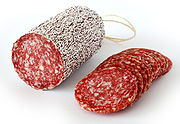
- For the city in Iran, see Salami, IranSalami, IranSalami is a city in and capital of Salami District, Khvaf County, Razavi Khorasan Province, Iran. At the 2006 census, its population was 6,056, in 1,341 families....
; for the district, see Salami DistrictSalami DistrictSalami District is a district in Khvaf County, Razavi Khorasan Province, Iran. At the 2006 census, its population was 29,658, in 6,429 families. The District has one city: Salami....
; for other uses, see SalamaSalamaSalama may refer to:* Fathy Salama, musician* Hannu Salama , Finnish author* Hasan Salama , commander of the Palestinian Holy War Army* Salama al-Khufaji, member of the Interim Iraq Governing Council...
and SalamehSalamehSalameh , may refer to:* Hassan Salameh, killed fighting the Israelis in 1948* Ali Hassan Salameh , Palestinian chief of operations for the Black September organization...
; for the broader term "Salumi", see CharcuterieCharcuterieCharcuterie is the branch of cooking devoted to prepared meat products such as bacon, ham, sausage, terrines, galantines, pâtés, and confit, primarily from pork. Charcuterie is part of the garde manger chef's repertoire...
.
Salami is cured
Curing (food preservation)
Curing refers to various food preservation and flavoring processes, especially of meat or fish, by the addition of a combination of salt, nitrates, nitrite or sugar. Many curing processes also involve smoking, the process of flavoring, or cooking...
sausage
Sausage
A sausage is a food usually made from ground meat , mixed with salt, herbs, and other spices, although vegetarian sausages are available. The word sausage is derived from Old French saussiche, from the Latin word salsus, meaning salted.Typically, a sausage is formed in a casing traditionally made...
, fermented
Fermentation (food)
Fermentation in food processing typically is the conversion of carbohydrates to alcohols and carbon dioxide or organic acids using yeasts, bacteria, or a combination thereof, under anaerobic conditions. Fermentation in simple terms is the chemical conversion of sugars into ethanol...
and air-dried meat, originating from one of a variety of animals. Historically, salami has been popular among Southern European peasant
Peasant
A peasant is an agricultural worker who generally tend to be poor and homeless-Etymology:The word is derived from 15th century French païsant meaning one from the pays, or countryside, ultimately from the Latin pagus, or outlying administrative district.- Position in society :Peasants typically...
s because it can be stored at room temperature for periods of up to 10 years, supplementing a possibly meager or inconsistent supply of fresh meat. Varieties of salami are traditionally made in Italy, France, Hungary, Germany, Spain, Serbia, Slovenia, Croatia, Czech Republic, Netherlands, Belgium, Luxembourg, Greece, Romania, Macedonia, Bulgaria, Poland and Turkey.
Etymology
The word salami, as currently used in EnglishEnglish language
English is a West Germanic language that arose in the Anglo-Saxon kingdoms of England and spread into what was to become south-east Scotland under the influence of the Anglian medieval kingdom of Northumbria...
, is actually the plural form of the Italian
Italian language
Italian is a Romance language spoken mainly in Europe: Italy, Switzerland, San Marino, Vatican City, by minorities in Malta, Monaco, Croatia, Slovenia, France, Libya, Eritrea, and Somalia, and by immigrant communities in the Americas and Australia...
salame; it is indifferently used as a singular or plural word in English for cured meats in a European, particularly Italian, style. In Romanian, Bulgarian and Turkish it is Salam; in Hungarian it is szalámi; in French it is saucisson.
The word originates from the word Sale (salt) with a termination -ame used in Italian as an indicator of collective nouns; the original meaning was thus all kind of salted (meats). The Italian
Italy
Italy , officially the Italian Republic languages]] under the European Charter for Regional or Minority Languages. In each of these, Italy's official name is as follows:;;;;;;;;), is a unitary parliamentary republic in South-Central Europe. To the north it borders France, Switzerland, Austria and...
tradition of cured meats including several styles, the word salame soon specialised to indicate only the most popular kind, made with ground, salted and spiced meat forced into animal gut with an elongated and thin shape, then left to undergo some kind of fermentation process.
Ingredients of salami
A traditional salame, with its typical marbled appearance, is made from one or more of the following meats:- porkPorkPork is the culinary name for meat from the domestic pig , which is eaten in many countries. It is one of the most commonly consumed meats worldwide, with evidence of pig husbandry dating back to 5000 BC....
, or less commonly, especially in Kosher and HalalHalalHalal is a term designating any object or an action which is permissible to use or engage in, according to Islamic law. The term is used to designate food seen as permissible according to Islamic law...
salami, beefBeefBeef is the culinary name for meat from bovines, especially domestic cattle. Beef can be harvested from cows, bulls, heifers or steers. It is one of the principal meats used in the cuisine of the Middle East , Australia, Argentina, Brazil, Europe and the United States, and is also important in...
(particularly vealVealVeal is the meat of young cattle , as opposed to meat from older cattle. Though veal can be produced from a calf of either sex and any breed, most veal comes from male calves of dairy cattle breeds...
), venisonVenisonVenison is the meat of a game animal, especially a deer but also other animals such as antelope, wild boar, etc.-Etymology:The word derives from the Latin vēnor...
, poultryPoultryPoultry are domesticated birds kept by humans for the purpose of producing eggs, meat, and/or feathers. These most typically are members of the superorder Galloanserae , especially the order Galliformes and the family Anatidae , commonly known as "waterfowl"...
(mostly turkeyTurkey (bird)A turkey is a large bird in the genus Meleagris. One species, Meleagris gallopavo, commonly known as the Wild Turkey, is native to the forests of North America. The domestic turkey is a descendant of this species...
because of dietary limitations, but also gooseGooseThe word goose is the English name for a group of waterfowl, belonging to the family Anatidae. This family also includes swans, most of which are larger than true geese, and ducks, which are smaller....
salami is traditional in some areas of Northern Italy), and horseHorse meatHorse meat is the culinary name for meat cut from a horse. It is a major meat in only a few countries, notably in Central Asia, but it forms a significant part of the culinary traditions of many others, from Europe to South America to Asia. The top eight countries consume about 4.7 million horses...
, also swordfish and sometimes shark in southern parts of Japan.
Additional ingredients may include:
- saltSaltIn chemistry, salts are ionic compounds that result from the neutralization reaction of an acid and a base. They are composed of cations and anions so that the product is electrically neutral...
- spices, usually white pepperWhite Pepper-Singles:* "Even If You Don't" was released as a single on Mushroom Records with the B-side "Cornbread Red".* "Stay Forever" was released as a single on Mushroom Records with "The Grobe" and "Who Dat?"-Musicians featured on the record:* Dean Ween* Gene Ween...
- garlicGarlicAllium sativum, commonly known as garlic, is a species in the onion genus, Allium. Its close relatives include the onion, shallot, leek, chive, and rakkyo. Dating back over 6,000 years, garlic is native to central Asia, and has long been a staple in the Mediterranean region, as well as a frequent...
- minced fat
- wineWineWine is an alcoholic beverage, made of fermented fruit juice, usually from grapes. The natural chemical balance of grapes lets them ferment without the addition of sugars, acids, enzymes, or other nutrients. Grape wine is produced by fermenting crushed grapes using various types of yeast. Yeast...
- various herbHerbExcept in botanical usage, an herb is "any plant with leaves, seeds, or flowers used for flavoring, food, medicine, or perfume" or "a part of such a plant as used in cooking"...
s - vinegar
The raw meat mixture is usually allowed to ferment for a day, then the mixture is either stuffed into an edible natural
Intestine
In human anatomy, the intestine is the segment of the alimentary canal extending from the pyloric sphincter of the stomach to the anus and, in humans and other mammals, consists of two segments, the small intestine and the large intestine...
or inedible cellulose
Paper
Paper is a thin material mainly used for writing upon, printing upon, drawing or for packaging. It is produced by pressing together moist fibers, typically cellulose pulp derived from wood, rags or grasses, and drying them into flexible sheets....
casing and hung to cure. Heat treatment to about 104°F (40 °C) may be used to accelerate further fermentation and start the drying process. Higher temperatures (about 140°F (60 °C)) are used to stop the fermentation when the desired pH is reached, but the product is not fully cooked (167°F (75 °C) or higher). The casings are often treated with an edible mold
Mold
Molds are fungi that grow in the form of multicellular filaments called hyphae. Molds are not considered to be microbes but microscopic fungi that grow as single cells called yeasts...
(Penicillium
Penicillium
Penicillium is a genus of ascomycetous fungi of major importance in the natural environment as well as food and drug production. Members of the genus produce penicillin, a molecule that is used as an antibiotic, which kills or stops the growth of certain kinds of bacteria inside the body...
) culture as well. The mold is desired as it imparts flavor and prevents spoilage during the curing process.
Varieties of salami
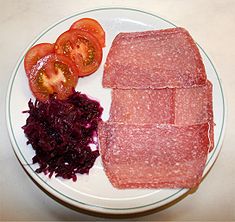
- CacciatoreCacciatoreCacciatore means "hunter" in Italian. In cuisine, "alla cacciatora" refers to a meal prepared "hunter-style" with tomatoes, onions, mushrooms, herbs, often bell pepper, and sometimes wine. Cacciatore is popularly made with braised chicken or rabbit...
(Cacciatora, Cacciatorini) "Hunter" salami. Italy. - Spegepølse (Danish, means salted and dried sausage)
- Milanese
- GenoveseGenoa salamiThe original Genoese sausage is the salame genovese di Sant'Olcese, which is a "prodotto agroalimentare tradizionale" , and originates in the hilly interior of its province where pigs could be easily maintained on acorns, chestnuts, and hazelnuts of the local Mediterranean woodlands.Genoa salami is...
- Fegatelli
- Felino, Province of Parma
- Finocchiona, typical of southern TuscanyTuscanyTuscany is a region in Italy. It has an area of about 23,000 square kilometres and a population of about 3.75 million inhabitants. The regional capital is Florence ....
- PepperoniPepperoniPepperoni is a spicy Italian-American variety of salami usually made from cured pork and beef, but poultry may be added, if labeled correctly, for less expensive versions. Pepperoni is characteristically soft, slightly smoky, and bright red in color...
- SopressataSopressataSoppressata is an Italian cured dry salami. Two principal types are made, a cured dry sausage typical of Basilicata, Apulia and Calabria, the other, a very different uncured salami, native to Tuscany and Liguria. Each of these varieties qualifies for prodotto agroalimentare tradizionale P.A.T....
, typical of CalabriaCalabriaCalabria , in antiquity known as Bruttium, is a region in southern Italy, south of Naples, located at the "toe" of the Italian Peninsula. The capital city of Calabria is Catanzaro.... - CiauscoloCiauscoloCiauscolo is a variety of Italian salame, typical of the Marche region , although it is also widely used in nearby Umbria .Ciauscolo is a smoked and dry-cured sausage, made from pork meat and fat cut from the shoulder...
, typical of MarcheMarcheThe population density in the region is below the national average. In 2008, it was 161.5 inhabitants per km2, compared to the national figure of 198.8. It is highest in the province of Ancona , and lowest in the province of Macerata... - NdujaNduja'Nduja is a spicy spreadable sausage made with pork. It is typically made with parts of the pig such as the shoulder, belly and jowl as well as tripe, roasted peppers and a mixture of spices...
- Saucisson sec (French "dry sausage")
- Winter salamiWinter salamiWinter salami is a type of Hungarian salami based on a centuries old producing tradition. Made from mangalitsa pork and spices: white pepper, allspice and others. Winter salami is cured in cold air and smoked slowly...
(Hungarian Téli Szalámi) - GermanGermanyGermany , officially the Federal Republic of Germany , is a federal parliamentary republic in Europe. The country consists of 16 states while the capital and largest city is Berlin. Germany covers an area of 357,021 km2 and has a largely temperate seasonal climate...
Salami
Many Old World
Old World
The Old World consists of those parts of the world known to classical antiquity and the European Middle Ages. It is used in the context of, and contrast with, the "New World" ....
salami are named after the region or country of their origin. Examples include Arles
Arles
Arles is a city and commune in the south of France, in the Bouches-du-Rhône department, of which it is a subprefecture, in the former province of Provence....
, Genoa
Genoa
Genoa |Ligurian]] Zena ; Latin and, archaically, English Genua) is a city and an important seaport in northern Italy, the capital of the Province of Genoa and of the region of Liguria....
, Hungarian
Hungary
Hungary , officially the Republic of Hungary , is a landlocked country in Central Europe. It is situated in the Carpathian Basin and is bordered by Slovakia to the north, Ukraine and Romania to the east, Serbia and Croatia to the south, Slovenia to the southwest and Austria to the west. The...
and Milan
Milan
Milan is the second-largest city in Italy and the capital city of the region of Lombardy and of the province of Milan. The city proper has a population of about 1.3 million, while its urban area, roughly coinciding with its administrative province and the bordering Province of Monza and Brianza ,...
o salame. Many are flavored with garlic. Some types – including a few varieties from Spain
Spain
Spain , officially the Kingdom of Spain languages]] under the European Charter for Regional or Minority Languages. In each of these, Spain's official name is as follows:;;;;;;), is a country and member state of the European Union located in southwestern Europe on the Iberian Peninsula...
, most Hungarian types (Pick salami), and southern Italian styles (such as those from Naples
Naples
Naples is a city in Southern Italy, situated on the country's west coast by the Gulf of Naples. Lying between two notable volcanic regions, Mount Vesuvius and the Phlegraean Fields, it is the capital of the region of Campania and of the province of Naples...
, which in turn originated American pepperoni
Pepperoni
Pepperoni is a spicy Italian-American variety of salami usually made from cured pork and beef, but poultry may be added, if labeled correctly, for less expensive versions. Pepperoni is characteristically soft, slightly smoky, and bright red in color...
) include paprika
Paprika
Paprika is a spice made from the grinding of dried fruits of Capsicum annuum . In many European languages, the word paprika refers to bell peppers themselves. The seasoning is used in many cuisines to add color and flavor to dishes. Paprika can range from mild to hot...
or chili powder. Varieties are also differentiated by the coarseness or fineness of the chopped meat as well as the size and style of the casing used.
In the United States, traditional salami are either imported or referred to as an "Italian Salame", the protected term for salami made in the United States.
Manufacturing process
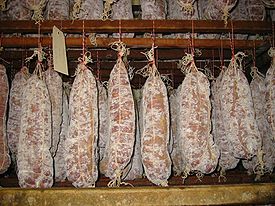
Curing (food preservation)
Curing refers to various food preservation and flavoring processes, especially of meat or fish, by the addition of a combination of salt, nitrates, nitrite or sugar. Many curing processes also involve smoking, the process of flavoring, or cooking...
. The term salame cotto refers to salami cooked or smoked before or after curing and it is typical of Piedmont
Piedmont
Piedmont is one of the 20 regions of Italy. It has an area of 25,402 square kilometres and a population of about 4.4 million. The capital of Piedmont is Turin. The main local language is Piedmontese. Occitan is also spoken by a minority in the Occitan Valleys situated in the Provinces of...
region in Italy
Italy
Italy , officially the Italian Republic languages]] under the European Charter for Regional or Minority Languages. In each of these, Italy's official name is as follows:;;;;;;;;), is a unitary parliamentary republic in South-Central Europe. To the north it borders France, Switzerland, Austria and...
. This is done to impart a specific flavor but not to cook the meat. Before curing, a cotto salame is still considered raw and is not ready to be eaten.
Salami are cured in warm, humid conditions to encourage growth of the bacteria involved in the fermentation process. Sugars (usually dextrose) are added as a food source for the bacteria during the curing process, although it tends not to be added to horse meat because of the latter's naturally high levels of glycogen
Glycogen
Glycogen is a molecule that serves as the secondary long-term energy storage in animal and fungal cells, with the primary energy stores being held in adipose tissue...
. Lactic acid is produced by the bacteria as a waste product, lowering the pH and coagulating and lowering the water-holding capacity of the meat. The acid produced by the bacteria makes the meat an inhospitable environment for other, pathogenic bacteria and imparts a tangy flavor that distinguishes salami from machine-dried pork. The flavor of a salami relies just as much on how these bacteria are cultivated as it does on quality and variety of other ingredients. Originally, the bacteria were introduced into the meat mixture with wine, which contains other types of beneficial bacteria; now, starter cultures are used. The whole process takes about 36 weeks, although some age it more for additional taste, and some can cut it down to about 24 weeks for a sweeter taste.
The drying and curing process is determined by the climate of the curing environment and the size and style of casing. After fermentation, the sausage has to be dried. This changes the casings from being water-permeable to being reasonably airtight. A white covering of either mold or flour helps prevent the photo-oxidation of the meat and rancidity in the fat.
Nitrate
Nitrate
The nitrate ion is a polyatomic ion with the molecular formula NO and a molecular mass of 62.0049 g/mol. It is the conjugate base of nitric acid, consisting of one central nitrogen atom surrounded by three identically-bonded oxygen atoms in a trigonal planar arrangement. The nitrate ion carries a...
s or nitrite
Nitrite
The nitrite ion has the chemical formula NO2−. The anion is symmetric with equal N-O bond lengths and a O-N-O bond angle of ca. 120°. On protonation the unstable weak acid nitrous acid is produced. Nitrite can be oxidised or reduced, with product somewhat dependent on the oxidizing/reducing agent...
s are added to provide the cured meat color and inhibit growth of harmful bacteria from the genus Clostridium
Clostridium
Clostridium is a genus of Gram-positive bacteria, belonging to the Firmicutes. They are obligate anaerobes capable of producing endospores. Individual cells are rod-shaped, which gives them their name, from the Greek kloster or spindle...
. Salt, acidity, nitrate/nitrite levels and dryness of the fully cured salami combine to make the uncooked meat safe to consume.
It is important that high quality, fresh ingredients are used; otherwise, deadly microrganisms and toxins can develop.
See also
- Bologna sausageBologna sausageBologna sausage is an American sausage derived from and definitely not similar to the Italian mortadella . It is commonly called boloney, baloney or, more formally, bologna...
- CharcuterieCharcuterieCharcuterie is the branch of cooking devoted to prepared meat products such as bacon, ham, sausage, terrines, galantines, pâtés, and confit, primarily from pork. Charcuterie is part of the garde manger chef's repertoire...
(Salumi in Italian; this term refers to prepared meat products generally. Salami is one example, and is not a variant spelling of "salumi".) - PastramiPastramiPastrami , is a popular delicatessen meat usually made from beef and, traditionally in Romania, also from pork and mutton. In Israel, "Pastrama" is the term used for sliced chicken and turkey. Like corned beef, pastrami was originally created as a way to preserve meat before modern refrigeration...
Further reading
- Jim Bacus "Utilization of Microorganisms in Meat Processing - a handbook for meat plant operators", Research Studies Press
- Campbell-Platt, G and Cook, P. (Eds) (1995) "Fermented Meats", Blackie Academic and Professional, Glasgow
- Darby W.J et al. "Food: the gift of Osiris", London 1977
- Gou P. et al. "Potassium Chloride, Potassium lactate & Glycine as Sodium Chloride substitutes in fermented sausages & in dry cured pork loin", Meat Science vol 42 nol p37-48 1996