
Home      Discussion      Topics      Dictionary      Almanac
Signup       Login
Penicillium

Penicillium

Discussion
Ask a question about 'Penicillium'
Start a new discussion about 'Penicillium'
Answer questions from other users
Full Discussion Forum
 
Encyclopedia
Penicillium (from Latin penicillus: paintbrush) is a genus
Genus
In biology, a genus is a taxonomic unit used in the classification of living and fossil organisms. The term comes from Latin genus "descent, family, type, gender" , cognate with – genos, "race, stock, kin" ..In addition, genus is a taxonomic rank in the hierarchy In biology, a genus (plural:...

 of ascomycetous fungi of major importance in the environment, food and drug production. It is a form of antibiotic, this means that it kills or stops the growth of a bacterium inside the body.

Characteristics


The thallus , (mycelium
Mycelium
thumb|right|Fungal myceliaMycelium is the vegetative part of a fungus, consisting of a mass of branching, thread-like hyphae. The mass of hyphae is sometimes called shiro, especially within the fairy ring fungi. Fungal colonies composed of mycelia are found in soil and on or in many other substrates...

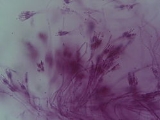
) typically consists of a highly branched network of multinucleate, septate, usually colorless hyphae. Many-branched conidiophores sprout on the mycelia, bearing individually constricted conidiospores. The conidiospores, are the main dispersal route of the fungi, and often green.

Sexual reproduction involves the production of ascospore
Ascospore
An ascospore is a spore contained in an ascus or that was produced inside an ascus. This kind of spore is specific to fungi classified as ascomycetes ....

s, commencing with the fusion of an ascogonium and an antheridium
Antheridium
An antheridium is a haploid structure or organ producing and containing male gametes . It is present in the gametophyte phase of lower plants like mosses and ferns, and also in the primitive vascular psilotophytes...

, with sharing of nuclei. The irrregularly distributed asci
Ascus
An ascus is the sexual spore-bearing cell produced in ascomycete fungi. On average, asci normally contain 8 ascospores, produced by a meiotic cell division followed, in most species, by a mitotic cell division. However, asci in some genera or species can number 1 , 2, 4, or multiples of four...

 contain eight unicellular ascospores each.

Ecology


Species of Penicillium are ubiquitous soil fungi preferring cool and moderate climates, commonly present wherever organic material is available. Saprophytic species of Penicillium and Aspergillus
Aspergillus
Aspergillus is a genus of a few hundred molds found throughout much of nature worldwide. Aspergillus was first catalogued in 1729 by the Italian priest and biologist Pier Antonio Micheli. Viewing the fungi under a microscope, Micheli was reminded of the shape of an aspergillum , and named the genus...

 are among the best-known representatives of the Eurotiales
Eurotiales
The Eurotiales are an order of sac fungi, also known as the green and blue molds....

 and live mainly on organic biodegradable substances. They are commonly known as moulds and are among the main causes of food spoilage. Many species produce highly toxic mycotoxin
Mycotoxin
A mycotoxin is a toxic secondary metabolite produced by an organism of the fungus kingdom, including mushrooms, molds, and yeasts. The term 'mycotoxin' is usually reserved for the toxic chemical products produced by fungi that readily colonize crops...

s.

Economic value


Several species of Penicillium play a central role in the production of cheese and of various meat products. Penicillium camemberti
Penicillium camemberti
Penicillium camemberti is a species of fungus used in the production of Camembert and Brie cheeses, on which colonies of P. camemberti form a hard, white crust. It is responsible for giving these cheeses their distinctive taste.- Synonyms :...

 and Penicillium roqueforti
Penicillium roqueforti
Penicillium roqueforti is a common saprotrophic fungus from the family Trichocomaceae. Widespread in nature, it can be isolated from soil, decaying organic matter, and plants. The major industrial use of this fungus is the production of blue cheeses, flavoring agents, antifungals, polysaccharides,...

 are the moulds on Camembert
Camembert
Camembert is a commune in the Orne department in north-western France.It is most famous as the place where camembert cheese originated.Camembert has been called "The largest small village in France." This is because the area of the commune itself is out of proportion to the center of the village...

, Brie
Brie
Brie is a historic region of France most famous for its dairy products, especially Brie cheese. It was once divided into two sections ruled by different feudal lords: the western Brie française, corresponding roughly to the modern département of Seine-et-Marne in the Île-de-France région; and the...

, Roquefort and many other cheeses. Penicillium nalgiovense is used to improve the taste of sausages and hams and to prevent colonization by other moulds and bacteria.

In addition to their importance in the food industry, species of Penicillium and Aspergillus serve in the production of a number of biotechnologally produced enzymes and other macromolecules, such as gluconic, citric and tartaric acids, as well as several pectinases, lipase , amylases, cellulases and proteases.

Most importantly, they are the source of major antibiotics , particularly penicillin and griseofulvin.

Some species


  • Penicillium bilaiae
    Penicillium bilaiae
    Penicillium bilaiae is a species of native soil fungus which can be used as a PGPM . R. Kucey first identified that organic acids excreted by the microorganism can solubilize soil-bound phosphate...

    , which is an agricultural inoculant.
  • Penicillium camemberti
    Penicillium camemberti
    Penicillium camemberti is a species of fungus used in the production of Camembert and Brie cheeses, on which colonies of P. camemberti form a hard, white crust. It is responsible for giving these cheeses their distinctive taste.- Synonyms :...

    , which is used in the production of Camembert
    Camembert (cheese)
    Camembert is a soft, creamy French cheese. It was first made in the late 18th century in Normandy in northern France.-Production:Camembert is made from unpasteurised cows' milk, and is ripened by the moulds Penicillium candidum and Penicillium camemberti for at least three weeks...

     and Brie cheese
    Cheese
    Cheese is a food consisting of proteins and fat from milk, usually the milk of cows, buffalo, goats, or sheep. It is produced by coagulation of the milk protein casein. Typically, the milk is acidified and addition of the enzyme rennet causes coagulation. The solids are separated and pressed into...

    s.
  • Penicillium candidum, which is used in making Brie and Camembert. It has been reduced to synonymy with Penicillium camemberti.
  • Penicillium chrysogenum
    Penicillium chrysogenum
    Penicillium chrysogenum is a mold that is widely distributed in nature, and is often found living on foods and in indoor environments. It was previously known as Penicillium notatum. It has rarely been reported as a cause of human disease. It is the source of several β-lactam antibiotics, most...

    (previously known as Penicillium notatum), which produces the antibiotic
    Antibiotic
    In common usage, an antibiotic is a substance or compound that kills or inhibits the growth of bacteria...

     penicillin
    Penicillin
    Penicillin is a group of antibiotics derived from Penicillium fungi. Penicillin antibiotics are historically significant because they are the first drugs that were effective against many previously serious diseases such as syphilis and Staphylococcus infections...

    .
  • Penicillium claviforme
    Penicillium claviforme
    Penicillium claviforme is a species of Penicillium within the phylum Ascomycota.*Is found within the subgenus Terverticillium.*Has a coremium-type morphology in the sexual structures, named for its resemblance to matchsticks....

  • Penicillium commune
  • Penicillium crustosum
    Penicillium crustosum
    Penicillium crustosum is a species of Penicillium, within the phylum Ascomycota.*This is the most complex penicillus.*The end of each conidiophore has clusters of 2 or more branches , each supporting a cluster of conideogenous cells called phialides.*Can tolerate low temperatures ; as well as low...

  • Penicillium funiculosum
    Penicillium funiculosum
    Penicillium funiculosum is a plant pathogen.-External links:**...

  • Penicillium glaucum
    Penicillium glaucum
    Penicillium glaucum is a mold which is used in the making of many types of cheese including the French blue cheeses, Fourme d'Ambert, Gorgonzola, and Stilton....

  • Penicillium expansum
    Penicillium expansum
    Penicillium expansum is a plant pathogen. It is a blue-colored mold responsible for the postharvest decay of stored apples. This mold also produces the carcinogenic metabolite patulin.- External links :*
    *...

    , a plant pathogen.
  • Penicillium funiculosum
    Penicillium funiculosum
    Penicillium funiculosum is a plant pathogen.-External links:**...

    , a plant pathogen.
  • Penicillium glaucum
    Penicillium glaucum
    Penicillium glaucum is a mold which is used in the making of many types of cheese including the French blue cheeses, Fourme d'Ambert, Gorgonzola, and Stilton....

    , which is used in making Gorgonzola cheese.
  • Penicillium lacussarmientei
  • Penicillium marneffei
    Penicillium marneffei
    Penicillium species are usually regarded as unimportant in terms of causing human disease. Penicillium marneffei, discovered in 1956, is different...

    , a thermally dimorphic
    Thermally dimorphic fungus
    Dimorphic fungi are fungi that can reproduce as either a mycelial or a yeast-like state. Generally the mycelial saprotrophic form grows at 25° C, and the yeast-like pathogenic form at 37° C...

     species endemic in Southeast Asia
    Southeast Asia
    Manila
    Bangkok
    Ho Chi Minh City
    Kuala Lumpur
    Singapore
    Yangon
    Bandung
    Hanoi
    Surabaya
    Taichung
    Kaohsiung
    Medan|-|}...

    , which presents a threat of systemic infection
    Systemic infection
    Systemic infection is a generic term for infection caused by microorganisms in animals or plants, where the causal agent has spread actively or passively in the host's anatomy and is disseminated throughout several organs in different systems of the host...

     to AIDS
    AIDS
    Acquired immune deficiency syndrome or acquired immunodeficiency syndrome is a disease of the human immune system caused by the human immunodeficiency virus ....

     patients.
  • Penicillium purpurogenum
    Penicillium purpurogenum
    Penicillium purpurogenum is a plant pathogen.- External links :* *...

  • Penicillium roqueforti
    Penicillium roqueforti
    Penicillium roqueforti is a common saprotrophic fungus from the family Trichocomaceae. Widespread in nature, it can be isolated from soil, decaying organic matter, and plants. The major industrial use of this fungus is the production of blue cheeses, flavoring agents, antifungals, polysaccharides,...

    , which is used in making Roquefort, Danish Blue cheese
    Danish Blue cheese
    Danish Blue cheese, also known as Danablu if it is made in Denmark, is a light, blue-veined cheese. This semi-soft creamery cheese is typically drum or block shaped and has a white to yellowish, slightly moist, edible rind...

     and also recently Gorgonzola.
  • Penicillium stoloniferum
  • Penicillium verrucosum produces ochratoxin A
    Ochratoxin A
    Ochratoxin A, a toxin produced by Aspergillus ochraceus and Penicillium verrucosum, is one of the most abundant food-contaminating mycotoxins in the world. Human exposure occurs mainly through consumption of improperly stored food products, particularly contaminated grain and pork products, as well...

  • Penicillium viridicatum produces ochratoxin
    Ochratoxin
    Ochratoxin A, B, and C are mycotoxins produced by some Aspergillus species and Penicillium species, like Aspergillus ochraceus or Penicillium viridicatum, with ochratoxin A as the most prevalent and relevant fungal toxin of this group....


External links