

Pre-Socratic philosophy

Encyclopedia
Pre-Socratic philosophy is Greek philosophy
before Socrates
(but includes schools contemporary with Socrates which were not influenced by him). In Classical antiquity
, the Presocratic philosophers were called physiologoi (in English, physical or natural philosophers). Diogenes Laërtius
divides the physiologoi into two groups, Ionian
and Italiote
, led by Anaximander
and Pythagoras
, respectively.
Hermann Diels popularized the term pre-socratic in Die Fragmente der Vorsokratiker (The Fragments of the Pre-Socratics) in 1903. However, the term pre-Sokratic was in use as early as George Grote
's Plato and the Other Companions of Sokrates in 1865. Major analyses of pre-Socratic thought have been made by Gregory Vlastos
, Jonathan Barnes
, and Friedrich Nietzsche
in his Philosophy in the Tragic Age of the Greeks
.
It may sometimes be difficult to determine the actual line of argument some Presocratics used in supporting their particular views. While most of them produced significant texts, none of the texts has survived in complete form. All that is available are quotations by later philosophers (often biased) and historians, and the occasional textual fragment.
The Presocratic philosophers rejected traditional mythological explanations of the phenomena
they saw around them in favor of more rational explanations. These philosophers asked questions about "the essence of things":
Others concentrated on defining problems and paradoxes that became the basis for later mathematical, scientific and philosophic study.
Later philosophers rejected many of the answers the early Greek philosophers provided, but continued to place importance on their questions. Furthermore, the cosmologies
proposed by them have been updated by later developments in science
.
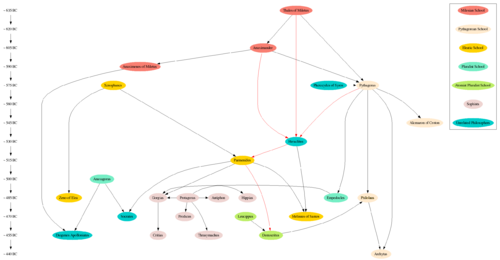 Western philosophy began in ancient Greece in the 6th century BCE. The Presocratics were mostly from the eastern or western fringes of the Greek world. Their efforts were directed to the investigation of the ultimate basis and essential nature of the external world. They sought the material principle (archê
) of things, and the method of their origin and disappearance. As the first philosophers, they emphasized the rational unity of things, and rejected mythological explanations of the world. Only fragments of the original writings of the presocratics survive. The knowledge we have of them derives from accounts of later philosophical writers (especially Aristotle
, Plutarch
, Diogenes Laërtius
, Stobaeus
and Simplicius
), and some early theologians, (especially Clement of Alexandria
and Hippolytus).
Milesian school
The first Presocratic philosophers were from Miletus
on the western coast of Anatolia. Thales
(624-546 BCE) is reputed the father of Greek philosophy; he declared water to be the basis of all things. Next came Anaximander
(610-546 BCE), the first writer on philosophy. He assumed as the first principle an undefined, unlimited substance without qualities, out of which the primary opposites, hot and cold, moist and dry, became differentiated. His younger contemporary, Anaximenes
(585-525 BCE), took for his principle air, conceiving it as modified, by thickening and thinning, into fire, wind, clouds, water, and earth.
Pythagoreanism
The practical side of philosophy was introduced by Pythagoras of Samos
(582-496 BCE). Regarding the world as perfect harmony, dependent on number, he aimed at inducing humankind likewise to lead a harmonious life. His doctrine was adopted and extended by a large following of Pythagoreans who gathered at his school in south Italy
in the town of Croton. His followers included Philolaus
(470-380 BCE), Alcmaeon of Croton
, and Archytas
(428-347 BCE).
Ephesian school
Heraclitus of Ephesus
on the western coast of Anatolia in modern Turkey (535-475 BCE) posited that all things in nature are in a state of perpetual flux, connected by logical structure or pattern, which he termed Logos. To Heraclitus, fire, one of the four classical elements
, motivates and substantiates this eternal pattern. From fire all things originate, and return to it again in a process of eternal cycles.
(570-470 BCE), declared God to be the eternal unity, permeating the universe, and governing it by his thought. Parmenides of Elea
(510-440 BCE), affirmed the one unchanging existence to be alone true and capable of being conceived, and multitude and change to be an appearance without reality. This doctrine was defended by his younger countryman Zeno of Elea
(490-430 BCE) in a polemic against the common opinion which sees in things multitude, becoming, and change. Zeno propounded a number of celebrated paradoxes, much debated by later philosophers, which try to show that supposing that there is any change or multiplicity leads to contradictions. Melissus of Samos
(born c. 470 BCE) was another eminent member of this school.
Pluralist School
Empedocles of Agrigentum
(490-430 BCE) was from the ancient Greek city of Akragas (Ἀκράγας), Agrigentum in Latin, modern Agrigento, in Sicily. He appears to have been partly in agreement with the Eleatic School, partly in opposition to it. On the one hand, he maintained the unchangeable nature of substance; on the other, he supposes a plurality of such substances - i.e. four classical elements, earth, water, air, and fire. Of these the world is built up, by the agency of two ideal motive forces - love as the cause of union, strife as the cause of separation. Anaxagoras of Clazomenae
(500-428 BCE) in Asia Minor, also maintained the existence of an ordering principle as well as a material substance, and while regarding the latter as an infinite multitude of imperishable primary elements; he conceived divine reason or Mind (nous
) as ordering them. He referred all generation and disappearance to mixture and resolution respectively. To him belongs the credit of first establishing philosophy at Athens.
Atomist School
The first explicitly materialistic system was formed by Leucippus
(5th century BCE) and his pupil Democritus of Abdera
(460-370 BCE) from Thrace. This was the doctrine of atoms - small primary bodies infinite in number, indivisible and imperishable, qualitatively similar, but distinguished by their shapes. Moving eternally through the infinite void, they collide and unite, thus generating objects which differ in accordance with the varieties, in number, size, shape, and arrangement, of the atoms which compose them.
, especially the single material principle, which he identified as air. He explained natural processes in reference to the rarefactions and condensations of this primary substance. He also adopted Anaxagoras' cosmic thought.
Sophism
The Sophists held that all thought rests solely on the apprehensions of the senses and on subjective impression, and that therefore we have no other standards of action than convention for the individual. Specializing in rhetoric, the Sophists were more professional educators than philosophers. They flourished as a result of a special need at that time for Greek education. Prominent Sophists include Protagoras
(490-420 BCE) from Abdera in Thrace, Gorgias
(487-376 BCE) from Leontini in Sicily, Hippias
(485-415 BCE) from Elis in the Peloponnesos, and Prodicus
(465-390 BCE) from the island of Ceos.
, who appear to have been practical politicians and sources of epigrammatic wisdom, rather than speculative thinkers or philosophers
in the modern sense.
Greek philosophy
Ancient Greek philosophy arose in the 6th century BCE and continued through the Hellenistic period, at which point Ancient Greece was incorporated in the Roman Empire...
before Socrates
Socrates
Socrates was a classical Greek Athenian philosopher. Credited as one of the founders of Western philosophy, he is an enigmatic figure known chiefly through the accounts of later classical writers, especially the writings of his students Plato and Xenophon, and the plays of his contemporary ...
(but includes schools contemporary with Socrates which were not influenced by him). In Classical antiquity
Classical antiquity
Classical antiquity is a broad term for a long period of cultural history centered on the Mediterranean Sea, comprising the interlocking civilizations of ancient Greece and ancient Rome, collectively known as the Greco-Roman world...
, the Presocratic philosophers were called physiologoi (in English, physical or natural philosophers). Diogenes Laërtius
Diogenes Laertius
Diogenes Laertius was a biographer of the Greek philosophers. Nothing is known about his life, but his surviving Lives and Opinions of Eminent Philosophers is one of the principal surviving sources for the history of Greek philosophy.-Life:Nothing is definitively known about his life...
divides the physiologoi into two groups, Ionian
Ionians
The Ionians were one of the four major tribes into which the Classical Greeks considered the population of Hellenes to have been divided...
and Italiote
Italiotes
The Italiotes were the pre-Roman Greek-speaking inhabitants of the Italian Peninsula, between Naples and Sicily.Greek colonization of the coastal areas of southern Italy and Sicily started in the 8th century BC and, by the time of Roman ascendance, the area was so extensively hellenized that...
, led by Anaximander
Anaximander
Anaximander was a pre-Socratic Greek philosopher who lived in Miletus, a city of Ionia; Milet in modern Turkey. He belonged to the Milesian school and learned the teachings of his master Thales...
and Pythagoras
Pythagoras
Pythagoras of Samos was an Ionian Greek philosopher, mathematician, and founder of the religious movement called Pythagoreanism. Most of the information about Pythagoras was written down centuries after he lived, so very little reliable information is known about him...
, respectively.
Hermann Diels popularized the term pre-socratic in Die Fragmente der Vorsokratiker (The Fragments of the Pre-Socratics) in 1903. However, the term pre-Sokratic was in use as early as George Grote
George Grote
George Grote was an English classical historian, best known in the field for a major work, the voluminous History of Greece, still read.-Early life:He was born at Clay Hill near Beckenham in Kent...
's Plato and the Other Companions of Sokrates in 1865. Major analyses of pre-Socratic thought have been made by Gregory Vlastos
Gregory Vlastos
Gregory Vlastos was a scholar of ancient philosophy, and author of several works on Plato and Socrates. He was also a Christian and has written on Christian faith as well.-Life and works:...
, Jonathan Barnes
Jonathan Barnes
Jonathan Barnes is a British philosopher, translator and historian of ancient philosophy.-Education and career:He was educated at the City of London School and Balliol College, Oxford University....
, and Friedrich Nietzsche
Friedrich Nietzsche
Friedrich Wilhelm Nietzsche was a 19th-century German philosopher, poet, composer and classical philologist...
in his Philosophy in the Tragic Age of the Greeks
Philosophy in the Tragic Age of the Greeks
Philosophy in the Tragic Age of the Greeks is a publication of an incomplete book by Friedrich Nietzsche. He had a clean copy made from his notes with the intention of publication. The notes were written around 1873. In it he discussed five Greek philosophers from the sixth and fifth centuries B.C....
.
It may sometimes be difficult to determine the actual line of argument some Presocratics used in supporting their particular views. While most of them produced significant texts, none of the texts has survived in complete form. All that is available are quotations by later philosophers (often biased) and historians, and the occasional textual fragment.
The Presocratic philosophers rejected traditional mythological explanations of the phenomena
Phenomenon
A phenomenon , plural phenomena, is any observable occurrence. Phenomena are often, but not always, understood as 'appearances' or 'experiences'...
they saw around them in favor of more rational explanations. These philosophers asked questions about "the essence of things":
- From where does everything come?
- From what is everything created?
- How do we explain the plurality of things found in nature?
- How might we describe nature mathematically?
Others concentrated on defining problems and paradoxes that became the basis for later mathematical, scientific and philosophic study.
Later philosophers rejected many of the answers the early Greek philosophers provided, but continued to place importance on their questions. Furthermore, the cosmologies
Cosmology
Cosmology is the discipline that deals with the nature of the Universe as a whole. Cosmologists seek to understand the origin, evolution, structure, and ultimate fate of the Universe at large, as well as the natural laws that keep it in order...
proposed by them have been updated by later developments in science
Science
Science is a systematic enterprise that builds and organizes knowledge in the form of testable explanations and predictions about the universe...
.
History
Arche
Arche is a Greek word with primary senses 'beginning', 'origin' or 'first cause' and 'power', 'sovereignty', 'domination' as extended meanings. This list is extended to 'ultimate underlying substance' and 'ultimate undemonstrable principle'...
) of things, and the method of their origin and disappearance. As the first philosophers, they emphasized the rational unity of things, and rejected mythological explanations of the world. Only fragments of the original writings of the presocratics survive. The knowledge we have of them derives from accounts of later philosophical writers (especially Aristotle
Aristotle
Aristotle was a Greek philosopher and polymath, a student of Plato and teacher of Alexander the Great. His writings cover many subjects, including physics, metaphysics, poetry, theater, music, logic, rhetoric, linguistics, politics, government, ethics, biology, and zoology...
, Plutarch
Plutarch
Plutarch then named, on his becoming a Roman citizen, Lucius Mestrius Plutarchus , c. 46 – 120 AD, was a Greek historian, biographer, essayist, and Middle Platonist known primarily for his Parallel Lives and Moralia...
, Diogenes Laërtius
Diogenes Laertius
Diogenes Laertius was a biographer of the Greek philosophers. Nothing is known about his life, but his surviving Lives and Opinions of Eminent Philosophers is one of the principal surviving sources for the history of Greek philosophy.-Life:Nothing is definitively known about his life...
, Stobaeus
Stobaeus
Joannes Stobaeus , from Stobi in Macedonia, was the compiler of a valuable series of extracts from Greek authors. The work was originally divided into two volumes containing two books each...
and Simplicius
Simplicius of Cilicia
Simplicius of Cilicia, was a disciple of Ammonius Hermiae and Damascius, and was one of the last of the Neoplatonists. He was among the pagan philosophers persecuted by Justinian in the early 6th century, and was forced for a time to seek refuge in the Persian court, before being allowed back into...
), and some early theologians, (especially Clement of Alexandria
Clement of Alexandria
Titus Flavius Clemens , known as Clement of Alexandria , was a Christian theologian and the head of the noted Catechetical School of Alexandria. Clement is best remembered as the teacher of Origen...
and Hippolytus).
Milesian schoolMilesian schoolThe Milesian school was a school of thought founded in the 6th century BC. The ideas associated with it are exemplified by three philosophers from the Ionian town of Miletus, on the Aegean coast of Anatolia: Thales, Anaximander, and Anaximenes...
The first Presocratic philosophers were from MiletusMiletus
Miletus was an ancient Greek city on the western coast of Anatolia , near the mouth of the Maeander River in ancient Caria...
on the western coast of Anatolia. Thales
Thales
Thales of Miletus was a pre-Socratic Greek philosopher from Miletus in Asia Minor, and one of the Seven Sages of Greece. Many, most notably Aristotle, regard him as the first philosopher in the Greek tradition...
(624-546 BCE) is reputed the father of Greek philosophy; he declared water to be the basis of all things. Next came Anaximander
Anaximander
Anaximander was a pre-Socratic Greek philosopher who lived in Miletus, a city of Ionia; Milet in modern Turkey. He belonged to the Milesian school and learned the teachings of his master Thales...
(610-546 BCE), the first writer on philosophy. He assumed as the first principle an undefined, unlimited substance without qualities, out of which the primary opposites, hot and cold, moist and dry, became differentiated. His younger contemporary, Anaximenes
Anaximenes of Miletus
Anaximenes of Miletus was an Archaic Greek Pre-Socratic philosopher active in the latter half of the 6th century BC. One of the three Milesian philosophers, he is identified as a younger friend or student of Anaximander. Anaximenes, like others in his school of thought, practiced material monism...
(585-525 BCE), took for his principle air, conceiving it as modified, by thickening and thinning, into fire, wind, clouds, water, and earth.
PythagoreanismPythagoreanismPythagoreanism was the system of esoteric and metaphysical beliefs held by Pythagoras and his followers, the Pythagoreans, who were considerably influenced by mathematics. Pythagoreanism originated in the 5th century BCE and greatly influenced Platonism...
The practical side of philosophy was introduced by Pythagoras of SamosPythagoras
Pythagoras of Samos was an Ionian Greek philosopher, mathematician, and founder of the religious movement called Pythagoreanism. Most of the information about Pythagoras was written down centuries after he lived, so very little reliable information is known about him...
(582-496 BCE). Regarding the world as perfect harmony, dependent on number, he aimed at inducing humankind likewise to lead a harmonious life. His doctrine was adopted and extended by a large following of Pythagoreans who gathered at his school in south Italy
Italy
Italy , officially the Italian Republic languages]] under the European Charter for Regional or Minority Languages. In each of these, Italy's official name is as follows:;;;;;;;;), is a unitary parliamentary republic in South-Central Europe. To the north it borders France, Switzerland, Austria and...
in the town of Croton. His followers included Philolaus
Philolaus
Philolaus was a Greek Pythagorean and Presocratic philosopher. He argued that all matter is composed of limiting and limitless things, and that the universe is determined by numbers. He is credited with originating the theory that the earth was not the center of the universe.-Life:Philolaus is...
(470-380 BCE), Alcmaeon of Croton
Alcmaeon of Croton
Alcmaeon of Croton was one of the most eminent natural philosophers and medical theorists of antiquity. His father's name was Peirithus . He is said by some to have been a pupil of Pythagoras, and he may have been born around 510 BC...
, and Archytas
Archytas
Archytas was an Ancient Greek philosopher, mathematician, astronomer, statesman, and strategist. He was a scientist of the Pythagorean school and famous for being the reputed founder of mathematical mechanics, as well as a good friend of Plato....
(428-347 BCE).
Ephesian schoolEphesian SchoolEphesian school sometimes refers to the philosophical thought of the ancient Greek philosopher Heraclitus of Ephesus, who considered that the being of all the universe is fire. According to him, the being is material and one, but at the same time he acknowledges that the world witnesses constant...
Heraclitus of EphesusHeraclitus
Heraclitus of Ephesus was a pre-Socratic Greek philosopher, a native of the Greek city Ephesus, Ionia, on the coast of Asia Minor. He was of distinguished parentage. Little is known about his early life and education, but he regarded himself as self-taught and a pioneer of wisdom...
on the western coast of Anatolia in modern Turkey (535-475 BCE) posited that all things in nature are in a state of perpetual flux, connected by logical structure or pattern, which he termed Logos. To Heraclitus, fire, one of the four classical elements
Classical element
Many philosophies and worldviews have a set of classical elements believed to reflect the simplest essential parts and principles of which anything consists or upon which the constitution and fundamental powers of anything are based. Most frequently, classical elements refer to ancient beliefs...
, motivates and substantiates this eternal pattern. From fire all things originate, and return to it again in a process of eternal cycles.
Eleatic School
The Eleatic School, called after the town of Elea (modern name Velia in south Italy), emphasized the doctrine of the One. Xenophanes of ColophonXenophanes
of Colophon was a Greek philosopher, theologian, poet, and social and religious critic. Xenophanes life was one of travel, having left Ionia at the age of 25 he continued to travel throughout the Greek world for another 67 years. Some scholars say he lived in exile in Siciliy...
(570-470 BCE), declared God to be the eternal unity, permeating the universe, and governing it by his thought. Parmenides of Elea
Parmenides
Parmenides of Elea was an ancient Greek philosopher born in Elea, a Greek city on the southern coast of Italy. He was the founder of the Eleatic school of philosophy. The single known work of Parmenides is a poem, On Nature, which has survived only in fragmentary form. In this poem, Parmenides...
(510-440 BCE), affirmed the one unchanging existence to be alone true and capable of being conceived, and multitude and change to be an appearance without reality. This doctrine was defended by his younger countryman Zeno of Elea
Zeno of Elea
Zeno of Elea was a pre-Socratic Greek philosopher of southern Italy and a member of the Eleatic School founded by Parmenides. Aristotle called him the inventor of the dialectic. He is best known for his paradoxes, which Bertrand Russell has described as "immeasurably subtle and profound".- Life...
(490-430 BCE) in a polemic against the common opinion which sees in things multitude, becoming, and change. Zeno propounded a number of celebrated paradoxes, much debated by later philosophers, which try to show that supposing that there is any change or multiplicity leads to contradictions. Melissus of Samos
Melissus
Melissus may refer to:People:* Melissus of Samos , Greek philosopher* Melissus of Thebes, Greek athlete contrasted to Orion by Pindar* Gaius Maecenas Melissus, , Roman writerOther:...
(born c. 470 BCE) was another eminent member of this school.
Pluralist SchoolPluralist SchoolThe Pluralist School was a school of pre-Socratic philosophers who attempted to reconcile Parmenides' rejection of change with the apparently changing world of sense experience. The school consisted of Anaxagoras, Archelaus, and Empedocles. It can also be said to have included the Atomists,...
Empedocles of AgrigentumEmpedocles
Empedocles was a Greek pre-Socratic philosopher and a citizen of Agrigentum, a Greek city in Sicily. Empedocles' philosophy is best known for being the originator of the cosmogenic theory of the four Classical elements...
(490-430 BCE) was from the ancient Greek city of Akragas (Ἀκράγας), Agrigentum in Latin, modern Agrigento, in Sicily. He appears to have been partly in agreement with the Eleatic School, partly in opposition to it. On the one hand, he maintained the unchangeable nature of substance; on the other, he supposes a plurality of such substances - i.e. four classical elements, earth, water, air, and fire. Of these the world is built up, by the agency of two ideal motive forces - love as the cause of union, strife as the cause of separation. Anaxagoras of Clazomenae
Anaxagoras
Anaxagoras was a Pre-Socratic Greek philosopher. Born in Clazomenae in Asia Minor, Anaxagoras was the first philosopher to bring philosophy from Ionia to Athens. He attempted to give a scientific account of eclipses, meteors, rainbows, and the sun, which he described as a fiery mass larger than...
(500-428 BCE) in Asia Minor, also maintained the existence of an ordering principle as well as a material substance, and while regarding the latter as an infinite multitude of imperishable primary elements; he conceived divine reason or Mind (nous
Nous
Nous , also called intellect or intelligence, is a philosophical term for the faculty of the human mind which is described in classical philosophy as necessary for understanding what is true or real, very close in meaning to intuition...
) as ordering them. He referred all generation and disappearance to mixture and resolution respectively. To him belongs the credit of first establishing philosophy at Athens.
Atomist SchoolAtomismAtomism is a natural philosophy that developed in several ancient traditions. The atomists theorized that the natural world consists of two fundamental parts: indivisible atoms and empty void.According to Aristotle, atoms are indestructible and immutable and there are an infinite variety of shapes...
The first explicitly materialistic system was formed by LeucippusLeucippus
Leucippus or Leukippos was one of the earliest Greeks to develop the theory of atomism — the idea that everything is composed entirely of various imperishable, indivisible elements called atoms — which was elaborated in greater detail by his pupil and successor, Democritus...
(5th century BCE) and his pupil Democritus of Abdera
Democritus
Democritus was an Ancient Greek philosopher born in Abdera, Thrace, Greece. He was an influential pre-Socratic philosopher and pupil of Leucippus, who formulated an atomic theory for the cosmos....
(460-370 BCE) from Thrace. This was the doctrine of atoms - small primary bodies infinite in number, indivisible and imperishable, qualitatively similar, but distinguished by their shapes. Moving eternally through the infinite void, they collide and unite, thus generating objects which differ in accordance with the varieties, in number, size, shape, and arrangement, of the atoms which compose them.
Others
The last of the Presocratic natural philosophers was Diogenes of Apollonia from Thrace (born c. 460 BCE). He was an eclectic philosopher who adopted many principles of the Milesian schoolMilesian school
The Milesian school was a school of thought founded in the 6th century BC. The ideas associated with it are exemplified by three philosophers from the Ionian town of Miletus, on the Aegean coast of Anatolia: Thales, Anaximander, and Anaximenes...
, especially the single material principle, which he identified as air. He explained natural processes in reference to the rarefactions and condensations of this primary substance. He also adopted Anaxagoras' cosmic thought.
SophismSophismSophism in the modern definition is a specious argument used for deceiving someone. In ancient Greece, sophists were a category of teachers who specialized in using the tools of philosophy and rhetoric for the purpose of teaching aretê — excellence, or virtue — predominantly to young statesmen and...
The Sophists held that all thought rests solely on the apprehensions of the senses and on subjective impression, and that therefore we have no other standards of action than convention for the individual. Specializing in rhetoric, the Sophists were more professional educators than philosophers. They flourished as a result of a special need at that time for Greek education. Prominent Sophists include ProtagorasProtagoras
Protagoras was a pre-Socratic Greek philosopher and is numbered as one of the sophists by Plato. In his dialogue Protagoras, Plato credits him with having invented the role of the professional sophist or teacher of virtue...
(490-420 BCE) from Abdera in Thrace, Gorgias
Gorgias
Gorgias ,Greek sophist, pre-socratic philosopher and rhetorician, was a native of Leontini in Sicily. Along with Protagoras, he forms the first generation of Sophists. Several doxographers report that he was a pupil of Empedocles, although he would only have been a few years younger...
(487-376 BCE) from Leontini in Sicily, Hippias
Hippias
Hippias of Elis was a Greek Sophist, and a contemporary of Socrates. With an assurance characteristic of the later sophists, he claimed to be regarded as an authority on all subjects, and lectured on poetry, grammar, history, politics, mathematics, and much else...
(485-415 BCE) from Elis in the Peloponnesos, and Prodicus
Prodicus
Prodicus of Ceos was a Greek philosopher, and part of the first generation of Sophists. He came to Athens as ambassador from Ceos, and became known as a speaker and a teacher. Plato treats him with greater respect than the other sophists, and in several of the Platonic dialogues Socrates appears...
(465-390 BCE) from the island of Ceos.
Other early Greek thinkers
This list includes several men, particularly the Seven SagesSeven Sages of Greece
The Seven Sages or Seven Wise Men was the title given by ancient Greek tradition to seven early 6th century BC philosophers, statesmen and law-givers who were renowned in the following centuries for their wisdom.-The Seven Sages:Traditionally, each of the seven sages represents an aspect of worldly...
, who appear to have been practical politicians and sources of epigrammatic wisdom, rather than speculative thinkers or philosophers
Philosophy
Philosophy is the study of general and fundamental problems, such as those connected with existence, knowledge, values, reason, mind, and language. Philosophy is distinguished from other ways of addressing such problems by its critical, generally systematic approach and its reliance on rational...
in the modern sense.
- Seven Sages of GreeceSeven Sages of GreeceThe Seven Sages or Seven Wise Men was the title given by ancient Greek tradition to seven early 6th century BC philosophers, statesmen and law-givers who were renowned in the following centuries for their wisdom.-The Seven Sages:Traditionally, each of the seven sages represents an aspect of worldly...
- SolonSolonSolon was an Athenian statesman, lawmaker, and poet. He is remembered particularly for his efforts to legislate against political, economic and moral decline in archaic Athens...
(c. 594 BCE) - Chilon of SpartaChilon of SpartaChilon of Sparta was a Lacedaemonian and one of the Seven Sages of Greece.-Early life:Chilon was the son of Damagetus, and lived towards the beginning of the 6th century BC.-Standing and influence:...
(c. 560 BCE) - ThalesThalesThales of Miletus was a pre-Socratic Greek philosopher from Miletus in Asia Minor, and one of the Seven Sages of Greece. Many, most notably Aristotle, regard him as the first philosopher in the Greek tradition...
(c. 585 BCE) - Bias of PrieneBias of PrieneBias , the son of Teutamus and a citizen of Priene was a Greek philosopher. Satyrus puts him as the wisest of all the Seven Sages of Greece. He was renowned for his goodness....
(c. 570 BCE) - Cleobulus of Rhodes (c. 600 BCE)
- Pittacus of Mitylene (c. 600 BCE)
- PerianderPerianderPeriander was the second tyrant of Corinth, Greece in the 7th century BC. He was the son of the first tyrant, Cypselus. Periander succeeded his father in 627 BC. He died in 585 BC....
(625-585 BCE)- AristeasAristeasAristeas was a semi-legendary Greek poet and miracle-worker, a native of Proconnesus in Asia Minor, active ca. 7th century BCE. In book IV of The Histories, Herodotus reports...
of Proconnesus (7th century BCE ?) - Pherecydes of SyrosPherecydes of SyrosPherecydes of Syros was a Greek thinker from the island of Syros, of the 6th century BC. Pherecydes authored the Pentemychos or Heptamychos, one of the first attested prose works in Greek literature, which formed an important bridge between mythic and pre-Socratic thought.- Life :Very little is...
(c. 540 BCE) - AnacharsisAnacharsisAnacharsis was a Scythian philosopher who travelled from his homeland on the northern shores of the Black Sea to Athens in the early 6th century BCE and made a great impression as a forthright, outspoken "barbarian", apparently a forerunner of the Cynics, though none of his works have...
(c. 590 BCE)
- Aristeas
Editions
- Daniel W. Graham (ed.), The Texts of Early Greek Philosophy: the Complete Fragments and Selected Testimonies of the Major Presocratics, 2 vols. (Cambridge; New York: Cambridge University Press, 2010).