


Prodicus

Encyclopedia
Greek philosophy
Ancient Greek philosophy arose in the 6th century BCE and continued through the Hellenistic period, at which point Ancient Greece was incorporated in the Roman Empire...
, and part of the first generation of Sophists
Sophism
Sophism in the modern definition is a specious argument used for deceiving someone. In ancient Greece, sophists were a category of teachers who specialized in using the tools of philosophy and rhetoric for the purpose of teaching aretê — excellence, or virtue — predominantly to young statesmen and...
. He came to Athens
Athens
Athens , is the capital and largest city of Greece. Athens dominates the Attica region and is one of the world's oldest cities, as its recorded history spans around 3,400 years. Classical Athens was a powerful city-state...
as ambassador from Ceos, and became known as a speaker and a teacher. Plato
Plato
Plato , was a Classical Greek philosopher, mathematician, student of Socrates, writer of philosophical dialogues, and founder of the Academy in Athens, the first institution of higher learning in the Western world. Along with his mentor, Socrates, and his student, Aristotle, Plato helped to lay the...
treats him with greater respect than the other sophists, and in several of the Platonic dialogues Socrates
Socrates
Socrates was a classical Greek Athenian philosopher. Credited as one of the founders of Western philosophy, he is an enigmatic figure known chiefly through the accounts of later classical writers, especially the writings of his students Plato and Xenophon, and the plays of his contemporary ...
appears as the friend of Prodicus. Prodicus made linguistics
Linguistics
Linguistics is the scientific study of human language. Linguistics can be broadly broken into three categories or subfields of study: language form, language meaning, and language in context....
and ethics
Ethics
Ethics, also known as moral philosophy, is a branch of philosophy that addresses questions about morality—that is, concepts such as good and evil, right and wrong, virtue and vice, justice and crime, etc.Major branches of ethics include:...
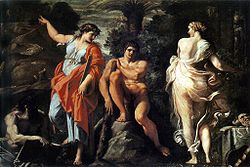
prominent in his curriculum. The content of one of his speeches is still known, and concerns a fable in which Heracles
Heracles
Heracles ,born Alcaeus or Alcides , was a divine hero in Greek mythology, the son of Zeus and Alcmene, foster son of Amphitryon and great-grandson of Perseus...
has to make a choice between Virtue and Vice. He also interpreted religion through the framework of naturalism
Naturalism (philosophy)
Naturalism commonly refers to the philosophical viewpoint that the natural universe and its natural laws and forces operate in the universe, and that nothing exists beyond the natural universe or, if it does, it does not affect the natural universe that we know...
.
Life
Prodicus was a native of IoulisIoulis
Ioulis or Ioulida , locally called Khora like the main towns of most Greek islands and sometimes known by the island name of Kea or Keos , is the capital of the island of Kea in the Cyclades.-Modern town:...
on the island of Ceos, the birthplace of Simonides
Simonides of Ceos
Simonides of Ceos was a Greek lyric poet, born at Ioulis on Kea. The scholars of Hellenistic Alexandria included him in the canonical list of nine lyric poets, along with Bacchylides and Pindar...
, whom he is described as having imitated. Prodicus came frequently to Athens
Athens
Athens , is the capital and largest city of Greece. Athens dominates the Attica region and is one of the world's oldest cities, as its recorded history spans around 3,400 years. Classical Athens was a powerful city-state...
for the purpose of transacting business on behalf of his native city, and attracted admiration as an orator, although his voice was deep and apt to fall. Plutarch
Plutarch
Plutarch then named, on his becoming a Roman citizen, Lucius Mestrius Plutarchus , c. 46 – 120 AD, was a Greek historian, biographer, essayist, and Middle Platonist known primarily for his Parallel Lives and Moralia...
describes him as slender and weak; and Plato
Plato
Plato , was a Classical Greek philosopher, mathematician, student of Socrates, writer of philosophical dialogues, and founder of the Academy in Athens, the first institution of higher learning in the Western world. Along with his mentor, Socrates, and his student, Aristotle, Plato helped to lay the...
also alludes to his weakness, and a degree of effeminacy which thus resulted. Philostratus
Philostratus
Philostratus or Lucius Flavius Philostratus , , called "the Athenian", was a Greek sophist of the Roman imperial period. His father was a minor sophist of the same name. He was born probably around 172, and is said by the Suda to have been living in the reign of emperor Philip the Arab . His death...
accuses him of luxury and avarice, but no earlier source mentions this.
In the Protagoras
Protagoras (dialogue)
Protagoras is a dialogue of Plato. The traditional subtitle is "or the Sophists, probative". The main argument is between the elderly Protagoras, a celebrated sophist, and Socrates...
of Plato, (dramatic date c. 430 BC), Prodicus is mentioned as having previously arrived in Athens
Athens
Athens , is the capital and largest city of Greece. Athens dominates the Attica region and is one of the world's oldest cities, as its recorded history spans around 3,400 years. Classical Athens was a powerful city-state...
. He appears in a play of Eupolis
Eupolis
Eupolis was an Athenian poet of the Old Comedy, who flourished during the time of the Peloponnesian War.-Biography:Nothing whatsoever is known of his personal history. There are few sources on when he first appeared on the stage...
, and in The Clouds
The Clouds
The Clouds is a comedy written by the celebrated playwright Aristophanes lampooning intellectual fashions in classical Athens. It was originally produced at the City Dionysia in 423 BC and it was not well received, coming last of the three plays competing at the festival that year. It was revised...
(423 BC) and The Birds
The Birds (play)
The Birds is a comedy by the Ancient Greek playwright Aristophanes. It was performed in 414 BCE at the City Dionysia where it won second prize. It has been acclaimed by modern critics as a perfectly realized fantasy remarkable for its mimicry of birds and for the gaiety of its songs...
(414 BC) of Aristophanes
Aristophanes
Aristophanes , son of Philippus, of the deme Cydathenaus, was a comic playwright of ancient Athens. Eleven of his forty plays survive virtually complete...
. He came frequently to Athens on public business. His pupils included the orators Theramenes
Theramenes
Theramenes was an Athenian statesman, prominent in the final decade of the Peloponnesian War. He was particularly active during the two periods of oligarchic government at Athens, as well as in the trial of the generals who had commanded at Arginusae in 406 BC...
and Isocrates
Isocrates
Isocrates , an ancient Greek rhetorician, was one of the ten Attic orators. In his time, he was probably the most influential rhetorician in Greece and made many contributions to rhetoric and education through his teaching and written works....
, and in the year of the death of Socrates
Socrates
Socrates was a classical Greek Athenian philosopher. Credited as one of the founders of Western philosophy, he is an enigmatic figure known chiefly through the accounts of later classical writers, especially the writings of his students Plato and Xenophon, and the plays of his contemporary ...
(399 BC), Prodicus was still living. According to the statement of Philostratus, on which little reliance can be placed, he delivered his lecture on virtue and vice in Thebes
Thebes, Greece
Thebes is a city in Greece, situated to the north of the Cithaeron range, which divides Boeotia from Attica, and on the southern edge of the Boeotian plain. It played an important role in Greek myth, as the site of the stories of Cadmus, Oedipus, Dionysus and others...
and Sparta
Sparta
Sparta or Lacedaemon, was a prominent city-state in ancient Greece, situated on the banks of the River Eurotas in Laconia, in south-eastern Peloponnese. It emerged as a political entity around the 10th century BC, when the invading Dorians subjugated the local, non-Dorian population. From c...
also. The Apology
Apology (Plato)
The Apology of Socrates is Plato's version of the speech given by Socrates as he unsuccessfully defended himself in 399 BC against the charges of "corrupting the young, and by not believing in the gods in whom the city believes, but in other daimonia that are novel"...
of Plato unites him with Gorgias
Gorgias
Gorgias ,Greek sophist, pre-socratic philosopher and rhetorician, was a native of Leontini in Sicily. Along with Protagoras, he forms the first generation of Sophists. Several doxographers report that he was a pupil of Empedocles, although he would only have been a few years younger...
and Hippias
Hippias
Hippias of Elis was a Greek Sophist, and a contemporary of Socrates. With an assurance characteristic of the later sophists, he claimed to be regarded as an authority on all subjects, and lectured on poetry, grammar, history, politics, mathematics, and much else...
as among those who were considered competent to instruct the youth in any city. Lucian
Lucian
Lucian of Samosata was a rhetorician and satirist who wrote in the Greek language. He is noted for his witty and scoffing nature.His ethnicity is disputed and is attributed as Assyrian according to Frye and Parpola, and Syrian according to Joseph....
mentions him among those who held lectures at Olympia
Olympia, Greece
Olympia , a sanctuary of ancient Greece in Elis, is known for having been the site of the Olympic Games in classical times, comparable in importance to the Pythian Games held in Delphi. Both games were held every Olympiad , the Olympic Games dating back possibly further than 776 BC...
.
In the dialogues of Plato he is mentioned or introduced with a certain degree of esteem, compared with the other sophists. Aristophanes
Aristophanes
Aristophanes , son of Philippus, of the deme Cydathenaus, was a comic playwright of ancient Athens. Eleven of his forty plays survive virtually complete...
, in The Clouds, deals more indulgently with him than with Socrates; and Xenophon
Xenophon
Xenophon , son of Gryllus, of the deme Erchia of Athens, also known as Xenophon of Athens, was a Greek historian, soldier, mercenary, philosopher and a contemporary and admirer of Socrates...
's Socrates, for the purpose of combating the voluptuousness of Aristippus
Aristippus
Aristippus of Cyrene, , was the founder of the Cyrenaic school of Philosophy. He was a pupil of Socrates, but adopted a very different philosophical outlook, teaching that the goal of life was to seek pleasure by adapting circumstances to oneself and by maintaining proper control over both...
, borrows from the book of "the wise Prodicus" the story of the choice of Hercules
Hercules
Hercules is the Roman name for Greek demigod Heracles, son of Zeus , and the mortal Alcmene...
. Like Protagoras
Protagoras
Protagoras was a pre-Socratic Greek philosopher and is numbered as one of the sophists by Plato. In his dialogue Protagoras, Plato credits him with having invented the role of the professional sophist or teacher of virtue...
and others, Prodicus delivered lectures in return for payment of from half a drachma to 50 drachmae, probably according to whether the hearers limited themselves to a single lecture or a more complete course. Prodicus is said to have amassed a great amount of money. The assertion that he hunted after rich young men, is only found in Philostratus.
Teachings
Prodicus was part of the first generation of SophistsSophism
Sophism in the modern definition is a specious argument used for deceiving someone. In ancient Greece, sophists were a category of teachers who specialized in using the tools of philosophy and rhetoric for the purpose of teaching aretê — excellence, or virtue — predominantly to young statesmen and...
. "He was a Sophist in the full sense of a professional freelance educator." As he taught both philosophy
Philosophy
Philosophy is the study of general and fundamental problems, such as those connected with existence, knowledge, values, reason, mind, and language. Philosophy is distinguished from other ways of addressing such problems by its critical, generally systematic approach and its reliance on rational...
and politics
Politics
Politics is a process by which groups of people make collective decisions. The term is generally applied to the art or science of running governmental or state affairs, including behavior within civil governments, but also applies to institutions, fields, and special interest groups such as the...
, so Plato represents his instructions as chiefly ethical, and gives preference to his distinction of ideas, such as courage, rashness, boldness, over similar attempts of other sophists. He sometimes gave individual show-orations, and though known to Callimachus
Callimachus
Callimachus was a native of the Greek colony of Cyrene, Libya. He was a noted poet, critic and scholar at the Library of Alexandria and enjoyed the patronage of the Egyptian–Greek Pharaohs Ptolemy II Philadelphus and Ptolemy III Euergetes...
, they do not appear to have been long preserved. In contrast with Gorgias and others, who boasted of possessing the art of making the small appear great, the great small, and of expatiating in long or short speeches, Prodicus required that the speech should be neither long nor short, but of the proper measure, and it is only as associated with other sophists that he is charged with endeavouring to make the weaker cause appear strong by means of his rhetoric.
Linguistics
Several of Plato'sPlato
Plato , was a Classical Greek philosopher, mathematician, student of Socrates, writer of philosophical dialogues, and founder of the Academy in Athens, the first institution of higher learning in the Western world. Along with his mentor, Socrates, and his student, Aristotle, Plato helped to lay the...
dialogues focus upon Prodicus' linguistic theory, and his insistence upon the correct use of names. He paid special attention to the correct use of words, and the distinction of expressions related in sense. Thucydides
Thucydides
Thucydides was a Greek historian and author from Alimos. His History of the Peloponnesian War recounts the 5th century BC war between Sparta and Athens to the year 411 BC...
is said to have gained from him his accuracy in the use of words. In the Cratylus
Cratylus (dialogue)
Cratylus is the name of a dialogue by Plato. Most modern scholars agree that it was written mostly during Plato's so-called middle period...
, Socrates
Socrates
Socrates was a classical Greek Athenian philosopher. Credited as one of the founders of Western philosophy, he is an enigmatic figure known chiefly through the accounts of later classical writers, especially the writings of his students Plato and Xenophon, and the plays of his contemporary ...
jokes that if he could have afforded the fifty drachma lectures he would now be an expert on "the correctness of names." In several of the Platonic dialogues Socrates appears as the friend and companion of Prodicus, which reveals at least that the two did have close personal relations, and that Socrates did attend at least a few of his lectures. "For Socrates, correct language was the prerequisite for correct living (including an efficient government). But Prodicus, though his linguistic teaching undoubtedly included semantic distinctions between ethical terms, had stopped at the threshold. The complete art of logoi embraced nothing less than the whole of philosophy."
Ethics
The speech on the choice of HerculesHercules
Hercules is the Roman name for Greek demigod Heracles, son of Zeus , and the mortal Alcmene...
was entitled Horai . Hercules, as he was entering manhood, had to choose one of the two paths of life, that of virtue
Virtue
Virtue is moral excellence. A virtue is a positive trait or quality subjectively deemed to be morally excellent and thus is valued as a foundation of principle and good moral being....
and that of vice
Hedonism
Hedonism is a school of thought which argues that pleasure is the only intrinsic good. In very simple terms, a hedonist strives to maximize net pleasure .-Etymology:The name derives from the Greek word for "delight" ....
. There appeared two women, the one of dignified beauty, adorned with purity, modesty, and discretion, the other of a voluptuous form, and meretricious look and dress. The latter promises to lead him by the shortest road, without any toil, to the enjoyment of every pleasure. The other, while she reminds him of his progenitors and his noble nature, does not conceal from him that the gods have not granted what is really beautiful and good apart from trouble and careful striving. While one seeks to deter him from the path of virtue by urging the difficulty of it; the other calls attention to the unnatural character of enjoyment which anticipates the need of it, its want of the highest joy, that arising from noble deeds, and the consequences of a life of voluptuousness, and how she herself, honoured by gods and men, leads to all noble works, and to true well-being in all circumstances of life. Hercules decides for virtue. This outline in Xenophon probably represents, in a very abbreviated form, the leading ideas of the original, of which no fragments remain.
Another speech, apparently by Prodicus, is mentioned in the spurious Platonic dialogue Eryxias
Eryxias (dialogue)
Eryxias is a Socratic dialogue attributed to Plato, but which is considered spurious. It is set in the Stoa of Zeus Eleutherios, and features Socrates in conversation with Critias, Eryxias, and Erasistratus ....
. Prodicus undertakes to show that the value of external goods depends simply upon the use which is made of them, and that virtue must be learnt. Similar sentiments were expressed in Prodicus's Praise of Agriculture. The spurious dialogue Axiochus
Axiochus (dialogue)
Axiochus is a Socratic dialogue attributed to Plato, but which is considered spurious. The work dates from the Hellenistic era, c. 1st century BC. The author was probably a Platonist, or perhaps a Neopythagorean...
attributes to him views respecting the worthlessness of earthly life in different ages and callings, and how we must long after freedom from connection with the body in the heavenly and cognate aether
Aether (classical element)
According to ancient and medieval science aether , also spelled æther or ether, is the material that fills the region of the universe above the terrestrial sphere.-Mythological origins:...
. Also found here is a doctrine that death is not to be feared, as it affects neither the living nor the departed.
Naturalism
Prodicus, like some of his fellow Sophists, interpreted religion through the framework of naturalismNaturalism (philosophy)
Naturalism commonly refers to the philosophical viewpoint that the natural universe and its natural laws and forces operate in the universe, and that nothing exists beyond the natural universe or, if it does, it does not affect the natural universe that we know...
. The gods he regarded as personifications of the sun, moon, rivers, fountains, and whatever else contributes to the comfort of our life, and he was sometimes charged with atheism
Atheism
Atheism is, in a broad sense, the rejection of belief in the existence of deities. In a narrower sense, atheism is specifically the position that there are no deities...
. "His theory was that primitive man was so impressed with the gifts nature provided him for the furtherance of his life that he believed them to be the discovery of gods or themselves to embody the godhead. This theory was not only remarkable for its rationalism but for its discernment of a close connection between religion and agriculture."