


Pope Gregory XV

Encyclopedia
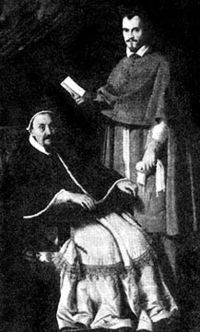
Pope Gregory XV born Alessandro Ludovisi, was pope from 1621, succeeding Paul V
on 9 February 1621.
to Pompeo Ludovisi, Count of Samoggia, and Camilla Bianchini, one of seven children.
 Educated at the Collegio Romano of the Jesuits in Rome, he went to the University of Bologna
to get degrees in canon
and Roman law
, June 1575. There is no evidence that he ever took orders
: his early career was as a papal jurist in Rome. In 1612, Paul V
appointed him Archbishop of Bologna
and sent him in August 1616 as nuncio to the Duchy of Savoy
, to mediate between Charles Emmanuel I, Duke of Savoy
and Philip III of Spain
in their dispute concerning the Gonzaga
Marquisate of Montferrat. In September 1616, Paul created him Cardinal-Priest of Santa Maria in Traspontina
. Cardinal Ludovisi remained at his see in Bologna until he went to Rome after the death of Pope Paul V to take part in the conclave
in which he was chosen.
At the moment of his election, chiefly through the influence of Cardinal Borghese, at his advanced age (he was 67) and with his weak state of health he saw at once that he would need an energetic man, in whom he could place implicit confidence, to assist him in the government of the Church. His nephew Ludovico Ludovisi, a young man of 25 years, seemed to him to be the right person and, at the risk of being charged with nepotism, he created him cardinal on the third day of his pontificate. On the same day, Orazio
, a brother of the pope, was put at the head of the pontifical army. The future revealed that Gregory XV was not disappointed in his nephew. The Catholic Encyclopedia allows that "Ludovico, it is true, advanced the interests of his family in every possible way, but he also used his brilliant talents and his great influence for the welfare of the Church, and was sincerely devoted to the pope." Gregory secured for the Ludovisi two dukedoms, one for his youngest brother Orazio, made a Nobile Romano and duca di Fiano, 1621, and the other, the duchy of Zagarolo
, purchased from the Colonna by his nephew Ludovico Ludovisi in 1622. A second nephew, Niccolò
, was made reigning prince of Piombino
and Lord of the Isola d'Elba
in 1634, having married the heiress, 30 March 1632.
Beyond assisting Ferdinand II, Holy Roman Emperor
and the Catholic League against the Protestants, to the tune of a million gold ducats, and Sigismund III Vasa
against the Turks
, he interfered little in European politics. His Constitution against magicians and witches (Omnipotentis Dei, 20 March 1623) was the last papal ordinance against witchcraft
. Former punishments were lessened, and the death penalty was limited to those who were "proved to have entered into a compact with the devil
, and to have committed homicide with his assistance" (CE). He was a learned divine and manifested a reforming spirit; his bull of 15 November 1621, Aeterni Patris regulated papal elections which were to be secret and in writing; three methods of election were allowed: by scrutiny, compromise and quasi-inspiration
. On 6 January 1622, he established the Congregatio de propaganda fide the missionary arm of the Roman Curia. His pontificate was marked by the canonisation of Teresa of Avila
, Francis Xavier
, Ignatius Loyola, Philip Neri
, and Isidore the Farmer. He also beatified Aloysius Gonzaga
and Peter of Alcantara
. He was influential in bringing the Bolognese artist Guercino to Rome, a landmark in the development of the High Baroque
style. He sat for his portrait bust both to Gian Lorenzo Bernini
and to Alessandro Algardi
, whose restrained bust in a tondo is in the church of Santa Maria in Vallicella
.
Gregory XV died in the Quirinal Palace
on 8 July 1623, and was buried in the church of Sant'Ignazio
. He was succeeded by Urban VIII
.
Pope Paul V
-Theology:Paul met with Galileo Galilei in 1616 after Cardinal Bellarmine had, on his orders, warned Galileo not to hold or defend the heliocentric ideas of Copernicus. Whether there was also an order not to teach those ideas in any way has been a matter for controversy...
on 9 February 1621.
Biography
He was born in BolognaBologna
Bologna is the capital city of Emilia-Romagna, in the Po Valley of Northern Italy. The city lies between the Po River and the Apennine Mountains, more specifically, between the Reno River and the Savena River. Bologna is a lively and cosmopolitan Italian college city, with spectacular history,...
to Pompeo Ludovisi, Count of Samoggia, and Camilla Bianchini, one of seven children.
University of Bologna
The Alma Mater Studiorum - University of Bologna is the oldest continually operating university in the world, the word 'universitas' being first used by this institution at its foundation. The true date of its founding is uncertain, but believed by most accounts to have been 1088...
to get degrees in canon
Canon law
Canon law is the body of laws & regulations made or adopted by ecclesiastical authority, for the government of the Christian organization and its members. It is the internal ecclesiastical law governing the Catholic Church , the Eastern and Oriental Orthodox churches, and the Anglican Communion of...
and Roman law
Roman law
Roman law is the legal system of ancient Rome, and the legal developments which occurred before the 7th century AD — when the Roman–Byzantine state adopted Greek as the language of government. The development of Roman law comprises more than a thousand years of jurisprudence — from the Twelve...
, June 1575. There is no evidence that he ever took orders
Holy Orders
The term Holy Orders is used by many Christian churches to refer to ordination or to those individuals ordained for a special role or ministry....
: his early career was as a papal jurist in Rome. In 1612, Paul V
Pope Paul V
-Theology:Paul met with Galileo Galilei in 1616 after Cardinal Bellarmine had, on his orders, warned Galileo not to hold or defend the heliocentric ideas of Copernicus. Whether there was also an order not to teach those ideas in any way has been a matter for controversy...
appointed him Archbishop of Bologna
Archdiocese of Bologna
The Archdiocese of Bologna is a Roman Catholic archbishopric in northern Italy, with the archiepiscopal seat in Bologna Cathedral. The current Archbishop is Cardinal Carlo Caffarra since 2003.The archdiocese has the following suffragans:*diocese of Imola...
and sent him in August 1616 as nuncio to the Duchy of Savoy
Duchy of Savoy
From 1416 to 1847, the House of Savoy ruled the eponymous Duchy of Savoy . The Duchy was a state in the northern part of the Italian Peninsula, with some territories that are now in France. It was a continuation of the County of Savoy...
, to mediate between Charles Emmanuel I, Duke of Savoy
Charles Emmanuel I, Duke of Savoy
Charles Emmanuel I , known as the Great, was the Duke of Savoy from 1580 to 1630...
and Philip III of Spain
Philip III of Spain
Philip III , also known as Philip the Pious, was the King of Spain and King of Portugal and the Algarves, where he ruled as Philip II , from 1598 until his death...
in their dispute concerning the Gonzaga
House of Gonzaga
The Gonzaga family ruled Mantua in Northern Italy from 1328 to 1708.-History:In 1433, Gianfrancesco I assumed the title of Marquis of Mantua, and in 1530 Federico II received the title of Duke of Mantua. In 1531, the family acquired the Duchy of Monferrato through marriage...
Marquisate of Montferrat. In September 1616, Paul created him Cardinal-Priest of Santa Maria in Traspontina
Santa Maria in Traspontina
Santa Maria in Traspontina is a Carmelite church in Rome, Italy.The shrine lies on the Via della Conciliazione, the main road of the Rione Borgo....
. Cardinal Ludovisi remained at his see in Bologna until he went to Rome after the death of Pope Paul V to take part in the conclave
Papal conclave, 1621
Papal conclave 1621 – convoked after the death of Pope Paul V, elected Cardinal Alessandro Ludovisi, who under the name of Gregory XV became 234th Pope of the Catholic Church. It was the shortest conclave in the seventeenth century.-List of participants:Pope Paul V died on January 28, 1621 in the...
in which he was chosen.
At the moment of his election, chiefly through the influence of Cardinal Borghese, at his advanced age (he was 67) and with his weak state of health he saw at once that he would need an energetic man, in whom he could place implicit confidence, to assist him in the government of the Church. His nephew Ludovico Ludovisi, a young man of 25 years, seemed to him to be the right person and, at the risk of being charged with nepotism, he created him cardinal on the third day of his pontificate. On the same day, Orazio
Orazio Ludovisi
Orazio Ludovisi was an Italian nobleman, military commander and patrician of Bologna. During his brother's reign as Pope Gregory XV, he became Commander of the Papal Armies and Duke of Fiano and Zagarolo.-Early life:...
, a brother of the pope, was put at the head of the pontifical army. The future revealed that Gregory XV was not disappointed in his nephew. The Catholic Encyclopedia allows that "Ludovico, it is true, advanced the interests of his family in every possible way, but he also used his brilliant talents and his great influence for the welfare of the Church, and was sincerely devoted to the pope." Gregory secured for the Ludovisi two dukedoms, one for his youngest brother Orazio, made a Nobile Romano and duca di Fiano, 1621, and the other, the duchy of Zagarolo
Zagarolo
Zagarolo is a town and comune in the province of Rome, in the region of Lazio of central Italy. It has 14,620 inhabitants, a total area of 28 km2....
, purchased from the Colonna by his nephew Ludovico Ludovisi in 1622. A second nephew, Niccolò
Niccolò Ludovisi
Niccolò I Ludovisi was Prince of Piombino from 1634 until his death.-Family:He was the son of Orazio Ludovisi, patrician of Bologna and commander-in-chief of the Papal Army , and Lavinia Albergati. He was the nephew of later-Cardinal Niccolò Albergati-Ludovisi...
, was made reigning prince of Piombino
Principality of Piombino
The Principality of Piombino was a state of Italy, which existed from 1399 to 1805, when Napoleon absorbed it into the Principality of Lucca and Piombino...
and Lord of the Isola d'Elba
Elba
Elba is a Mediterranean island in Tuscany, Italy, from the coastal town of Piombino. The largest island of the Tuscan Archipelago, Elba is also part of the National Park of the Tuscan Archipelago and the third largest island in Italy after Sicily and Sardinia...
in 1634, having married the heiress, 30 March 1632.
Beyond assisting Ferdinand II, Holy Roman Emperor
Ferdinand II, Holy Roman Emperor
Ferdinand II , a member of the House of Habsburg, was Holy Roman Emperor , King of Bohemia , and King of Hungary . His rule coincided with the Thirty Years' War.- Life :...
and the Catholic League against the Protestants, to the tune of a million gold ducats, and Sigismund III Vasa
Sigismund III Vasa
Sigismund III Vasa was King of Poland and Grand Duke of Lithuania, a monarch of the united Polish–Lithuanian Commonwealth from 1587 to 1632, and King of Sweden from 1592 until he was deposed in 1599...
against the Turks
Ottoman Empire
The Ottoman EmpireIt was usually referred to as the "Ottoman Empire", the "Turkish Empire", the "Ottoman Caliphate" or more commonly "Turkey" by its contemporaries...
, he interfered little in European politics. His Constitution against magicians and witches (Omnipotentis Dei, 20 March 1623) was the last papal ordinance against witchcraft
Witchcraft
Witchcraft, in historical, anthropological, religious, and mythological contexts, is the alleged use of supernatural or magical powers. A witch is a practitioner of witchcraft...
. Former punishments were lessened, and the death penalty was limited to those who were "proved to have entered into a compact with the devil
Deal with the Devil
Deal With The Devil is the fifth studio album by the American heavy metal band Lizzy Borden released in 2000 .A return to form, featuring a cover by Todd McFarlane.2 covers were recorded...
, and to have committed homicide with his assistance" (CE). He was a learned divine and manifested a reforming spirit; his bull of 15 November 1621, Aeterni Patris regulated papal elections which were to be secret and in writing; three methods of election were allowed: by scrutiny, compromise and quasi-inspiration
Acclamation (in Papal Elections)
Acclamation was formerly one of the methods of papal election.The method of electing the Roman Pontiff is contained in the constitutions of Gregory XV Æterni Patris Filius and Decet Romanum Pontificem, Urban VIII's constitution Ad Romani Pontificis Providentiam, and John Paul II's Universi...
. On 6 January 1622, he established the Congregatio de propaganda fide the missionary arm of the Roman Curia. His pontificate was marked by the canonisation of Teresa of Avila
Teresa of Ávila
Saint Teresa of Ávila, also called Saint Teresa of Jesus, baptized as Teresa Sánchez de Cepeda y Ahumada, was a prominent Spanish mystic, Roman Catholic saint, Carmelite nun, and writer of the Counter Reformation, and theologian of contemplative life through mental prayer...
, Francis Xavier
Francis Xavier
Francis Xavier, born Francisco de Jasso y Azpilicueta was a pioneering Roman Catholic missionary born in the Kingdom of Navarre and co-founder of the Society of Jesus. He was a student of Saint Ignatius of Loyola and one of the first seven Jesuits, dedicated at Montmartre in 1534...
, Ignatius Loyola, Philip Neri
Philip Neri
Saint Philip Romolo Neri , also known as Apostle of Rome, was an Italian priest, noted for founding a society of secular priests called the "Congregation of the Oratory".-Early life:...
, and Isidore the Farmer. He also beatified Aloysius Gonzaga
Aloysius Gonzaga
- Early life :Aloysius Gonzaga was born at his family's castle in Castiglione delle Stiviere, between Brescia and Mantova in northern Italy in what was then part of the Papal States. He was a member of the illustrious House of Gonzaga...
and Peter of Alcantara
Peter of Alcantara
Saint Peter of Alcántara, O.F.M. was a Spanish Franciscan friar.- Biography :He was born at Alcántara, Province of Cáceres, Extremadura, Spain. His father, Peter Garavito, was the governor of Alcántara, and his mother was of the noble family of Sanabia...
. He was influential in bringing the Bolognese artist Guercino to Rome, a landmark in the development of the High Baroque
Baroque
The Baroque is a period and the style that used exaggerated motion and clear, easily interpreted detail to produce drama, tension, exuberance, and grandeur in sculpture, painting, literature, dance, and music...
style. He sat for his portrait bust both to Gian Lorenzo Bernini
Gian Lorenzo Bernini
Gian Lorenzo Bernini was an Italian artist who worked principally in Rome. He was the leading sculptor of his age and also a prominent architect...
and to Alessandro Algardi
Alessandro Algardi
Alessandro Algardi was an Italian high-Baroque sculptor active almost exclusively in Rome, where for the latter decades of his life, he was the major rival of Gian Lorenzo Bernini.-Early years:...
, whose restrained bust in a tondo is in the church of Santa Maria in Vallicella
Santa Maria in Vallicella
Santa Maria in Vallicella, also called Chiesa Nuova, is a church in Rome, Italy, which today faces onto the main thoroughfare of the Corso Vittorio Emanuele...
.
Gregory XV died in the Quirinal Palace
Quirinal Palace
The Quirinal Palace is a historical building in Rome, Italy, the current official residence of the President of the Italian Republic. It is located on the Quirinal Hill, the tallest of the seven hills of Rome...
on 8 July 1623, and was buried in the church of Sant'Ignazio
Sant'Ignazio
The Church of Saint Ignatius of Loyola at Campus Martius is Roman Catholic titular church dedicated to Ignatius of Loyola, the founder of the Jesuit order, located in Rome, Italy...
. He was succeeded by Urban VIII
Pope Urban VIII
Pope Urban VIII , born Maffeo Barberini, was pope from 1623 to 1644. He was the last pope to expand the papal territory by force of arms, and was a prominent patron of the arts and reformer of Church missions...
.