


Photocopier

Encyclopedia
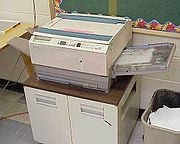
Machine
A machine manages power to accomplish a task, examples include, a mechanical system, a computing system, an electronic system, and a molecular machine. In common usage, the meaning is that of a device having parts that perform or assist in performing any type of work...
that makes paper
Paper
Paper is a thin material mainly used for writing upon, printing upon, drawing or for packaging. It is produced by pressing together moist fibers, typically cellulose pulp derived from wood, rags or grasses, and drying them into flexible sheets....
copies of documents and other visual images quickly and cheaply. Most current photocopiers use a technology called xerography
Xerography
Xerography is a dry photocopying technique invented by Chester Carlson in 1938, for which he was awarded on October 6, 1942. Carlson originally called his invention electrophotography...
, a dry process using heat. (Copiers can also use other technologies such as ink jet
Inkjet printer
An inkjet printer is a type of computer printer that creates a digital image by propelling droplets of ink onto paper. Inkjet printers are the most commonly used type of printer and range from small inexpensive consumer models to very large professional machines that can cost up to thousands of...
, but xerography is standard for office copying.)
Xerographic office photocopying was introduced by Xerox
Xerox
Xerox Corporation is an American multinational document management corporation that produced and sells a range of color and black-and-white printers, multifunction systems, photo copiers, digital production printing presses, and related consulting services and supplies...
in 1959, and it gradually replaced copies made by Verifax, Photostat, carbon paper
Carbon paper
Carbon paper is paper coated on one side with a layer of a loosely bound dry ink or pigmented coating, usually bound with wax. It is used for making one or more copies simultaneous with the creation of an original document...
, mimeograph machine
Mimeograph machine
The stencil duplicator or mimeograph machine is a low-cost printing press that works by forcing ink through a stencil onto paper....
s, and other duplicating machines
Duplicating machines
Duplicating machines were the predecessors of modern document-reproduction technology. They have now been replaced by digital duplicators, scanners, laser printers and photocopiers, but for many years they were the primary means of reproducing documents for limited-run distribution.Like the...
. The prevalence of its use is one of the factors that prevented the development of the paperless office
Paperless office
A paperless office is a work environment in which the use of paper is eliminated or greatly reduced. This is done by converting documents and other papers into digital form. Proponents claim that "going paperless" can save money, boost productivity, save space, make documentation and information...
heralded early in the digital revolution
Digital Revolution
The Digital Revolution is the change from analog mechanical and electronic technology to digital technology that has taken place since c. 1980 and continues to the present day. Implicitly, the term also refers to the sweeping changes brought about by digital computing and communication technology...
.
Photocopying is widely used in business, education, and government. There have been many predictions that photocopiers will eventually become obsolete as information workers continue to increase their digital document creation and distribution, and rely less on distributing actual pieces of paper.
How a photocopier works (using xerography)
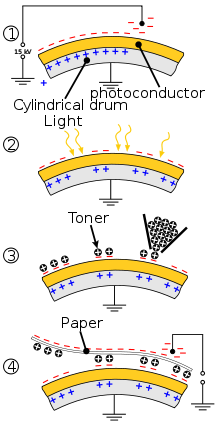
- Charging: cylindrical drum is electrostatically charged by a high voltage wire called a corona wire or a charge roller. The drum has a coating of a photoconductive material. A photoconductor is a semiconductorSemiconductorA semiconductor is a material with electrical conductivity due to electron flow intermediate in magnitude between that of a conductor and an insulator. This means a conductivity roughly in the range of 103 to 10−8 siemens per centimeter...
that becomes conductive when exposed to light. - Exposure: A bright lamp illuminates the original document, and the white areas of the original document reflect the light onto the surface of the photoconductive drum. The areas of the drum that are exposed to light become conductive and therefore discharge to ground. The area of the drum not exposed to light (those areas that correspond to black portions of the original document) remain negatively charged. The result is a latent electrical image on the surface of the drum.
- Developing: The tonerTonerToner is a powder used in laser printers and photocopiers to form the printed text and images on the paper. In its early form it was simply carbon powder. Then, to improve the quality of the printout, the carbon was melt-mixed with a polymer...
is positively charged. When it is applied to the drum to develop the image, it is attracted and sticks to the areas that are negatively charged (black areas), just as paper sticks to a toy balloon with a static charge. - Transfer: The resulting toner image on the surface of the drum is transferred from the drum onto a piece of paper with a higher negative charge than the drum.
- Fusing: The toner is melted and bonded to the paper by heat and pressure rollers.
This example is of a negatively charged drum and paper, and positively charged toner as is common in today's digital copiers. Some copiers, mostly older analog copiers, employ a positively charged drum and paper, and negatively charged toner.
A negative photocopy inverts the colors of the document when creating a photocopy, resulting in letters that appear white on a black background instead of black on a white background. Negative photocopies of old or faded documents sometimes produce documents which have better focus and are easier to read and study.
History
The first widely used copy machine for offices was invented by James WattJames Watt
James Watt, FRS, FRSE was a Scottish inventor and mechanical engineer whose improvements to the Newcomen steam engine were fundamental to the changes brought by the Industrial Revolution in both his native Great Britain and the rest of the world.While working as an instrument maker at the...
in 1779. It relied on physically transferring some of the (specially formulated) ink from an original letter or drawing to a moistened thin unsized sheet of paper by means of a press. The copy could then be read from the obverse side. The system was a commercial success and was in use in for over a century.
In 1937, Bulgaria
Bulgaria
Bulgaria , officially the Republic of Bulgaria , is a parliamentary democracy within a unitary constitutional republic in Southeast Europe. The country borders Romania to the north, Serbia and Macedonia to the west, Greece and Turkey to the south, as well as the Black Sea to the east...
n physicist
Physicist
A physicist is a scientist who studies or practices physics. Physicists study a wide range of physical phenomena in many branches of physics spanning all length scales: from sub-atomic particles of which all ordinary matter is made to the behavior of the material Universe as a whole...
Georgi Nadjakov
Georgi Nadjakov
Georgi Nadjakov is a famous Bulgarian physicist. He became a corresponding member of the Göttingen Academy of Sciences , member of the Bulgarian Academy of Sciences and member of the Russian Academy of Sciences...
found that, when placed into an electric field and exposed to light, some dielectric
Dielectric
A dielectric is an electrical insulator that can be polarized by an applied electric field. When a dielectric is placed in an electric field, electric charges do not flow through the material, as in a conductor, but only slightly shift from their average equilibrium positions causing dielectric...
s acquire permanent electric polarization in the exposed areas. That polarization persists in the dark and is destroyed in light.
Chester Carlson
Chester Carlson
Chester Floyd Carlson was an American physicist, inventor, and patent attorney born in Seattle, Washington....
, the inventor of photocopying, was originally a patent attorney
Patent attorney
A patent attorney is an attorney who has the specialized qualifications necessary for representing clients in obtaining patents and acting in all matters and procedures relating to patent law and practice, such as filing an opposition...
, as well as a part-time researcher and inventor. His job at the patent office
Patent office
A patent office is a governmental or intergovernmental organization which controls the issue of patents. In other words, "patent offices are government bodies that may grant a patent or reject the patent application based on whether or not the application fulfils the requirements for...
in New York
New York
New York is a state in the Northeastern region of the United States. It is the nation's third most populous state. New York is bordered by New Jersey and Pennsylvania to the south, and by Connecticut, Massachusetts and Vermont to the east...
required him to make a large number of copies of important papers. Carlson, who was arthritic
Arthritis
Arthritis is a form of joint disorder that involves inflammation of one or more joints....
, found this to be a painful and tedious process. This motivated him to conduct experiments with photoconductivity
Photoconductivity
Photoconductivity is an optical and electrical phenomenon in which a material becomes more electrically conductive due to the absorption of electromagnetic radiation such as visible light, ultraviolet light, infrared light, or gamma radiation....
. Carlson used his kitchen for his "electrophotography
Electrophotography
Electrophotography is a dry photocopying technique invented by Chester Carlson in 1938, for which he was awarded on October 6, 1942...
" experiments, and, in 1938, he applied for a patent for the process. He made the first photocopy using a zinc
Zinc
Zinc , or spelter , is a metallic chemical element; it has the symbol Zn and atomic number 30. It is the first element in group 12 of the periodic table. Zinc is, in some respects, chemically similar to magnesium, because its ion is of similar size and its only common oxidation state is +2...
plate covered with sulfur
Sulfur
Sulfur or sulphur is the chemical element with atomic number 16. In the periodic table it is represented by the symbol S. It is an abundant, multivalent non-metal. Under normal conditions, sulfur atoms form cyclic octatomic molecules with chemical formula S8. Elemental sulfur is a bright yellow...
. The words "10-22-38 Astoria" were written on a microscope
Microscope
A microscope is an instrument used to see objects that are too small for the naked eye. The science of investigating small objects using such an instrument is called microscopy...
slide, which was placed on top of more sulfur and under a bright light. After the slide was removed, a mirror image of the words remained. Carlson tried to sell his invention to some companies, but failed because the process was still underdeveloped. At the time, multiple copies were most commonly made at the point of document origination, using carbon paper
Carbon paper
Carbon paper is paper coated on one side with a layer of a loosely bound dry ink or pigmented coating, usually bound with wax. It is used for making one or more copies simultaneous with the creation of an original document...
or manual duplicating machines, and people did not see the need for an electronic machine. Between 1939 and 1944, Carlson was turned down by over 20 companies, including IBM
IBM
International Business Machines Corporation or IBM is an American multinational technology and consulting corporation headquartered in Armonk, New York, United States. IBM manufactures and sells computer hardware and software, and it offers infrastructure, hosting and consulting services in areas...
and General Electric
General Electric
General Electric Company , or GE, is an American multinational conglomerate corporation incorporated in Schenectady, New York and headquartered in Fairfield, Connecticut, United States...
—neither of which believed there was a significant market for copiers.
In 1944, the Battelle Memorial Institute
Battelle Memorial Institute
Battelle Memorial Institute is a private nonprofit applied science and technology development company headquartered in Columbus, Ohio. Battelle is a charitable trust organized as a nonprofit corporation under the laws of the State of Ohio and is exempt from taxation under Section 501 of the...
, a non-profit organization in Columbus, Ohio
Columbus, Ohio
Columbus is the capital of and the largest city in the U.S. state of Ohio. The broader metropolitan area encompasses several counties and is the third largest in Ohio behind those of Cleveland and Cincinnati. Columbus is the third largest city in the American Midwest, and the fifteenth largest city...
, contracted with Carlson to refine his new process. Over the next five years, the institute conducted experiments to improve the process of electrophotography. In 1947, Haloid Corporation (a small New York-based manufacturer and seller of photographic paper) approached Battelle to obtain a license to develop and market a copying machine based on this technology.
Haloid felt that the word "electrophotography" was too complicated and did not have good recall value. After consulting a professor of classical language at Ohio State University
Ohio State University
The Ohio State University, commonly referred to as Ohio State, is a public research university located in Columbus, Ohio. It was originally founded in 1870 as a land-grant university and is currently the third largest university campus in the United States...
, Haloid and Carlson changed the name of the process to "xerography
Xerography
Xerography is a dry photocopying technique invented by Chester Carlson in 1938, for which he was awarded on October 6, 1942. Carlson originally called his invention electrophotography...
," which was derived from Greek
Greek language
Greek is an independent branch of the Indo-European family of languages. Native to the southern Balkans, it has the longest documented history of any Indo-European language, spanning 34 centuries of written records. Its writing system has been the Greek alphabet for the majority of its history;...
words that meant "dry writing." Haloid called the new copier machines "Xerox Machines" and, in 1948, the word "Xerox" was trademarked. Haloid eventually changed its name to Xerox Corporation.
In 1949, Xerox Corporation introduced the first xerographic copier called the Model A. Xerox became so successful that, in North America
North America
North America is a continent wholly within the Northern Hemisphere and almost wholly within the Western Hemisphere. It is also considered a northern subcontinent of the Americas...
, photocopying came to be popularly known as "xeroxing." Xerox has actively fought to prevent "Xerox" from becoming a genericized trademark
Genericized trademark
A genericized trademark is a trademark or brand name that has become the colloquial or generic description for, or synonymous with, a general class of product or service, rather than as an indicator of source or affiliation as intended by the trademark's holder...
. While the word "Xerox" has appeared in some dictionaries as a synonym for photocopying, Xerox Corporation typically requests that such entries be modified, and that people not use the term "Xerox" in this way. Some languages include hybrid terms, such as the widely used Polish
Polish language
Polish is a language of the Lechitic subgroup of West Slavic languages, used throughout Poland and by Polish minorities in other countries...
term kserokopia ("xerocopy"), even though relatively few photocopiers are of the Xerox brand.
In the early 1950s, Radio Corporation of America (RCA) introduced a variation on the process called Electrofax
Electrofax
An electrofax is an electrostatic printer and copier technology where the image is formed directly on the paper, instead of first on a drum as it would be in xerography...
, whereby images are formed directly on specially coated paper and rendered with a toner dispersed in a liquid.
During the 1960s and through the 1980s, Savin Corporation
Savin (photocopiers)
Savin was incorporated in 1959 by Max M. Low and was run by Low's son, Robert K. Low and E. Paul Charlap...
developed and sold a line of liquid-toner copiers that implemented a technology based on patents held by the company.
Prior to the widespread adoption of xerographic copiers, photo-direct copies produced by machines such as Kodak's Verifax were used. A primary obstacle associated with the pre-xerographic copying technologies was the high cost of supplies: a Verifax print required supplies costing USD $0.15 in 1969, while a Xerox print could be made for USD $0.03 including paper and labor. At that time, Thermofax photocopying machines in libraries could make letter-sized copies for USD $0.25 or more (at a time when the minimum wage for a US worker was USD $1.65/hour).
Xerographic copier manufacturers took advantage of a high perceived-value of the 1960s and early 1970s, and marketed paper that was "specially designed" for xerographic output. By the end of the 1970s, paper producers made xerographic "runability" one of the requirements for most of their office paper brands.
Some devices sold as photocopiers have replaced the drum-based process with inkjet or transfer film technology.
Among the key advantages of photocopiers over earlier copying technologies are their ability:
- to use plain (untreated) office paper,
- to implement duplexDuplex printingDuplex printing is a feature of computer printers and multifunction printers that allows the automatic printing of a sheet of paper on both sides...
(or two-sided) printing, and - eventually, to sort and/or stapleStaple (fastener)A staple is a type of two-pronged fastener, usually metal, used for joining or binding materials together. Large staples might be used with a hammer or staple gun for masonry, roofing, corrugated boxes and other heavy-duty uses...
output.
Color photocopiers
Colored toner became available in the 1950s, although full-color copiers were not commercially available until 3M3M
3M Company , formerly known as the Minnesota Mining and Manufacturing Company, is an American multinational conglomerate corporation based in Maplewood, Minnesota, United States....
released the Color-in-Color copier in 1968, which used a dye sublimation process rather than conventional electrostatic technology. The first electrostatic color copier was released by Canon
Canon Inc.
is a Japanese multinational corporation that specialises in the manufacture of imaging and optical products, including cameras, camcorders, photocopiers, steppers and computer printers. Its headquarters are located in Ōta, Tokyo, Japan.-Origins:...
in 1973.
Color photocopying is a concern to government
Government
Government refers to the legislators, administrators, and arbitrators in the administrative bureaucracy who control a state at a given time, and to the system of government by which they are organized...
s, as it facilitates counterfeiting currency
Currency
In economics, currency refers to a generally accepted medium of exchange. These are usually the coins and banknotes of a particular government, which comprise the physical aspects of a nation's money supply...
. Some countries have incorporated anti-counterfeiting technologies into their currency specifically to make it harder to use a color photocopier for counterfeiting. These technologies include watermarks, microprinting, hologram
Holography
Holography is a technique that allows the light scattered from an object to be recorded and later reconstructed so that when an imaging system is placed in the reconstructed beam, an image of the object will be seen even when the object is no longer present...
s, tiny security strips made of plastic (or other material), and ink that appears to change color as the currency is viewed at an angle. Some photocopying machines contain special software that can prevent copying currency that contains a special pattern
EURion constellation
The EURion constellation is a pattern of symbols found on a number of banknote designs worldwide since about 1996. It is added to help software detect the presence of a banknote in a digital image. Such software can then block the user from reproducing banknotes to prevent counterfeiting using...
.
Digital technology
There is an increasing trend for new photocopiers to adopt digitalDigital
A digital system is a data technology that uses discrete values. By contrast, non-digital systems use a continuous range of values to represent information...
technology, thus replacing the older analog
Analog signal
An analog or analogue signal is any continuous signal for which the time varying feature of the signal is a representation of some other time varying quantity, i.e., analogous to another time varying signal. It differs from a digital signal in terms of small fluctuations in the signal which are...
technology. With digital copying, the copier effectively consists of an integrated scanner
Image scanner
In computing, an image scanner—often abbreviated to just scanner—is a device that optically scans images, printed text, handwriting, or an object, and converts it to a digital image. Common examples found in offices are variations of the desktop scanner where the document is placed on a glass...
and laser printer
Laser printer
A laser printer is a common type of computer printer that rapidly produces high quality text and graphics on plain paper. As with digital photocopiers and multifunction printers , laser printers employ a xerographic printing process, but differ from analog photocopiers in that the image is produced...
. This design has several advantages, such as automatic image quality enhancement and the ability to "build jobs" (that is, to scan page images independently of the process of printing them). Some digital copiers can function as high-speed scanners; such models typically offer the ability to send documents via email or to make them available on file servers.
A great advantage of digital copier technology is "automatic digital collation
Collation
Collation is the assembly of written information into a standard order. One common type of collation is called alphabetization, though collation is not limited to ordering letters of the alphabet...
." For example, when copying a set of 20 pages 20 times, a digital copier scans each page only once, then uses the stored information to produce 20 sets. In an analog copier, either each page is scanned 20 times (a total of 400 scans), making one set at a time, or 20 separate output trays are used for the 20 sets.
Low-end copiers also use digital
Digital
A digital system is a data technology that uses discrete values. By contrast, non-digital systems use a continuous range of values to represent information...
technology, but tend to consist of a standard PC scanner coupled to an inkjet or low-end laser printer, both of which are far slower than their counterparts in high-end copiers. However, low-end scanner-inkjets can provide color copying at a far lower cost than can a traditional color copier. The cost of electronics is such that combined scanner-printers sometimes have built-in fax machines. (See Multifunction printer
Multifunction printer
An MFP , multifunctional, all-in-one , or Multifunction Device , is an office machine which incorporates the functionality of multiple devices in one, so as to have a smaller footprint in a home or small business setting , or to provide centralized document...
.)
Copyright issues
Photocopying material that is subject to copyrightCopyright
Copyright is a legal concept, enacted by most governments, giving the creator of an original work exclusive rights to it, usually for a limited time...
(such as books or scientific papers) is subject to restrictions in most countries. This is common practice, as the cost of purchasing a book for the sake of one article or a few pages can be excessive. The principle of fair use
Fair use
Fair use is a limitation and exception to the exclusive right granted by copyright law to the author of a creative work. In United States copyright law, fair use is a doctrine that permits limited use of copyrighted material without acquiring permission from the rights holders...
(in the United States) or fair dealing
Fair dealing
Fair dealing is a limitation and exception to the exclusive right granted by copyright law to the author of a creative work, which is found in many of the common law jurisdictions of the Commonwealth of Nations....
(in other Berne Convention
Berne Convention for the Protection of Literary and Artistic Works
The Berne Convention for the Protection of Literary and Artistic Works, usually known as the Berne Convention, is an international agreement governing copyright, which was first accepted in Berne, Switzerland in 1886.- Content :...
countries) allows this type of copying for research purposes.
In certain countries, such as Canada
Canada
Canada is a North American country consisting of ten provinces and three territories. Located in the northern part of the continent, it extends from the Atlantic Ocean in the east to the Pacific Ocean in the west, and northward into the Arctic Ocean...
, some universities
University
A university is an institution of higher education and research, which grants academic degrees in a variety of subjects. A university is an organisation that provides both undergraduate education and postgraduate education...
pay royalties from each photocopy made at university copy machines and copy centers to copyright collective
Copyright collective
A copyright collective is a body created by copyright law or private agreement which engages in collective rights management...
s out of the revenues from the photocopying, and these collectives distribute resulting funds to various scholarly publishers. In the United States, photocopied compilations of articles, handouts, graphics, and other information called readers are often required texts for college classes. Either the instructor or the copy center is responsible for clearing copyright for every article in the reader, and attribution information must be clearly included in the reader.
Health issues
Exposure to ultraviolet light is a concern. In the early days of photocopiers, the sensitizing light source was filtered green to match the optimal sensitivity of the photoconductive surface. This filtering conveniently removed all ultraviolet. Currently, a variety of light sources are used. As glassGlass
Glass is an amorphous solid material. Glasses are typically brittle and optically transparent.The most familiar type of glass, used for centuries in windows and drinking vessels, is soda-lime glass, composed of about 75% silica plus Na2O, CaO, and several minor additives...
transmits ultraviolet rays between 325 and 400 nanometers, copiers with ultraviolet-producing lights such as fluorescent, tungsten
Tungsten
Tungsten , also known as wolfram , is a chemical element with the chemical symbol W and atomic number 74.A hard, rare metal under standard conditions when uncombined, tungsten is found naturally on Earth only in chemical compounds. It was identified as a new element in 1781, and first isolated as...
halogen, or xenon
Xenon
Xenon is a chemical element with the symbol Xe and atomic number 54. The element name is pronounced or . A colorless, heavy, odorless noble gas, xenon occurs in the Earth's atmosphere in trace amounts...
flash, expose documents to some ultraviolet.
Concerns about emissions from photocopy machines have been expressed by some in connection with the use of selenium
Selenium
Selenium is a chemical element with atomic number 34, chemical symbol Se, and an atomic mass of 78.96. It is a nonmetal, whose properties are intermediate between those of adjacent chalcogen elements sulfur and tellurium...
and emissions of ozone
Ozone
Ozone , or trioxygen, is a triatomic molecule, consisting of three oxygen atoms. It is an allotrope of oxygen that is much less stable than the diatomic allotrope...
and fumes from heated toner. However, these concerns may be due to misunderstanding or exaggeration. There are real concerns over the emissions from this equipment. The manufacturers manuals clearly identify concerns and publish rules for both the siting of the machines adjacent to people and the need for air in the locality. There are various warnings regarding emissions from the manufacturers and this should not be disregarded.
Forensic identification
Similar to forensic identificationForensic identification
Forensic identification is the application of forensic science, or "forensics", and technology to identify specific objects from the trace evidence they leave, often at a crime scene or the scene of an accident. Forensic means "for the courts"....
of typewriters, computer printer
Computer printer
In computing, a printer is a peripheral which produces a text or graphics of documents stored in electronic form, usually on physical print media such as paper or transparencies. Many printers are primarily used as local peripherals, and are attached by a printer cable or, in most new printers, a...
s and copiers can be traced by imperfections in their output. The mechanical tolerances of the toner and paper feed mechanisms cause banding
Colour banding
Colour banding is a problem of inaccurate colour presentation in computer graphics. While in 24 bit colour modes, 8 bits per channel should be enough to render images in the full visible spectrum, in some cases there is a risk of producing abrupt changes between shades of the same colour...
, which can reveal information about the individual device's mechanical properties. It is often possible to identify the manufacturer and brand, and, in some cases, the individual printer can be identified from a set of known printers by comparing their outputs.
Some high-quality color printers and copiers steganographically
Steganography
Steganography is the art and science of writing hidden messages in such a way that no one, apart from the sender and intended recipient, suspects the existence of the message, a form of security through obscurity...
embed their identification code into the printed pages, as fine and almost invisible patterns of yellow dots. Some sources identify Xerox
Xerox
Xerox Corporation is an American multinational document management corporation that produced and sells a range of color and black-and-white printers, multifunction systems, photo copiers, digital production printing presses, and related consulting services and supplies...
and Canon
Canon Inc.
is a Japanese multinational corporation that specialises in the manufacture of imaging and optical products, including cameras, camcorders, photocopiers, steppers and computer printers. Its headquarters are located in Ōta, Tokyo, Japan.-Origins:...
as companies doing this. The Electronic Frontier Foundation
Electronic Frontier Foundation
The Electronic Frontier Foundation is an international non-profit digital rights advocacy and legal organization based in the United States...
(EFF) has investigated this issue and documented how the Xerox DocuColor printer's serial number, as well as the date and time of the printout, are encoded in a repeating 8×15 dot pattern in the yellow channel. EFF
Electronic Frontier Foundation
The Electronic Frontier Foundation is an international non-profit digital rights advocacy and legal organization based in the United States...
is working to reverse engineer additional printers. The US government has been reported to have asked these companies to implement such a tracking scheme, so that counterfeit
Counterfeit
To counterfeit means to illegally imitate something. Counterfeit products are often produced with the intent to take advantage of the superior value of the imitated product...
ing can be traced.
See also
- Duplicating machinesDuplicating machinesDuplicating machines were the predecessors of modern document-reproduction technology. They have now been replaced by digital duplicators, scanners, laser printers and photocopiers, but for many years they were the primary means of reproducing documents for limited-run distribution.Like the...
- List of duplicating processes
- Managed Print ServicesManaged Print ServicesManaged Print Services involve managing hardcopy device fleets in a unified fashion...
- Multifunctional copier
- PrintingPrintingPrinting is a process for reproducing text and image, typically with ink on paper using a printing press. It is often carried out as a large-scale industrial process, and is an essential part of publishing and transaction printing....
- RisographRisographRisograph is a high-speed digital printing system manufactured by the Riso Kagaku Corporation and designed mainly for high-volume photocopying and printing. Increasingly, Risograph machines have been commonly referred to as a RISO Printer-Duplicator, due to their common usage as a network printer...
- Thermochromatic inkThermochromatic inkThermochromatic ink is a type of dye that changes color when temperatures increase or decrease.Often used in the manufacture of many toys or product packaging, as well as thermometers....
- ThermofaxThermofaxThermo-Fax is 3M's trademarked name for a photocopying technology which it introduced in 1950. It was a form of thermographic printing and an example of a dry silver process. It was a significant advance as no chemicals were required, other than those contained in the copy paper itself...