
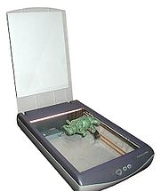
>
In computing, an
image scanner—often abbreviated to just
scanner—is a device that optically scans images, printed text,
handwritingHandwriting is a person's particular & individual style of writing with pen or pencil, which contrasts with "Hand" which is an impersonal and formalised writing style in several historical varieties...
, or an object, and converts it to a
digital imageA digital image is a numeric representation of a two-dimensional image. Depending on whether or not the image resolution is fixed, it may be of vector or raster type...
. Common examples found in offices are variations of the
desktop (or flatbed) scanner where the document is placed on a glass window for scanning.
Hand-held scanners, where the device is moved by hand, have evolved from text scanning "wands" to
3D scannerA 3D scanner is a device that analyzes a real-world object or environment to collect data on its shape and possibly its appearance . The collected data can then be used to construct digital, three dimensional models....
s used for industrial design, reverse engineering, test and measurement, orthotics, gaming and other applications. Mechanically driven scanners that move the document are typically used for large-format documents, where a flatbed design would be impractical.
Modern scanners typically use a
charge-coupled deviceA charge-coupled device is a device for the movement of electrical charge, usually from within the device to an area where the charge can be manipulated, for example conversion into a digital value. This is achieved by "shifting" the signals between stages within the device one at a time...
(CCD) or a
Contact Image SensorContact Image Sensors are a relatively recent technological innovation in the field of optical flatbed scanners that are rapidly replacing CCDs in low power and portable applications...
(CIS) as the image sensor, whereas older
drum scanners use a
photomultiplierPhotomultiplier tubes , members of the class of vacuum tubes, and more specifically phototubes, are extremely sensitive detectors of light in the ultraviolet, visible, and near-infrared ranges of the electromagnetic spectrum...
tube as the image sensor. A
rotary scanner, used for high-speed document scanning, is another type of drum scanner, using a CCD array instead of a photomultiplier. Other types of scanners are
planetary scannerA planetary scanner is a type of image scanner for making scans of rare books and other easily damaged documents. In essence, such a scanner is a mounted camera taking photos of a well-lit environment...
s, which take photographs of books and documents, and 3D scanners, for producing three-dimensional models of objects.
Another category of scanner is
digital cameraA digital camera is a camera that takes video or still photographs, or both, digitally by recording images via an electronic image sensor. It is the main device used in the field of digital photography...
scanners, which are based on the concept of
reprographicReprography is the reproduction of graphics through mechanical or electrical means, such as photography or xerography. Reprography is commonly used in catalogs and archives, as well as in the architectural, engineering, and construction industries....
cameras. Due to increasing resolution and new features such as anti-shake, digital cameras have become an attractive alternative to regular scanners. While still having disadvantages compared to traditional scanners (such as distortion, reflections, shadows, low contrast), digital cameras offer advantages such as speed, portability and gentle digitizing of thick documents without damaging the book spine. New scanning technologies are combining 3D scanners with digital cameras to create full-color, photo-realistic 3D models of objects.
In the biomedical research area, detection devices for DNA microarrays are called scanners as well. These scanners are high-resolution systems (up to 1 µm/ pixel), similar to microscopes. The detection is done via CCD or a
photomultiplierPhotomultiplier tubes , members of the class of vacuum tubes, and more specifically phototubes, are extremely sensitive detectors of light in the ultraviolet, visible, and near-infrared ranges of the electromagnetic spectrum...
tube (PMT).
Historical precedent
Modern scanners may be considered the successors of early telephotography and
faxFax , sometimes called telecopying, is the telephonic transmission of scanned printed material , normally to a telephone number connected to a printer or other output device...
input devices, consisting of a rotating drum with a single photodetector at a standard speed of 60 or 120 rpm (later models up to 240 rpm). They send a linear analog
AM signalAmplitude modulation is a technique used in electronic communication, most commonly for transmitting information via a radio carrier wave. AM works by varying the strength of the transmitted signal in relation to the information being sent...
through standard telephone voice lines to receptors, which synchronously print the proportional intensity on special paper. This system was in use in press from the 1920s to the mid-1990s. Color photos were sent as three separated
RGBThe RGB color model is an additive color model in which red, green, and blue light is added together in various ways to reproduce a broad array of colors...
filtered images consecutively, but only for special events due to transmission costs.
Drum
Drum scanners capture image information with
photomultiplier tubesPhotomultiplier tubes , members of the class of vacuum tubes, and more specifically phototubes, are extremely sensitive detectors of light in the ultraviolet, visible, and near-infrared ranges of the electromagnetic spectrum...
(PMT), rather than the
charge-coupled deviceA charge-coupled device is a device for the movement of electrical charge, usually from within the device to an area where the charge can be manipulated, for example conversion into a digital value. This is achieved by "shifting" the signals between stages within the device one at a time...
(CCD) arrays found in flatbed scanners and inexpensive
film scannerA film scanner is a device made for scanning photographic film directly into a computer without the use of any intermediate printmaking. It provides several benefits over using a flatbed scanner to scan in a print of any size: the photographer has direct control over cropping and aspect ratio from...
s. Reflective and transmissive originals are mounted on an acrylic cylinder, the scanner drum, which rotates at high speed while it passes the object being scanned in front of precision optics that deliver image information to the PMTs. Most modern color drum scanners use three matched PMTs, which read red, blue, and green light, respectively. Light from the original artwork is split into separate red, blue, and green beams in the optical bench of the scanner.
The drum scanner gets its name from the clear acrylic cylinder, the drum, on which the original artwork is mounted for scanning. Depending on size, it is possible to mount originals up to 11"x17", but maximum size varies by manufacturer. One of the unique features of drum scanners is the ability to control sample area and aperture size independently. The sample size is the area that the scanner encoder reads to create an individual pixel. The aperture is the actual opening that allows light into the optical bench of the scanner. The ability to control aperture and sample size separately is particularly useful for smoothing film grain when scanning black-and white and color negative originals.
While drum scanners are capable of scanning both reflective and transmissive artwork, a good-quality flatbed scanner can produce good scans from reflective artwork. As a result, drum scanners are rarely used to scan prints now that high-quality, inexpensive flatbed scanners are readily available. Film, however, is where drum scanners continue to be the tool of choice for high-end applications. Because film can be wet-mounted to the scanner drum and because of the exceptional sensitivity of the PMTs, drum scanners are capable of capturing very subtle details in film originals.
Only a few companies continue to manufacture drum scanners. While prices of both new and used units have come down over the last decade, they still require a considerable monetary investment when compared to CCD flatbed and film scanners. However, drum scanners remain in demand due to their capacity to produce scans that are superior in resolution, color gradation, and value structure. Also, because drum scanners are capable of resolutions up to 24,000
PPIPixels per inch or pixel density is a measurement of the resolution of devices in various contexts; typically computer displays, image scanners, and digital camera image sensors....
, their use is generally recommended when a scanned image is going to be enlarged.
In most graphic-arts operations, very-high-quality flatbed scanners have replaced drum scanners, being both less expensive and faster. However, drum scanners continue to be used in high-end applications, such as museum-quality archiving of photographs and print production of high-quality books and magazine advertisements. In addition, due to the greater availability of pre-owned units, many fine-art photographers are acquiring drum scanners, which has created a new niche market for the machines.
The first image scanner developed for use with a computer, was a drum scanner. It was built in 1957 at the US National Bureau of Standards by a team led by
Russell A. KirschRussell A. Kirsch led a team of colleagues in creating America’s first internally programmable computer, the Standards Eastern Automatic Computer , capable of scanning digital images in 1957. SEAC produced a photograph of Kirsch’s three month old son in a mere 176 pixels, measuring 5x5cm...
. The first image ever scanned on this machine was a 5 cm square photograph of Kirsch's then-three-month-old son, Walden. The black and white image had a resolution of 176
pixelIn digital imaging, a pixel, or pel, is a single point in a raster image, or the smallest addressable screen element in a display device; it is the smallest unit of picture that can be represented or controlled....
s on a side.
CCD Scanner
A flatbed scanner is usually composed of a glass pane (or
platenA platen is typically a flat metal plate pressed against a medium to cause an impression in letterpress printing...
), under which there is a bright light (often
xenonXenon is a chemical element with the symbol Xe and atomic number 54. The element name is pronounced or . A colorless, heavy, odorless noble gas, xenon occurs in the Earth's atmosphere in trace amounts...
or
cold cathode fluorescentA cold cathode is a cathode used within nixie tubes, gas discharge lamps, discharge tubes, and some types of vacuum tube which is not electrically heated by the circuit to which it is connected...
) which illuminates the pane, and a moving optical array in
CCDA charge-coupled device is a device for the movement of electrical charge, usually from within the device to an area where the charge can be manipulated, for example conversion into a digital value. This is achieved by "shifting" the signals between stages within the device one at a time...
scanning. CCD-type scanners typically contain three rows (arrays) of sensors with red, green, and blue filters.
CIS Scanner
CISContact Image Sensors are a relatively recent technological innovation in the field of optical flatbed scanners that are rapidly replacing CCDs in low power and portable applications...
scanning consists of a moving set of red, green and blue
LEDLEd is a TeX/LaTeX editing software working under Microsoft Windows. It is a freeware product....
s strobed for illumination and a connected monochromatic
photodiodeA photodiode is a type of photodetector capable of converting light into either current or voltage, depending upon the mode of operation.The common, traditional solar cell used to generateelectric solar power is a large area photodiode....
array for light collection. Images to be scanned are placed face down on the glass, an opaque cover is lowered over it to exclude ambient light, and the sensor array and light source move across the pane, reading the entire area. An image is therefore visible to the detector only because of the light it reflects. Transparent images do not work in this way, and require special accessories that illuminate them from the upper side. Many scanners offer this as an option.
Film
"Slide" (positive) or
negativeIn photography, a negative may refer to three different things, although they are all related.-A negative:Film for 35 mm cameras comes in long narrow strips of chemical-coated plastic or cellulose acetate. As each image is captured by the camera onto the film strip, the film strip advances so that...
film can be scanned in equipment specially manufactured for this purpose. Usually, uncut film strips of up to six frames, or four mounted slides, are inserted in a carrier, which is moved by a
stepper motorA stepper motor is a brushless, electric motor that can divide a full rotation into a large number of steps. The motor's position can be controlled precisely without any feedback mechanism , as long as the motor is carefully sized to the application...
across a lens and CCD sensor inside the scanner. Some models mainly used for same-size scans. Film scanners vary a great deal in price and quality. Consumer scanners are relatively inexpensive while the most expensive professional CCD based film scanning system was around 120,000 USD. More expensive solutions are said to produce better results.
Hand
Hand scanners come in two forms: document and 3D scanners. Hand held document scanners are manual devices that are dragged across the surface of the image to be scanned. Scanning documents in this manner requires a steady hand, as an uneven scanning rate would produce distorted images - a little light on the scanner would indicate if the motion was too fast. They typically have a "start" button, which is held by the user for the duration of the scan; some switches to set the
optical resolutionOptical resolution describes the ability of an imaging system to resolve detail in the object that is being imaged.An imaging system may have many individual components including a lens and recording and display components...
; and a roller, which generates a clock pulse for synchronization with the computer. Most hand scanners were
monochromeMonochrome describes paintings, drawings, design, or photographs in one color or shades of one color. A monochromatic object or image has colors in shades of limited colors or hues. Images using only shades of grey are called grayscale or black-and-white...
, and produced light from an array of green
LEDLEd is a TeX/LaTeX editing software working under Microsoft Windows. It is a freeware product....
s to illuminate the image. A typical hand scanner also had a small window through which the document being scanned could be viewed. They were popular during the early 1990s and usually had a proprietary interface module specific to a particular type of computer, usually an
Atari STThe Atari ST is a home/personal computer that was released by Atari Corporation in 1985 and commercially available from that summer into the early 1990s. The "ST" officially stands for "Sixteen/Thirty-two", which referred to the Motorola 68000's 16-bit external bus and 32-bit internals...
or Commodore
AmigaThe Amiga is a family of personal computers that was sold by Commodore in the 1980s and 1990s. The first model was launched in 1985 as a high-end home computer and became popular for its graphical, audio and multi-tasking abilities...
.
While popularity for document scanning has waned, use of hand held 3D scanners remains popular for many applications, including industrial design, reverse engineering, inspection & analysis, digital manufacturing and medical applications. To compensate for the uneven motion of the human hand, most 3D scanning systems rely on the placement of reference markers – typically adhesive reflective tabs that the scanner uses to align elements and mark positions in space.
Desktop digital camera scanner
One printer manufacturer (Lexmark) has introduced all-in-one printer which is provided with a desktop digital camera scanner that has 10 megapixel image sensors. For scanning a business card or a full 8.5x11 inch image, it takes not more than 3 seconds including the processing time.
Smartphone scanner apps
Cameras in smartphones have reached a resolution and quality that reasonable quality scans can be achieved by taking a photo with the phone and using a scanning app for post-processing (such as whitening the background of a page, correcting perspective distortion so that a document is output as a correct rectangle, conversion to black-and-white, etc.)
Most smartphone platforms now have a range of scanner apps available. These apps can typically scan multiple page documents through the use of multiple camera exposures, and output them to a PDF document or as separate JPEG images. Some smartphone scanning apps can also save documents directly to online storage locations such as Dropbox, Evernote, send via email or fax documents via email-to-fax gateways.
Quality
Scanners typically read
red-green-blue colorThe RGB color model is an additive color model in which red, green, and blue light is added together in various ways to reproduce a broad array of colors...
(RGB) data from the array. This data is then processed with some proprietary algorithm to correct for different exposure conditions, and sent to the computer via the device's
input/outputIn computing, input/output, or I/O, refers to the communication between an information processing system , and the outside world, possibly a human, or another information processing system. Inputs are the signals or data received by the system, and outputs are the signals or data sent from it...
interface (usually USB, previous to which was
SCSISmall Computer System Interface is a set of standards for physically connecting and transferring data between computers and peripheral devices. The SCSI standards define commands, protocols, and electrical and optical interfaces. SCSI is most commonly used for hard disks and tape drives, but it...
or bidirectional
parallel portA parallel port is a type of interface found on computers for connecting various peripherals. In computing, a parallel port is a parallel communication physical interface. It is also known as a printer port or Centronics port...
in older units).
Color depthIn computer graphics, color depth or bit depth is the number of bits used to represent the color of a single pixel in a bitmapped image or video frame buffer. This concept is also known as bits per pixel , particularly when specified along with the number of bits used...
varies depending on the scanning array characteristics, but is usually at least 24 bits. High quality models have 36-48 bits of color depth.
Another qualifying parameter for a scanner is its
resolutionImage resolution is an umbrella term that describes the detail an image holds. The term applies to raster digital images, film images, and other types of images. Higher resolution means more image detail....
, measured in
pixels per inchPixels per inch or pixel density is a measurement of the resolution of devices in various contexts; typically computer displays, image scanners, and digital camera image sensors....
(ppi), sometimes more accurately referred to as
Samples per inchSamples per inch is a measurement of the resolution of an image scanner, in particular the number of individual samples that are taken in the space of one linear inch. It is sometimes misreferred to as dots per inch, though that term more accurately refers to printing resolution...
(spi). Instead of using the scanner's true
optical resolution, the only meaningful parameter, manufacturers like to refer to the
interpolated resolution, which is much higher thanks to software
interpolationIn the mathematical field of numerical analysis, interpolation is a method of constructing new data points within the range of a discrete set of known data points....
. , a high-end flatbed scanner can scan up to 5400 ppi and drum scanners have an optical resolution of between 3,000 and 24,000 ppi.
Manufacturers often claim interpolated resolutions as high as 19,200 ppi; but such numbers carry little meaningful value, because the number of possible
interpolated pixelsDigital zoom is a method of decreasing the apparent angle of view of a digital photographic or video image. Digital zoom is accomplished by cropping an image down to a centered area with the same aspect ratio as the original, and usually also interpolating the result back up to the pixel...
is unlimited and doing so does not increase the level of captured detail.
The size of the file created increases with the square of the resolution; doubling the resolution quadruples the file size. A resolution must be chosen that is within the capabilities of the equipment, preserves sufficient detail, and does not produce a file of excessive size. The file size can be reduced for a given resolution by using "lossy" compression methods such as
JPEGIn computing, JPEG . The degree of compression can be adjusted, allowing a selectable tradeoff between storage size and image quality. JPEG typically achieves 10:1 compression with little perceptible loss in image quality....
, at some cost in quality. If the best possible quality is required lossless compression should be used; reduced-quality files of smaller size can be produced from such an image when required (e.g., image designed to be printed on a full page, and a much smaller file to be displayed as part of a fast-loading web page).
Purity can be diminished by scanner noise, optical flare, poor analog to digital conversion, scratches, dust, Newton rings, out of focus sensors, improper scanner operation, and poor software. Drum scanners are said to produce the purest digital representations of the film, followed by high end film scanners that use the larger Kodak Tri-Linear sensors.
The third important parameter for a scanner is its
density range or Drange (see
DensitometryDensitometry is the quantitative measurement of optical density in light-sensitive materials, such as photographic paper or film, due to exposure to light...
). A high density range means that the scanner is able to record shadow details and brightness details in one scan. Density of film is measured on a base 10 log scale and varies between 0.0 (transparent) and 4.0, about 13 stops. The maximum density of negative film is up to 3.0d (density), while slide film can reach 4.0d. Slower film can reach higher density than faster film. Consumer level flatbed scanners have a Drange in the 2.5-3.0 range, adequate for negative film. High end flatbed scanners can reach a Drange of 3.7. Drum scanners have a Drange of 3.6-4.5.
By combining full-color imagery with 3D models, modern hand-held scanners are able to completely reproduce objects electronically. The addition of 3D color printers enables accurate miniaturization of these objects, with applications across many industries and professions.
Computer connection
Scanning the document is only one part of the process. For the scanned image to be useful, it must be transferred from the scanner to an application running on the computer. There are two basic issues: (1) how the scanner is physically connected to the computer and (2) how the application retrieves the information from the scanner.
Direct physical connection to a computer
The amount of data generated by a scanner can be very large: a (9"x11") (slightly larger than A4 paper) uncompressed
24-bitIn computer graphics, color depth or bit depth is the number of bits used to represent the color of a single pixel in a bitmapped image or video frame buffer. This concept is also known as bits per pixel , particularly when specified along with the number of bits used...
image is about 100
megabyteThe megabyte is a multiple of the unit byte for digital information storage or transmission with two different values depending on context: bytes generally for computer memory; and one million bytes generally for computer storage. The IEEE Standards Board has decided that "Mega will mean 1 000...
s of data which must be transferred and stored. Recent scanners can generate this volume of data in a matter of seconds, making a fast connection desirable.
Scanners communicate to their host computer using one of the following physical interfaces, listing from slow to fast:
- Parallel port
A parallel port is a type of interface found on computers for connecting various peripherals. In computing, a parallel port is a parallel communication physical interface. It is also known as a printer port or Centronics port...
- Connecting through a parallel port is the slowest common transfer method. Early scanners had parallel port connections that could not transfer data faster than 70 kilobyteThe kilobyte is a multiple of the unit byte for digital information. Although the prefix kilo- means 1000, the term kilobyte and symbol KB have historically been used to refer to either 1024 bytes or 1000 bytes, dependent upon context, in the fields of computer science and information...
s/secondThe second is a unit of measurement of time, and is the International System of Units base unit of time. It may be measured using a clock....
. The primary advantage of the parallel port connection was economic and user skill level: it avoided adding an interface card to the computer.
- GPIB - General Purpose Interface Bus. Certain drumscanners like the Howtek D4000 featured both a SCSI and GPIB interface. The latter conforms to the IEEE-488 standard, introduced in the mid ’70's. The GPIB-interface has only been used by a few scanner manufactures, mostly serving the DOS/Windows environment. For Apple Macintosh systems, National Instruments provided a NuBus
NuBus is a 32-bit parallel computer bus, originally developed at MIT as a part of the NuMachine workstation project. The first complete implementation of the NuBus and the NuMachine was done by Western Digital for their NuMachine, and for the Lisp Machines Inc. LMI-Lambda. The NuBus was later...
GPIB interface card.
- Small Computer System Interface (SCSI)
Small Computer System Interface is a set of standards for physically connecting and transferring data between computers and peripheral devices. The SCSI standards define commands, protocols, and electrical and optical interfaces. SCSI is most commonly used for hard disks and tape drives, but it...
, which is supported by most computers only via an additional SCSI interface card. Some SCSI scanners are supplied together with a dedicated SCSI card for a PC, although any SCSI controller can be used. During the evolution of the SCSI standard speeds increased, with backwards compatibility; a SCSI connection can transfer data at the highest speed which both the controller and the device support. SCSI has been largely replaced by USB and Firewire, one or both of which are directly supported by most computers, and which are easier to set up than SCSI.
- Universal Serial Bus (USB) scanners can transfer data quickly, and they are easier to use and cheaper than SCSI devices. The early USB 1.1 standard could transfer data at only 1.5 megabytes per second (slower than SCSI), but the later USB 2.0 standard can theoretically transfer up to 60 megabytes per second (although everyday rates are much lower), resulting in faster operation.
- FireWire is an interface that is much faster than USB 1.1 and comparable to USB 2.0. FireWire speeds are 25, 50, and 100, 400 and 800 megabits per second (but a device may not support all speeds). Also known as: IEEE-1394.
- Proprietary
Proprietary hardware is computer hardware which is owned by the proprietor.Historically, most early computer hardware was designed as proprietary until the 1980s, when IBM PC changed this paradigm...
interfaces were used on some early scanners that used a proprietary interface card rather than a standard interface.
Indirect (network) connection to a computer
During the early nineties, professional flatbed scanners were targeted to professional users. Some vendors (like Umax) allowed a single scanner connected to a host computer to function as a scanner accessible by all users within a local computer network. This proved to be very handy to e.g. publishers, print shops, etc. This functionality gradually disappeared after the mid-’90's as flatbed scanners became more affordable each year.
However, as of 2000 and later, all-in-one multi-purpose devices targeted to serve both (small) offices and consumers usually combine a printer, scanner, copier and fax into a single apparatus available to a whole workgroup, providing each individual fax, scan, copy and print functionality.
Applications Programming Interface
A paint application such as
GIMPGIMP is a free software raster graphics editor. It is primarily employed as an image retouching and editing tool and is freely available in versions tailored for most popular operating systems including Microsoft Windows, Apple Mac OS X, and Linux.In addition to detailed image retouching and...
or Adobe Photoshop must communicate with the scanner. There are many different scanners, and many of those scanners use different protocols. In order to simplify applications programming, some Applications Programming Interfaces ("API") were developed. The API presents a uniform interface to the scanner. This means that the application does not need to know the specific details of the scanner in order to access it directly. For example, Adobe Photoshop supports the
TWAINTWAIN is a standard software protocol and applications programming interface that regulates communication between software applications and imaging devices such as scanners and digital cameras....
standard; therefore in theory Photoshop can acquire an image from any scanner that also supports TWAIN.
In practice, there are often problems with an application communicating with a scanner. Either the application or the scanner manufacturer (or both) may have faults in their implementation of the API.
Typically, the API is implemented as a dynamically linked library. Each scanner manufacturer provides software that translates the API procedure calls into primitive commands that are issued to a hardware controller (such as the SCSI, USB, or FireWire controller). The manufacturer's part of the API is commonly called a
device driverIn computing, a device driver or software driver is a computer program allowing higher-level computer programs to interact with a hardware device....
, but that designation is not strictly accurate: the API does not run in kernel mode and does not directly access the device. Rather the scanner API library translates application requests into hardware requests.
Common scanner software API interfaces:
SANEScanner Access Now Easy is an application programming interface that provides standardized access to any raster image scanner hardware ....
(Scanner Access Now Easy) is a
freeFree software, software libre or libre software is software that can be used, studied, and modified without restriction, and which can be copied and redistributed in modified or unmodified form either without restriction, or with restrictions that only ensure that further recipients can also do...
/
open sourceThe term open source describes practices in production and development that promote access to the end product's source materials. Some consider open source a philosophy, others consider it a pragmatic methodology...
API for accessing scanners. Originally developed for
UnixUnix is a multitasking, multi-user computer operating system originally developed in 1969 by a group of AT&T employees at Bell Labs, including Ken Thompson, Dennis Ritchie, Brian Kernighan, Douglas McIlroy, and Joe Ossanna...
and
LinuxLinux is a Unix-like computer operating system assembled under the model of free and open source software development and distribution. The defining component of any Linux system is the Linux kernel, an operating system kernel first released October 5, 1991 by Linus Torvalds...
operating systems, it has been ported to
OS/2OS/2 is a computer operating system, initially created by Microsoft and IBM, then later developed by IBM exclusively. The name stands for "Operating System/2," because it was introduced as part of the same generation change release as IBM's "Personal System/2 " line of second-generation personal...
,
Mac OS XMac OS X is a series of Unix-based operating systems and graphical user interfaces developed, marketed, and sold by Apple Inc. Since 2002, has been included with all new Macintosh computer systems...
, and
Microsoft WindowsMicrosoft Windows is a series of operating systems produced by Microsoft.Microsoft introduced an operating environment named Windows on November 20, 1985 as an add-on to MS-DOS in response to the growing interest in graphical user interfaces . Microsoft Windows came to dominate the world's personal...
. Unlike TWAIN, SANE does not handle the user interface. This allows batch scans and transparent network access without any special support from the device driver.
TWAINTWAIN is a standard software protocol and applications programming interface that regulates communication between software applications and imaging devices such as scanners and digital cameras....
is used by most scanners. Originally used for low-end and home-use equipment, it is now widely used for large-volume scanning.
ISIS (Image and Scanner Interface Specification) created by Pixel Translations, which still uses SCSI-II for performance reasons, is used by large, departmental-scale, machines.
WIAWindows Image Acquisition is a Microsoft driver model and application programming interface for Microsoft Windows Me and later Windows operating systems that enables graphics software to communicate with imaging hardware such as scanners, digital cameras and Digital Video-equipment...
(Windows Image Acquisition) is an API provided by Microsoft.
Bundled applications
Although no software beyond a scanning utility is a feature of any scanner, many scanners come bundled with software. Typically, in addition to the scanning utility, some type of image-editing application (such as Photoshop), and
optical character recognitionOptical character recognition, usually abbreviated to OCR, is the mechanical or electronic translation of scanned images of handwritten, typewritten or printed text into machine-encoded text. It is widely used to convert books and documents into electronic files, to computerize a record-keeping...
(OCR) software are supplied. OCR software converts graphical images of text into standard text that can be edited using common word-processing and text-editing software; accuracy is rarely perfect.
Output data
The scanned result is a non-compressed RGB image, which can be transferred to a computer's memory. Some scanners compress and clean up the image using embedded
firmwareIn electronic systems and computing, firmware is a term often used to denote the fixed, usually rather small, programs and/or data structures that internally control various electronic devices...
. Once on the computer, the image can be processed with a
raster graphicsIn computer graphics, a raster graphics image, or bitmap, is a data structure representing a generally rectangular grid of pixels, or points of color, viewable via a monitor, paper, or other display medium...
program (such as Photoshop or the
GIMPGIMP is a free software raster graphics editor. It is primarily employed as an image retouching and editing tool and is freely available in versions tailored for most popular operating systems including Microsoft Windows, Apple Mac OS X, and Linux.In addition to detailed image retouching and...
) and saved on a storage device (such as a
hard diskA hard disk drive is a non-volatile, random access digital magnetic data storage device. It features rotating rigid platters on a motor-driven spindle within a protective enclosure. Data is magnetically read from and written to the platter by read/write heads that float on a film of air above the...
).
Images are usually stored on a
hard diskA hard disk drive is a non-volatile, random access digital magnetic data storage device. It features rotating rigid platters on a motor-driven spindle within a protective enclosure. Data is magnetically read from and written to the platter by read/write heads that float on a film of air above the...
. Pictures are normally stored in image formats such as uncompressed
BitmapIn computer graphics, a bitmap or pixmap is a type of memory organization or image file format used to store digital images. The term bitmap comes from the computer programming terminology, meaning just a map of bits, a spatially mapped array of bits. Now, along with pixmap, it commonly refers to...
, "non-lossy" (lossless) compressed TIFF and PNG, and "lossy" compressed
JPEGIn computing, JPEG . The degree of compression can be adjusted, allowing a selectable tradeoff between storage size and image quality. JPEG typically achieves 10:1 compression with little perceptible loss in image quality....
. Documents are best stored in TIFF or PDF format; JPEG is particularly unsuitable for text.
Optical character recognitionOptical character recognition, usually abbreviated to OCR, is the mechanical or electronic translation of scanned images of handwritten, typewritten or printed text into machine-encoded text. It is widely used to convert books and documents into electronic files, to computerize a record-keeping...
(OCR) software allows a scanned image of text to be converted into editable text with reasonable accuracy, so long as the text is cleanly printed and in a typeface and size that can be read by the software. OCR capability may be integrated into the scanning software, or the scanned image file can be processed with a separate OCR program.
Document processing
The scanning or digitization of paper documents for storage makes different requirements of the scanning equipment used than scanning of pictures for reproduction. While documents can be scanned on general-purpose scanners, it is more efficiently performed on dedicated document scanners.
When scanning large quantities of documents, speed and paper-handling is very important, but the resolution of the scan will normally be much lower than for good reproduction of pictures.
Document scanners have
document feedersIn multifunction or all-in-one printers, fax machines, photocopiers and scanners, an automatic document feeder or ADF is a feature which takes several pages and feeds the paper one page at a time into a scanner or copier, allowing the user to scan, and thereby copy, print, or fax, multiple-page...
, usually larger than those sometimes found on copiers or all-purpose scanners. Scans are made at high speed, perhaps 20 to 150 pages per minute, often in grayscale, although many scanners support color. Many scanners can scan both sides of double-sided originals (duplex operation). Sophisticated document scanners have
firmwareIn electronic systems and computing, firmware is a term often used to denote the fixed, usually rather small, programs and/or data structures that internally control various electronic devices...
or software that cleans up scans of text as they are produced, eliminating accidental marks and sharpening type; this would be unacceptable for photographic work, where marks cannot reliably be distinguished from desired fine detail. Files created are compressed as they are made.
The resolution used is usually from 150 to 300
dpiDots per inch is a measure of spatial printing or video dot density, in particular the number of individual dots that can be placed in a line within the span of 1 inch . The DPI value tends to correlate with image resolution, but is related only indirectly.- DPI measurement in monitor...
, although the hardware may be capable of somewhat higher resolution; this produces images of text good enough to read and for
optical character recognitionOptical character recognition, usually abbreviated to OCR, is the mechanical or electronic translation of scanned images of handwritten, typewritten or printed text into machine-encoded text. It is widely used to convert books and documents into electronic files, to computerize a record-keeping...
(OCR), without the higher demands on storage space required by higher-resolution images.
Document scans are often processed using
OCROptical character recognition, usually abbreviated to OCR, is the mechanical or electronic translation of scanned images of handwritten, typewritten or printed text into machine-encoded text. It is widely used to convert books and documents into electronic files, to computerize a record-keeping...
technology to create editable and searchable files. Most scanners use
ISISISIS is an industry standard interface for image scanning technologies, developed by Pixel Translations in 1990 ....
or
TWAINTWAIN is a standard software protocol and applications programming interface that regulates communication between software applications and imaging devices such as scanners and digital cameras....
device drivers to scan documents into TIFF format so that the scanned pages can be fed into a
document management systemA document management system is a computer system used to track and store electronic documents and/or images of paper documents. It is usually also capable of keeping track of the different versions created by different users . The term has some overlap with the concepts of content management...
that will handle the archiving and retrieval of the scanned pages. Lossy JPEG compression, which is very efficient for pictures, is undesirable for text documents, as slanted straight edges take on a jagged appearance, and solid black (or other color) text on a light background compresses well with lossless compression formats.
While paper feeding and scanning can be done automatically and quickly, preparation and indexing are necessary and require much work by humans. Preparation involves manually inspecting the papers to be scanned and making sure that they are in order, unfolded, without staples or anything else that might jam the scanner. Additionally, some industries such as legal and medical may require documents to have
Bates NumberingBates numbering is used in the legal, medical, and business fields to place identifying numbers and/or date/time-marks on images and documents as they are scanned or processed...
or some other mark giving a document identification number and date/time of the document scan.
Indexing involves associating relevant keywords to files so that they can be retrieved by content. This process can sometimes be automated to some extent, but it often requires manual labour performed by
data-entry clerksA data entry clerk, sometimes called a typist, is a member of staff employed to type data into a database using a keyboard. The keyboards used can often have specialist keys and multiple colours to help them in the task and speed up the work.-Examples:...
. One common practice is the use of
barcodeA barcode is an optical machine-readable representation of data, which shows data about the object to which it attaches. Originally barcodes represented data by varying the widths and spacings of parallel lines, and may be referred to as linear or 1 dimensional . Later they evolved into rectangles,...
-recognition technology: during preparation, barcode sheets with folder names or index information are inserted into the document files, folders, and document groups. Using automatic batch scanning, the documents are saved into appropriate folders, and an index is created for integration into
document-management systemsA document management system is a computer system used to track and store electronic documents and/or images of paper documents. It is usually also capable of keeping track of the different versions created by different users . The term has some overlap with the concepts of content management...
.
A specialized form of document scanning is
book scanningBook scanning is the process of converting physical books and magazines into digital media such as images, electronic text, or electronic books by using an image scanner....
. Technical difficulties arise from the books usually being bound and sometimes fragile and irreplaceable, but some manufacturers have developed specialized machinery to deal with this. Often special
roboticRobotics is the branch of technology that deals with the design, construction, operation, structural disposition, manufacture and application of robots...
mechanisms are used to automate the page turning and scanning process.
Infrared cleaning
Infrared cleaning is a technique used to remove dust and scratches from film, and most modern scanners incorporate this feature. It works by scanning the film with infrared light. From this, it is possible to detect dust and scratches that cut off the infrared light; and they can then be automatically removed, by considering their position, size, shape, and surroundings.
Scanner manufacturers usually have their own name attached to this technique. For example, Epson,
Nikon , also known as just Nikon, is a multinational corporation headquartered in Tokyo, Japan, specializing in optics and imaging. Its products include cameras, binoculars, microscopes, measurement instruments, and the steppers used in the photolithography steps of semiconductor fabrication, of which...
,
MicrotekMicrotek International Inc. is a Taiwan-based manufacturer of digital imaging products and other consumer electronics. Among its current product line are Microtek branded plasma and LCD TVs, LCD flat panel monitors, LCD and DLP projectors, and digital cameras as well as their flagship line of...
, and others use
Digital ICEDigital Image Correction and Enhancement is a set of technologies related to producing an altered image in a variety of frequency spectra. The objective of these technologies is to render an image more usable by Fourier or other filtering techniques...
, while
Canonis a Japanese multinational corporation that specialises in the manufacture of imaging and optical products, including cameras, camcorders, photocopiers, steppers and computer printers. Its headquarters are located in Ōta, Tokyo, Japan.-Origins:...
uses its own system FARE (Film Automatic Retouching and Enhancement system). Some independent software developers are designing their own infrared cleaning tools.
Scanner Music
Flatbed scanners are capable of synthesising simple musical scores, due to the variable speed (and tone) of their
stepper motorA stepper motor is a brushless, electric motor that can divide a full rotation into a large number of steps. The motor's position can be controlled precisely without any feedback mechanism , as long as the motor is carefully sized to the application...
s. This property can be applied for hardware diagnostics: for example the HP Scanjet 5 plays
Ode to Joy"Ode to Joy" is an ode written in 1785 by the German poet, playwright and historian Friedrich Schiller, enthusiastically celebrating the brotherhood and unity of all mankind...
if powered on with the Scan button held down and the SCSI ID set to zero. Windows- and Linux-based software is available for several brands and types of flatbed scanners to play MIDI files for fun purposes.
Scanner art
Scanner art is
artArt is the product or process of deliberately arranging items in a way that influences and affects one or more of the senses, emotions, and intellect....
made by placing objects on a flatbed scanner and scanning them. There has been some debate as to whether scanner art is a form of
digital photographyDigital photography is a form of photography that uses an array of light sensitive sensors to capture the image focused by the lens, as opposed to an exposure on light sensitive film...
. Images made with a scanner differ from those made with a camera, as the scanner has very little
depth of fieldIn optics, particularly as it relates to film and photography, depth of field is the distance between the nearest and farthest objects in a scene that appear acceptably sharp in an image...
and a constant light all over the surface.
See also
- Barcode reader
A barcode reader is an electronic device for reading printed barcodes. Like a flatbed scanner, it consists of a light source, a lens and a light sensor translating optical impulses into electrical ones...
- Book scanning
Book scanning is the process of converting physical books and magazines into digital media such as images, electronic text, or electronic books by using an image scanner....
- Cintel
Cintel International Ltd is a British company, based in Ware, Hertfordshire,SG12 0AE, which specialises in the design and manufacture of professional post-production equipment, for transcribing film into video or data formats...
telecine equipment
- Display resolution
The display resolution of a digital television or display device is the number of distinct pixels in each dimension that can be displayed. It can be an ambiguous term especially as the displayed resolution is controlled by all different factors in cathode ray tube , flat panel or projection...
- Gamma correction
Gamma correction, gamma nonlinearity, gamma encoding, or often simply gamma, is the name of a nonlinear operation used to code and decode luminance or tristimulus values in video or still image systems...
- Telecine
Telecine is transferring motion picture film into video and is performed in a color suite. The term is also used to refer to the equipment used in the post-production process....
External links