


Xerography

Encyclopedia
Xerography is a dry photocopying
technique invented
by Chester Carlson
in 1938, for which he was awarded on October 6, 1942. Carlson originally called his invention electrophotography. It was later renamed xerography—from the Greek
roots
ξηρός xeros "dry" and -γραφία -graphia "writing"—to emphasize that, unlike reproduction techniques then in use such as cyanotype
, this process used no liquid chemicals.
Although Georg Christoph Lichtenberg
invented a dry electrostatic printing
process in 1778, Carlson's innovation combined electrostatic printing with photography
. Carlson's original process was cumbersome, requiring several manual processing steps with flat plates. It was almost 18 years before a fully automated process was developed, the key breakthrough being use of a cylindrical
drum coated with selenium
instead of a flat plate. This resulted in the first commercial automatic copier, the Xerox 914, being released by Haloid/Xerox
in 1960. Before that year Carlson proposed his idea to more than a dozen companies, but they all were not interested in it. Xerography is now used in most photocopying machines and in laser
and LED printer
s. This invention also marked the final rules of copyright, making it very easy to duplicate documents. Another important feature of this printing process, as a digital printing, is that the total cost on little edition sizes is less than the offset printing one. It is also possible to have a variable data on each paper, to personalize them.
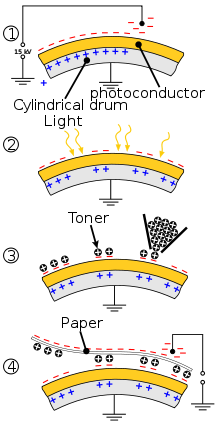 The first commercial use was hand processing of a flat photosensor (an electronic component that detects the presence of visible light) with a copy camera and a separate processing unit to produce offset lithographic plates. Today this technology is used in photocopy machines, laser printers, and digital presses such as Xerox iGen3 and Xeikon presses which are slowly replacing many traditional offset presses in the printing industry for shorter runs.
By using a cylinder to carry the photosensor, automatic processing was enabled. In 1960 the automatic photocopier
was created and many millions have been built since. The same process is used in microform
printers and computer output laser
or LED printer
s.
The steps of the process are described below as applied on a cylinder, as in a photocopier. Some variants are described within the text. Every step of the process has design variants.
A metal cylinder is mounted to rotate about a horizontal axis. This is called the drum. The end-to-end dimension is the width of print to be produced plus a generous tolerance. The drums in the copiers originally developed by Xerox Corporation were manufactured with a surface coating of amorphous
selenium
(more recently ceramic or organic photo-conductor or OPC), applied by vacuum deposition. Amorphous selenium will hold an electrostatic charge in darkness and will conduct away such a charge under light. In the 1970s, IBM Corporation sought to avoid Xerox's patents for selenium drums by developing organic photoconductors as an alternative to the selenium drum. In the organic system, photocopiers that rely on silicon or selenium (and its alloys) are charged positive and use negative toner. Photo-conductors using organic compounds (e.g., zinc oxide or cadmium sulfide) are vice versa. Organic photoconductors are now preferred because they can be deposited on a flexible, oval or triangular belt instead of a round drum.
Laser printer photo drums are made with a doped silicon diode sandwich structure with a hydrogen-doped silicon light chargeable layer, a boron nitride
rectifying (diode causing) layer that minimizes current leakage, as well as a surface layer of silicon doped with oxygen or nitrogen, silicon nitride is a scuff-resistant material.
The drum rotates at the speed of paper output. One revolution passes the drum surface through the steps described below.
Step 1. Charging
An electrostatic charge of −600 volts is uniformly distributed over the surface of the drum by a corona discharge
from a Corona unit (Corotron), with output limited by a control grid or screen. The complete unit is correctly called a Screened Corotron or Scorotron for short. This effect can also be achieved with the use of a contact roller with a charge applied to it. Essentially, a corona discharge is generated by a narrow wire 1/4 to 1/2 inch (6,35 to 12,7 mm) apart from the photoconductor. A negative charge is placed on the wire, which will ionize the space between the wire and conductor, so electrons will be repelled and pushed away onto the conductor. The conductor is set on top of a conducting surface, kept at ground potential.
The polarity is chosen to suit the Positive or Negative process. Positive process is used for producing black on white analogue copies. Negative process is used for producing black on white from negative originals (mainly microfilm) and all digital printing and copying. This is to economize on the use of laser light by the Blackwriting or Write to Black exposure method.
Step 2. Exposure
The document or microform to be copied is illuminated by flash lamps on the platen and either passed over a lens or is scanned by a moving light and lens, such that its image is projected onto and synchronized with the moving drum surface. Where there is text or image on the document, the corresponding area of the drum will remain unlit. Where there is no image the drum will be illuminated and the charge will be dissipated. The charge that remains on the drum after this exposure is a 'latent' image and is a negative of the original document. Alternatively, the image may be Flash Exposed, using a Xenon strobe, onto the surface of the moving drum or belt, fast enough to render a perfect latent image.
Whether in a scanning or a stationary optical system, combinations of lenses and mirrors are used to project the original image on the platen (scanning surface) onto the photoconductor. Additional lenses, with different focal lengths or zooming lenses are utilized to enlarge or reduce the image. The scanning system, though, must change its scanner speed to adapt to elements or reductions.
A drum is inferior to a belt in the sense that although it is simpler than a belt, it must be buffered gradually in parts rolling on the drum. As a result, the belt is more efficient to use one exposure to make a direct passage.
In a laser or LED printer, modulated light is projected onto the drum surface to create the latent image. The modulated light is used only to create the positive image, hence the term "blackwriting".
Step 3. Development
In high-volume copiers, the drum is presented with a slowly turbulent mixture of toner
particles (toner is a powder used in laser printers and photocopies: its early form was carbon powder, then melt-mixed with a polymer) and larger, iron, reusable carrier particles. The carrier particles have a coating which, during agitation, generates a triboelectric charge (a form of static electricity), which attracts a coating of toner particles. In addition, the mix is manipulated with a magnetic roller to present to the surface of the drum or belt a brush of toner. By contact with the carrier each neutral toner particle has an electric charge of polarity opposite to the charge of the latent image on the drum. The charge attracts toner to form a visible image on the drum. To control the amount of toner transferred, a bias voltage is applied to the developer roller to counteract the attraction between toner and latent image.
Where a negative image is required, as when printing from a microform negative, then the toner has the same polarity as the corona in step 1. Electrostatic lines of force drive the toner particles away from the latent image towards the uncharged area, which is the area exposed from the negative.
Early color copiers and printers used multiple copy cycles for each page output, using colored filters and toners. Modern units use only a single scan to four separate, miniature process units, operating simultaneously, each with its own coronas, drum and developer unit.
Step 4. Transfer
Paper is passed between the drum and the transfer corona, which has a polarity that is the opposite of the charge on the toner. The toner image is transferred by a combination of pressure and electrostatic attraction, from the drum to the paper. On many color and high-speed machines, it is common to replace the transfer corona with one or more charged Bias Transfer Rollers (BTRs), which apply greater pressure and produce a higher quality image.
Step 5. Separation or Detack
Electric charges on the paper are partially neutralized by AC from a second corona, usually constructed in tandem with the transfer corona and immediately after it. As a result, the paper, complete with most (but not all) of the toner image, is separated from the drum or belt surface.
Step 6. Fixing or fusing
The toner image is permanently fixed to the paper using either a heat and pressure mechanism (Hot Roll Fuser) or a radiant fusing technology (Oven Fuser) to melt and bond the toner particles into the medium (usually paper) being printed on. There also used to be available 'Offline' vapor fusers. These were trays covered in cotton gauze which was sprinkled with a volatile liquid, such as ether. When the transferred image was brought into proximity with the vapor from the evaporating liquid the result was a perfectly fixed copy without any of the distortion or toner migration which can occur with the other methods. This method is now outlawed by the 'Health and Safety' authorities, for obvious reasons.
Step 7. Cleaning
The drum, having already been partially discharged during detack, is further discharged, by light, and any remaining toner, that did not transfer in Step 6, is removed from the drum surface by a rotating brush under suction, or a squeegee known as the Cleaning Blade. In most cases, this 'waste' toner is routed into a waste toner compartment for later disposal; however, in some systems it is routed back into the developer unit for reuse. This process, known as Toner Reclaim, is much more economical but can possibly lead to a reduced overall toner efficiency through a process known as 'toner polluting' whereby concentration levels of toner/developer having poor electrostatic properties are permitted to build up in the developer unit, reducing the overall efficiency of the toner in the system.
Note: Some systems have abandoned entirely the use of a separate developer (carrier). These systems, known as Mono Component, operate as above but use either a magnetic toner or fusible developer (however one wishes to view it). This results in the complete removal of the need to replace worn-out developer, as the user effectively replaces it along with the toner. An alternative developing system, developed by KIP from an abandoned line of research by Xerox, completely replaces magnetic toner manipulation and the cleaning system, with a series of computer-controlled, varying biases. The toner is printed directly onto the drum, by direct contact with a rubber developing roller which, by reversing the bias, removes all the unwanted toner and returns it to the developer unit for re-use.
The development of xerography has led to new technologies that some predict will eventually eradicate traditional offset printing
machines. These new machines that print in full CMYK color, such as Xeikon, use xerography but provide nearly the quality of traditional ink prints.
A sentence that is helpful to remember the steps sequence in the Xerographic process is: Can I Eric Do The Funky Chicken Dance? (Charging, Imaging, Exposing, Developing, Transferring, Fusing, Cleaning and Discharging).
adapted xerography to eliminate the hand-inking stage in the animation process by printing the animator's drawings directly to the cels. The first feature animated film to use this process was One Hundred and One Dalmatians
(1961). At first only black lines were possible, but in the 1980s, colored lines were introduced and used in animated features like The Secret of NIMH
.
Photocopier
A photocopier is a machine that makes paper copies of documents and other visual images quickly and cheaply. Most current photocopiers use a technology called xerography, a dry process using heat...
technique invented
Invention
An invention is a novel composition, device, or process. An invention may be derived from a pre-existing model or idea, or it could be independently conceived, in which case it may be a radical breakthrough. In addition, there is cultural invention, which is an innovative set of useful social...
by Chester Carlson
Chester Carlson
Chester Floyd Carlson was an American physicist, inventor, and patent attorney born in Seattle, Washington....
in 1938, for which he was awarded on October 6, 1942. Carlson originally called his invention electrophotography. It was later renamed xerography—from the Greek
Greek language
Greek is an independent branch of the Indo-European family of languages. Native to the southern Balkans, it has the longest documented history of any Indo-European language, spanning 34 centuries of written records. Its writing system has been the Greek alphabet for the majority of its history;...
roots
Root (linguistics)
The root word is the primary lexical unit of a word, and of a word family , which carries the most significant aspects of semantic content and cannot be reduced into smaller constituents....
ξηρός xeros "dry" and -γραφία -graphia "writing"—to emphasize that, unlike reproduction techniques then in use such as cyanotype
Cyanotype
Cyanotype is a photographic printing process that gives a cyan-blue print. The process was popular in engineering circles well into the 20th century. The simple and low-cost process enabled them to produce large-scale copies of their work, referred to as blueprints...
, this process used no liquid chemicals.
Although Georg Christoph Lichtenberg
Georg Christoph Lichtenberg
Georg Christoph Lichtenberg was a German scientist, satirist and Anglophile. As a scientist, he was the first to hold a professorship explicitly dedicated to experimental physics in Germany...
invented a dry electrostatic printing
Printing
Printing is a process for reproducing text and image, typically with ink on paper using a printing press. It is often carried out as a large-scale industrial process, and is an essential part of publishing and transaction printing....
process in 1778, Carlson's innovation combined electrostatic printing with photography
Photography
Photography is the art, science and practice of creating durable images by recording light or other electromagnetic radiation, either electronically by means of an image sensor or chemically by means of a light-sensitive material such as photographic film...
. Carlson's original process was cumbersome, requiring several manual processing steps with flat plates. It was almost 18 years before a fully automated process was developed, the key breakthrough being use of a cylindrical
Cylinder (geometry)
A cylinder is one of the most basic curvilinear geometric shapes, the surface formed by the points at a fixed distance from a given line segment, the axis of the cylinder. The solid enclosed by this surface and by two planes perpendicular to the axis is also called a cylinder...
drum coated with selenium
Selenium
Selenium is a chemical element with atomic number 34, chemical symbol Se, and an atomic mass of 78.96. It is a nonmetal, whose properties are intermediate between those of adjacent chalcogen elements sulfur and tellurium...
instead of a flat plate. This resulted in the first commercial automatic copier, the Xerox 914, being released by Haloid/Xerox
Xerox
Xerox Corporation is an American multinational document management corporation that produced and sells a range of color and black-and-white printers, multifunction systems, photo copiers, digital production printing presses, and related consulting services and supplies...
in 1960. Before that year Carlson proposed his idea to more than a dozen companies, but they all were not interested in it. Xerography is now used in most photocopying machines and in laser
Laser printer
A laser printer is a common type of computer printer that rapidly produces high quality text and graphics on plain paper. As with digital photocopiers and multifunction printers , laser printers employ a xerographic printing process, but differ from analog photocopiers in that the image is produced...
and LED printer
LED printer
An LED printer is a type of computer printer. LED technology uses a light-emitting diode array as a light source in the printhead. The LED bar pulse-flashes across the entire page width and creates the image on the print drum or belt as it moves past....
s. This invention also marked the final rules of copyright, making it very easy to duplicate documents. Another important feature of this printing process, as a digital printing, is that the total cost on little edition sizes is less than the offset printing one. It is also possible to have a variable data on each paper, to personalize them.
Xerographic process
By using a cylinder to carry the photosensor, automatic processing was enabled. In 1960 the automatic photocopier
Photocopier
A photocopier is a machine that makes paper copies of documents and other visual images quickly and cheaply. Most current photocopiers use a technology called xerography, a dry process using heat...
was created and many millions have been built since. The same process is used in microform
Microform
Microforms are any forms, either films or paper, containing microreproductions of documents for transmission, storage, reading, and printing. Microform images are commonly reduced to about one twenty-fifth of the original document size...
printers and computer output laser
Laser printer
A laser printer is a common type of computer printer that rapidly produces high quality text and graphics on plain paper. As with digital photocopiers and multifunction printers , laser printers employ a xerographic printing process, but differ from analog photocopiers in that the image is produced...
or LED printer
LED printer
An LED printer is a type of computer printer. LED technology uses a light-emitting diode array as a light source in the printhead. The LED bar pulse-flashes across the entire page width and creates the image on the print drum or belt as it moves past....
s.
The steps of the process are described below as applied on a cylinder, as in a photocopier. Some variants are described within the text. Every step of the process has design variants.
A metal cylinder is mounted to rotate about a horizontal axis. This is called the drum. The end-to-end dimension is the width of print to be produced plus a generous tolerance. The drums in the copiers originally developed by Xerox Corporation were manufactured with a surface coating of amorphous
Amorphous solid
In condensed matter physics, an amorphous or non-crystalline solid is a solid that lacks the long-range order characteristic of a crystal....
selenium
Selenium
Selenium is a chemical element with atomic number 34, chemical symbol Se, and an atomic mass of 78.96. It is a nonmetal, whose properties are intermediate between those of adjacent chalcogen elements sulfur and tellurium...
(more recently ceramic or organic photo-conductor or OPC), applied by vacuum deposition. Amorphous selenium will hold an electrostatic charge in darkness and will conduct away such a charge under light. In the 1970s, IBM Corporation sought to avoid Xerox's patents for selenium drums by developing organic photoconductors as an alternative to the selenium drum. In the organic system, photocopiers that rely on silicon or selenium (and its alloys) are charged positive and use negative toner. Photo-conductors using organic compounds (e.g., zinc oxide or cadmium sulfide) are vice versa. Organic photoconductors are now preferred because they can be deposited on a flexible, oval or triangular belt instead of a round drum.
Laser printer photo drums are made with a doped silicon diode sandwich structure with a hydrogen-doped silicon light chargeable layer, a boron nitride
Nitride
In chemistry, a nitride is a compound of nitrogen where nitrogen has a formal oxidation state of −3. Nitrides are a large class of compounds with a wide range of properties and applications....
rectifying (diode causing) layer that minimizes current leakage, as well as a surface layer of silicon doped with oxygen or nitrogen, silicon nitride is a scuff-resistant material.
The drum rotates at the speed of paper output. One revolution passes the drum surface through the steps described below.
Step 1. Charging
An electrostatic charge of −600 volts is uniformly distributed over the surface of the drum by a corona discharge
Corona discharge
In electricity, a corona discharge is an electrical discharge brought on by the ionization of a fluid surrounding a conductor that is electrically energized...
from a Corona unit (Corotron), with output limited by a control grid or screen. The complete unit is correctly called a Screened Corotron or Scorotron for short. This effect can also be achieved with the use of a contact roller with a charge applied to it. Essentially, a corona discharge is generated by a narrow wire 1/4 to 1/2 inch (6,35 to 12,7 mm) apart from the photoconductor. A negative charge is placed on the wire, which will ionize the space between the wire and conductor, so electrons will be repelled and pushed away onto the conductor. The conductor is set on top of a conducting surface, kept at ground potential.
The polarity is chosen to suit the Positive or Negative process. Positive process is used for producing black on white analogue copies. Negative process is used for producing black on white from negative originals (mainly microfilm) and all digital printing and copying. This is to economize on the use of laser light by the Blackwriting or Write to Black exposure method.
Step 2. Exposure
The document or microform to be copied is illuminated by flash lamps on the platen and either passed over a lens or is scanned by a moving light and lens, such that its image is projected onto and synchronized with the moving drum surface. Where there is text or image on the document, the corresponding area of the drum will remain unlit. Where there is no image the drum will be illuminated and the charge will be dissipated. The charge that remains on the drum after this exposure is a 'latent' image and is a negative of the original document. Alternatively, the image may be Flash Exposed, using a Xenon strobe, onto the surface of the moving drum or belt, fast enough to render a perfect latent image.
Whether in a scanning or a stationary optical system, combinations of lenses and mirrors are used to project the original image on the platen (scanning surface) onto the photoconductor. Additional lenses, with different focal lengths or zooming lenses are utilized to enlarge or reduce the image. The scanning system, though, must change its scanner speed to adapt to elements or reductions.
A drum is inferior to a belt in the sense that although it is simpler than a belt, it must be buffered gradually in parts rolling on the drum. As a result, the belt is more efficient to use one exposure to make a direct passage.
In a laser or LED printer, modulated light is projected onto the drum surface to create the latent image. The modulated light is used only to create the positive image, hence the term "blackwriting".
Step 3. Development
In high-volume copiers, the drum is presented with a slowly turbulent mixture of toner
Toner
Toner is a powder used in laser printers and photocopiers to form the printed text and images on the paper. In its early form it was simply carbon powder. Then, to improve the quality of the printout, the carbon was melt-mixed with a polymer...
particles (toner is a powder used in laser printers and photocopies: its early form was carbon powder, then melt-mixed with a polymer) and larger, iron, reusable carrier particles. The carrier particles have a coating which, during agitation, generates a triboelectric charge (a form of static electricity), which attracts a coating of toner particles. In addition, the mix is manipulated with a magnetic roller to present to the surface of the drum or belt a brush of toner. By contact with the carrier each neutral toner particle has an electric charge of polarity opposite to the charge of the latent image on the drum. The charge attracts toner to form a visible image on the drum. To control the amount of toner transferred, a bias voltage is applied to the developer roller to counteract the attraction between toner and latent image.
Where a negative image is required, as when printing from a microform negative, then the toner has the same polarity as the corona in step 1. Electrostatic lines of force drive the toner particles away from the latent image towards the uncharged area, which is the area exposed from the negative.
Early color copiers and printers used multiple copy cycles for each page output, using colored filters and toners. Modern units use only a single scan to four separate, miniature process units, operating simultaneously, each with its own coronas, drum and developer unit.
Step 4. Transfer
Paper is passed between the drum and the transfer corona, which has a polarity that is the opposite of the charge on the toner. The toner image is transferred by a combination of pressure and electrostatic attraction, from the drum to the paper. On many color and high-speed machines, it is common to replace the transfer corona with one or more charged Bias Transfer Rollers (BTRs), which apply greater pressure and produce a higher quality image.
Step 5. Separation or Detack
Electric charges on the paper are partially neutralized by AC from a second corona, usually constructed in tandem with the transfer corona and immediately after it. As a result, the paper, complete with most (but not all) of the toner image, is separated from the drum or belt surface.
Step 6. Fixing or fusing
The toner image is permanently fixed to the paper using either a heat and pressure mechanism (Hot Roll Fuser) or a radiant fusing technology (Oven Fuser) to melt and bond the toner particles into the medium (usually paper) being printed on. There also used to be available 'Offline' vapor fusers. These were trays covered in cotton gauze which was sprinkled with a volatile liquid, such as ether. When the transferred image was brought into proximity with the vapor from the evaporating liquid the result was a perfectly fixed copy without any of the distortion or toner migration which can occur with the other methods. This method is now outlawed by the 'Health and Safety' authorities, for obvious reasons.
Step 7. Cleaning
The drum, having already been partially discharged during detack, is further discharged, by light, and any remaining toner, that did not transfer in Step 6, is removed from the drum surface by a rotating brush under suction, or a squeegee known as the Cleaning Blade. In most cases, this 'waste' toner is routed into a waste toner compartment for later disposal; however, in some systems it is routed back into the developer unit for reuse. This process, known as Toner Reclaim, is much more economical but can possibly lead to a reduced overall toner efficiency through a process known as 'toner polluting' whereby concentration levels of toner/developer having poor electrostatic properties are permitted to build up in the developer unit, reducing the overall efficiency of the toner in the system.
Note: Some systems have abandoned entirely the use of a separate developer (carrier). These systems, known as Mono Component, operate as above but use either a magnetic toner or fusible developer (however one wishes to view it). This results in the complete removal of the need to replace worn-out developer, as the user effectively replaces it along with the toner. An alternative developing system, developed by KIP from an abandoned line of research by Xerox, completely replaces magnetic toner manipulation and the cleaning system, with a series of computer-controlled, varying biases. The toner is printed directly onto the drum, by direct contact with a rubber developing roller which, by reversing the bias, removes all the unwanted toner and returns it to the developer unit for re-use.
The development of xerography has led to new technologies that some predict will eventually eradicate traditional offset printing
Offset printing
Offset printing is a commonly used printing technique in which the inked image is transferred from a plate to a rubber blanket, then to the printing surface...
machines. These new machines that print in full CMYK color, such as Xeikon, use xerography but provide nearly the quality of traditional ink prints.
A sentence that is helpful to remember the steps sequence in the Xerographic process is: Can I Eric Do The Funky Chicken Dance? (Charging, Imaging, Exposing, Developing, Transferring, Fusing, Cleaning and Discharging).
Uses in animation
Ub IwerksUb Iwerks
Ub Iwerks, A.S.C. was a two-time Academy Award winning American animator, cartoonist, character designer, inventor, creator of Mickey Mouse, and special effects technician, who was famous for his work for Walt Disney....
adapted xerography to eliminate the hand-inking stage in the animation process by printing the animator's drawings directly to the cels. The first feature animated film to use this process was One Hundred and One Dalmatians
One Hundred and One Dalmatians
One Hundred and One Dalmatians, often abbreviated as 101 Dalmatians, is a 1961 American animated film produced by Walt Disney and based on the novel The Hundred and One Dalmatians by Dodie Smith...
(1961). At first only black lines were possible, but in the 1980s, colored lines were introduced and used in animated features like The Secret of NIMH
The Secret of NIMH
The Secret of NIMH is a 1982 animated film directed by Don Bluth in his directorial debut. It is an adaptation of Robert C. O'Brien's 1971 children's novel Mrs. Frisby and the Rats of NIMH. The film was produced by Aurora Pictures and released by United Artists. While released to critical acclaim,...
.
External links
- "Static Pops Pictures On Paper" detailed 1949 article on the history and technology of Xerography