

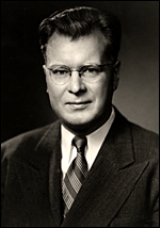
Chester Carlson

Encyclopedia
Chester Floyd Carlson was an American
physicist
, inventor, and patent attorney
born in Seattle, Washington.
He is best known for having invented the process of electrophotography
, which produced a dry copy rather than a wet copy, as was produced by the mimeograph process. Carlson's process was subsequently renamed to xerography
, a term that literally means "dry writing."
When Carlson was an infant, his father contracted tuberculosis
, and also later suffered from arthritis
of the spine (a common, age-related disease). When Olaf moved the family to Mexico for a seven-month period in 1910, in hopes of gaining riches through what Carlson described as "a crazy American land colonization scheme," Ellen contracted malaria. Because of his parents' illnesses, and the resulting poverty, Carlson worked to support his family from an early age; he began working odd jobs for money when he was eight. By the time he was thirteen, he would work for two or three hours before going to school, then go back to work after classes. By the time Carlson was in high school, he was his family's principal provider. His mother died of tuberculosis when he was 17, and his father died when Carlson was 27.
Carlson began thinking about reproducing print early in his life. At age ten, he created a newspaper called This and That, created by hand and circulated among his friends with a routing list. His favorite plaything was a rubber stamp printing set, and his most coveted possession was a toy typewriter an aunt gave him for Christmas in 1916—although he was disappointed that it was not an office typewriter.
While working for a local printer while in high school, Carlson attempted to typeset and publish a magazine for science-minded students like himself. He quickly became frustrated with traditional duplicating techniques. As he told Dartmouth College professor Joseph J. Ermene in a 1965 interview, "That set me to thinking about easier ways to do that, and I got to thinking about duplicating methods."
After three years at Riverside, Chester transferred to the California Institute of Technology
, or Caltech—his ambition since high school. His tuition, $260 a year, exceeded his total earnings, and the workload prevented him from earning much money—though he did mow lawns and do odd jobs on weekends, and work at a cement factory in the summer. By the time he graduated, he was $1,500 in debt. He graduated with good—but not exceptional—grades, earning a B.S. degree in Physics in 1930, near the start of the Great Depression
. He wrote letters seeking employment to 82 companies; none offered him a job.
in New York City
as a research engineer. Finding the work dull and routine, After a year, Carlson transferred to the patent
department as an assistant to one of the company's patent attorneys.
Carlson wrote over 400 ideas for new inventions in his personal notebooks while working at Bell Labs. He kept coming back to his love of printing, especially since his job in the patent department gave him new determination to find a better way to copy documents. "In the course of my patent work," wrote Carlson, "I frequently had need for copies of patent specifications and drawings, and there was no really convenient way of getting them at that time." At the time, the department primarily made copies by having typists retype the patent application in its entirety, using carbon paper
to make multiple copies at once. There were other methods available, such as mimeographs and Photostats, but they were more expensive than carbon paper, and they had other limitations that made them impractical. The existing solutions were 'duplicating' machines—they could make many duplicates, but one had to create a special master copy first, usually at great expense of time or money. Carlson wanted to invent a 'copying' machine, that could take an existing document and copy it onto a new piece of paper without any intermediate steps.
In 1933, during the Great Depression
, Carlson was fired from Bell Labs for participating in a failed "business scheme" outside of the Labs with several other employees. After six weeks of job-hunting, he got a job at the firm Austin & Dix, near Wall Street
, but he left the job about a year later as the firm's business was declining. He got a better job at the electronics firm P. R. Mallory Company, founded by Philip Mallory
(now known as the Duracell
division of Procter & Gamble
), where Carlson was promoted to head of the patent department.
, receiving his LL.B. degree in 1939. He studied at the New York Public Library, copying longhand from law books there because he could not afford to buy them. The pains induced by this laborious copying hardened his resolve to find a way to build a true copying machine. He began supplementing his law studies with trips to the Public Library's science and technology department. It was there that he was inspired by a brief article, written by Hungarian physicist Pál Selényi
in an obscure German scientific journal, that showed him a way to obtain his dream machine.
Carlson's early experiments, conducted in his apartment kitchen, were smoky, smelly, and occasionally explosive. In one set of experiments, he was melting pure crystalline sulfur (a photoconductor) onto a plate of zinc by moving it just so over the flame of his kitchen stove. This often resulted in a sulfur fire, filling the building with the smell of rotten eggs. In another experiment, the chemicals he was working with caught fire, and he and his wife were hard-pressed to extinguish the flames.
During this period, he developed arthritis of the spine, like his father. He pressed on with his experiments, however, in addition to his law school studies and his regular job.
Having learned about the value of patents in his early career as a patent clerk and attorney, Carlson patented his developments every step along the way. He filed his first preliminary patent application on October 18, 1937.
By the fall of 1938, Carlson's wife had convinced him that his experiments needed to be conducted elsewhere. He rented a room on the second floor of a house owned by his mother-in-law at 32-05 37th Street in Astoria, Queens
. He hired an assistant, Otto Kornei, an out-of-work Austrian physicist.
Carlson knew that several major corporations were researching ways of copying paper. The Haloid Company
had the Photostat, which it licensed to Eastman Kodak
, the photography giant. However, these companies were researching along photographic lines, and their solutions required special chemicals and papers. The Photostat, for instance, was essentially a photograph of the document being copied.
To this point, Carlson's apartment-kitchen experiments in constructing a copying machine had involved trying to generate an electric current in the original piece of paper using light. Selényi's article convinced Carlson to instead use light to 'remove' the static charge from a uniformly-ionized photoconductor. As no light would reflect from the black marks on the paper, those areas would remain charged on the photoconductor, and would therefore retain the fine powder. He could then transfer the powder to a fresh sheet of paper, resulting in a duplicate of the original. This approach would give his invention an advantage over the Photostat, which could only create a photographic negative
of the original.
On October 22, 1938, they had their historic breakthrough. Kornei wrote the words "10.-22.-38 ASTORIA." in India ink
on a glass microscope slide
. The Austrian prepared a zinc
plate with a sulfur
coating, darkened the room, rubbed the sulfur surface with a cotton handkerchief to apply an electrostatic charge, then laid the slide on the plate, exposing it to a bright, incandescent light. They removed the slide, sprinkled lycopodium
powder to the sulfur surface, softly blew the excess away, and transferred the image to a sheet of wax paper
. They heated the paper, softening the wax so the lycopodium would adhere to it, and had the world's first xerographic copy. After repeating the experiment to be sure it worked, Carlson celebrated taking Kornei out for a modest lunch.
Kornei was not as excited about the results of the experiment as Carlson. Within a year, he left Carlson on cordial terms. His pessimism about electrophotography was so strong that he decided to dissolve his agreement with Carlson that would have given Kornei ten percent of Carlson's future proceeds from the invention and partial rights to the inventions they had worked on together. Years later, when Xerox stock was soaring, Carlson sent Kornei a gift of one hundred shares in the company. Had Kornei held onto that gift, it would have been worth more than $1 million by 1972.
The road to his success—or that for xerography's success—had been long and filled with failure. From 1939 to 1944, his funding requests were turned down by more than twenty companies. He tried for some time to sell the invention to International Business Machines (IBM), the great vendor of office equipment, but no one at the company saw merit in the concept—it is not clear that anyone at IBM even 'understood' the concept. His next-to-last attempt to garner the interest—and funds—he needed to commercialize the physics was a meeting with the Department of the Navy. The Navy had a specific interest in the production of dry copies but they did not "see" what Carlson saw.
On October 6, 1942, the Patent Office issued Carlson's patent on electrophotography.
in Columbus, Ohio
, visited the patent department at Mallory where Carlson worked. Dayton, brought in as an expert witness in a patent appeal case by Mallory, seemed to Carlson to be "the kind of fellow who looked like he was interested in new ideas." Although Battelle had not previously developed ideas generated by others, Dayton was fascinated by Carlson's invention. When Carlson was invited to Columbus to demonstrate his invention, Dayton's statement to the Battelle scientists and engineers present showed that he understood the importance of Carlson's invention: "However crude this may seem, this is the first time any of you have seen a reproduction made without any chemical reaction and a dry process."
Battelle took a risk on Carlson's invention, which seemed to come out of nowhere:
By the fall of 1945, Battelle agreed to act as Carlson's agent for his patents, pay for further research, and develop the idea. Battelle tried to interest major printing and photography companies, like Eastman Kodak and Harris-Seybold, to license the idea, but to no avail.
In December 1946, Battelle, Carlson, and Haloid signed the first agreement to license electrophotography for a commercial product. The $10,000 contract—representing ten percent of Haloid's total earnings from 1945—granted a nonexclusive right to make electophotography-based copying machines intended to make no more than twenty copies of an original. Both sides were tentative; Battelle was concerned by Haloid's relatively small size, and Haloid had concerns about electrophotography's viability.
During this period, Battelle conducted most of the basic research into electrophotography, while Haloid concentrated on trying to make a commercial product out of the results. In 1948, Haloid's CEO, Joseph Wilson, convinced the U.S. Army Signal Corps to invest $100,000 in the technology, an amount that would double later. The Signal Corps was concerned about nuclear war. The traditional photographic techniques they used for reconnaissance would not function properly when exposed to the radiation from a nuclear attack; the film would fog, much as consumer photographic film can be fogged by an airport X-ray machine. The Signal Corps thought that electrophotography might be developed into a product that would be immune to such radiation. Through the 1950s, over half the money Battelle spent developing electrophotography came from government contracts.
In 1947, Carlson was becoming worried that Battelle was not developing electrophotography quickly enough; his patent would expire in ten years. After meeting with Joe Wilson, Carlson accepted an offer to become a consultant to Haloid. He and his wife Dorris moved to the Rochester area, to be near the company's base of operations.
After years of trying to interest additional licensees in electrophotography, Battelle agreed to renegotiate with Haloid, making them the exclusive licensee for the invention (except for a few minor uses that Battelle wished to retain for itself).
slide was copied, the Haloid Company made the first public announcement of xerography. In 1949, they shipped the first commercial photocopier: the XeroX Model A Copier, known inside the company as the "Ox Box." The Model A was difficult to use, requiring thirty-nine steps to make a copy, as the process was mostly manual. The product would likely have been a failure, except that it turned out to be a good way to make paper masters for offset printing presses, even with the difficulty of use. Sales of the Model A to the printing departments of companies like Ford Motor Company
kept the product alive.
Before the Model A, in order to make a paper lithographic master for a lithographic press like the Multigraph 1250, one had two choices: Type up a new master using wax-coated carbon paper on a special master sheet, or use a metal plate coated with a modified silver halide photographic emulsion. If retyping the document was not feasible, the photographic method could be used, but it was slow, expensive, and messy. Because the Model A's toner repelled water but attracted oil-based inks, a lithographic master could be made easily by simply making a copy of the document with the Model A onto a blank paper master. It reduced the cost of creating a lithographic master for an existing document from three dollars to less than forty cents. Ford saved so much money by using the Model A that the savings were specifically mentioned in one of Ford's annual reports.
After the Model A, Haloid released a number of xerographic copiers to the market, but none yet particularly easy to use. Meanwhile, competitors such as Kodak and 3M
brought out their own copying devices using other technologies. Kodak's Verifax, for instance, could sit on one side of a desk and sold for $100; Haloid's competing machines were more expensive and substantially larger.
in a joint venture called Rank Xerox
.
Haloid needed to grow, and its existing offices in Rochester were old and scattered. In 1955, the company purchased a large parcel of land in the Rochester suburb of Webster, New York; this would eventually become the company's main research-and-development campus.
Haloid's CEO, Joseph Wilson, had decided Haloid needed a new name as early as 1954. After years of debate within the company, the board approved a name change to "Haloid Xerox" in 1958, reflecting the fact that xerography was now the company's main line of business.
in New York City on September 16, 1959. Even plagued with early problems—of the two demonstration units at the hotel, one caught fire, and one worked fine—the Xerox 914 became massively successful. Between 1959, when the Model 914 first shipped, and 1961, Haloid Xerox's revenues nearly doubled.
The 914's success was not only due to its relative ease of use, its design (that, unlike competing copiers, carried no risk of damage to the original), and its low operating costs compared to other machines that required special paper; Haloid Xerox's decision to rent the 914—at the price of $25 per month, plus the cost of copies at four cents each with a minimum of $49 per month—made it vastly more affordable than a similar competing copier.
In 1961, because of the success of the Xerox 914, the company changed its name again, to Xerox Corporation.
For Carlson, the commercial success of the Xerox 914 was the culmination of his life's work: a device that could quickly and cheaply make an exact copy of an existing document. After the 914 went into production, Carlson's involvement with Xerox declined as he began pursuing his philanthropic interests.
Carlson married his second wife, Dorris Helen Hudgins, while the negotiations between Battelle and Haloid were under way.
In 1968, Fortune magazine ranked Carlson among the wealthiest people in America. He sent them a brief letter: "Your estimate of my net worth is too high by $150 million. I belong in the 0 to $50 million bracket." This was because Carlson had spent years quietly giving most of his fortune away. He told his wife his remaining ambition was "to die a poor man."
Carlson devoted his wealth to philanthropic purposes. He donated over $150 million to charitable causes and was an active supporter of the NAACP. Carlson's wife Dorris got him interested in Hinduism, particularly the ancient texts known as the Vedanta, as well as in Zen Buddhism. They hosted Buddhist meetings, with meditation, at their home. After reading Philip Kapleau
's book The Three Pillars of Zen, Dorris invited Kapleau to join their meditation group; in June 1966, they provided the funding that allowed Kapleau to start the Rochester Zen Center
. Dorris paid for 1400 acres (5.7 km²) of land that became Dai Bosatsu Zendo Kongo-ji
, a Zen monastery in the Catskill Mountains
of New York led by Eido Tai Shimano
. Carlson had purchased a New York City carriage house for use by Shimano; he died four days after it was dedicated. Carlson is still commemorated in special services by Shimano; his dharma name, Daitokuin Zenshin Carlson Koji, is mentioned.
In his essay "Half a Career with the Paranormal," researcher Ian Stevenson
describes Carlson's philanthropic style. According to Stevenson, Carlson's wife, Dorris, had some skill at extrasensory perception, and convinced Carlson to help support Stevenson's research. Carlson not only made annual donations to the University of Virginia
to fund Stevenson's work, but in 1964 he made a particularly large donation that helped fund one of the first endowed chairs at the University. Stevenson was the first incumbent of this chair.
Although Carlson insisted on anonymous donations, wrote Stevenson, he was unusual in that he closely followed the details of the research, maintaining contact with Stevenson. "He rarely made suggestions, but what he said always deserved attention," wrote Stevenson.
In the spring of 1968, while on vacation in the Bahamas, Carlson had his first heart attack. He was gravely ill, but hid this from his wife, embarking on a number of unexpected household improvements and concealing his doctor's visits. On September 19, 1968, Carlson died of a heart attack in the Festival Theatre, on West 57th Street in New York City, while watching the film He Who Rides a Tiger
. Dorris arranged a small service in New York City; Xerox held a much larger service in the corporate auditorium in Rochester on September 26, 1968.
was among the beneficiaries of his bequests. The University of Virginia received $1 million, under strict instructions that the money was to be used only to fund parapsychology research. The Center for the Study of Democratic Institutions
received a bequest of over $4.2 million from Carlson, in addition to the more than $4 million he had contributed while alive.
In 1981 Carlson was inducted into the National Inventors Hall of Fame
.
United States Public Law 100-548, signed into law by Ronald Reagan
, designated October 22, 1988 as "National Chester F. Carlson Recognition Day". He was honored by the United States Postal Service
with a 21¢ Great Americans series
postage stamp
.
Carlson is memorialized by buildings at the two largest institutions of higher learning in Rochester, New York
, Xerox's hometown. The Chester F. Carlson Center for Imaging Science, a department of the Rochester Institute of Technology
, specializes in remote sensing, eye tracking, and xerography. The University of Rochester
's Carlson Science and Engineering Library is the University's primary library for the science and engineering disciplines.
The following awards are named in Carlson's honor:
United States
The United States of America is a federal constitutional republic comprising fifty states and a federal district...
physicist
Physicist
A physicist is a scientist who studies or practices physics. Physicists study a wide range of physical phenomena in many branches of physics spanning all length scales: from sub-atomic particles of which all ordinary matter is made to the behavior of the material Universe as a whole...
, inventor, and patent attorney
Patent attorney
A patent attorney is an attorney who has the specialized qualifications necessary for representing clients in obtaining patents and acting in all matters and procedures relating to patent law and practice, such as filing an opposition...
born in Seattle, Washington.
He is best known for having invented the process of electrophotography
Electrophotography
Electrophotography is a dry photocopying technique invented by Chester Carlson in 1938, for which he was awarded on October 6, 1942...
, which produced a dry copy rather than a wet copy, as was produced by the mimeograph process. Carlson's process was subsequently renamed to xerography
Xerography
Xerography is a dry photocopying technique invented by Chester Carlson in 1938, for which he was awarded on October 6, 1942. Carlson originally called his invention electrophotography...
, a term that literally means "dry writing."
Early life
Carlson's father, Olof Adolph Carlson, had little formal education but was described as "brilliant" by a relative. Carlson wrote of his mother, Ellen, that she "was looked up to by her sisters as one of the wisest."When Carlson was an infant, his father contracted tuberculosis
Tuberculosis
Tuberculosis, MTB, or TB is a common, and in many cases lethal, infectious disease caused by various strains of mycobacteria, usually Mycobacterium tuberculosis. Tuberculosis usually attacks the lungs but can also affect other parts of the body...
, and also later suffered from arthritis
Arthritis
Arthritis is a form of joint disorder that involves inflammation of one or more joints....
of the spine (a common, age-related disease). When Olaf moved the family to Mexico for a seven-month period in 1910, in hopes of gaining riches through what Carlson described as "a crazy American land colonization scheme," Ellen contracted malaria. Because of his parents' illnesses, and the resulting poverty, Carlson worked to support his family from an early age; he began working odd jobs for money when he was eight. By the time he was thirteen, he would work for two or three hours before going to school, then go back to work after classes. By the time Carlson was in high school, he was his family's principal provider. His mother died of tuberculosis when he was 17, and his father died when Carlson was 27.
Carlson began thinking about reproducing print early in his life. At age ten, he created a newspaper called This and That, created by hand and circulated among his friends with a routing list. His favorite plaything was a rubber stamp printing set, and his most coveted possession was a toy typewriter an aunt gave him for Christmas in 1916—although he was disappointed that it was not an office typewriter.
While working for a local printer while in high school, Carlson attempted to typeset and publish a magazine for science-minded students like himself. He quickly became frustrated with traditional duplicating techniques. As he told Dartmouth College professor Joseph J. Ermene in a 1965 interview, "That set me to thinking about easier ways to do that, and I got to thinking about duplicating methods."
Education
Because of the work he put in supporting his family, Carlson had to take a postgraduate year at his high school to fill in missed courses. He then entered a cooperative work/study program at Riverside Junior College, working and going to classes in alternating six-week periods. Carlson held three jobs while at Riverside, paying for a cheap one-bedroom apartment for himself and his father. At Riverside, Chester began as a chemistry major, but switched to physics, largely due to a favorite professor.After three years at Riverside, Chester transferred to the California Institute of Technology
California Institute of Technology
The California Institute of Technology is a private research university located in Pasadena, California, United States. Caltech has six academic divisions with strong emphases on science and engineering...
, or Caltech—his ambition since high school. His tuition, $260 a year, exceeded his total earnings, and the workload prevented him from earning much money—though he did mow lawns and do odd jobs on weekends, and work at a cement factory in the summer. By the time he graduated, he was $1,500 in debt. He graduated with good—but not exceptional—grades, earning a B.S. degree in Physics in 1930, near the start of the Great Depression
Great Depression
The Great Depression was a severe worldwide economic depression in the decade preceding World War II. The timing of the Great Depression varied across nations, but in most countries it started in about 1929 and lasted until the late 1930s or early 1940s...
. He wrote letters seeking employment to 82 companies; none offered him a job.
Early career
As a last resort, he began working for Bell Telephone LaboratoriesBell Labs
Bell Laboratories is the research and development subsidiary of the French-owned Alcatel-Lucent and previously of the American Telephone & Telegraph Company , half-owned through its Western Electric manufacturing subsidiary.Bell Laboratories operates its...
in New York City
New York City
New York is the most populous city in the United States and the center of the New York Metropolitan Area, one of the most populous metropolitan areas in the world. New York exerts a significant impact upon global commerce, finance, media, art, fashion, research, technology, education, and...
as a research engineer. Finding the work dull and routine, After a year, Carlson transferred to the patent
Patent
A patent is a form of intellectual property. It consists of a set of exclusive rights granted by a sovereign state to an inventor or their assignee for a limited period of time in exchange for the public disclosure of an invention....
department as an assistant to one of the company's patent attorneys.
Carlson wrote over 400 ideas for new inventions in his personal notebooks while working at Bell Labs. He kept coming back to his love of printing, especially since his job in the patent department gave him new determination to find a better way to copy documents. "In the course of my patent work," wrote Carlson, "I frequently had need for copies of patent specifications and drawings, and there was no really convenient way of getting them at that time." At the time, the department primarily made copies by having typists retype the patent application in its entirety, using carbon paper
Carbon paper
Carbon paper is paper coated on one side with a layer of a loosely bound dry ink or pigmented coating, usually bound with wax. It is used for making one or more copies simultaneous with the creation of an original document...
to make multiple copies at once. There were other methods available, such as mimeographs and Photostats, but they were more expensive than carbon paper, and they had other limitations that made them impractical. The existing solutions were 'duplicating' machines—they could make many duplicates, but one had to create a special master copy first, usually at great expense of time or money. Carlson wanted to invent a 'copying' machine, that could take an existing document and copy it onto a new piece of paper without any intermediate steps.
In 1933, during the Great Depression
Great Depression
The Great Depression was a severe worldwide economic depression in the decade preceding World War II. The timing of the Great Depression varied across nations, but in most countries it started in about 1929 and lasted until the late 1930s or early 1940s...
, Carlson was fired from Bell Labs for participating in a failed "business scheme" outside of the Labs with several other employees. After six weeks of job-hunting, he got a job at the firm Austin & Dix, near Wall Street
Wall Street
Wall Street refers to the financial district of New York City, named after and centered on the eight-block-long street running from Broadway to South Street on the East River in Lower Manhattan. Over time, the term has become a metonym for the financial markets of the United States as a whole, or...
, but he left the job about a year later as the firm's business was declining. He got a better job at the electronics firm P. R. Mallory Company, founded by Philip Mallory
Philip Mallory
Philip Rogers Mallory was the founder of the company that is now known as Duracell International. Rather than making a career in his family's shipping business, he founded his own manufacturing company, the P. R. Mallory Company...
(now known as the Duracell
Duracell
Duracell is a brand of batteries manufactured by Procter & Gamble.Additionally, Duracell owns the Procell professional-use brand.-Products:Duracell manufactures alkaline batteries in many common sizes, such as AAA, AA, C, D, and 9V...
division of Procter & Gamble
Procter & Gamble
Procter & Gamble is a Fortune 500 American multinational corporation headquartered in downtown Cincinnati, Ohio and manufactures a wide range of consumer goods....
), where Carlson was promoted to head of the patent department.
The invention of electrophotography
In 1936, Carlson began to study law at night at New York Law SchoolNew York Law School
New York Law School is a private law school in the TriBeCa neighborhood of Lower Manhattan in New York City. New York Law School is one of the oldest independent law schools in the United States. The school is located within four blocks of all major courts in Manhattan. In 2011, New York Law School...
, receiving his LL.B. degree in 1939. He studied at the New York Public Library, copying longhand from law books there because he could not afford to buy them. The pains induced by this laborious copying hardened his resolve to find a way to build a true copying machine. He began supplementing his law studies with trips to the Public Library's science and technology department. It was there that he was inspired by a brief article, written by Hungarian physicist Pál Selényi
Pál Selényi
Engineer Pál Selényi was known as the "father of xerography" at Tungsram corporation. He is also known as Paul Selenyi. Chester Carlson read one of Selenyi's papers in the 1930s and was very greatly impressed; subsequently, he invested in a big effort to develop xerography. That may be the reason...
in an obscure German scientific journal, that showed him a way to obtain his dream machine.
Carlson's early experiments, conducted in his apartment kitchen, were smoky, smelly, and occasionally explosive. In one set of experiments, he was melting pure crystalline sulfur (a photoconductor) onto a plate of zinc by moving it just so over the flame of his kitchen stove. This often resulted in a sulfur fire, filling the building with the smell of rotten eggs. In another experiment, the chemicals he was working with caught fire, and he and his wife were hard-pressed to extinguish the flames.
During this period, he developed arthritis of the spine, like his father. He pressed on with his experiments, however, in addition to his law school studies and his regular job.
Having learned about the value of patents in his early career as a patent clerk and attorney, Carlson patented his developments every step along the way. He filed his first preliminary patent application on October 18, 1937.
By the fall of 1938, Carlson's wife had convinced him that his experiments needed to be conducted elsewhere. He rented a room on the second floor of a house owned by his mother-in-law at 32-05 37th Street in Astoria, Queens
Astoria, Queens
Astoria is a neighborhood in the northwestern corner of the borough of Queens in New York City. Located in Community Board 1, Astoria is bounded by the East River and is adjacent to three other Queens neighborhoods: Long Island City, Sunnyside , and Woodside...
. He hired an assistant, Otto Kornei, an out-of-work Austrian physicist.
Carlson knew that several major corporations were researching ways of copying paper. The Haloid Company
Xerox
Xerox Corporation is an American multinational document management corporation that produced and sells a range of color and black-and-white printers, multifunction systems, photo copiers, digital production printing presses, and related consulting services and supplies...
had the Photostat, which it licensed to Eastman Kodak
Eastman Kodak
Eastman Kodak Company is a multinational imaging and photographic equipment, materials and services company headquarted in Rochester, New York, United States. It was founded by George Eastman in 1892....
, the photography giant. However, these companies were researching along photographic lines, and their solutions required special chemicals and papers. The Photostat, for instance, was essentially a photograph of the document being copied.
Electrophotography
Selényi's article described a way of transmitting and printing facsimilies of printed images using a beam of directed ions directed onto a rotating drum of insulating material. The ions would create an electrostatic charge on the drum. A fine powder could then be dusted upon the drum; the powder would stick to the parts of the drum that had been charged, much as a balloon will stick to a static-charged stocking.To this point, Carlson's apartment-kitchen experiments in constructing a copying machine had involved trying to generate an electric current in the original piece of paper using light. Selényi's article convinced Carlson to instead use light to 'remove' the static charge from a uniformly-ionized photoconductor. As no light would reflect from the black marks on the paper, those areas would remain charged on the photoconductor, and would therefore retain the fine powder. He could then transfer the powder to a fresh sheet of paper, resulting in a duplicate of the original. This approach would give his invention an advantage over the Photostat, which could only create a photographic negative
Negative (photography)
In photography, a negative may refer to three different things, although they are all related.-A negative:Film for 35 mm cameras comes in long narrow strips of chemical-coated plastic or cellulose acetate. As each image is captured by the camera onto the film strip, the film strip advances so that...
of the original.
On October 22, 1938, they had their historic breakthrough. Kornei wrote the words "10.-22.-38 ASTORIA." in India ink
India ink
India ink is a simple black ink once widely used for writing and printing and now more commonly used for drawing, especially when inking comic books and comic strips.-Composition:...
on a glass microscope slide
Microscope slide
A microscope slide is a thin flat piece of glass, typically 75 by 25 mm and about 1 mm thick, used to hold objects for examination under a microscope. Typically the object is placed or secured on the slide, and then both are inserted together in the microscope for viewing...
. The Austrian prepared a zinc
Zinc
Zinc , or spelter , is a metallic chemical element; it has the symbol Zn and atomic number 30. It is the first element in group 12 of the periodic table. Zinc is, in some respects, chemically similar to magnesium, because its ion is of similar size and its only common oxidation state is +2...
plate with a sulfur
Sulfur
Sulfur or sulphur is the chemical element with atomic number 16. In the periodic table it is represented by the symbol S. It is an abundant, multivalent non-metal. Under normal conditions, sulfur atoms form cyclic octatomic molecules with chemical formula S8. Elemental sulfur is a bright yellow...
coating, darkened the room, rubbed the sulfur surface with a cotton handkerchief to apply an electrostatic charge, then laid the slide on the plate, exposing it to a bright, incandescent light. They removed the slide, sprinkled lycopodium
Lycopodium
Lycopodium is a genus of clubmosses, also known as ground pines or creeping cedar, in the family Lycopodiaceae, a family of fern-allies...
powder to the sulfur surface, softly blew the excess away, and transferred the image to a sheet of wax paper
Wax paper
Wax paper is a kind of paper that is made moisture proof through the application of wax....
. They heated the paper, softening the wax so the lycopodium would adhere to it, and had the world's first xerographic copy. After repeating the experiment to be sure it worked, Carlson celebrated taking Kornei out for a modest lunch.
Kornei was not as excited about the results of the experiment as Carlson. Within a year, he left Carlson on cordial terms. His pessimism about electrophotography was so strong that he decided to dissolve his agreement with Carlson that would have given Kornei ten percent of Carlson's future proceeds from the invention and partial rights to the inventions they had worked on together. Years later, when Xerox stock was soaring, Carlson sent Kornei a gift of one hundred shares in the company. Had Kornei held onto that gift, it would have been worth more than $1 million by 1972.
The road to his success—or that for xerography's success—had been long and filled with failure. From 1939 to 1944, his funding requests were turned down by more than twenty companies. He tried for some time to sell the invention to International Business Machines (IBM), the great vendor of office equipment, but no one at the company saw merit in the concept—it is not clear that anyone at IBM even 'understood' the concept. His next-to-last attempt to garner the interest—and funds—he needed to commercialize the physics was a meeting with the Department of the Navy. The Navy had a specific interest in the production of dry copies but they did not "see" what Carlson saw.
On October 6, 1942, the Patent Office issued Carlson's patent on electrophotography.
Battelle Memorial Institute
When Carlson was close to giving up on getting his invention from a proof-of-concept to a usable product, happenstance provided a solution. In 1944, Russell W. Dayton, a young engineer from the Battelle Memorial InstituteBattelle Memorial Institute
Battelle Memorial Institute is a private nonprofit applied science and technology development company headquartered in Columbus, Ohio. Battelle is a charitable trust organized as a nonprofit corporation under the laws of the State of Ohio and is exempt from taxation under Section 501 of the...
in Columbus, Ohio
Columbus, Ohio
Columbus is the capital of and the largest city in the U.S. state of Ohio. The broader metropolitan area encompasses several counties and is the third largest in Ohio behind those of Cleveland and Cincinnati. Columbus is the third largest city in the American Midwest, and the fifteenth largest city...
, visited the patent department at Mallory where Carlson worked. Dayton, brought in as an expert witness in a patent appeal case by Mallory, seemed to Carlson to be "the kind of fellow who looked like he was interested in new ideas." Although Battelle had not previously developed ideas generated by others, Dayton was fascinated by Carlson's invention. When Carlson was invited to Columbus to demonstrate his invention, Dayton's statement to the Battelle scientists and engineers present showed that he understood the importance of Carlson's invention: "However crude this may seem, this is the first time any of you have seen a reproduction made without any chemical reaction and a dry process."
Battelle took a risk on Carlson's invention, which seemed to come out of nowhere:
By the fall of 1945, Battelle agreed to act as Carlson's agent for his patents, pay for further research, and develop the idea. Battelle tried to interest major printing and photography companies, like Eastman Kodak and Harris-Seybold, to license the idea, but to no avail.
Haloid Company
The commercial breakthrough came when John Dessauer, chief of research at the Haloid Company, read an article about Carlson's invention. Haloid, a manufacturer of photographic paper, was looking for a way out of the shadow of its Rochester, New York neighbor, Eastman Kodak. Through previous acquisitions, Haloid was already in the duplicating-machine business; Dessauer thought that electrophotography might allow Haloid to expand into a new field that Kodak did not dominate.In December 1946, Battelle, Carlson, and Haloid signed the first agreement to license electrophotography for a commercial product. The $10,000 contract—representing ten percent of Haloid's total earnings from 1945—granted a nonexclusive right to make electophotography-based copying machines intended to make no more than twenty copies of an original. Both sides were tentative; Battelle was concerned by Haloid's relatively small size, and Haloid had concerns about electrophotography's viability.
During this period, Battelle conducted most of the basic research into electrophotography, while Haloid concentrated on trying to make a commercial product out of the results. In 1948, Haloid's CEO, Joseph Wilson, convinced the U.S. Army Signal Corps to invest $100,000 in the technology, an amount that would double later. The Signal Corps was concerned about nuclear war. The traditional photographic techniques they used for reconnaissance would not function properly when exposed to the radiation from a nuclear attack; the film would fog, much as consumer photographic film can be fogged by an airport X-ray machine. The Signal Corps thought that electrophotography might be developed into a product that would be immune to such radiation. Through the 1950s, over half the money Battelle spent developing electrophotography came from government contracts.
In 1947, Carlson was becoming worried that Battelle was not developing electrophotography quickly enough; his patent would expire in ten years. After meeting with Joe Wilson, Carlson accepted an offer to become a consultant to Haloid. He and his wife Dorris moved to the Rochester area, to be near the company's base of operations.
After years of trying to interest additional licensees in electrophotography, Battelle agreed to renegotiate with Haloid, making them the exclusive licensee for the invention (except for a few minor uses that Battelle wished to retain for itself).
Xerox
Xerography
By 1948, Haloid realized that they would have to make a public announcement about electrophotography in order to retain their claims to the technology. However, the term electrophotography troubled Haloid; for one thing, its use of the term "photography" invited unwelcome comparisons with traditional duplicating technologies. After considering several options, Haloid chose a term invented by a public-relations employee at Battelle, who had asked a classics professor at Ohio State University for ideas. The professor suggested the term xerography—formed by combining the Greek words xeros ("dry") and graphein ("writing"). Carlson was not fond of the name, but Haloid's Wilson liked it, and so Haloid's board of directors voted to adopt it. The company's patent department wanted to trademark "xerography;" Haloid's head of sales and advertising, John Hartnett, vetoed the idea: "Don't do that. We want people to use the word."XeroX Model A
On October 22, 1948, ten years to the day after that first microscopeMicroscope
A microscope is an instrument used to see objects that are too small for the naked eye. The science of investigating small objects using such an instrument is called microscopy...
slide was copied, the Haloid Company made the first public announcement of xerography. In 1949, they shipped the first commercial photocopier: the XeroX Model A Copier, known inside the company as the "Ox Box." The Model A was difficult to use, requiring thirty-nine steps to make a copy, as the process was mostly manual. The product would likely have been a failure, except that it turned out to be a good way to make paper masters for offset printing presses, even with the difficulty of use. Sales of the Model A to the printing departments of companies like Ford Motor Company
Ford Motor Company
Ford Motor Company is an American multinational automaker based in Dearborn, Michigan, a suburb of Detroit. The automaker was founded by Henry Ford and incorporated on June 16, 1903. In addition to the Ford and Lincoln brands, Ford also owns a small stake in Mazda in Japan and Aston Martin in the UK...
kept the product alive.
Before the Model A, in order to make a paper lithographic master for a lithographic press like the Multigraph 1250, one had two choices: Type up a new master using wax-coated carbon paper on a special master sheet, or use a metal plate coated with a modified silver halide photographic emulsion. If retyping the document was not feasible, the photographic method could be used, but it was slow, expensive, and messy. Because the Model A's toner repelled water but attracted oil-based inks, a lithographic master could be made easily by simply making a copy of the document with the Model A onto a blank paper master. It reduced the cost of creating a lithographic master for an existing document from three dollars to less than forty cents. Ford saved so much money by using the Model A that the savings were specifically mentioned in one of Ford's annual reports.
After the Model A, Haloid released a number of xerographic copiers to the market, but none yet particularly easy to use. Meanwhile, competitors such as Kodak and 3M
3M
3M Company , formerly known as the Minnesota Mining and Manufacturing Company, is an American multinational conglomerate corporation based in Maplewood, Minnesota, United States....
brought out their own copying devices using other technologies. Kodak's Verifax, for instance, could sit on one side of a desk and sold for $100; Haloid's competing machines were more expensive and substantially larger.
Haloid Xerox
In 1955, Haloid signed a new agreement with Battelle granting them full title to Carlson's xerography patents, in exchange for fifty thousand shares of Haloid stock. Carlson received forty percent of the cash and stock from that deal, due to his agreement with Battelle. That same year, in order to exploit those patents in Europe, it partnered with the British motion-picture company Rank OrganisationRank Organisation
The Rank Organisation was a British entertainment company formed during 1937 and absorbed in 1996 by The Rank Group Plc. It was the largest and most vertically-integrated film company in Britain, owning production, distribution and exhibition facilities....
in a joint venture called Rank Xerox
Rank Xerox
Rank Xerox was formed in 1956 as a joint venture between the Xerox Corporation of U.S. and the Rank Organisation of UK, to manufacture and market Xerox equipment initially in Europe and later in Africa and Asia...
.
Haloid needed to grow, and its existing offices in Rochester were old and scattered. In 1955, the company purchased a large parcel of land in the Rochester suburb of Webster, New York; this would eventually become the company's main research-and-development campus.
Haloid's CEO, Joseph Wilson, had decided Haloid needed a new name as early as 1954. After years of debate within the company, the board approved a name change to "Haloid Xerox" in 1958, reflecting the fact that xerography was now the company's main line of business.
The Xerox 914
The first device recognizable as a modern photocopier was the Xerox 914. Although large and crude by modern standards, it allowed an operator to place an original on a sheet of glass, press a button, and receive a copy on plain paper. Manufactured in a leased building off Orchard Street in Rochester, the 914 was introduced to the market at the Sherry Netherland HotelSherry Netherland Hotel
The Sherry Netherland Hotel is a 38-story hotel located at 781 Fifth Avenue on the corner of East 59th Street in Manhattan, New York City. It was designed and built by Schultze & Weaver with Buchman & Kahn. Construction began in 1926, and the upper floors suffered a spectacular fire in 1927 before...
in New York City on September 16, 1959. Even plagued with early problems—of the two demonstration units at the hotel, one caught fire, and one worked fine—the Xerox 914 became massively successful. Between 1959, when the Model 914 first shipped, and 1961, Haloid Xerox's revenues nearly doubled.
The 914's success was not only due to its relative ease of use, its design (that, unlike competing copiers, carried no risk of damage to the original), and its low operating costs compared to other machines that required special paper; Haloid Xerox's decision to rent the 914—at the price of $25 per month, plus the cost of copies at four cents each with a minimum of $49 per month—made it vastly more affordable than a similar competing copier.
In 1961, because of the success of the Xerox 914, the company changed its name again, to Xerox Corporation.
For Carlson, the commercial success of the Xerox 914 was the culmination of his life's work: a device that could quickly and cheaply make an exact copy of an existing document. After the 914 went into production, Carlson's involvement with Xerox declined as he began pursuing his philanthropic interests.
Personal life
In the fall of 1934, Carlson married Elsa von Mallon, whom he had met at a YWCA party in New York City. Carlson described the marriage as "an unhappy period interspersed with sporadic escapes." They were divorced in 1945.Carlson married his second wife, Dorris Helen Hudgins, while the negotiations between Battelle and Haloid were under way.
Later life
In 1951, Carlson's royalties from Battelle amounted to about $15,000 (in current terms, $). Carlson continued to work at Haloid until 1955, and he remained a consultant to the company until his death. From 1956 to 1965, he continued to earn royalties on his patents from Xerox, amounting to about one-sixteenth of a cent for every Xerox copy made worldwide.In 1968, Fortune magazine ranked Carlson among the wealthiest people in America. He sent them a brief letter: "Your estimate of my net worth is too high by $150 million. I belong in the 0 to $50 million bracket." This was because Carlson had spent years quietly giving most of his fortune away. He told his wife his remaining ambition was "to die a poor man."
Carlson devoted his wealth to philanthropic purposes. He donated over $150 million to charitable causes and was an active supporter of the NAACP. Carlson's wife Dorris got him interested in Hinduism, particularly the ancient texts known as the Vedanta, as well as in Zen Buddhism. They hosted Buddhist meetings, with meditation, at their home. After reading Philip Kapleau
Philip Kapleau
Philip Kapleau was a teacher of Zen Buddhism in the Sanbo Kyodan tradition, a blending of Japanese Sōtō and Rinzai schools.-Early life:...
's book The Three Pillars of Zen, Dorris invited Kapleau to join their meditation group; in June 1966, they provided the funding that allowed Kapleau to start the Rochester Zen Center
Rochester Zen Center
The Rochester Zen Center is a Sōtō and Rinzai Zen Buddhist sangha in the Sanbo Kyodan lineage, located in Rochester, New York and established in 1966 by Philip Kapleau. It is one of the oldest Zen centers in the United States. The history of the Rochester Zen Center begins overseas with the...
. Dorris paid for 1400 acres (5.7 km²) of land that became Dai Bosatsu Zendo Kongo-ji
Dai Bosatsu Zendo Kongo-ji
Dai Bosatsu Zendo Kongo-ji, or International Dai Bosatsu Zendo Kongo-ji, is a Rinzai monastery and retreat center located in the Catskill Mountains of upstate New York. Maintained by the Zen Studies Society, Dai Bosatsu Zendo Kongo-ji is led by Shinge-Shitsu Roko Sherry Chayat...
, a Zen monastery in the Catskill Mountains
Catskill Mountains
The Catskill Mountains, an area in New York State northwest of New York City and southwest of Albany, are a mature dissected plateau, an uplifted region that was subsequently eroded into sharp relief. They are an eastward continuation, and the highest representation, of the Allegheny Plateau...
of New York led by Eido Tai Shimano
Eido Tai Shimano
is a Rinzai Zen Buddhist roshi. He was the founding abbot of the New York Zendo Shobo-Ji in Manhattan and Dai Bosatsu Zendo Kongo-Ji monastery in the Catskill mountains of New York; he retired from that position after 40 years amid controversy.-Biography:...
. Carlson had purchased a New York City carriage house for use by Shimano; he died four days after it was dedicated. Carlson is still commemorated in special services by Shimano; his dharma name, Daitokuin Zenshin Carlson Koji, is mentioned.
In his essay "Half a Career with the Paranormal," researcher Ian Stevenson
Ian Stevenson
Ian Pretyman Stevenson, MD, was a Canadian biochemist and professor of psychiatry. Until his retirement in 2002, he was head of the Division of Perceptual Studies at the University of Virginia, which investigates the paranormal.Stevenson considered that the concept of reincarnation might...
describes Carlson's philanthropic style. According to Stevenson, Carlson's wife, Dorris, had some skill at extrasensory perception, and convinced Carlson to help support Stevenson's research. Carlson not only made annual donations to the University of Virginia
University of Virginia
The University of Virginia is a public research university located in Charlottesville, Virginia, United States, founded by Thomas Jefferson...
to fund Stevenson's work, but in 1964 he made a particularly large donation that helped fund one of the first endowed chairs at the University. Stevenson was the first incumbent of this chair.
Although Carlson insisted on anonymous donations, wrote Stevenson, he was unusual in that he closely followed the details of the research, maintaining contact with Stevenson. "He rarely made suggestions, but what he said always deserved attention," wrote Stevenson.
In the spring of 1968, while on vacation in the Bahamas, Carlson had his first heart attack. He was gravely ill, but hid this from his wife, embarking on a number of unexpected household improvements and concealing his doctor's visits. On September 19, 1968, Carlson died of a heart attack in the Festival Theatre, on West 57th Street in New York City, while watching the film He Who Rides a Tiger
He Who Rides a Tiger
He Who Rides a Tiger is a 1965 British crime drama directed by Charles Crichton, and starring Tom Bell and Judi Dench.-Cast:* Tom Bell as Peter Rayston* Judi Dench as Joanne* Paul Rogers as Superintendent Taylor* Kay Walsh as Mrs...
. Dorris arranged a small service in New York City; Xerox held a much larger service in the corporate auditorium in Rochester on September 26, 1968.
Legacy
The New York Civil Liberties UnionNew York Civil Liberties Union
The New York Civil Liberties Union is an civil rights organization in the United States. Founded in 1951 as the New York affiliate of the American Civil Liberties Union, it is a not-for-profit, nonpartisan organization with nearly 50,000 members across New York State.NYCLU's stated mission is to...
was among the beneficiaries of his bequests. The University of Virginia received $1 million, under strict instructions that the money was to be used only to fund parapsychology research. The Center for the Study of Democratic Institutions
Center for the Study of Democratic Institutions
The Center for the Study of Democratic Institutions in Santa Barbara, California was an important think tank from 1959 to 1977, declining in influence thereafter. The Center held discussions in a variety of areas that it hoped would influence public deliberation...
received a bequest of over $4.2 million from Carlson, in addition to the more than $4 million he had contributed while alive.
In 1981 Carlson was inducted into the National Inventors Hall of Fame
National Inventors Hall of Fame
The National Inventors Hall of Fame is a not-for-profit organization dedicated to recognizing, honoring and encouraging invention and creativity through the administration of its programs. The Hall of Fame honors the men and women responsible for the great technological advances that make human,...
.
United States Public Law 100-548, signed into law by Ronald Reagan
Ronald Reagan
Ronald Wilson Reagan was the 40th President of the United States , the 33rd Governor of California and, prior to that, a radio, film and television actor....
, designated October 22, 1988 as "National Chester F. Carlson Recognition Day". He was honored by the United States Postal Service
United States Postal Service
The United States Postal Service is an independent agency of the United States government responsible for providing postal service in the United States...
with a 21¢ Great Americans series
Great Americans series
The Great Americans series is a set of definitive stamps issued by the United States Postal Service, starting on December 27, 1980 with the 19¢ stamp depicting Sequoyah, and continuing through 2002, the final stamp being the 78¢ Alice Paul self-adhesive stamp. The series, noted for its simplicity...
postage stamp
Postage stamp
A postage stamp is a small piece of paper that is purchased and displayed on an item of mail as evidence of payment of postage. Typically, stamps are made from special paper, with a national designation and denomination on the face, and a gum adhesive on the reverse side...
.
Carlson is memorialized by buildings at the two largest institutions of higher learning in Rochester, New York
Rochester, New York
Rochester is a city in Monroe County, New York, south of Lake Ontario in the United States. Known as The World's Image Centre, it was also once known as The Flour City, and more recently as The Flower City...
, Xerox's hometown. The Chester F. Carlson Center for Imaging Science, a department of the Rochester Institute of Technology
Rochester Institute of Technology
The Rochester Institute of Technology is a private university, located within the town of Henrietta in metropolitan Rochester, New York, United States...
, specializes in remote sensing, eye tracking, and xerography. The University of Rochester
University of Rochester
The University of Rochester is a private, nonsectarian, research university in Rochester, New York, United States. The university grants undergraduate and graduate degrees, including doctoral and professional degrees. The university has six schools and various interdisciplinary programs.The...
's Carlson Science and Engineering Library is the University's primary library for the science and engineering disciplines.
The following awards are named in Carlson's honor:
- American Society for Engineering Education: The Chester F. Carlson Award is presented annually to an individual innovator in engineering education who, by motivation and ability to extend beyond the accepted tradition, has made a significant contribution to the profession.
- Royal Swedish Academy of Engineering Science, IVA: The Chester Carlson Award recognizes persons or institutions for significant research or development within the area of information science.
- Society for Imaging Science and Technology: The Chester F. Carlson Award recognizes outstanding technical work that advances the state of the art in electrophotographic printing.
Further reading
David Owen, Copies in Seconds: How a lone inventor and an unknown company created the biggest communication breakthrough since Gutenberg—Chester Carlson and the birth of the Xerox Machine (New York: Simon and Schuster, 2004) ISBN 0-7432-5117-2, ISBN 0-7432-5118-0External links
- Making Copies from Carbon to Kinkos
- Copies in Seconds (PDF)—excerpted from the book of the same name