


Peter and Paul Fortress

Encyclopedia
The Peter and Paul Fortress is the original citadel
of St. Petersburg
, Russia
, founded by Peter the Great in 1703 and built to Domenico Trezzini
's designs from 1706-1740.
on May 16 (by the Julian Calendar
, hereafter indicated using "(J)"; May 27 by the Gregorian Calendar
) 1703 on small Hare Island
by the north bank of the Neva River
, the last upstream island of the Neva delta. Built at the height of the Northern War
in order to protect the projected capital from a feared Swedish counterattack, the fort never fulfilled its martial purpose. The citadel was completed with six bastion
s in earth and timber within a year, and it was rebuilt in stone from 1706-1740.
From around 1720, the fort served as a base for the city garrison and also as a prison
for high ranking or political prisoner
s. The Trubetskoy
bastion, rebuilt in the 1870s, became the main prison block. The first person to escape from the fortress prison (now an important destination for tourists) was the anarchist Prince Peter Kropotkin
in 1876. Other people incarcerated in the "Russian Bastille
" include Shneur Zalman of Liadi
, Tsarevich Alexis, Artemy Volynsky, Tadeusz Kościuszko
, Alexander Radishchev
, the Decembrists, Grigory Danilevsky
, Fyodor Dostoevsky
, Mikhail Bakunin
, Nikolai Chernyshevsky
, Leon Trotsky
and Josip Broz Tito
.
of 1917, it was attacked by mutinous soldiers of the Pavlovskii regiment on February 27 (J)
and the prisoners were freed. Under the Provisional Government hundreds of Tsarist officials were held in the Fortress.
The Tsar was threatened with being incarcerated at the Fortress on his return from Mogilev
to Tsarskoe Selo on March 8 (J), the threat was not followed through and he was placed under house arrest. On July 4 (J) when the Bolshevik
s attempted a coup the Fortress garrison of 8,000 men declared for the Bolsheviks. They surrendered to government forces without a struggle on July 6 (J).
On October 25 (J), again, the Fortress quickly came into Bolshevik hands. Following the ultimatum from the Petrograd Soviet
to the Provisional Government ministers in the Winter Palace
, after the blank salvo of the Cruiser Aurora at 21.00, the guns of the Fortress fired 30 or so shells at the Winter Palace. Only two actually hit, inflicting minor damage, and the defenders refused to surrender– at that time. At 02.10 on the morning of October 26 (J) the Winter Palace was taken by forces under Vladimir Antonov-Ovseenko
, the captured ministers were taken to the Fortress as prisoners.
In 1924, most of the site was converted to a museum. In 1931, the Gas Dynamics Laboratory was added to the site. The structure suffered heavy damage during the bombardment of the city during WW II
by the German
army who were laying siege to the city. It has been faithfully restored post-war.
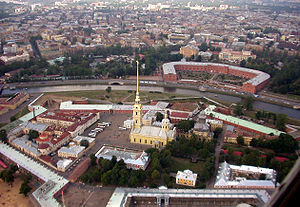 The fortress contains several notable buildings clustered around the Peter and Paul Cathedral
(1712–1733), which has a 123.2 m (404.2 ft) bell-tower (the tallest in the downtown) and a gilded angel-topped cupola.
The cathedral is the burial place of all Russian tsar
s from Peter I
to Alexander III
, with the exception of Peter II
. The remains of Nicholas II
and his family and entourage were also interred there, in the side St.Catherine's Chapel, on the 80th anniversary of their deaths, July 17, 1998. Towards the end of 2006, the remains of Dowager Empress Maria Feodorovna were brought from Roskilde Cathedral
outside Copenhagen
to finally rest next to her husband, Alexander III.
The newer Grand Ducal Mausoleum (built in the Neo-Baroque style under Leon Benois
's supervision in 1896-1908) is connected to the cathedral by a corridor. It was constructed in order to remove the remains of some of the non-reigning Romanovs from the cathedral where there was scarcely any room for new burials. The mausoleum was expected to hold up to sixty tombs, but by the time of the Russian Revolution there were only thirteen. The latest burial there was of Nicholas II's first cousin once removed, Grand Duke Vladimir Cyrilovich (1992). The remains of his parents, Grand Duke Cyril Vladimirovich and his wife Viktoria Fyodorovna, were transferred to the mausoleum from Coburg in 1995.
Other structures inside the fortress include the still functioning mint
building
(constructed to Antonio Porta
's designs under Emperor Paul), the Trubetskoy and Alekseyevsky bastions with their grim prison cells, and the city museum
. According to a centuries-old tradition, a cannon is fired each noon from the Naryshkin Bastion. Annual celebrations of the city day (May 27) are normally centered on the island where the city was born.
The sandy beaches underneath the fortress walls are among the most popular in St. Petersburg. In summer, the beach is often overcrowded, especially when a major sand festival
takes place on the shore.
Citadel
A citadel is a fortress for protecting a town, sometimes incorporating a castle. The term derives from the same Latin root as the word "city", civis, meaning citizen....
of St. Petersburg
Saint Petersburg
Saint Petersburg is a city and a federal subject of Russia located on the Neva River at the head of the Gulf of Finland on the Baltic Sea...
, Russia
Russia
Russia or , officially known as both Russia and the Russian Federation , is a country in northern Eurasia. It is a federal semi-presidential republic, comprising 83 federal subjects...
, founded by Peter the Great in 1703 and built to Domenico Trezzini
Domenico Trezzini
Domenico Trezzini was a Swiss Italian architect who elaborated the Petrine Baroque style of Russian architecture.Domenico was born in Astano, near Lugano, in the Italian-speaking Ticino . He probably studied in Rome...
's designs from 1706-1740.
History
The fortress was established by Peter the GreatPeter I of Russia
Peter the Great, Peter I or Pyotr Alexeyevich Romanov Dates indicated by the letters "O.S." are Old Style. All other dates in this article are New Style. ruled the Tsardom of Russia and later the Russian Empire from until his death, jointly ruling before 1696 with his half-brother, Ivan V...
on May 16 (by the Julian Calendar
Julian calendar
The Julian calendar began in 45 BC as a reform of the Roman calendar by Julius Caesar. It was chosen after consultation with the astronomer Sosigenes of Alexandria and was probably designed to approximate the tropical year .The Julian calendar has a regular year of 365 days divided into 12 months...
, hereafter indicated using "(J)"; May 27 by the Gregorian Calendar
Gregorian calendar
The Gregorian calendar, also known as the Western calendar, or Christian calendar, is the internationally accepted civil calendar. It was introduced by Pope Gregory XIII, after whom the calendar was named, by a decree signed on 24 February 1582, a papal bull known by its opening words Inter...
) 1703 on small Hare Island
Zayachy Island
Zayachy Island is an island in the Neva River in St. Petersburg, Russia...
by the north bank of the Neva River
Neva River
The Neva is a river in northwestern Russia flowing from Lake Ladoga through the western part of Leningrad Oblast to the Neva Bay of the Gulf of Finland. Despite its modest length , it is the third largest river in Europe in terms of average discharge .The Neva is the only river flowing from Lake...
, the last upstream island of the Neva delta. Built at the height of the Northern War
Great Northern War
The Great Northern War was a conflict in which a coalition led by the Tsardom of Russia successfully contested the supremacy of the Swedish Empire in northern Central Europe and Eastern Europe. The initial leaders of the anti-Swedish alliance were Peter I the Great of Russia, Frederick IV of...
in order to protect the projected capital from a feared Swedish counterattack, the fort never fulfilled its martial purpose. The citadel was completed with six bastion
Bastion
A bastion, or a bulwark, is a structure projecting outward from the main enclosure of a fortification, situated in both corners of a straight wall , facilitating active defence against assaulting troops...
s in earth and timber within a year, and it was rebuilt in stone from 1706-1740.
From around 1720, the fort served as a base for the city garrison and also as a prison
Prison
A prison is a place in which people are physically confined and, usually, deprived of a range of personal freedoms. Imprisonment or incarceration is a legal penalty that may be imposed by the state for the commission of a crime...
for high ranking or political prisoner
Political prisoner
According to the Longman Dictionary of Contemporary English, a political prisoner is ‘someone who is in prison because they have opposed or criticized the government of their own country’....
s. The Trubetskoy
Trubetskoy
Trubetskoy , Трубецкой , Трубяцкі , Trubecki , Trubetsky , Трубецький , Troubetzkoy , Trubezkoi or Trubetzkoy , is a Ruthenian Gediminid gentry family of Black Ruthenian stock, like many other princely houses of Grand Duchy of Lithuania, later prominent in Russian...
bastion, rebuilt in the 1870s, became the main prison block. The first person to escape from the fortress prison (now an important destination for tourists) was the anarchist Prince Peter Kropotkin
Peter Kropotkin
Prince Pyotr Alexeyevich Kropotkin was a Russian zoologist, evolutionary theorist, philosopher, economist, geographer, author and one of the world's foremost anarcho-communists. Kropotkin advocated a communist society free from central government and based on voluntary associations between...
in 1876. Other people incarcerated in the "Russian Bastille
Bastille
The Bastille was a fortress in Paris, known formally as the Bastille Saint-Antoine. It played an important role in the internal conflicts of France and for most of its history was used as a state prison by the kings of France. The Bastille was built in response to the English threat to the city of...
" include Shneur Zalman of Liadi
Shneur Zalman of Liadi
Shneur Zalman of Liadi , also known as the Baal HaTanya, , was an Orthodox Rabbi, and the founder and first Rebbe of Chabad, a branch of Hasidic Judaism, then based in Liadi, Imperial Russia...
, Tsarevich Alexis, Artemy Volynsky, Tadeusz Kościuszko
Tadeusz Kosciuszko
Andrzej Tadeusz Bonawentura Kościuszko was a Polish–Lithuanian and American general and military leader during the Kościuszko Uprising. He is a national hero of Poland, Lithuania, the United States and Belarus...
, Alexander Radishchev
Alexander Radishchev
Alexander Nikolayevich Radishchev was a Russian author and social critic who was arrested and exiled under Catherine the Great. He brought the tradition of radicalism in Russian literature to prominence with the publication in 1790 of his Journey from St. Petersburg to Moscow...
, the Decembrists, Grigory Danilevsky
Grigory Danilevsky
-Life:Born into the family of an impoverished landowner, Petr Ivanovich Danilevsky, in the Izyumsky district of Sloboda Ukraine, Grigory was educated in the Moscow Dvoryansky institut from 1841 to 1846, then studied law at Saint Petersburg University...
, Fyodor Dostoevsky
Fyodor Dostoevsky
Fyodor Mikhaylovich Dostoyevsky was a Russian writer of novels, short stories and essays. He is best known for his novels Crime and Punishment, The Idiot and The Brothers Karamazov....
, Mikhail Bakunin
Mikhail Bakunin
Mikhail Alexandrovich Bakunin was a well-known Russian revolutionary and theorist of collectivist anarchism. He has also often been called the father of anarchist theory in general. Bakunin grew up near Moscow, where he moved to study philosophy and began to read the French Encyclopedists,...
, Nikolai Chernyshevsky
Nikolai Chernyshevsky
Nikolay Gavrilovich Chernyshevsky was a Russian revolutionary democrat, materialist philosopher, critic, and socialist...
, Leon Trotsky
Leon Trotsky
Leon Trotsky , born Lev Davidovich Bronshtein, was a Russian Marxist revolutionary and theorist, Soviet politician, and the founder and first leader of the Red Army....
and Josip Broz Tito
Josip Broz Tito
Marshal Josip Broz Tito – 4 May 1980) was a Yugoslav revolutionary and statesman. While his presidency has been criticized as authoritarian, Tito was a popular public figure both in Yugoslavia and abroad, viewed as a unifying symbol for the nations of the Yugoslav federation...
.
Russian Revolution and beyond
During the February RevolutionFebruary Revolution
The February Revolution of 1917 was the first of two revolutions in Russia in 1917. Centered around the then capital Petrograd in March . Its immediate result was the abdication of Tsar Nicholas II, the end of the Romanov dynasty, and the end of the Russian Empire...
of 1917, it was attacked by mutinous soldiers of the Pavlovskii regiment on February 27 (J)
Julian calendar
The Julian calendar began in 45 BC as a reform of the Roman calendar by Julius Caesar. It was chosen after consultation with the astronomer Sosigenes of Alexandria and was probably designed to approximate the tropical year .The Julian calendar has a regular year of 365 days divided into 12 months...
and the prisoners were freed. Under the Provisional Government hundreds of Tsarist officials were held in the Fortress.
The Tsar was threatened with being incarcerated at the Fortress on his return from Mogilev
Mogilev
Mogilev is a city in eastern Belarus, about 76 km from the border with Russia's Smolensk Oblast and 105 km from the border with Russia's Bryansk Oblast. It has more than 367,788 inhabitants...
to Tsarskoe Selo on March 8 (J), the threat was not followed through and he was placed under house arrest. On July 4 (J) when the Bolshevik
Bolshevik
The Bolsheviks, originally also Bolshevists , derived from bol'shinstvo, "majority") were a faction of the Marxist Russian Social Democratic Labour Party which split apart from the Menshevik faction at the Second Party Congress in 1903....
s attempted a coup the Fortress garrison of 8,000 men declared for the Bolsheviks. They surrendered to government forces without a struggle on July 6 (J).
On October 25 (J), again, the Fortress quickly came into Bolshevik hands. Following the ultimatum from the Petrograd Soviet
Petrograd Soviet
The Petrograd Soviet of Workers' and Soldiers' Deputies , usually called the Petrograd Soviet , was the soviet in Petrograd , Russia, established in March 1917 after the February Revolution as the representative body of the city's workers.The Petrograd Soviet became important during the Russian...
to the Provisional Government ministers in the Winter Palace
Winter Palace
The Winter Palace in Saint Petersburg, Russia, was, from 1732 to 1917, the official residence of the Russian monarchs. Situated between the Palace Embankment and the Palace Square, adjacent to the site of Peter the Great's original Winter Palace, the present and fourth Winter Palace was built and...
, after the blank salvo of the Cruiser Aurora at 21.00, the guns of the Fortress fired 30 or so shells at the Winter Palace. Only two actually hit, inflicting minor damage, and the defenders refused to surrender– at that time. At 02.10 on the morning of October 26 (J) the Winter Palace was taken by forces under Vladimir Antonov-Ovseenko
Vladimir Antonov-Ovseenko
Vladimir Alexandrovich Antonov-Ovseyenko , real surname Ovseyenko, party aliases the 'Bayonet' and 'Nikita' , a literary pseudonym A. Gal , was a prominent Soviet Bolshevik leader and diplomat. He was born in Chernigov into an officer's family.In 1903, Antonov-Ovseyenko joined the Menshevik party...
, the captured ministers were taken to the Fortress as prisoners.
In 1924, most of the site was converted to a museum. In 1931, the Gas Dynamics Laboratory was added to the site. The structure suffered heavy damage during the bombardment of the city during WW II
World War II
World War II, or the Second World War , was a global conflict lasting from 1939 to 1945, involving most of the world's nations—including all of the great powers—eventually forming two opposing military alliances: the Allies and the Axis...
by the German
Nazi Germany
Nazi Germany , also known as the Third Reich , but officially called German Reich from 1933 to 1943 and Greater German Reich from 26 June 1943 onward, is the name commonly used to refer to the state of Germany from 1933 to 1945, when it was a totalitarian dictatorship ruled by...
army who were laying siege to the city. It has been faithfully restored post-war.
Sights
Peter and Paul Cathedral
The Peter and Paul Cathedral is a Russian Orthodox cathedral located inside the Peter and Paul Fortress in St. Petersburg, Russia. It is the first and oldest landmark in St. Petersburg, built between 1712 and 1733 on Zayachy Island along the Neva River. Both the cathedral and the fortress were...
(1712–1733), which has a 123.2 m (404.2 ft) bell-tower (the tallest in the downtown) and a gilded angel-topped cupola.
The cathedral is the burial place of all Russian tsar
Tsar
Tsar is a title used to designate certain European Slavic monarchs or supreme rulers. As a system of government in the Tsardom of Russia and Russian Empire, it is known as Tsarist autocracy, or Tsarism...
s from Peter I
Peter I of Russia
Peter the Great, Peter I or Pyotr Alexeyevich Romanov Dates indicated by the letters "O.S." are Old Style. All other dates in this article are New Style. ruled the Tsardom of Russia and later the Russian Empire from until his death, jointly ruling before 1696 with his half-brother, Ivan V...
to Alexander III
Alexander III of Russia
Alexander Alexandrovich Romanov , historically remembered as Alexander III or Alexander the Peacemaker reigned as Emperor of Russia from until his death on .-Disposition:...
, with the exception of Peter II
Peter II of Russia
Pyotr II Alekseyevich was Emperor of Russia from 1727 until his death. He was the only son of Tsarevich Alexei Petrovich, son of Peter I of Russia by his first wife Eudoxia Lopukhina, and Princess Charlotte, daughter of Duke Louis Rudolph of Brunswick-Lüneburg and sister-in-law of Charles VI,...
. The remains of Nicholas II
Nicholas II of Russia
Nicholas II was the last Emperor of Russia, Grand Prince of Finland, and titular King of Poland. His official short title was Nicholas II, Emperor and Autocrat of All the Russias and he is known as Saint Nicholas the Passion-Bearer by the Russian Orthodox Church.Nicholas II ruled from 1894 until...
and his family and entourage were also interred there, in the side St.Catherine's Chapel, on the 80th anniversary of their deaths, July 17, 1998. Towards the end of 2006, the remains of Dowager Empress Maria Feodorovna were brought from Roskilde Cathedral
Roskilde Cathedral
Roskilde Cathedral , in the city of Roskilde on the island of Zealand in eastern Denmark, is a cathedral of the Lutheran Church of Denmark. The first Gothic cathedral to be built of brick, it encouraged the spread of the Brick Gothic style throughout Northern Europe...
outside Copenhagen
Copenhagen
Copenhagen is the capital and largest city of Denmark, with an urban population of 1,199,224 and a metropolitan population of 1,930,260 . With the completion of the transnational Øresund Bridge in 2000, Copenhagen has become the centre of the increasingly integrating Øresund Region...
to finally rest next to her husband, Alexander III.
The newer Grand Ducal Mausoleum (built in the Neo-Baroque style under Leon Benois
Leon Benois
Leon Benois was a Russian architect. He was the son of architect Nicholas Benois, the brother of artists Alexandre Benois and Albert Benois, and the grandfather of the actor Sir Peter Ustinov...
's supervision in 1896-1908) is connected to the cathedral by a corridor. It was constructed in order to remove the remains of some of the non-reigning Romanovs from the cathedral where there was scarcely any room for new burials. The mausoleum was expected to hold up to sixty tombs, but by the time of the Russian Revolution there were only thirteen. The latest burial there was of Nicholas II's first cousin once removed, Grand Duke Vladimir Cyrilovich (1992). The remains of his parents, Grand Duke Cyril Vladimirovich and his wife Viktoria Fyodorovna, were transferred to the mausoleum from Coburg in 1995.
Other structures inside the fortress include the still functioning mint
Mint (coin)
A mint is an industrial facility which manufactures coins for currency.The history of mints correlates closely with the history of coins. One difference is that the history of the mint is usually closely tied to the political situation of an era...
building
(constructed to Antonio Porta
Antonio Porta
Antonio Alejandro Porta Pernigotti is an Argentinian professional basketball player. He plays the point guard and shooting guard positions. He is 6 ft 2 ¾ in tall and he weighs 200 lbs...
's designs under Emperor Paul), the Trubetskoy and Alekseyevsky bastions with their grim prison cells, and the city museum
Saint Petersburg Museum of History
St. Petersburg Museum of History, formerly Museum of Leningrad History from 1955 to 1991, is a museum in Saint Petersburg, Russia.The headquarters of the museum are located in the Peter and Paul Fortress. It was established in 1938 as the Museum of History and Development of Leningrad. It is a...
. According to a centuries-old tradition, a cannon is fired each noon from the Naryshkin Bastion. Annual celebrations of the city day (May 27) are normally centered on the island where the city was born.
The sandy beaches underneath the fortress walls are among the most popular in St. Petersburg. In summer, the beach is often overcrowded, especially when a major sand festival
Sand festival
Sand festivals or festivals of sand sculpture are exhibitions of sculptures made of sand carried out in various places around the world. These events usually include a competition.Traditional sand sculptures are sandcastles...
takes place on the shore.