


Petrograd Soviet

Encyclopedia
The Petrograd Soviet of Workers' and Soldiers' Deputies , usually called the Petrograd Soviet , was the soviet
(workers' council) in Petrograd
(Saint Petersburg), Russia
, established in March 1917 after the February Revolution
as the representative body of the city's workers.
The Petrograd Soviet became important during the Russian Revolution leading up to the October Revolution
as a rival power center to the Provisional Government
.
, and in 1905 the workers' soviet called the St Petersburg Soviet was created. But the main precursor to the 1917 Petrograd Soviet was the Central Workers' Group (Центральная Рабочая Группа, Tsentral'naya Rabochaya Grupa), founded in November 1915 by the Menshevik
s to sit between workers and the new Central Military-Industrial Committee in Petrograd. The group became increasingly radical as World War I
progressed and the economic situation became worse, encouraging street demonstrations and issuing revolutionary proclamations.
On January 27, 1917 (all dates Old Style
) the entire leadership of the Central Workers' Group was arrested and taken away to the Peter and Paul Fortress
on the orders of Alexander Protopopov
, the Minister of the Interior in Imperial Russia
. They were freed by a crowd of disaffected soldiers on the morning of February 27, the beginning of the February Revolution, and the chairman convened a meeting to organize and elect a Soviet of Workers' Deputies that day.
That evening, between 50 and 300 people attended the meeting at the Tauride Palace
. A provisional executive
committee (Ispolkom), was chosen with Nikolay Chkheidze
as head, and with mostly Menshevik deputies. (Chkheize was replaced by Irakli Tsereteli
in late March). Izvestia
was chosen as the official newspaper of the group. The following day, February 28, was the plenary session; elected representatives from factories
and the military
joined the soviet, and again moderates dominated. Non-representative voting and enthusiasm gave the Soviet almost 3,000 deputies in two weeks, of which the majority were soldiers. The meetings were chaotic, confused and unruly, little more than a stage for speechmakers. The party-based Ispolkom quickly took charge of actual decision-making.
On March 1, the Executive Committee resolved to remain outside any new State Duma
. This allowed the group to criticize without responsibility, and kept them away from any potential backlash. On March 2, the Soviet received the eight-point program of the Provisional Committee of the State Duma
, appointed an oversight committee (nabliudatel'nyi komitet), and issued a decidedly conditional statement of support. Moreover, the Soviet undermined the Provisional Government by issuing its own orders, beginning with the seven-article Order No. 1
. The Soviet was not opposed to the war – internal divisions produced a public ambivalence–but was deeply worried about counterrevolutionary
moves from the military, and was determined to have garrison
troops firmly on its side.
to the Provisional Government
under (Prince) Georgy Lvov and later Alexander Kerensky
·
This created a situation described as dvoevlastie (dual power
), in which the Petrograd Soviet competed for legitimacy
with the Provisional Government until the October Revolution.
The Ispolkom (the "executive committee") of the Petrograd Soviet often publicly attacked the Provisional Government as bourgeois
and boasted of its de facto
power over de jure
authority (control over post
, telegraphs
, the press, railroads, food supply, and other infrastructure
). A "shadow government
" with a Contact Commission (created March 8) to "inform... [the Provisional Government] about the demands of the revolutionary people, to exert pressure on the government to satisfy all these demands, and to exercise uninterrupted control over their implementation." On March 19, the control extended into the military frontlines with commissar
s appointed with Ministry of War
support.
On March 1917, the Petrograd Soviet was actually opposed to the workers, which protested its deliberations with strikes. On March 8, the Menshevik
Rabochaia Gazeta even claimed that the strikers were discrediting the soviet by not obeying it.
The Ispolkom expanded to 19 members on April 8, nine representing the Soldiers' Section, and ten the Workers' Section. All members were socialists, the majority Mensheviks or Socialist-Revolutionaries
; there was no Bolshevik
representation. After the All-Russian Consultation of Soviets, the Petrograd Soviet began adding representatives from other parts of Russia
and the front lines, renaming itself the All-Russian Soviet of Workers' and Soldiers' Deputies
. The executive committee became the All-Russian Central Executive Committee (CEC or VTsIK) with over 70 members (but no peasant
representatives). The mass meeting of the entire body were tapered off, being reduced from daily in the first weeks to roughly weekly by April.
. The unrest was quickly directed by Bolshevik leaders into what some interpret as a coup attempt. The Ispolkom issued proclamations to restrain disorder and repeatedly quashed Lavr Kornilov's
demands to put troops and artillery
on the streets. There were riots in Petrograd, and also Moscow, but anti-Bolshevik and pro-Provisional Government groups soon stopped the agitators.
The riots deeply worried the Provisional Government. There were a number of resignation
s, and on May 1, the Ispolkom voted to allow its members to take Cabinet posts in return for further concessions (the Bolsheviks and the left Menshevik followers of Julius Martov
opposed the move, and were against any cooperation with the Provisional Government). After negotiations, a new cabinet was chosen on May 6. Alexander Guchkov
and Pavel Milyukov
, the leader of the Constitutional Democrats
(Cadets), left the government. Alexander Kerensky was moved to the Ministry of War. Six socialists took cabinet posts.
, and took advantage of the new socialist presence in the Cabinet to attack them for the failures of the Provisional Government. The Bolsheviks began a strong run of propaganda
. In June, 100,000 copies of Pravda
(including Soldatskaya Pravda, Golos Pravdy, and Okopnaya Pravda) were printed daily. In July, over 350,000 leaflets were distributed. The July Days
riots from July 16–17 led by the Bolsheviks were without success.
The rise of Kerensky, and the later shock of the Kornilov affair
, polarized the political scene. The Petrograd Soviet moved steadily leftwards, just as those of the center and right consolidated around Kerensky. Despite the events in July, the Ispolkom moved to protect the Bolsheviks from serious consequences, adopting resolutions on August 4 and August 18 against the arrest and prosecution of Bolsheviks. Still wary of the Ispolkom, the government released many senior Bolsheviks on bail
or promise of good behavior.
In the August 20 municipal elections, the Bolsheviks took a third of the votes, a 50 percent increase in three months. There was also a general falling away in the attendance of soviet meetings. Indeed, many of the smaller soviets no longer existed except on paper.
During the Kornilov affair, the Ispolkom was forced to use the Bolsheviks' military as its main force against the "counter-revolution." Kerensky ordered the distribution of 40,000 rifles to the workers of Petrograd (some Red Guards
), many of which ended in the hands of Bolshevik groups.
As all other socialist parties abandoned the Soviet organizations, the Bolsheviks increased their presence. On September 25, they gained a majority in the Workers' Section and Leon Trotsky
was elected chairman. He directed the transformation of the Soviet into an adjunct of the party, bypassing the Menshevik-SR Ispolkom and non-Bolshevik soviets to form a new Bolshevik control structure.
The Bolsheviks used their power in the Petrograd Soviet to set up a second All-Russian Congress of Soviets
on October 20 (agreed September 26), despite only eight of 169 soldiers' or workers' soviets expressing support. With the November elections
to the Constituent Assembly
looming the Bolsheviks had to use their power quickly to discredit the elections. The Ispolkom denounced the Congress and the steps the Bolsheviks were taking to create its delegates. Suddenly and without reason, on October 17, the Ispolkom Bureau approved the Congress.
 On October 6, with a German advance threatening the city, the government - after advice from the military – made plans to evacuate to Moscow. The Ispolkom attacked the move and Trotsky had the still-Menshevik Soldiers' Section vote on a resolution condemning the evacuation. The Provisional Government gave way and delayed any evacuation plans indefinitely. Its attempts to dispatch Petrograd garrison units to the front were resisted by the troops and by the Ispolkom.
On October 9, the Soviet considered the creation of a Committee of Revolutionary Defense. The Bolsheviks and Leon Trotsky amended the resolution to create a Military Defense Committee, to control the security of Petrograd against both German and domestic threats. The Plenum of the Soviet voted in favour of a committee to "gather... all the forces participating in the defense of Petrograd... to arm the workers... ensuring the revolutionary defense of Petrograd... against the... military and civilian Kornilovites."
The Ispolkom approved the resolution, against Menshevik resistance, on October 12, and the measure was formally approved by the Soviet on October 16 (despite warnings from the Mensheviks and SRs), creating the Military Revolutionary Committee
(Voenno-Revoliutsionnyi Komitet), also called the Milrevcom or Military Committee.
The Military-Revolutionary Committee was chaired by Pavel Lazimir
, with Nikolai Podvoisky
as his deputy. Basically, it was the front for the activities of the Bolshevik's Military Organization. Podvoisky would take official control of the Committee on the day of the uprising, with Vladimir Antonov-Ovseenko
as secretary. The Ispolkom and the Provisional Government had been cut out of control of the forces in the Petrograd Military District, and without orders, the garrison would remain neutral.
The Military Staff was side-lined when the Milrevcom took exclusive control of the garrison troops in the name of the Soldiers' Section of the Soviet on the night of October 21. The commander of the District, Colonel Polkovnikov, refused to allow this control, and he and his staff were condemned in a Milrevcom public statement as "a direct weapon of the counter-revolutionary forces." The military command responded with an ultimatum to the Soviet, which lead to delaying negotiations and meetings over October 23–October 24.
The Bolshevik uprising began on October 24, as liberal forces attempted to shut down Pravda
and take other steps to secure the government. The Milrevcom sent armed groups to seize the main telegraph offices and lower the bridges across the Neva. Over the night of October 24, the Bolsheviks took control quickly and easily.
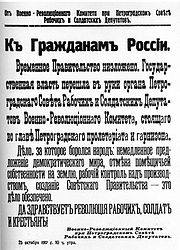
An announcement declaring the end of the Provisional Government and the transfer of power to the Petrograd Soviet was issued by the Milrevcom at 1000 hours on October 25 – in fact written by Lenin. In the early afternoon, an Extraordinary Session of the Petrograd Soviet was convened by Trotsky, to preempt the Congress of Soviets. It was packed with Bolsheviks and Left SR deputies.
The Second Congress of Soviets opened that evening in the Assembly Hall in Smolnyi. The six hundred or so delegates chose a Presidium of three Mensheviks and twenty-one Bolsheviks and Left SRs. The Ispolkom rejected the workings of the Congress the following day, and called on the Soviets and the army to defend the Revolution.
In the evening session of October 26, the Congress approved the Decree on Peace
, the Decree on Land
and the formation of a new government under Lenin - the Council of People's Commissars (Sovet Narodnykh Komissarov, abbreviated to Sovnarkom) – until the meeting of the Constituent Assembly. The previous Soviet Ispolkom was dismissed and replaced by a new group of 101 members (62 Bolsheviks) under Lev Borisovich Kamenev. The Sovnarkom was accountable to the CEC/VTsIK in theory, but the organization was in every aspect powerless.
Soviet (council)
Soviet was a name used for several Russian political organizations. Examples include the Czar's Council of Ministers, which was called the “Soviet of Ministers”; a workers' local council in late Imperial Russia; and the Supreme Soviet of the Soviet Union....
(workers' council) in Petrograd
Saint Petersburg
Saint Petersburg is a city and a federal subject of Russia located on the Neva River at the head of the Gulf of Finland on the Baltic Sea...
(Saint Petersburg), Russia
Russia
Russia or , officially known as both Russia and the Russian Federation , is a country in northern Eurasia. It is a federal semi-presidential republic, comprising 83 federal subjects...
, established in March 1917 after the February Revolution
February Revolution
The February Revolution of 1917 was the first of two revolutions in Russia in 1917. Centered around the then capital Petrograd in March . Its immediate result was the abdication of Tsar Nicholas II, the end of the Romanov dynasty, and the end of the Russian Empire...
as the representative body of the city's workers.
The Petrograd Soviet became important during the Russian Revolution leading up to the October Revolution
October Revolution
The October Revolution , also known as the Great October Socialist Revolution , Red October, the October Uprising or the Bolshevik Revolution, was a political revolution and a part of the Russian Revolution of 1917...
as a rival power center to the Provisional Government
Russian Provisional Government
The Russian Provisional Government was the short-lived administrative body which sought to govern Russia immediately following the abdication of Tsar Nicholas II . On September 14, the State Duma of the Russian Empire was officially dissolved by the newly created Directorate, and the country was...
.
Formation
Before 1914, Petrograd was known as Saint PetersburgSaint Petersburg
Saint Petersburg is a city and a federal subject of Russia located on the Neva River at the head of the Gulf of Finland on the Baltic Sea...
, and in 1905 the workers' soviet called the St Petersburg Soviet was created. But the main precursor to the 1917 Petrograd Soviet was the Central Workers' Group (Центральная Рабочая Группа, Tsentral'naya Rabochaya Grupa), founded in November 1915 by the Menshevik
Menshevik
The Mensheviks were a faction of the Russian revolutionary movement that emerged in 1904 after a dispute between Vladimir Lenin and Julius Martov, both members of the Russian Social-Democratic Labour Party. The dispute originated at the Second Congress of that party, ostensibly over minor issues...
s to sit between workers and the new Central Military-Industrial Committee in Petrograd. The group became increasingly radical as World War I
World War I
World War I , which was predominantly called the World War or the Great War from its occurrence until 1939, and the First World War or World War I thereafter, was a major war centred in Europe that began on 28 July 1914 and lasted until 11 November 1918...
progressed and the economic situation became worse, encouraging street demonstrations and issuing revolutionary proclamations.
On January 27, 1917 (all dates Old Style
Old Style and New Style dates
Old Style and New Style are used in English language historical studies either to indicate that the start of the Julian year has been adjusted to start on 1 January even though documents written at the time use a different start of year ; or to indicate that a date conforms to the Julian...
) the entire leadership of the Central Workers' Group was arrested and taken away to the Peter and Paul Fortress
Peter and Paul Fortress
The Peter and Paul Fortress is the original citadel of St. Petersburg, Russia, founded by Peter the Great in 1703 and built to Domenico Trezzini's designs from 1706-1740.-History:...
on the orders of Alexander Protopopov
Alexander Protopopov
Alexander Dmitriyevich Protopopov was a Russian statesman, politician Octobrist Party.- Biography :Member of Third and Fourth Dumas...
, the Minister of the Interior in Imperial Russia
Russian Empire
The Russian Empire was a state that existed from 1721 until the Russian Revolution of 1917. It was the successor to the Tsardom of Russia and the predecessor of the Soviet Union...
. They were freed by a crowd of disaffected soldiers on the morning of February 27, the beginning of the February Revolution, and the chairman convened a meeting to organize and elect a Soviet of Workers' Deputies that day.
That evening, between 50 and 300 people attended the meeting at the Tauride Palace
Tauride Palace
Tauride Palace is one of the largest and most historic palaces in Saint Petersburg, Russia.- Potemkin :...
. A provisional executive
Executive (government)
Executive branch of Government is the part of government that has sole authority and responsibility for the daily administration of the state bureaucracy. The division of power into separate branches of government is central to the idea of the separation of powers.In many countries, the term...
committee (Ispolkom), was chosen with Nikolay Chkheidze
Nikolay Chkheidze
Nikoloz Chkheidze was a Georgian Menshevik politician who helped to introduce Marxism to Georgia in the 1890s and played a prominent role in the Russian and Georgian revolutions of 1917 and 1918....
as head, and with mostly Menshevik deputies. (Chkheize was replaced by Irakli Tsereteli
Irakli Tsereteli
Irakli Tsereteli was a Georgian politician, one of the leaders of the Russian Social-Democratic Labour Party and later the Georgian Mensheviks....
in late March). Izvestia
Izvestia
Izvestia is a long-running high-circulation daily newspaper in Russia. The word "izvestiya" in Russian means "delivered messages", derived from the verb izveshchat . In the context of newspapers it is usually translated as "news" or "reports".-Origin:The newspaper began as the News of the...
was chosen as the official newspaper of the group. The following day, February 28, was the plenary session; elected representatives from factories
Factory
A factory or manufacturing plant is an industrial building where laborers manufacture goods or supervise machines processing one product into another. Most modern factories have large warehouses or warehouse-like facilities that contain heavy equipment used for assembly line production...
and the military
Imperial Russian Army
The Imperial Russian Army was the land armed force of the Russian Empire, active from around 1721 to the Russian Revolution of 1917. In the early 1850s, the Russian army consisted of around 938,731 regular soldiers and 245,850 irregulars . Until the time of military reform of Dmitry Milyutin in...
joined the soviet, and again moderates dominated. Non-representative voting and enthusiasm gave the Soviet almost 3,000 deputies in two weeks, of which the majority were soldiers. The meetings were chaotic, confused and unruly, little more than a stage for speechmakers. The party-based Ispolkom quickly took charge of actual decision-making.
Executive committee
The Executive Committee members came only from political groups, with every socialist party given three seats (agreed March 18). This created an intellectual and radical head to the peasant-, worker-, and soldier-dominated body. The Executive Committee meetings were more intense and almost as disorderly as the public meetings, and were often extremely long.On March 1, the Executive Committee resolved to remain outside any new State Duma
State Duma
The State Duma , common abbreviation: Госду́ма ) in the Russian Federation is the lower house of the Federal Assembly of Russia , the upper house being the Federation Council of Russia. The Duma headquarters is located in central Moscow, a few steps from Manege Square. Its members are referred to...
. This allowed the group to criticize without responsibility, and kept them away from any potential backlash. On March 2, the Soviet received the eight-point program of the Provisional Committee of the State Duma
Provisional Committee of the State Duma
Provisional Committee of the State Duma was a special government body established on March 12, 1917 by the Fourth State Duma deputies at the outbreak of the Russian February Revolution....
, appointed an oversight committee (nabliudatel'nyi komitet), and issued a decidedly conditional statement of support. Moreover, the Soviet undermined the Provisional Government by issuing its own orders, beginning with the seven-article Order No. 1
Order No. 1
Order Number 1 was issued March 1, 1917 and was the first official decree of The Petrograd Soviet of Workers' and Soldiers' Deputies.The order was issued following the February Revolution in response to actions taken the day before by the Provisional Committee of the State Duma, headed by Mikhail...
. The Soviet was not opposed to the war – internal divisions produced a public ambivalence–but was deeply worried about counterrevolutionary
Counterrevolutionary
A counter-revolutionary is anyone who opposes a revolution, particularly those who act after a revolution to try to overturn or reverse it, in full or in part...
moves from the military, and was determined to have garrison
Garrison
Garrison is the collective term for a body of troops stationed in a particular location, originally to guard it, but now often simply using it as a home base....
troops firmly on its side.
Power struggle with the Provisional Government
The Petrograd Soviet developed into an alternate source of authorityAuthority
The word Authority is derived mainly from the Latin word auctoritas, meaning invention, advice, opinion, influence, or command. In English, the word 'authority' can be used to mean power given by the state or by academic knowledge of an area .-Authority in Philosophy:In...
to the Provisional Government
Russian Provisional Government
The Russian Provisional Government was the short-lived administrative body which sought to govern Russia immediately following the abdication of Tsar Nicholas II . On September 14, the State Duma of the Russian Empire was officially dissolved by the newly created Directorate, and the country was...
under (Prince) Georgy Lvov and later Alexander Kerensky
Alexander Kerensky
Alexander Fyodorovich Kerensky was a major political leader before and during the Russian Revolutions of 1917.Kerensky served as the second Prime Minister of the Russian Provisional Government until Vladimir Lenin was elected by the All-Russian Congress of Soviets following the October Revolution...
·
This created a situation described as dvoevlastie (dual power
Dual power
Dual power is a concept that has taken on a broad meaning in the hands of anarchists and Libertarian socialists who use it to refer to the concept of gradual revolution through the creation of "alternative-institutions" and "counter-institutions" in place of and in opposition to state and corporate...
), in which the Petrograd Soviet competed for legitimacy
Legitimacy (political science)
In political science, legitimacy is the popular acceptance of a governing law or régime as an authority. Whereas “authority” denotes a specific position in an established government, the term “legitimacy” denotes a system of government — wherein “government” denotes “sphere of influence”...
with the Provisional Government until the October Revolution.
The Ispolkom (the "executive committee") of the Petrograd Soviet often publicly attacked the Provisional Government as bourgeois
Bourgeoisie
In sociology and political science, bourgeoisie describes a range of groups across history. In the Western world, between the late 18th century and the present day, the bourgeoisie is a social class "characterized by their ownership of capital and their related culture." A member of the...
and boasted of its de facto
De facto
De facto is a Latin expression that means "concerning fact." In law, it often means "in practice but not necessarily ordained by law" or "in practice or actuality, but not officially established." It is commonly used in contrast to de jure when referring to matters of law, governance, or...
power over de jure
De jure
De jure is an expression that means "concerning law", as contrasted with de facto, which means "concerning fact".De jure = 'Legally', De facto = 'In fact'....
authority (control over post
Mail
Mail, or post, is a system for transporting letters and other tangible objects: written documents, typically enclosed in envelopes, and also small packages are delivered to destinations around the world. Anything sent through the postal system is called mail or post.In principle, a postal service...
, telegraphs
Telegraphy
Telegraphy is the long-distance transmission of messages via some form of signalling technology. Telegraphy requires messages to be converted to a code which is known to both sender and receiver...
, the press, railroads, food supply, and other infrastructure
Infrastructure
Infrastructure is basic physical and organizational structures needed for the operation of a society or enterprise, or the services and facilities necessary for an economy to function...
). A "shadow government
Shadow government
Shadow government may refer to:*An opposition government in a parliamentary system, see Shadow Cabinet*A term for plans for an emergency government that takes over in the event of a disaster, see continuity of government...
" with a Contact Commission (created March 8) to "inform... [the Provisional Government] about the demands of the revolutionary people, to exert pressure on the government to satisfy all these demands, and to exercise uninterrupted control over their implementation." On March 19, the control extended into the military frontlines with commissar
Commissar
Commissar is the English transliteration of an official title used in Russia from the time of Peter the Great.The title was used during the Provisional Government for regional heads of administration, but it is mostly associated with a number of Cheka and military functions in Bolshevik and Soviet...
s appointed with Ministry of War
Ministry of War
A Ministry of War or Ministry for War is an administrative, supply and services agency of an army, as opposed to the entire military establishment. Both Mexico and Brazil both still maintain a War Department for the support of their armies...
support.
On March 1917, the Petrograd Soviet was actually opposed to the workers, which protested its deliberations with strikes. On March 8, the Menshevik
Menshevik
The Mensheviks were a faction of the Russian revolutionary movement that emerged in 1904 after a dispute between Vladimir Lenin and Julius Martov, both members of the Russian Social-Democratic Labour Party. The dispute originated at the Second Congress of that party, ostensibly over minor issues...
Rabochaia Gazeta even claimed that the strikers were discrediting the soviet by not obeying it.
The Ispolkom expanded to 19 members on April 8, nine representing the Soldiers' Section, and ten the Workers' Section. All members were socialists, the majority Mensheviks or Socialist-Revolutionaries
Socialist-Revolutionary Party
thumb|right|200px|Socialist-Revolutionary election poster, 1917. The caption in red reads "партия соц-рев" , short for Party of the Socialist Revolutionaries...
; there was no Bolshevik
Bolshevik
The Bolsheviks, originally also Bolshevists , derived from bol'shinstvo, "majority") were a faction of the Marxist Russian Social Democratic Labour Party which split apart from the Menshevik faction at the Second Party Congress in 1903....
representation. After the All-Russian Consultation of Soviets, the Petrograd Soviet began adding representatives from other parts of Russia
Russia
Russia or , officially known as both Russia and the Russian Federation , is a country in northern Eurasia. It is a federal semi-presidential republic, comprising 83 federal subjects...
and the front lines, renaming itself the All-Russian Soviet of Workers' and Soldiers' Deputies
Congress of Soviets
The Congress of Soviets was the supreme governing body of the Russian Soviet Federative Socialist Republic and several other Soviet republics from 1917–36 and again from 1989-91. After the creation of the Soviet Union, the Congress of Soviets of the Soviet Union functioned as its legislative branch...
. The executive committee became the All-Russian Central Executive Committee (CEC or VTsIK) with over 70 members (but no peasant
Peasant
A peasant is an agricultural worker who generally tend to be poor and homeless-Etymology:The word is derived from 15th century French païsant meaning one from the pays, or countryside, ultimately from the Latin pagus, or outlying administrative district.- Position in society :Peasants typically...
representatives). The mass meeting of the entire body were tapered off, being reduced from daily in the first weeks to roughly weekly by April.
Riots and street protests
Disputes over war aims led to street protests on April 20–21, including military units protesting outside the Mariinsky PalaceMariinsky Palace
Mariinsky Palace, also known as Marie Palace , was the last Neoclassical imperial palace to be constructed in Saint Petersburg, Russia. It was built between 1839 and 1844 to a design by the court architect Andrei Stackensneider....
. The unrest was quickly directed by Bolshevik leaders into what some interpret as a coup attempt. The Ispolkom issued proclamations to restrain disorder and repeatedly quashed Lavr Kornilov's
Lavr Kornilov
Lavr Georgiyevich Kornilov was a military intelligence officer, explorer, and general in the Imperial Russian Army during World War I and the ensuing Russian Civil War...
demands to put troops and artillery
Artillery
Originally applied to any group of infantry primarily armed with projectile weapons, artillery has over time become limited in meaning to refer only to those engines of war that operate by projection of munitions far beyond the range of effect of personal weapons...
on the streets. There were riots in Petrograd, and also Moscow, but anti-Bolshevik and pro-Provisional Government groups soon stopped the agitators.
The riots deeply worried the Provisional Government. There were a number of resignation
Resignation
A resignation is the formal act of giving up or quitting one's office or position. It can also refer to the act of admitting defeat in a game like chess, indicated by the resigning player declaring "I resign", turning his king on its side, extending his hand, or stopping the chess clock...
s, and on May 1, the Ispolkom voted to allow its members to take Cabinet posts in return for further concessions (the Bolsheviks and the left Menshevik followers of Julius Martov
Julius Martov
Julius Martov or L. Martov was born in Constantinople in 1873...
opposed the move, and were against any cooperation with the Provisional Government). After negotiations, a new cabinet was chosen on May 6. Alexander Guchkov
Alexander Guchkov
Alexander Ivanovich Guchkov was a Russian politician, Chairman of the Duma and Minister of War in the Russian Provisional Government.-Early years:...
and Pavel Milyukov
Pavel Milyukov
Pavel Nikolayevich Milyukov , a Russian politician, was the founder, leader, and the most prominent member of the Constitutional Democratic party...
, the leader of the Constitutional Democrats
Constitutional Democratic party
The Constitutional Democratic Party was a liberal political party in the Russian Empire. Party members were called Kadets, from the abbreviation K-D of the party name...
(Cadets), left the government. Alexander Kerensky was moved to the Ministry of War. Six socialists took cabinet posts.
Rise of the Bolsheviks
The Bolsheviks rapidly assumed the mantle of the official oppositionOpposition (politics)
In politics, the opposition comprises one or more political parties or other organized groups that are opposed to the government , party or group in political control of a city, region, state or country...
, and took advantage of the new socialist presence in the Cabinet to attack them for the failures of the Provisional Government. The Bolsheviks began a strong run of propaganda
Propaganda
Propaganda is a form of communication that is aimed at influencing the attitude of a community toward some cause or position so as to benefit oneself or one's group....
. In June, 100,000 copies of Pravda
Pravda
Pravda was a leading newspaper of the Soviet Union and an official organ of the Central Committee of the Communist Party between 1912 and 1991....
(including Soldatskaya Pravda, Golos Pravdy, and Okopnaya Pravda) were printed daily. In July, over 350,000 leaflets were distributed. The July Days
July Days
The July Days refers to events in 1917 that took place in Petrograd, Russia, between 3 July and 7 July , when soldiers and industrial workers engaged in spontaneous demonstrations against the Russian Provisional Government...
riots from July 16–17 led by the Bolsheviks were without success.
The rise of Kerensky, and the later shock of the Kornilov affair
Kornilov Affair
The Kornilov Affair, or the Kornilov Putsch as it is sometimes referred to, was an attempted coup d'état by the then Commander-in-Chief of the Russian Army, General Lavr Kornilov, in August 1917 against the Russian Provisional Government headed by Alexander Kerensky.-Background:Following the...
, polarized the political scene. The Petrograd Soviet moved steadily leftwards, just as those of the center and right consolidated around Kerensky. Despite the events in July, the Ispolkom moved to protect the Bolsheviks from serious consequences, adopting resolutions on August 4 and August 18 against the arrest and prosecution of Bolsheviks. Still wary of the Ispolkom, the government released many senior Bolsheviks on bail
Bail
Traditionally, bail is some form of property deposited or pledged to a court to persuade it to release a suspect from jail, on the understanding that the suspect will return for trial or forfeit the bail...
or promise of good behavior.
In the August 20 municipal elections, the Bolsheviks took a third of the votes, a 50 percent increase in three months. There was also a general falling away in the attendance of soviet meetings. Indeed, many of the smaller soviets no longer existed except on paper.
During the Kornilov affair, the Ispolkom was forced to use the Bolsheviks' military as its main force against the "counter-revolution." Kerensky ordered the distribution of 40,000 rifles to the workers of Petrograd (some Red Guards
Red Guards (Russia)
In the context of the history of Russia and Soviet Union, Red Guards were paramilitary formations consisting of workers and partially of soldiers and sailors formed in the time frame of the Russian Revolution of 1917...
), many of which ended in the hands of Bolshevik groups.
As all other socialist parties abandoned the Soviet organizations, the Bolsheviks increased their presence. On September 25, they gained a majority in the Workers' Section and Leon Trotsky
Leon Trotsky
Leon Trotsky , born Lev Davidovich Bronshtein, was a Russian Marxist revolutionary and theorist, Soviet politician, and the founder and first leader of the Red Army....
was elected chairman. He directed the transformation of the Soviet into an adjunct of the party, bypassing the Menshevik-SR Ispolkom and non-Bolshevik soviets to form a new Bolshevik control structure.
The Bolsheviks used their power in the Petrograd Soviet to set up a second All-Russian Congress of Soviets
All-Russian Congress of Soviets
The All-Russian Congress of Soviets was the supreme governing body of the Russian Soviet Federative Socialist Republic from 1917–22 and of the Soviet Union until 1936. The 1918 Constitution of the Russian SFSR mandated that Congress shall convene at least twice a year...
on October 20 (agreed September 26), despite only eight of 169 soldiers' or workers' soviets expressing support. With the November elections
Russian Constituent Assembly election, 1917
The elections to the Russian Constituent Assembly that were organised as a result of events in the Russian Revolution of 1917 were held on November 25, 1917 , around 2 months after they were originally meant to occur...
to the Constituent Assembly
Russian Constituent Assembly
The All Russian Constituent Assembly was a constitutional body convened in Russia after the October Revolution of 1917. It is generally reckoned as the first democratically elected legislative body of any kind in Russian history. It met for 13 hours, from 4 p.m...
looming the Bolsheviks had to use their power quickly to discredit the elections. The Ispolkom denounced the Congress and the steps the Bolsheviks were taking to create its delegates. Suddenly and without reason, on October 17, the Ispolkom Bureau approved the Congress.
German advance and Committee of Revolutionary Defense
On October 9, the Soviet considered the creation of a Committee of Revolutionary Defense. The Bolsheviks and Leon Trotsky amended the resolution to create a Military Defense Committee, to control the security of Petrograd against both German and domestic threats. The Plenum of the Soviet voted in favour of a committee to "gather... all the forces participating in the defense of Petrograd... to arm the workers... ensuring the revolutionary defense of Petrograd... against the... military and civilian Kornilovites."
The Ispolkom approved the resolution, against Menshevik resistance, on October 12, and the measure was formally approved by the Soviet on October 16 (despite warnings from the Mensheviks and SRs), creating the Military Revolutionary Committee
Military Revolutionary Committee
The Military Revolutionary Committee also known as the Milrevcom was the name for military organs under the soviets during the period of the Russian Revolution and Russian Civil War. The most notable ones were those of the Petrograd Soviet, the Moscow Soviet, and at Stavka.These committees were...
(Voenno-Revoliutsionnyi Komitet), also called the Milrevcom or Military Committee.
The Military-Revolutionary Committee was chaired by Pavel Lazimir
Pavel Lazimir
Pavel Evgen'evich Lazimir was a prominent Left Socialist Revolutionaries who served on the Military Revolutionary Committee of the Petrograd Soviet during the October Revolution....
, with Nikolai Podvoisky
Nikolai Podvoisky
Nikolai Ilyich Podvoisky was a Russian revolutionary. He played a large role in the Russian Revolution of 1917 and wrote many articles for the Soviet newspaper Krasnaya Gazeta...
as his deputy. Basically, it was the front for the activities of the Bolshevik's Military Organization. Podvoisky would take official control of the Committee on the day of the uprising, with Vladimir Antonov-Ovseenko
Vladimir Antonov-Ovseenko
Vladimir Alexandrovich Antonov-Ovseyenko , real surname Ovseyenko, party aliases the 'Bayonet' and 'Nikita' , a literary pseudonym A. Gal , was a prominent Soviet Bolshevik leader and diplomat. He was born in Chernigov into an officer's family.In 1903, Antonov-Ovseyenko joined the Menshevik party...
as secretary. The Ispolkom and the Provisional Government had been cut out of control of the forces in the Petrograd Military District, and without orders, the garrison would remain neutral.
The Military Staff was side-lined when the Milrevcom took exclusive control of the garrison troops in the name of the Soldiers' Section of the Soviet on the night of October 21. The commander of the District, Colonel Polkovnikov, refused to allow this control, and he and his staff were condemned in a Milrevcom public statement as "a direct weapon of the counter-revolutionary forces." The military command responded with an ultimatum to the Soviet, which lead to delaying negotiations and meetings over October 23–October 24.
The Bolshevik uprising began on October 24, as liberal forces attempted to shut down Pravda
Pravda
Pravda was a leading newspaper of the Soviet Union and an official organ of the Central Committee of the Communist Party between 1912 and 1991....
and take other steps to secure the government. The Milrevcom sent armed groups to seize the main telegraph offices and lower the bridges across the Neva. Over the night of October 24, the Bolsheviks took control quickly and easily.
An announcement declaring the end of the Provisional Government and the transfer of power to the Petrograd Soviet was issued by the Milrevcom at 1000 hours on October 25 – in fact written by Lenin. In the early afternoon, an Extraordinary Session of the Petrograd Soviet was convened by Trotsky, to preempt the Congress of Soviets. It was packed with Bolsheviks and Left SR deputies.
The Second Congress of Soviets opened that evening in the Assembly Hall in Smolnyi. The six hundred or so delegates chose a Presidium of three Mensheviks and twenty-one Bolsheviks and Left SRs. The Ispolkom rejected the workings of the Congress the following day, and called on the Soviets and the army to defend the Revolution.
In the evening session of October 26, the Congress approved the Decree on Peace
Decree on Peace
The Decree On Peace, written by Vladimir Lenin, was passed by the Second Congress of the Soviet of Workers', Soldiers', and Peasants' Deputies on the 26 October 1917, following the success of the October Revolution. It was published in the Izvestiya newspaper, #208, October 27, 1917...
, the Decree on Land
Decree on Land
The Decree on Land, written by Vladimir Lenin, was passed by the Second Congress of Soviets of Workers', Soldiers', and Peasants' Deputies on 26 October 1917, following the success of the October Revolution. It decreed an abolition of private property, and the redistribution of the landed estates...
and the formation of a new government under Lenin - the Council of People's Commissars (Sovet Narodnykh Komissarov, abbreviated to Sovnarkom) – until the meeting of the Constituent Assembly. The previous Soviet Ispolkom was dismissed and replaced by a new group of 101 members (62 Bolsheviks) under Lev Borisovich Kamenev. The Sovnarkom was accountable to the CEC/VTsIK in theory, but the organization was in every aspect powerless.