
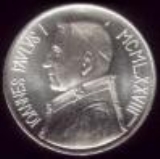
John Paul I born
Albino Luciani, (17 October 1912 – 28 September 1978), reigned as
PopeThe Pope is the Bishop of Rome, a position that makes him the leader of the worldwide Catholic Church . In the Catholic Church, the Pope is regarded as the successor of Saint Peter, the Apostle...
of the Catholic Church and as
SovereignA monarch is the person who heads a monarchy. This is a form of government in which a state or polity is ruled or controlled by an individual who typically inherits the throne by birth and occasionally rules for life or until abdication...
of
Vatican CityVatican City , or Vatican City State, in Italian officially Stato della Città del Vaticano , which translates literally as State of the City of the Vatican, is a landlocked sovereign city-state whose territory consists of a walled enclave within the city of Rome, Italy. It has an area of...
from 26 August 1978 until his death 33 days later. His reign is among the shortest in papal history, resulting in the most recent
Year of Three PopesThe Year of Three Popes is a common reference to 1978, when the College of Cardinals of the Catholic Church was required to elect two new popes within the same calendar year...
. John Paul I was the first Pope to be born in the 20th century, and was also the last Pope to die in it.
In
ItalyItaly , officially the Italian Republic languages]] under the European Charter for Regional or Minority Languages. In each of these, Italy's official name is as follows:;;;;;;;;), is a unitary parliamentary republic in South-Central Europe. To the north it borders France, Switzerland, Austria and...
he is remembered with the appellatives of "Il Papa del Sorriso" (
The Smiling Pope) and "Il Sorriso di Dio" (
The smile of God).
Time magazine and other publications referred to him as
The September Pope.
Early years
Albino Luciani was born on 17 October 1912 in
Forno di CanaleCanale d'Agordo is a town and comune in the province of Belluno, in the region of Veneto, northern Italy. It has 1,230 inhabitants...
(now Canale d'Agordo) in
BellunoTheThe Province of Belluno is a province in the Veneto region of Italy. Its capital is the city of Belluno.It has an area of 3,678 km², and a total population of 214,026 .-Geography:...
, a province of the
VenetoVeneto is one of the 20 regions of Italy. Its population is about 5 million, ranking 5th in Italy.Veneto had been for more than a millennium an independent state, the Republic of Venice, until it was eventually annexed by Italy in 1866 after brief Austrian and French rule...
region in
Northern ItalyNorthern Italy is a wide cultural, historical and geographical definition, without any administrative usage, used to indicate the northern part of the Italian state, also referred as Settentrione or Alta Italia...
. He was the son of Giovanni Luciani (1872?–1952), a
bricklayerA bricklayer or mason is a craftsman who lays bricks to construct brickwork. The term also refers to personnel who use blocks to construct blockwork walls and other forms of masonry. In British and Australian English, a bricklayer is colloquially known as a "brickie".The training of a trade in...
, and Bortola Tancon (1879?–1948). Albino was followed by two brothers, Federico (1915–1916) and Edoardo (1917–2008), and a sister, Antonia (1920–2009).
Luciani entered the
minor seminaryA minor seminary is a secondary boarding school created for the specific purpose of enrolling teenage boys who have expressed interest in becoming priests. They are generally Roman Catholic institutions, and designed to prepare boys both academically and spiritually for vocations to the priesthood...
of
FeltreFeltre is a town and comune of the province of Belluno in Veneto, northern Italy. A hill town in the southern reaches of the province, it is located on the Stizzon River, about 4 km from its junction with the Piave, and 20 km southwest from Belluno...
in 1923, where his teachers found him "too lively", and later went on to the
major seminaryA seminary, theological college, or divinity school is an institution of secondary or post-secondary education for educating students in theology, generally to prepare them for ordination as clergy or for other ministry...
of Belluno. During his stay at Belluno, he attempted to join the
JesuitsThe Society of Jesus is a Catholic male religious order that follows the teachings of the Catholic Church. The members are called Jesuits, and are also known colloquially as "God's Army" and as "The Company," these being references to founder Ignatius of Loyola's military background and a...
, but was denied by the seminary's
rectorThe word rector has a number of different meanings; it is widely used to refer to an academic, religious or political administrator...
, Bishop
Giosuè CattarossiBishop Giosuè Cattarossi was a late 19th century/early-mid 20th century Italian cleric.Born 23 April 1863 at Cortale, he was ordained a priest in April 1888, aged 24....
.
OrdainedThe term Holy Orders is used by many Christian churches to refer to ordination or to those individuals ordained for a special role or ministry....
a
priestThe ministerial orders of the Catholic Church include the orders of bishops, deacons and presbyters, which in Latin is sacerdos. The ordained priesthood and common priesthood are different in function and essence....
on 7 July 1935, Luciani then served as a
curateA curate is a person who is invested with the care or cure of souls of a parish. In this sense "curate" correctly means a parish priest but in English-speaking countries a curate is an assistant to the parish priest...
in his native Forno de Canale before becoming a professor and the vice-rector of the Belluno seminary in 1937. Among the different subjects, he taught
dogmaticDogmatic theology is that part of theology dealing with the theoretical truths of faith concerning God and his works, especially the official theology recognized by an organized Church body, such as the Roman Catholic Church, Dutch Reformed Church, etc...
and
moral theologyMost religions have an ethical component, often derived from purported supernatural revelation or guidance. "For many people, ethics is not only tied up with religion, but is completely settled by it...
,
canon lawThe canon law of the Catholic Church, is a fully developed legal system, with all the necessary elements: courts, lawyers, judges, a fully articulated legal code and principles of legal interpretation. It lacks the necessary binding force present in most modern day legal systems. The academic...
and
sacred artSacred art is imagery intended to uplift the mind to the spiritual. Sacred art involves the ritual and cultic practices and practical and operative aspects of the path of the spiritual realization within the bosom of the tradition in question....
.
In 1941, Luciani began to seek a
doctorate in theologyLicentiate of Sacred Theology is the title of the second cycle of studies of a Faculty of Theology offered by a pontifical universities or ecclesiastical faculties of sacred theology. An Ecclesiastical Faculty offers three cycles of study: Baccalaureate or fundamentals, Licentiate or specialized,...
from the
Pontifical Gregorian UniversityThe Pontifical Gregorian University is a pontifical university located in Rome, Italy.Heir of the Roman College founded by Saint Ignatius of Loyola over 460 years ago, the Gregorian University was the first university founded by the Jesuits...
, which required at least one year's attendance in Rome. However, the seminary's superiors wanted him to continue teaching during his doctoral studies; the situation was resolved by a special
dispensationIn the canon law of the Roman Catholic Church, a dispensation is the suspension by competent authority of general rules of law in particular cases...
of
Pope Pius XIIThe Venerable Pope Pius XII , born Eugenio Maria Giuseppe Giovanni Pacelli , reigned as Pope, head of the Catholic Church and sovereign of Vatican City State, from 2 March 1939 until his death in 1958....
himself, on 27 March 1941. His
thesisA dissertation or thesis is a document submitted in support of candidature for an academic degree or professional qualification presenting the author's research and findings...
(
The origin of the human soul according to Antonio RosminiBlessed Antonio Rosmini-Serbati was an Italian Roman Catholic priest and philosopher. He founded the Rosminians, officially the Institute of Charity or Societas a charitate nuncupata.-Biography:...
) largely attacked Rosmini's theology, and earned him his doctorate
magna cum laudeLatin honors are Latin phrases used to indicate the level of academic distinction with which an academic degree was earned. This system is primarily used in the United States, Canada, and in many countries of continental Europe, though some institutions also use the English translation of these...
.
In 1947, he was named
vicar generalA vicar general is the principal deputy of the bishop of a diocese for the exercise of administrative authority. As vicar of the bishop, the vicar general exercises the bishop's ordinary executive power over the entire diocese and, thus, is the highest official in a diocese or other particular...
to Bishop
Girolamo BortignonGirolamo Bartolomeo Bortignon, OFM Cap was an Italian prelate of the Roman Catholic Church, serving as Bishop of Padua from 1949 to 1982....
,
OFM CapThe Order of Friars Minor Capuchin is an Order of friars in the Catholic Church, among the chief offshoots of the Franciscans. The worldwide head of the Order, called the Minister General, is currently Father Mauro Jöhri.-Origins :...
, of Belluno. Two years later, in 1949, he was placed in charge of
diocesanA diocese is the district or see under the supervision of a bishop. It is divided into parishes.An archdiocese is more significant than a diocese. An archdiocese is presided over by an archbishop whose see may have or had importance due to size or historical significance...
catecheticsA catechism , i.e. to indoctrinate) is a summary or exposition of doctrine, traditionally used in Christian religious teaching from New Testament times to the present...
.
On 15 December 1958, Luciani was appointed Bishop of Vittorio Veneto by
Pope John XXIII-Papal election:Following the death of Pope Pius XII in 1958, Roncalli was elected Pope, to his great surprise. He had even arrived in the Vatican with a return train ticket to Venice. Many had considered Giovanni Battista Montini, Archbishop of Milan, a possible candidate, but, although archbishop...
. He received his
episcopal consecrationIn the Catholic Church, a bishop is an ordained minister who holds the fullness of the sacrament of Holy Orders and is responsible for teaching the Catholic faith and ruling the Church....
on the following 27 December from Pope John himself, with Bishops Bortignon and
Gioacchino MuccinGioacchino Muccin was an Italian Roman Catholic clergyman who became the bishop of the Diocese of Belluno-Feltre.-Early life:...
serving as co-
consecratorConsecrator is a term used in the Roman Catholic Church to designate a bishop who ordains a priest to the episcopal state. The term is often used in Eastern Rite Churches and in Anglican communities. The term "Principal Consecrator" is used to designate the primary bishop who ordains a new bishop...
s. As a bishop, he participated in all the sessions of the
Second Vatican CouncilThe Second Vatican Council addressed relations between the Roman Catholic Church and the modern world. It was the twenty-first Ecumenical Council of the Catholic Church and the second to be held at St. Peter's Basilica in the Vatican. It opened under Pope John XXIII on 11 October 1962 and closed...
(1962–1965).
On 15 December 1969, he was appointed
Patriarch of VeniceThe Patriarch of Venice is the ordinary bishop of the Roman Catholic Archdiocese of Venice. The bishop is one of the few Patriarchs in the Latin Rite of the Roman Catholic Church...
by
Pope Paul VIPaul VI , born Giovanni Battista Enrico Antonio Maria Montini , reigned as Pope of the Catholic Church from 21 June 1963 until his death on 6 August 1978. Succeeding Pope John XXIII, who had convened the Second Vatican Council, he decided to continue it...
and took possession of the archdiocese on 3 February 1970. Pope Paul created Luciani Cardinal-Priest of
S. MarcoSan Marco is a basilica in Rome dedicated to St. Mark located in the small Piazza di San Marco adjoining Piazza Venezia. It was built in 336 by Pope Mark and rebuilt in 833 by Pope Gregory IV.-History:...
in the
consistory-Antiquity:Originally, the Latin word consistorium meant simply 'sitting together', just as the Greek synedrion ....
of 5 March 1973. Catholics were struck by his
humilityHumility is the quality of being modest, and respectful. Humility, in various interpretations, is widely seen as a virtue in many religious and philosophical traditions, being connected with notions of transcendent unity with the universe or the divine, and of egolessness.-Term:The term "humility"...
, a prime example being his embarrassment when Paul VI once removed his papal stole and put it on Patriarch Luciani. He recalls the occasion in his first Angelus thus:
Election
Luciani was elected on the fourth ballot of the August 1978
papal conclaveA papal conclave is a meeting of the College of Cardinals convened to elect a Bishop of Rome, who then becomes the Pope during a period of vacancy in the papal office. The Pope is considered by Roman Catholics to be the apostolic successor of Saint Peter and earthly head of the Roman Catholic Church...
. Senior Cardinal Deacon Pericle Felici announced that the Cardinals had elected Venice patriarch Albino Luciani to be Pope John Paul I. He chose the
regnal nameA regnal name, or reign name, is a formal name used by some monarchs and popes during their reigns. Since medieval times, monarchs have frequently chosen to use a name different from their own personal name when they inherit a throne....
of
John Paul, the first double name in the history of the papacy, explaining in his
AngelusThe Angelus is a Christian devotion in memory of the Incarnation. The name Angelus is derived from the opening words: Angelus Domini nuntiavit Mariæ The Angelus (Latin for "angel") is a Christian devotion in memory of the Incarnation. The name Angelus is derived from the opening words: Angelus...
that he took it as a thankful honour to his two immediate predecessors:
John XXIII-Papal election:Following the death of Pope Pius XII in 1958, Roncalli was elected Pope, to his great surprise. He had even arrived in the Vatican with a return train ticket to Venice. Many had considered Giovanni Battista Montini, Archbishop of Milan, a possible candidate, but, although archbishop...
, who had named him a bishop, and
Paul VIPaul VI , born Giovanni Battista Enrico Antonio Maria Montini , reigned as Pope of the Catholic Church from 21 June 1963 until his death on 6 August 1978. Succeeding Pope John XXIII, who had convened the Second Vatican Council, he decided to continue it...
, who had named him Patriarch of Venice and a
cardinalA cardinal is a senior ecclesiastical official, usually an ordained bishop, and ecclesiastical prince of the Catholic Church. They are collectively known as the College of Cardinals, which as a body elects a new pope. The duties of the cardinals include attending the meetings of the College and...
. He was also the first (and so far only) pope to use
"the first" in his
regnal nameA regnal name, or reign name, is a formal name used by some monarchs and popes during their reigns. Since medieval times, monarchs have frequently chosen to use a name different from their own personal name when they inherit a throne....
.
Observers have suggested that his selection was linked to the rumoured divisions between rival camps within the
College of CardinalsThe College of Cardinals is the body of all cardinals of the Catholic Church.A function of the college is to advise the pope about church matters when he summons them to an ordinary consistory. It also convenes on the death or abdication of a pope as a papal conclave to elect a successor...
:
- Conservatives
Conservatism is a political and social philosophy that promotes the maintenance of traditional institutions and supports, at the most, minimal and gradual change in society. Some conservatives seek to preserve things as they are, emphasizing stability and continuity, while others oppose modernism...
and CurialistsThe Roman Curia is the administrative apparatus of the Holy See and the central governing body of the entire Catholic Church, together with the Pope...
supporting Cardinal Giuseppe Siri, who favoured a more conservative interpretation or even correction of Vatican II's reforms.There remains a conspiracy theory (the so-called 'Siri Conspiracy') concerning allegations Siri was actually elected in this conclave, but then forced to withdraw acceptance of his election.
- Those who favoured a more liberal interpretation of Vatican II's reforms, and some Italian
Italy , officially the Italian Republic languages]] under the European Charter for Regional or Minority Languages. In each of these, Italy's official name is as follows:;;;;;;;;), is a unitary parliamentary republic in South-Central Europe. To the north it borders France, Switzerland, Austria and...
cardinals supporting Cardinal Giovanni Benelli, who was opposed because of his "autocraticAn autocracy is a form of government in which one person is the supreme power within the state. It is derived from the Greek : and , and may be translated as "one who rules by himself". It is distinct from oligarchy and democracy...
" tendencies.
Outside the Italians, who were experiencing diminished influence within the increasingly internationalist
College of CardinalsThe College of Cardinals is the body of all cardinals of the Catholic Church.A function of the college is to advise the pope about church matters when he summons them to an ordinary consistory. It also convenes on the death or abdication of a pope as a papal conclave to elect a successor...
, were figures like Cardinal
Karol WojtyłaBlessed Pope John Paul II , born Karol Józef Wojtyła , reigned as Pope of the Catholic Church and Sovereign of Vatican City from 16 October 1978 until his death on 2 April 2005, at of age. His was the second-longest documented pontificate, which lasted ; only Pope Pius IX ...
. Over the days following the conclave, cardinals effectively declared that with general great joy they had elected "God's candidate".
ArgentineArgentina , officially the Argentine Republic , is the second largest country in South America by land area, after Brazil. It is constituted as a federation of 23 provinces and an autonomous city, Buenos Aires...
Cardinal
Eduardo Francisco PironioEduardo Francisco Pironio, Servant of God was a Roman Catholic Cardinal-Bishop. On 30 June 2006 the Diocese of Rome began requesting testimonies about the life and sanctity of Cardinal Pironio.-Early life:...
stated that, "We were witnesses of a moral miracle." And later,
Mother TeresaMother Teresa , born Agnes Gonxha Bojaxhiu , was a Roman Catholic nun of Albanian ethnicity and Indian citizenship, who founded the Missionaries of Charity in Calcutta, India, in 1950...
commented: "He has been the greatest gift of God, a sunray of God's love shining in the darkness of the world."
Metropolitan Nikodim (Rotov) of LeningradMetropolitan Nikodim of Leningrad , was metropolitan of Leningrad and Minsk from 1963 until his death.He was born in Frolovo in southwest Russia....
, who was present at his installation, collapsed and died during the ceremony, and the new Pope prayed over him.
Church policies
Humanising the papacy
After his election, John Paul quickly made several decisions that would "humanise" the office of pope, admitting publicly he had turned scarlet when Paul VI had named him the Patriarch of Venice. He was the first modern pope to speak in the singular form, using 'I' instead of the
royal weThe majestic plural , is the use of a plural pronoun to refer to a single person holding a high office, such as a monarch, bishop, or pope...
, though the official records of his speeches were often rewritten in more formal style by traditionalist aides, who reinstated the royal
we in press releases and in
L'Osservatore RomanoL'Osservatore Romano is the "semi-official" newspaper of the Holy See. It covers all the Pope's public activities, publishes editorials by important churchmen, and runs official documents after being released...
. He was the first to refuse the
sedia gestatoriaThe sedia gestatoria is a portable throne on which Popes were carried until 1978. It consists of a richly adorned, silk-covered armchair, fastened on a suppedaneum, on each side of which are two gilded rings; through these rings pass the long rods with which twelve footmen , in red uniforms, carry...
, until Vatican pressure convinced him of its need, in order to allow the faithful to see him.
He was the first pope to choose an "investiture" to commence his papacy rather than the traditional papal coronation.
One of his remarks, reported in the press, was that God "is our father; even more he is our mother," referring to , which compares God to a mother who will never forget her child Zion. The comment appeared in his 10 September
AngelusThe Angelus is a Christian devotion in memory of the Incarnation. The name Angelus is derived from the opening words: Angelus Domini nuntiavit Mariæ The Angelus (Latin for "angel") is a Christian devotion in memory of the Incarnation. The name Angelus is derived from the opening words: Angelus...
address, which urged prayer for the upcoming
Camp David AccordsThe Camp David Accords were signed by Egyptian President Anwar El Sadat and Israeli Prime Minister Menachem Begin on September 17, 1978, following thirteen days of secret negotiations at Camp David. The two framework agreements were signed at the White House, and were witnessed by United States...
.
Encyclical on devolution
John Paul I intended to prepare an
encyclicalAn encyclical was originally a circular letter sent to all the churches of a particular area in the ancient Catholic Church. At that time, the word could be used for a letter sent out by any bishop...
in order to confirm the lines of the
Second Vatican CouncilThe Second Vatican Council addressed relations between the Roman Catholic Church and the modern world. It was the twenty-first Ecumenical Council of the Catholic Church and the second to be held at St. Peter's Basilica in the Vatican. It opened under Pope John XXIII on 11 October 1962 and closed...
("an extraordinary long-range historical event and of growth for the Church," he said) and to enforce the Church's discipline in the life of priests and the faithful. In discipline, he was a reformist, instead, and was the author of initiatives such as the
devolutionDevolution is the statutory granting of powers from the central government of a sovereign state to government at a subnational level, such as a regional, local, or state level. Devolution can be mainly financial, e.g. giving areas a budget which was formerly administered by central government...
of one per cent of each church's entries for the poor churches in the
Third WorldThe term Third World arose during the Cold War to define countries that remained non-aligned with either capitalism and NATO , or communism and the Soviet Union...
. The visit of
Jorge Rafael VidelaJorge Rafael Videla Redondo is a former senior commander in the Argentine Army who was the de facto President of Argentina from 1976 to 1981. He came to power in a coup d'état that deposed Isabel Martínez de Perón...
, president of the
ArgentineArgentina , officially the Argentine Republic , is the second largest country in South America by land area, after Brazil. It is constituted as a federation of 23 provinces and an autonomous city, Buenos Aires...
juntaA military dictatorship is a form of government where in the political power resides with the military. It is similar but not identical to a stratocracy, a state ruled directly by the military....
, to the Vatican caused considerable controversy, especially when the Pope reminded Videla about
human rightsHuman rights are "commonly understood as inalienable fundamental rights to which a person is inherently entitled simply because she or he is a human being." Human rights are thus conceived as universal and egalitarian . These rights may exist as natural rights or as legal rights, in both national...
violations taking place in Argentina during the so-called
Dirty WarThe Dirty War was a period of state-sponsored violence in Argentina from 1976 until 1983. Victims of the violence included several thousand left-wing activists, including trade unionists, students, journalists, Marxists, Peronist guerrillas and alleged sympathizers, either proved or suspected...
.
Moral theology
The moral theology of John Paul I has been openly debated due to his interpretation of
Humanae VitaeHumanae Vitae is an encyclical written by Pope Paul VI and issued on 25 July 1968. Subtitled On the Regulation of Birth, it re-affirms the traditional teaching of the Catholic Church regarding married love, responsible parenthood, and the continuing proscription of most forms of birth...
. According to journalist John L. Allen "John Paul I would not have insisted upon the negative judgment in
Humanae VitaeHumanae Vitae is an encyclical written by Pope Paul VI and issued on 25 July 1968. Subtitled On the Regulation of Birth, it re-affirms the traditional teaching of the Catholic Church regarding married love, responsible parenthood, and the continuing proscription of most forms of birth...
as aggressively and publicly as John Paul II, and probably would not have treated it as a quasi-infallible teaching" However, others have argued, "Luciani was intransigent with his upholding of the teaching of the Church and severe with those, who through intellectual pride and disobedience paid no attention to the Church's prohibition of contraception", though while not condoning the sin, he was tolerant of those who sincerely tried and failed to live up to the Church's teaching."
Personality
John Paul was regarded as a skilled communicator and writer, and has left behind some writings. His book
IllustrissimiIllustrissimi or To the Illustrious Ones, are a collection of letters written by Pope John Paul I when he was Patriarch of Venice. The letters were originally published in the Italian Christian paper 'Messaggero di S. Antonio' between 1972 and 1975, and published in book form in 1976...
, written while he was a Cardinal, is a series of letters to a wide collection of historical and fictional persons. Among those still available are his letters to
JesusJesus of Nazareth , commonly referred to as Jesus Christ or simply as Jesus or Christ, is the central figure of Christianity...
, King
DavidDavid was the second king of the united Kingdom of Israel according to the Hebrew Bible and, according to the Gospels of Matthew and Luke, an ancestor of Jesus Christ through both Saint Joseph and Mary...
, Figaro the Barber, Empress Maria Theresa and
PinocchioThe Adventures of Pinocchio is a novel for children by Italian author Carlo Collodi, written in Florence. The first half was originally a serial between 1881 and 1883, and then later completed as a book for children in February 1883. It is about the mischievous adventures of Pinocchio , an...
. Others 'written to' included
Mark TwainSamuel Langhorne Clemens , better known by his pen name Mark Twain, was an American author and humorist...
,
Charles DickensCharles John Huffam Dickens was an English novelist, generally considered the greatest of the Victorian period. Dickens enjoyed a wider popularity and fame than had any previous author during his lifetime, and he remains popular, having been responsible for some of English literature's most iconic...
and
Christopher MarloweChristopher Marlowe was an English dramatist, poet and translator of the Elizabethan era. As the foremost Elizabethan tragedian, next to William Shakespeare, he is known for his blank verse, his overreaching protagonists, and his mysterious death.A warrant was issued for Marlowe's arrest on 18 May...
.
John Paul impressed people with his personal warmth. There are reports that within the Vatican he was seen as an intellectual lightweight not up to the responsibilities of the papacy, although
David YallopDavid Anthony Yallop is an agnostic British author who writes chiefly about unsolved crimes. In the 1970s he also contributed scripts for a number of BBC comedy shows...
("In God's Name") says that this is the result of a whispering campaign by people in the Vatican who were opposed to Luciani's policies. In the words of
John CornwellJohn Cornwell is an English journalist and author, and a Fellow of Jesus College, Cambridge. He is best known for various books on the papacy, most notably Hitler's Pope; investigative journalism; memoir; and the public understanding of science and philosophy. More recently he has been concerned...
, "they treated him with condescension"; one senior cleric discussing Luciani said "they have elected
Peter SellersRichard Henry Sellers, CBE , known as Peter Sellers, was a British comedian and actor. Perhaps best known as Chief Inspector Clouseau in The Pink Panther film series, he is also notable for playing three different characters in Dr...
." Critics contrasted his sermons mentioning
PinocchioThe Adventures of Pinocchio is a novel for children by Italian author Carlo Collodi, written in Florence. The first half was originally a serial between 1881 and 1883, and then later completed as a book for children in February 1883. It is about the mischievous adventures of Pinocchio , an...
to the learned intellectual discourses of
Pius XIIThe Venerable Pope Pius XII , born Eugenio Maria Giuseppe Giovanni Pacelli , reigned as Pope, head of the Catholic Church and sovereign of Vatican City State, from 2 March 1939 until his death in 1958....
or
Paul VIPaul VI , born Giovanni Battista Enrico Antonio Maria Montini , reigned as Pope of the Catholic Church from 21 June 1963 until his death on 6 August 1978. Succeeding Pope John XXIII, who had convened the Second Vatican Council, he decided to continue it...
. Visitors spoke of his isolation and loneliness, and the fact that he was the first pope in decades not to have had either a diplomatic role (like
Pius XIPope Pius XI , born Ambrogio Damiano Achille Ratti, was Pope from 6 February 1922, and sovereign of Vatican City from its creation as an independent state on 11 February 1929 until his death on 10 February 1939...
and John XXIII) or
CurialThe Roman Curia is the administrative apparatus of the Holy See and the central governing body of the entire Catholic Church, together with the Pope...
role (like Pius XII and Paul VI) in the Church.
His personal impact, however, was twofold: his image as a warm, gentle, kind man captivated the world. This image was immediately formed when he was presented to the crowd in St. Peter's Square following his election. The warmth of his presence made him a much-loved figure before he even spoke a word. The media in particular fell under his spell. He was a skilled orator. Whereas Pope Paul VI spoke as if delivering a doctoral thesis, John Paul I produced warmth, laughter, a 'feel-good factor,' and plenty of media-friendly sound bites.
According to his aides, he was not the naive idealist his critics made him out to be. Cardinal Giuseppe Caprio, the substitute Papal Secretary of State, said that John Paul quickly accepted his new role and performed it with confidence.
John Paul was the first pope to admit that the prospect of the papacy had daunted him to the point that other cardinals had to encourage him to accept it. He refused to have the millennium-old traditional
Papal CoronationA papal coronation was the ceremony of the placing of the Papal Tiara on a newly elected pope. The first recorded papal coronation was that of Pope Celestine II in 1143. Soon after his coronation in 1963, Pope Paul VI abandoned the practice of wearing the tiara. His successors have chosen not to...
and wear the
Papal TiaraThe Papal Tiara, also known incorrectly as the Triple Tiara, or in Latin as the Triregnum, in Italian as the Triregno and as the Trirègne in French, is the three-tiered jewelled papal crown, supposedly of Byzantine and Persian origin, that is a prominent symbol of the papacy...
. He instead chose to have a simplified
Papal Inauguration MassThe Papal Inauguration is a liturgical service of the Catholic Church within Mass celebrated in the Roman Rite but with elements of Byzantine Rite for the ecclesiastical investiture of the Pope...
. John Paul I used as his
mottoA motto is a phrase meant to formally summarize the general motivation or intention of a social group or organization. A motto may be in any language, but Latin is the most used. The local language is usual in the mottoes of governments...
HumilitasHumility is the quality of being modest, and respectful. Humility, in various interpretations, is widely seen as a virtue in many religious and philosophical traditions, being connected with notions of transcendent unity with the universe or the divine, and of egolessness.-Term:The term "humility"...
. In his notable
Angelus of 27 August 1978 (delivered on the first day of his papacy) he impressed the world with his natural friendliness.
Death
John Paul I was found dead sitting up in his bed shortly before dawn on 29 September 1978, just 33 days into his papacy. The Vatican reported that the 65-year-old pope most likely died the previous night of a heart attack. It has been claimed that the Vatican altered some of the details of the discovery of the death to avoid possible unseemliness
in that he was discovered by Sister Vincenza, a nun.
An autopsy was not performed, as is customary. This, along with inconsistent statements made following the Pope's death, led to a number of
conspiracy theories concerning itPope John Paul I died alone in September 1978 only a month after his election to the Papacy. The suddenness of the death, and the Vatican's difficulties with the ceremonial and legal death procedures have resulted in several conspiracy theories.-Rationale:Discrepancies in the Vatican's account of...
. These statements relate to who found the Pope's body, the time when he was found, and what papers were in his hand.
Legacy
Pope John Paul I was the first pope to abandon the
Papal CoronationA papal coronation was the ceremony of the placing of the Papal Tiara on a newly elected pope. The first recorded papal coronation was that of Pope Celestine II in 1143. Soon after his coronation in 1963, Pope Paul VI abandoned the practice of wearing the tiara. His successors have chosen not to...
, and he was the first Pope to choose a double name (
John PaulA papal name is a regnal name taken by popes. Beginning in the sixth century, some popes adopted a new name upon their accession to the papacy; this became customary in the 10th century, and every pope since the 16th century has done so.-History:...
) for his papal name. This legacy was so remarkable that his successor, Cardinal
Karol WojtylaBlessed Pope John Paul II , born Karol Józef Wojtyła , reigned as Pope of the Catholic Church and Sovereign of Vatican City from 16 October 1978 until his death on 2 April 2005, at of age. His was the second-longest documented pontificate, which lasted ; only Pope Pius IX ...
, chose the same name.
Initiation of canonization process
The process of canonisation formally began in 1990 with the petition by 226
BrazilBrazil , officially the Federative Republic of Brazil , is the largest country in South America. It is the world's fifth largest country, both by geographical area and by population with over 192 million people...
ian bishops, including four cardinals.
On 26 August 2002, Bishop Vincenzo Savio announced the start of the preliminary phase to collect documents and testimonies necessary to start the process of canonisation. On 8 June 2003 the
Congregation for the Causes of SaintsThe Congregation for the Causes of Saints is the congregation of the Roman Curia which oversees the complex process that leads to the canonization of saints, passing through the steps of a declaration of "heroic virtues" and beatification...
gave its assent to the work. On 23 November, the process formally opened in the Cathedral Basilica of
BellunoBelluno , is a town and province in the Veneto region of northern Italy. Located about 100 kilometres north of Venice, Belluno is the capital of the province of Belluno and the most important city in the Eastern Dolomiti's region. With its roughly 37,000 inhabitants, it the largest populated area...
with Cardinal José Saraiva Martins in charge.
The Diocesan inquiry subsequently concluded on 11 November 2006 at Belluno. In June 2009, the Vatican began the "Roman" phase of the beatification process for John Paul I, drawing upon the testimony of Giuseppe Denora di Altamura who claimed to have been cured of cancer. An official investigation into the alleged miracle is now under way. For Luciani to be
beatifiedBeatification is a recognition accorded by the Catholic Church of a dead person's entrance into Heaven and capacity to intercede on behalf of individuals who pray in his or her name . Beatification is the third of the four steps in the canonization process...
, the investigators have to certify at least one
miracleA miracle often denotes an event attributed to divine intervention. Alternatively, it may be an event attributed to a miracle worker, saint, or religious leader. A miracle is sometimes thought of as a perceptible interruption of the laws of nature. Others suggest that a god may work with the laws...
. For canonisation there must be a second miracle, though the reigning pope may waive these requirements altogether, as is often done in the case of beatified popes.
John Paul II on his predecessor
Cardinal
Karol WojtyłaBlessed Pope John Paul II , born Karol Józef Wojtyła , reigned as Pope of the Catholic Church and Sovereign of Vatican City from 16 October 1978 until his death on 2 April 2005, at of age. His was the second-longest documented pontificate, which lasted ; only Pope Pius IX ...
was elected to succeed John Paul I as Supreme Pontiff on Monday, 16 October 1978. The next day he celebrated
Mass"Mass" is one of the names by which the sacrament of the Eucharist is called in the Roman Catholic Church: others are "Eucharist", the "Lord's Supper", the "Breaking of Bread", the "Eucharistic assembly ", the "memorial of the Lord's Passion and Resurrection", the "Holy Sacrifice", the "Holy and...
together with the
College of CardinalsThe College of Cardinals is the body of all cardinals of the Catholic Church.A function of the college is to advise the pope about church matters when he summons them to an ordinary consistory. It also convenes on the death or abdication of a pope as a papal conclave to elect a successor...
in the
Sistine ChapelSistine Chapel is the best-known chapel in the Apostolic Palace, the official residence of the Pope in Vatican City. It is famous for its architecture and its decoration that was frescoed throughout by Renaissance artists including Michelangelo, Sandro Botticelli, Pietro Perugino, Pinturicchio...
. After the Mass, he delivered his first
Urbi et OrbiUrbi et Orbi denotes a papal address and Apostolic Blessing that is given to the City of Rome and to the entire world, on certain occasions. It was a standard opening of Ancient Roman proclamations....
(a traditional blessing) message, broadcast worldwide via radio. In it he pledged fidelity to the
Second Vatican CouncilThe Second Vatican Council addressed relations between the Roman Catholic Church and the modern world. It was the twenty-first Ecumenical Council of the Catholic Church and the second to be held at St. Peter's Basilica in the Vatican. It opened under Pope John XXIII on 11 October 1962 and closed...
and paid tribute to his predecessor:
Media
- In 2006, the Italian Public Broadcasting Service, RAI
RAI — Radiotelevisione italiana S.p.A. known until 1954 as Radio Audizioni Italiane, is the Italian state owned public service broadcaster controlled by the Ministry of Economic Development. Rai is the biggest television company in Italy...
, produced a television miniseries about the life of John Paul I, called Papa Luciani: Il sorriso di Dio (literally, "Pope Luciani: The smile of God"). It stars Italian comedian Neri Marcorè in the titular role.
- The Fall's song "Hey! Luciani" is about Pope John Paul I.
- Patti Smith
Patricia Lee "Patti" Smith is an American singer-songwriter, poet and visual artist, who became a highly influential component of the New York City punk rock movement with her 1975 debut album Horses....
's recitative song "Wave" is about Luciani, and her Wave album is dedicated to him.
- The 1990 film The Godfather Part III
The Godfather Part III is a 1990 American gangster film written by Mario Puzo and Francis Ford Coppola, and directed by Coppola. It completes the story of Michael Corleone, a Mafia kingpin who tries to legitimize his criminal empire...
included the assassination theory of Pope John Paul I, although the character's lay name differs from the actual Pope's.
- Portuguese author Luis Miguel Rocha's 2008 fiction book The Last Pope
The Last Pope is a novel by Portuguese author Luís Miguel Rocha, released in 2006.It is a thriller set thirty years after the death of Pope John Paul I, in which a journalist, Sarah Monteiro, receives menaces connected with the secrets of Vatican City and the Italian secret lodge Propaganda...
avers that John Paul I was assassinated.
- Robert Littell
Robert Littell is an American novelist and journalist residing part of the time in France. He specializes in spy novels that often concern the CIA and the Soviet Union....
's 2002 book The CompanyThe Company is a 2003 film about the Joffrey Ballet of Chicago. It was released on December 26, 2003 in the United States and around the world in the first half of 2004. The movie was directed by Robert Altman and stars Neve Campbell, who also co-wrote and co-produced the film...
also portrays John Paul I's death as a KGBThe KGB was the commonly used acronym for the . It was the national security agency of the Soviet Union from 1954 until 1991, and was the premier internal security, intelligence, and secret police organization during that time.The State Security Agency of the Republic of Belarus currently uses the...
-directed assassination.
- David Yallop
David Anthony Yallop is an agnostic British author who writes chiefly about unsolved crimes. In the 1970s he also contributed scripts for a number of BBC comedy shows...
's book In God's NameIn God's Name: An Investigation into the Murder of Pope John Paul I is a book by David A. Yallop on Pope John Paul I conspiracy theories. It was published in 1984 by Bantam Books.-Potential danger:...
developed the theories behind the alleged murder of John Paul I
- On 11 October 2008, BBC Radio 4
BBC Radio 4 is a British domestic radio station, operated and owned by the BBC, that broadcasts a wide variety of spoken-word programmes, including news, drama, comedy, science and history. It replaced the BBC Home Service in 1967. The station controller is currently Gwyneth Williams, and the...
broadcast Conclave by Hugh Costello-Career:Costello made his name in radio and television . He also wrote the short film The Rope Trick as well as the feature Auto de Fe...
as part of the Saturday Play series, starring David CalderDavid Calder may refer to:*David Calder , Canadian rower and Olympic athlete*David Calder , British actor*David O. Calder , Mormon pioneer and journalist...
as Cardinal Franz Koenig, Allison Reid as Hannah Popper, Nicholas Le PrevostNicholas Le Prevost is an English actor. He was educated at Shaftesbury Grammar School, Shaftesbury, Dorset from 1957 to 1961 and at Kingswood School, Bath from 1961 to 1964...
as Cardinal Giovanni Benelli and Andrew Hilton as Cardinal Karol WojtylaBlessed Pope John Paul II , born Karol Józef Wojtyła , reigned as Pope of the Catholic Church and Sovereign of Vatican City from 16 October 1978 until his death on 2 April 2005, at of age. His was the second-longest documented pontificate, which lasted ; only Pope Pius IX ...
(the future John Paul IIBlessed Pope John Paul II , born Karol Józef Wojtyła , reigned as Pope of the Catholic Church and Sovereign of Vatican City from 16 October 1978 until his death on 2 April 2005, at of age. His was the second-longest documented pontificate, which lasted ; only Pope Pius IX ...
). The play takes place after John Paul I's mysterious death, with the election of a new Pope taking place in an atmosphere of high tension between opposing factions within the Vatican (including those who want to elect the first non-Italian Pope for over four hundred years). The production was re-broadcast on BBC Radio 4BBC Radio 4 is a British domestic radio station, operated and owned by the BBC, that broadcasts a wide variety of spoken-word programmes, including news, drama, comedy, science and history. It replaced the BBC Home Service in 1967. The station controller is currently Gwyneth Williams, and the...
on 25 February 2011 as part of the Friday Play series.
External links