


PDP-10

Encyclopedia
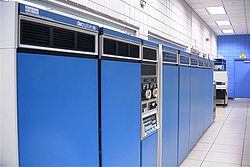
Mainframe computer
Mainframes are powerful computers used primarily by corporate and governmental organizations for critical applications, bulk data processing such as census, industry and consumer statistics, enterprise resource planning, and financial transaction processing.The term originally referred to the...
family manufactured by Digital Equipment Corporation
Digital Equipment Corporation
Digital Equipment Corporation was a major American company in the computer industry and a leading vendor of computer systems, software and peripherals from the 1960s to the 1990s...
(DEC) from the late 1960s on; the name stands for "Programmed Data Processor model 10". The first model was delivered in 1966. It was the machine that made time-sharing
Time-sharing
Time-sharing is the sharing of a computing resource among many users by means of multiprogramming and multi-tasking. Its introduction in the 1960s, and emergence as the prominent model of computing in the 1970s, represents a major technological shift in the history of computing.By allowing a large...
common; it looms large in hacker folklore because of its adoption in the 1970s by many university computing facilities and research labs, the most notable of which were MIT
Massachusetts Institute of Technology
The Massachusetts Institute of Technology is a private research university located in Cambridge, Massachusetts. MIT has five schools and one college, containing a total of 32 academic departments, with a strong emphasis on scientific and technological education and research.Founded in 1861 in...
's AI Lab and Project MAC, Stanford
Stanford University
The Leland Stanford Junior University, commonly referred to as Stanford University or Stanford, is a private research university on an campus located near Palo Alto, California. It is situated in the northwestern Santa Clara Valley on the San Francisco Peninsula, approximately northwest of San...
's SAIL, Computer Center Corporation (CCC), and Carnegie Mellon University
Carnegie Mellon University
Carnegie Mellon University is a private research university in Pittsburgh, Pennsylvania, United States....
.
The PDP-10 architecture was an almost identical version of the earlier PDP-6
PDP-6
The PDP-6 was a computer model developed by Digital Equipment Corporation in 1963. It was influential primarily as the prototype for the later PDP-10; the instruction sets of the two machines are almost identical.The PDP-6 was DEC's first "big" machine...
architecture, sharing the same 36-bit word length
36-bit word length
Many early computers aimed at the scientific market had a 36-bit word length. This word length was just long enough to represent positive and negative integers to an accuracy of ten decimal digits . It also allowed the storage of six alphanumeric characters encoded in a six-bit character encoding...
and slightly extending the instruction set (but with improved hardware implementation). Some aspects of the instruction set
Instruction set
An instruction set, or instruction set architecture , is the part of the computer architecture related to programming, including the native data types, instructions, registers, addressing modes, memory architecture, interrupt and exception handling, and external I/O...
are unique, most notably the "byte
Byte
The byte is a unit of digital information in computing and telecommunications that most commonly consists of eight bits. Historically, a byte was the number of bits used to encode a single character of text in a computer and for this reason it is the basic addressable element in many computer...
" instructions, which operated on bit field
Bit field
A bit field is a common idiom used in computer programming to compactly store multiple logical values as a short series of bits where each of the single bits can be addressed separately. A bit field is most commonly used to represent integral types of known, fixed bit-width. A well-known usage of...
s of any size from 1 to 36 bits inclusive according to the general definition of a byte as a contiguous sequence of a fixed number of bits.
Models and technical evolution
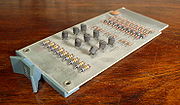
Transistor
A transistor is a semiconductor device used to amplify and switch electronic signals and power. It is composed of a semiconductor material with at least three terminals for connection to an external circuit. A voltage or current applied to one pair of the transistor's terminals changes the current...
s packaged in DEC's Flip-Chip
Flip Chip (trademark)
Flip-Chip modules were used in the DEC PDP-7 , PDP-8, PDP-9 and PDP-10, beginning on August 24, 1964. The trademark "Flip-Chip"' was filed on August 27, 1964...
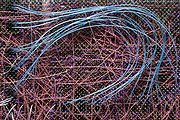
technology, with backplanes wire wrap
Wire wrap
Wire wrap is a technology used to assemble electronics. It is a method to construct circuit boards without having to make a printed circuit board. Wires can be wrapped by hand or by machine, and can be hand-modified afterwards. It was popular for large-scale manufacturing in the 60s and early 70s,...
ped via a semi-automated manufacturing process. In 1973, the KA10 was replaced by the KI10, which used TTL
Transistor-transistor logic
Transistor–transistor logic is a class of digital circuits built from bipolar junction transistors and resistors. It is called transistor–transistor logic because both the logic gating function and the amplifying function are performed by transistors .TTL is notable for being a widespread...
SSI. This was joined in 1975 by the higher-performance KL10 (later faster variants), which was built from ECL
Emitter-coupled logic
In electronics, emitter-coupled logic , is a logic family that achieves high speed by using an overdriven BJT differential amplifier with single-ended input, whose emitter current is limited to avoid the slow saturation region of transistor operation....
, was microprogrammed, and had cache
CPU cache
A CPU cache is a cache used by the central processing unit of a computer to reduce the average time to access memory. The cache is a smaller, faster memory which stores copies of the data from the most frequently used main memory locations...
memory. A smaller, less expensive model, the KS10, was introduced in 1978, using TTL and Am2901
AMD Am2900
Am2900 is a family of integrated circuits created in 1975 by Advanced Micro Devices . They were constructed with bipolar devices, in a bit-slice topology, and were designed to be used as modular components each representing a different aspect of a computer control unit...
bit-slice components and including the PDP-11
PDP-11
The PDP-11 was a series of 16-bit minicomputers sold by Digital Equipment Corporation from 1970 into the 1990s, one of a succession of products in the PDP series. The PDP-11 replaced the PDP-8 in many real-time applications, although both product lines lived in parallel for more than 10 years...
Unibus
Unibus
The Unibus was the earliest of several computer bus technologies used with PDP-11 and early VAX systems manufactured by the Digital Equipment Corporation of Maynard, Massachusetts.-History:...
to connect peripherals.
KA10
The KA10 had a maximum main memory capacity (both virtual and physical) of 256 kilowordsBinary prefix
In computing, a binary prefix is a specifier or mnemonic that is prepended to the units of digital information, the bit and the byte, to indicate multiplication by a power of 2...
(equivalent to 1152 kilobyte
Kilobyte
The kilobyte is a multiple of the unit byte for digital information. Although the prefix kilo- means 1000, the term kilobyte and symbol KB have historically been used to refer to either 1024 bytes or 1000 bytes, dependent upon context, in the fields of computer science and information...
s). As supplied by DEC, it did not include paging
Paging
In computer operating systems, paging is one of the memory-management schemes by which a computer can store and retrieve data from secondary storage for use in main memory. In the paging memory-management scheme, the operating system retrieves data from secondary storage in same-size blocks called...
hardware; memory management
Memory management
Memory management is the act of managing computer memory. The essential requirement of memory management is to provide ways to dynamically allocate portions of memory to programs at their request, and freeing it for reuse when no longer needed. This is critical to the computer system.Several...
consisted of two sets of protection and relocation registers, called "base and bounds" registers. This allowed each half of a user's address space
Address space
In computing, an address space defines a range of discrete addresses, each of which may correspond to a network host, peripheral device, disk sector, a memory cell or other logical or physical entity.- Overview :...
to be limited to a set section of main memory, designated by the base physical address and size. This allowed the model (later used by Unix
Unix
Unix is a multitasking, multi-user computer operating system originally developed in 1969 by a group of AT&T employees at Bell Labs, including Ken Thompson, Dennis Ritchie, Brian Kernighan, Douglas McIlroy, and Joe Ossanna...
) of separate read-only shareable code segment (normally the high segment) and read-write data/stack
Stack (data structure)
In computer science, a stack is a last in, first out abstract data type and linear data structure. A stack can have any abstract data type as an element, but is characterized by only three fundamental operations: push, pop and stack top. The push operation adds a new item to the top of the stack,...
segment (normally the low segment). Some KA10 machines, first at MIT, and later at Bolt, Beranek and Newman
BBN Technologies
BBN Technologies is a high-technology company which provides research and development services. BBN is based next to Fresh Pond in Cambridge, Massachusetts, USA...
(BBN), were modified to add virtual memory
Virtual memory
In computing, virtual memory is a memory management technique developed for multitasking kernels. This technique virtualizes a computer architecture's various forms of computer data storage , allowing a program to be designed as though there is only one kind of memory, "virtual" memory, which...
and support for demand paging
Demand paging
In computer operating systems, demand paging is an application of virtual memory. In a system that uses demand paging, the operating system copies a disk page into physical memory only if an attempt is made to access it...
, as well as more physical memory.
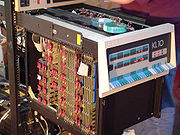
KI10 and KL10
The KI10 and later processors offered paged memory management, and also supported a larger physical address space of 4 megawords. KI10 models included 1060, 1070 and 1077, the latter incorporating two CPUs.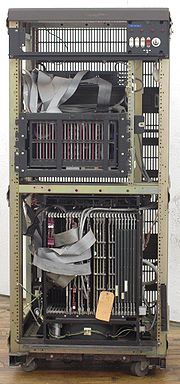
Magnetic core memory
Magnetic-core memory was the predominant form of random-access computer memory for 20 years . It uses tiny magnetic toroids , the cores, through which wires are threaded to write and read information. Each core represents one bit of information...
(the picture on the right hand side of the introduction shows six of these cabinets). The processors used in the DECSYSTEM-20
DECSYSTEM-20
The DECSYSTEM-20 was a 36-bit Digital Equipment Corporation PDP-10 mainframe computer running the TOPS-20 operating system.PDP-10 computers running the TOPS-10 operating system were labeled DECsystem-10 as a way of differentiating them from the PDP-11...
(2040, 2050, 2060, 2065), commonly but incorrectly called "KL20", used internal memory, mounted in the same cabinet as the CPU
Central processing unit
The central processing unit is the portion of a computer system that carries out the instructions of a computer program, to perform the basic arithmetical, logical, and input/output operations of the system. The CPU plays a role somewhat analogous to the brain in the computer. The term has been in...
. The 10xx models also had different packaging; they came in the original tall PDP-10 cabinets, rather than the short ones used later on for the DECSYSTEM-20. The differences between the 10xx and 20xx models were more cosmetic than real; some 10xx systems had "20-style" internal memory and I/O, and some 20xx systems had "10-style" external memory and an I/O bus. In particular, all ARPAnet TOPS-20 systems had an I/O bus because the AN20 IMP
Interface Message Processor
The Interface Message Processor was the packet-switching node used to interconnect participant networks to the ARPANET from the late 1960s to 1989. It was the first generation of gateways, which are known today as routers. An IMP was a ruggedized Honeywell DDP-516 minicomputer with...
interface was an I/O bus device. Both could run either TOPS-10 or TOPS-20 microcode and thus the corresponding operating system.
MASSbus
The I/O architecture of the 20xx series KL machines was based on a new DEC bus design called the MASSbus. While many attributed the success of the PDP-11 to DEC's decision to make the PDP-11 Unibus an open architecture, DEC reverted to prior philosophy with the KL, making MASSbus both unique and proprietary. Consequently, there were no aftermarket peripheral manufacturers who made devices for the MASSbus, and DEC chose to price their own MASSbus devices, notably the RP06 disk drive, at a substantial premium above comparable IBM-compatible devices. CompuServeCompuServe
CompuServe was the first major commercial online service in the United States. It dominated the field during the 1980s and remained a major player through the mid-1990s, when it was sidelined by the rise of services such as AOL with monthly subscriptions rather than hourly rates...
for one, designed its own alternative disk controller that could operate on the MASSbus, but connect to IBM style 3330 disk subsystems.
Model B
Later, the "Model B" version of the 2060 processors removed the 256 kiloBinary prefix
In computing, a binary prefix is a specifier or mnemonic that is prepended to the units of digital information, the bit and the byte, to indicate multiplication by a power of 2...
word limitation on the virtual address space, by allowing the use of up to 32 "sections" of up to 256 kilowords each, along with substantial changes to the instruction set. "Model A" and "Model B" KL10 processors can be thought of as being different CPUs. The first operating system that took advantage of the Model B's capabilities was TOPS-20 release 3, and user mode extended addressing was offered in TOPS-20 release 4. TOPS-20 versions after release 4.1 would only run on a Model B.
KS10
The KS10 design was crippled to be a Model A even though most of the necessary data paths needed to support the Model B architecture were present. This was no doubt intended to segment the market, but it greatly shortened the KS10's product life.MCA25
The final upgrade to the KL10 was the MCA25 upgrade of a 2060 to 2065, which gave some performance increases for programs which run in multiple sections.Front End Systems
Floppy disk
A floppy disk is a disk storage medium composed of a disk of thin and flexible magnetic storage medium, sealed in a rectangular plastic carrier lined with fabric that removes dust particles...
drive or DECtape
DECtape
DECtape, originally called "Microtape", was a magnetic tape data storage medium used with many Digital Equipment Corporation computers, including the PDP-6, PDP-8, LINC-8, PDP-10, PDP-11, PDP-12, and the PDP-15. On DEC's 32-bit systems, VAX/VMS support for it was implemented but did not become an...
), and then commands could be given to the PDP-11 to start the main processor, which was typically booted from the same RP06 disk drive as the PDP-11. The PDP-11 would perform watchdog functions once the main processor was running.
The KS system used a similar boot procedure. An 8080 CPU loaded the microcode from an RM03, RM80, or RP06 disk or magnetic tape and then started the main processor. The 8080 switched modes after the operating system booted and controlled the console and remote diagnostic serial ports.
Instruction set architecture
From the first PDP-6's to the Model A KL-10s, the user-mode instruction set architecture was largely the same. This section covers that architecture.Addressing
The PDP-10 has 36-bit words and 18-bit word addresses. In supervisor mode, instruction addresses correspond directly to physical memory. In user mode, addresses are translated to physical memory. Earlier models gave a user process a "high" and a "low" memory: addresses with a 0 top bit used one base register, and higher addresses used another. Each segment was contiguous. Later architectures had paged memory access, allowing non-contiguous address spaces. The CPU's general-purpose registers can also be addressed as memory locations 0-15.Registers
There are 16 general-purpose, 36-bit registers. The right half of these registers (other than register 0) may be used for indexing. A few instructions operate on pairs of registers. There is also a condition register, which records extra bits from the results of arithmetic operations (e.g. overflow), and can be accessed by only a few instructions.Supervisor mode
There are two operational modes, supervisor and user mode. Besides the difference in memory referencing described above, supervisor-mode programs can execute input/output operations.Communication from user-mode to supervisor-mode is done through Unimplemented User Operations (UUOs): instructions which are not defined by the hardware are trapped by the supervisor. This mechanism is also used to emulate operations which may not have hardware implementations in cheaper models.
Data types
The major datatypes which are directly supported by the architecture are two's complementTwo's complement
The two's complement of a binary number is defined as the value obtained by subtracting the number from a large power of two...
36-bit integer arithmetic (including bitwise operations), 36-bit floating-point, and halfwords. Extended, 72-bit, floating point is supported through special instructions designed to be used in multi-instruction sequences. Byte pointers are supported by special instructions. A word structured as a "count" half and a "pointer" half facilitates the use of bounded regions of memory, notably stacks.
Instructions
The instruction set is very symmetric. Every instruction consists of a 9-bit opcode, a 4-bit register code, and a 23-bit effective address field, which consists in turn of a 1-bit indirect bit, a 4-bit register code, and an 18-bit offset. Instruction execution begins by calculating the effective address. It adds the contents of the given register (if non-zero) to the offset; then, if the indirect bit is 1, fetches the word at the calculated address and repeats the effective address calculation until an effective address with a zero indirect bit is reached. The resulting effective address can be used by the instruction either to fetch memory contents, or simply as a constant. Thus, for example, MOVEI A,3(C) adds 3 to the 18 lower bits of register C and puts the result in register A, without touching memory.There are three main classes of instruction: arithmetic, logical, and move; conditional jump; conditional skip (which may have side effects). There are also several smaller classes.
The arithmetic, logical, and move operations include variants which operate immediate-to-register, memory-to-register, register-to-memory, register-and-memory-to-both or memory-to-memory. Since registers may be addressed as part of memory, register-to-register operations are also defined. (Not all variants are useful, though they are well-defined.) For example, the ADD operation has as variants ADDI (add an 18-bit Immediate constant to a register), ADDM (add register contents to a Memory location), ADDB (add to Both, that is, add register contents to memory and also put the result in the register). A more elaborate example is HLROM (Half Left to Right, Ones to Memory), which takes the Left half of the register contents, places them in the Right half of the memory location, and replaces the left half of the memory location with Ones.
The conditional jump operations examine register contents and jump to a given location depending on the result of the comparison. The mnemonics for these instructions all start with JUMP, JUMPA meaning "jump always" and JUMP meaning "jump never" - as a consequence of the symmetrical design of the instruction set, it contains several no-ops such as JUMP. For example, JUMPN A,LOC jumps to the address LOC if the contents of register A is non-zero. There are also conditional jumps based on the processor's condition register using the JRST instruction. On the KA10 and KI10, JRST was faster than JUMPA, so the standard unconditional jump was JRST.
The conditional skip operations compare register and memory contents and skip the next instruction (which is often an unconditional jump) depending on the result of the comparison. A simple example is CAMN A,LOC which compares the contents of register A with the contents of location LOC and skips the next instruction if they are not equal. A more elaborate example is TLCE A,LOC (read "Test Left Complement, skip if Equal"), which using the contents of LOC as a mask, selects the corresponding bits in the left half of register A. If all those bits are Equal to zero, skip the next instruction; and in any case, replace those bits by their boolean complement.
Some smaller instruction classes include the shift/rotate instructions and the procedure call instructions. Particularly notable are the stack instructions PUSH and POP, and the corresponding stack call instructions PUSHJ and POPJ. The byte instructions use a special format of indirect word to extract and store arbitrary-sized bit fields, possibly advancing a pointer to the next unit.
Software
The original PDP-10 operating systemOperating system
An operating system is a set of programs that manage computer hardware resources and provide common services for application software. The operating system is the most important type of system software in a computer system...
was simply called "Monitor", but was later renamed TOPS-10
TOPS-10
The TOPS-10 System was a computer operating system from Digital Equipment Corporation for the PDP-10 mainframe computer launched in 1967...
. Eventually the PDP-10 system itself was renamed the DECsystem-10. Early versions of Monitor and TOPS-10 formed the basis of Stanford's WAITS
WAITS
WAITS was a heavily-modified variant of Digital Equipment Corporation's Monitor operating system for the PDP-6 and PDP-10 mainframe computers, used at the Stanford Artificial Intelligence Laboratory up until 1990; the mainframe computer it ran on also went by the name of "SAIL".There was never an...
operating system and the Compuserve
CompuServe
CompuServe was the first major commercial online service in the United States. It dominated the field during the 1980s and remained a major player through the mid-1990s, when it was sidelined by the rise of services such as AOL with monthly subscriptions rather than hourly rates...
time-sharing system.
Over time, some PDP-10 operators began running operating systems assembled from major components developed outside DEC. For example, the main Scheduler might come from one university, the Disk Service from another, and so on. The commercial timesharing services such as CompuServe
CompuServe
CompuServe was the first major commercial online service in the United States. It dominated the field during the 1980s and remained a major player through the mid-1990s, when it was sidelined by the rise of services such as AOL with monthly subscriptions rather than hourly rates...
, On-Line Systems (OLS), and Rapidata maintained sophisticated inhouse systems programming groups so that they could modify the operating system as needed for their own businesses without being dependent on DEC or others. There were also strong user communities such as DECUS
DECUS
The Digital Equipment Computer Users' Society was an independent computer user group related to Digital Equipment Corporation.The Connect User Group Community, formed from the consolidation in May, 2008 of DECUS, Encompass, HP-Interex, and ITUG is Hewlett-Packard’s largest user community...
through which users could share software that they had developed. In some ways, this was one of the first open source environments, although the commercial operators tended to only take code from open sources, keeping their own proprietary enhancements to themselves.
BBN developed their own alternative operating system, TENEX
TOPS-20
The TOPS-20 operating system by Digital Equipment Corporation was the second proprietary OS for the PDP-10 mainframe computer. TOPS-20 began in 1969 as the TENEX operating system of Bolt, Beranek and Newman...
, which fairly quickly became the de facto standard in the research community. DEC later ported Tenex to the KL10, enhanced it considerably, and named it TOPS-20
TOPS-20
The TOPS-20 operating system by Digital Equipment Corporation was the second proprietary OS for the PDP-10 mainframe computer. TOPS-20 began in 1969 as the TENEX operating system of Bolt, Beranek and Newman...
, forming the DECSYSTEM-20 line. MIT also had developed their own influential system, the Incompatible Timesharing System
Incompatible Timesharing System
ITS, the Incompatible Timesharing System , was an early, revolutionary, and influential time-sharing operating system from MIT; it was developed principally by the Artificial Intelligence Laboratory at MIT, with some help from Project MAC.In addition to being technically influential ITS, the...
(named in parody of the Compatible Time-Sharing System, developed at MIT for a modified IBM 7094).
Tymshare
Tymshare
Tymshare, Inc. was headquartered in Cupertino, California from 1964 to 1984.It was a well-known timesharing service and third-party hardware maintenance company throughout its history and competed with companies such as Four Phase, Compuserve, and Digital Equipment Corporation...
developed TYMCOM-X, derived from TOPS-10
TOPS-10
The TOPS-10 System was a computer operating system from Digital Equipment Corporation for the PDP-10 mainframe computer launched in 1967...
but using a page-based file system like TOPS-20
TOPS-20
The TOPS-20 operating system by Digital Equipment Corporation was the second proprietary OS for the PDP-10 mainframe computer. TOPS-20 began in 1969 as the TENEX operating system of Bolt, Beranek and Newman...
.
Clones
In 1971 to 1972 researchers at Xerox PARCXerox PARC
PARC , formerly Xerox PARC, is a research and co-development company in Palo Alto, California, with a distinguished reputation for its contributions to information technology and hardware systems....
were frustrated by top company management's refusal to let them purchase a PDP-10. Xerox had just bought Scientific Data Systems
Scientific Data Systems
Scientific Data Systems, or SDS, was an American computer company founded in September 1961 by Max Palevsky, a veteran of Packard Bell and Bendix, along with eleven other computer scientists. SDS was an early adopter of integrated circuits in computer design and the first to employ silicon...
in 1969, and wanted PARC to use an SDS machine.
Instead, a group led by Charles P. Thacker
Charles P. Thacker
Charles P. Thacker is an American pioneer computer designer.-Biography:Thacker was born in Pasadena, California on February 26, 1943.He received his B.S...
designed and constructed two PDP-10 clone systems named "MAXC" ' onMouseout='HidePop("45272")' href="/topics/Max_Palevsky">Max Palevsky
Max Palevsky
Max Palevsky was an American art collector, venture capitalist, philanthropist, and computer technology pioneer.-Early life:...
, who had sold SDS to Xerox) for their own use. MAXC was also a backronym
Backronym
A backronym or bacronym is a phrase constructed purposely, such that an acronym can be formed to a specific desired word. Backronyms may be invented with serious or humorous intent, or may be a type of false or folk etymology....
for Multiple Access Xerox Computer.
MAXC ran a modified version of TENEX.
Third-party attempts to sell PDP-10 clones were relatively unsuccessful; see Foonly
Foonly
Foonly was the computer company formed by Dave Poole, who was one of the principal Super Foonly designers as well as one of hackerdom's more colorful personalities....
, Systems Concepts
Systems Concepts
Systems Concepts is a company co-founded by Stewart Nelson and Mike Levitt focused on making hardware products related to the DEC PDP-10 series of computers...
, and XKL.
Usage by CompuServe
One of the largest collections of DECsystem-10 architecture systems ever assembled was at CompuServeCompuServe
CompuServe was the first major commercial online service in the United States. It dominated the field during the 1980s and remained a major player through the mid-1990s, when it was sidelined by the rise of services such as AOL with monthly subscriptions rather than hourly rates...
, which at its peak operated over 200 loosely-coupled systems in three data centers in Columbus, Ohio
Columbus, Ohio
Columbus is the capital of and the largest city in the U.S. state of Ohio. The broader metropolitan area encompasses several counties and is the third largest in Ohio behind those of Cleveland and Cincinnati. Columbus is the third largest city in the American Midwest, and the fifteenth largest city...
. CompuServe used these systems as 'hosts', providing access to commercial applications as well as the CompuServe Information Service. While the first such systems were purchased from DEC, when DEC abandoned the PDP-10 architecture in favor of the VAX
VAX
VAX was an instruction set architecture developed by Digital Equipment Corporation in the mid-1970s. A 32-bit complex instruction set computer ISA, it was designed to extend or replace DEC's various Programmed Data Processor ISAs...
, CompuServe and other PDP-10 customers began purchasing plug-compatible computers from Systems Concepts. As of January 2007, CompuServe continues to operate a small number of PDP-10 architecture machines to perform some billing and routing functions.
The main power supplies used in the KL-series machines were so inefficient that CompuServe engineers designed a replacement power supply that consumed about half the energy. CompuServe offered to license the design for its KL power supply to DEC for free if DEC would promise that any new KL purchased by CompuServe would have the more efficient power supply installed. DEC declined the offer.

Cancellation and influence
The PDP-10 was eventually eclipsed by the VAXVAX
VAX was an instruction set architecture developed by Digital Equipment Corporation in the mid-1970s. A 32-bit complex instruction set computer ISA, it was designed to extend or replace DEC's various Programmed Data Processor ISAs...
superminicomputer machines (descendants of the PDP-11
PDP-11
The PDP-11 was a series of 16-bit minicomputers sold by Digital Equipment Corporation from 1970 into the 1990s, one of a succession of products in the PDP series. The PDP-11 replaced the PDP-8 in many real-time applications, although both product lines lived in parallel for more than 10 years...
) when DEC recognized that the PDP-10 and VAX product lines were competing with each other and decided to concentrate its software development effort on the more profitable VAX. The PDP-10 product line cancellation was announced in 1983, including cancelling the on-going Jupiter project
Jupiter project
The Jupiter project was to be a successor to Digital Equipment Corporation 's PDP-10 model. This project was cancelled in 1983, as the PDP-10 was increasingly eclipsed by the VAX supermini machines...
to produce a new high-end PDP-10 processor (despite that project being in good shape at the time of the cancellation) and the Minnow project to produce a desktop PDP-10, which may then have been at the prototyping stage.
This event spelled the doom of ITS
Incompatible Timesharing System
ITS, the Incompatible Timesharing System , was an early, revolutionary, and influential time-sharing operating system from MIT; it was developed principally by the Artificial Intelligence Laboratory at MIT, with some help from Project MAC.In addition to being technically influential ITS, the...
and the technical cultures that had spawned the original jargon file
Jargon File
The Jargon File is a glossary of computer programmer slang. The original Jargon File was a collection of terms from technical cultures such as the MIT AI Lab, the Stanford AI Lab and others of the old ARPANET AI/LISP/PDP-10 communities, including Bolt, Beranek and Newman, Carnegie Mellon...
, but by the 1990s it had become something of a badge of honor among old-time hackers to have cut one's teeth on a PDP-10.
The PDP-10 assembly language
Assembly language
An assembly language is a low-level programming language for computers, microprocessors, microcontrollers, and other programmable devices. It implements a symbolic representation of the machine codes and other constants needed to program a given CPU architecture...
instructions LDB and DPB (load/deposit byte
Byte
The byte is a unit of digital information in computing and telecommunications that most commonly consists of eight bits. Historically, a byte was the number of bits used to encode a single character of text in a computer and for this reason it is the basic addressable element in many computer...
) live on as functions in the programming language
Programming language
A programming language is an artificial language designed to communicate instructions to a machine, particularly a computer. Programming languages can be used to create programs that control the behavior of a machine and/or to express algorithms precisely....
Common Lisp
Common Lisp
Common Lisp, commonly abbreviated CL, is a dialect of the Lisp programming language, published in ANSI standard document ANSI INCITS 226-1994 , . From the ANSI Common Lisp standard the Common Lisp HyperSpec has been derived for use with web browsers...
. See the "References" section on the LISP article — the 36-bit word size of the PDP-6 and PDP-10 was influenced by the programming convenience of having 2 LISP pointers, each 18 bits, in one word.
Will Crowther created Adventure
Colossal Cave Adventure
Colossal Cave Adventure gave its name to the computer adventure game genre . It was originally designed by Will Crowther, a programmer and caving enthusiast who based the layout on part of the Mammoth Cave system in Kentucky...
, the prototypical computer adventure game, for a PDP-10. Don Daglow
Don Daglow
Don Daglow is an American computer game and video game designer, programmer and producer. He is best known for designing a series of pioneering simulation games and role-playing games, as well as the first computer baseball game and the first graphical MMORPG, all between 1971 and 1995...
created the first computer baseball
Baseball
Baseball is a bat-and-ball sport played between two teams of nine players each. The aim is to score runs by hitting a thrown ball with a bat and touching a series of four bases arranged at the corners of a ninety-foot diamond...
game (1971) and Dungeon
Dungeon (computer game)
Dungeon was one of the earliest computer role-playing games, running on PDP-10 mainframe computers manufactured by Digital Equipment Corporation.-History:...
(1975), the first role-playing video game
Role-playing video game
Role-playing video games are a video game genre with origins in pen-and-paper role-playing games such as Dungeons & Dragons, using much of the same terminology, settings and game mechanics. The player in RPGs controls one character, or several adventuring party members, fulfilling one or many quests...
on a PDP-10. Walter Bright
Walter Bright
Walter Bright is a computer programmer known for being the designer of the D programming language. He was also the main developer of the first C++ compiler that translated directly to object without going via C, Zortech C++ . Before the C++ compiler, he developed the Datalight C compiler, also...
originally created Empire
Classic Empire (computer game)
Empire is a turn-based wargame with simple rules, conceived by Walter Bright in 1971 based on various war movies and board games, notably Battle of Britain and Risk. In the game, each player starts with one city in an unexplored world, and uses the city to build armies, aircraft, and various...
for the PDP-10. Roy Trubshaw
Roy Trubshaw
Roy Trubshaw was a programmer at the University of Essex who co-authored MUD1, the first MUD, with Richard Bartle on a DEC PDP-10. Both of them now work together at Multi-User Entertainment with Trubshaw being the company’s technical director....
and Richard Bartle
Richard Bartle
Richard Allan Bartle is a British writer, professor and game researcher, best known for being the co-creator of MUD1 and the author of the seminal Designing Virtual Worlds. He is one of the pioneers of the massively multiplayer online game industry.-Life and career:Bartle received a Ph.D...
created the first MUD
MUD
A MUD , pronounced , is a multiplayer real-time virtual world, with the term usually referring to text-based instances of these. MUDs combine elements of role-playing games, hack and slash, player versus player, interactive fiction, and online chat...
on a PDP-10. In addition, Zork
Zork
Zork was one of the first interactive fiction computer games and an early descendant of Colossal Cave Adventure. The first version of Zork was written in 1977–1979 on a DEC PDP-10 computer by Tim Anderson, Marc Blank, Bruce Daniels, and Dave Lebling, and implemented in the MDL programming language...
was written on the PDP-10, and Infocom
Infocom
Infocom was a software company, based in Cambridge, Massachusetts, that produced numerous works of interactive fiction. They also produced one notable business application, a relational database called Cornerstone....
used several PDP-10s for game development and testing.
Emulation or simulation
The software for simulation of historical computers SIMHSIMH
SIMH is a highly portable, multi-system emulator which runs on Windows, Linux, Mac OS X, FreeBSD, OpenBSD, NetBSD, OpenVMS, and other operating systems...
contains a module to emulate the KS10 CPU on a Windows or Unix-based machine. Copies of DEC's original distribution tapes are available as downloads from the Internet so that a running TOPS-10 or TOPS-20 system may be established. ITS is also available for SIMH.
Ken Harrenstien's KLH10 software for Unix-like systems emulates a KL10B processor with extended addressing and 4 MW of memory or a KS10 processor with 512 KW of memory. The KL10 emulation supports v.442 of the KL10 microcode, which enables it to run the final versions of both TOPS-10 and TOPS-20. The KS10 emulation supports both ITS v.262 microcode for the final version of KS10 ITS and DEC v.130 microcode for the final versions of KS TOPS-10 and TOPS-20.
Further reading
- C. Gordon Bell, Alan KotokAlan KotokAlan Kotok was an American computer scientist known for his work at Digital Equipment Corporation and at the World Wide Web Consortium...
, Thomas N. Hastings, Richard Hill, The Evolution of the DECsystem-10, in C. Gordon Bell, J. Craig Mudge, John E. McNamara, Computer Engineering: A DEC View of Hardware Systems Design (Digital, Bedford, 1979)
External links
- 36 Bits Forever!
- PDP-10 stuff
- PDP10 Miscellany Page
- Life in the Fast AC's
- Columbia University DEC PDP-10 page
- Panda Programming TOPS-20 page
- Living Computer Museum, a portal into the Paul AllenPaul AllenPaul Gardner Allen is an American business magnate, investor, and philanthropist. Allen co-founded Microsoft with Bill Gates...
collection of timesharing and interactive computers, including an operational PDP-10 (KL-10) - [ftp://ftp.classicempire.com/pdp10.zip Empire] for the PDP-10 (zip file of FORTRANFortranFortran is a general-purpose, procedural, imperative programming language that is especially suited to numeric computation and scientific computing...
-10 source code download) from Classic Empire - PDP-10 software archive at Trailing Edge
- Computer World ad for Personal Mainframe