

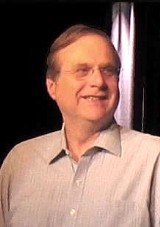
Paul Allen

Encyclopedia
Paul Gardner Allen is an American business magnate
, investor
, and philanthropist
. Allen co-founded Microsoft
with Bill Gates
. He is also the 57th richest along with Viktor Vekselberg
and Gerald Cavendish Grosvenor
(& family) who all rank the same with an estimated wealth of $13 billion as of 2011.
He is the founder and chairman of Vulcan Inc.
, which manages his business and philanthropic efforts. Allen also has a multi-billion dollar investment portfolio which includes technology companies such as Evri
and Gist
, real estate holdings, and stakes in other technology, media, and content companies. Allen also owns two professional sports teams, the Seattle Seahawks
of the National Football League
(NFL), and the Portland Trail Blazers
of the National Basketball Association
(NBA). He is also part-owner of the Seattle Sounders FC
, which joined Major League Soccer
(MLS) in 2009. Allen's memoir Idea Man: A Memoir by the Cofounder of Microsoft was released on April 19, 2011.
, to parents Kenneth S. Allen, an associate director of the University of Washington
libraries, and Faye G. Allen, on January 21, 1953. Allen attended Lakeside School
, a private school in Seattle, and befriended Bill Gates, who was almost three years younger and shared a common enthusiasm for computers. They used Lakeside's Teletype
terminal to develop their programming skills on several time-sharing
computer systems. After graduation, Allen attended Washington State University
, where he was a member of Phi Kappa Theta
Fraternity but dropped out
after two years in order to work as a programmer for Honeywell
in Boston
, placing him near his old friend again. Allen later convinced Gates to drop out of Harvard University
in order to create Microsoft.
, in 1975, and began marketing a BASIC
programming language interpreter. Allen came up with the original name of "Micro-Soft," as recounted in a 1995 Fortune
magazine article. In 1980, after promising to deliver IBM a Disk Operating System (DOS
) they had not yet developed for the Intel 8088
-based IBM PC
, Allen spearheaded a deal for Microsoft to purchase a Quick and Dirty Operating System (QDOS) written by Tim Paterson
who, at the time, was employed at Seattle Computer Products
. As a result of this transaction, Microsoft was able to secure a contract to supply the DOS that would eventually run on IBM's PC line. This contract with IBM was the watershed in Microsoft history that led to Allen and Gates's fabulous wealth.
Allen was diagnosed with Hodgkin's lymphoma
in 1982. His cancer was successfully treated by several months of radiation therapy
. However, he did not return to Microsoft and began distancing himself from the company. Allen officially resigned from his position on the Microsoft board in November 2000 but was asked to consult as a senior strategy advisor to the company's executives. He sold 68 million shares of Microsoft stock that year, but still owns a reported 138 million shares.
.
He received the Vanguard Award from the National Cable & Telecommunications Association
on May 20, 2008.
On October 30, 2008, the Seattle-King County Association of Realtors honored Paul Allen for his “unwavering commitment to nonprofit organizations in the Pacific Northwest and lifetime giving approaching US$1 billion.”
Paul Allen has received awards and honorary degrees from several universities. In May 1999, Washington State University
bestowed its highest honor, the Regents' Distinguished Alumnus Award, upon him. He received a Docteur honoris causa
from the École Polytechnique Fédérale de Lausanne
on March 31, 2007.
On October 26, 2008, Paul Allen was given the Herbie Hancock Humanitarian Award from the Thelonious Monk
Institute of Jazz for his "visionary achievements as a businessman and a global philanthropist."
On January 31, 2009, Paul Allen received a special merit award from the Oregon Sports Authority.
was established in 1986 to administer most of his contributions. Through the Foundation, Allen awards approximately $30 million in grants annually. Roughly 60% of the Foundation's money goes to non-profit organizations in Seattle and the state of Washington, and 12% to Portland, Oregon
. The remaining 28% is distributed to other cities within the Pacific Northwest
and internationally. Since 1990, The Paul G. Allen Family Foundation has awarded $428 million to non-profit organizations, as of 2010. That includes charitable projects known as "venture philanthropy
". The most famous of these projects are the Experience Music Project
, Seattle Cinerama Theatre, the Science Fiction Museum and Hall of Fame, the Flying Heritage Collection
(airworthy vintage military aircraft) and the Allen Telescope Array
(ATA). The ATA is a partnership between the University of California, Berkeley
and the SETI Institute
. Allen has a flower fly named after him for his contributions to Dipterology, called Paul Allen's flower fly
. Allen has also funded the purchase of many Jimi Hendrix
artifacts, including the guitar Hendrix played at Woodstock
, and ensured their public display in the Experience Music Project exhibits.
In December 2010, it was announced that Paul Allen had pledged $26 million to his alma mater, Washington State University, for its School for Global Animal Health. The gift will be the largest received by the university. In the late 1980s, Allen donated US$18 million to build a new library at the University of Washington, named after his father, Kenneth S. Allen. US$5 million was donated in 2003 to establish the Faye G. Allen Center for Visual Arts, named after his mother. Allen was also the top private contributor, with US$14 million in donations, and namesake, of the "Paul G. Allen Center for Computer Science & Engineering", which was designed by LMN Architects
of Seattle and completed in 2003. Throughout the years, Allen has contributed millions of US$ to the University of Washington Medical School
. The foundation awarded US$3.2 million for prostatitis
research in 1997, followed by an additional $1.0 million grant in 2002. More recently, the foundation contributed $5.0 million for an early cancer-detection project at the Fred Hutchinson Cancer Research Center
.
With his sister, Jo Lynn Allen, Paul Allen pledged $100 million in 2003 to found the Allen Institute for Brain Science
, a nonprofit corporation (501(c) (3)) and medical research organization. Utilizing the mouse model system (given its great similarity to human DNA), 20,000 genes in the adult mouse brain were mapped to a cellular level for the Allen Brain Atlas
. The data generated from this effort is contained in the free and publicly available Allen Brain Atlas application.
On July 16, 2008, Allen launched a $ 41 million online "Allen Spinal Cord Atlas" mouse gene map
. Allan Jones
, chief scientific officer, said: "The Allen Spinal Cord Atlas offers profound potential for researchers to unlock the mysteries of the spinal cord and how it is altered during disease or injury." The spinal cord atlas is set up like the Allen Institute's earlier atlas of the mouse brain. The Map could reveal new treatments for human neurological disorders. The map points researchers toward places where genes are active
On November 19, 2008, Allen appeared at the Experience Music Project/Science Fiction Hall of Fame to present the second annual Founder's Award for musical achievement. The award was presented to Robbie Robertson
, a founding member of the seminal 1960s band The Band
and a noted composer of film scores. Allen founded the museum in 2000. The award was presented as part of a gala benefit for EMP. The finale was a four-song set with all the evening's musicians on stage, including Allen and Robertson on guitar.
Paul Allen is also a founding member of The International SeaKeepers Society and hosts its proprietary SeaKeeper 1000TM oceanographic and atmospheric monitoring system on all three of his megayachts.
On November 15, 2009, Jody Allen, Paul Allen's sister and the CEO of Vulcan made public that Paul had been diagnosed with non-Hodgkin lymphoma
, a form of cancer in the lymph system. As of October 2010, he has been free of cancer.
On May 24, 2010, Allen launched the Allen Human Brain Atlas , a publicly available online atlas charting genes at work throughout the human brain. The data provided represent the most extensive and detailed body of information about gene activity in the human brain to date, documenting which genes are expressed, or "turned on" where.
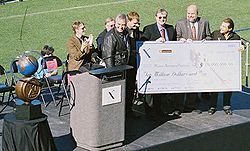 In 1993, Paul Allen invested $240 million to acquire 80% of Ticketmaster
. Under his ownership, Ticketmaster moved into the Internet in 2 phases: it started in June 1995 by displaying a searchable database of Ticketmaster's events; on September 11, 1996, the first transaction came in. The company went public on 19 November 1996. In 1997, David Geffen
introduced Barry Diller
to Paul Allen, who was increasingly frustrated at Fred Rosen
, Ticketmaster's CEO, and was looking for a change at the helm: in May, Home Shopping Network
acquired 47.5% of Allen's stock for $209 million worth of HSN stock.
In 1992, he and David Liddle
cofounded Interval Research Corporation
, a Silicon Valley-based laboratory and new business incubator that was dissolved in 2000 after generating over 300 patents, four of which were the subject of Allen's August 2010 patent infringement
lawsuit against AOL
, Apple, eBay
, Facebook, Google
, Netflix
, Office Depot
, OfficeMax
, Staples, Yahoo!
, and YouTube
. He confirmed that he was the sole investor behind Burt Rutan
's Scaled Composites
' SpaceShipOne suborbital commercial spacecraft on October 4, 2004. SpaceShipOne climbed to an altitude of 377591 feet (115,090 m) and was the first privately funded effort to successfully put a civilian in suborbital space. It won the Ansari X Prize
competition and received the $10 million prize.
Allen was a key developer and investor in the development of the South Lake Union neighborhood of Seattle as a biotechnology
hub and mixed-use community. He was also the largest private landowner in South Lake Union and owns nearly 2600000 square feet (241,547.9 m²) in the neighborhood. His holdings company has a development capacity of more than 10000000 square feet (929,030.4 m²) of new residential, office, retail and biotech research space. The South Lake Union redevelopment represents one of the largest urban revitalization projects in the country. Allen has made investments estimated at US$200 million as of 2005, and promoted for city funding of the Seattle Streetcar line known as South Lake Union Streetcar
, which runs from Seattle's Westlake Center
to the south end of Lake Union
. The Streetcar is a public and private partnership made possible because of a Local Improvement District (LID) supported by businesses and residents along the line; it officially started operation on December 12, 2007. This development has been criticized as a city-supported real estate investment for Vulcan Inc., and concerns over the loss of low-income housing have been expressed.
The launch of Paul Allen's 416 feet (126.8 m) yacht, Octopus
, secured its position as one of the world's largest yachts in 2003. As at 2005, it is ninth in the list of motor yachts by length. The yacht is equipped with two helicopters, two submarines, a swimming pool, a music studio and a basketball court. Allen also owns Tatoosh
, also one of the world's 100 largest yachts.
Allen is known for throwing huge, celebrity-studded parties on his yacht, such as a 2005 New Year's Eve party in which he and his band played Johnny Cash
songs with R&B star Usher
. His band also played at another party he hosted during the Cannes film festival
with keyboardist Dave Stewart.
for $70 million. He was also instrumental in the development and funding of their Rose Garden in 1993. The Blazers are valued at approximately $300 million according to a 2006 issue of Forbes
. Allen has been asking Portland and Oregon officials for assistance in the financing of the Blazers since 2006, which he estimated would lose $100 million over the next three years. Then-Portland Mayor Tom Potter
rebuffed the requests. Allen announced the completion of the acquisition of the Rose Garden on April 2, 2007, and stated that this was a major milestone and a positive step for the franchise. He said, “My efforts are focused on continuing to support the Trail Blazers and the long-term financial health of the franchise." As of 2010, according to a 2011 issue of Forbes, the Portland Trail Blazers were worth $356 million, ranked No. 14 out of 30 NBA teams.
Allen purchased the Seattle Seahawks NFL team in 1997 when former owner Ken Behring
threatened to move the Seahawks to Southern California. Allen was allowed to buy the team despite owning the NBA's Trail Blazers because Portland doesn't have an NFL team. (NFL rules prohibit team owners from either outright ownership or a majority share of another sports team outside its home market if they play in the same city as another NFL team.) He played a large part in the development of the new Seahawks' stadium, CenturyLink Field, although it was funded largely by tax revenue.
Allen's Vulcan Sports & Entertainment is part of the ownership team of the Seattle Sounders FC, a Major League Soccer franchise that began play in 2009 at CenturyLink Field, a stadium also controlled by Paul Allen. The ownership team also includes film producer Joe Roth
, businessman Adrian Hanauer
, and comedian Drew Carey
. Sigi Schmid
, two-time MLS Cup winner, is the team’s head coach.
The Sounders sold out every home game during its first season, setting a new MLS record for average match attendance and the most season tickets sold in the league. The team finished the 2009 season with a winning record and qualified for the MLS playoffs, where they were eliminated in the conference semi-finals. Seattle Sounders FC is only the second expansion team in MLS history to win the U.S. Open Cup tournament in its first season, and in 2010 became the first team to repeat as U.S. Open Cup champion in almost three decades, in front of the largest crowd to ever witness a Lamar Hunt U.S. Open Cup Final in the history of the 97-year-old tournament.
On January 26, 2011 at Seattle’s Benaroya Hall
, Paul Allen was named Seattle Sports Commission Sports Citizen of the Year, an award that has been renamed the Paul Allen Award.
, a filmmaking company headquartered in Seattle. Vulcan Productions’ mission is to initiate, develop and finance independent film projects of substance and enduring significance. Their projects support the passionate vision of the artist, while challenging and celebrating the world of ideas and human values. Through their collaborative partnerships with established and emerging filmmakers, Vulcan Productions explores creative opportunities that result in engaging and inspirational storytelling.
Their films have received prestigious recognition, ranging from a Peabody
to Independent Spirit Awards
to Golden Globes, Emmys and Grammys, and have also been nominated for Academy Awards
, among many others.
As of 2011, Vulcan Productions’ Web-based project, Success at the Core, is providing a comprehensive professional toolkit that helps middle school leadership teams and teachers elevate classroom instruction for significantly improved student success. This Emotional Life, a documentary series on psychology created by Vulcan Productions and the NOVA
/WGBH
Science Unit in 2010, examines the human desire and struggle for happiness. This multi-platform project also includes pertinent resources for audiences, including innovative toolkits in the areas of early childhood attachment and the emotional health of military families—two areas covered in depth in the series.
In March 2011, Vulcan Productions' This Emotional Life won three medals at the 2011 New York Festival Television and Film Awards. They include:
Business magnate
A business magnate, sometimes referred to as a capitalist, czar, mogul, tycoon, baron, oligarch, or industrialist, is an informal term used to refer to an entrepreneur who has reached prominence and derived a notable amount of wealth from a particular industry .-Etymology:The word magnate itself...
, investor
Investor
An investor is a party that makes an investment into one or more categories of assets --- equity, debt securities, real estate, currency, commodity, derivatives such as put and call options, etc...
, and philanthropist
Philanthropist
A philanthropist is someone who engages in philanthropy; that is, someone who donates his or her time, money, and/or reputation to charitable causes...
. Allen co-founded Microsoft
Microsoft
Microsoft Corporation is an American public multinational corporation headquartered in Redmond, Washington, USA that develops, manufactures, licenses, and supports a wide range of products and services predominantly related to computing through its various product divisions...
with Bill Gates
Bill Gates
William Henry "Bill" Gates III is an American business magnate, investor, philanthropist, and author. Gates is the former CEO and current chairman of Microsoft, the software company he founded with Paul Allen...
. He is also the 57th richest along with Viktor Vekselberg
Viktor Vekselberg
Viktor Felixovich Vekselberg is the owner and president of Renova Group, a large Russian conglomerate.-Business empire:Victor Vekselberg was born in 1957 in Western Ukraine. He graduated from the Moscow Transportation Engineering Institute in 1979...
and Gerald Cavendish Grosvenor
Gerald Grosvenor, 6th Duke of Westminster
Major-General Gerald Cavendish Grosvenor, 6th Duke of Westminster, , is the son of Robert George Grosvenor, 5th Duke of Westminster, and his wife Hon. Viola Maud Lyttelton. He is the owner of property company Grosvenor Group...
(& family) who all rank the same with an estimated wealth of $13 billion as of 2011.
He is the founder and chairman of Vulcan Inc.
Vulcan Inc.
Vulcan Inc. is an investment and project management company founded in 1986 by Paul Allen, co-founder of Microsoft, to manage his investments...
, which manages his business and philanthropic efforts. Allen also has a multi-billion dollar investment portfolio which includes technology companies such as Evri
Evri
Evri is a mobile content discovery engine. It focuses on topic-based news aggregation. It has offices in Seattle and San Francisco. The technology specializes in returning results for breaking news, regularly followed topics, new topic searches, and friends' recommendation...
and Gist
Gist (Computing)
In computing, Gist is a scientific graphics library written in C by David H. Munro of Lawrence Livermore National Laboratory. It supports three graphics output devices: X Window, PostScript, and Computer Graphics Metafiles . The library is promoted as being small , efficient, and full-featured...
, real estate holdings, and stakes in other technology, media, and content companies. Allen also owns two professional sports teams, the Seattle Seahawks
Seattle Seahawks
The Seattle Seahawks are a professional American football team based in Seattle, Washington. They are currently members of the Western Division of the National Football Conference in the National Football League . The team joined the NFL in 1976 as an expansion team...
of the National Football League
National Football League
The National Football League is the highest level of professional American football in the United States, and is considered the top professional American football league in the world. It was formed by eleven teams in 1920 as the American Professional Football Association, with the league changing...
(NFL), and the Portland Trail Blazers
Portland Trail Blazers
The Portland Trail Blazers, commonly known as the Blazers, are an American professional basketball team based in Portland, Oregon. They play in the Northwest Division of the Western Conference in the National Basketball Association . The Trail Blazers originally played their home games in the...
of the National Basketball Association
National Basketball Association
The National Basketball Association is the pre-eminent men's professional basketball league in North America. It consists of thirty franchised member clubs, of which twenty-nine are located in the United States and one in Canada...
(NBA). He is also part-owner of the Seattle Sounders FC
Seattle Sounders FC
Seattle Sounders FC is an American professional soccer club based in Seattle, Washington. The club competes in Major League Soccer , the top professional soccer league in the United States and Canada. Sounders FC was established in November 2007 as a MLS expansion team, making it the 15th team in...
, which joined Major League Soccer
Major League Soccer
Major League Soccer is a professional soccer league based in the United States and sanctioned by the United States Soccer Federation . The league is composed of 19 teams — 16 in the U.S. and 3 in Canada...
(MLS) in 2009. Allen's memoir Idea Man: A Memoir by the Cofounder of Microsoft was released on April 19, 2011.
Early years
Paul Allen was born in Seattle, WashingtonSeattle, Washington
Seattle is the county seat of King County, Washington. With 608,660 residents as of the 2010 Census, Seattle is the largest city in the Northwestern United States. The Seattle metropolitan area of about 3.4 million inhabitants is the 15th largest metropolitan area in the country...
, to parents Kenneth S. Allen, an associate director of the University of Washington
University of Washington
University of Washington is a public research university, founded in 1861 in Seattle, Washington, United States. The UW is the largest university in the Northwest and the oldest public university on the West Coast. The university has three campuses, with its largest campus in the University...
libraries, and Faye G. Allen, on January 21, 1953. Allen attended Lakeside School
Lakeside School
Lakeside School is a private/independent school located in the Haller Lake neighborhood at the north city limits of Seattle, Washington, USA, for grades 5–12....
, a private school in Seattle, and befriended Bill Gates, who was almost three years younger and shared a common enthusiasm for computers. They used Lakeside's Teletype
Teletype Corporation
The Teletype Corporation, a part of American Telephone and Telegraph Company's Western Electric manufacturing arm since 1930, came into being in 1928 when the Morkrum-Kleinschmidt Company changed its name to the name of its trademark equipment...
terminal to develop their programming skills on several time-sharing
Time-sharing
Time-sharing is the sharing of a computing resource among many users by means of multiprogramming and multi-tasking. Its introduction in the 1960s, and emergence as the prominent model of computing in the 1970s, represents a major technological shift in the history of computing.By allowing a large...
computer systems. After graduation, Allen attended Washington State University
Washington State University
Washington State University is a public research university based in Pullman, Washington, in the Palouse region of the Pacific Northwest. Founded in 1890, WSU is the state's original and largest land-grant university...
, where he was a member of Phi Kappa Theta
Phi Kappa Theta
Phi Kappa Theta is a national social fraternity with over 50 chapters and colonies at universities across the United States. "Phi Kaps", as they are commonly referred to colloquially, are known for diversity among their brothers and a dedication to service.-History:Phi Kappa Theta was established...
Fraternity but dropped out
Dropping out
Dropping out means leaving a group for either practical reasons, necessities or disillusionment with the system from which the individual in question leaves....
after two years in order to work as a programmer for Honeywell
Honeywell
Honeywell International, Inc. is a major conglomerate company that produces a variety of consumer products, engineering services, and aerospace systems for a wide variety of customers, from private consumers to major corporations and governments....
in Boston
Boston
Boston is the capital of and largest city in Massachusetts, and is one of the oldest cities in the United States. The largest city in New England, Boston is regarded as the unofficial "Capital of New England" for its economic and cultural impact on the entire New England region. The city proper had...
, placing him near his old friend again. Allen later convinced Gates to drop out of Harvard University
Harvard University
Harvard University is a private Ivy League university located in Cambridge, Massachusetts, United States, established in 1636 by the Massachusetts legislature. Harvard is the oldest institution of higher learning in the United States and the first corporation chartered in the country...
in order to create Microsoft.
Microsoft
Allen co-founded Microsoft with Bill Gates in Albuquerque, New MexicoAlbuquerque, New Mexico
Albuquerque is the largest city in the state of New Mexico, United States. It is the county seat of Bernalillo County and is situated in the central part of the state, straddling the Rio Grande. The city population was 545,852 as of the 2010 Census and ranks as the 32nd-largest city in the U.S. As...
, in 1975, and began marketing a BASIC
BASIC
BASIC is a family of general-purpose, high-level programming languages whose design philosophy emphasizes ease of use - the name is an acronym from Beginner's All-purpose Symbolic Instruction Code....
programming language interpreter. Allen came up with the original name of "Micro-Soft," as recounted in a 1995 Fortune
Fortune (magazine)
Fortune is a global business magazine published by Time Inc. Founded by Henry Luce in 1930, the publishing business, consisting of Time, Life, Fortune, and Sports Illustrated, grew to become Time Warner. In turn, AOL grew as it acquired Time Warner in 2000 when Time Warner was the world's largest...
magazine article. In 1980, after promising to deliver IBM a Disk Operating System (DOS
DOS
DOS, short for "Disk Operating System", is an acronym for several closely related operating systems that dominated the IBM PC compatible market between 1981 and 1995, or until about 2000 if one includes the partially DOS-based Microsoft Windows versions 95, 98, and Millennium Edition.Related...
) they had not yet developed for the Intel 8088
Intel 8088
The Intel 8088 microprocessor was a variant of the Intel 8086 and was introduced on July 1, 1979. It had an 8-bit external data bus instead of the 16-bit bus of the 8086. The 16-bit registers and the one megabyte address range were unchanged, however...
-based IBM PC
IBM PC
The IBM Personal Computer, commonly known as the IBM PC, is the original version and progenitor of the IBM PC compatible hardware platform. It is IBM model number 5150, and was introduced on August 12, 1981...
, Allen spearheaded a deal for Microsoft to purchase a Quick and Dirty Operating System (QDOS) written by Tim Paterson
Tim Paterson
Tim Paterson is an American computer programmer, best known as the original author of MS-DOS, the most widely used personal computer operating system in the 1980s....
who, at the time, was employed at Seattle Computer Products
Seattle Computer Products
Seattle Computer Products was a Seattle, Washington microcomputer hardware company which was one of the first manufacturers of computer systems based on the 16-bit Intel 8086 processor...
. As a result of this transaction, Microsoft was able to secure a contract to supply the DOS that would eventually run on IBM's PC line. This contract with IBM was the watershed in Microsoft history that led to Allen and Gates's fabulous wealth.
Allen was diagnosed with Hodgkin's lymphoma
Hodgkin's lymphoma
Hodgkin's lymphoma, previously known as Hodgkin's disease, is a type of lymphoma, which is a cancer originating from white blood cells called lymphocytes...
in 1982. His cancer was successfully treated by several months of radiation therapy
Radiation therapy
Radiation therapy , radiation oncology, or radiotherapy , sometimes abbreviated to XRT or DXT, is the medical use of ionizing radiation, generally as part of cancer treatment to control malignant cells.Radiation therapy is commonly applied to the cancerous tumor because of its ability to control...
. However, he did not return to Microsoft and began distancing himself from the company. Allen officially resigned from his position on the Microsoft board in November 2000 but was asked to consult as a senior strategy advisor to the company's executives. He sold 68 million shares of Microsoft stock that year, but still owns a reported 138 million shares.
Recognition
In 2007 and 2008, Allen was listed among the Time 100 Most Influential People in The WorldTime 100
Time 100 is an annual list of the 100 most influential people in the world, as assembled by Time. First published in 1999 as a result of a debate among several academics, the list has become an annual event.-History and format:...
.
He received the Vanguard Award from the National Cable & Telecommunications Association
National Cable & Telecommunications Association
The National Cable & Telecommunications Association is the principal trade association for the U.S. cable TV industry, representing cable operators serving more than 90 percent of the nation’s cable households and more than 200 cable program networks, as well as equipment suppliers and providers...
on May 20, 2008.
On October 30, 2008, the Seattle-King County Association of Realtors honored Paul Allen for his “unwavering commitment to nonprofit organizations in the Pacific Northwest and lifetime giving approaching US$1 billion.”
Paul Allen has received awards and honorary degrees from several universities. In May 1999, Washington State University
Washington State University
Washington State University is a public research university based in Pullman, Washington, in the Palouse region of the Pacific Northwest. Founded in 1890, WSU is the state's original and largest land-grant university...
bestowed its highest honor, the Regents' Distinguished Alumnus Award, upon him. He received a Docteur honoris causa
Honorary degree
An honorary degree or a degree honoris causa is an academic degree for which a university has waived the usual requirements, such as matriculation, residence, study, and the passing of examinations...
from the École Polytechnique Fédérale de Lausanne
École polytechnique fédérale de Lausanne
The École polytechnique fédérale de Lausanne is one of the two Swiss Federal Institutes of Technology and is located in Lausanne, Switzerland.The school was founded by the Swiss Federal Government with the stated mission to:...
on March 31, 2007.
On October 26, 2008, Paul Allen was given the Herbie Hancock Humanitarian Award from the Thelonious Monk
Thelonious Monk
Thelonious Sphere Monk was an American jazz pianist and composer considered "one of the giants of American music". Monk had a unique improvisational style and made numerous contributions to the standard jazz repertoire, including "Epistrophy", "'Round Midnight", "Blue Monk", "Straight, No Chaser"...
Institute of Jazz for his "visionary achievements as a businessman and a global philanthropist."
On January 31, 2009, Paul Allen received a special merit award from the Oregon Sports Authority.
Philanthropy
Paul Allen has made contributions to organizations related to health and human services, and toward the advancement of science and technology. The Paul G. Allen Family FoundationPaul G. Allen Family Foundation
The Paul G. Allen Family Foundation is a private foundation located at in Seattle, Washington. Their mission is to transform individual lives and strengthen communities by fostering innovation, creating knowledge, and promoting social progress.-About:...
was established in 1986 to administer most of his contributions. Through the Foundation, Allen awards approximately $30 million in grants annually. Roughly 60% of the Foundation's money goes to non-profit organizations in Seattle and the state of Washington, and 12% to Portland, Oregon
Portland, Oregon
Portland is a city located in the Pacific Northwest, near the confluence of the Willamette and Columbia rivers in the U.S. state of Oregon. As of the 2010 Census, it had a population of 583,776, making it the 29th most populous city in the United States...
. The remaining 28% is distributed to other cities within the Pacific Northwest
Pacific Northwest
The Pacific Northwest is a region in northwestern North America, bounded by the Pacific Ocean to the west and, loosely, by the Rocky Mountains on the east. Definitions of the region vary and there is no commonly agreed upon boundary, even among Pacific Northwesterners. A common concept of the...
and internationally. Since 1990, The Paul G. Allen Family Foundation has awarded $428 million to non-profit organizations, as of 2010. That includes charitable projects known as "venture philanthropy
Venture philanthropy
Venture philanthropy, also known as philanthrocapitalism, takes concepts and techniques from venture capital finance and high technology business management and applies them to achieving philanthropic goals.Venture philanthropy is characterized by:...
". The most famous of these projects are the Experience Music Project
Experience Music Project
The EMP Museum is a museum dedicated to the history and exploration of both popular music and science fiction located in Seattle, Washington...
, Seattle Cinerama Theatre, the Science Fiction Museum and Hall of Fame, the Flying Heritage Collection
Flying Heritage Collection
The Flying Heritage Collection is Paul G. Allen's collection of rare military aircraft, which comprises examples from Germany, Japan, Russia, the United Kingdom and the United States...
(airworthy vintage military aircraft) and the Allen Telescope Array
Allen Telescope Array
The Allen Telescope Array , formerly known as the One Hectare Telescope , was a joint effort by the SETI Institute and the Radio Astronomy Laboratory at the University of California, Berkeley to construct a radio interferometer that is dedicated to astronomical observations and a simultaneous...
(ATA). The ATA is a partnership between the University of California, Berkeley
University of California, Berkeley
The University of California, Berkeley , is a teaching and research university established in 1868 and located in Berkeley, California, USA...
and the SETI Institute
SETI Institute
The SETI Institute is a not-for-profit organization whose mission is to “explore, understand and explain the origin, nature and prevalence of life in the universe”. SETI stands for the "search for extraterrestrial intelligence". One program is the use of both radio and optical telescopes to search...
. Allen has a flower fly named after him for his contributions to Dipterology, called Paul Allen's flower fly
Paul Allen's flower fly
Paul Allen's flower fly is a flower fly found only in Costa Rican forest in the central highlands. It was named after Paul Allen...
. Allen has also funded the purchase of many Jimi Hendrix
Jimi Hendrix
James Marshall "Jimi" Hendrix was an American guitarist and singer-songwriter...
artifacts, including the guitar Hendrix played at Woodstock
Woodstock Festival
Woodstock Music & Art Fair was a music festival, billed as "An Aquarian Exposition: 3 Days of Peace & Music". It was held at Max Yasgur's 600-acre dairy farm in the Catskills near the hamlet of White Lake in the town of Bethel, New York, from August 15 to August 18, 1969...
, and ensured their public display in the Experience Music Project exhibits.
In December 2010, it was announced that Paul Allen had pledged $26 million to his alma mater, Washington State University, for its School for Global Animal Health. The gift will be the largest received by the university. In the late 1980s, Allen donated US$18 million to build a new library at the University of Washington, named after his father, Kenneth S. Allen. US$5 million was donated in 2003 to establish the Faye G. Allen Center for Visual Arts, named after his mother. Allen was also the top private contributor, with US$14 million in donations, and namesake, of the "Paul G. Allen Center for Computer Science & Engineering", which was designed by LMN Architects
LMN Architects
LMN is an architecture firm based in Seattle in the United States. The company was founded in 1979, and provides planning and design services to create convention centers, cultural arts venues, higher education facilities, commercial and mixed-use developments....
of Seattle and completed in 2003. Throughout the years, Allen has contributed millions of US$ to the University of Washington Medical School
University of Washington Medical Center
The University of Washington Medical Center is a nationally renowned hospital located along the Montlake Cut and Portage Bay in the University District of Seattle, Washington, USA. It is one of the teaching hospitals affiliated with the University of Washington School of Medicine. UW Medical Center...
. The foundation awarded US$3.2 million for prostatitis
Prostatitis
Prostatitis is an inflammation of the prostate gland, in men. A prostatitis diagnosis is assigned at 8% of all urologist and 1% of all primary care physician visits in the United States.-Classification:...
research in 1997, followed by an additional $1.0 million grant in 2002. More recently, the foundation contributed $5.0 million for an early cancer-detection project at the Fred Hutchinson Cancer Research Center
Fred Hutchinson Cancer Research Center
The Fred Hutchinson Cancer Research Center, is one of the world’s leading cancer research institutes...
.
With his sister, Jo Lynn Allen, Paul Allen pledged $100 million in 2003 to found the Allen Institute for Brain Science
Allen Institute for Brain Science
The Allen Institute for Brain Science is a Seattle-based nonprofit medical research organization that was launched in 2003 with a $100 million seed donation from philanthropist, founder and former Microsoft executive Paul Allen.-Overview:...
, a nonprofit corporation (501(c) (3)) and medical research organization. Utilizing the mouse model system (given its great similarity to human DNA), 20,000 genes in the adult mouse brain were mapped to a cellular level for the Allen Brain Atlas
Allen Brain Atlas
The Allen Mouse Brain Atlas is a project within the Allen Institute for Brain Science which seeks to combine genomics with neuroanatomy by creating gene expression maps for the mouse brain. It was initiated in September 2003 with a $100 million donation from Paul G. Allen.The atlas went public in...
. The data generated from this effort is contained in the free and publicly available Allen Brain Atlas application.
On July 16, 2008, Allen launched a $ 41 million online "Allen Spinal Cord Atlas" mouse gene map
Gene map
A gene map is the descriptive representation of the structure of a single gene. It includes the DNA sequence of a gene with introns and exons, 3' or 5' transcribed-untranslated regions, termination signal, regulatory elements such as promoters, enhancers and it may include known mutations defining...
. Allan Jones
Allan Jones
Allan Jones was an American actor and singer. For many years he was married to actress Irene Hervey; their son is American pop singer Jack Jones.-Life and career:...
, chief scientific officer, said: "The Allen Spinal Cord Atlas offers profound potential for researchers to unlock the mysteries of the spinal cord and how it is altered during disease or injury." The spinal cord atlas is set up like the Allen Institute's earlier atlas of the mouse brain. The Map could reveal new treatments for human neurological disorders. The map points researchers toward places where genes are active
On November 19, 2008, Allen appeared at the Experience Music Project/Science Fiction Hall of Fame to present the second annual Founder's Award for musical achievement. The award was presented to Robbie Robertson
Robbie Robertson
Robbie Robertson, OC; is a Canadian singer-songwriter, and guitarist. He is best known for his membership as the guitarist and primary songwriter within The Band. He was ranked 59th in Rolling Stone magazine’s list of the 100 Greatest Guitarists of All Time...
, a founding member of the seminal 1960s band The Band
The Band
The Band was an acclaimed and influential roots rock group. The original group consisted of Rick Danko , Garth Hudson , Richard Manuel , and Robbie Robertson , and Levon Helm...
and a noted composer of film scores. Allen founded the museum in 2000. The award was presented as part of a gala benefit for EMP. The finale was a four-song set with all the evening's musicians on stage, including Allen and Robertson on guitar.
Paul Allen is also a founding member of The International SeaKeepers Society and hosts its proprietary SeaKeeper 1000TM oceanographic and atmospheric monitoring system on all three of his megayachts.
On November 15, 2009, Jody Allen, Paul Allen's sister and the CEO of Vulcan made public that Paul had been diagnosed with non-Hodgkin lymphoma
Non-Hodgkin lymphoma
The non-Hodgkin lymphomas are a diverse group of blood cancers that include any kind of lymphoma except Hodgkin's lymphomas. Types of NHL vary significantly in their severity, from indolent to very aggressive....
, a form of cancer in the lymph system. As of October 2010, he has been free of cancer.
On May 24, 2010, Allen launched the Allen Human Brain Atlas , a publicly available online atlas charting genes at work throughout the human brain. The data provided represent the most extensive and detailed body of information about gene activity in the human brain to date, documenting which genes are expressed, or "turned on" where.
Assets & Real Estate Investing
Ticketmaster
Ticketmaster Entertainment, Inc. is an independent American ticket sales and distribution company based in West Hollywood, California, USA, with operations in many countries around the world. In 2010 it merged with Live Nation to become Live Nation Entertainment...
. Under his ownership, Ticketmaster moved into the Internet in 2 phases: it started in June 1995 by displaying a searchable database of Ticketmaster's events; on September 11, 1996, the first transaction came in. The company went public on 19 November 1996. In 1997, David Geffen
David Geffen
David Geffen is an American record executive, film producer, theatrical producer and philanthropist. Geffen is noted for creating Asylum Records in 1970, Geffen Records in 1980, and DGC Records in 1990...
introduced Barry Diller
Barry Diller
Barry Charles Diller is the Chairman and Senior Executive of IAC/InterActiveCorp and the media executive responsible for the creation of Fox Broadcasting Company and USA Broadcasting.-Early life:...
to Paul Allen, who was increasingly frustrated at Fred Rosen
Fred Rosen
Fred S. Rosen was a paediatrician and immunologist at Harvard Medical School, Harvard Center for Blood Research, and Children's Hospital of Boston. He was also an expert in antique furniture....
, Ticketmaster's CEO, and was looking for a change at the helm: in May, Home Shopping Network
Home Shopping Network
Home Shopping Network or HSN began in 1977 as a 24-hour/7 day a week home shopping television network televised via cable, satellite, and some terrestrial channels in the Philippines. HSN can also be shopped online at hsn.com...
acquired 47.5% of Allen's stock for $209 million worth of HSN stock.
In 1992, he and David Liddle
David Liddle
David Liddle is co-founder of Interval Research Corporation, consulting professor of computer science at Stanford University, and credited with heading development of the groundbreaking Xerox Star computer system. He has served on the board of many corporations. He was chair of the board of...
cofounded Interval Research Corporation
Interval Research Corporation
- External links :* Wired Magazine, December 1999...
, a Silicon Valley-based laboratory and new business incubator that was dissolved in 2000 after generating over 300 patents, four of which were the subject of Allen's August 2010 patent infringement
Patent infringement
Patent infringement is the commission of a prohibited act with respect to a patented invention without permission from the patent holder. Permission may typically be granted in the form of a license. The definition of patent infringement may vary by jurisdiction, but it typically includes using or...
lawsuit against AOL
AOL
AOL Inc. is an American global Internet services and media company. AOL is headquartered at 770 Broadway in New York. Founded in 1983 as Control Video Corporation, it has franchised its services to companies in several nations around the world or set up international versions of its services...
, Apple, eBay
EBay
eBay Inc. is an American internet consumer-to-consumer corporation that manages eBay.com, an online auction and shopping website in which people and businesses buy and sell a broad variety of goods and services worldwide...
, Facebook, Google
Google
Google Inc. is an American multinational public corporation invested in Internet search, cloud computing, and advertising technologies. Google hosts and develops a number of Internet-based services and products, and generates profit primarily from advertising through its AdWords program...
, Netflix
Netflix
Netflix, Inc., is an American provider of on-demand internet streaming media in the United States, Canada, and Latin America and flat rate DVD-by-mail in the United States. The company was established in 1997 and is headquartered in Los Gatos, California...
, Office Depot
Office Depot
Office Depot is a supplier of office products and provides many services. The company's selection of brand name office supplies includes business machines, computers, computer software and office furniture, while its business services encompass copying, printing, document reproduction, shipping,...
, OfficeMax
OfficeMax
OfficeMax , is an American office supplies retailer that was founded in 1988 and is headquartered in Naperville, Illinois.-History:On April 1, 1988, OfficeMax was founded in Cleveland, Ohio, by Bob Hurwitz and Michael Feuer. Hurwitz served as executive chairman and chief executive officer and Feuer...
, Staples, Yahoo!
Yahoo!
Yahoo! Inc. is an American multinational internet corporation headquartered in Sunnyvale, California, United States. The company is perhaps best known for its web portal, search engine , Yahoo! Directory, Yahoo! Mail, Yahoo! News, Yahoo! Groups, Yahoo! Answers, advertising, online mapping ,...
, and YouTube
YouTube
YouTube is a video-sharing website, created by three former PayPal employees in February 2005, on which users can upload, view and share videos....
. He confirmed that he was the sole investor behind Burt Rutan
Burt Rutan
Elbert Leander "Burt" Rutan is an American aerospace engineer noted for his originality in designing light, strong, unusual-looking, energy-efficient aircraft...
's Scaled Composites
Scaled Composites
Scaled Composites is an aerospace company founded by Burt Rutan and currently owned by Northrop Grumman that is located at the Mojave Spaceport, Mojave, California, United States...
' SpaceShipOne suborbital commercial spacecraft on October 4, 2004. SpaceShipOne climbed to an altitude of 377591 feet (115,090 m) and was the first privately funded effort to successfully put a civilian in suborbital space. It won the Ansari X Prize
Ansari X Prize
The Ansari X Prize was a space competition in which the X Prize Foundation offered a US$10,000,000 prize for the first non-government organization to launch a reusable manned spacecraft into space twice within two weeks...
competition and received the $10 million prize.
Allen was a key developer and investor in the development of the South Lake Union neighborhood of Seattle as a biotechnology
Biotechnology
Biotechnology is a field of applied biology that involves the use of living organisms and bioprocesses in engineering, technology, medicine and other fields requiring bioproducts. Biotechnology also utilizes these products for manufacturing purpose...
hub and mixed-use community. He was also the largest private landowner in South Lake Union and owns nearly 2600000 square feet (241,547.9 m²) in the neighborhood. His holdings company has a development capacity of more than 10000000 square feet (929,030.4 m²) of new residential, office, retail and biotech research space. The South Lake Union redevelopment represents one of the largest urban revitalization projects in the country. Allen has made investments estimated at US$200 million as of 2005, and promoted for city funding of the Seattle Streetcar line known as South Lake Union Streetcar
South Lake Union Streetcar
The Seattle Streetcar—South Lake Union Line is a streetcar line connecting the South Lake Union neighborhood to Downtown Seattle, United States. Service began on December 12, 2007...
, which runs from Seattle's Westlake Center
Westlake Center
Westlake Center is a four-story shopping center and twenty-five story office tower in Downtown Seattle, Washington, USA. The southern terminus of the Seattle Center Monorail, it is located across Pine Street from Westlake Park, between 4th and 5th Avenues. It is named for Westlake Avenue, which now...
to the south end of Lake Union
Lake Union
Lake Union is a freshwater lake entirely within the Seattle, Washington city limits.-Origins:A glacial lake, its basin was dug 12,000 years ago by the Vashon glacier, which also created Lake Washington and Seattle's Green, Bitter, and Haller Lakes.-Name:...
. The Streetcar is a public and private partnership made possible because of a Local Improvement District (LID) supported by businesses and residents along the line; it officially started operation on December 12, 2007. This development has been criticized as a city-supported real estate investment for Vulcan Inc., and concerns over the loss of low-income housing have been expressed.
The launch of Paul Allen's 416 feet (126.8 m) yacht, Octopus
Octopus (yacht)
Octopus is a megayacht owned by Paul Allen, the co-founder of Microsoft. Delivered in 2003, it was believed to be the biggest such yacht at the time of its construction...
, secured its position as one of the world's largest yachts in 2003. As at 2005, it is ninth in the list of motor yachts by length. The yacht is equipped with two helicopters, two submarines, a swimming pool, a music studio and a basketball court. Allen also owns Tatoosh
Tatoosh (yacht)
Tatoosh is a 303-foot private yacht owned by Microsoft co-founder Paul G. Allen, who also owns the 416-foot Octopus. She is now the world's 33rd largest superyacht.-History:...
, also one of the world's 100 largest yachts.
Allen is known for throwing huge, celebrity-studded parties on his yacht, such as a 2005 New Year's Eve party in which he and his band played Johnny Cash
Johnny Cash
John R. "Johnny" Cash was an American singer-songwriter, actor, and author, who has been called one of the most influential musicians of the 20th century...
songs with R&B star Usher
Usher (entertainer)
Usher Terry Raymond IV , who performs under the mononym Usher, is an American singer-songwriter, and actor. He is considered around the world to be the reigning King of R&B. Usher rose to fame in the late 1990s with the release of his second album My Way, which spawned his first Billboard Hot 100...
. His band also played at another party he hosted during the Cannes film festival
Cannes Film Festival
The Cannes International Film Festival , is an annual film festival held in Cannes, France, which previews new films of all genres including documentaries from around the world. Founded in 1946, it is among the world's most prestigious and publicized film festivals...
with keyboardist Dave Stewart.
Sports
Allen purchased the Portland Trail Blazers NBA team in 1988 from California real estate developer Larry WeinbergLarry Weinberg (businessman)
Larry Weinberg is an American real estate developer who was one of the founders of the NBA's Portland Trail Blazers. Weinberg is a US military veteran who served in the US 6th Army Group as and infantry grunt during World War II. He was severely wounded in combat in France and spent over a year...
for $70 million. He was also instrumental in the development and funding of their Rose Garden in 1993. The Blazers are valued at approximately $300 million according to a 2006 issue of Forbes
Forbes
Forbes is an American publishing and media company. Its flagship publication, the Forbes magazine, is published biweekly. Its primary competitors in the national business magazine category are Fortune, which is also published biweekly, and Business Week...
. Allen has been asking Portland and Oregon officials for assistance in the financing of the Blazers since 2006, which he estimated would lose $100 million over the next three years. Then-Portland Mayor Tom Potter
Tom Potter
Tom Potter is the former Mayor of the city of Portland, Oregon in the United States. He was elected in 2004, and left office in January 2009. He was succeeded by City Commissioner Sam Adams. Prior to Potter's service as mayor, he was Portland's police chief....
rebuffed the requests. Allen announced the completion of the acquisition of the Rose Garden on April 2, 2007, and stated that this was a major milestone and a positive step for the franchise. He said, “My efforts are focused on continuing to support the Trail Blazers and the long-term financial health of the franchise." As of 2010, according to a 2011 issue of Forbes, the Portland Trail Blazers were worth $356 million, ranked No. 14 out of 30 NBA teams.
Allen purchased the Seattle Seahawks NFL team in 1997 when former owner Ken Behring
Ken Behring
Kenneth Eugene Behring is a real-estate developer, former owner of the Seattle Seahawks football team, and philanthropist.-Early years:...
threatened to move the Seahawks to Southern California. Allen was allowed to buy the team despite owning the NBA's Trail Blazers because Portland doesn't have an NFL team. (NFL rules prohibit team owners from either outright ownership or a majority share of another sports team outside its home market if they play in the same city as another NFL team.) He played a large part in the development of the new Seahawks' stadium, CenturyLink Field, although it was funded largely by tax revenue.
Allen's Vulcan Sports & Entertainment is part of the ownership team of the Seattle Sounders FC, a Major League Soccer franchise that began play in 2009 at CenturyLink Field, a stadium also controlled by Paul Allen. The ownership team also includes film producer Joe Roth
Joe Roth
Joe Roth is an American film executive, producer and film director. He co-founded Morgan Creek Productions in 1987 and was chairman of 20th Century Fox , Caravan Pictures , and Walt Disney Studios before founding Revolution Studios in 2000.-Life and career:Roth was born in New York, New York,...
, businessman Adrian Hanauer
Adrian Hanauer
Adrian Hanauer is an American businessman and minority owner and general manager of the Seattle Sounders FC.- Business history :Hanauer's family owns Pacific Coast Feather Co., a down pillow, feather bed, and high-end bedding products manufacturer that was originally founded in 1884 in Germany, but...
, and comedian Drew Carey
Drew Carey
Drew Allison Carey is an American actor, singer, comedian, photographer, sports executive, and game show host. After serving in the U.S. Marine Corps and making a name for himself in stand-up comedy, Carey eventually gained popularity starring on his own sitcom, The Drew Carey Show, and serving as...
. Sigi Schmid
Sigi Schmid
Siegfried "Sigi" Schmid is a German-American soccer coach. Born in Tübingen, West Germany, he moved to the United States with his family when he was a child. He played college soccer from 1972 to 1975 at the University of California, Los Angeles , where he was a starting midfielder in each...
, two-time MLS Cup winner, is the team’s head coach.
The Sounders sold out every home game during its first season, setting a new MLS record for average match attendance and the most season tickets sold in the league. The team finished the 2009 season with a winning record and qualified for the MLS playoffs, where they were eliminated in the conference semi-finals. Seattle Sounders FC is only the second expansion team in MLS history to win the U.S. Open Cup tournament in its first season, and in 2010 became the first team to repeat as U.S. Open Cup champion in almost three decades, in front of the largest crowd to ever witness a Lamar Hunt U.S. Open Cup Final in the history of the 97-year-old tournament.
On January 26, 2011 at Seattle’s Benaroya Hall
Benaroya Hall
Benaroya Hall is the home of the Seattle Symphony in Downtown Seattle, Washington, USA. It features two auditoria, the S. Mark Taper Foundation Auditorium, a 2500-seat performance venue, as well as the Nordstrom Recital Hall, which seats roughly 500...
, Paul Allen was named Seattle Sports Commission Sports Citizen of the Year, an award that has been renamed the Paul Allen Award.
Filmmaking
Paul and Jo Lyn Allen are the owners and executive producers of Vulcan ProductionsVulcan Productions
Vulcan Productions is a production company headquartered in Seattle, Washington, led by Paul Allen and Jody Allen. Vulcan Productions produces feature films, educational films, and documentaries...
, a filmmaking company headquartered in Seattle. Vulcan Productions’ mission is to initiate, develop and finance independent film projects of substance and enduring significance. Their projects support the passionate vision of the artist, while challenging and celebrating the world of ideas and human values. Through their collaborative partnerships with established and emerging filmmakers, Vulcan Productions explores creative opportunities that result in engaging and inspirational storytelling.
Their films have received prestigious recognition, ranging from a Peabody
Peabody Award
The George Foster Peabody Awards recognize distinguished and meritorious public service by radio and television stations, networks, producing organizations and individuals. In 1939, the National Association of Broadcasters formed a committee to recognize outstanding achievement in radio broadcasting...
to Independent Spirit Awards
Independent Spirit Awards
The Independent Spirit Awards , founded in 1984, are awards dedicated to independent filmmakers. Winners were typically presented with acrylic glass pyramids containing suspended shoestrings representing the paltry budgets of independent films. In 1986, the event was renamed the Independent Spirit...
to Golden Globes, Emmys and Grammys, and have also been nominated for Academy Awards
Academy Awards
An Academy Award, also known as an Oscar, is an accolade bestowed by the American Academy of Motion Picture Arts and Sciences to recognize excellence of professionals in the film industry, including directors, actors, and writers...
, among many others.
As of 2011, Vulcan Productions’ Web-based project, Success at the Core, is providing a comprehensive professional toolkit that helps middle school leadership teams and teachers elevate classroom instruction for significantly improved student success. This Emotional Life, a documentary series on psychology created by Vulcan Productions and the NOVA
NOVA (TV series)
Nova is a popular science television series from the U.S. produced by WGBH Boston. It can be seen on the Public Broadcasting Service in the United States, and in more than 100 other countries...
/WGBH
WGBH-TV
WGBH-TV, channel 2, is a non-commercial educational public television station located in Boston, Massachusetts, USA. WGBH-TV is a member station of the Public Broadcasting Service , and produces more than two-thirds of PBS's national prime time television programming...
Science Unit in 2010, examines the human desire and struggle for happiness. This multi-platform project also includes pertinent resources for audiences, including innovative toolkits in the areas of early childhood attachment and the emotional health of military families—two areas covered in depth in the series.
In March 2011, Vulcan Productions' This Emotional Life won three medals at the 2011 New York Festival Television and Film Awards. They include:
- Gold Medal — Film Production
- Gold Medal — Health/Medical Information
- Silver World Medal — Direction ("Facing Our Fears" episode)
Books
- Allen, Paul, Idea Man: a memoir by the co-founder of Microsoft, New York : Portfolio/Penguin, 2011. ISBN 9781591843825
Further reading
- Rich, Laura, The accidental zillionaire: demystifying Paul Allen, Hoboken, N.J. : John Wiley & SonsJohn Wiley & SonsJohn Wiley & Sons, Inc., also referred to as Wiley, is a global publishing company that specializes in academic publishing and markets its products to professionals and consumers, students and instructors in higher education, and researchers and practitioners in scientific, technical, medical, and...
, 2003. ISBN 0471234915
External links
- Paul Allen official home page
- Paul Allen entry from The Oregon EncyclopediaThe Oregon EncyclopediaThe Oregon Encyclopedia of History and Culture is a collaborative encyclopedia, under development, focused on the history of the U.S. state of Oregon. The encyclopedia is a project of Portland State University's History Department and the Oregon Historical Society...
- Paul Allen at THOCP.net
- Business profile at ForbesForbesForbes is an American publishing and media company. Its flagship publication, the Forbes magazine, is published biweekly. Its primary competitors in the national business magazine category are Fortune, which is also published biweekly, and Business Week...