

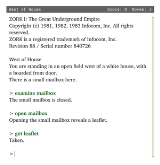
Zork

Encyclopedia
Zork was one of the first interactive fiction
computer games and an early descendant of Colossal Cave Adventure
. The first version of Zork was written in 1977–1979 on a DEC PDP-10
computer by Tim Anderson
, Marc Blank
, Bruce Daniels
, and Dave Lebling
, and implemented in the MDL programming language
. All four were members of the MIT
Dynamic Modelling Group.
"Zork" was originally MIT
hacker slang
for an unfinished program. The implementors briefly named the completed game Dungeon, but changed it back to Zork after receiving a trademark violation notice from the publisher of Dungeons & Dragons
. Zork has also been adapted to a book series
.
Three of the original Zork programmers joined with others to found Infocom
in 1979. That company adapted the PDP-10 Zork into Zork I-III, a trilogy of games for most popular small computers of the era, including the Apple II, the Commodore 64
, the Commodore Plus/4
, the Atari 8-bit family
, the TRS-80
, CP/M
systems and the IBM PC
. Zork I
was published on 5¼" and 8" floppy disk
s. Joel Berez and Marc Blank developed a specialized virtual machine
to run Zork I, called the Z-machine
. The first "Z-machine Interpreter Program" ZIP for a small computer was written by Scott Cutler for the TRS-80. The trilogy was written in ZIL, which stands for "Zork Implementation Language", a language similar to LISP
. Personal Software published what would become the first part of the trilogy under the name Zork when it was first released in 1980, but Infocom later handled the distribution of that game and their subsequent games. Part of the reason for splitting Zork into three different games was that, unlike the PDP systems the original ran on, micros did not have enough memory and disk storage to handle the entirety of the original game. In the process, more content was added to Zork to make each game stand on its own. A version of Zork I was issued as a hidden 'easter egg' in Call of Duty: Black Ops, a video game produced as a collaboration between Activision and Treyarch in November 2010. It has exactly the same text and rules as the original.
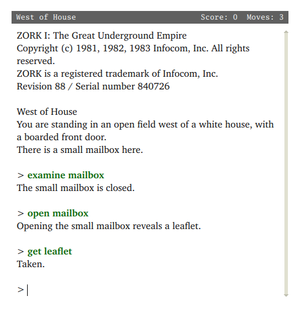
Zork distinguished itself in its genre as an especially rich game, in terms of both the quality of the storytelling and the sophistication of its text parser, which was not limited to simple verb-noun commands ("hit troll"), but some prepositions and conjunctions ("hit the troll with the Elvish sword").
, zorkmids, and Flood Control Dam #3—all of which are referenced by subsequent Infocom
text adventures.
FrobozzCo International is a fictional monopolous
conglomerate from the game. FrobozzCo products are littered throughout all Zork games, often with humorous effect.
After a six year hiatus, the following games were produced:
The Enchanter trilogy and Wishbringer occupy somewhat unusual positions within the Zork universe. Enchanter was originally developed as Zork IV; Infocom decided to instead release it separately, however, and it became the basis of a new trilogy. (In each trilogy, there is a sense of assumed continuity; that is, the player's character in Zork III is assumed to have experienced the events of Zork I and Zork II. Similarly, events from Enchanter are referenced in Sorcerer and Spellbreaker; but the Enchanter character is not assumed to be the same one from the Zork trilogy. In fact, in Enchanter the player's character encounters the Adventurer from Zork, who helps the player's character solve a puzzle in the game.) Although Wishbringer was never officially linked to the Zork series, the game is generally agreed to be "Zorkian" due to its use of magic and several terms and names from established Zork games.
 Among the games bundled in The Lost Treasures of Infocom
, published in 1991 by Activision under the Infocom brand, were the original Zork trilogy, the Enchanter trilogy, Beyond Zork and Zork Zero. A second bundle published in 1992, The Lost Treasures of Infocom II, contained Wishbringer and ten other non-Zork-related games.
Activision's 1996 compilation, Classic Text Adventure Masterpieces of Infocom
, includes all the text-based Zork games; the Zork and Enchanter trilogies, Wishbringer, Beyond Zork and Zork Zero.
Activision briefly offered free downloads of Zork I as part of the promotion of Zork: Nemesis, and Zork II and Zork III as part of the promotion for Zork Grand Inquisitor, as well as a new adventure: Zork: The Undiscovered Underground.
Of six novels published as "Infocom Books" by Avon Books between 1989–1991, four were directly based on Zork: The Zork Chronicles by George Alec Effinger
(1990), The Lost City of Zork by Robin W. Bailey (1991), Wishbringer by Craig Shaw Gardner
and Enchanter, also by Bailey.
In 2006, an over-the-phone version of Zork entitled Zasterisk entered beta testing. Programmed by Simon Ditner using Asterisk
and the Festival Speech Synthesis System
, players can call in and play Zork over the phone by speaking voice commands. The results are read back by the automated text-to-voice synthesis system. It is now known as Zoip, a reference to VoIP.
The latest installation of the Zork series is Legends of Zork
, a persistent browser-based MMORPG
, which was released on April 1, 2009.
2010 saw Zork I, Zork II, Zork III, and Mini-Zork formatted specifically for the Amazon Kindle
– with more interactive text adventures promised for the platform.
A full version of Zork I is playable on a computer terminal in the interrogation room in the 2010 game Call of Duty: Black Ops
where it unlocks the achievement or bronze trophy (Xbox 360 or PS3, respectively) called "Eaten by a Grue."
Since January 18, 2011 Zork Anthology (featuring Zork I, Zork II, Zork III, Beyond Zork, Zork Zero and Planetfall
) is internationally available at Good Old Games, in a form of digital download.
On June 22, 2011 the original Zork trilogy, along with downloadable maps and walk-through guides, were made available on the Iron Realms website.
In all of the Zork text adventures, the following commands apply:
> n, s, e, w
> nw, ne, sw, se
> u and d
> i
> verbose
> score
, to create a Fortran IV port, which allowed the game to run on the smaller DEC PDP-11
. Late 1977 the Zork authors had decided to rename Zork to Dungeon, and Supnik subsequently released his port as Dungeon in January 1978. Somewhere in 1978 the Zork developers received notice from Tactical Studies Rules, who claimed that the name Dungeon infringed their trademark rights, and they subsequently changed the name back to Zork. When Zork became a commercial product at Infocom, Infocom agreed that if an Infocom copyright notice was put on the Fortran version, noncommercial distribution would be allowed. This Fortran version, and C
translations thereof, have been included in several Linux distribution
s.
The Fortran version of Dungeon was widely available on DEC VAX
es, being one of the most popular items distributed by DECUS
. It went through multiple modifications both to incorporate more features from the original and to track changes in the MDL version. In the late 1980s, the Fortran version was extensively rewritten for VAX Fortran and became fully compatible with the last MDL release. It had one extra joke: an apparent entrance to the Mill (a reference to DEC's headquarters) that was, in fact, impassable.
It also had a gdt command (game debugging technique, a reference to the DDT debugger
) which enabled the player to move any object (including the player) to any room. Use of gdt required answering a random question requiring deep knowledge of the game. The game's response to a wrong answer (“A booming voice says ‘Wrong, cretin!’ and you notice that you have turned into a pile of dust”) appears in many "fortune cookie" databases.
The FORTRAN version was also included in the distribution media for some Data General
operating systems. It was used as an acceptance test to verify that the OS had been correctly installed. Being able to compile, link, and run the program demonstrated that all of the run-time libraries, compiler, and link editor were installed in the correct locations.
Interactive fiction
Interactive fiction, often abbreviated IF, describes software simulating environments in which players use text commands to control characters and influence the environment. Works in this form can be understood as literary narratives and as video games. In common usage, the term refers to text...
computer games and an early descendant of Colossal Cave Adventure
Colossal Cave Adventure
Colossal Cave Adventure gave its name to the computer adventure game genre . It was originally designed by Will Crowther, a programmer and caving enthusiast who based the layout on part of the Mammoth Cave system in Kentucky...
. The first version of Zork was written in 1977–1979 on a DEC PDP-10
PDP-10
The PDP-10 was a mainframe computer family manufactured by Digital Equipment Corporation from the late 1960s on; the name stands for "Programmed Data Processor model 10". The first model was delivered in 1966...
computer by Tim Anderson
Tim Anderson (Zork)
Tim Anderson is a computer programmer who helped create the adventure game Zork, one of the first works of interactive fiction and an early descendant of ADVENT . The first version of Zork was written in 1977–1979 in the MDL programming language on a DEC PDP-10 computer by Anderson, Marc Blank,...
, Marc Blank
Marc Blank
Marc Blank is an American game developer and software engineer. He is best known as part of the team that created one of the first hit text adventure computer games, Zork....
, Bruce Daniels
Bruce Daniels
Dr. Bruce Daniels is an American computer programmer and business executive who has worked for Hewlett Packard, Apple Computer, Oracle, Borland, Sun Microsystems and his own start-up Singular Software, which created Mac database management software...
, and Dave Lebling
Dave Lebling
P. David Lebling is an interactive fiction game designer and programmer who has worked at various companies, including Infocom and Avid....
, and implemented in the MDL programming language
MDL programming language
MDL is a descendant of the Lisp Programming language. Its initial purpose was to provide high level language support for the Dynamic Modeling Group at MIT's Project MAC...
. All four were members of the MIT
Massachusetts Institute of Technology
The Massachusetts Institute of Technology is a private research university located in Cambridge, Massachusetts. MIT has five schools and one college, containing a total of 32 academic departments, with a strong emphasis on scientific and technological education and research.Founded in 1861 in...
Dynamic Modelling Group.
"Zork" was originally MIT
Massachusetts Institute of Technology
The Massachusetts Institute of Technology is a private research university located in Cambridge, Massachusetts. MIT has five schools and one college, containing a total of 32 academic departments, with a strong emphasis on scientific and technological education and research.Founded in 1861 in...
hacker slang
Slang
Slang is the use of informal words and expressions that are not considered standard in the speaker's language or dialect but are considered more acceptable when used socially. Slang is often to be found in areas of the lexicon that refer to things considered taboo...
for an unfinished program. The implementors briefly named the completed game Dungeon, but changed it back to Zork after receiving a trademark violation notice from the publisher of Dungeons & Dragons
Dungeons & Dragons
Dungeons & Dragons is a fantasy role-playing game originally designed by Gary Gygax and Dave Arneson, and first published in 1974 by Tactical Studies Rules, Inc. . The game has been published by Wizards of the Coast since 1997...
. Zork has also been adapted to a book series
Zork books
The Zork books were a series of four books, written by S. Eric Meretzky, which took place in the fictional universe of Zork. The books were published by Tor Books...
.
Three of the original Zork programmers joined with others to found Infocom
Infocom
Infocom was a software company, based in Cambridge, Massachusetts, that produced numerous works of interactive fiction. They also produced one notable business application, a relational database called Cornerstone....
in 1979. That company adapted the PDP-10 Zork into Zork I-III, a trilogy of games for most popular small computers of the era, including the Apple II, the Commodore 64
Commodore 64
The Commodore 64 is an 8-bit home computer introduced by Commodore International in January 1982.Volume production started in the spring of 1982, with machines being released on to the market in August at a price of US$595...
, the Commodore Plus/4
Commodore Plus/4
The Commodore Plus/4 was a home computer released by Commodore International in 1984. The "Plus/4" name refers to the four-application ROM resident office suite ; it was billed as "the productivity computer with software built-in"...
, the Atari 8-bit family
Atari 8-bit family
The Atari 8-bit family is a series of 8-bit home computers manufactured from 1979 to 1992. All are based on the MOS Technology 6502 CPU and were the first home computers designed with custom coprocessor chips...
, the TRS-80
TRS-80
TRS-80 was Tandy Corporation's desktop microcomputer model line, sold through Tandy's Radio Shack stores in the late 1970s and early 1980s. The first units, ordered unseen, were delivered in November 1977, and rolled out to the stores the third week of December. The line won popularity with...
, CP/M
CP/M
CP/M was a mass-market operating system created for Intel 8080/85 based microcomputers by Gary Kildall of Digital Research, Inc...
systems and the IBM PC
IBM PC
The IBM Personal Computer, commonly known as the IBM PC, is the original version and progenitor of the IBM PC compatible hardware platform. It is IBM model number 5150, and was introduced on August 12, 1981...
. Zork I
Zork I
Zork: The Great Underground Empire - Part I, later known as Zork I, is an interactive fiction computer game written by Marc Blank, Dave Lebling, Bruce Daniels and Tim Anderson and published by Infocom in 1980. It was the first game in the popular Zork trilogy and was released for a wide range of...
was published on 5¼" and 8" floppy disk
Floppy disk
A floppy disk is a disk storage medium composed of a disk of thin and flexible magnetic storage medium, sealed in a rectangular plastic carrier lined with fabric that removes dust particles...
s. Joel Berez and Marc Blank developed a specialized virtual machine
Virtual machine
A virtual machine is a "completely isolated guest operating system installation within a normal host operating system". Modern virtual machines are implemented with either software emulation or hardware virtualization or both together.-VM Definitions:A virtual machine is a software...
to run Zork I, called the Z-machine
Z-machine
The Z-machine is a virtual machine that was developed by Joel Berez and Marc Blank in 1979 and used by Infocom for its text adventure games. Infocom compiled game code to files containing Z-machine instructions , and could therefore port all its text adventures to a new platform simply by writing a...
. The first "Z-machine Interpreter Program" ZIP for a small computer was written by Scott Cutler for the TRS-80. The trilogy was written in ZIL, which stands for "Zork Implementation Language", a language similar to LISP
Lisp
A lisp is a speech impediment, historically also known as sigmatism. Stereotypically, people with a lisp are unable to pronounce sibilants , and replace them with interdentals , though there are actually several kinds of lisp...
. Personal Software published what would become the first part of the trilogy under the name Zork when it was first released in 1980, but Infocom later handled the distribution of that game and their subsequent games. Part of the reason for splitting Zork into three different games was that, unlike the PDP systems the original ran on, micros did not have enough memory and disk storage to handle the entirety of the original game. In the process, more content was added to Zork to make each game stand on its own. A version of Zork I was issued as a hidden 'easter egg' in Call of Duty: Black Ops, a video game produced as a collaboration between Activision and Treyarch in November 2010. It has exactly the same text and rules as the original.
Zork distinguished itself in its genre as an especially rich game, in terms of both the quality of the storytelling and the sophistication of its text parser, which was not limited to simple verb-noun commands ("hit troll"), but some prepositions and conjunctions ("hit the troll with the Elvish sword").
Setting
Zork is set in "the ruins of an ancient empire lying far underground". The player is a nameless adventurer "who is venturing into this dangerous land in search of wealth and adventure". The goal is to return from the "Great Underground Empire" alive with the treasures, ultimately inheriting the title of Dungeon Master. The dungeons are stocked with many novel creatures, objects and locations, among them gruesGrue (monster)
A grue is a fictional predator that dwells in the dark. The word was first used in modern times as a fictional predator in Jack Vance's Dying Earthuniverse ....
, zorkmids, and Flood Control Dam #3—all of which are referenced by subsequent Infocom
Infocom
Infocom was a software company, based in Cambridge, Massachusetts, that produced numerous works of interactive fiction. They also produced one notable business application, a relational database called Cornerstone....
text adventures.
FrobozzCo International is a fictional monopolous
Monopoly
A monopoly exists when a specific person or enterprise is the only supplier of a particular commodity...
conglomerate from the game. FrobozzCo products are littered throughout all Zork games, often with humorous effect.
The original Zork Trilogy
- Zork I: The Great Underground EmpireZork IZork: The Great Underground Empire - Part I, later known as Zork I, is an interactive fiction computer game written by Marc Blank, Dave Lebling, Bruce Daniels and Tim Anderson and published by Infocom in 1980. It was the first game in the popular Zork trilogy and was released for a wide range of...
(1980, Infocom) - Zork II: The Wizard of FrobozzZork IIZork II: The Wizard of Frobozz is an interactive fiction computer game published by Infocom in 1981. It was written by Marc Blank, Dave Lebling, Bruce Daniels and Tim Anderson. It was the second game in the popular Zork trilogy and was released for a wide range of computer systems. It begins where...
(1981, Infocom) - Zork III: The Dungeon MasterZork IIIZork III: The Dungeon Master is an interactive fiction computer game written by Marc Blank, Dave Lebling, Bruce Daniels and Tim Anderson and published by Infocom in 1982. It was the third game in the popular Zork trilogy and was released for a wide range of computer systems...
(1982, Infocom)
Later additions to the series
All these are text-only unless otherwise noted.- The Enchanter trilogy:
- EnchanterEnchanter (computer game)Enchanter is a 1983 interactive fiction computer game written by Marc Blank and Dave Lebling and published by Infocom. It belongs to the fantasy genre and was the first fantasy game published by Infocom after the Zork trilogy...
(1983, Infocom) - SorcererSorcerer (computer game)Sorcerer is an interactive fiction computer game written by Steve Meretzky and released by Infocom in 1984. It is the second game in the magic-themed "Enchanter trilogy", preceded by Enchanter and followed by Spellbreaker...
(1984, Infocom) - SpellbreakerSpellbreakerSpellbreaker is an interactive fiction computer game written by Dave Lebling and released by Infocom in 1985, the third and final game in the "Enchanter Trilogy". Like most of Infocom's games, it was released for many of the time's popular computer platforms, such as the Commodore 64, Atari ST and...
(1985, Infocom)
- Enchanter
- Games that take place somewhere in the Zork universe:
- WishbringerWishbringerWishbringer: The Magick Stone of Dreams is an interactive fiction computer game written by Brian Moriarty and published by Infocom in 1985. It was intended to be an easier game to solve than the typical Infocom release, and provide a good introduction to interactive fiction for inexperienced players...
: The Magick Stone of Dreams (1985, Infocom)
- Wishbringer
- The Zork Quest series:
- Zork Quest: Assault on Egreth Castle (1988, Infocom, interactive computer comic book)
- Zork Quest: The Crystal of Doom (1989, Infocom, interactive computer comic book)
- The Zork Anthology comprises the original Zork Trilogy plus:
- Beyond ZorkBeyond ZorkBeyond Zork was an interactive fiction computer game written by Brian Moriarty and released by Infocom in 1987...
: The Coconut of Quendor (1987, Infocom) - Zork ZeroZork ZeroZork Zero: The Revenge of Megaboz is an interactive fiction computer game, written by Steve Meretzky over nearly 18 months and published by Infocom in 1988, with an original retail price of $59.95...
: The Revenge of Megaboz (1988, Infocom, text with some graphics)
- Beyond Zork
After a six year hiatus, the following games were produced:
- Return to ZorkReturn to ZorkReturn to Zork is a 1993 adventure game in the Zork series. It was developed by Activision and was the final Zork game to be published under the Infocom label.-Gameplay:...
(1993, Infocom/ActivisionActivisionActivision is an American publisher, majority owned by French conglomerate Vivendi SA. Its current CEO is Robert Kotick. It was founded on October 1, 1979 and was the world's first independent developer and distributor of video games for gaming consoles...
, graphical) - The Philosopher's Stone (Activision, unfinished text prequel to Zork Nemesis)
- Zork Nemesis: The Forbidden Lands (1996, Activision, graphical)
- Zork: The Undiscovered UndergroundZork: The Undiscovered UndergroundZork: The Undiscovered Underground is an interactive fiction computer game written by former Infocom Implementors Marc Blank and Michael Berlyn and implemented by G. Kevin Wilson using the Inform language. The game was released by Activision on August 28, 1997 for free to coincide with the release...
(1997, written by Michael BerlynMichael BerlynMichael Berlyn is an American computer game designer and writer. He is best known as an Implementor at Infocom, part of the text adventure game design team....
and Marc Blank (original Infocom implementors) and released by Activision to promote the release of Zork Grand Inquisitor) - Zork Grand InquisitorZork Grand InquisitorZork: Grand Inquisitor is a graphical adventure game, developed by Activision and released in 1997 for the IBM compatible PC and Macintosh . It builds upon the Zork and Enchanter series of interactive fiction computer games originally released by Infocom. The cast includes Erick Avari, Dirk...
(1997, Activision, graphical)
The Enchanter trilogy and Wishbringer occupy somewhat unusual positions within the Zork universe. Enchanter was originally developed as Zork IV; Infocom decided to instead release it separately, however, and it became the basis of a new trilogy. (In each trilogy, there is a sense of assumed continuity; that is, the player's character in Zork III is assumed to have experienced the events of Zork I and Zork II. Similarly, events from Enchanter are referenced in Sorcerer and Spellbreaker; but the Enchanter character is not assumed to be the same one from the Zork trilogy. In fact, in Enchanter the player's character encounters the Adventurer from Zork, who helps the player's character solve a puzzle in the game.) Although Wishbringer was never officially linked to the Zork series, the game is generally agreed to be "Zorkian" due to its use of magic and several terms and names from established Zork games.
Later compilations and current availability
The Lost Treasures of Infocom
The Lost Treasures of Infocom is a collection of 20 computer games from interactive fiction pioneer Infocom, released in 1991. It was available in MS-DOS, Apple Macintosh, Amiga, and Apple IIGS versions, as well as a cross-platform CD-ROM version. Infocom was closed in 1989 by its then-parent...
, published in 1991 by Activision under the Infocom brand, were the original Zork trilogy, the Enchanter trilogy, Beyond Zork and Zork Zero. A second bundle published in 1992, The Lost Treasures of Infocom II, contained Wishbringer and ten other non-Zork-related games.
Activision's 1996 compilation, Classic Text Adventure Masterpieces of Infocom
Classic Text Adventure Masterpieces of Infocom
Classic Text Adventure Masterpieces of Infocom is a collection of 33 computer games from interactive fiction pioneer Infocom, and the top 6 winners of the 1995 Interactive Fiction Competition, released in 1996...
, includes all the text-based Zork games; the Zork and Enchanter trilogies, Wishbringer, Beyond Zork and Zork Zero.
Activision briefly offered free downloads of Zork I as part of the promotion of Zork: Nemesis, and Zork II and Zork III as part of the promotion for Zork Grand Inquisitor, as well as a new adventure: Zork: The Undiscovered Underground.
Of six novels published as "Infocom Books" by Avon Books between 1989–1991, four were directly based on Zork: The Zork Chronicles by George Alec Effinger
George Alec Effinger
George Alec Effinger was an American science fiction author, born in 1947 in Cleveland, Ohio.-Writing career:...
(1990), The Lost City of Zork by Robin W. Bailey (1991), Wishbringer by Craig Shaw Gardner
Craig Shaw Gardner
Craig Shaw Gardner is an American author, best known for producing fantasy parodies similar to those of Terry Pratchett.He was also a member of the Swordsmen and Sorcerers' Guild of America , a loose-knit group of Heroic Fantasy authors founded in the 1960s, some of whose works were anthologized...
and Enchanter, also by Bailey.
In 2006, an over-the-phone version of Zork entitled Zasterisk entered beta testing. Programmed by Simon Ditner using Asterisk
Asterisk PBX
Asterisk is a software implementation of a telephone private branch exchange ; it was created in 1999 by Mark Spencer of Digium. Like any PBX, it allows attached telephones to make calls to one another, and to connect to other telephone services including the public switched telephone network and...
and the Festival Speech Synthesis System
Festival Speech Synthesis System
Festival is a general multi-lingual speech synthesis system originally developed by Alan W. Black at at the University of Edinburgh. Substantial contributions have also been provided by Carnegie Mellon University and other sites...
, players can call in and play Zork over the phone by speaking voice commands. The results are read back by the automated text-to-voice synthesis system. It is now known as Zoip, a reference to VoIP.
The latest installation of the Zork series is Legends of Zork
Legends of Zork
Legends of Zork was a popular browser-based online adventure game, based on the legendary Zork universe.-Production:A Zork massively multiplayer online game was originally announced in January, 2009. However, the developers recanted that MMO statement, calling it a "casual adventure game", instead...
, a persistent browser-based MMORPG
MMORPG
Massively multiplayer online role-playing game is a genre of role-playing video games in which a very large number of players interact with one another within a virtual game world....
, which was released on April 1, 2009.
2010 saw Zork I, Zork II, Zork III, and Mini-Zork formatted specifically for the Amazon Kindle
Amazon Kindle
The Amazon Kindle is an e-book reader developed by Amazon.com subsidiary Lab126 which uses wireless connectivity to enable users to shop for, download, browse, and read e-books, newspapers, magazines, blogs, and other digital media...
– with more interactive text adventures promised for the platform.
A full version of Zork I is playable on a computer terminal in the interrogation room in the 2010 game Call of Duty: Black Ops
Call of Duty: Black Ops
Call of Duty: Black Ops is a first-person shooter video game developed by Treyarch, published by Activision and released worldwide on November 9, for Microsoft Windows, Xbox 360, PlayStation 3, Wii consoles, with a separate version for Nintendo DS developed by n-Space. Announced on April 30, 2010,...
where it unlocks the achievement or bronze trophy (Xbox 360 or PS3, respectively) called "Eaten by a Grue."
Since January 18, 2011 Zork Anthology (featuring Zork I, Zork II, Zork III, Beyond Zork, Zork Zero and Planetfall
Planetfall
Planetfall is a science fiction interactive fiction computer game written by Steve Meretzky, and the eighth title published by Infocom in 1983. Like most Infocom games, thanks to the portable Z-machine, it was released for several platforms simultaneously. The original release included versions...
) is internationally available at Good Old Games, in a form of digital download.
On June 22, 2011 the original Zork trilogy, along with downloadable maps and walk-through guides, were made available on the Iron Realms website.
Commands
In the Zork games, the player is not limited to verb-noun commands, such as "take lamp", "open mailbox", and so forth. Instead, the parser supports more sophisticated sentences such as "put the lamp and sword in the case", "look under the rug", and "drop all except lantern". The game understands many common verbs, including "take", "drop", "examine", "attack", "climb", "open", "close", "count", and many more. The games also support commands to the game directly (rather than taking actions within the fictional setting of the game) such as "save" and "restore", "script" and "unscript" (which begin and end a text transcript of the game text), "restart", and "quit".In all of the Zork text adventures, the following commands apply:
> n, s, e, w
- Short for "go north", "go south", etc.
> nw, ne, sw, se
- Short for "go northwest", "go southwest", etc.
> u and d
- Short for "go up" and "go down"
> i
- Reveals a player's inventory
> verbose
- Gives full descriptions after each command (rather than omitting details already given to the player)
> score
- Displays the player's current score, number of moves, and ranking
Dungeon
In late 1977 a hacker obtained a copy of the Zork source code, which was subsequently spread. The leaked Zork source code was later used by Bob Supnik, a programmer from Digital Equipment CorporationDigital Equipment Corporation
Digital Equipment Corporation was a major American company in the computer industry and a leading vendor of computer systems, software and peripherals from the 1960s to the 1990s...
, to create a Fortran IV port, which allowed the game to run on the smaller DEC PDP-11
PDP-11
The PDP-11 was a series of 16-bit minicomputers sold by Digital Equipment Corporation from 1970 into the 1990s, one of a succession of products in the PDP series. The PDP-11 replaced the PDP-8 in many real-time applications, although both product lines lived in parallel for more than 10 years...
. Late 1977 the Zork authors had decided to rename Zork to Dungeon, and Supnik subsequently released his port as Dungeon in January 1978. Somewhere in 1978 the Zork developers received notice from Tactical Studies Rules, who claimed that the name Dungeon infringed their trademark rights, and they subsequently changed the name back to Zork. When Zork became a commercial product at Infocom, Infocom agreed that if an Infocom copyright notice was put on the Fortran version, noncommercial distribution would be allowed. This Fortran version, and C
C (programming language)
C is a general-purpose computer programming language developed between 1969 and 1973 by Dennis Ritchie at the Bell Telephone Laboratories for use with the Unix operating system....
translations thereof, have been included in several Linux distribution
Linux distribution
A Linux distribution is a member of the family of Unix-like operating systems built on top of the Linux kernel. Such distributions are operating systems including a large collection of software applications such as word processors, spreadsheets, media players, and database applications...
s.
The Fortran version of Dungeon was widely available on DEC VAX
VAX
VAX was an instruction set architecture developed by Digital Equipment Corporation in the mid-1970s. A 32-bit complex instruction set computer ISA, it was designed to extend or replace DEC's various Programmed Data Processor ISAs...
es, being one of the most popular items distributed by DECUS
DECUS
The Digital Equipment Computer Users' Society was an independent computer user group related to Digital Equipment Corporation.The Connect User Group Community, formed from the consolidation in May, 2008 of DECUS, Encompass, HP-Interex, and ITUG is Hewlett-Packard’s largest user community...
. It went through multiple modifications both to incorporate more features from the original and to track changes in the MDL version. In the late 1980s, the Fortran version was extensively rewritten for VAX Fortran and became fully compatible with the last MDL release. It had one extra joke: an apparent entrance to the Mill (a reference to DEC's headquarters) that was, in fact, impassable.
It also had a gdt command (game debugging technique, a reference to the DDT debugger
Dynamic debugging technique
Dynamic Debugging Technique, or DDT, was the name of several debugger programs originally developed for DEC hardware, initially known as DEC Debugging Tape because it was distributed on paper tape. The name is a pun on the insecticide Dynamic Debugging Technique, or DDT, was the name of several...
) which enabled the player to move any object (including the player) to any room. Use of gdt required answering a random question requiring deep knowledge of the game. The game's response to a wrong answer (“A booming voice says ‘Wrong, cretin!’ and you notice that you have turned into a pile of dust”) appears in many "fortune cookie" databases.
The FORTRAN version was also included in the distribution media for some Data General
Data General
Data General was one of the first minicomputer firms from the late 1960s. Three of the four founders were former employees of Digital Equipment Corporation. Their first product, the Data General Nova, was a 16-bit minicomputer...
operating systems. It was used as an acceptance test to verify that the OS had been correctly installed. Being able to compile, link, and run the program demonstrated that all of the run-time libraries, compiler, and link editor were installed in the correct locations.
See also
- Legends of ZorkLegends of ZorkLegends of Zork was a popular browser-based online adventure game, based on the legendary Zork universe.-Production:A Zork massively multiplayer online game was originally announced in January, 2009. However, the developers recanted that MMO statement, calling it a "casual adventure game", instead...
, an online, browser-based spin-off - 6910569105 (number)The number 69,105 was used as an in-joke at the United States computer game manufacturer Infocom. It has occasionally appeared in later computer games as a tribute to Infocom.-Significance of the number:...
, a number that became somewhat of an in-jokeIn-jokeAn in-joke, also known as an inside joke or in joke, is a joke whose humour is clear only to people who are in a particular social group, occupation, or other community of common understanding...
in several Infocom games - The Lurking HorrorThe Lurking HorrorThe Lurking Horror is an interactive fiction computer game released by Infocom in 1987. The game was written by Dave Lebling and inspired by the horror writings of H. P. Lovecraft...
, another Infocom IF, that references Zork. - GrueGrue (monster)A grue is a fictional predator that dwells in the dark. The word was first used in modern times as a fictional predator in Jack Vance's Dying Earthuniverse ....
, the infamous Zork monster - The Meteor, the Stone and a Long Glass of SherbetThe Meteor, the Stone and a Long Glass of SherbetThe Meteor, the Stone and a Long Glass of Sherbet is a 1996 work of interactive fiction by Graham Nelson, distributed in z-code format as freeware. It won the 1996 Interactive Fiction Competition after being entered pseudonymously under the name "Angela M. Horns" . The game is set in the Zork...
, the winner of the 1996 Interactive Fiction CompetitionInteractive Fiction CompetitionThe Interactive Fiction Competition is one of the best known of several annual competitions for works of interactive fiction. It has been held since 1995. It is intended for fairly short games, as judges are only allowed to spend two hours playing a game before deciding how many points to award it...
, is strongly influenced by the Zork universe and includes many elements.
External links
- Play Zork online at THCNET's interactive 404 errorHTTP 404The 404 or Not Found error message is a HTTP standard response code indicating that the client was able to communicate with the server, but the server could not find what was requested. A 404 error should not be confused with "server not found" or similar errors, in which a connection to the...
page. - Play Zork I online at InfocomInfocomInfocom was a software company, based in Cambridge, Massachusetts, that produced numerous works of interactive fiction. They also produced one notable business application, a relational database called Cornerstone....
, the place where it all started. - Download and play the original mainframe version of Zork, as well as a 1982 map of the Zork universe.
- Zork I, II, III and The Undiscovered Underground Download Zork I, II and III for Win, DOS or Mac (no Z-interpreter needed), and The Undiscovered Underground (Z-machineZ-machineThe Z-machine is a virtual machine that was developed by Joel Berez and Marc Blank in 1979 and used by Infocom for its text adventure games. Infocom compiled game code to files containing Z-machine instructions , and could therefore port all its text adventures to a new platform simply by writing a...
interpreters included). Includes "The New Zork Times" - Infocom-IF.org, Infocom history, authors, etc.; often updated with any news from Activision; also downloads of games ready for Z-Machine interpreters like frotz.
- Article at The Dot Eaters, featuring an extensive history of the Zork games and Infocom
- The History Of Zork – Article
- The Zork trilogy on Iron Realms.
- Retroist Zork Podcast