


Binary prefix

Encyclopedia
In computing, a binary prefix is a specifier or mnemonic that is prepended to the unit
s of digital information, the bit
and the byte
, to indicate multiplication by a power
of 2. In practice the powers used are multiples of 10, so the prefixes denote powers of
The computer industry uses terms such as kilobyte, megabyte, and gigabyte, and corresponding symbols KB, MB, and GB, in two different ways. For example, in citations of main memory or RAM capacity, gigabyte customarily means bytes. This is a power of 2, specifically 230, therefore this usage is referred to as a binary unit or binary prefix.
In most other contexts, the industry uses kilo, mega, giga, etc., in a manner consistent with their meaning in the International System of Units
(SI): as powers of 1000. For example, a 500 gigabyte hard drive holds bytes, and a 100 megabit per second Ethernet connection transfers data at bit/s.
Starting in about 1998, a number of standards and trade organizations approved standards and recommendations for a new set of binary prefixes, proposed earlier by the International Electrotechnical Commission
(IEC), that would refer unambiguously to powers of 1024.
According to these, the SI prefix
es would only be used in the decimal sense, even when referring to data storage capacities: kilobyte
and megabyte
would denote one thousand bytes and one million bytes respectively (consistent with SI), while new terms such as kibibyte
, mebibyte
and gibibyte
,
abbreviated KiB, MiB, and GiB, would denote 1024 bytes, bytes, and bytes respectively. However, as of 2011 adoption has been slow and usage has been limited in the marketplace and in the press.
For example, the IBM 701
(1952) used binary and could address 2048 36-bit
words, while the IBM 702
(1953) used decimal and could address 7-bit words.
By the mid 1960s, binary addressing had become the standard architecture in most computer designs, and main memory sizes were most commonly powers of two. This is the most natural configuration for memory, as all combinations of their address lines map to a valid address, allowing easy aggregation into a larger block of memory with contiguous addresses.
Early computer system documentation would specify the memory size with an exact number such as 4096, 8192, or 16384 words of storage. These are all powers of 2, and furthermore are small multiples of 210,
or 1024. As storage capacities increased, several different methods were developed to abbreviate these quantities.
The method most commonly used today uses prefixes such as kilo, mega, giga, and corresponding symbols K, M, and G,
which the computer industry originally adopted from the metric system
. The prefixes kilo- and mega-, meaning 1000 and respectively, were commonly used in the electronics industry before World War II.
Along with giga- or G-, meaning , they are now known as SI prefixes after the International System of Units
(SI), introduced in 1960 to formalize aspects of the metric system, although K is the SI unit for temperature (kelvin
) and should not be mixed up with k, the SI prefix for kilo.
The International System of Units does not define units for digital information but notes that the SI prefixes may be applied outside the contexts where base units or derived units would be used. But as computer main memory in a binary-addressed system is manufactured in sizes that were easily expressed as multiples of 1024, kilobyte, when applied to computer memory, came to be used to mean 1024 bytes instead of 1000. (SI explicitly prohibits this usage, stating that the prefixes only have the 1000-based meaning, and cannot be used as placeholders for other numbers, like
1024.)
The use of K in the binary sense as in a "32K core" meaning 32×1024, or , can be found as early as 1959.
was a character addressable computer.
Gene Amdahl's
seminal 1964 article on IBM System/360 used 1K to mean 1024.
This style was used by other computer vendors, the CDC 7600
System Description (1968) made extensive use of K as 1024.
Thus the first binary prefix was born.
Another style was to truncate the last 3 digits and append K, essentially using K as a decimal prefix similar to SI, but always truncating to the next lower whole number instead of rounding to the nearest. The exact values , and would then be described as 32K, 65K and 131K.
(If these values had been rounded they would have become 33K, 66K, and 131K, respectively.)
This style was used from about 1965 to 1975.
These two styles (K = 1024 and truncation) were used loosely around the same time, sometimes by the same company. In discussions of binary-addressed memories, the exact size was evident from context. (For memory sizes of 32K and below, there is no difference between the two styles.) The HP 21MX
real-time computer (1974) denoted (which is 192×1024) as 196K and as 1M,
while the HP 3000
business computer (1973) could have 64K, 96K, or 128K bytes of memory.
The "truncation" method gradually waned. Capitalization of the letter K became the de facto standard for binary notation, although this could not be extended to higher powers. Nevertheless, the practice of using the SI-inspired "kilo" to indicate 1024 was later extended to "megabyte" meaning 10242 bytes, and later "gigabyte" for 10243 bytes. For example, a "512 megabyte" RAM module is 512×10242 bytes (512×, or ), rather than .
The symbols Kbit, Kbyte, Mbit and Mbyte started to be used as "binary units"—"bit" or "byte" with a multiplier that is a power of 1024—in the early 1970s.
For a time, memory capacities were often expressed in K, even when M could have been used: The IBM System/370 Model 158 brochure (1972) had the following: "Real storage capacity is available in 512K increments ranging from 512K to 2,048K bytes."
Megabyte was used to describe the 22-bit addressing of DEC PDP-11
/70 (1975)
and gigabyte the 30-bit addressing DEC VAX-11/780 (1977).
and continuing today, is to specify hard drives using SI prefixes and symbols in their SI or "decimal" interpretation. Unlike binary-addressed computer main memory, there is nothing in a disk drive that influences it to have a total capacity easily expressed using a power of 1024. The first commercially sold disk drive, the IBM 350, had 50 (not 32 or 64) physical disk "platters" containing a total of 50,000 sectors of 100 characters each, for a total quoted capacity of "5 million characters."
In the 1960s most disk drives used IBM's variable block length format (called Count Key Data
or "CKD").
Any block size could be specified up to the maximum track length. Since the block headers occupied space, the usable capacity of the drive was dependent on the block size. Blocks ("records" in IBM's terminology) of 88, 96, 880 and 960 were often used because they related to the fixed block size of punch cards. The drive capacity was usually stated under conditions of full track record blocking. For example, the 100 megabyte 3336 disk pack only achieved that capacity with a full track block size of 13,030 bytes.
Hard disk drive manufacturers used "megabytes" or "MB", meaning 106 bytes, to characterize their products as early as 1974. By 1977, in its first edition, Disk/Trend, a leading hard disk drive industry marketing consultancy segmented the industry according to MBs (decimal sense) of capacity.
One of the earliest hard disk drives in personal computing history,
the Seagate ST-412, was specified as "Formatted: 10.0 Megabytes". The specification of 4 heads or active surfaces (tracks per cylinder), 306 cylinders and when formatted with a sector size of 256 bytes and 32 sectors/track results in a capacity of bytes. With the customary binary prefixes, this would be expressed as 9.5625 megabytes. This drive was one of several types installed into the IBM PC/XT and extensively advertised and reported as a "10 MB" (formatted) hard disk drive.
The hard drive industry continues to use decimal prefixes for drive capacity. Today, for example, a "300 GB" hard drive offers slightly more than 300×109, or , bytes, not 300×230 (which would be about 322×109). Operating systems such as Microsoft Windows
that display hard drive sizes using the customary binary prefix "GB" (as it is used for RAM) would display this as 279.4 GB (meaning 279.4×10243, or 279.4×).
However, other usages still occur. For example, in one document, Seagate specifies data transfer rates of some of its hard drives in both IEC and decimal units.
"Advanced Format" drives using 4096-byte sectors are described as having "4K sectors."
circuit or data transfer path that demands or even encourages that things happen at rates easily expressed using powers of 1024, or even using powers of 2.
Computer clock
frequencies are always quoted using SI prefixes in their decimal sense. For example, the internal clock frequency of the original IBM PC
was 4.77 MHz, that is, Hz.
Similarly, digital information transfer rates are mostly quoted using decimal prefixes:
In the 1980s, as capacities of both types of devices increased,
the SI prefix G, with SI meaning, was commonly applied to disk storage, while M in its binary meaning, became common for computer memory. In the 1990s, the prefix G, in its binary meaning, became commonly used for computer memory capacity. The first terabyte (SI prefix, bytes) hard disk drive was introduced in 2007.
The dual usage of the kilo, mega, and giga prefixes and their corresponding symbols K, M, and G as both powers of 1000 and powers of 1024 was recorded in standards and dictionaries. For example, the 1986 ANSI/IEEE Std 1084-1986
defined dual uses for kilo and mega.
The binary units Kbyte and Mbyte were formally defined in ANSI/IEEE Std 1212-1991.
Many dictionaries have noted the practice of using traditional prefixes to indicate binary multiples.
Oxford online dictionary defines, for example, megabyte as: "Computing: a unit of information equal to one million or (strictly) ."
The units Kbyte, Mbyte, and Gbyte are found in the trade press and in IEEE journals. Gigabyte was formally defined in IEEE Std 610.10-1994 as either or 230 bytes.
Kilobyte, Kbyte, and KB are equivalent units and all are defined in the current standard, IEEE 100-2000.
Byte multiples using powers of 1024 up to yottabyte are given by the on-line computing dictionary FOLDOC (Free On-Line Dictionary of Computing).
The hardware industry has coped with the dual definitions because of relative consistency:
system memory (RAM) typically uses the binary meaning while magnetic disk storage uses the SI meaning.
There are, however, exceptions and special cases.
Diskettes use yet another "megabyte" equal to 1024×1000 bytes.
In optical disks, Compact Disks use MB to mean 10242 bytes while DVD
s use GB to mean 10003 bytes.
Because both the SI and "binary" meanings of kilo, mega, etc., are based on powers
of 1000 or 1024 rather than simple multiples, the difference between 1M "binary" and 1M "decimal" is proportionally larger than that between 1K "binary" and 1k "decimal," and so on up the scale.
The relative difference between the values in the binary and decimal interpretations increases, when using the SI prefixes as the base, from 2.4% for kilo to over 20% for the yotta prefix.

For example, in 1965 IBM stated about the System/360 Model 75 that "Its main memory operated at 750 nanoseconds and was available in three sizes up to 1,048,576 characters of information."
One source of consumer confusion is the difference in the way many operating systems display hard drive sizes, compared to the way hard drive manufacturers describe them.
As noted previously, hard drives are described and sold using "GB" or "TB" in their SI meaning: one billion and one trillion bytes.
Many operating systems and other software however display hard drive and file sizes using "MB", "GB" or other SI-looking prefixes in their "binary" meaning, just as they do for displays of RAM capacity.
(The earliest known presentation of hard disk drive capacity by an operating system using "KB" or "MB" in a binary sense is 1984; earlier operating systems generally presented hard disk drive capacity in decimal digits with no prefix of any sort, e.g. in the MS/PC DOS CHKDSK
command.)
The following three images show the discrepancy of reporting the identical disk capacity on the manufacturer's packaging (160 GB = 160×10003), the Windows XP
disk manager (149.05 GB = 149.05×10243),
and the drive properties display ( = ×10242).
One case involved flash memory and the other two involved hard disk drives.
Both were settled with the manufacturers admitting no wrongdoing but agreeing to clarify the storage capacity of their products on the consumer packaging.
Flash memory and hard disk manufacturers now have disclaimers on their packaging and web sites clarifying the formatted capacity of the devices
or defining MB as 1 million bytes and 1 GB as 1 billion bytes.
against Lexar Media, Dane–Elec Memory, Fuji Photo Film USA
, Eastman Kodak
Company, Kingston Technology Company, Inc., Memorex
Products, Inc.; PNY Technologies
Inc., SanDisk Corporation
, Verbatim Corporation
, and Viking Interworks alleging that their descriptions of the capacity of their flash memory
cards were false and misleading.
Vroegh claimed that a 256 MB Flash Memory Device had only 244 MB of accessible memory. "Plaintiffs allege that Defendants marketed the memory capacity of their products by assuming that one megabyte equals one million bytes and one gigabyte equals one billion bytes."
The plaintiffs wanted the defendants to use the traditional values of 10242 for megabyte and 10243 for gigabyte.
The plaintiffs acknowledged that the IEC and IEEE standards define a MB as one million bytes but stated that the industry has largely ignored the IEC standards.
The manufacturers agreed to clarify the flash memory card capacity on the packaging and web sites. The consumers could apply for "a discount of ten percent off a future online purchase from Defendants' Online Stores Flash Memory Device".
Corporation, et al.," was filed in the Superior Court for the City and County of San Francisco, Case No. CGC-05-442812.
The case was subsequently moved to the Northern District of California, Case No. 05-03353 BZ.
Although Western Digital maintained that their usage of units is consistent with "the indisputably correct industry standard for measuring and describing storage capacity", and that they "cannot be expected to reform the software industry", they agreed to settle in March 2006 with 14 June 2006 as the Final Approval hearing date.
Western Digital offered to compensate customers with a free download of backup and recovery software valued at US$30. They also paid $500,000 in fees and expenses to San Francisco lawyers Adam Gutride and Seth Safier, who filed the suit.
The settlement called for Western Digital to add a disclaimer to their later packaging and advertising.
, alleging that Seagate overrepresented the amount of usable storage by 7% on hard drives sold between March 22, 2001 and September 26, 2007. The case was settled without Seagate admitting wrongdoing, but agreeing to supply those purchasers with free backup software or a 5% refund on the cost of the drives.
Several proposals for unique binary prefixes
For example, in the computer industry's customary practice,
one "megabyte" of RAM is 10242 bytes of RAM,
one "gigabyte" of RAM is 10243 bytes of RAM, and so on.
In the IEC system, these would be expressed as one "mebibyte" and one "gibibyte," respectively.
Both are "binary prefixes" in these usages.
were made in 1968.
Donald Morrison proposed to use the Greek letter kappa (κ) to denote 1024, κ2 to denote 1024×1024, and so on.
(At the time, memory size was small, and only K was in widespread use.)
Wallace Givens
responded with a proposal to use bK as an abbreviation for 1024 and bK2 or bK2 for 1024×1024, though he noted that neither the Greek letter nor lowercase letter b would be easy to reproduce on computer printers of the day.
Bruce A. Martin further proposed that the prefixes be abandoned altogether, and the letter B be used as a binary exponent, similar to E notation, to create shorthands like 3B20 for 3×220
None of these gained much acceptance, and capitalization of the letter K became the de facto standard for indicating a factor of 1024 instead of 1000, although this could not be extended to higher powers.
As the discrepancy between the two systems increased in the higher order powers, more proposals for unique prefixes were made.
In 1996, Markus Kuhn
proposed a system with di prefixes, like the "dikilobyte" (K₂B or K2B).
(IEC). Such prefixes are only used with the units bits or bytes (or compound units derived from them such as bytes/second) and always denote powers of 1024; that is, they are always used as binary prefixes. Thus 1 mebibyte of RAM is 10242 bytes of RAM, 1 gibibyte or 1 GiB of RAM is 10243 bytes, and so on. were first proposed by the
International Union of Pure and Applied Chemistry
's (IUPAC) Interdivisional Committee on Nomenclature and Symbols (IDCNS) in 1995. At that time, it was proposed that the terms kilobyte and megabyte be used only for 103 bytes and 106 bytes, respectively. The new prefixes kibi (kilobinary), mebi (megabinary) and gibi (gigabinary) were also proposed at the time, and the proposed symbols for the prefixes were kb, Mb and Gb respectively, rather than Ki, Mi and Gi. The proposal was not accepted at the time.
The Institute of Electrical and Electronic Engineers (IEEE) began to collaborate with the International Organization for Standardization
(ISO) and International Electrotechnical Commission
(IEC) to find acceptable names for binary prefixes. The IEC proposed kibi, mebi, gibi and tebi, with the symbols Ki, Mi, Gi and Ti respectively, in 1996.
The names for the new prefixes are derived from the original SI prefixes combined with the term binary, but contracted, by taking the first two letters of the SI prefix and "bi" from binary. The first letter of each such prefix is therefore identical to the corresponding SI prefixes, except for "K", which is used interchangeably with "k", whereas in SI, only the lower-case k represents 1000.
The IEEE decided that their standards would use the prefixes kilo, etc. with their metric definitions, but allowed the binary definitions to be used in an interim period as long as such usage was explicitly pointed out on a case-by-case basis.
The IEC 60027-2 Amendment 2 also states that the IEC position is the same as that of BIPM (the body that regulates the SI system); the SI prefixes retain their definitions in powers of 1000 and are never used to mean a power of 1024.
In usage, products and concepts typically described using powers of 1024 would continue to be, but with the new IEC prefixes. For example, a memory module of bytes (512×) would be referred to as 512 MiB or 512 mebibytes instead of 512 MB or 512 megabytes. Conversely, since hard drives have historically been marketed using the SI convention that "giga" means , a "500 GB" hard drive would still be labeled as such. According to these recommendations, operating systems and other software would also use binary and SI prefixes in the same way, so the purchaser of a "500 GB" hard drive would find the operating system reporting either "500 GB" or "466 GiB", while bytes of RAM would be displayed as "512 MiB".
The second edition of the standard, published in 2000,
defined them only up to exbi, but in 2005, the third edition added prefixes zebi and yobi, thus matching all SI prefixes with binary counterparts.
The harmonized ISO
/IEC
IEC 80000-13:2008
standard cancels and replaces subclauses 3.8 and 3.9 of IEC 60027-2:2005 (those defining prefixes for binary multiples). The only significant change is the addition of explicit definitions for some quantities.
The United States National Institute of Standards and Technology
(NIST) supports the ISO/IEC standards for
"Prefixes for binary multiples" and has a web site documenting them, describing and justifying their use. NIST suggests that in English, the first syllable of the name of the binary-multiple prefix should be pronounced in the same way as the first syllable of the name of the corresponding SI prefix, and that the second syllable should be pronounced as bee. NIST has stated the SI prefixes "refer strictly to powers of 10" and that the binary definitions "should not be used" for them.
In December 2002, JEDEC
, a leading standards organization in the microelectronics industry, mentioned the IEC prefixes in their Terms, Definitions, and Letter Symbols for Microcomputers, Microprocessors, and Memory Integrated Circuits document. This document defines "kilo", "mega", and "giga" with binary multipliers. A "Note" to this definition then states that that definition is only presented "to reflect common usage", and quotes the IEC in describing the binary prefixes as "an alternative system". However, subsequent memory standards
published by JEDEC still define and use the prefixes kilo, mega, and giga as binary multipliers.
On 19 March 2005, the IEEE standard IEEE 1541-2002 ("Prefixes for Binary Multiples") was elevated to a full-use standard by the IEEE Standards Association after a two-year trial period. However, , the IEEE Publications division does not require the use of IEC prefixes in its major magazines such as Spectrum or Computer.
The International Bureau of Weights and Measures
(BIPM), which maintains the International System of Units
(SI), expressly prohibits the use of SI prefixes to denote binary multiples, and recommends the use of the IEC prefixes as an alternative since units of information are not included in SI.
The Society of Automotive Engineers (SAE) prohibits the use of SI prefixes with anything but a power-of-1000 meaning, but does not recommend or otherwise cite the IEC binary prefixes.
The European Committee for Electrotechnical Standardization (CENELEC) adopted the IEC-recommended binary prefixes via the harmonization document HD 60027-2:2003-03.
The European Union (EU) has required the use of the IEC binary prefixes since 2007.
, who uses decimal notation like 1 MB = 1000 kB, expressed "astonishment" that the IEC proposal was adopted, calling them "funny-sounding" and opining that proponents were assuming "that standards are automatically adopted just because they are there." Knuth proposed that the powers of 1024 be designated as "large kilobytes" and "large megabytes" (abbreviated KKB and MMB, as "doubling the letter connotes both binary-ness and large-ness"). Double prefixes were already abolished from SI, however, having a multiplicative meaning ("MMB" would be equivalent to "TB"), and this proposed usage never gained any traction.
Main memory and cache memory universally use customary binary prefixesAs used in this article, the term customary binary prefix or similar refers to prefixes such as kilo, mega, giga, etc., borrowed from the similarly named SI prefix
es but commonly used to denote a power of 1024. to state capacity.
On the other hand, flash memory
, like that found in solid state drives, uses SI prefixes to state capacity.
With a few exceptions, most operating systems and other software continue to use the customary binary prefixes in displays of memory, disk storage capacity, and file size, but SI prefixesThe term SI prefix or similar refers to prefixes such as kilo, mega, giga, etc., defined by the SI system
of units and always used to denote a power of 1000; in other words, always as decimal prefixes. in other areas such as network communication speeds and processor speeds.
Nearly all articles, papers, and marketing materials in the industry continue to use the customary binary prefixes when referring to computer memory, even those published under the aegis of organizations that have shown support for the IEC prefixes.
In the following subsections, unless otherwise noted, examples are first given using the common prefixes used in each case, and then followed by interpretation using other notation where appropriate.
of 1000. For example, "kilo" denotes 1000, "mega" denotes 10002 or one million, "giga" denotes 10003 or one billion, and so on. SI prefixes are decimal prefixes.
The IEC
binary naming convention has been adopted by a few, but this is not used universally.
One of the stated goals of the introduction of the IEC prefixes was "to preserve the SI prefixes as unambiguous decimal multipliers." Programs such as fdisk
/cfdisk
, parted, and apt-get use SI prefixes with their decimal meaning.
Example of the use of IEC binary prefixes in the Linux
operating system displaying traffic volume on a network interface in kibibytes (KiB) and mebibytes (MiB), as obtained with the ifconfig
utility:
Software that uses standard SI prefixes for powers of 1000, but not IEC binary prefixes for powers of 1024, includes:
Software that uses IEC binary prefixes for powers of 1024 and uses standard SI prefixes for powers of 1000 includes:
Even hardware types that use powers-of-1024 multipliers, such as memory, continue to be marketed with
customary binary prefixes.
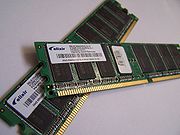 Measurements of most types of electronic memory
such as RAM, ROM
are given using customary binary prefixes (kilo, mega, and giga). This includes some Flash memory
, like EEPROM
s.
For example, a "512 megabyte" memory module is 512×220 bytes (512×, or ).
JEDEC Solid State Technology Association, the semiconductor engineering standardization body of the Electronic Industries Alliance (EIA), continues to include the customary binary definitions of kilo, mega and giga in their Terms, Definitions, and Letter Symbols document,
and uses those definitions in later memory standards
(See also JEDEC memory standards
.)
Many computer programming tasks reference memory in terms of powers of two because of the inherent binary design of current hardware addressing systems. For example, a 16-bit processor register can reference at most 65,536 items (bytes, words, or other objects); this is conveniently expressed as "64K" items. An operating system might map memory as 4096-byte pages
, in which case exactly 8192 pages could be allocated within of memory: 8K (8192) pages of 4 kilobytes (4096) each within 32 megabytes (32 MiB) of memory.
drive manufacturers state capacity using SI prefixes.
s, flash-based memory cards like CompactFlash
or Secure Digital
, and flash-based SSDs
use SI prefixes;
for example, a "256 MB" flash card provides at least 256 million bytes , not 256×1024×1024 .
These devices usually physically contain the binary capacities, but some space is reserved for internal functions of the flash drive. In other words, there are physically 256×1024×1024 bytes of storage on a typical "256MB" flash drive, but some space is needed for functions like wear leveling
. In the case of a "256MB" flash drive, the manufacturer can allocate approximately 12MB to internal functions, and still provide 256 million usable bytes.
s have existed in numerous physical and logical formats, and have been sized inconsistently. In part, this is because the end user capacity of a particular disk is a function of the controller hardware, so that the same disk could be formatted to a variety of capacities. In many cases, the media are marketed without any indication of the end user capacity, as for example, DSDD, meaning double-sided double-density.
The last widely adopted diskette was the 3½ inch high density. This has a formatted capacity of bytes or 1440 KB (1440×1024, using "KB" in the customary binary sense). These are marketed as "HD", or "1.44 MB" or both.
This case defines a "third megabyte" of 1000×1024.
Most operating systems display the capacity using "MB" in the customary binary sense, resulting in a display of "1.4 MB" (1.40625 MB). Some users have noticed the missing 0.04 MB and both Apple and Microsoft have support bulletins referring to them as 1.4 MB.
The earlier 1200 KB (1200×1024) 5¼ inch diskette sold with the IBM PC AT was marketed as 1.2 MB (1.171875 MiB). The largest 8 inch diskette formats could contain more than a megabyte, and the capacities of those devices were often irregularly specified in megabytes, also without controversy.
Older and smaller diskette formats were usually identified as an accurate number of (binary) KB, for example the Apple Disk II
described as 140KB had a 140×1024 byte capacity, and the original "360KB" double sided, double density disk drive used on the IBM PC had a 360×1024 byte capacity.
In many cases diskette hardware was marketed based on unformatted capacity, and the overhead required to format sectors on the media would reduce the nominal capacity as well (and this overhead typically varied based on the size of the formatted sectors), leading to more irregularities.
storage media like DVD
, Blu-ray Disc
, HD DVD
and magneto-optical (MO)
are given using SI decimal prefixes.
A "4.7 GB" DVD has a nominal capacity of about 4.38 GiB
. However, CD
capacities are always given using customary binary prefixes. Thus a "700 MB" (or "80 minute") CD has a nominal capacity of about 700 MiB
(approx 730 MB).
Two examples are hertz
(Hz), which is used to measure the clock rate
s of electronic components, and bit/s, used to measure data transmission speed
.
Bus
clock speeds and therefore bandwidths are both quoted using SI decimal prefixes.
Units of measurement
A unit of measurement is a definite magnitude of a physical quantity, defined and adopted by convention and/or by law, that is used as a standard for measurement of the same physical quantity. Any other value of the physical quantity can be expressed as a simple multiple of the unit of...
s of digital information, the bit
Bit
A bit is the basic unit of information in computing and telecommunications; it is the amount of information stored by a digital device or other physical system that exists in one of two possible distinct states...
and the byte
Byte
The byte is a unit of digital information in computing and telecommunications that most commonly consists of eight bits. Historically, a byte was the number of bits used to encode a single character of text in a computer and for this reason it is the basic addressable element in many computer...
, to indicate multiplication by a power
Exponentiation
Exponentiation is a mathematical operation, written as an, involving two numbers, the base a and the exponent n...
of 2. In practice the powers used are multiples of 10, so the prefixes denote powers of
The computer industry uses terms such as kilobyte, megabyte, and gigabyte, and corresponding symbols KB, MB, and GB, in two different ways. For example, in citations of main memory or RAM capacity, gigabyte customarily means bytes. This is a power of 2, specifically 230, therefore this usage is referred to as a binary unit or binary prefix.
In most other contexts, the industry uses kilo, mega, giga, etc., in a manner consistent with their meaning in the International System of Units
International System of Units
The International System of Units is the modern form of the metric system and is generally a system of units of measurement devised around seven base units and the convenience of the number ten. The older metric system included several groups of units...
(SI): as powers of 1000. For example, a 500 gigabyte hard drive holds bytes, and a 100 megabit per second Ethernet connection transfers data at bit/s.
Starting in about 1998, a number of standards and trade organizations approved standards and recommendations for a new set of binary prefixes, proposed earlier by the International Electrotechnical Commission
International Electrotechnical Commission
The International Electrotechnical Commission is a non-profit, non-governmental international standards organization that prepares and publishes International Standards for all electrical, electronic and related technologies – collectively known as "electrotechnology"...
(IEC), that would refer unambiguously to powers of 1024.
According to these, the SI prefix
SI prefix
The International System of Units specifies a set of unit prefixes known as SI prefixes or metric prefixes. An SI prefix is a name that precedes a basic unit of measure to indicate a decadic multiple or fraction of the unit. Each prefix has a unique symbol that is prepended to the unit symbol...
es would only be used in the decimal sense, even when referring to data storage capacities: kilobyte
Kilobyte
The kilobyte is a multiple of the unit byte for digital information. Although the prefix kilo- means 1000, the term kilobyte and symbol KB have historically been used to refer to either 1024 bytes or 1000 bytes, dependent upon context, in the fields of computer science and information...
and megabyte
Megabyte
The megabyte is a multiple of the unit byte for digital information storage or transmission with two different values depending on context: bytes generally for computer memory; and one million bytes generally for computer storage. The IEEE Standards Board has decided that "Mega will mean 1 000...
would denote one thousand bytes and one million bytes respectively (consistent with SI), while new terms such as kibibyte
Kibibyte
The kibibyte is a multiple of the unit byte for quantities of digital information. The binary prefix kibi means 1024; therefore, 1 kibibyte is . The unit symbol for the kibibyte is KiB. The unit was established by the International Electrotechnical Commission in 1999 and has been accepted for use...
, mebibyte
Mebibyte
The mebibyte is a multiple of the unit byte for digital information. The binary prefix mebi means 220, therefore 1 mebibyte is . The unit symbol for the mebibyte is MiB. The unit was established by the International Electrotechnical Commission in 2000 and has been accepted for use by all major...
and gibibyte
Gibibyte
The gibibyte is a standards-based binary multiple of the byte, a unit of digital information storage. The gibibyte unit symbol is GiB....
,
abbreviated KiB, MiB, and GiB, would denote 1024 bytes, bytes, and bytes respectively. However, as of 2011 adoption has been slow and usage has been limited in the marketplace and in the press.
Main memory
Early computers used one of two addressing methods to access the system memory; binary (base-2) or decimal (base-10).For example, the IBM 701
IBM 701
The IBM 701, known as the Defense Calculator while in development, was announced to the public on April 29, 1952, and was IBM’s first commercial scientific computer...
(1952) used binary and could address 2048 36-bit
Bit
A bit is the basic unit of information in computing and telecommunications; it is the amount of information stored by a digital device or other physical system that exists in one of two possible distinct states...
words, while the IBM 702
IBM 702
The IBM 702 was IBM's response to the UNIVAC—the first mainframe computer using magnetic tapes. Because these machines had less computational power than the IBM 701 and ERA 1103, which were favored for scientific computing, the 702 was aimed at business computing.The system used electrostatic...
(1953) used decimal and could address 7-bit words.
By the mid 1960s, binary addressing had become the standard architecture in most computer designs, and main memory sizes were most commonly powers of two. This is the most natural configuration for memory, as all combinations of their address lines map to a valid address, allowing easy aggregation into a larger block of memory with contiguous addresses.
Early computer system documentation would specify the memory size with an exact number such as 4096, 8192, or 16384 words of storage. These are all powers of 2, and furthermore are small multiples of 210,
or 1024. As storage capacities increased, several different methods were developed to abbreviate these quantities.
The method most commonly used today uses prefixes such as kilo, mega, giga, and corresponding symbols K, M, and G,
which the computer industry originally adopted from the metric system
Metric system
The metric system is an international decimalised system of measurement. France was first to adopt a metric system, in 1799, and a metric system is now the official system of measurement, used in almost every country in the world...
. The prefixes kilo- and mega-, meaning 1000 and respectively, were commonly used in the electronics industry before World War II.
Along with giga- or G-, meaning , they are now known as SI prefixes after the International System of Units
International System of Units
The International System of Units is the modern form of the metric system and is generally a system of units of measurement devised around seven base units and the convenience of the number ten. The older metric system included several groups of units...
(SI), introduced in 1960 to formalize aspects of the metric system, although K is the SI unit for temperature (kelvin
Kelvin
The kelvin is a unit of measurement for temperature. It is one of the seven base units in the International System of Units and is assigned the unit symbol K. The Kelvin scale is an absolute, thermodynamic temperature scale using as its null point absolute zero, the temperature at which all...
) and should not be mixed up with k, the SI prefix for kilo.
The International System of Units does not define units for digital information but notes that the SI prefixes may be applied outside the contexts where base units or derived units would be used. But as computer main memory in a binary-addressed system is manufactured in sizes that were easily expressed as multiples of 1024, kilobyte, when applied to computer memory, came to be used to mean 1024 bytes instead of 1000. (SI explicitly prohibits this usage, stating that the prefixes only have the 1000-based meaning, and cannot be used as placeholders for other numbers, like
1024.)
The use of K in the binary sense as in a "32K core" meaning 32×1024, or , can be found as early as 1959.
IBM 1401
The IBM 1401 was a variable wordlength decimal computer that was announced by IBM on October 5, 1959. The first member of the highly successful IBM 1400 series, it was aimed at replacing electromechanical unit record equipment for processing data stored on punched cards...
was a character addressable computer.
Gene Amdahl's
Gene Amdahl
Gene Myron Amdahl is a Norwegian-American computer architect and high-tech entrepreneur, chiefly known for his work on mainframe computers at IBM and later his own companies, especially Amdahl Corporation...
seminal 1964 article on IBM System/360 used 1K to mean 1024.
This style was used by other computer vendors, the CDC 7600
CDC 7600
The CDC 7600 was the Seymour Cray-designed successor to the CDC 6600, extending Control Data's dominance of the supercomputer field into the 1970s. The 7600 ran at 36.4 MHz and had a 65 Kword primary memory using core and variable-size secondary memory...
System Description (1968) made extensive use of K as 1024.
Thus the first binary prefix was born.
Another style was to truncate the last 3 digits and append K, essentially using K as a decimal prefix similar to SI, but always truncating to the next lower whole number instead of rounding to the nearest. The exact values , and would then be described as 32K, 65K and 131K.
(If these values had been rounded they would have become 33K, 66K, and 131K, respectively.)
This style was used from about 1965 to 1975.
These two styles (K = 1024 and truncation) were used loosely around the same time, sometimes by the same company. In discussions of binary-addressed memories, the exact size was evident from context. (For memory sizes of 32K and below, there is no difference between the two styles.) The HP 21MX
HP 2100
The HP 2100 was a series of minicomputers produced by Hewlett-Packard from the mid-1960s to early 1990s. The 2100 was also a specific model in this series. The series was renamed HP 1000 by the 1970s and sold as real-time computers, complementing the more complex IT-oriented HP 3000, and would be...
real-time computer (1974) denoted (which is 192×1024) as 196K and as 1M,
while the HP 3000
HP 3000
The HP 3000 series is a family of minicomputers released by Hewlett-Packard in 1973. It was designed to be the first minicomputer delivered with a full featured operating system with time-sharing. The first models were withdrawn from the market until speed improvements could be made. It ultimately...
business computer (1973) could have 64K, 96K, or 128K bytes of memory.
The "truncation" method gradually waned. Capitalization of the letter K became the de facto standard for binary notation, although this could not be extended to higher powers. Nevertheless, the practice of using the SI-inspired "kilo" to indicate 1024 was later extended to "megabyte" meaning 10242 bytes, and later "gigabyte" for 10243 bytes. For example, a "512 megabyte" RAM module is 512×10242 bytes (512×, or ), rather than .
The symbols Kbit, Kbyte, Mbit and Mbyte started to be used as "binary units"—"bit" or "byte" with a multiplier that is a power of 1024—in the early 1970s.
For a time, memory capacities were often expressed in K, even when M could have been used: The IBM System/370 Model 158 brochure (1972) had the following: "Real storage capacity is available in 512K increments ranging from 512K to 2,048K bytes."
Megabyte was used to describe the 22-bit addressing of DEC PDP-11
PDP-11
The PDP-11 was a series of 16-bit minicomputers sold by Digital Equipment Corporation from 1970 into the 1990s, one of a succession of products in the PDP series. The PDP-11 replaced the PDP-8 in many real-time applications, although both product lines lived in parallel for more than 10 years...
/70 (1975)
and gigabyte the 30-bit addressing DEC VAX-11/780 (1977).
Disk drives
The disk drive industry followed a different pattern. Industry practice, more thoroughly documented at Timeline of binary prefixesTimeline of binary prefixes
This article presents a terminology timeline of binary prefixes. Early computers used two different approaches to memory addressing, representing the address as either a binary number or as a decimal number. Early machines that used decimal addressing included the ENIAC, UNIVAC 1, IBM 702, IBM 705,...
and continuing today, is to specify hard drives using SI prefixes and symbols in their SI or "decimal" interpretation. Unlike binary-addressed computer main memory, there is nothing in a disk drive that influences it to have a total capacity easily expressed using a power of 1024. The first commercially sold disk drive, the IBM 350, had 50 (not 32 or 64) physical disk "platters" containing a total of 50,000 sectors of 100 characters each, for a total quoted capacity of "5 million characters."
In the 1960s most disk drives used IBM's variable block length format (called Count Key Data
Count Key Data
Count Key Data is a disk data architecture. Each physical disk record consists of a count field, an optional key field, and a data field with error correction/detection information appended to each field and gaps separating each field...
or "CKD").
Any block size could be specified up to the maximum track length. Since the block headers occupied space, the usable capacity of the drive was dependent on the block size. Blocks ("records" in IBM's terminology) of 88, 96, 880 and 960 were often used because they related to the fixed block size of punch cards. The drive capacity was usually stated under conditions of full track record blocking. For example, the 100 megabyte 3336 disk pack only achieved that capacity with a full track block size of 13,030 bytes.
Hard disk drive manufacturers used "megabytes" or "MB", meaning 106 bytes, to characterize their products as early as 1974. By 1977, in its first edition, Disk/Trend, a leading hard disk drive industry marketing consultancy segmented the industry according to MBs (decimal sense) of capacity.
One of the earliest hard disk drives in personal computing history,
the Seagate ST-412, was specified as "Formatted: 10.0 Megabytes". The specification of 4 heads or active surfaces (tracks per cylinder), 306 cylinders and when formatted with a sector size of 256 bytes and 32 sectors/track results in a capacity of bytes. With the customary binary prefixes, this would be expressed as 9.5625 megabytes. This drive was one of several types installed into the IBM PC/XT and extensively advertised and reported as a "10 MB" (formatted) hard disk drive.
The hard drive industry continues to use decimal prefixes for drive capacity. Today, for example, a "300 GB" hard drive offers slightly more than 300×109, or , bytes, not 300×230 (which would be about 322×109). Operating systems such as Microsoft Windows
Microsoft Windows
Microsoft Windows is a series of operating systems produced by Microsoft.Microsoft introduced an operating environment named Windows on November 20, 1985 as an add-on to MS-DOS in response to the growing interest in graphical user interfaces . Microsoft Windows came to dominate the world's personal...
that display hard drive sizes using the customary binary prefix "GB" (as it is used for RAM) would display this as 279.4 GB (meaning 279.4×10243, or 279.4×).
However, other usages still occur. For example, in one document, Seagate specifies data transfer rates of some of its hard drives in both IEC and decimal units.
"Advanced Format" drives using 4096-byte sectors are described as having "4K sectors."
Information transfer and clock rates
Like the hard drive, there is nothing in a computer clockClock signal
In electronics and especially synchronous digital circuits, a clock signal is a particular type of signal that oscillates between a high and a low state and is utilized like a metronome to coordinate actions of circuits...
circuit or data transfer path that demands or even encourages that things happen at rates easily expressed using powers of 1024, or even using powers of 2.
Computer clock
Clock signal
In electronics and especially synchronous digital circuits, a clock signal is a particular type of signal that oscillates between a high and a low state and is utilized like a metronome to coordinate actions of circuits...
frequencies are always quoted using SI prefixes in their decimal sense. For example, the internal clock frequency of the original IBM PC
IBM PC
The IBM Personal Computer, commonly known as the IBM PC, is the original version and progenitor of the IBM PC compatible hardware platform. It is IBM model number 5150, and was introduced on August 12, 1981...
was 4.77 MHz, that is, Hz.
Similarly, digital information transfer rates are mostly quoted using decimal prefixes:
- The ATA-100 disk interface refers to
- 1x CD-ROM CD-ROM speed is 150K or
- A "56K" modem refers to
- SATA-2 has a raw bit rate of 3 Gbit/s =
- PC2-6400 ram transfers
- Firewire 800 has a raw rate of
- As of 2011, Seagate specifies the transfer speed of some hard disk drives with IEC binary prefixes as well as decimal.
Standardization of dual definitions
By the mid 1970s it was common to see K meaning 1024 and the occasional M meaning for words or bytes of main memory (RAM) while K and M were commonly used with their decimal meaning for disk storage.In the 1980s, as capacities of both types of devices increased,
the SI prefix G, with SI meaning, was commonly applied to disk storage, while M in its binary meaning, became common for computer memory. In the 1990s, the prefix G, in its binary meaning, became commonly used for computer memory capacity. The first terabyte (SI prefix, bytes) hard disk drive was introduced in 2007.
The dual usage of the kilo, mega, and giga prefixes and their corresponding symbols K, M, and G as both powers of 1000 and powers of 1024 was recorded in standards and dictionaries. For example, the 1986 ANSI/IEEE Std 1084-1986
defined dual uses for kilo and mega.
The binary units Kbyte and Mbyte were formally defined in ANSI/IEEE Std 1212-1991.
Many dictionaries have noted the practice of using traditional prefixes to indicate binary multiples.
Oxford online dictionary defines, for example, megabyte as: "Computing: a unit of information equal to one million or (strictly) ."
The units Kbyte, Mbyte, and Gbyte are found in the trade press and in IEEE journals. Gigabyte was formally defined in IEEE Std 610.10-1994 as either or 230 bytes.
Kilobyte, Kbyte, and KB are equivalent units and all are defined in the current standard, IEEE 100-2000.
Byte multiples using powers of 1024 up to yottabyte are given by the on-line computing dictionary FOLDOC (Free On-Line Dictionary of Computing).
The hardware industry has coped with the dual definitions because of relative consistency:
system memory (RAM) typically uses the binary meaning while magnetic disk storage uses the SI meaning.
There are, however, exceptions and special cases.
Diskettes use yet another "megabyte" equal to 1024×1000 bytes.
In optical disks, Compact Disks use MB to mean 10242 bytes while DVD
DVD
A DVD is an optical disc storage media format, invented and developed by Philips, Sony, Toshiba, and Panasonic in 1995. DVDs offer higher storage capacity than Compact Discs while having the same dimensions....
s use GB to mean 10003 bytes.
Deviation between powers of 1024 and powers of 1000
Computer storage has become cheaper per unit and thereby larger, by many orders of magnitude since "K" was first used to mean 1024.Because both the SI and "binary" meanings of kilo, mega, etc., are based on powers
Exponentiation
Exponentiation is a mathematical operation, written as an, involving two numbers, the base a and the exponent n...
of 1000 or 1024 rather than simple multiples, the difference between 1M "binary" and 1M "decimal" is proportionally larger than that between 1K "binary" and 1k "decimal," and so on up the scale.
The relative difference between the values in the binary and decimal interpretations increases, when using the SI prefixes as the base, from 2.4% for kilo to over 20% for the yotta prefix.
| Prefix | Bin ÷ Dec | Dec ÷ Bin | Percentage difference |
|---|---|---|---|
| kilo | 1.024 | 0.9766 | +2.4% or −2.3% |
| mega | 1.049 | 0.9537 | +4.9% or −4.6% |
| giga | 1.074 | 0.9313 | +7.4% or −6.9% |
| tera | 1.100 | 0.9095 | +10.0% or −9.1% |
| peta | 1.126 | 0.8882 | +12.6% or −11.2% |
| exa | 1.153 | 0.8674 | +15.3% or −13.3% |
| zetta | 1.181 | 0.8470 | +18.1% or −15.3% |
| yotta | 1.209 | 0.8272 | +20.9% or −17.3% |
Consumer confusion
In the early days of computers there was little or no consumer confusion because of the sophisticated nature of the consumers and the practice of computer manufacturers to specify their products with capacities in full precision.For example, in 1965 IBM stated about the System/360 Model 75 that "Its main memory operated at 750 nanoseconds and was available in three sizes up to 1,048,576 characters of information."
One source of consumer confusion is the difference in the way many operating systems display hard drive sizes, compared to the way hard drive manufacturers describe them.
As noted previously, hard drives are described and sold using "GB" or "TB" in their SI meaning: one billion and one trillion bytes.
Many operating systems and other software however display hard drive and file sizes using "MB", "GB" or other SI-looking prefixes in their "binary" meaning, just as they do for displays of RAM capacity.
(The earliest known presentation of hard disk drive capacity by an operating system using "KB" or "MB" in a binary sense is 1984; earlier operating systems generally presented hard disk drive capacity in decimal digits with no prefix of any sort, e.g. in the MS/PC DOS CHKDSK
CHKDSK
CHKDSK is a command on computers running DOS, OS/2 and Microsoft Windows operating systems that displays the file system integrity status of hard disks and floppy disk and can fix logical file system errors. It is similar to the fsck command in Unix.The command is implemented as an executable...
command.)
The following three images show the discrepancy of reporting the identical disk capacity on the manufacturer's packaging (160 GB = 160×10003), the Windows XP
Windows XP
Windows XP is an operating system produced by Microsoft for use on personal computers, including home and business desktops, laptops and media centers. First released to computer manufacturers on August 24, 2001, it is the second most popular version of Windows, based on installed user base...
disk manager (149.05 GB = 149.05×10243),
and the drive properties display ( = ×10242).
Legal disputes
The different interpretations of disk size prefixes has led to three significant class action lawsuits against digital storage manufacturers.One case involved flash memory and the other two involved hard disk drives.
Both were settled with the manufacturers admitting no wrongdoing but agreeing to clarify the storage capacity of their products on the consumer packaging.
Flash memory and hard disk manufacturers now have disclaimers on their packaging and web sites clarifying the formatted capacity of the devices
or defining MB as 1 million bytes and 1 GB as 1 billion bytes.
Willem Vroegh v. Eastman Kodak Company
On 20 February 2004, Willem Vroegh filed a lawsuitWillem Vroegh v. Eastman Kodak Company
Vroegh v. Eastman Kodak Company, et al. is a class action complaint that alleges that the defendants, "[i]n marketing, advertising and/or packaging their Flash Memory Cards and Flash Memory Drives, Defendants misrepresent the size of the memory storage contained in the Flash Memory Cards and Flash...
against Lexar Media, Dane–Elec Memory, Fuji Photo Film USA
Fujifilm
is a multinational photography and imaging company headquartered in Tokyo, Japan.Fujifilm's principal activities are the development, production, sale and servicing of color photographic film, digital cameras, photofinishing equipment, color paper, photofinishing chemicals, medical imaging...
, Eastman Kodak
Eastman Kodak
Eastman Kodak Company is a multinational imaging and photographic equipment, materials and services company headquarted in Rochester, New York, United States. It was founded by George Eastman in 1892....
Company, Kingston Technology Company, Inc., Memorex
Memorex
Memorex began as a computer tape producer and expanded to become a major IBM plug compatible peripheral supplier. It is now a consumer electronics brand of Imation specializing in disk recordable media for CD and DVD drives, flash memory, computer accessories and other electronics.Established in...
Products, Inc.; PNY Technologies
PNY Technologies
PNY Technologies, Inc is a manufacturer of flash memory cards, USB flash drives, solid state drives, memory upgrade modules, as well as consumer and professional graphics cards...
Inc., SanDisk Corporation
SanDisk
SanDisk Corporation is an American multinational corporation that designs, develops and manufactures data storage solutions in a range of form factors using the flash memory, controller and firmware technologies. It was founded in 1988 by Dr. Eli Harari and Sanjay Mehrotra, non-volatile memory...
, Verbatim Corporation
Verbatim Corporation
Verbatim Americas, LLC is a US company that markets storage media and flash memory products. It is a subsidiary of Mitsubishi Chemical Holdings Corporation of Japan and is based in Charlotte, North Carolina.-History:...
, and Viking Interworks alleging that their descriptions of the capacity of their flash memory
Flash memory
Flash memory is a non-volatile computer storage chip that can be electrically erased and reprogrammed. It was developed from EEPROM and must be erased in fairly large blocks before these can be rewritten with new data...
cards were false and misleading.
Vroegh claimed that a 256 MB Flash Memory Device had only 244 MB of accessible memory. "Plaintiffs allege that Defendants marketed the memory capacity of their products by assuming that one megabyte equals one million bytes and one gigabyte equals one billion bytes."
The plaintiffs wanted the defendants to use the traditional values of 10242 for megabyte and 10243 for gigabyte.
The plaintiffs acknowledged that the IEC and IEEE standards define a MB as one million bytes but stated that the industry has largely ignored the IEC standards.
The manufacturers agreed to clarify the flash memory card capacity on the packaging and web sites. The consumers could apply for "a discount of ten percent off a future online purchase from Defendants' Online Stores Flash Memory Device".
Orin Safier v. Western Digital Corporation
On 7 July 2005, an action entitled "Orin Safier v. Western DigitalWestern Digital
Western Digital Corporation is one of the largest computer hard disk drive manufacturers in the world. It has a long history in the electronics industry as an integrated circuit maker and a storage products company. Western Digital was founded on April 23, 1970 by Alvin B...
Corporation, et al.," was filed in the Superior Court for the City and County of San Francisco, Case No. CGC-05-442812.
The case was subsequently moved to the Northern District of California, Case No. 05-03353 BZ.
Although Western Digital maintained that their usage of units is consistent with "the indisputably correct industry standard for measuring and describing storage capacity", and that they "cannot be expected to reform the software industry", they agreed to settle in March 2006 with 14 June 2006 as the Final Approval hearing date.
Western Digital offered to compensate customers with a free download of backup and recovery software valued at US$30. They also paid $500,000 in fees and expenses to San Francisco lawyers Adam Gutride and Seth Safier, who filed the suit.
The settlement called for Western Digital to add a disclaimer to their later packaging and advertising.
Cho v. Seagate Technology (US) Holdings, Inc.
A lawsuit (Cho v. Seagate Technology (US) Holdings, Inc., San Francisco Superior Court, Case No. CGC-06-453195) was filed against Seagate TechnologySeagate Technology
Seagate Technology is one of the world's largest manufacturers of hard disk drives. Incorporated in 1978 as Shugart Technology, Seagate is currently incorporated in Dublin, Ireland and has its principal executive offices in Scotts Valley, California, United States.-1970s:On November 1, 1979...
, alleging that Seagate overrepresented the amount of usable storage by 7% on hard drives sold between March 22, 2001 and September 26, 2007. The case was settled without Seagate admitting wrongdoing, but agreeing to supply those purchasers with free backup software or a 5% refund on the cost of the drives.
Early suggestions
While early computer scientists typically used k to mean 1000, some recognized the convenience that would result from working with multiples of 1024 and the confusion that resulted from using the same prefixes for two different meanings.Several proposals for unique binary prefixes
For example, in the computer industry's customary practice,
one "megabyte" of RAM is 10242 bytes of RAM,
one "gigabyte" of RAM is 10243 bytes of RAM, and so on.
In the IEC system, these would be expressed as one "mebibyte" and one "gibibyte," respectively.
Both are "binary prefixes" in these usages.
were made in 1968.
Donald Morrison proposed to use the Greek letter kappa (κ) to denote 1024, κ2 to denote 1024×1024, and so on.
(At the time, memory size was small, and only K was in widespread use.)
Wallace Givens
Wallace Givens
James Wallace Givens, Jr. was a mathematician and a pioneer in computer science. He is the eponym of the well-known Givens rotations...
responded with a proposal to use bK as an abbreviation for 1024 and bK2 or bK2 for 1024×1024, though he noted that neither the Greek letter nor lowercase letter b would be easy to reproduce on computer printers of the day.
Bruce A. Martin further proposed that the prefixes be abandoned altogether, and the letter B be used as a binary exponent, similar to E notation, to create shorthands like 3B20 for 3×220
None of these gained much acceptance, and capitalization of the letter K became the de facto standard for indicating a factor of 1024 instead of 1000, although this could not be extended to higher powers.
As the discrepancy between the two systems increased in the higher order powers, more proposals for unique prefixes were made.
In 1996, Markus Kuhn
Markus Kuhn
Markus G. Kuhn is a German computer scientist, currently teaching and researching at the University of Cambridge Computer Laboratory. A graduate of the University of Erlangen , he received his MSc at Purdue University and PhD at the University of Cambridge...
proposed a system with di prefixes, like the "dikilobyte" (K₂B or K2B).
IEC prefixes
The set of binary prefixes that were eventually adopted, now referred to as the "IEC prefixes", The term IEC binary prefix or IEC prefix refers to the prefixes such as kibi, mebi, gibi, etc., or their corresponding symbols Ki, Mi, Gi, etc., first adopted by the International Electrotechnical CommissionInternational Electrotechnical Commission
The International Electrotechnical Commission is a non-profit, non-governmental international standards organization that prepares and publishes International Standards for all electrical, electronic and related technologies – collectively known as "electrotechnology"...
(IEC). Such prefixes are only used with the units bits or bytes (or compound units derived from them such as bytes/second) and always denote powers of 1024; that is, they are always used as binary prefixes. Thus 1 mebibyte of RAM is 10242 bytes of RAM, 1 gibibyte or 1 GiB of RAM is 10243 bytes, and so on. were first proposed by the
International Union of Pure and Applied Chemistry
International Union of Pure and Applied Chemistry
The International Union of Pure and Applied Chemistry is an international federation of National Adhering Organizations that represents chemists in individual countries. It is a member of the International Council for Science . The international headquarters of IUPAC is located in Zürich,...
's (IUPAC) Interdivisional Committee on Nomenclature and Symbols (IDCNS) in 1995. At that time, it was proposed that the terms kilobyte and megabyte be used only for 103 bytes and 106 bytes, respectively. The new prefixes kibi (kilobinary), mebi (megabinary) and gibi (gigabinary) were also proposed at the time, and the proposed symbols for the prefixes were kb, Mb and Gb respectively, rather than Ki, Mi and Gi. The proposal was not accepted at the time.
The Institute of Electrical and Electronic Engineers (IEEE) began to collaborate with the International Organization for Standardization
International Organization for Standardization
The International Organization for Standardization , widely known as ISO, is an international standard-setting body composed of representatives from various national standards organizations. Founded on February 23, 1947, the organization promulgates worldwide proprietary, industrial and commercial...
(ISO) and International Electrotechnical Commission
International Electrotechnical Commission
The International Electrotechnical Commission is a non-profit, non-governmental international standards organization that prepares and publishes International Standards for all electrical, electronic and related technologies – collectively known as "electrotechnology"...
(IEC) to find acceptable names for binary prefixes. The IEC proposed kibi, mebi, gibi and tebi, with the symbols Ki, Mi, Gi and Ti respectively, in 1996.
The names for the new prefixes are derived from the original SI prefixes combined with the term binary, but contracted, by taking the first two letters of the SI prefix and "bi" from binary. The first letter of each such prefix is therefore identical to the corresponding SI prefixes, except for "K", which is used interchangeably with "k", whereas in SI, only the lower-case k represents 1000.
The IEEE decided that their standards would use the prefixes kilo, etc. with their metric definitions, but allowed the binary definitions to be used in an interim period as long as such usage was explicitly pointed out on a case-by-case basis.
Adoption by IEC and NIST
In January 1999, the IEC published the first international standard (IEC 60027-2 Amendment 2) with the new prefixes, extended up to pebi (Pi) and exbi (Ei).The IEC 60027-2 Amendment 2 also states that the IEC position is the same as that of BIPM (the body that regulates the SI system); the SI prefixes retain their definitions in powers of 1000 and are never used to mean a power of 1024.
In usage, products and concepts typically described using powers of 1024 would continue to be, but with the new IEC prefixes. For example, a memory module of bytes (512×) would be referred to as 512 MiB or 512 mebibytes instead of 512 MB or 512 megabytes. Conversely, since hard drives have historically been marketed using the SI convention that "giga" means , a "500 GB" hard drive would still be labeled as such. According to these recommendations, operating systems and other software would also use binary and SI prefixes in the same way, so the purchaser of a "500 GB" hard drive would find the operating system reporting either "500 GB" or "466 GiB", while bytes of RAM would be displayed as "512 MiB".
The second edition of the standard, published in 2000,
defined them only up to exbi, but in 2005, the third edition added prefixes zebi and yobi, thus matching all SI prefixes with binary counterparts.
The harmonized ISO
International Organization for Standardization
The International Organization for Standardization , widely known as ISO, is an international standard-setting body composed of representatives from various national standards organizations. Founded on February 23, 1947, the organization promulgates worldwide proprietary, industrial and commercial...
/IEC
International Electrotechnical Commission
The International Electrotechnical Commission is a non-profit, non-governmental international standards organization that prepares and publishes International Standards for all electrical, electronic and related technologies – collectively known as "electrotechnology"...
IEC 80000-13:2008
ISO/IEC 80000
International standard ISO 80000 or IEC 80000—depending on which of the two international standards bodies International Organization for Standardization and International Electrotechnical Commission is in charge of each respective part—is a style guide for the use of physical quantities and units...
standard cancels and replaces subclauses 3.8 and 3.9 of IEC 60027-2:2005 (those defining prefixes for binary multiples). The only significant change is the addition of explicit definitions for some quantities.
Specific units of IEC 60027-2 A.2 and ISO/IEC 80000
| IEC prefix | Representations | Customary prefix | ||||||
|---|---|---|---|---|---|---|---|---|
| Name | Symbol | Base 2 | Base 1024 | Value | Base 10 | Name | Symbol | |
| kibi | Ki | 210 | 10241 | ≈ | kilo | k, K | ||
| mebi | Mi | 220 | 10242 | ≈ | mega | M | ||
| gibi | Gi | 230 | 10243 | ≈ | giga | G | ||
| tebi | Ti | 240 | 10244 | ≈ | tera | T | ||
| pebi | Pi | 250 | 10245 | ≈ | peta | P | ||
| exbi | Ei | 260 | 10246 | ≈ | exa | E | ||
| zebi | Zi | 270 | 10247 | ≈ | zetta | Z | ||
| yobi | Yi | 280 | 10248 | ≈ | yotta | Y | ||
Other standards bodies and organizations
The IEC-proposed binary prefixes are now supported by other standardization bodies and technical organizations.The United States National Institute of Standards and Technology
National Institute of Standards and Technology
The National Institute of Standards and Technology , known between 1901 and 1988 as the National Bureau of Standards , is a measurement standards laboratory, otherwise known as a National Metrological Institute , which is a non-regulatory agency of the United States Department of Commerce...
(NIST) supports the ISO/IEC standards for
"Prefixes for binary multiples" and has a web site documenting them, describing and justifying their use. NIST suggests that in English, the first syllable of the name of the binary-multiple prefix should be pronounced in the same way as the first syllable of the name of the corresponding SI prefix, and that the second syllable should be pronounced as bee. NIST has stated the SI prefixes "refer strictly to powers of 10" and that the binary definitions "should not be used" for them.
In December 2002, JEDEC
JEDEC
The JEDEC Solid State Technology Association, formerly known as the Joint Electron Devices Engineering Council , is an independent semiconductor engineering trade organization and standardization body...
, a leading standards organization in the microelectronics industry, mentioned the IEC prefixes in their Terms, Definitions, and Letter Symbols for Microcomputers, Microprocessors, and Memory Integrated Circuits document. This document defines "kilo", "mega", and "giga" with binary multipliers. A "Note" to this definition then states that that definition is only presented "to reflect common usage", and quotes the IEC in describing the binary prefixes as "an alternative system". However, subsequent memory standards
JEDEC memory standards
The JEDEC memory standards are the specifications for semiconductor memory circuits and similar storage devices promulgated by the JEDEC Solid State Technology Association, a semiconductor trade and engineering standardization organization....
published by JEDEC still define and use the prefixes kilo, mega, and giga as binary multipliers.
On 19 March 2005, the IEEE standard IEEE 1541-2002 ("Prefixes for Binary Multiples") was elevated to a full-use standard by the IEEE Standards Association after a two-year trial period. However, , the IEEE Publications division does not require the use of IEC prefixes in its major magazines such as Spectrum or Computer.
The International Bureau of Weights and Measures
International Bureau of Weights and Measures
The International Bureau of Weights and Measures , is an international standards organisation, one of three such organisations established to maintain the International System of Units under the terms of the Metre Convention...
(BIPM), which maintains the International System of Units
International System of Units
The International System of Units is the modern form of the metric system and is generally a system of units of measurement devised around seven base units and the convenience of the number ten. The older metric system included several groups of units...
(SI), expressly prohibits the use of SI prefixes to denote binary multiples, and recommends the use of the IEC prefixes as an alternative since units of information are not included in SI.
The Society of Automotive Engineers (SAE) prohibits the use of SI prefixes with anything but a power-of-1000 meaning, but does not recommend or otherwise cite the IEC binary prefixes.
The European Committee for Electrotechnical Standardization (CENELEC) adopted the IEC-recommended binary prefixes via the harmonization document HD 60027-2:2003-03.
The European Union (EU) has required the use of the IEC binary prefixes since 2007.
Dissent
Even among proponents of unique prefixes for binary multiples, proposals for alternative sets of prefixes have continued following the introduction of Ki, Mi, etc., by the IEC. For example, Donald KnuthDonald Knuth
Donald Ervin Knuth is a computer scientist and Professor Emeritus at Stanford University.He is the author of the seminal multi-volume work The Art of Computer Programming. Knuth has been called the "father" of the analysis of algorithms...
, who uses decimal notation like 1 MB = 1000 kB, expressed "astonishment" that the IEC proposal was adopted, calling them "funny-sounding" and opining that proponents were assuming "that standards are automatically adopted just because they are there." Knuth proposed that the powers of 1024 be designated as "large kilobytes" and "large megabytes" (abbreviated KKB and MMB, as "doubling the letter connotes both binary-ness and large-ness"). Double prefixes were already abolished from SI, however, having a multiplicative meaning ("MMB" would be equivalent to "TB"), and this proposed usage never gained any traction.
Current practice
Most computer hardware uses SI prefixes to state capacity and define other performance parameters such as data rate. Main and cache memories are notable exceptions.Main memory and cache memory universally use customary binary prefixesAs used in this article, the term customary binary prefix or similar refers to prefixes such as kilo, mega, giga, etc., borrowed from the similarly named SI prefix
SI prefix
The International System of Units specifies a set of unit prefixes known as SI prefixes or metric prefixes. An SI prefix is a name that precedes a basic unit of measure to indicate a decadic multiple or fraction of the unit. Each prefix has a unique symbol that is prepended to the unit symbol...
es but commonly used to denote a power of 1024. to state capacity.
On the other hand, flash memory
Flash memory
Flash memory is a non-volatile computer storage chip that can be electrically erased and reprogrammed. It was developed from EEPROM and must be erased in fairly large blocks before these can be rewritten with new data...
, like that found in solid state drives, uses SI prefixes to state capacity.
With a few exceptions, most operating systems and other software continue to use the customary binary prefixes in displays of memory, disk storage capacity, and file size, but SI prefixesThe term SI prefix or similar refers to prefixes such as kilo, mega, giga, etc., defined by the SI system
International System of Units
The International System of Units is the modern form of the metric system and is generally a system of units of measurement devised around seven base units and the convenience of the number ten. The older metric system included several groups of units...
of units and always used to denote a power of 1000; in other words, always as decimal prefixes. in other areas such as network communication speeds and processor speeds.
Nearly all articles, papers, and marketing materials in the industry continue to use the customary binary prefixes when referring to computer memory, even those published under the aegis of organizations that have shown support for the IEC prefixes.
In the following subsections, unless otherwise noted, examples are first given using the common prefixes used in each case, and then followed by interpretation using other notation where appropriate.
Operating Systems
Prior to the release of Macintosh System Software (1984), file sizes were typically reported by the operating system without any prefixes. Today, most operating systems report file sizes with prefixes.- The Linux kernelLinux kernelThe Linux kernel is an operating system kernel used by the Linux family of Unix-like operating systems. It is one of the most prominent examples of free and open source software....
uses binary prefixes when booting up. However, many Unix-likeUnix-likeA Unix-like operating system is one that behaves in a manner similar to a Unix system, while not necessarily conforming to or being certified to any version of the Single UNIX Specification....
system utilities like the lsLsIn computing, ls is a command to list files in Unix and Unix-like operating systems. ls is specified by POSIX and the Single UNIX Specification.- History :An ls utility appeared in the original version of AT&T UNIX...
command, use powers of 1024 indicated as KB/MB (customary binary prefixes).- The UbuntuUbuntu (operating system)Ubuntu is a computer operating system based on the Debian Linux distribution and distributed as free and open source software. It is named after the Southern African philosophy of Ubuntu...
GNU/Linux distribution uses the IEC prefixes for base-2 numbers as of the 10.10 release.
- The Ubuntu
- Microsoft WindowsMicrosoft WindowsMicrosoft Windows is a series of operating systems produced by Microsoft.Microsoft introduced an operating environment named Windows on November 20, 1985 as an add-on to MS-DOS in response to the growing interest in graphical user interfaces . Microsoft Windows came to dominate the world's personal...
reports file sizes and disk device capacities using the customary binary prefixes or, in a "Properties" dialog, using the exact value in bytes. - Mac OS X Snow Leopard, Apple's Mac OS XMac OS XMac OS X is a series of Unix-based operating systems and graphical user interfaces developed, marketed, and sold by Apple Inc. Since 2002, has been included with all new Macintosh computer systems...
reports sizes using SI decimal prefixesSI prefixThe International System of Units specifies a set of unit prefixes known as SI prefixes or metric prefixes. An SI prefix is a name that precedes a basic unit of measure to indicate a decadic multiple or fraction of the unit. Each prefix has a unique symbol that is prepended to the unit symbol...
(1 MB means 1000000 bytes).
Software
, most software does not distinguish symbols for binary and decimal prefixes.A decimal prefix is a prefix that denotes a powerExponentiation
Exponentiation is a mathematical operation, written as an, involving two numbers, the base a and the exponent n...
of 1000. For example, "kilo" denotes 1000, "mega" denotes 10002 or one million, "giga" denotes 10003 or one billion, and so on. SI prefixes are decimal prefixes.
The IEC
International Electrotechnical Commission
The International Electrotechnical Commission is a non-profit, non-governmental international standards organization that prepares and publishes International Standards for all electrical, electronic and related technologies – collectively known as "electrotechnology"...
binary naming convention has been adopted by a few, but this is not used universally.
One of the stated goals of the introduction of the IEC prefixes was "to preserve the SI prefixes as unambiguous decimal multipliers." Programs such as fdisk
Fdisk
On personal computer operating systems, fdisk is a commonly used name for a command-line utility that provides disk partitioning functions...
/cfdisk
Cfdisk
cfdisk is a Linux partition editor, similar to fdisk, but with a different user interface . It is part of the util-linux package of Linux utility programs.Originally written in 1992, the current version is 2.12r....
, parted, and apt-get use SI prefixes with their decimal meaning.
Example of the use of IEC binary prefixes in the Linux
Linux
Linux is a Unix-like computer operating system assembled under the model of free and open source software development and distribution. The defining component of any Linux system is the Linux kernel, an operating system kernel first released October 5, 1991 by Linus Torvalds...
operating system displaying traffic volume on a network interface in kibibytes (KiB) and mebibytes (MiB), as obtained with the ifconfig
Ifconfig
ifconfig is a system administration utility in Unix-like operating systems to configure, control, and query TCP/IP network interface parameters from a command line interface or in system configuration scripts...
utility:
eth0      Link encap:Ethernet  HWaddr 00:14:A0:B0:7A:42

          inet6 addr: 2001:491:890a:1:214:a5ff:febe:7a42/64 Scope:Global

          inet6 addr: fe80::214:a5ff:febe:7a42/64 Scope:Link

          UP BROADCAST RUNNING MULTICAST  MTU:1500  Metric:1

          RX packets:254804 errors:0 dropped:0 overruns:0 frame:0

          TX packets:756 errors:0 dropped:0 overruns:0 carrier:0

          collisions:0 txqueuelen:1000

          RX bytes:18613795 (17.7 MiB)  TX bytes:45708 (44.6 KiB)
Software that uses standard SI prefixes for powers of 1000, but not IEC binary prefixes for powers of 1024, includes:
- Mac OS X v10.6 and later for hard drive and file sizes
Software that uses IEC binary prefixes for powers of 1024 and uses standard SI prefixes for powers of 1000 includes:
- GNU Core UtilitiesGNU Core UtilitiesThe GNU Core Utilities or coreutils is a package of GNU software containing many of the basic tools, such as cat, ls, and rm, needed for Unix-like operating systems...
- Flyspray
- bugs.mysql.com
- GPartedGPartedGParted is a GTK+ front-end to GNU Parted and the official GNOME Partition Editor application.It is used for creating, deleting, resizing, moving, checking and copying partitions, and the file systems on them...
- DFSee
- disktype
- raidutil
- FreeDOS-32
- ifconfigIfconfigifconfig is a system administration utility in Unix-like operating systems to configure, control, and query TCP/IP network interface parameters from a command line interface or in system configuration scripts...
- GNOME Network
- SLIBSLIBSLIB is a Scheme library written by Aubrey Jaffer. It uses only standard syntax and consequently works on many different Scheme implementations, such as Bigloo, Chez Scheme, Extension Language Kit 3.0, Gambit 3.0, GNU Guile, JScheme, MIT/GNU Scheme, Pocket Scheme, Racket, RScheme, Scheme 48, SCM,...
- Cygwin/XCygwin/XCygwin/X is an implementation of the X Window System that runs under Microsoft Windows. It is part of the Cygwin project, and is installed using Cygwin's standard setup system...
- HTTrackHTTrackHTTrack is a free and open source Web crawler and offline browser, developed by Xavier Roche and licensed under the GNU General Public License....
- Pidgin (IM client)
- DelugeDeluge (software)- See also :* Comparison of BitTorrent clients* Usage share of BitTorrent clients-External links:* * * *...
- zFTPServer
- yafcYafcYafc is a command-line FTP program, its name an acronym for 'Yet Another FTP Client'. It is developed in and available for Linux under the GPL license, but there should be little or no problem compiling it on any nearly POSIX-compliant Unix with an ANSI C compiler.It has the following features:*...
- tnftpTnftptnftp is an FTP client for Unix-like operating systems. It is based on the original BSD FTP client, and is the default ftp client included with NetBSD, FreeBSD, OpenBSD, and Darwin. It is maintained by Luke Mewburn....
- WinSCPWinSCPWinSCP is a free and open source SFTP, SCP, and FTP client for Microsoft Windows. Its main function is secure file transfer between a local and a remote computer. Beyond this, WinSCP offers basic file manager and file synchronization functionality...
- MediaInfo
Computer hardware
, no examples of hardware marketed using IEC binary prefixes have been found.Even hardware types that use powers-of-1024 multipliers, such as memory, continue to be marketed with
customary binary prefixes.
Computer memory
Computer memory
In computing, memory refers to the physical devices used to store programs or data on a temporary or permanent basis for use in a computer or other digital electronic device. The term primary memory is used for the information in physical systems which are fast In computing, memory refers to the...
such as RAM, ROM
Read-only memory
Read-only memory is a class of storage medium used in computers and other electronic devices. Data stored in ROM cannot be modified, or can be modified only slowly or with difficulty, so it is mainly used to distribute firmware .In its strictest sense, ROM refers only...
are given using customary binary prefixes (kilo, mega, and giga). This includes some Flash memory
Flash memory
Flash memory is a non-volatile computer storage chip that can be electrically erased and reprogrammed. It was developed from EEPROM and must be erased in fairly large blocks before these can be rewritten with new data...
, like EEPROM
EEPROM
EEPROM stands for Electrically Erasable Programmable Read-Only Memory and is a type of non-volatile memory used in computers and other electronic devices to store small amounts of data that must be saved when power is removed, e.g., calibration...
s.
For example, a "512 megabyte" memory module is 512×220 bytes (512×, or ).
JEDEC Solid State Technology Association, the semiconductor engineering standardization body of the Electronic Industries Alliance (EIA), continues to include the customary binary definitions of kilo, mega and giga in their Terms, Definitions, and Letter Symbols document,
and uses those definitions in later memory standards
(See also JEDEC memory standards
JEDEC memory standards
The JEDEC memory standards are the specifications for semiconductor memory circuits and similar storage devices promulgated by the JEDEC Solid State Technology Association, a semiconductor trade and engineering standardization organization....
.)
Many computer programming tasks reference memory in terms of powers of two because of the inherent binary design of current hardware addressing systems. For example, a 16-bit processor register can reference at most 65,536 items (bytes, words, or other objects); this is conveniently expressed as "64K" items. An operating system might map memory as 4096-byte pages
Page (computing)
A page, memory page, or virtual page is a fixed-length contiguous block of virtual memory that is the smallest unit of data for the following:* memory allocation performed by the operating system for a program; and...
, in which case exactly 8192 pages could be allocated within of memory: 8K (8192) pages of 4 kilobytes (4096) each within 32 megabytes (32 MiB) of memory.
Hard disk drives
All hard diskHard disk
A hard disk drive is a non-volatile, random access digital magnetic data storage device. It features rotating rigid platters on a motor-driven spindle within a protective enclosure. Data is magnetically read from and written to the platter by read/write heads that float on a film of air above the...
drive manufacturers state capacity using SI prefixes.
Flash drives
USB flash driveUSB flash drive
A flash drive is a data storage device that consists of flash memory with an integrated Universal Serial Bus interface. flash drives are typically removable and rewritable, and physically much smaller than a floppy disk. Most weigh less than 30 g...
s, flash-based memory cards like CompactFlash
CompactFlash
CompactFlash is a mass storage device format used in portable electronic devices. Most CompactFlash devices contain flash memory in a standardized enclosure. The format was first specified and produced by SanDisk in 1994...
or Secure Digital
Secure Digital
Secure Digital is a non-volatile memory card format developed by the SD Card Association for use in portable devices. The SD technology is used by more than 400 brands across dozens of product categories and more than 8,000 models, and is considered the de-facto industry standard.Secure Digital...
, and flash-based SSDs
Solid-state drive
A solid-state drive , sometimes called a solid-state disk or electronic disk, is a data storage device that uses solid-state memory to store persistent data with the intention of providing access in the same manner of a traditional block i/o hard disk drive...
use SI prefixes;
for example, a "256 MB" flash card provides at least 256 million bytes , not 256×1024×1024 .
These devices usually physically contain the binary capacities, but some space is reserved for internal functions of the flash drive. In other words, there are physically 256×1024×1024 bytes of storage on a typical "256MB" flash drive, but some space is needed for functions like wear leveling
Wear leveling
Wear leveling is a technique for prolonging the service life of some kinds of erasable computer storage media, such as Flash memory used in solid-state drives and USB Flash drives...
. In the case of a "256MB" flash drive, the manufacturer can allocate approximately 12MB to internal functions, and still provide 256 million usable bytes.
Floppy drives
Floppy diskFloppy disk
A floppy disk is a disk storage medium composed of a disk of thin and flexible magnetic storage medium, sealed in a rectangular plastic carrier lined with fabric that removes dust particles...
s have existed in numerous physical and logical formats, and have been sized inconsistently. In part, this is because the end user capacity of a particular disk is a function of the controller hardware, so that the same disk could be formatted to a variety of capacities. In many cases, the media are marketed without any indication of the end user capacity, as for example, DSDD, meaning double-sided double-density.
The last widely adopted diskette was the 3½ inch high density. This has a formatted capacity of bytes or 1440 KB (1440×1024, using "KB" in the customary binary sense). These are marketed as "HD", or "1.44 MB" or both.
This case defines a "third megabyte" of 1000×1024.
Most operating systems display the capacity using "MB" in the customary binary sense, resulting in a display of "1.4 MB" (1.40625 MB). Some users have noticed the missing 0.04 MB and both Apple and Microsoft have support bulletins referring to them as 1.4 MB.
The earlier 1200 KB (1200×1024) 5¼ inch diskette sold with the IBM PC AT was marketed as 1.2 MB (1.171875 MiB). The largest 8 inch diskette formats could contain more than a megabyte, and the capacities of those devices were often irregularly specified in megabytes, also without controversy.
Older and smaller diskette formats were usually identified as an accurate number of (binary) KB, for example the Apple Disk II
Disk II
The Disk II Floppy Disk Subsystem was a 5¼-inch floppy disk drive designed by Steve Wozniak and manufactured by Apple Computer. It was first introduced in 1978 at a retail price of US$495 for pre-order; it was later sold for $595 including the controller card and cable...
described as 140KB had a 140×1024 byte capacity, and the original "360KB" double sided, double density disk drive used on the IBM PC had a 360×1024 byte capacity.
In many cases diskette hardware was marketed based on unformatted capacity, and the overhead required to format sectors on the media would reduce the nominal capacity as well (and this overhead typically varied based on the size of the formatted sectors), leading to more irregularities.
Optical discs
The capacities of most optical discOptical disc
In computing and optical disc recording technologies, an optical disc is a flat, usually circular disc which encodes binary data in the form of pits and lands on a special material on one of its flat surfaces...
storage media like DVD
DVD
A DVD is an optical disc storage media format, invented and developed by Philips, Sony, Toshiba, and Panasonic in 1995. DVDs offer higher storage capacity than Compact Discs while having the same dimensions....
, Blu-ray Disc
Blu-ray Disc
Blu-ray Disc is an optical disc storage medium designed to supersede the DVD format. The plastic disc is 120 mm in diameter and 1.2 mm thick, the same size as DVDs and CDs. Blu-ray Discs contain 25 GB per layer, with dual layer discs being the norm for feature-length video discs...
, HD DVD
HD DVD
HD DVD is a discontinued high-density optical disc format for storing data and high-definition video.Supported principally by Toshiba, HD DVD was envisioned to be the successor to the standard DVD format...
and magneto-optical (MO)
Magneto-optical drive
A magneto-optical drive is a kind of optical disc drive capable of writing and rewriting data upon a magneto-optical disc. Both 130 mm and 90 mm form factors exist. The technology was introduced commercially in 1985...
are given using SI decimal prefixes.
A "4.7 GB" DVD has a nominal capacity of about 4.38 GiB
Gib
Gib may refer to:* A castrated male cat or ferret* Gibibit , measurement unit of digitally stored computer information* Gibraltar, British overseas territory* Drywall, construction material...
. However, CD
Compact Disc
The Compact Disc is an optical disc used to store digital data. It was originally developed to store and playback sound recordings exclusively, but later expanded to encompass data storage , write-once audio and data storage , rewritable media , Video Compact Discs , Super Video Compact Discs ,...
capacities are always given using customary binary prefixes. Thus a "700 MB" (or "80 minute") CD has a nominal capacity of about 700 MiB
MIB
MIB may refer to any of several concepts:* Master of International Business, a postgraduate business degree* Melayu Islam Beraja, the adopted national philosophy of Brunei* Motion induced blindness, a visual illusion in peripheral vision...
(approx 730 MB).
Tape drives and media
Tape drive and media manufacturers use SI decimal prefixes to identify capacity.Data transmission and clock rates
Certain units are always used with SI decimal prefixes even in computing contexts.Two examples are hertz
Hertz
The hertz is the SI unit of frequency defined as the number of cycles per second of a periodic phenomenon. One of its most common uses is the description of the sine wave, particularly those used in radio and audio applications....
(Hz), which is used to measure the clock rate
Clock rate
The clock rate typically refers to the frequency that a CPU is running at.For example, a crystal oscillator frequency reference typically is synonymous with a fixed sinusoidal waveform, a clock rate is that frequency reference translated by electronic circuitry into a corresponding square wave...
s of electronic components, and bit/s, used to measure data transmission speed
Bit rate
In telecommunications and computing, bit rate is the number of bits that are conveyed or processed per unit of time....
.
- A 1 GHz processor receives clock ticks per second
- A sound file sampled at 44.1 kHz has samples per second
- A 128 kbit/s MP3MP3MPEG-1 or MPEG-2 Audio Layer III, more commonly referred to as MP3, is a patented digital audio encoding format using a form of lossy data compression...
stream consumes (16 kilobytes, 15.6 KiB) per second - A 1 Mbit/s Internet connection can transfer per second ( bytes per second ≈ 122 KiB/s, assuming an 8-bit byte and no overhead)
- A 1 Gbit/s Ethernet connection can transfer per second ( bytes per second ≈ 119 MiB/s, assuming an 8-bit byte and no overhead)
- A 56K modem transfers bits per second ≈ 6.8 KiB/s.
Bus
Computer bus
In computer architecture, a bus is a subsystem that transfers data between components inside a computer, or between computers.Early computer buses were literally parallel electrical wires with multiple connections, but the term is now used for any physical arrangement that provides the same...
clock speeds and therefore bandwidths are both quoted using SI decimal prefixes.
- PC3200DDR SDRAMDouble data rate synchronous dynamic random access memory is a class of memory integrated circuits used in computers. DDR SDRAM has been superseded by DDR2 SDRAM and DDR3 SDRAM, neither of which are either forward or backward compatible with DDR SDRAM, meaning that DDR2 or DDR3 memory modules...
memory on a double data rateDouble data rateIn computing, a computer bus operating with double data rate transfers data on both the rising and falling edges of the clock signal. This is also known as double pumped, dual-pumped, and double transition....
bus, transferring 8 bytes per cycle with a clock speed of 200 MHz ( per second) has a bandwidth of = = 3.2 GB/s (about 3.0 GiB/s). - A PCI-XPCI-XPCI-X, short for PCI-eXtended, is a computer bus and expansion card standard that enhances the 32-bit PCI Local Bus for higher bandwidth demanded by servers. It is a double-wide version of PCI, running at up to four times the clock speed, but is otherwise similar in electrical implementation and...
bus at 66 MHz ( per second), 64 bits per transfer, has a bandwidth of = , or , usually quoted as 528 MB/s (about 503 MiB/s).
Websites and Government agencies
- The UK government.
- The Pirate BayThe Pirate BayThe Pirate Bay is a Swedish website which hosts magnet links and .torrent files, which allow users to share electronic files, including multimedia, computer games and software via BitTorrent...
. - Ars TechnicaArs TechnicaArs Technica is a technology news and information website created by Ken Fisher and Jon Stokes in 1998. It publishes news, reviews and guides on issues such as computer hardware and software, science, technology policy, and video games. Ars Technica is known for its features, long articles that go...
- AnandtechAnandTechAnandTech is an online computer hardware magazine. It was founded in 1997 by then 15-year-old Anand Lal Shimpi, who is the current editor-in-chief and CEO. The web site is recommended as a good resource of hardware reviews for off-the-shelf components addressed to computer building enthusiasts...
See also
- IntegerInteger (computer science)In computer science, an integer is a datum of integral data type, a data type which represents some finite subset of the mathematical integers. Integral data types may be of different sizes and may or may not be allowed to contain negative values....
- BitBitA bit is the basic unit of information in computing and telecommunications; it is the amount of information stored by a digital device or other physical system that exists in one of two possible distinct states...
- NibbleNibbleIn computing, a nibble is a four-bit aggregation, or half an octet...
- ByteByteThe byte is a unit of digital information in computing and telecommunications that most commonly consists of eight bits. Historically, a byte was the number of bits used to encode a single character of text in a computer and for this reason it is the basic addressable element in many computer...
- OctetOctet (computing)An octet is a unit of digital information in computing and telecommunications that consists of eight bits. The term is often used when the term byte might be ambiguous, as there is no standard for the size of the byte.-Overview:...
- Orders of magnitudeOrders of magnitude (data)An order of magnitude is generally a factor of ten. A quantity growing by four orders of magnitude implies it has grown by a factor of 10000 or 104. However, because computers are binary, orders of magnitude are sometimes given as powers of two....
- Timeline of binary prefixesTimeline of binary prefixesThis article presents a terminology timeline of binary prefixes. Early computers used two different approaches to memory addressing, representing the address as either a binary number or as a decimal number. Early machines that used decimal addressing included the ENIAC, UNIVAC 1, IBM 702, IBM 705,...
- IEC 60027IEC 60027IEC 60027 is the International Electrotechnical Commission's standard on Letter symbols to be used in electrical technology...
-2 - ISO/IEC 80000ISO/IEC 80000International standard ISO 80000 or IEC 80000—depending on which of the two international standards bodies International Organization for Standardization and International Electrotechnical Commission is in charge of each respective part—is a style guide for the use of physical quantities and units...
- IEEE 1541-2002