


DECtape

Encyclopedia
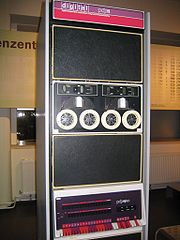
Magnetic tape data storage
Magnetic tape data storage uses digital recording on to magnetic tape to store digital information. Modern magnetic tape is most commonly packaged in cartridges and cassettes. The device that performs actual writing or reading of data is a tape drive...
medium used with many Digital Equipment Corporation
Digital Equipment Corporation
Digital Equipment Corporation was a major American company in the computer industry and a leading vendor of computer systems, software and peripherals from the 1960s to the 1990s...
computer
Computer
A computer is a programmable machine designed to sequentially and automatically carry out a sequence of arithmetic or logical operations. The particular sequence of operations can be changed readily, allowing the computer to solve more than one kind of problem...
s, including the PDP-6
PDP-6
The PDP-6 was a computer model developed by Digital Equipment Corporation in 1963. It was influential primarily as the prototype for the later PDP-10; the instruction sets of the two machines are almost identical.The PDP-6 was DEC's first "big" machine...
, PDP-8
PDP-8
The 12-bit PDP-8 was the first successful commercial minicomputer, produced by Digital Equipment Corporation in the 1960s. DEC introduced it on 22 March 1965, and sold more than 50,000 systems, the most of any computer up to that date. It was the first widely sold computer in the DEC PDP series of...
, LINC-8
LINC-8
LINC-8 was the name of a minicomputer manufactured by Digital Equipment Corporation between 1966 and 1969. It combined a LINC computer with a PDP-8 in one cabinet, thus being able to run programs written for either of the two architectures.-Architecture:...
, PDP-10
PDP-10
The PDP-10 was a mainframe computer family manufactured by Digital Equipment Corporation from the late 1960s on; the name stands for "Programmed Data Processor model 10". The first model was delivered in 1966...
, PDP-11
PDP-11
The PDP-11 was a series of 16-bit minicomputers sold by Digital Equipment Corporation from 1970 into the 1990s, one of a succession of products in the PDP series. The PDP-11 replaced the PDP-8 in many real-time applications, although both product lines lived in parallel for more than 10 years...
, PDP-12, and the PDP-15. On DEC's 32-bit systems, VAX/VMS
OpenVMS
OpenVMS , previously known as VAX-11/VMS, VAX/VMS or VMS, is a computer server operating system that runs on VAX, Alpha and Itanium-based families of computers. Contrary to what its name suggests, OpenVMS is not open source software; however, the source listings are available for purchase...
support for it was implemented but did not become an official part of the product lineup. DECtapes were 3/4 inch wide, and formatted into blocks of data that could each be read or written individually. Each tape stored 184K 12-bit PDP-8 words or 144K 18-bit
18-bit
18 binary digits have unique combinations.-Example 18-bit computer architectures:* Possibly the most well-known 18-bit computer architectures are the PDP-1, PDP-4, PDP-7, PDP-9 and PDP-15 minicomputers produced by Digital Equipment Corporation from 1960 to 1975.* UNIVAC produced a number of...
words. Block size
Block (data storage)
In computing , a block is a sequence of bytes or bits, having a nominal length . Data thus structured are said to be blocked. The process of putting data into blocks is called blocking. Blocking is used to facilitate the handling of the data-stream by the computer program receiving the data...
was 128 12-bit words (for the 12-bit machines), or 256 18-bit words for the other machines (16, 18, 32, or 36 bit systems). From a programming point of view, DECtape behaved like a very slow disk drive.
Origins
DECtape had its origin in the LINCtape tape system, which was originally designed by Wesley ClarkWesley A. Clark
Wesley Allison Clark is a computer scientist and one of the main participants, along with Charles Molnar, in the creation of the LINC laboratory computer, which was the first mini-computer and shares with a number of other computers the claim to be the inspiration for the personal computer.Clark...
at the MIT Lincoln Laboratory
Lincoln Laboratory
MIT Lincoln Laboratory, located in Lexington, Massachusetts, is a United States Department of Defense research and development center chartered to apply advanced technology to problems of national security. Research and development activities focus on long-term technology development as well as...
as an integral part of the LINC
LINC
The LINC was a 12-bit, 2048-word computer. The LINC can be considered the first minicomputer and a forerunner to the personal computer....
computer. The design of the LINC, including LINCtape, was in the public domain, and LINCtape drives were manufactured by several companies, including Digital. DECtape used the same transport mechanism as LINCtape, but the tape was run in the opposite direction, thus the supply and takeup reels were reversed. Mechanical dimensions, speeds, and signal characteristics were identical, and at least one system, the PDP-12 (with the TC12-F option), was capable of using either LINCtape or DECtape on the same transport.
On the PDP-12, the DECtape drives were tightly integrated into the LINC CPU instruction set. There were simple LINC instructions, single instructions, for reading and writing tape blocks.
While LINCtape was designed to support high-speed bidirectional block search, it only supported actual data read and write operations in the forward direction. DECtape used a significantly different mark track format to provide for the possibility of read and write operations in either direction. Some but not all DECtape controllers supported reverse read. This bidirectional data transfer capability is the subject of .
In turn, LINCtape's origin can be found in the magnetic tape system for the historic Lincoln Laboratory TX-2
TX-2
The MIT Lincoln Laboratory TX-2 computer was the successor to the Lincoln TX-0 and was known for its role in advancing both artificial intelligence and human-computer interaction.- Specifications :...
computer. Best and Stockebrand's 1958 paper "A Computer-Integrated Rapid-Access Magnetic Tape System with Fixed Address" is the direct ancestor of LINCtape, including the use of two redundant sets of five tracks and a direct drive tape transport.
Technical details
DECtape was designed to be reliable and durable enough to be used as the main storage medium for a computer's operating systemOperating system
An operating system is a set of programs that manage computer hardware resources and provide common services for application software. The operating system is the most important type of system software in a computer system...
. It was possible, though slow, to use a DECtape drive to run a small OS such as OS/8
OS/8
OS/8 was the primary operating system used on the PDP-8 minicomputer developed by Digital Equipment Corporation of Maynard, Massachusetts. OS/8 was originally called MS/8 and, for a brief time, PS/8 before Digital settled on the name OS/8 in 1971.A virtually identical version of OS/8, called...
or OS/12. The system would be configured to put temporary swap files on a second DECtape drive, so as to not slow down access to the main drive holding the system programs.
Upon its introduction, DECtape was considered a major improvement over hand-loaded paper tapes, which could not be used to support swap files essential for practical timesharing. Early hard disk
Hard disk
A hard disk drive is a non-volatile, random access digital magnetic data storage device. It features rotating rigid platters on a motor-driven spindle within a protective enclosure. Data is magnetically read from and written to the platter by read/write heads that float on a film of air above the...
and drum drives were very expensive, limited in capacity, and notoriously unreliable, so the DECtape was a breakthrough in supporting the first timesharing systems on DEC computers. The legendary PDP-1 at MIT, where early computer hacker culture developed, adopted multiple DECtape drives to support a primitive software sharing community. The hard disk system (when it was working) was considered a "temporary" file storage device used for speed, not to be trusted to hold files for long-term storage. Computer users would keep their own personal work files on DECtapes, as well as software to be shared with others.
The design of DECtape and its controllers was quite different from any other type of tape drive or controller. Physically, DECtape used dual-redundancy to keep the error rate low. Each bit was written twice across the width of the tape, using Manchester encoding (PE)
Manchester code
In telecommunication and data storage, Manchester code is a line code in which the encoding of each data bit has at least one transition and occupies the same time...
. During read, the two read heads for each bit were wired in series, so the resultant output was the sum of the two bit amplitudes. This meant a "drop-out" on one channel could be tolerated; even a hole punched through the tape with a 1/4 inch hole punch would not cause the read to fail. Another reason for DECtape's unusually high reliability was the use of laminated tape: the magnetic oxide was sandwiched between two layers of mylar, rather than being on the surface as was common in other magnetic tape types. This allowed the tape to survive many thousands of passes over the tape heads without wearing away the oxide layer, which would otherwise have occurred in heavy use on timesharing systems.
The fundamental durability and reliability of DECtape was underscored when the design of the tape reel mounting hubs was changed in the early 1970s. A metal hub with a retaining spring was replaced by a lower cost single-piece plastic hub with 6 flexible arms in a "starfish" or "flower" shape. When a defective batch of these new design hubs was shipped on new DECtape drives, these hubs would loosen over time. As a result, DECtape reels would fall off the drives, usually when being spun at full speed, as in an end-to-end seek. The reel of tape would fall onto the floor and roll in a straight line or circle, often unspooling and tangling the tape as it went. In spite of this horrifying spectacle, desperate users would carefully untangle that tape and wind it laboriously back onto the tape reel, then re-install it onto the hub, with a paper shim to hold the reel more tightly. The data on the mangled DECtape could often be recovered completely and copied to another tape, provided that the original tape had only been creased multiple times, and not stretched or broken. DEC quickly issued an Engineering Change Order (ECO) to replace the defective hubs, to resolve the problem.
Eventually, a heavily-used or abused DECtape would start to become unreliable. The operating system was usually programmed to keep retrying a failed read operation, which often would succeed after multiple attempts. Experienced DECtape users learned to notice the characteristic "shoe-shining" motion of a failing DECtape as it was passed repeatedly back and forth over the tape heads, and would retire the tape from further use.
DECtape II
Compact Cassette
The Compact Cassette, often referred to as audio cassette, cassette tape, cassette, or simply tape, is a magnetic tape sound recording format. It was designed originally for dictation, but improvements in fidelity led the Compact Cassette to supplant the Stereo 8-track cartridge and reel-to-reel...
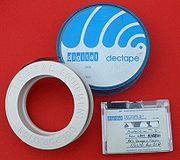
). The tape was packaged in a special, pre-formatted DC150
DC100
The DC100 tape format and drive was developed by Hewlett-Packard and introduced as a data storage mechanism for the HP-9825 programmable calculator. The DC100 tape cartridge was a scaled down version of the DC300 cartridge pioneered by 3M, and represents an early version of what is now referred to...
miniature cartridge consisting of a clear plastic cover mounted on a textured metal base. Cartridge dimensions were 2 3/8" × 3 3/16" × 1/2". The TU58 DECtape II drive had an RS232 serial interface, allowing it to be used with the ordinary serial ports that were very common on Digital's contemporary processors.
Because of its low cost, the TU58 was fitted to several different systems (including the VT103, PDP-11/24 and /44 and the VAX-11/730 and /750) as a DEC-standard device for software product distribution, and for loading diagnostic programs and microcode. The first version of the TU58 imposed very severe timing constraints on the unbuffered UART
Universal asynchronous receiver/transmitter
A universal asynchronous receiver/transmitter, abbreviated UART , is a type of "asynchronous receiver/transmitter", a piece of computer hardware that translates data between parallel and serial forms. UARTs are commonly used in conjunction with communication standards such as EIA RS-232, RS-422 or...
s then being used by Digital, but a later firmware revision eased the flow-control problems. The RT11 single-user operating system could be bootstrapped from a TU58, but the relatively slow access time of the tape drive made use of the system challenging to an impatient user.
Like its predecessor DECtape, and like the faster RX01 floppies used on the VAX-11/780
VAX-11
The VAX-11 was a family of minicomputers developed and manufactured by Digital Equipment Corporation using processors implementing the VAX instruction set architecture . The VAX-11/780 was the first VAX computer.- VAX-11/780 :...
, a DECtape II cartridge had a capacity of about 256 kilobytes.
The TU58 was also used with other computers, such as the Automatix
Automatix
Automatix Inc., founded in January 1980, was the first company to market industrial robots with built-in machine vision. Its founders were Victor Scheinman, inventor of the Stanford arm; Phillippe Villers, Michael Cronin, and Arnold Reinhold of Computervision; Jake Dias and Dan Nigro of Data...
Autovision machine vision
Machine vision
Machine vision is the process of applying a range of technologies and methods to provide imaging-based automatic inspection, process control and robot guidance in industrial applications. While the scope of MV is broad and a comprehensive definition is difficult to distil, a "generally accepted...
system and AI32 robot controller. TU58 driver software is available for modern PCs.
Early production TU58s suffered from some reliability and data interchangeability problems, which were eventually resolved. However, rapid advances in low-cost floppy disk
Floppy disk
A floppy disk is a disk storage medium composed of a disk of thin and flexible magnetic storage medium, sealed in a rectangular plastic carrier lined with fabric that removes dust particles...
technology, which had an inherent speed advantage, soon outflanked the DECtape II and rendered it obsolete.
See also
- Leonard Hantman "MICROTAPE: Its Features and Applications" DECUS Proceedings (November 1963)
- LINC — additional material on LINCtape lineage and operation
External links
- TU56 DECtape Drive Information
- DECtape Documentation at bitsavers.org
- VT103 manual at bitsavers.org. Appendix A describes the TU58 interface protocol.