

Orochi

Encyclopedia
English language
English is a West Germanic language that arose in the Anglo-Saxon kingdoms of England and spread into what was to become south-east Scotland under the influence of the Anglian medieval kingdom of Northumbria...
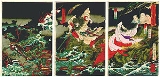
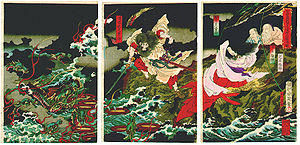
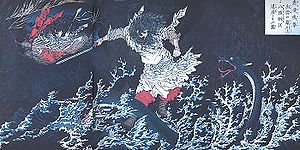
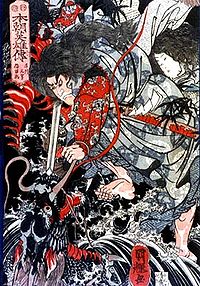
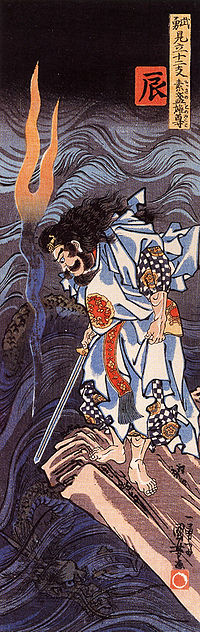
, is a legendary 8-headed and 8-tailed Japanese dragon
Japanese dragon
Japanese dragons are diverse legendary creatures in Japanese mythology and folklore. Japanese dragon myths amalgamate native legends with imported stories about dragons from China, Korea and India. The style of the dragon was heavily influenced by the Chinese dragon...
that was slain by the Shinto
Shinto
or Shintoism, also kami-no-michi, is the indigenous spirituality of Japan and the Japanese people. It is a set of practices, to be carried out diligently, to establish a connection between present day Japan and its ancient past. Shinto practices were first recorded and codified in the written...
storm-god Susanoo
Susanoo
, also known as is the Shinto god of the sea and storms. He is also considered to be ruler of Yomi.-Myths:In Japanese mythology, Susanoo, the powerful storm of Summer, is the brother of Amaterasu, the goddess of the sun, and of Tsukuyomi, the god of the moon. All three were born from Izanagi, when...
.
Mythology
Yamata no Orochi legends are originally recorded in two ancient texts about Japanese mythologyJapanese mythology
Japanese mythology is a system of beliefs that embraces Shinto and Buddhist traditions as well as agriculturally based folk religion. The Shinto pantheon comprises innumerable kami...
and history. The ca. 680 AD Kojiki
Kojiki
is the oldest extant chronicle in Japan, dating from the early 8th century and composed by Ō no Yasumaro at the request of Empress Gemmei. The Kojiki is a collection of myths concerning the origin of the four home islands of Japan, and the Kami...
transcribes this dragon name as 八岐遠呂智 and ca. 720 AD Nihongi writes it as 八岐大蛇. In both versions of the Orochi myth, Susanoo or Susa-no-Ō is expelled from Heaven for tricking his sister Amaterasu
Amaterasu
, or is apart of the Japanese myth cycle and also a major deity of the Shinto religion. She is the goddess of the sun, but also of the universe. the name Amaterasu derived from Amateru meaning "shining in heaven." The meaning of her whole name, Amaterasu-ōmikami, is "the great August kami who...
the sun-goddess.
After expulsion from Heaven, Susanoo encounters two "Earthly Deities" (國神) near the head of the Hi River (簸川) in Izumo Province
Izumo Province
was an old province of Japan which today consists of the eastern part of Shimane Prefecture. It was sometimes called . The province is in the Chūgoku Region.- History :It was one of the regions of ancient Japan where major political powers arose...
. They are weeping because they were forced to give the Orochi one of their daughters every year for seven years, and now they must sacrifice their eighth
Princess and dragon
Princess and dragon is a generic premise common to many legends and fairy tales. It is not a fairy tale itself, but along with Prince Charming, is a repeated cliché...
, Kushi-inada-hime (櫛名田比売 "comb/wondrous rice-field princess", who Susanoo transforms into a kushi 櫛 "comb" for safekeeping). The Kojiki tells the following version.
So, having been expelled, [His-Swift-impetuous-Male-Augustness] descended to a place [called] Tori-kami at the head-waters of the River Hi in the Land of Idzumo. At this time some chopsticks came floating down the stream. So His-Swift-Impetuous-Male-Augustness, thinking that there must be people at the head-waters of the river, went up it in quest of them, when he came upon an old man and an old woman, --two of them,--who had a young girl between them, and were weeping. Then he deigned to ask: "Who are ye?" So the old man replied, saying: "I am an Earthly Deity, child of the Deity Great-Mountain-Possessor. I am called by the name of Foot-Stroking-Elder, my wife is called by the name of Hand-Stroking Elder, and my daughter is called by the name of Wondrous-Inada-Princess." Again he asked: What is the cause of your crying?" [The old man answered] saying: "I had originally eight young girls as daughters. But the eight-forked serpent of Koshi has come every year and devoured [one], and it is now its time to come, wherefore we weep." Then he asked him: "What is its form like?" [The old man] answered, saying: "Its eyes are like akahagachi, it has one body with eight heads and eight tails. Moreover on its body grows moss, and also chamaecyparis and cryptomerias. Its length extends over eight valleys and eight hills, and if one look at its belly, it is all constantly bloody and inflamed." (What is called here akahagachi is the modern hohodzuki [winter-cherry]) Then His-Swift-Impetuous-Male-Augustness said to the old man: "If this be thy daughter, wilt thou offer her to me?" He replied, saying: "With reverence, but I know not thine august name." Then he replied, saying: "I am elder brother to the Heaven-Shining-Great-August-Deity. So I have now descended from Heaven." Then the Deities Foot-Stroker-Elder and Hand-Stroking-Elder said: "If that be so, with reverence will we offer [her to thee]." So His-Swift-Impetuous-Male-Augustness, at once taking and changing the young girl into a multitudinous and close-toothed comb which he stuck into his august hair-bunch, said to the Deities Foot-Stroking-Elder and Hand-Stroking-Elder: "Do you distill some eight-fold refined liquor. Also make a fence round about, in that fence make eight gates, at each gate tie [together] eight platforms, on each platform put a liquor-vat, and into each vat pour the eight-fold refined liquor, and wait." So as they waited after having thus prepared everything in accordance with his bidding, the eight-forked serpent came truly as [the old man] had said, and immediately dipped a head into each vat, and drank the liquor. Thereupon it was intoxicated with drinking, and all [the heads] lay down and slept. Then His-Swift-Impetuous-Male-Augustness drew the ten-grasp sabre, that was augustly girded on him, and cut the serpent in pieces, so that the River Hi flowed on changed into a river of blood. So when he cut the middle tail, the edge of his august sword broke. Then, thinking it strange, he thrust into and split [the flesh] with the point of his august sword and looked, and there was a great sword [within]. So he took this great sword, and, thinking it a strange thing, he respectfully informed the Heaven-Shining-Great-August-Deity. This is the Herb-Quelling Great Sword. (tr. Chamberlain 1919:71-3)
Compare the Nihongi description of the Yamata no Orochi (tr. Aston 1896:1:52-53). "It had an eight-forked head and an eight-forked tail; its eyes were red, like the winter-cherry; and on its back firs and cypresses were growing. As it crawled it extended over a space of eight hills and eight valleys." These botanical names used to describe this Orochi are akahagachi or hoozuki ("winter cherry or Japanese lantern, Physalis alkekengi
Physalis alkekengi
Physalis alkekengi , is a relative of P. peruviana , easily identifiable by the larger, bright orange to red papery covering over its fruit, which resemble Chinese lanterns. It is native from southern Europe east across southern Asia to Japan...
"), hikage ("club moss, Lycopodiopsida
Lycopodiopsida
Lycopodiopsida is a class of plants often loosely grouped as the fern allies. Traditionally the group included not only the clubmosses and firmosses, but also the spikemosses and the quillworts...
), hinoki ("Japanese cypress, Chamaecyparis obtusa
Chamaecyparis obtusa
Chamaecyparis obtusa is a species of cypress native to central Japan.It is a slow-growing tree which grows to 35 m tall with a trunk up to 1 m in diameter. The bark is dark red-brown...
), and sugi ("Japanese cedar, Cryptomeria
Cryptomeria
Cryptomeria is a monotypic genus of conifer in the cypress family Cupressaceae formerly belonging to the family Taxodiaceae; it includes only one species, Cryptomeria japonica . It is endemic to Japan, where it is known as Sugi...
").
This legendary sword Kusanagi-no-Tsurugi
Kusanagi
is a legendary Japanese sword and one of three Imperial Regalia of Japan. It was originally called but its name was later changed to the more popular Kusanagi-no-Tsurugi .-Legends:...
, along with the Yata no Kagami
Yata no kagami
is a sacred mirror that is part of the Imperial Regalia of Japan. It is said to be housed in Ise Shrine in Mie prefecture, Japan, although a lack of public access makes this difficult to verify. The Yata no Kagami represents "wisdom" or "honesty," depending on the source. Its name literally means...
mirror and Yasakani no Magatama jewel or orb, are the three sacred Imperial Regalia of Japan
Imperial Regalia of Japan
The , also known as the Three Sacred Treasures of Japan, consist of the sword Kusanagi , the mirror Yata no Kagami , and the jewel Yasakani no Magatama...
.
Etymology
The JapaneseJapanese language
is a language spoken by over 130 million people in Japan and in Japanese emigrant communities. It is a member of the Japonic language family, which has a number of proposed relationships with other languages, none of which has gained wide acceptance among historical linguists .Japanese is an...
name orochi 大蛇 derives from Old Japanese
Old Japanese
is the oldest attested stage of the Japanese language.This stage in the development of Japanese is still actively studied and debated, and key Old Japanese texts, such as the Man'yōshū, remain obscure in places.-Dating:...
woröti (with a regular o- from wo- shift, Miller 1971:25-7), but its etymology
Etymology
Etymology is the study of the history of words, their origins, and how their form and meaning have changed over time.For languages with a long written history, etymologists make use of texts in these languages and texts about the languages to gather knowledge about how words were used during...
is enigmatic. Besides this ancient orochi reading, the kanji 大蛇 are commonly pronounced daija "big snake; large serpent".
Carr (1990:169) notes that Japanese scholars have proposed "more than a dozen" orochi < woröti etymologies, while Western linguists have suggested loanwords from Austronesian
Austronesian languages
The Austronesian languages are a language family widely dispersed throughout the islands of Southeast Asia and the Pacific, with a few members spoken on continental Asia that are spoken by about 386 million people. It is on par with Indo-European, Niger-Congo, Afroasiatic and Uralic as one of the...
, Tungusic
Tungusic languages
The Tungusic languages form a language family spoken in Eastern Siberia and Manchuria by Tungusic peoples. Many Tungusic languages are endangered, and the long-term future of the family is uncertain...
, and Indo-European languages
Indo-European languages
The Indo-European languages are a family of several hundred related languages and dialects, including most major current languages of Europe, the Iranian plateau, and South Asia and also historically predominant in Anatolia...
. The most feasible native etymological proposals are Japanese o- from o 尾 "tail" (which is where Susanoo discovered the sacred sword), ō 大 "big; great", or oro 峰 "peak; summit"; and -chi meaning "god; spirit", cognate with the mizuchi
Mizuchi
was a Japanese dragon and water deity.The name mizuchi is written with several Japanese kanji, usually the Chinese characters for jiao 蛟 "4-legged dragon" and qiu 虬 or 虯 "hornless dragon"...
river-dragon. Benedict (1985:167) originally proposed woröti "large snake" was suffixed from Proto-Austro-Japanese *(w)oröt-i acquired from Austronesian *[q]uḷəj "snake; worm"; which he later (1990:243) modified to *(u-)orot-i from *[q,ʔ]oḷəj. Miller (1987:647) criticized Benedict for overlooking Old Japanese "worö 'tail' + suffix -ti — as well as an obvious Tungus etymology, [Proto-Tungus] *xürgü-či 'the tailed one'", and notes "this apparently well-traveled orochi has now turned up in the speculation of the [Indo-European] folklorists (Littleton 1981)." Littleton's hypothesis involves the 3-headed monster Trisiras
Trisiras
Trisiras is the three-headed son of Tvashta in Hinduism. He was created by Tvashta to dethrone Indra. With one head, he ate; with another head, he observed his surroundings; with his last head, he read the Vedas. He grew so powerful that Indra became frightened of him, especially after Trisiras...
or Viśvarūpa, which has a mythological parallel because Indra
Indra
' or is the King of the demi-gods or Devas and Lord of Heaven or Svargaloka in Hindu mythology. He is also the God of War, Storms, and Rainfall.Indra is one of the chief deities in the Rigveda...
killed it after giving it soma
Soma
Soma , or Haoma , from Proto-Indo-Iranian *sauma-, was a ritual drink of importance among the early Indo-Iranians, and the subsequent Vedic and greater Persian cultures. It is frequently mentioned in the Rigveda, whose Soma Mandala contains 114 hymns, many praising its energizing qualities...
, wine, and food, but lacks a phonological connection.
Mythological parallels
Polycephalic or multi-headed animals are rare in biology but common in mythologyMythology
The term mythology can refer either to the study of myths, or to a body or collection of myths. As examples, comparative mythology is the study of connections between myths from different cultures, whereas Greek mythology is the body of myths from ancient Greece...
and heraldry
Heraldry
Heraldry is the profession, study, or art of creating, granting, and blazoning arms and ruling on questions of rank or protocol, as exercised by an officer of arms. Heraldry comes from Anglo-Norman herald, from the Germanic compound harja-waldaz, "army commander"...
. Multi-headed dragons, like the 8-headed Orochi and 3-headed Trisiras above, are a common motif in comparative mythology
Comparative mythology
Comparative mythology is the comparison of myths from different cultures in an attempt to identify shared themes and characteristics. Comparative mythology has served a variety of academic purposes...
. For instance, multi-headed dragons in Greek mythology
Dragons in Greek mythology
-Ladon:Ladon was the serpent-like dragon that twined round the tree in the Garden of the Hesperides and guarded the golden apples. Ladon was also said to have as many as one hundred heads. He was overcome and possibly slain by Heracles...
include the wind-god Typhon
Typhon
Typhon , also Typhoeus , Typhaon or Typhos was the last son of Gaia, fathered by Tartarus, and the most deadly monster of Greek mythology. He was known as the "Father of all monsters"; his wife Echidna was likewise the "Mother of All Monsters."Typhon was described in pseudo-Apollodorus,...
who had several polycephalic offspring, including the 9-headed Lernaean Hydra
Lernaean Hydra
In Greek mythology, the Lernaean Hydra was an ancient nameless serpent-like chthonic water beast, with reptilian traits, that possessed many heads — the poets mention more heads than the vase-painters could paint, and for each head cut off it grew two more — and poisonous breath so virulent even...
and the 100-headed Ladon
Ladon (mythology)
Ladon was the serpent-like dragon that twined and twisted around the tree in the Garden of the Hesperides and guarded the golden apples. He was overcome by Heracles...
, both slain by Hercules
Hercules
Hercules is the Roman name for Greek demigod Heracles, son of Zeus , and the mortal Alcmene...
.
Two other Japanese examples derive from Buddhist importations of Indian dragon myths. Benzaiten
Benzaiten
Benzaiten is the Japanese name for the Hindu goddess Saraswati. Worship of Benzaiten arrived in Japan during the 6th through 8th centuries, mainly via the Chinese translations of the Sutra of Golden Light, which has a section devoted to her...
, the Japanese name of Saraswati
Saraswati
In Hinduism Saraswati , is the goddess of knowledge, music, arts, science and technology. She is the consort of Brahma, also revered as His Shakti....
, supposedly killed a 5-headed dragon at Enoshima
Enoshima
is a small island, about 4 km in circumference, at the mouth of the Katase River, which flows into Sagami Bay in Japan. Part of the city of Fujisawa, it is linked to the Katase section of the same city on the mainland by a 600 meter-long bridge...
in 552 AD. Kuzuryū
Kuzuryu
, or is a deity that appears in folklore and legends of various parts of Japan, including, for example, Hakone , Nagano Prefecture and Fukui Prefecture. In many cases, the Kuzuryū is associated with water.-Hakone Kuzuryū legend:...
九頭龍 "9-headed dragon", deriving from the Nagaraja
Nagaraja
Nagaraja is a Sanskrit word from naga and raj meaning King of Snakes. It is applied to three main deities, Anantha , Takshak, and Vasuki. Anantha, Vasuki and Takshak are brothers, children of Kashyap and Kadru, who are the parents of all snakes...
snake-kings Vasuki
Vasuki
Vasuki is a Sanskrit name for a naga, one of the serpents of Buddhist and Hindu mythology. He is a great King of the nagas and has a gem on his head. Manasa, another naga, is his sister...
and Shesha
Shesha
In Hindu tradition, Shesha or Sheshanaag is the king of all nagas, one of the primal beings of creation, and according to the Bhagavata Purana, an Avatar of the Supreme God known as Sankarshan. In the Puranas, Shesha is said to hold all the planets of the Universe on his hoods and to constantly...
, is worshipped at Togakushi Shrine
Togakushi Shrine
The is a Shinto shrine in Togakushi, Nagano Prefecture, Japan. The shrine is located within the Jōshin'etsu Kōgen National Park. There are actually three shrines, known as the lower, middle, and upper shrine , each about 2 km apart...
in Nagano Prefecture
Nagano Prefecture
is a prefecture of Japan located in the Chūbu region of the island of Honshū. The capital is the city of Nagano.- History :Nagano was formerly known as the province of Shinano...
. (Compare the Jiutouniao 九頭鳥 "nine-headed bird" in Chinese mythology
Chinese mythology
Chinese mythology is a collection of cultural history, folktales, and religions that have been passed down in oral or written tradition. These include creation myths and legends and myths concerning the founding of Chinese culture and the Chinese state...
.)
Comparing folklore about polycephalic dragons and serpents, 8-headed creatures are less common than 7- or 9-headed ones. Among Japanese numerals
Japanese numerals
The system of Japanese numerals is the system of number names used in the Japanese language. The Japanese numerals in writing are entirely based on the Chinese numerals and the grouping of large numbers follow the Chinese tradition of grouping by 10,000...
, ya or hachi 八 can mean "many; varied" (e.g., yaoya 八百屋 [lit. "800 store"] "greengrocer; jack-of-all-trades"). De Visser (1913:150) says the number 8 is "stereotypical" in legends about kings or gods riding dragons or having their carriages drawn by them. Smith (1919:212), who quotes the orochi myth with "seven or eight heads" and compares a Celtic dragon, says, "The seven-headed dragon is found also in the Scottish dragon-myth, and the legends of Cambodia, India, Persia, Western Asia, East Africa, and the Mediterranean area." Smith (1919:215) identifies the mythic 7- or 8-headed dragons with the 7-spiked Pteria spider shell or 8-tentacled octopus.
The myth of a Storm God fighting a Sea Serpent
Sea serpent
A sea serpent or sea dragon is a type of sea monster either wholly or partly serpentine.Sightings of sea serpents have been reported for hundreds of years, and continue to be claimed today. Cryptozoologist Bruce Champagne identified more than 1,200 purported sea serpent sightings...
is itself a popular mythic trope
Trope (literature)
A literary trope is the usage of figurative language in literature, or a figure of speech in which words are used in a sense different from their literal meaning...
potentially originating with the Proto-Indo-European religion
Proto-Indo-European religion
Proto-Indo-European religion is the hypothesized religion of the Proto-Indo-European peoples based on the existence of similarities among the deities, religious practices and mythologies of the Indo-European peoples. Reconstruction of the hypotheses below is based on linguistic evidence using the...
and later transmitted into the religions of the Ancient Near East
Religions of the Ancient Near East
The religions of the ancient Near East were mostly polytheistic, with some early examples of primitive monolatry , Ashurism and Monism...
most likely initially through interaction with Hittite
Hittite language
Hittite is the extinct language once spoken by the Hittites, a people who created an empire centred on Hattusa in north-central Anatolia...
speaking peoples into Syria
Syria
Syria , officially the Syrian Arab Republic , is a country in Western Asia, bordering Lebanon and the Mediterranean Sea to the West, Turkey to the north, Iraq to the east, Jordan to the south, and Israel to the southwest....
and the Fertile Crescent
Fertile Crescent
The Fertile Crescent, nicknamed "The Cradle of Civilization" for the fact the first civilizations started there, is a crescent-shaped region containing the comparatively moist and fertile land of otherwise arid and semi-arid Western Asia. The term was first used by University of Chicago...
. This motif, known as chaoskampf (German for "struggle against chaos") represents the clash between order and chaos. Often as these myths evolve from their original source, the role of the storm god (himself often the head of a pantheon) is adopted by culture heroes or a personage symbolizing royalty. A non-inclusive list of mythological parallels to the story of Susanoo vs. Orochi include:
Indo-European
Indo-European
Indo-European may refer to:* Indo-European languages** Aryan race, a 19th century and early 20th century term for those peoples who are the native speakers of Indo-European languages...
- ThorThorIn Norse mythology, Thor is a hammer-wielding god associated with thunder, lightning, storms, oak trees, strength, the protection of mankind, and also hallowing, healing, and fertility...
vs. JörmungandrJörmungandrIn Norse mythology, Jörmungandr , mostly known as Jormungand, orJörmungand , or Midgard Serpent , or World Serpent, is a sea serpent, and the middle child of the giantess Angrboða and the god Loki...
(NorseNorse mythologyNorse mythology, a subset of Germanic mythology, is the overall term for the myths, legends and beliefs about supernatural beings of Norse pagans. It flourished prior to the Christianization of Scandinavia, during the Early Middle Ages, and passed into Nordic folklore, with some aspects surviving...
) - Tarhunt vs. IlluyankaIlluyankaIn Hittite mythology, Illuyanka was a serpentine dragon slain by Tarhunt , the Hittite incarnation of the Hurrian god of sky and storm. It is known from Hittite cuneiform tablets found at Çorum-Boğazköy, the former Hittite capital Hattusa...
(HittiteHittite mythologyMost of the narratives embodying Hittite mythology are lost, and the elements that would give a balanced view of Hittite religion are lacking among the tablets recovered at the Hittite capital Hattusa and other Hittite sites: "there are no canonical scriptures, no theological disquisitions or...
) - ZeusZeusIn the ancient Greek religion, Zeus was the "Father of Gods and men" who ruled the Olympians of Mount Olympus as a father ruled the family. He was the god of sky and thunder in Greek mythology. His Roman counterpart is Jupiter and his Etruscan counterpart is Tinia.Zeus was the child of Cronus...
vs. TyphonTyphonTyphon , also Typhoeus , Typhaon or Typhos was the last son of Gaia, fathered by Tartarus, and the most deadly monster of Greek mythology. He was known as the "Father of all monsters"; his wife Echidna was likewise the "Mother of All Monsters."Typhon was described in pseudo-Apollodorus,...
(GreekGreek mythologyGreek mythology is the body of myths and legends belonging to the ancient Greeks, concerning their gods and heroes, the nature of the world, and the origins and significance of their own cult and ritual practices. They were a part of religion in ancient Greece...
)- HerculesHerculesHercules is the Roman name for Greek demigod Heracles, son of Zeus , and the mortal Alcmene...
vs. The Lernaean HydraLernaean HydraIn Greek mythology, the Lernaean Hydra was an ancient nameless serpent-like chthonic water beast, with reptilian traits, that possessed many heads — the poets mention more heads than the vase-painters could paint, and for each head cut off it grew two more — and poisonous breath so virulent even...
(GreekGreek mythologyGreek mythology is the body of myths and legends belonging to the ancient Greeks, concerning their gods and heroes, the nature of the world, and the origins and significance of their own cult and ritual practices. They were a part of religion in ancient Greece...
)
- Hercules
- IndraIndra' or is the King of the demi-gods or Devas and Lord of Heaven or Svargaloka in Hindu mythology. He is also the God of War, Storms, and Rainfall.Indra is one of the chief deities in the Rigveda...
vs. VritraVritraIn the early Vedic religion, Vritra , is an Asura and also a serpent or dragon, the personification of drought and enemy of Indra. Vritra was also known in the Vedas as Ahi...
(VedicVedic mythologyVedic mythology refers to the mythological aspects of the historical Vedic religion and Vedic literature, most notably alluded to in the hymns of the Rigveda...
)- KrishnaKrishnaKrishna is a central figure of Hinduism and is traditionally attributed the authorship of the Bhagavad Gita. He is the supreme Being and considered in some monotheistic traditions as an Avatar of Vishnu...
vs. KāliyāKaliyaKaliya , in Hindu mythology, was the name of a poisonous Naga living in the Yamuna River, in Vrindavan. The water of the Yamuna for four leagues all around him boiled and bubbled with poison...
(IndianIndian mythologyIndian mythology may refer to:*Indian epic poetry*Vedic mythology*Hindu mythology*Buddhist mythology*Native American mythology...
)
- Krishna
- ΘraētaonaFereydunFereydūn also pronounced Farīdūn or Afrīdūn , also called Apam Napat, "Son of the Waters", is the name of an Iranian mythical king and hero who is an emblem of victory, justice and generosity in the Persian literature.-Etymology:All of the forms of...
vs. Aži DahākaZahhakZahhāk or Zohhāk is an evil figure in Iranian mythology, evident in ancient Iranian folklore as Aži Dahāka, the name by which he also appears in the texts of the Avesta...
(Zorastrian)- GarshaspGarshaspGarshāsp is the name of a monster-slaying hero in Iranian mythology. The Avestan form of his name is Kərəsāspa and in Middle Persian his name is Kirsāsp.-Kərəsāspa / Kirsāsp in Zoroastrian literature:...
vs. ZahhakZahhakZahhāk or Zohhāk is an evil figure in Iranian mythology, evident in ancient Iranian folklore as Aži Dahāka, the name by which he also appears in the texts of the Avesta...
(IranianIranian mythologyIranian mythologies include:*Persian mythology*Scythian mythology*Ossetic mythology...
)
- Garshasp
- Dobrynya NikitichDobrynya NikitichDobrynya Nikitich is one of the most popular bogatyrs after Ilya Murometz from the Kievan Rus era. Many byliny center on Dobrynya completing tasks set him by the prince. Dobrynya is often portrayed as being close to the royal family, undertaking sensitive and diplomatic missions.As a courtier,...
vs. Zmey GorynychSlavic dragonIn Slavic mythology, the word “zmey” and its cognates zmiy and zmaj , are used to describe a dragon. These words are masculine forms of the Slavic word for "snake", which are normally feminine . In Romania, there is a similar figure, derived from the Slavic dragon and named zmeu...
(SlavicSlavic mythologySlavic mythology is the mythological aspect of the polytheistic religion that was practised by the Slavs before Christianisation.The religion possesses many common traits with other religions descended from the Proto-Indo-European religion....
)- Saint GeorgeSaint George and the DragonThe episode of Saint George and the Dragon appended to the hagiography of Saint George was Eastern in origin, brought back with the Crusaders and retold with the courtly appurtenances belonging to the genre of Romance...
vs. The DragonSaint George and the DragonThe episode of Saint George and the Dragon appended to the hagiography of Saint George was Eastern in origin, brought back with the Crusaders and retold with the courtly appurtenances belonging to the genre of Romance...
(ChristianChristian mythologyChristian mythology is the body of myths associated with Christianity. In the study of mythology, the term "myth" refers to a traditional story, often one which is regarded as sacred and which explains how the world and its inhabitants came to have their present form.Classicist G.S. Kirk defines a...
)
- Saint George
- Făt-FrumosFat-FrumosFăt-Frumos is a knight hero in Romanian folklore, usually present in fairy tales....
vs. BalaurBalaurA balaur is a creature in Romanian folklore, similar to a European dragon. A bălaur is quite large, has fins, feet, and is polycephalous...
(Romanian)
Afro-Asiatic
- BaʿalBaʿalBaʿal is a Northwest Semitic title and honorific meaning "master" or "lord" that is used for various gods who were patrons of cities in the Levant and Asia Minor, cognate to Akkadian Bēlu...
vs. YamYam (god)Yam, from the Canaanite word Yam, meaning "Sea", also written "Yaw", is one name of the Ugaritic god of Rivers and Sea. Also titled Judge Nahar , he is also one of the 'ilhm or sons of El, the name given to the Levantine pantheon...
(CanaaniteCanaanite religionCanaanite religion is the name for the group of Ancient Semitic religions practiced by the Canaanites living in the ancient Levant from at least the early Bronze Age through the first centuries of the Common Era....
) - MardukMardukMarduk was the Babylonian name of a late-generation god from ancient Mesopotamia and patron deity of the city of Babylon, who, when Babylon became the political center of the Euphrates valley in the time of Hammurabi , started to...
vs. TiamatTiamatIn Babylonian mythology, Tiamat is a chaos monster, a primordial goddess of the ocean, mating with Abzû to produce younger gods. It is suggested that there are two parts to the Tiamat mythos, the first in which Tiamat is 'creatrix', through a "Sacred marriage" between salt and fresh water,...
(Babylonian) - AtumAtumAtum, sometimes rendered as Atem or Tem, is an important deity in Egyptian mythology.- Name :Atum's name is thought to be derived from the word 'tem' which means to complete or finish. Thus he has been interpreted as being the 'complete one' and also the finisher of the world, which he returns to...
vs. NehebkauNehebkauIn Egyptian mythology, Nehebkau was originally the explanation of the cause of binding of Ka and Ba after death. Thus his name, which means brings together Ka...
(EgyptianEgyptian mythologyAncient Egyptian religion was a complex system of polytheistic beliefs and rituals which were an integral part of ancient Egyptian society. It centered on the Egyptians' interaction with a multitude of deities who were believed to be present in, and in control of, the forces and elements of nature...
)- RaRaRa is the ancient Egyptian sun god. By the Fifth Dynasty he had become a major deity in ancient Egyptian religion, identified primarily with the mid-day sun...
vs. ApepApepIn Egyptian mythology, Apep was an evil god, the deification of darkness and chaos , and thus opponent of light and Ma'at , whose existence was believed from the 8th Dynasty onwards...
(EgyptianEgyptian mythologyAncient Egyptian religion was a complex system of polytheistic beliefs and rituals which were an integral part of ancient Egyptian society. It centered on the Egyptians' interaction with a multitude of deities who were believed to be present in, and in control of, the forces and elements of nature...
)
- Ra
- YahwehYahwehYahweh is the name of God in the Bible, the God of Abraham, Isaac, Jacob, Jews and Christians.The word Yahweh is a modern scholarly convention for the Hebrew , transcribed into Roman letters as YHWH and known as the Tetragrammaton, for which the original pronunciation is unknown...
vs. LeviathanLeviathanLeviathan , is a sea monster referred to in the Bible. In Demonology, Leviathan is one of the seven princes of Hell and its gatekeeper . The word has become synonymous with any large sea monster or creature...
(JewishJewish mythologyJewish mythology is generally the sacred and traditional narratives that help explain and symbolize the Jewish religion, whereas Jewish folklore consists of the folk tales and legends that existed in the general Jewish culture. There is very little early folklore distinct from the aggadah literature...
)- GabrielGabrielIn Abrahamic religions, Gabriel is an Archangel who typically serves as a messenger to humans from God.He first appears in the Book of Daniel, delivering explanations of Daniel's visions. In the Gospel of Luke Gabriel foretells the births of both John the Baptist and of Jesus...
vs. Rahab (JewishJewish mythologyJewish mythology is generally the sacred and traditional narratives that help explain and symbolize the Jewish religion, whereas Jewish folklore consists of the folk tales and legends that existed in the general Jewish culture. There is very little early folklore distinct from the aggadah literature...
)- ChristChristChrist is the English term for the Greek meaning "the anointed one". It is a translation of the Hebrew , usually transliterated into English as Messiah or Mashiach...
vs. SatanSatanSatan , "the opposer", is the title of various entities, both human and divine, who challenge the faith of humans in the Hebrew Bible...
(ChristianChristian mythologyChristian mythology is the body of myths associated with Christianity. In the study of mythology, the term "myth" refers to a traditional story, often one which is regarded as sacred and which explains how the world and its inhabitants came to have their present form.Classicist G.S. Kirk defines a...
)
- Christ
- Gabriel
In many of these examples, the serpent god is often seen as multi-headed or multi-tailed.
In popular culture
- Orochi appears in the 1959 Japanese film The Three Treasures. This is one of the first depictions to give Orochi a variety of elemental powers, mostly associated with individual heads.
- Orochi appears in the 1963 animated film The Little Prince and the Eight-Headed DragonWanpaku Ouji no Orochi Taijiis a Japanese traditional animation fantasy adventure feature film, the 6th feature produced by Tōei Animation , released in Japan on March 24, 1963...
- In the 2001 film Godzilla, Mothra and King Ghidorah: Giant Monsters All-Out AttackGodzilla, Mothra and King Ghidorah: Giant Monsters All-Out Attackis a 2001 science fiction kaiju film co-written and directed by Shūsuke Kaneko with a very catchy name. It was the twenty-fifth film to be released in the Godzilla film series. This is the eleventh film to feature Mothra, sixth to feature King Ghidorah, and third to feature Baragon. It is part of...
, King Ghidorah, the archnemesis of GodzillaGodzillais a daikaijū, a Japanese movie monster, first appearing in Ishirō Honda's 1954 film Godzilla. Since then, Godzilla has gone on to become a worldwide pop culture icon starring in 28 films produced by Toho Co., Ltd. The monster has appeared in numerous other media incarnations including video games,...
, is alluded to being an immature Orochi. - The character Ryu in the Manga series Shaman KingShaman Kingis a Japanese manga series written and illustrated by Hiroyuki Takei. Shaman King follows the adventures of Yoh Asakura as he attempts to hone his shaman skills to become the Shaman King in the Shaman tournament....
harnessed the power of Yamata no Orochi through his guardian ghost Tokagero, several times throughout the series. - Orochi is also referenced in the Naruto and Naruto: Shippuden series as one of the series' main antagonists, Orochimaru. As his techniques usually involve snakes. Also, Orochimaru was eventually defeated by a technique called Susanoo, influenced by the story of Yamata no Orochi's death by the hands of Susanoo
- Orochi figures prominently into the story of the 2011 anime movie Legend of the Millenium Dragon.
- In the video game Okami, Orochi is the main villain in the first section of the game, and a major villain in the second and third sections. In this game, however, he is defeated by the sun goddess AmaterasuAmaterasu, or is apart of the Japanese myth cycle and also a major deity of the Shinto religion. She is the goddess of the sun, but also of the universe. the name Amaterasu derived from Amateru meaning "shining in heaven." The meaning of her whole name, Amaterasu-ōmikami, is "the great August kami who...
, who takes the form of a white wolf, and Susano.
External links
- Yamata-no-orochi, Encyclopedia of Shinto
- Hyakkai Ryūran: Yamata-No-Orochi