

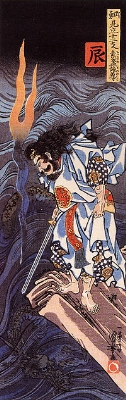
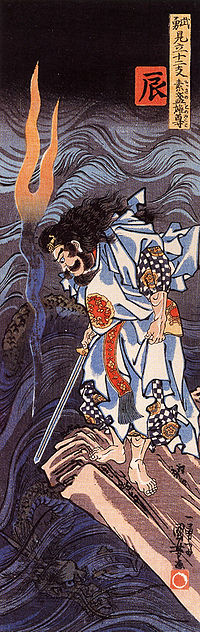
Susanoo

Encyclopedia
Shinto
or Shintoism, also kami-no-michi, is the indigenous spirituality of Japan and the Japanese people. It is a set of practices, to be carried out diligently, to establish a connection between present day Japan and its ancient past. Shinto practices were first recorded and codified in the written...
god
God
God is the English name given to a singular being in theistic and deistic religions who is either the sole deity in monotheism, or a single deity in polytheism....
of the sea
Sea
A sea generally refers to a large body of salt water, but the term is used in other contexts as well. Most commonly, it means a large expanse of saline water connected with an ocean, and is commonly used as a synonym for ocean...
and storms. He is also considered to be ruler of Yomi
Yomi
, the Japanese word for the underworld in which horrible creatures guard the exits; according to Shinto mythology as related in Kojiki, this is where the dead go to dwell and apparently rot indefinitely. Once one has eaten at the hearth of Yomi it is impossible to return to the land of the living...
.
Myths
In Japanese mythologyJapanese mythology
Japanese mythology is a system of beliefs that embraces Shinto and Buddhist traditions as well as agriculturally based folk religion. The Shinto pantheon comprises innumerable kami...
, Susanoo, the powerful storm of Summer, is the brother of Amaterasu
Amaterasu
, or is apart of the Japanese myth cycle and also a major deity of the Shinto religion. She is the goddess of the sun, but also of the universe. the name Amaterasu derived from Amateru meaning "shining in heaven." The meaning of her whole name, Amaterasu-ōmikami, is "the great August kami who...
, the goddess of the sun
Sun
The Sun is the star at the center of the Solar System. It is almost perfectly spherical and consists of hot plasma interwoven with magnetic fields...
, and of Tsukuyomi, the god of the moon
Moon
The Moon is Earth's only known natural satellite,There are a number of near-Earth asteroids including 3753 Cruithne that are co-orbital with Earth: their orbits bring them close to Earth for periods of time but then alter in the long term . These are quasi-satellites and not true moons. For more...
. All three were born from Izanagi
Izanagi
is a deity born of the seven divine generations in Japanese mythology and Shinto, and is also referred to in the roughly translated Kojiki as "male-who-invites" or Izanagi-no-mikoto. It is also pronounced Izanaki-no-Okami....
, when he washed his face clean of the pollutants of Yomi
Yomi
, the Japanese word for the underworld in which horrible creatures guard the exits; according to Shinto mythology as related in Kojiki, this is where the dead go to dwell and apparently rot indefinitely. Once one has eaten at the hearth of Yomi it is impossible to return to the land of the living...
, the underworld. Amaterasu was born when Izanagi washed out his left eye, Tsukuyomi was born
Born
Born may refer to:* Childbirth* Born , a limited series comic book featuring the Punisher* Born Feinkost GmbH, a German food company* Born , a lunar crater-Places:* Born, Netherlands, a town in the Netherlands...
from the washing of the right eye, and Susanoo from the washing of the nose.
The oldest sources for Susanoo myths are the ca. 680 AD Kojiki
Kojiki
is the oldest extant chronicle in Japan, dating from the early 8th century and composed by Ō no Yasumaro at the request of Empress Gemmei. The Kojiki is a collection of myths concerning the origin of the four home islands of Japan, and the Kami...
and ca. 720 AD Nihon Shoki
Nihon Shoki
The , sometimes translated as The Chronicles of Japan, is the second oldest book of classical Japanese history. It is more elaborate and detailed than the Kojiki, the oldest, and has proven to be an important tool for historians and archaeologists as it includes the most complete extant historical...
. They tell of a long-standing rivalry between Susanoo and his sister. When he was to leave Heaven
Heaven
Heaven, the Heavens or Seven Heavens, is a common religious cosmological or metaphysical term for the physical or transcendent place from which heavenly beings originate, are enthroned or inhabit...
by orders of Izanagi, he went to bid his sister goodbye. Amaterasu was suspicious, but when Susanoo proposed a challenge to prove his sincerity, she accepted. Each of them took an object of the other's and from it birthed gods and goddesses. Amaterasu birthed three women from Susanoo's sword while he birthed five men from her necklace. Claiming the gods were hers because they were born of her necklace, and the goddesses were his, he decided that he has won the challenge, as his item produced women. The two were content for a time, but Susanoo, the Storm God, became restless and went on a rampage destroying his sister's rice fields, hurled a flayed pony at her loom, and killed one of her attendants in a fit of rage. Amaterasu, who was in fury and grief, hid inside the Ama-no-Iwato ("heavenly rock cave"), thus effectively hiding the sun for a long period of time.
Though she was persuaded to leave the cave, Susanoo was punished by being banished from Heaven. He descended to the province of Izumo
Izumo Province
was an old province of Japan which today consists of the eastern part of Shimane Prefecture. It was sometimes called . The province is in the Chūgoku Region.- History :It was one of the regions of ancient Japan where major political powers arose...
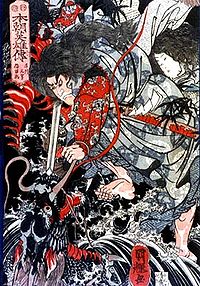
, where he met an elderly couple who told him that seven of their eight daughters had been devoured by the eight-headed serpent Yamata no Orochi and it was nearing time for their eighth, . The Nihon Shoki gives the most detailed account of Susanoo slaying the Yamata no Orochi. Compare the Kojiki version where Chamberlain (1919:71-3) translates Susanoo as "His-Swift-Impetuous-Male-Augustness."
Then [His-Swift-Impetuous-Male-Augustness] descended from Heaven and proceeded to the head-waters of the River Hi, in the province of Izumo. At this time he heard a sound of weeping at the head-waters of the river, and he went in search of the sound. He found there an old man and an old woman. Between them was set [sic] a young girl, whom they were caressing and lamenting over. Sosa no wo no Mikoto asked them, saying: "Who are ye and why do ye grieve lament thus?" The answer was: "I am an Earthly Deity, and my name is Ashi-nadzuchi. My wife's name is Te-nadzuchi. This girl is our daughter, and her name is Kushinada-hime. The reason of our weeping is that formerly we had eight children, daughters. But they have been devoured year after year by an eight-forked serpent and now the time approaches for this girl to be devoured. There is no means of escape for her, and therefore do we grieve.” His-Swift-Impetuous-Male-Augustness said: "If that is so, wilt thou give me thy daughter?" He replied, and said: "I will comply with thy behest and give her to thee." Therefore His Swift-Impetuous-Male-Augustness on the spot changed Kushinada-hime into a many-toothed close-comb which he stuck in the august knot of his hair. Then he made Ashi-nadzuchi and Te-nadzuchi to brew eight-fold sake, to make eight cupboards, in each of them to set a tub filled with sake, and so to await the arrival its coming. When the time came, the serpent actually appeared. It had an eight-forked head and an eight-forked tail; its eyes were red, like the winter-cherry; and on its back firs and cypresses were growing. As it crawled it extended over a space of eight hills and eight valleys. Now when it came and found the sake, each head drank up one tub, and it became drunk and fell asleep. Then Sosa no wo no Mikoto drew the ten-span sword which he wore and chopped the serpent into small pieces. When he came to the tail, the edge of his sword was slightly notched, and he therefore split open the tail and examined it. In the inside there was a sword. This is the sword which is called Kusa-nagi no tsurugi. (tr. Aston 1896:1:52-53)
This sword from the dragon's tail, the Ama-no-Murakumo-no-Tsurugi ("Sword of the Gathering Clouds of Heaven") or the Kusanagi-no-Tsurugi
Kusanagi
is a legendary Japanese sword and one of three Imperial Regalia of Japan. It was originally called but its name was later changed to the more popular Kusanagi-no-Tsurugi .-Legends:...
("Grasscutter Sword"), was presented by Susanoo to Amaterasu as a reconciliation gift. According to legends, she bequeathed it to her descendant Ninigi along with the Yata no Kagami
Yata no kagami
is a sacred mirror that is part of the Imperial Regalia of Japan. It is said to be housed in Ise Shrine in Mie prefecture, Japan, although a lack of public access makes this difficult to verify. The Yata no Kagami represents "wisdom" or "honesty," depending on the source. Its name literally means...
mirror and Yasakani no Magatama jewel or orb. This sacred sword, mirror and jewel collectively became the three Imperial Regalia of Japan
Imperial Regalia of Japan
The , also known as the Three Sacred Treasures of Japan, consist of the sword Kusanagi , the mirror Yata no Kagami , and the jewel Yasakani no Magatama...
.
Izumo
While Amaterasu is enshrined at the Honden Shrine or "Grand Shrine", which is at the entrance to the Ise ShrineIse Shrine
is a Shinto shrine dedicated to goddess Amaterasu-ōmikami, located in the city of Ise in Mie prefecture, Japan. Officially known simply as , Ise Jingū is in fact a shrine complex composed of a large number of Shinto shrines centered on two main shrines, and ....
, Susano'o is enshrined at Kumano Taisha located in Shimane (formerly the Izumo region), where he descended when banished from heaven.
In Popular Culture
- TokusatsuTokusatsuis a Japanese term that applies to any live-action film or television drama that usually features superheroes and makes considerable use of special effects ....
films such as The Three TreasuresThe Birth of Japan, also called The Three Treasures, is a 1959 Japanese tokusatsu fantasy epic film. Telling the story of the creation of Japan according to Japanese mythology, specifically the Shinto religion, it is considered Japan's answer to The Ten Commandments...
(where he was played by Toshiro MifuneToshiro MifuneToshirō Mifune was a Japanese actor who appeared in almost 170 feature films. He is best known for his 16-film collaboration with filmmaker Akira Kurosawa, from 1948 to 1965, in works such as Rashomon, Seven Samurai, Throne of Blood, and Yojimbo...
) and Yamato Takeru - The 2003 film Onmyoji IIOnmyoji (film)is a Japanese movie that was released in 2001 and sent to the US in 2004. Directed by Yōjirō Takita, it tells of the exploits of Abe no Seimei, the Onmyoji from the court of the Emperor. He befriended bungling court noble, Minamoto no Hiromasa, who enlists his aid to defend the Heian emperor...
, played by Hayato Ichihara. - NarutoNarutois an ongoing Japanese manga series written and illustrated by Masashi Kishimoto. The plot tells the story of Naruto Uzumaki, an adolescent ninja who constantly searches for recognition and aspires to become the Hokage, the ninja in his village who is acknowledged as the leader and the strongest of...
, in which Susanoo is the name of SasukeSasuke Uchihais a fictional character in the Naruto manga and anime series created by Masashi Kishimoto. He was created as a rival and foil to the series' titular character, Naruto Uzumaki...
, Itachi and Madara's jutsu. - He is named in the song Dragón de los Campos (dragon of the fields) of the Costa RicaCosta RicaCosta Rica , officially the Republic of Costa Rica is a multilingual, multiethnic and multicultural country in Central America, bordered by Nicaragua to the north, Panama to the southeast, the Pacific Ocean to the west and the Caribbean Sea to the east....
n Power metalPower metalPower metal is a style of heavy metal combining characteristics of traditional metal with speed metal, often within symphonic context. The term refers to two different but related styles: the first pioneered and largely practiced in North America with a harder sound similar to speed metal, and a...
band Anima Impugnis.. - The Japanese ShintoShintoor Shintoism, also kami-no-michi, is the indigenous spirituality of Japan and the Japanese people. It is a set of practices, to be carried out diligently, to establish a connection between present day Japan and its ancient past. Shinto practices were first recorded and codified in the written...
black metalBlack metalBlack metal is an extreme subgenre of heavy metal music. Common traits include fast tempos, shrieked vocals, highly distorted guitars played with tremolo picking, blast beat drumming, raw recording, and unconventional song structure....
band Misogi (身殺, means something like "killing the body", pun on 禊 the rigid shinto cleansing ritual "misogiMisogiis a Japanese mountain ascetic practice of ritual purification. This may be undertaken through exhaustive activities such as extended periods without sleep, breath training, standing under waterfalls, or other methods...
") features a song called Susanowo (スサノヲ) on their 3rd demo Kiriu (輝流, probably meaning "stream of light" or "shining stream").
External links
- Susanoo, Encyclopedia of Shinto
- Susano-O no Mikoto, Kimberley Winkelmann
- Shinto Creation Stories: Sosa no wo in Izumo, Richard Hooker