
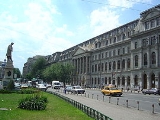
The
University of Bucharest , in
RomaniaRomania is a country located at the crossroads of Central and Southeastern Europe, on the Lower Danube, within and outside the Carpathian arch, bordering on the Black Sea...
, is a
universityA university is an institution of higher education and research, which grants academic degrees in a variety of subjects. A university is an organisation that provides both undergraduate education and postgraduate education...
founded in 1864 by
decreeA decree is a rule of law issued by a head of state , according to certain procedures . It has the force of law...
of Prince
Alexander John CuzaAlexander John Cuza was a Moldavian-born Romanian politician who ruled as the first Domnitor of the United Principalities of Moldavia and Wallachia between 1859 and 1866.-Early life:...
to convert the former
Saint Sava AcademySaint Sava College was one of the earliest academic institutions in Wallachia, Romania. It was the predecessor to both Saint Sava National College and the University of Bucharest.-History:...
into the current University of Bucharest.
Presentation
The University of Bucharest is a very important and influential player within the community, within the sphere of higher education and research. It is part of a global intellectual collectivity activating towards protecting and reinforcing academic values, as well as towards promoting diversity and international collaboration. Being one of the most important institutions of higher education in Romania, it bears both the responsibility as well as the obligation to be a pioneer and a model. In its 145 years of existence, the University of Bucharest has gained solid national and international prestige, being the first Romanian academic institution in the top 600 universities in the world, having the position 501-600 according to the Quacquarelli Symonds top (known from The Times Higher Education Supplement). This is the highest position of a Romanian university, being succeeded by the
Babeş-Bolyai UniversityThe Babeș-Bolyai University in Cluj-Napoca is an university in Romania. With almost 50,000 students, the university offers 105 specialisations, of which there are 105 in Romanian, 67 in Hungarian, 17 in German, and 5 in English...
on the position 601+.
In 2010, the University of Bucharest has the position 501-550 in the top QS.
The University of Bucharest offers numerous study programs, for all cycles and forms of organized university training, as well as other numerous higher postgraduate programs, programs for professional re-conversion and enhancement. At the same time, it constantly works with 124 prestigious universities from forty different countries. All programs are accredited or authorized. The degrees granted by the University of Bucharest are recognized in most countries of the world.
Many graduates from the University have become important personalities and can be encountered as professors and researchers in great universities around the world, or as members of the Romanian Academy or other academies in other countries, writers, politicians (members of Parliament, ministers, prime-ministers, and presidents), diplomats etc.
Its diplomas are recognized in many countries.
History
In 1694
Constantin BrâncoveanuConstantin Brâncoveanu was Prince of Wallachia between 1688 and 1714.-Ascension:A descendant of the Craioveşti boyar family and related to Matei Basarab, Brâncoveanu was born at the estate of Brâncoveni and raised in the house of his uncle, stolnic Constantin Cantacuzino...
, ruler of
WallachiaWallachia or Walachia is a historical and geographical region of Romania. It is situated north of the Danube and south of the Southern Carpathians...
, had founded the Princely Academy of Saint Sava in
BucharestBucharest is the capital municipality, cultural, industrial, and financial centre of Romania. It is the largest city in Romania, located in the southeast of the country, at , and lies on the banks of the Dâmbovița River....
with lectures delivered in Greek. In 1776,
Alexander YpsilantisAlexander Ypsilantis was a Greek Voivode of Wallachia from 1775 to 1782, and again from 1796 to 1797, and also Voivode of Moldavia from 1786 to 1788. He bears the same name as, but should not be confused with, his grandson, the Greek War of Independence hero of the early 19th century...
, ruler of Wallachia, reformed the curriculum of the Saint Sava Academy, where courses of French, Italian and Latin were now taught. In 1859, the Faculty of Law was created. In 1857,
Carol DavilaCarol Davila was a prestigious Romanian physician of Italian ancestry.-Biography:He started from humble beginnings, most probably as an abandoned child, and the surname Davila was bestowed on him by his adoptive family and guirdian...
created the National School of Medicine and Pharmacy. In 1857, the foundation stone of the University Palace in Bucharest was laid.
On July 4/16 1864 Prince Alexander John Cuza created the University of Bucharest, bringing together the Faculties of Law, Sciences and Letters as one single body. In the following years, new faculties were created: 1884 – the Faculty of Theology; 1906 – the Institute of Geology; 1913 – the Academic Institute for Electrotechnology; 1921 – the Faculty of Veterinary Medicine; 1923 – the Faculty of Pharmacy, 1924 – the
Mina MinoviciMina Minovici was a Romanian forensic scientist, famous for his extensive research regarding cadaverous alkaloids, putrefaction, simulated mind diseases, and criminal anthropology...
Institute of Forensic Medicine.
In 1956, student leaders, mainly from this university, planned a peaceful protest against Romania's
Communist regimeCommunist Romania was the period in Romanian history when that country was a Soviet-aligned communist state in the Eastern Bloc, with the dominant role of Romanian Communist Party enshrined in its successive constitutions...
but were forcibly prevented from carrying it out. (See
Bucharest student movement of 1956The events in Poland which led to the elimination of that country's Stalinist leadership and the rise to power of Władysław Gomułka on 19 October 1956 provoked unrest among university students in Eastern bloc countries. The state of unrest in Poland began to spread into Hungary...
)
Post-1989 history
The area around the old University building (the
University SquareUniversity Square is located in downtown Bucharest, near the University of Bucharest.Four statues are located in the University Square, in front of the University; they depict Ion Heliade Rădulescu , Michael the Brave , Gheorghe Lazăr and Spiru Haret .The square was the site of the 1990 Golaniad,...
), adjacent to the
C. A. RosettiConstantin Alexandru Rosetti was a Romanian literary and political leader, born in Bucharest into a Phanariot Greek family.In 1845, Rosetti went to Paris, where he met Alphonse de Lamartine, the patron of the Society of Romanian Students in Paris. In 1847, he married Mary Grant, the sister of the...
, Roman,
KogălniceanuMihail Kogălniceanu was a Moldavian-born Romanian liberal statesman, lawyer, historian and publicist; he became Prime Minister of Romania October 11, 1863, after the 1859 union of the Danubian Principalities under Domnitor Alexander John Cuza, and later served as Foreign Minister under Carol I. He...
, and Union Squares was the scene of many riots, protests and clashes with the
security forcesThe Securitate was the secret police agency of Communist Romania. Previously, the Romanian secret police was called Siguranţa Statului. Founded on August 30, 1948, with help from the Soviet NKVD, the Securitate was abolished in December 1989, shortly after President Nicolae Ceaușescu was...
during the
Romanian Revolution of 1989The Romanian Revolution of 1989 was a series of riots and clashes in December 1989. These were part of the Revolutions of 1989 that occurred in several Warsaw Pact countries...
. During the months of April-June 1990, the University of Bucharest was the centre of
anti-communistAnti-communism is opposition to communism. Organized anti-communism developed in reaction to the rise of communism, especially after the 1917 October Revolution in Russia and the beginning of the Cold War in 1947.-Objections to communist theory:...
protests.
In 1996,
Emil ConstantinescuEmil Constantinescu was President of Romania from 1996 to 2000.He graduated from the law school of the University of Bucharest, and subsequently started a career as a geologist...
, the then
rectorThe word rector has a number of different meanings; it is widely used to refer to an academic, religious or political administrator...
of the University of Bucharest, was elected
President of RomaniaThe President of Romania is the head of state of Romania. The President is directly elected by a two-round system for a five-year term . An individual may serve two terms...
, after defeating
Ion IliescuIon Iliescu served as President of Romania from 1990 until 1996, and from 2000 until 2004. From 1996 to 2000 and from 2004 until his retirement in 2008, Iliescu was a Senator for the Social Democratic Party , whose honorary president he remains....
in
national presidential electionsThese are the results of the Romanian presidential elections of November 3, run-off held on November 17, 1996:-First round:-Run-off:...
.
Mission
The University of Bucharest contributes through research and higher-education to the development and use of knowledge, at both national and international level. The University of Bucharest is a university with academic integrity and concern for critical thinking, a significant point of reference in society.
Position in National and International Ranking Lists
The Times Higher Education Supplement classification ranked the University of Bucharest among the first 600 in the world in the last three years. The classification, according to fields of interest, is as follows: Arts and Humanities – 277; Social Sciences – 330; Engineering and Information Technology (IT) – 336; Life Sciences and Biomedicine – 427; and Natural Sciences – 447.
Over the last five years, the University of Bucharest occupied the 1st or 2nd place in the national classification regarding quality indicators in the field of scientific research. Furthermore, UB ranked among the first three places, as far as the value of research contracts obtained, within national competitions was concerned.
Departments
The entire structure of the curricula has been made compatible with the Bologna process. This restructuring has involved a considerable effort of readjustment on the part of all of the University’s faculties. The University of Bucharest currently offers thirty-eight graduate domains with approximately 100 majors in all three forms of education: day courses, minimal-attendance, and distance learning. The educational offer at the level of masters’ studies is extremely diversified, the current offer amounting to 180 programmes. This has allowed for the continuous increase in requests for masters’ programmes, from graduates of other faculties, as well as requests for professional re-conversion. The University of Bucharest has the necessary human resources for developing masters’ programmes at an adequate level of quality.
The system of doctoral schools has been generalized in all faculties, ensuring a much more consistent training of the PhD students. The doctoral schools are currently financed by structural funds within three-year projects.
Currently the University has 18 departments (faculties), covering fields such as natural sciences, humanities, social sciences, and theology:
The University also has a publishing house, different research institutes and research groups (such as the Institute for Political Research, the Institute for Mathematics,
the Center for Byzantine Studies, the
Vasile PârvanVasile Pârvan was a Romanian historian and archaeologist.He studied history in Bucharest, with Nicolae Iorga as one of his professors. He continued his studies in Germany. His Ph.D. thesis, written in 1909, was titled The nationality of merchants in the Roman Empire...
Archeology Seminary, the Center for Nuclear Research, etc.), master and doctorate programmes, and a number of lifelong learning facilities and programmes. It has partnership agreements with over 50 universities in 40 countries, and participates in European programmes such as
ERASMUSThe Erasmus Programme , a.k.a. Erasmus Project is a European Union student exchange programme established in 1987...
, Lingua, Naric, Leonardo da Vinci, UNICA, AMOS, TEMPUS, TEMPRA. It is an accredited
CiscoCisco Systems, Inc. is an American multinational corporation headquartered in San Jose, California, United States, that designs and sells consumer electronics, networking, voice, and communications technology and services. Cisco has more than 70,000 employees and annual revenue of US$...
Academy, has
MicrosoftMicrosoft Corporation is an American public multinational corporation headquartered in Redmond, Washington, USA that develops, manufactures, licenses, and supports a wide range of products and services predominantly related to computing through its various product divisions...
curriculum, and is accredited by
Red HatRed Hat, Inc. is an S&P 500 company in the free and open source software sector, and a major Linux distribution vendor. Founded in 1993, Red Hat has its corporate headquarters in Raleigh, North Carolina with satellite offices worldwide....
for its academic programme.
The University of Bucharest has been awarded the 2000 National Academic Excellence Diploma, and the 2004 National Academic Excellence Medal. All of the degrees and diplomas awarded by the university are internationally recognised.
Continuing-Education (Lifelong Learning) Programs
A program for educating adults rapidly developed. The University of Bucharest was one of the first universities in the country that highlighted the importance of lifelong learning programmes. An important part in the rapid development of continuing-education (lifelong learning) programmes is played by the CREDIS department, which offered methodology and infrastructure for the functioning of those programmes, or at least supported certain faculties during the first years when those programmes came into force. By means of its continuing-education (lifelong learning) programmes, the University of Bucharest proves its capacity of adjustment to the dynamic requirements on the labor market, answering important social needs and ensuring increasingly bigger self-financing.
Laboratories
Due to the diversity of academic training domains, the teaching activity at the UB is carried out along nineteen distinct locations, where there are 286 laboratories for undergraduate studies, 187 laboratories for research and activities of master students, and the teaching process is carried out in amphitheatres with a total of 7900 seats, 1941 seats in lecture halls, and 4409 in seminar rooms. The average surface is above two sqm per student.
Practice Bases
For the activities and the practical training, the UB has research stations at Orşova, Drobeta Turnu-Severin, Măcin and Sf. Gheorge (for Geography), Brăila and Sinaia (for Biology), as well as the Dinosaurs’ Geopark in Haţeg County (for the use of Geology and Geography students).
The Dinosaurs’ Geopark of Haţeg County is a natural park with special features. It plays an active part in the economic development of its own territory and offers its inhabitants the opportunity to appreciate the values of territorial heritage.
The dwarf dinosaurs of the fabulous Haţeg County are the best-known dinosaurs in Europe. They remind people about one of the most fascinating episodes of our planet: the great disappearance of the dinosaurs at the end of the Cretaceous period, 68 million years ago.
Furthermore, the teaching activity of the Faculty of Geography is carried out at the branches of the faculty from Călimăneşti, Măcin, Drobeta Turnu-Severin. The scientific research of the Faculty of Geography from the University of Bucharest covers a large spectrum of domains and issues, geography being exclusively a border science – that is a science of interdisciplinary connections.
Buildings
The University of Bucharest has a number of buildings throughout Bucharest, so in that respect it does not have a single campus. Its two main buildings are:
- The Old Building, in the University Square (practically right in the center of the city), housing the Faculties of Mathematics and Computer Science, History, Chemistry, Geography, Letters and the Department of Romance Languages and Literatures.
- The Kogălniceanu Building, near the Opera House
The Romanian National Opera is one of the national opera companies of Romania, situated in a historical building in Bucharest, near the Cotroceni neighbourhood....
, housing the Administrative section and the Faculty of Law.
Other faculties have their own buildings and research facilities, scattered throughout the city, such as:
- The Departments of Germanic, Slavic and Oriental Languages and Literatures, on Pitar Moş street.
- The Faculty of Physics, in the small town of Măgurele
Măgurele is a town situated in the southwestern part of Ilfov County, Romania. Its population is 9,200. Four villages are administered by the town: Alunişu, Dumitrana, Pruni and Vârteju....
, situated 16 km (9.9 mi) south of Bucharest.
- The Faculty of Political Science, on Sfântu Ştefan street.
- The Faculty of Orthodox Theology, in the Unirii Square
Piața Unirii is one of the largest squares in central Bucharest, located in the center of the city where Sectors 1, 2, 3, and 4 meet. It is bisected by Unirii Boulevard, originally built during the Communist era as the Boulevard of the Victory of Socialism, and renamed after the Romanian...
This, mixed with the fact that student dormitories and other facilities are located in very different locations, prompted the University to print a yearly guide for freshmen.
Students' Campus
“GROZĂVEŞTI” STUDENT COMPLEX
(Total accommodation capacity: 2,300) It comprises hostels A, B, C, and D (ground floor + 5 storeys) and rooms with two beds, furniture for two people (wardrobe, PC desk and chair) and a sink. The bathroom is shared by all the students on the floor. There are two bathrooms on each floor at the end of the corridor.
A distinct place is occupied by the new hostel A1 (ground floor + 9 storeys). It has rooms with three beds, furniture for three people (a PC desk, wardrobes, bed tables and chairs) and its own fully equipped bathroom. Hostel A1 has rooms for people with physical disabilities, a café and an elevator. Each floor has a kitchen with a stove, as well as a launderette equipped with a washing machine and a room for drying clothes.
Address: 204 Splaiul Independenţei Street
“MIHAIL KOGĂLNICEANU” COMPLEX
(Total accommodation capacity: 614) It comprises hostels A and B, with rooms having two, three, or four beds and two bathrooms on each floor. The hostels have been renovated, equipped with double-glazed windows and completely new furniture.
Address: 36-46 Mihail Kogălniceanu Boulevard
“POLIGRAFIE” STUDENT HOSTEL
(Total accommodation capacity: 244) It has rooms with four beds and two bathrooms on each floor. The hostel’s renovation in 2007 consisted in exterior thermal insulation and double-glazing doors and windows. The furniture in the rooms is new.
Address: 4 Ficusului Boulevard
“TH. PALLADY 1” STUDENT HOSTEL
(Total accommodation capacity: 218) It has studio-like rooms, with an inner hallway, four beds, thermo-pane windows, thermal insulation, their own bathrooms and modern furniture.
The hostel was renovated in 2007.
“TH. PALLADY 2” STUDENT HOSTEL
(Total accommodation capacity: 194) It has studio-like rooms with two beds, thermo-pane windows, thermal insulation, their own bathroom, and new furniture. It has been in the accommodation circuit since October 2008.
“STOIAN MILITARU” STUDENT HOSTEL
(Total accommodation capacity: 471) – An apartment building with rooms having two/three/or four beds, a kitchen and a bathroom. The hostel has been repaired and renovated (including the installation of thermo-pane windows), and the furniture will soon be replaced.
Address: 18 Stoian Militaru Street
“FUNDENI” STUDENT HOSTEL
(Total accommodation capacity: 204) It has rooms with two beds, furniture and its own bathroom. The hostel has been renovated and thermally insulated.
Address: 252-254 Şoseaua Fundeni
“PANDURI” STUDENT COMPLEX
(Total accommodation capacity: 224) It is equipped with rooms having two/five beds, common bathrooms, and washing machines on each floor.
The hostel was renovated in 2007.
Address: 90 Şoseaua Panduri
“MĂGURELE” STUDENT COMPLEX
(Total accommodation capacity: 648) It comprises hostels G1, G2, G3, and G4, which have two room layouts, with two/three beds. It also has a hallway and its own bathroom.
Address: 3-9 Măgurele, Fizicienilor Street
STUDENT HOSTEL “C-LEU”, 1st and 2nd Floors
(Total accommodation capacity: 244) it has rooms with two beds and bathrooms on the hallways of each floor.
Address: 1-3 Iuliu Maniu Boulevard
THE STUDENT CANTEEN: THE M. KOGĂLNICEANU CANTEEN
The Mihail Kogălniceanu Canteen has the capacity to accommodate 1000 people/day, new furniture, and bathrooms. It was renovated in 2007.
Address: 36-46 Mihail Kogălniceanu Boulevard
Programme: Monday-Friday, 11:30am – 5:00pm; and 6:00 – 8:00pm
“Dimitrie Brândză” Botanical Gardens
Through its structure, the Botanic Gardens of Bucharest – bearing the name of the remarkable professor Dimitrie Brândză – turned the venerable age of 149 years. Located near the city centre, it is a cultural and educational centre, an active factor in the general process of acknowledging the relationship between man and nature.
It hosts important plant collections where the visitor can perceive the diversity of the vegetal world. Specialists may take advantage of the opportunity to use them in research activities or preservation of the natural richness of our planet.
The University Museum
For the Greeks, the museum signified the place dedicated to the inspiring muses of the arts and letters... In times to come, the museums that had been founded—as some sort of sanctuaries of history, art and culture that wanted to be preserved—had structured their themes on several categories: archaeology, anthropology and ethnology, folklore, history, cultural, military, natural history, as well as the history of art, technology and science.
Open to all those willing to know their past, museums exhibit the most representative objects or artefacts from the domain they represent, thus becoming “living schools” for those crossing their thresholds. This is what the Museum of the University of Bucharest has set out to be ever since September 1967, the year of its foundation, when Academy member Gheorghe Mihoc, Rector of the University at that time, ordered “the foundation of a public collection comprising documentary material, original pieces or significant copies, in view of a scientific reconstitution of the history of this University, with the Rector’s Office at the University of Bucharest and within its budget.”
Located on the ground floor of the left pavilion in the Palace of the Faculty of Law, the Museum has reached a valuable collection made up of 2486 pieces, most of them out of donations of its own teaching staff, former graduates: prints, documents, rare books, pictures, paintings, furniture, medals, plaques, and various thematic accessories.
The visitor has the opportunity to go through the complicated itinerary of the evolution of Romanian education, with the aid of original documents which mark the evolution of the University of Bucharest from its very foundation. Through their documentary importance, the prints and the documents (acts, incunabula) with great historical value are the most representative, entirely covering the most fertile period of progress within the Romanian educational system, from 1649 until the present day.
Libraries
Students have free access to the offices and main buildings of the “Carol I” Central University Library (Biblioteca Centrală Universitară „Carol I”), which is the first large university library in Romania to have introduced an integrated computerized system. The ongoing expansion and increasing performance of the computerized infrastructure offers quick-use opportunities and creative use of documentary resources to its beneficiaries.
Offering a permanent dynamics of cultural and educational traditions, which has defined it since the beginning, BCU “Carol I” was inaugurated, on March 14, 1865, as Royal Foundation.
BCU is an integrated library structure, be comprissed of the Central Unit, with an encyclopaedic profile, and 14 libraries organised as specialized branches, which function within the faculties of the University of Bucharest.
Consequently, the current publication fund has a similar encyclopaedic structure, the library owning a total fund of over 1,900,000 volumes from different domains: literature, philosophy, law, psychology, history, geography-geology, management, economics, mathematics, etc.
Here, students, teachers, as well as other categories (unqualified teaching staff, high school students in their senior years, researchers, etc.) can obtain the information needed from the largest university centre in the country. Every year, the BCU halls are visited by over 150,000 students, professors, and other categories of readers; the institution currently has an impressive number of 32,883 individual subscriptions.
The elegant library building has 385 seats, distributed among six specialized reading rooms. In the Europa reading room, one can find publications about Europe, the European Union, the World Bank, other monographic publications and law books. The Minerva reading room offers political works, different specialized dictionaries, catalogues, encyclopaedias, and guides. Also this room displays an important donation of the Chinese Embassy, including works from different domains. As far as periodicals are concerned, 300 magazines and 60 newspapers are available. Moreover, one can read here the Chemical Abstracts, one of the centralizing catalogues, with summaries in the field of Chemistry. As for the fourth reading room, Titu Maiorescu, philosophy, religion, sociology, history, and archaeology books are available on the bookshelves. Şt. O. Iosif reading room features literature, linguistics, folklore and art books. Those interested in astronomy, chemistry, economics, physics, but also in management or mathematics, can find what they need in the Rădulescu-Motru reading room. Finally, the last reading room, Simion Mehendinţi, contains medicine, biology, botany, geography-geology, technical engineering.
BCU offers free access to international academic databases: PROQUEST, EBSCO, and SPRINGER. Here, one can find 20,000 periodicals that can be accessed, in full text, with automatic translation from French into English or vice versa.
Through the INTERNET services, the BCU “Carol I” network is integrated into the dynamics of the world circuit of information. The connection with national and international databases at an academic level ensures synchronization with contemporary tendencies of knowledge, offering users a remarkable potential for study and research.
14 libraries function within the faculties of the University of Bucharest, its branches specializing in different domains: literature, philosophy, law, psychology, history, geography-geology, management, economics, and mathematics; the current publication fund consists of over 1,000,000 volumes.
The university also has a virtual library (eBooks) which is made up of reference sites existing on the Internet. Furthermore, the site of the University, “Unibuc Classica”, hosts seminal works by several famous professors of the institution (Nicolae Iorga, A.D. Xenopol, G. Călinescu).
International Academic Cooperation
One of the main objectives the University pays great attention to is international academic cooperation. There are 200 agreements for bilateral inter-university and inter-departmental cooperation with universities from Algeria, Austria, Belgium, Bolivia, Bosnia-Herzegovina, Brazil, Bulgaria, Cyprus, Chile, China, Egypt, Finland, France, Georgia, Germany, Great Britain, Greece, Hungary, Iran, India, Italy, Japan, Kazakhstan, Mexico, Morocco, the Republic of Moldova, Senegal, Singapore, South Korea, Spain, Slovenia, the United Arab Emirates, USA, Sweden, Russia, Tunisia, Turkey, Ukraine, Uruguay, etc.
The University has 130 bilateral agreements for joint supervision doctoral studies and an intense collaboration within numerous community programmes – ERASMUS, LEONARDO DA VINCI, and GRUNDTVIG.
Its intense international activity makes the University of Bucharest makes the University of Bucharest increasingly more notorious in Europe and worldwide. The number of ERASMUS students who come to learn with us is close to 100 per year, and many choose to remain a second semester as well, because the learning environment seems favorable to them. The number of students coming from African and Asian countries has also risen. The University has programmes in foreign languages that are offered on a yearly basis to the 1000 foreign students.
The ERASMUS programme is a component of the Community Education Programme (Lifelong Learning Programme – LLP), which sets out to help university mobility – both for undergraduate students / master students / doctoral students as well as teaching staff. Another ERASMUS objective is encouraging the cooperation between universities in Europe in the field of higher-education. The development of the European dimension of graduate and post-graduate studies is supported through ERASMUS, since the programme covers all disciplines and study areas within the University of Bucharest.
The purpose of the ERASMUS programme is to facilitate the creation of European unity and identity by means of study travel from one country to another. It is not a physics or theology programme. The European Union wishes to lay the human foundations of a European identity through a means that are, at the same time, simple and inevitable: travel. Travel favors direct contact between people and cultures. They remove clichés learned through life experiences. They replace memories from books as well as personal memories. They reward you with friends. They offer you the opportunity of speaking another language, of tasting unknown dishes, of seeing new landscapes, of observing how the trade you train for is learned in another country, with a different history, with other customs, with a different social structure. This is valuable in itself, and does not need other excuses or explanations.
Within this programme there are 286 agreements with European universities that offer opportunities for both students and professors to carry out study terms, teaching terms, take part in common projects to be implemented in curricula, intensive courses or activities in thematic networks dedicated to the development of a graduate domain. The mobility offered within this programme is coordinated by the ERASMUS Office for Community Programs within UB.
The University is also a member in several European and international academic organizations – the European Universities Association (EUA), the University Agency for Francophony (AUF), the Association of Universities from European Capital Cities (UNICA), and the Black Sea University Network (BSUN).
The University has established partnerships with other governmental or non-governmental organizations such as DAAD, USIA, the Humboldt Foundations, Volkswagen, Fulbright, Nippon, and Onassis.
Notable alumni
- Gheorghe I. Cantacuzino
Gheorghe I. Cantacuzino is a Romanian historian and archeologist.Gheorghe I. Cantacuzino studied at the Sfântul Sava High School, graduating in 1954. Thereafter he attended the courses of the Faculty of History at the University of Bucharest, specializing in history of the antiquity and archeology...
- archeologist
- Zoia Ceauşescu
Elena Zoia Ceaușescu was a Romanian mathematician, the daughter of Communist leader Nicolae and his wife, Elena Ceaușescu.She did her studies at the University of Bucharest. After completing her Ph.D. in mathematics, she worked as a researcher at the Institute of Mathematics of the Romanian...
- mathematician, daughter of Nicolae CeauşescuNicolae Ceaușescu was a Romanian Communist politician. He was General Secretary of the Romanian Communist Party from 1965 to 1989, and as such was the country's second and last Communist leader...
- George Ciucu - mathematician
- Iosif Constantin Drăgan
Iosif Constantin Drăgan was a Romanian and Italian businessman, writer and historian. In 2005, he was the second wealthiest Romanian, according to the Romanian financial magazine Capital, having a wealth estimated at $850 million...
- businessman, writer and historian
- Paul Timitriu - polititician and publicist
- Mircea Eliade
Mircea Eliade was a Romanian historian of religion, fiction writer, philosopher, and professor at the University of Chicago. He was a leading interpreter of religious experience, who established paradigms in religious studies that persist to this day...
- historian of religion, fiction writer, philosopher, and professor at the University of ChicagoThe University of Chicago is a private research university in Chicago, Illinois, USA. It was founded by the American Baptist Education Society with a donation from oil magnate and philanthropist John D. Rockefeller and incorporated in 1890...
- Mircea Cărtărescu
Mircea Cărtărescu is a Romanian poet, novelist and essayist.Born in Bucharest, he graduated from the University of Bucharest's Faculty of Letters, Department of Romanian Language And Literature, in 1980. Between 1980 and 1989 he worked as a Romanian language teacher, then he worked at the Writers'...
- postmodern writer
- Nicholas Georgescu-Roegen
Nicholas Georgescu-Roegen, born Nicolae Georgescu was a Romanian mathematician, statistician and economist, best known for his 1971 magnum opus The Entropy Law and the Economic Process, which situated the view that the second law of thermodynamics, i.e., that usable "free energy" tends to disperse...
- economist
- Eugen Filotti
Eugen Filotti was a Romanian diplomat, journalist and writer. As a diplomat he worked at the League of Nations in Geneva and then as minister plenipotentiary in Turkey, Greece, Bulgaria and Hungary. As minister plenipotentiary to Budapest he issued transit visas for Jews during the Holocaust...
- diplomat
- Horia Hulubei
Horia Hulubei was a Romanian atomic/nuclear physicist, known for his contributions to the development of X-ray spectroscopy.-Education:He studied at the University of Iaşi and in Paris at the Sorbonne, with the Nobel laureate Jean Perrin as his PhD advisor; he obtained his Ph.D. from the...
- physicist
- Traian Lalescu
Traian Lalescu was a Romanian mathematician. His main focus was on integral equations and he contributed to work in the areas of functional equations, trigonometric series, mathematical physics, geometry, mechanics, algebra, and the history of mathematics....
- mathematician
- Gheorghe Mihoc
Gheorghe Mihoc was a famous Romanian statistician. He was born in Brăila, the son of a worker.In 1908, his father moved the family to Bucharest. Here he attended elementary school and the Gheorghe Şincai high school...
- mathematician
- Grigore Moisil
Grigore Constantin Moisil was a Romanian mathematician, computer pioneer, and member of the Romanian Academy. His research was mainly in the fields of mathematical logic, , Algebraic logic, MV-algebra, algebra and differential equations...
- mathematician and computer scientist
- Miron Nicolescu
Miron Nicolescu was a Romanian mathematician.Born in Giurgiu, he attended the Matei Basarab high school in Bucharest. After completing his undergraduate studies at the Faculty of Mathematics of the University of Bucharest in 1924, he went to Paris, where he enrolled at the École Normale...
- mathematician
- Grigore Iunian
Grigore Iunian was a Romanian left-wing politician and lawyer. A member of the National Liberal Party during the 1910s, he rallied with the Peasants' Party after World War I, and followed it into the National Peasants' Party , before leaving in 1933 to create the Radical Peasants' Party-Grigore...
- politician
- Ştefan Odobleja
Ştefan Odobleja was a Romanian scientist, one of the precursors of cybernetics. His major work, Psychologie consonantiste, first published in 1938 and 1939, in Paris, had established many of the major themes of cybernetics regarding cybernetics and systems thinking ten years before the work of...
- scientist, one of the precursors of cyberneticsCybernetics is the interdisciplinary study of the structure of regulatory systems. Cybernetics is closely related to information theory, control theory and systems theory, at least in its first-order form...
- Octav Onicescu
Octav Onicescu was a Romanian mathematician, member of the Romanian Academy, and founder of the Romanian school of probability theory and statistics.-Biography:...
- mathematician
- George Emil Palade
George Emil Palade was a Romanian cell biologist. Described as "the most influential cell biologist ever", in 1974 he was awarded the Nobel Prize in Physiology and Medicine, together with Albert Claude and Christian de Duve. The prize was granted for his innovations in electron microscopy and...
- cell biologist, 1974 Nobel Prize laureate
- Eleni Papadopulos-Eleopulos
Eleni Papadopulos-Eleopulos is the leader of a group of AIDS denialists who call themselves the "Perth Group" and have claimed since 1988 that HIV has never been fully isolated and therefore may not exist...
- Nuclear Physicist and AIDS denialists
- Andrei Pleşu
Andrei Gabriel Pleşu is a Romanian philosopher, essayist, journalist, literary and art critic, and politician.- Biography :Born in Bucharest, the son of Radu Pleşu, a surgeon and Zoe Pleşu , he spent much of his early youth in the country side...
- philosopher, essayist, journalist, literary and art critic, and politician
- Valentin Poénaru
Valentin Alexandre Poénaru is a Professor of Mathematics at Université de Paris-Sud. He specializes in low-dimensional topology.Born in Romania, he did his undergraduate studies at the University of Bucharest. In 1962, he was an invited speaker at the International Congress of Mathematicians in...
- mathematician
- Constantin Rădulescu-Motru
Constantin Rădulescu-Motru was a Romanian philosopher, psychologist, sociologist, logician, academic, dramatist, as well as centre-left nationalist politician with a noted anti-fascist discourse...
- psychologist and sociologist
- Mircea Rusu - physicist
- Mihail Sadoveanu
Mihail Sadoveanu was a Romanian novelist, short story writer, journalist and political figure, who twice served as acting republican head of state under the communist regime . One of the most prolific Romanian-language writers, he is remembered mostly for his historical and adventure novels, as...
- writer
- Gheorghe Taşcă
Gheorghe Taşcă was a Romanian economist and politician.He was the son of Gheorghe I...
- economist
- Şerban Ţiţeica - physicist
- Dan-Virgil Voiculescu
Dan-Virgil Voiculescu is a professor of mathematics at the University of California, Berkeley. He has worked in single operator theory, operator K-theory and von Neumann algebras. More recently, he developed free probability theory....
- mathematician
Notable faculty members
- Ion Barbu
Ion Barbu was a distinguished Romanian mathematician and poet.He was born in Câmpulung-Muscel, Argeş County, the son of Constantin Barbilian and Smaranda, born Şoiculescu. He attended Ion Brătianu High School in Piteşti and Gheorghe Lazăr High School in Bucharest...
also known as Dan Barbilian - mathematician and poet;
- Silviu Brucan
Silviu Brucan was a Romanian communist politician. Though he disagreed with Nicolae Ceauşescu's policies, he never gave up his communist beliefs and did not oppose communist ideology...
- political analyst and author
- George Călinescu
George Călinescu was a Romanian literary critic, historian, novelist, academician and journalist, and a writer of classicist and humanist tendencies...
- writer and literary critic
- Mircea Cărtărescu
Mircea Cărtărescu is a Romanian poet, novelist and essayist.Born in Bucharest, he graduated from the University of Bucharest's Faculty of Letters, Department of Romanian Language And Literature, in 1980. Between 1980 and 1989 he worked as a Romanian language teacher, then he worked at the Writers'...
- Postmodern writer
- Emil Constantinescu
Emil Constantinescu was President of Romania from 1996 to 2000.He graduated from the law school of the University of Bucharest, and subsequently started a career as a geologist...
- former President of Romania
- Petru Creţia - philologist
- Neagu Djuvara
Neagu Djuvara is a Romanian historian, essayist, philosopher, journalist, novelist, and diplomat.-Early life:A native of Bucharest, he descended from an aristocratic Aromanian family...
- historian
- Alexandru Graur
Alexandru Graur was a Romanian linguist.Born into a Jewish family in Botoşani, Graur graduated from the Faculty of Letters of the University of Bucharest and the École Pratique des Hautes Études in Paris . He obtained a Doctor of Philosophy degree from the Sorbonne...
- linguist
- Spiru Haret
Spiru C. Haret was a Romanian mathematician, astronomer and politician. He made a fundamental contribution to the n-body problem in celestial mechanics by proving that using a third degree approximation for the disturbing forces implies instability of the major axes of the orbits, and by...
- mathematician, astronomer and politician
- Iorgu Iordan
Iorgu Iordan was a Romanian linguist, philologist, diplomat, journalist, and left-wing agrarian, later communist, politician. The author of works on a large variety of topics, most of them dealing with issues of the Romanian language and Romance languages in general, he was elected a full member...
- linguist
- Nicolae Iorga
Nicolae Iorga was a Romanian historian, politician, literary critic, memoirist, poet and playwright. Co-founder of the Democratic Nationalist Party , he served as a member of Parliament, President of the Deputies' Assembly and Senate, cabinet minister and briefly as Prime Minister...
- historian, literary critic and politician
- Traian Lalescu
Traian Lalescu was a Romanian mathematician. His main focus was on integral equations and he contributed to work in the areas of functional equations, trigonometric series, mathematical physics, geometry, mechanics, algebra, and the history of mathematics....
- mathematician
- Gabriel Liiceanu
Gabriel Liiceanu is a Romanian philosopher.He graduated from University of Bucharest's Faculty of Philosophy in 1965, and from Faculty of Classical Languages in 1973. He earned a doctorate in philosophy at the University of Bucharest in 1976....
- philosopher
- Titu Maiorescu
Titu Liviu Maiorescu was a Romanian literary critic and politician, founder of the Junimea Society. As a literary critic, he was instrumental in the development of Romanian culture in the second half of the 19th century....
- literary critic
- Nicolae Manolescu
Nicolae Manolescu is a Romanian literary critic. As an editor of România Literară literary magazine, he has reached a record in reviewing books for almost 30 years...
-literary critic
- Solomon Marcus
Solomon Marcus is a Romanian mathematician, member of the Mathematical Section of the Romanian Academy and Emeritus Professor of the University of Bucharest's Faculty of Mathematics...
- mathematician
- Adrian Năstase
Adrian Năstase is a Romanian politician who was the Prime Minister of Romania from December 2000 to December 2004.He competed as the Social Democratic Party candidate in the 2004 presidential election, but was defeated by centre-right Justice and Truth Alliance candidate Traian Băsescu.He was...
- politician
- Miron Nicolescu
Miron Nicolescu was a Romanian mathematician.Born in Giurgiu, he attended the Matei Basarab high school in Bucharest. After completing his undergraduate studies at the Faculty of Mathematics of the University of Bucharest in 1924, he went to Paris, where he enrolled at the École Normale...
- mathematician
- Bogdan Petriceicu Hasdeu
Bogdan Petriceicu Hasdeu was a Romanian writer and philologist, who pioneered many branches of Romanian philology and history. Hasdeu is considered to have been able to understand 26 languages .-Life:...
- writer and philologist
- Dimitrie Pompeiu
-Biography:After studying in Dorohoi and Bucharest, he went to France, where he studied mathematics at the University of Paris . He obtained a Ph.D. degree in mathematics in 1905 with a thesis, On the continuity of complex variable functions, written under the direction of Henri Poincaré...
- mathematician
- Alexandru Rosetti - linguist
- Ion Th. Simionescu
- Simion Stoilow
Simion Stoilow or Stoilov was a Romanian mathematician, creator of the Romanian school of complex analysis, and author of over 100 publications.-Biography:...
- mathematician
- Nicolae Titulescu
Nicolae Titulescu was a well-known Romanian diplomat, at various times government minister, finance and foreign minister, and for two terms President of the General Assembly of the League of Nations . He was a member of the Freemasonry.-Early years:...
- politician
- Tudor Vianu
Tudor Vianu was a Romanian literary critic, art critic, poet, philosopher, academic, and translator. Known for his left-wing and anti-fascist convictions, he had a major role on the reception and development of Modernism in Romanian literature and art...
- literary critic, philosopher
- Dan-Virgil Voiculescu
Dan-Virgil Voiculescu is a professor of mathematics at the University of California, Berkeley. He has worked in single operator theory, operator K-theory and von Neumann algebras. More recently, he developed free probability theory....
- mathematician
- Gheorghe Vrânceanu
Gheorghe Vrânceanu was a Romanian mathematician, best known for his work in differential geometry and topology....
- mathematician
External links
Official site
Footnotes