

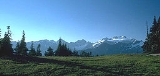
Olympic Mountains

Encyclopedia
The Olympic Mountains is a mountain range
on the Olympic Peninsula
of western Washington in the United States
. The mountain
s, part of the Pacific Coast Ranges
, are not especially high - Mount Olympus
is the highest at 7962 ft (2,427 m) - but the western slopes of the Olympics rise directly out of the Pacific Ocean
and are the wettest place in the 48 contiguous states. On the wetter end of the spectrum, 140 and 170 in (3,556 and 4,318 mm) of rain falls on the Hoh Rainforest
annually. Conversely, areas to the northeast of the mountains are located in a rain shadow
and receive as little as 16 in (406.4 mm) of precipitation. Most of the mountains are protected within the bounds of the Olympic National Park
.
Physiographically, they are a section of the larger Pacific Border province
, which is in turn a part of the larger Pacific Mountain System.
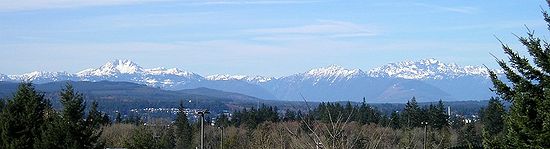 The Olympics have the form of a cluster of steep-sided peaks surrounded by heavily-forested foothills and incised by deep valleys.
The climax forest
s consist of Sitka spruce
and western hemlock
. Douglas fir occurs in groves. Other types of fir
s may be seen also. Due to high precipitation, clearings in the forest quickly become covered with vine maple
, slide alder
, and devil's club
, making cross-country travel most challenging.
Another consequence of the high precipitation is the large number of snowfields and glacier
s, reaching down to 1,500 m (5,000 ft) above sea level. There are about 266 glaciers crowning the Olympics peaks. The most prominent glaciers are those on Mount Olympus
covering approximately 10 square miles (25.9 km²). Beyond the Olympic complex are the glaciers of Mount Carrie
, the Bailey Range, Mount Christie, and Mount Anderson
.
s, and basalt
ic oceanic crust. Unlike the Cascades, the Olympic Mountains are not volcanic.
Millions of years ago, vents and fissures opened under the Pacific ocean and lava flowed forth, creating huge underwater mountains and ranges called seamount
s. The plates that formed the ocean floor inched toward North America about 35 million years ago and most of the sea floor went beneath the continental land mass. Some of the sea floor, however, was scraped off and jammed against the mainland, creating the dome that was the forerunner of today's Olympics. Powerful forces fractured, folded, and over-turned rock formations, which helps explain the jumbled appearance of the Olympics.
In the Pleistocene
era, a vast continental ice sheet
descended from Alaska south through British Columbia to the Olympics. The ice split into the Juan de Fuca
and Puget
ice lobes, as they encountered the resistant Olympic Mountains. A glacial outwash stream surged around the southern end of the peninsula to the Pacific Ocean. This isolated the Olympic Peninsula from the nearby Cascade Mountains and limited species from entering and exiting the peninsula. When the ice sheet reached the Peninsula, large areas of the continental shelf were also exposed by the lower sea levels since so much water was trapped as ice. This created a coastal refuge. The distance from Mount Olympus to the Pacific Ocean may have been double that of today.
 The ecosystems of the Olympics vary depending on elevation: the lower elevations are quite different from the higher ones. The rain shadow effect also has a significant impact on the make up and character of the forest.
The low Olympics contains foothills and mountains and rises to an elevation of approximately
4000 feet (1,219.2 m). Copious precipitation (up to 200 inches (5,080 mm) per year) supports a lush, epiphyte
-rich rainforest
of Western Hemlock
, Western Red Cedar, and Douglas-fir
. Much of the region is in the third rotation of logging
. However, a portion of the region lies within the Olympic National Park
and contains ancient forests.
The high Olympics contains steep, glaciated mountains that reach an elevation of almost 8000 feet (2,438.4 m). It is characterized by rock outcrops, tarn
s, persistent snow pack, alpine glaciers, and high-gradient, glacial-fed streams. Its vegetation includes subalpine
Mountain Hemlock
and Pacific Silver Fir
forests as well as alpine meadows. Subalpine fir
occurs on the xeric soils of northeastern rainshadow areas.
, while the first European to see them, the Spanish
navigator Juan Perez, named them "Sierra Nevada de Santa Rosalia", in 1774. But the English captain John Meares
, seeing them in 1788, thought them beautiful enough for the gods to dwell there, and named them "Mount Olympus" after the one in Greece
. Alternate proposals never caught on, and in 1864 the Seattle
Weekly Gazette persuaded the government to make the present-day name official. Though readily visible from most parts of western Washington, the interior was almost entirely unexplored until the 1890s. Mount Olympus itself was not ascended until 1907, one of the first successes of The Mountaineers
, which had been organized in Seattle just a few years earlier. A number of the more obscure and least-accessible peaks in the range weren't ascended until the 1970s.
The Mount Olympus National Monument
was proclaimed by Theodore Roosevelt
in 1909, and made into a park in 1938.
Other Summits
Mountain range
A mountain range is a single, large mass consisting of a succession of mountains or narrowly spaced mountain ridges, with or without peaks, closely related in position, direction, formation, and age; a component part of a mountain system or of a mountain chain...
on the Olympic Peninsula
Olympic Peninsula
The Olympic Peninsula is the large arm of land in western Washington state of the USA, that lies across Puget Sound from Seattle. It is bounded on the west by the Pacific Ocean, the north by the Strait of Juan de Fuca, and the east by Puget Sound. Cape Alava, the westernmost point in the contiguous...
of western Washington in the United States
United States
The United States of America is a federal constitutional republic comprising fifty states and a federal district...
. The mountain
Mountain
Image:Himalaya_annotated.jpg|thumb|right|The Himalayan mountain range with Mount Everestrect 58 14 160 49 Chomo Lonzorect 200 28 335 52 Makalurect 378 24 566 45 Mount Everestrect 188 581 920 656 Tibetan Plateaurect 250 406 340 427 Rong River...
s, part of the Pacific Coast Ranges
Pacific Coast Ranges
The Pacific Coast Ranges and the Pacific Mountain System are the series of mountain ranges that stretch along the West Coast of North America from Alaska south to Northern and Central Mexico...
, are not especially high - Mount Olympus
Mount Olympus (Washington)
Mount Olympus is the tallest and most prominent mountain in the Olympic Mountains of western Washington state. Located on the Olympic Peninsula, it is the central feature of Olympic National Park. Mount Olympus is the highest summit of the Olympic Mountains, however, peaks such as Mount Constance,...
is the highest at 7962 ft (2,427 m) - but the western slopes of the Olympics rise directly out of the Pacific Ocean
Pacific Ocean
The Pacific Ocean is the largest of the Earth's oceanic divisions. It extends from the Arctic in the north to the Southern Ocean in the south, bounded by Asia and Australia in the west, and the Americas in the east.At 165.2 million square kilometres in area, this largest division of the World...
and are the wettest place in the 48 contiguous states. On the wetter end of the spectrum, 140 and 170 in (3,556 and 4,318 mm) of rain falls on the Hoh Rainforest
Hoh Rainforest
The Hoh Rainforest is located on the Olympic Peninsula in western Washington state, USA. It is one of the few temperate rainforests in the U.S., and also one of the largest. Within Olympic National Park, the forest is protected from commercial exploitation. This includes of low elevation forest ...
annually. Conversely, areas to the northeast of the mountains are located in a rain shadow
Rain shadow
A rain shadow is a dry area on the lee side of a mountainous area. The mountains block the passage of rain-producing weather systems, casting a "shadow" of dryness behind them. As shown by the diagram to the right, the warm moist air is "pulled" by the prevailing winds over a mountain...
and receive as little as 16 in (406.4 mm) of precipitation. Most of the mountains are protected within the bounds of the Olympic National Park
Olympic National Park
Olympic National Park is located in the U.S. state of Washington, in the Olympic Peninsula. The park can be divided into four basic regions: the Pacific coastline, alpine areas, the west side temperate rainforest and the forests of the drier east side. U.S...
.
Physiographically, they are a section of the larger Pacific Border province
Pacific Border province
The Pacific Border province is a physiographic province of the Physiographic regions of the world physical geography system.-Description:The Pacific Border province encompasses most of the North American Pacific Coast, with the southern end at the start of the Lower California-Peninsular Ranges...
, which is in turn a part of the larger Pacific Mountain System.
Geography
The climax forest
Forest
A forest, also referred to as a wood or the woods, is an area with a high density of trees. As with cities, depending where you are in the world, what is considered a forest may vary significantly in size and have various classification according to how and what of the forest is composed...
s consist of Sitka spruce
Sitka Spruce
Picea sitchensis, the Sitka Spruce, is a large coniferous evergreen tree growing to 50–70 m tall, exceptionally to 95 m tall, and with a trunk diameter of up to 5 m, exceptionally to 6–7 m diameter...
and western hemlock
Western Hemlock
Tsuga heterophylla. the Western Hemlock, is a species of hemlock native to the west coast of North America, with its northwestern limit on the Kenai Peninsula, Alaska, and its southeastern limit in northern Sonoma County, California.-Habitat:...
. Douglas fir occurs in groves. Other types of fir
Fir
Firs are a genus of 48–55 species of evergreen conifers in the family Pinaceae. They are found through much of North and Central America, Europe, Asia, and North Africa, occurring in mountains over most of the range...
s may be seen also. Due to high precipitation, clearings in the forest quickly become covered with vine maple
Maple
Acer is a genus of trees or shrubs commonly known as maple.Maples are variously classified in a family of their own, the Aceraceae, or together with the Hippocastanaceae included in the family Sapindaceae. Modern classifications, including the Angiosperm Phylogeny Group system, favour inclusion in...
, slide alder
Alder
Alder is the common name of a genus of flowering plants belonging to the birch family . The genus comprises about 30 species of monoecious trees and shrubs, few reaching large size, distributed throughout the North Temperate Zone and in the Americas along the Andes southwards to...
, and devil's club
Devil's Club
Devil's Club is a large shrub primarily native to the cool moist forests of western North America, but also disjunct on islands in Lake Superior. It is noted for its large palmate leaves and erect, woody stems covered in brittle spines...
, making cross-country travel most challenging.
Another consequence of the high precipitation is the large number of snowfields and glacier
Glacier
A glacier is a large persistent body of ice that forms where the accumulation of snow exceeds its ablation over many years, often centuries. At least 0.1 km² in area and 50 m thick, but often much larger, a glacier slowly deforms and flows due to stresses induced by its weight...
s, reaching down to 1,500 m (5,000 ft) above sea level. There are about 266 glaciers crowning the Olympics peaks. The most prominent glaciers are those on Mount Olympus
Mount Olympus (Washington)
Mount Olympus is the tallest and most prominent mountain in the Olympic Mountains of western Washington state. Located on the Olympic Peninsula, it is the central feature of Olympic National Park. Mount Olympus is the highest summit of the Olympic Mountains, however, peaks such as Mount Constance,...
covering approximately 10 square miles (25.9 km²). Beyond the Olympic complex are the glaciers of Mount Carrie
Carrie Glacier
Carrie Glacier is a glacier located on Mount Carrie and Mount Fairchild in the Olympic Mountains of Olympic National Park. The body of ice is lies on the northern slopes of Mount Carrie. Starting at an elevation of about , the glacier descends northward, but the ice soon reaches a cliff...
, the Bailey Range, Mount Christie, and Mount Anderson
Mount Anderson (Washington)
Mount Anderson is a high peak in the Olympic Mountains of Washington state. Rising in the center of Olympic National Park, it the second highest peak on the Anderson Massif. Anderson Glacier is located in a cirque on the mountain's southern flank while Eel Glacier is in another cirque, northwest...
.
Geology
The Olympics are made up of an obducted clastic wedge material and oceanic crust. They are primarily Eocene sandstones, turbiditeTurbidite
Turbidite geological formations have their origins in turbidity current deposits, which are deposits from a form of underwater avalanche that are responsible for distributing vast amounts of clastic sediment into the deep ocean.-The ideal turbidite sequence:...
s, and basalt
Basalt
Basalt is a common extrusive volcanic rock. It is usually grey to black and fine-grained due to rapid cooling of lava at the surface of a planet. It may be porphyritic containing larger crystals in a fine matrix, or vesicular, or frothy scoria. Unweathered basalt is black or grey...
ic oceanic crust. Unlike the Cascades, the Olympic Mountains are not volcanic.
Millions of years ago, vents and fissures opened under the Pacific ocean and lava flowed forth, creating huge underwater mountains and ranges called seamount
Seamount
A seamount is a mountain rising from the ocean seafloor that does not reach to the water's surface , and thus is not an island. These are typically formed from extinct volcanoes, that rise abruptly and are usually found rising from a seafloor of depth. They are defined by oceanographers as...
s. The plates that formed the ocean floor inched toward North America about 35 million years ago and most of the sea floor went beneath the continental land mass. Some of the sea floor, however, was scraped off and jammed against the mainland, creating the dome that was the forerunner of today's Olympics. Powerful forces fractured, folded, and over-turned rock formations, which helps explain the jumbled appearance of the Olympics.
In the Pleistocene
Pleistocene
The Pleistocene is the epoch from 2,588,000 to 11,700 years BP that spans the world's recent period of repeated glaciations. The name pleistocene is derived from the Greek and ....
era, a vast continental ice sheet
Ice sheet
An ice sheet is a mass of glacier ice that covers surrounding terrain and is greater than 50,000 km² , thus also known as continental glacier...
descended from Alaska south through British Columbia to the Olympics. The ice split into the Juan de Fuca
Strait of Juan de Fuca
The Strait of Juan de Fuca is a large body of water about long that is the Salish Sea outlet to the Pacific Ocean...
and Puget
Puget Sound
Puget Sound is a sound in the U.S. state of Washington. It is a complex estuarine system of interconnected marine waterways and basins, with one major and one minor connection to the Strait of Juan de Fuca and the Pacific Ocean — Admiralty Inlet being the major connection and...
ice lobes, as they encountered the resistant Olympic Mountains. A glacial outwash stream surged around the southern end of the peninsula to the Pacific Ocean. This isolated the Olympic Peninsula from the nearby Cascade Mountains and limited species from entering and exiting the peninsula. When the ice sheet reached the Peninsula, large areas of the continental shelf were also exposed by the lower sea levels since so much water was trapped as ice. This created a coastal refuge. The distance from Mount Olympus to the Pacific Ocean may have been double that of today.
Ecology
The low Olympics contains foothills and mountains and rises to an elevation of approximately
4000 feet (1,219.2 m). Copious precipitation (up to 200 inches (5,080 mm) per year) supports a lush, epiphyte
Epiphyte
An epiphyte is a plant that grows upon another plant non-parasitically or sometimes upon some other object , derives its moisture and nutrients from the air and rain and sometimes from debris accumulating around it, and is found in the temperate zone and in the...
-rich rainforest
Rainforest
Rainforests are forests characterized by high rainfall, with definitions based on a minimum normal annual rainfall of 1750-2000 mm...
of Western Hemlock
Western Hemlock
Tsuga heterophylla. the Western Hemlock, is a species of hemlock native to the west coast of North America, with its northwestern limit on the Kenai Peninsula, Alaska, and its southeastern limit in northern Sonoma County, California.-Habitat:...
, Western Red Cedar, and Douglas-fir
Douglas-fir
Douglas-fir is one of the English common names for evergreen coniferous trees of the genus Pseudotsuga in the family Pinaceae. Other common names include Douglas tree, and Oregon pine. There are five species, two in western North America, one in Mexico, and two in eastern Asia...
. Much of the region is in the third rotation of logging
Logging
Logging is the cutting, skidding, on-site processing, and loading of trees or logs onto trucks.In forestry, the term logging is sometimes used in a narrow sense concerning the logistics of moving wood from the stump to somewhere outside the forest, usually a sawmill or a lumber yard...
. However, a portion of the region lies within the Olympic National Park
Olympic National Park
Olympic National Park is located in the U.S. state of Washington, in the Olympic Peninsula. The park can be divided into four basic regions: the Pacific coastline, alpine areas, the west side temperate rainforest and the forests of the drier east side. U.S...
and contains ancient forests.
The high Olympics contains steep, glaciated mountains that reach an elevation of almost 8000 feet (2,438.4 m). It is characterized by rock outcrops, tarn
Tarn (lake)
A tarn is a mountain lake or pool, formed in a cirque excavated by a glacier. A moraine may form a natural dam below a tarn. A corrie may be called a cirque.The word is derived from the Old Norse word tjörn meaning pond...
s, persistent snow pack, alpine glaciers, and high-gradient, glacial-fed streams. Its vegetation includes subalpine
Subalpine
The subalpine zone is the biotic zone immediately below tree line around the world. Species that occur in this zone depend on the location of the zone on the Earth, for example, Snow Gum in Australia, or Subalpine Larch, Mountain Hemlock and Subalpine Fir in western North America.Trees in the...
Mountain Hemlock
Mountain Hemlock
Tsuga mertensiana, known as Mountain Hemlock, is a species of hemlock native to the west coast of North America, with its northwestern limit on the Kenai Peninsula, Alaska, and its southeastern limit in northern Tulare County, California....
and Pacific Silver Fir
Pacific Silver Fir
Abies amabilis, commonly known as the Pacific silver fir, is a fir native to the Pacific Northwest of North America, occurring in the Pacific Coast Ranges and the Cascade Range from the extreme southeast of Alaska, through western British Columbia, Washington and Oregon, to the extreme northwest of...
forests as well as alpine meadows. Subalpine fir
Subalpine Fir
The Subalpine Fir or Rocky Mountain Fir is a western North American fir, native to the mountains of Yukon, British Columbia and western Alberta in Canada; southeastern Alaska, Washington, Oregon, Idaho, western Montana, Wyoming, Utah, Colorado, New Mexico, Arizona, northeastern Nevada, and the...
occurs on the xeric soils of northeastern rainshadow areas.
History
The mountains were originally called "Sun-a-do" by the Duwamish IndiansDuwamish (tribe)
The Duwamish are a Lushootseed Native American tribe in western Washington, and the indigenous people of metropolitan Seattle, where they have been living since the end of the last glacial period...
, while the first European to see them, the Spanish
Spain
Spain , officially the Kingdom of Spain languages]] under the European Charter for Regional or Minority Languages. In each of these, Spain's official name is as follows:;;;;;;), is a country and member state of the European Union located in southwestern Europe on the Iberian Peninsula...
navigator Juan Perez, named them "Sierra Nevada de Santa Rosalia", in 1774. But the English captain John Meares
John Meares
John Meares was a navigator, explorer, and maritime fur trader, best known for his role in the Nootka Crisis, which brought Britain and Spain to the brink of war.- Career :...
, seeing them in 1788, thought them beautiful enough for the gods to dwell there, and named them "Mount Olympus" after the one in Greece
Greece
Greece , officially the Hellenic Republic , and historically Hellas or the Republic of Greece in English, is a country in southeastern Europe....
. Alternate proposals never caught on, and in 1864 the Seattle
Seattle, Washington
Seattle is the county seat of King County, Washington. With 608,660 residents as of the 2010 Census, Seattle is the largest city in the Northwestern United States. The Seattle metropolitan area of about 3.4 million inhabitants is the 15th largest metropolitan area in the country...
Weekly Gazette persuaded the government to make the present-day name official. Though readily visible from most parts of western Washington, the interior was almost entirely unexplored until the 1890s. Mount Olympus itself was not ascended until 1907, one of the first successes of The Mountaineers
The Mountaineers (Pacific NW)
The Mountaineers is an outdoor recreation, education, and conservation group based in Seattle, Washington and is the third largest group of its kind in the country. Its central Program Center located in Seattle's Magnuson Park is complete with education facilities for all aspects of the alpine...
, which had been organized in Seattle just a few years earlier. A number of the more obscure and least-accessible peaks in the range weren't ascended until the 1970s.
The Mount Olympus National Monument
Olympic National Park
Olympic National Park is located in the U.S. state of Washington, in the Olympic Peninsula. The park can be divided into four basic regions: the Pacific coastline, alpine areas, the west side temperate rainforest and the forests of the drier east side. U.S...
was proclaimed by Theodore Roosevelt
Theodore Roosevelt
Theodore "Teddy" Roosevelt was the 26th President of the United States . He is noted for his exuberant personality, range of interests and achievements, and his leadership of the Progressive Movement, as well as his "cowboy" persona and robust masculinity...
in 1909, and made into a park in 1938.
List of summits
Principal summits:- Mount OlympusMount Olympus (Washington)Mount Olympus is the tallest and most prominent mountain in the Olympic Mountains of western Washington state. Located on the Olympic Peninsula, it is the central feature of Olympic National Park. Mount Olympus is the highest summit of the Olympic Mountains, however, peaks such as Mount Constance,...
- highest point, eight glaciers - Mount ConstanceMount ConstanceMount Constance is a peak in the Olympic Mountains of Washington and the third highest in the range. It is the most visually prominent peak on Seattle's western skyline. Despite being almost as tall as the ice-clad Mount Olympus to the west, Mount Constance has little in the way of glaciers and...
- largest peak visible from Seattle - Mount AndersonMount Anderson (Washington)Mount Anderson is a high peak in the Olympic Mountains of Washington state. Rising in the center of Olympic National Park, it the second highest peak on the Anderson Massif. Anderson Glacier is located in a cirque on the mountain's southern flank while Eel Glacier is in another cirque, northwest...
- West Peak of Mt Anderson is the hydrographicHydrographyHydrography is the measurement of the depths, the tides and currents of a body of water and establishment of the sea, river or lake bed topography and morphology. Normally and historically for the purpose of charting a body of water for the safe navigation of shipping...
apex of the Olympic Mountains: From this peak, rivers flow outward to the Pacific OceanPacific OceanThe Pacific Ocean is the largest of the Earth's oceanic divisions. It extends from the Arctic in the north to the Southern Ocean in the south, bounded by Asia and Australia in the west, and the Americas in the east.At 165.2 million square kilometres in area, this largest division of the World...
, the Strait of Juan de FucaStrait of Juan de FucaThe Strait of Juan de Fuca is a large body of water about long that is the Salish Sea outlet to the Pacific Ocean...
, and Hood CanalHood CanalHood Canal is a fjord forming the western lobe, and one of the four main basins, of Puget Sound in the state of Washington. Hood Canal is not a canal in the sense of being a man-made waterway—it is a natural waterway.-Geography:...
. - The BrothersThe Brothers (Olympic Mountains)The Brothers are a pair of prominent peaks in the Olympic Mountains which are located near the Hood Canal in Washington state on the boundary between Olympic National Park and The Brothers Wilderness....
- double peak visible from Seattle - Mount DeceptionMount DeceptionMount Deception is a peak in the Olympic Mountains in the U.S. state of Washington. It is in Olympic National Park on the Olympic Peninsula.- Description :...
- Mount AngelesMount AngelesMount Angeles is located just south of Port Angeles, Washington in the Olympic National Park. It is the highest peak in the Hurricane Ridge area...
Other Summits
- Boulder Peak - Peak located in the Lake CrescentLake CrescentLake Crescent is a deep lake located entirely within Olympic National Park in Clallam County, Washington, United States, approximately west of Port Angeles, Washington on U.S. Route 101 and nearby to the small community of Piedmont...
and Elwha RiverElwha RiverThe Elwha River is a -long river located on the Olympic Peninsula in the U.S. state of Washington. From its source at Elwha snowfinger in the Olympic Range of Olympic National Park it flows generally north to the Strait of Juan de Fuca. Most of the river is contained within Olympic National Park...
area - Mount Storm KingMount Storm KingMount Storm King is located within the Olympic National Park about 20 miles west of Port Angeles, Washington. The mountain is located on the south side of Lake Crescent near Barnes Point, and has an elevation of ....
- located just to the south of Lake CrescentLake CrescentLake Crescent is a deep lake located entirely within Olympic National Park in Clallam County, Washington, United States, approximately west of Port Angeles, Washington on U.S. Route 101 and nearby to the small community of Piedmont...
External links
- Park History
- ONP Info
- Early Explorations
- The Mountaineers Collection Photographic albums and text documenting the Mountaineers official annual outings undertaken by club members from 1907–1951, primarily on the Olympic Peninsula. Includes 7 Mt. Olympus albums (ca. 1905-1951).