

Sitka Spruce

Encyclopedia
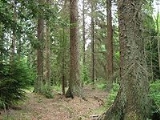
Picea sitchensis, the Sitka Spruce, is a large coniferous evergreen
tree
growing to 50–70 m tall, exceptionally to 95 m tall, and with a trunk diameter of up to 5 m, exceptionally to 6–7 m diameter . It is by far the largest species of spruce
; the fifth largest conifer in the world (behind Giant Sequoia
, Coast Redwood, Kauri
and Western Red Cedar); and the third tallest conifer species (after Coast Redwood and Coast Douglas-fir
). The Sitka Spruce is one of only five species documented to reach 300 feet in height. It acquires its name from the community of Sitka, Alaska
.
 The bark
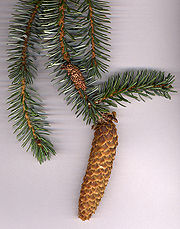
is thin and scaly, flaking off in small circular plates 5–20 cm across. The crown is broad conic in young trees, becoming cylindric in older trees; old trees may have no branches in the lowest 30–40 m. The shoots are very pale buff-brown, almost white, and glabrous (hairless) but with prominent pulvini. The leaves
are stiff, sharp and needle-like, 15–25 mm long, flattened in cross-section, dark glaucous blue-green above with two or three thin lines of stomata, and blue-white below with two dense bands of stomata.
The cones
are pendulous, slender cylindrical, 6–10 cm long and 2 cm broad when closed, opening to 3 cm broad. They have thin, flexible scales 15–20 mm long; the bracts just above the scales are the longest of any spruce, occasionally just exserted and visible on the closed cones. They are green or reddish, maturing pale brown 5–7 months after pollination. The seed
s are black, 3 mm long, with a slender, 7–9 mm long pale brown wing.
on Vancouver Island
, British Columbia
(the Carmanah Giant, at 96 m (315 ft) tall the tallest tree in Canada
), and in the Olympic National Park
, Washington and Prairie Creek Redwoods State Park
, California
(USA); two at the last site are just over 96 m (315 ft) tall. The Queets Spruce is the largest in the world with a trunk volume of 337 m³ (11,901 cu ft) it is 75.6 m (248 ft) tall and 455 cm (15 ft) in dbh
. It is located near the Queets River in Olympic National Park
, about 16 miles (25.7 km) from the Pacific Ocean.
position than Sitka Spruce to the rest of the Spruce. The other thirty-three species of Spruce are more derived
which suggests that Picea originated in North America
.
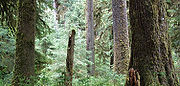 Sitka Spruce is native to the west coast of North America
, with its northwestern limit on Kodiak Island
, Alaska
, and its southeastern limit near Fort Bragg
in northern California
(Griffin & Critchfield 1972). It is closely associated with the temperate rain forest
s and is found within a few kilometers of the coast in the southern portion of its range. North of Oregon, its range extends inland along river floodplains, but nowhere does its range extend more than 80 km from the Pacific Ocean
and its inlets.
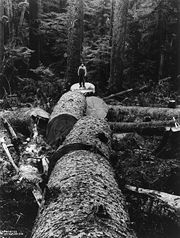 Sitka Spruce is of major importance in forestry
for timber
and paper
production. Outside of its native range, it is particularly valued for its fast growth on poor soils and exposed sites where few other trees can be grown successfully; in ideal conditions young trees may grow 1.5 m per year. It is naturalized in some parts of Ireland
and Great Britain
where it was introduced in 1831 (Mitchell, 1978) and New Zealand
, though not so extensively as to be considered invasive
. Sitka Spruce is also planted extensively in Denmark
, Norway
and Iceland
. In Norway, Sitka spruce was introduced in the early 1900s. An estimated 50,000 hectare
s have been planted in Norway, mainly along the coast from Vest-Agder
in the south to Troms
in the north. It is more tolerant to wind and saline ocean air, and grows faster than the native Norway Spruce
.
Sitka Spruce is used widely in piano
, harp
, violin
, and guitar
manufacture, as its high strength-to-weight ratio and regular, knot-free rings make it an excellent conductor of sound. For these reasons, the wood is also an important material for sailing boat spar
s, aircraft
wing spars, and the nosecones of Trident missile
s. The Wright brothers
' Flyer
was built using Sitka Spruce, as were many or most aircraft before World War II
; during that war, aircraft such as the British Mosquito
used it as a substitute for strategically important aluminium
.
Newly grown tips of Sitka Spruce branches are used to flavour spruce beer
and are boiled to make syrup
.
The root bark of Sitka Spruce trees is used in Native Alaskan basket-weaving designs.
, is sacred to the Haida Native American
people. It was illegally felled, although saplings grown from cuttings can now be found near its original site.
Evergreen
In botany, an evergreen plant is a plant that has leaves in all seasons. This contrasts with deciduous plants, which completely lose their foliage during the winter or dry season.There are many different kinds of evergreen plants, both trees and shrubs...
tree
Tree
A tree is a perennial woody plant. It is most often defined as a woody plant that has many secondary branches supported clear of the ground on a single main stem or trunk with clear apical dominance. A minimum height specification at maturity is cited by some authors, varying from 3 m to...
growing to 50–70 m tall, exceptionally to 95 m tall, and with a trunk diameter of up to 5 m, exceptionally to 6–7 m diameter . It is by far the largest species of spruce
Spruce
A spruce is a tree of the genus Picea , a genus of about 35 species of coniferous evergreen trees in the Family Pinaceae, found in the northern temperate and boreal regions of the earth. Spruces are large trees, from tall when mature, and can be distinguished by their whorled branches and conical...
; the fifth largest conifer in the world (behind Giant Sequoia
Sequoiadendron
Sequoiadendron giganteum is the sole living species in the genus Sequoiadendron, and one of three species of coniferous trees known as redwoods, classified in the family Cupressaceae in the subfamily Sequoioideae, together with Sequoia sempervirens and...
, Coast Redwood, Kauri
Agathis australis
Agathis australis, commonly known as the kauri, is a coniferous tree found north of 38°S in the northern districts of New Zealand's North Island. It is the largest but not tallest species of tree in New Zealand, standing up to 50 m tall in the emergent layer above the forest's main canopy. The...
and Western Red Cedar); and the third tallest conifer species (after Coast Redwood and Coast Douglas-fir
Coast Douglas-fir
Pseudotsuga menziesii, known as Douglas-fir, Oregon Pine, or Douglas spruce, is an evergreen conifer species native to western North America. Its variety Pseudotsuga menziesii var. menziesii, also known as coast Douglas-fir grows in the coastal regions, from west-central British Columbia, Canada...
). The Sitka Spruce is one of only five species documented to reach 300 feet in height. It acquires its name from the community of Sitka, Alaska
Alaska
Alaska is the largest state in the United States by area. It is situated in the northwest extremity of the North American continent, with Canada to the east, the Arctic Ocean to the north, and the Pacific Ocean to the west and south, with Russia further west across the Bering Strait...
.
Description
Bark
Bark is the outermost layers of stems and roots of woody plants. Plants with bark include trees, woody vines and shrubs. Bark refers to all the tissues outside of the vascular cambium and is a nontechnical term. It overlays the wood and consists of the inner bark and the outer bark. The inner...
is thin and scaly, flaking off in small circular plates 5–20 cm across. The crown is broad conic in young trees, becoming cylindric in older trees; old trees may have no branches in the lowest 30–40 m. The shoots are very pale buff-brown, almost white, and glabrous (hairless) but with prominent pulvini. The leaves
Leaf
A leaf is an organ of a vascular plant, as defined in botanical terms, and in particular in plant morphology. Foliage is a mass noun that refers to leaves as a feature of plants....
are stiff, sharp and needle-like, 15–25 mm long, flattened in cross-section, dark glaucous blue-green above with two or three thin lines of stomata, and blue-white below with two dense bands of stomata.
The cones
Conifer cone
A cone is an organ on plants in the division Pinophyta that contains the reproductive structures. The familiar woody cone is the female cone, which produces seeds. The male cones, which produce pollen, are usually herbaceous and much less conspicuous even at full maturity...
are pendulous, slender cylindrical, 6–10 cm long and 2 cm broad when closed, opening to 3 cm broad. They have thin, flexible scales 15–20 mm long; the bracts just above the scales are the longest of any spruce, occasionally just exserted and visible on the closed cones. They are green or reddish, maturing pale brown 5–7 months after pollination. The seed
Seed
A seed is a small embryonic plant enclosed in a covering called the seed coat, usually with some stored food. It is the product of the ripened ovule of gymnosperm and angiosperm plants which occurs after fertilization and some growth within the mother plant...
s are black, 3 mm long, with a slender, 7–9 mm long pale brown wing.
Size
More than a century of logging has left only a remnant of the spruce forest. The largest trees were cut long before careful measurements could be made. Trees over 90 m tall may still be seen in the Pacific Rim National Park and Carmanah Walbran Provincial ParkCarmanah Walbran Provincial Park
Carmanah Walbran Provincial Park, originally Carmanah Pacific Provincial Park, covers a land area of 16,450 ha immediately adjacent to Pacific Rim National Park Reserve's West Coast Trail on south-west Vancouver Island, British Columbia, Canada...
on Vancouver Island
Vancouver Island
Vancouver Island is a large island in British Columbia, Canada. It is one of several North American locations named after George Vancouver, the British Royal Navy officer who explored the Pacific Northwest coast of North America between 1791 and 1794...
, British Columbia
British Columbia
British Columbia is the westernmost of Canada's provinces and is known for its natural beauty, as reflected in its Latin motto, Splendor sine occasu . Its name was chosen by Queen Victoria in 1858...
(the Carmanah Giant, at 96 m (315 ft) tall the tallest tree in Canada
Canada
Canada is a North American country consisting of ten provinces and three territories. Located in the northern part of the continent, it extends from the Atlantic Ocean in the east to the Pacific Ocean in the west, and northward into the Arctic Ocean...
), and in the Olympic National Park
Olympic National Park
Olympic National Park is located in the U.S. state of Washington, in the Olympic Peninsula. The park can be divided into four basic regions: the Pacific coastline, alpine areas, the west side temperate rainforest and the forests of the drier east side. U.S...
, Washington and Prairie Creek Redwoods State Park
Redwood National and State Parks
The Redwood National and State Parks are located in the United States, along the coast of northern California. Comprising Redwood National Park and California's Del Norte Coast, Jedediah Smith, and Prairie Creek Redwoods State Parks , the combined RNSP contain...
, California
California
California is a state located on the West Coast of the United States. It is by far the most populous U.S. state, and the third-largest by land area...
(USA); two at the last site are just over 96 m (315 ft) tall. The Queets Spruce is the largest in the world with a trunk volume of 337 m³ (11,901 cu ft) it is 75.6 m (248 ft) tall and 455 cm (15 ft) in dbh
Diameter at breast height
Diameter at breast height, or DBH, is a standard method of expressing the diameter of the trunk or bole of a standing tree. DBH is one of the most common dendrometric measurements....
. It is located near the Queets River in Olympic National Park
Olympic National Park
Olympic National Park is located in the U.S. state of Washington, in the Olympic Peninsula. The park can be divided into four basic regions: the Pacific coastline, alpine areas, the west side temperate rainforest and the forests of the drier east side. U.S...
, about 16 miles (25.7 km) from the Pacific Ocean.
Age
Sitka Spruce is a long-lived tree, with individuals over 700 years old known. Because it grows rapidly under favorable conditions, large size may not indicate exceptional age. The Queets Spruce has been estimated to be only 350 to 450 years old, but adds more than a cubic meter of wood each year (Van Pelt, 2001).Taxonomy
DNA analyses has shown that only Picea breweriana has a more basalBasal (phylogenetics)
In phylogenetics, a basal clade is the earliest clade to branch in a larger clade; it appears at the base of a cladogram.A basal group forms an outgroup to the rest of the clade, such as in the following example:...
position than Sitka Spruce to the rest of the Spruce. The other thirty-three species of Spruce are more derived
Derived
In phylogenetics, a derived trait is a trait that is present in an organism, but was absent in the last common ancestor of the group being considered. This may also refer to structures that are not present in an organism, but were present in its ancestors, i.e. traits that have undergone secondary...
which suggests that Picea originated in North America
North America
North America is a continent wholly within the Northern Hemisphere and almost wholly within the Western Hemisphere. It is also considered a northern subcontinent of the Americas...
.
Distribution and habitat
North America
North America is a continent wholly within the Northern Hemisphere and almost wholly within the Western Hemisphere. It is also considered a northern subcontinent of the Americas...
, with its northwestern limit on Kodiak Island
Kodiak Island
Kodiak Island is a large island on the south coast of the U.S. state of Alaska, separated from the Alaska mainland by the Shelikof Strait. The largest island in the Kodiak Archipelago, Kodiak Island is the second largest island in the United States and the 80th largest island in the world, with an...
, Alaska
Alaska
Alaska is the largest state in the United States by area. It is situated in the northwest extremity of the North American continent, with Canada to the east, the Arctic Ocean to the north, and the Pacific Ocean to the west and south, with Russia further west across the Bering Strait...
, and its southeastern limit near Fort Bragg
Fort Bragg, California
Fort Bragg is a city located in coastal Mendocino County, California along State Route 1, the major north-south highway along the Pacific Coast. Fort Bragg is located west of Willits, at an elevation of 85 feet...
in northern California
California
California is a state located on the West Coast of the United States. It is by far the most populous U.S. state, and the third-largest by land area...
(Griffin & Critchfield 1972). It is closely associated with the temperate rain forest
Temperate rain forest
Temperate rainforests are coniferous or broadleaf forests that occur in the temperate zone and receive high rainfall.-Definition:For temperate rain forests of North America, Alaback's definition is widely recognized:-Global distribution:...
s and is found within a few kilometers of the coast in the southern portion of its range. North of Oregon, its range extends inland along river floodplains, but nowhere does its range extend more than 80 km from the Pacific Ocean
Pacific Ocean
The Pacific Ocean is the largest of the Earth's oceanic divisions. It extends from the Arctic in the north to the Southern Ocean in the south, bounded by Asia and Australia in the west, and the Americas in the east.At 165.2 million square kilometres in area, this largest division of the World...
and its inlets.
Uses
Forestry
Forestry is the interdisciplinary profession embracing the science, art, and craft of creating, managing, using, and conserving forests and associated resources in a sustainable manner to meet desired goals, needs, and values for human benefit. Forestry is practiced in plantations and natural stands...
for timber
Timber
Timber may refer to:* Timber, a term common in the United Kingdom and Australia for wood materials * Timber, Oregon, an unincorporated community in the U.S...
and paper
Paper
Paper is a thin material mainly used for writing upon, printing upon, drawing or for packaging. It is produced by pressing together moist fibers, typically cellulose pulp derived from wood, rags or grasses, and drying them into flexible sheets....
production. Outside of its native range, it is particularly valued for its fast growth on poor soils and exposed sites where few other trees can be grown successfully; in ideal conditions young trees may grow 1.5 m per year. It is naturalized in some parts of Ireland
Ireland
Ireland is an island to the northwest of continental Europe. It is the third-largest island in Europe and the twentieth-largest island on Earth...
and Great Britain
Great Britain
Great Britain or Britain is an island situated to the northwest of Continental Europe. It is the ninth largest island in the world, and the largest European island, as well as the largest of the British Isles...
where it was introduced in 1831 (Mitchell, 1978) and New Zealand
New Zealand
New Zealand is an island country in the south-western Pacific Ocean comprising two main landmasses and numerous smaller islands. The country is situated some east of Australia across the Tasman Sea, and roughly south of the Pacific island nations of New Caledonia, Fiji, and Tonga...
, though not so extensively as to be considered invasive
Invasive species
"Invasive species", or invasive exotics, is a nomenclature term and categorization phrase used for flora and fauna, and for specific restoration-preservation processes in native habitats, with several definitions....
. Sitka Spruce is also planted extensively in Denmark
Denmark
Denmark is a Scandinavian country in Northern Europe. The countries of Denmark and Greenland, as well as the Faroe Islands, constitute the Kingdom of Denmark . It is the southernmost of the Nordic countries, southwest of Sweden and south of Norway, and bordered to the south by Germany. Denmark...
, Norway
Norway
Norway , officially the Kingdom of Norway, is a Nordic unitary constitutional monarchy whose territory comprises the western portion of the Scandinavian Peninsula, Jan Mayen, and the Arctic archipelago of Svalbard and Bouvet Island. Norway has a total area of and a population of about 4.9 million...
and Iceland
Iceland
Iceland , described as the Republic of Iceland, is a Nordic and European island country in the North Atlantic Ocean, on the Mid-Atlantic Ridge. Iceland also refers to the main island of the country, which contains almost all the population and almost all the land area. The country has a population...
. In Norway, Sitka spruce was introduced in the early 1900s. An estimated 50,000 hectare
Hectare
The hectare is a metric unit of area defined as 10,000 square metres , and primarily used in the measurement of land. In 1795, when the metric system was introduced, the are was defined as being 100 square metres and the hectare was thus 100 ares or 1/100 km2...
s have been planted in Norway, mainly along the coast from Vest-Agder
Vest-Agder
In the 16th century, Dutch merchant vessels began to visit ports in southern Norway to purchase salmon and other goods. Soon thereafter the export of timber began, as oak from southern Norway was exceptionally well suited for shipbuilding...
in the south to Troms
Troms
or Romsa is a county in North Norway, bordering Finnmark to the northeast and Nordland in the southwest. To the south is Norrbotten Län in Sweden and further southeast is a shorter border with Lapland Province in Finland. To the west is the Norwegian Sea...
in the north. It is more tolerant to wind and saline ocean air, and grows faster than the native Norway Spruce
Norway Spruce
Norway Spruce is a species of spruce native to Europe. It is also commonly referred to as the European Spruce.- Description :...
.
Sitka Spruce is used widely in piano
Piano
The piano is a musical instrument played by means of a keyboard. It is one of the most popular instruments in the world. Widely used in classical and jazz music for solo performances, ensemble use, chamber music and accompaniment, the piano is also very popular as an aid to composing and rehearsal...
, harp
Harp
The harp is a multi-stringed instrument which has the plane of its strings positioned perpendicularly to the soundboard. Organologically, it is in the general category of chordophones and has its own sub category . All harps have a neck, resonator and strings...
, violin
Violin
The violin is a string instrument, usually with four strings tuned in perfect fifths. It is the smallest, highest-pitched member of the violin family of string instruments, which includes the viola and cello....
, and guitar
Guitar
The guitar is a plucked string instrument, usually played with fingers or a pick. The guitar consists of a body with a rigid neck to which the strings, generally six in number, are attached. Guitars are traditionally constructed of various woods and strung with animal gut or, more recently, with...
manufacture, as its high strength-to-weight ratio and regular, knot-free rings make it an excellent conductor of sound. For these reasons, the wood is also an important material for sailing boat spar
Spar
In sailing, a spar is a pole of wood, metal or lightweight materials such as carbon fiber used on a sailing vessel. Spars of all types In sailing, a spar is a pole of wood, metal or lightweight materials such as carbon fiber used on a sailing vessel. Spars of all types In sailing, a spar is a...
s, aircraft
Aircraft
An aircraft is a vehicle that is able to fly by gaining support from the air, or, in general, the atmosphere of a planet. An aircraft counters the force of gravity by using either static lift or by using the dynamic lift of an airfoil, or in a few cases the downward thrust from jet engines.Although...
wing spars, and the nosecones of Trident missile
Trident missile
The Trident missile is a submarine-launched ballistic missile equipped with multiple independently-targetable reentry vehicles . The Fleet Ballistic Missile is armed with nuclear warheads and is launched from nuclear-powered ballistic missile submarines . Trident missiles are carried by fourteen...
s. The Wright brothers
Wright brothers
The Wright brothers, Orville and Wilbur , were two Americans credited with inventing and building the world's first successful airplane and making the first controlled, powered and sustained heavier-than-air human flight, on December 17, 1903...
' Flyer
Wright Flyer
The Wright Flyer was the first powered aircraft, designed and built by the Wright brothers. They flew it four times on December 17, 1903 near the Kill Devil Hills, about four miles south of Kitty Hawk, North Carolina, U.S.The U.S...
was built using Sitka Spruce, as were many or most aircraft before World War II
World War II
World War II, or the Second World War , was a global conflict lasting from 1939 to 1945, involving most of the world's nations—including all of the great powers—eventually forming two opposing military alliances: the Allies and the Axis...
; during that war, aircraft such as the British Mosquito
De Havilland Mosquito
The de Havilland DH.98 Mosquito was a British multi-role combat aircraft that served during the Second World War and the postwar era. It was known affectionately as the "Mossie" to its crews and was also nicknamed "The Wooden Wonder"...
used it as a substitute for strategically important aluminium
Aluminium
Aluminium or aluminum is a silvery white member of the boron group of chemical elements. It has the symbol Al, and its atomic number is 13. It is not soluble in water under normal circumstances....
.
Newly grown tips of Sitka Spruce branches are used to flavour spruce beer
Spruce beer
Spruce beer is a beverage flavored with the buds, needles, or essence of spruce trees. Spruce beer can refer to either alcoholic or non-alcoholic beverages....
and are boiled to make syrup
Syrup
In cooking, a syrup is a thick, viscous liquid consisting primarily of a solution of sugar in water, containing a large amount of dissolved sugars but showing little tendency to deposit crystals...
.
The root bark of Sitka Spruce trees is used in Native Alaskan basket-weaving designs.
Culture
A unique specimen with golden foliage that used to grow on Haida Gwaii, known as Kiidk'yaasKiidk'yaas
Kiidk'yaas, also known as the Golden Spruce, was a Sitka Spruce tree, Picea sitchensis 'Aurea', that grew on the banks of the Yakoun River in Haida Gwaii archipelago, British Columbia...
, is sacred to the Haida Native American
Indigenous peoples of the Americas
The indigenous peoples of the Americas are the pre-Columbian inhabitants of North and South America, their descendants and other ethnic groups who are identified with those peoples. Indigenous peoples are known in Canada as Aboriginal peoples, and in the United States as Native Americans...
people. It was illegally felled, although saplings grown from cuttings can now be found near its original site.