


Turbidite

Encyclopedia
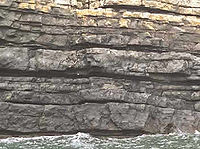
Turbidity current
A turbidity current is a current of rapidly moving, sediment-laden water moving down a slope through water, or another fluid. The current moves because it has a higher density and turbidity than the fluid through which it flows...
deposits
Deposition (geology)
Deposition is the geological process by which material is added to a landform or land mass. Fluids such as wind and water, as well as sediment flowing via gravity, transport previously eroded sediment, which, at the loss of enough kinetic energy in the fluid, is deposited, building up layers of...
, which are deposits from a form of underwater avalanche
Avalanche
An avalanche is a sudden rapid flow of snow down a slope, occurring when either natural triggers or human activity causes a critical escalating transition from the slow equilibrium evolution of the snow pack. Typically occurring in mountainous terrain, an avalanche can mix air and water with the...
that are responsible for distributing vast amounts of clastic sediment
Sediment
Sediment is naturally occurring material that is broken down by processes of weathering and erosion, and is subsequently transported by the action of fluids such as wind, water, or ice, and/or by the force of gravity acting on the particle itself....
into the deep ocean
Ocean
An ocean is a major body of saline water, and a principal component of the hydrosphere. Approximately 71% of the Earth's surface is covered by ocean, a continuous body of water that is customarily divided into several principal oceans and smaller seas.More than half of this area is over 3,000...
.
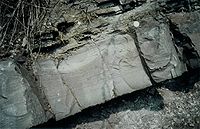
The ideal turbidite sequence
Shale
Shale is a fine-grained, clastic sedimentary rock composed of mud that is a mix of flakes of clay minerals and tiny fragments of other minerals, especially quartz and calcite. The ratio of clay to other minerals is variable. Shale is characterized by breaks along thin laminae or parallel layering...
s, which were anomalous because they started at pebble conglomerates
Conglomerate (geology)
A conglomerate is a rock consisting of individual clasts within a finer-grained matrix that have become cemented together. Conglomerates are sedimentary rocks consisting of rounded fragments and are thus differentiated from breccias, which consist of angular clasts...
and terminated in shales.
This was anomalous because within the deep ocean it had historically been assumed that there was no mechanism by which tractional flow could carry and deposit coarse-grained sediments into the abyssal depths.
Bouma cycles
Bouma sequence
right|300px|thumbnail|Complete Bouma sequence in Devonian Sandstone The Bouma Sequence describes a classic set of sedimentary beds deposited by a sediment-water turbidity current...
begin with an erosional contact of a coarse lower bed of pebble to granule conglomerate in a sandy matrix, and grade up through coarse then medium plane parallel sandstone; through cross-bedded sandstone
Sandstone
Sandstone is a sedimentary rock composed mainly of sand-sized minerals or rock grains.Most sandstone is composed of quartz and/or feldspar because these are the most common minerals in the Earth's crust. Like sand, sandstone may be any colour, but the most common colours are tan, brown, yellow,...
; rippled cross-bedded sand/silty sand, and finally laminar siltstone and shale. This vertical succession of sedimentary structures, bedding, and changing lithology is representative of strong to waning flow regime currents and their corresponding sedimentation.
It is unusual to see all of a complete Bouma cycle, as successive turbidity currents may erode the unconsolidated upper sequences. Alternatively, the entire sequence may not be present depending on whether the exposed section was at the edge of the turbidity current lobe (where it may be present as a thin deposit), or upslope from the deposition centre and manifested as a scour channel filled with fine sands grading up into a pelagic ooze
Pelagic sediments
Pelagic sediment or pelagite is a fine-grained sediment that has accumulated by the settling of particles through the water column to the ocean floor beneath the open ocean far from land. These particles consist primarily of either the microscopic, calcareous or siliceous shells of phytoplankton or...
.
Formation
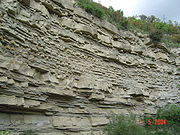
Density
The mass density or density of a material is defined as its mass per unit volume. The symbol most often used for density is ρ . In some cases , density is also defined as its weight per unit volume; although, this quantity is more properly called specific weight...
flow, not by traction
Traction
- Engineering :*Forces:** Traction , adhesive friction or force in the context of vehicle** Traction vector, in mechanics, the force per unit area on a surface, including normal and shear components...
al or friction
Friction
Friction is the force resisting the relative motion of solid surfaces, fluid layers, and/or material elements sliding against each other. There are several types of friction:...
al flow.
The distinction is that, in a normal river
River
A river is a natural watercourse, usually freshwater, flowing towards an ocean, a lake, a sea, or another river. In a few cases, a river simply flows into the ground or dries up completely before reaching another body of water. Small rivers may also be called by several other names, including...
or stream bed, particles of rock are carried along by frictional drag of water on the particle (known as tractional flow). The water must be travelling at a certain velocity in order to suspend the particle in the water and push it along. The greater the size or density of the particle relative to the fluid in which it is travelling, the higher the water velocity required to suspend it and transport it.
Density based flow, however, occurs when liquefaction
Liquefaction
Liquefaction may refer to:* Liquefaction, the general process of becoming liquid* Soil liquefaction, the process by which sediments become suspended* Liquefaction of gases in physics, chemistry, and thermal engineering* Liquefactive necrosis in pathology...
of sediment during transport causes a change to the density of the fluid. This is usually achieved by highly turbulent
Turbulence
In fluid dynamics, turbulence or turbulent flow is a flow regime characterized by chaotic and stochastic property changes. This includes low momentum diffusion, high momentum convection, and rapid variation of pressure and velocity in space and time...
liquids which have a suspended load of fine grained particles forming a slurry
Slurry
A slurry is, in general, a thick suspension of solids in a liquid.-Examples of slurries:Examples of slurries include:* Lahars* A mixture of water and cement to form concrete* A mixture of water, gelling agent, and oxidizers used as an explosive...
. In this case, larger fragments of rock can be transported at water velocities too low to otherwise do so because of the lower density contrast (that is, the water plus sediment has a higher density than the water and is therefore closer to the density of the rock).
This condition occurs in many environments aside from simply the deep ocean, where turbidites are particularly well represented. Lahars on the side of volcanoes, mudslide
Mudflow
A mudslide is the most rapid and fluid type of downhill mass wasting. It is a rapid movement of a large mass of mud formed from loose soil and water. Similar terms are mudflow, mud stream, debris flow A mudslide is the most rapid (up to 80 km/h, or 50 mph) and fluid type of downhill mass...
s and pyroclastic flow
Pyroclastic flow
A pyroclastic flow is a fast-moving current of superheated gas and rock , which reaches speeds moving away from a volcano of up to 700 km/h . The flows normally hug the ground and travel downhill, or spread laterally under gravity...
s all create density-based flow situations and, especially in the latter, can create sequences which are strikingly similar to turbidites.
Turbidites in sediments can occur in carbonate as well as siliciclastic sequences.
Classic, low-density turbidites are characterized by graded bedding
Graded bedding
In geology, a graded bed is one characterized by a systematic change in grain or clast size from the base of the bed to the top. Most commonly this takes the form of normal grading, with coarser sediments at the base, which grade upward into progressively finer ones...
, current
Ocean current
An ocean current is a continuous, directed movement of ocean water generated by the forces acting upon this mean flow, such as breaking waves, wind, Coriolis effect, cabbeling, temperature and salinity differences and tides caused by the gravitational pull of the Moon and the Sun...
ripple marks
Ripple marks
In geology, ripple marks are sedimentary structures and indicate agitation by water or wind.- Defining ripple cross-laminae and asymmetric ripples :...
, alternating sequences with pelagic sediments, distinct fauna changes between the turbidite and native pelagic sediments, sole markings
Sole markings
Sole marks are sedimentary structures found on the bases of certain strata, that indicate small-scale grooves or irregularities. This usually occurs at the interface of two differing lithologies and/or grain sizes. They are commonly preserved as casts of these indents on the bottom of the...
, thick sediment sequences, regular bedding
Stratum
In geology and related fields, a stratum is a layer of sedimentary rock or soil with internally consistent characteristics that distinguish it from other layers...
, and an absence of shallow-water features (Fairbridge, 1966).
Massive accumulations of turbidites and other deep water deposits may result in the formation of submarine fans. Sedimentary models of such fan systems typically are subdivided into upper, mid, and lower fan sequences each with distinct sand-body geometries, sediment
Sediment
Sediment is naturally occurring material that is broken down by processes of weathering and erosion, and is subsequently transported by the action of fluids such as wind, water, or ice, and/or by the force of gravity acting on the particle itself....
distributions, and lithologic characteristics (Mutti & Ricci Lucci, 1975; Normark, 1978; & Walker, 1978).
Importance of turbidites
Turbidites provide a mechanism for assigning a tectonic and depositional setting to ancient sedimentary sequences as they usually represent deep water rocks formed offshore of a convergent marginConvergent boundary
In plate tectonics, a convergent boundary, also known as a destructive plate boundary , is an actively deforming region where two tectonic plates or fragments of lithosphere move toward one another and collide...
, and generally require at least a sloping shelf and some form of tectonism to trigger density-based avalanches.
Turbidites from lakes are also important as they can provide chronologic evidence of the frequency of landslides and the earthquakes that presumably formed them, by dating varve
Varve
A varve is an annual layer of sediment or sedimentary rock.The word 'varve' is derived from the Swedish word varv whose meanings and connotations include 'revolution', 'in layers', and 'circle'. The term first appeared as Hvarfig lera on the first map produced by the Geological Survey of Sweden in...
s above and below the turbidite.
Economic geology of turbidites
Turbidite sequences are classic hosts for lode goldGold
Gold is a chemical element with the symbol Au and an atomic number of 79. Gold is a dense, soft, shiny, malleable and ductile metal. Pure gold has a bright yellow color and luster traditionally considered attractive, which it maintains without oxidizing in air or water. Chemically, gold is a...
deposits, the prime example being Bendigo
Bendigo, Victoria
Bendigo is a major regional city in the state of Victoria, Australia, located very close to the geographical centre of the state and approximately north west of the state capital Melbourne. It is the second largest inland city and fourth most populous city in the state. The estimated urban...
and Ballarat
Ballarat, Victoria
Ballarat is a city in the state of Victoria, Australia, approximately west-north-west of the state capital Melbourne situated on the lower plains of the Great Dividing Range and the Yarrowee River catchment. It is the largest inland centre and third most populous city in the state and the fifth...
, Victoria
Victoria (Australia)
Victoria is the second most populous state in Australia. Geographically the smallest mainland state, Victoria is bordered by New South Wales, South Australia, and Tasmania on Boundary Islet to the north, west and south respectively....
, Australia
Australia
Australia , officially the Commonwealth of Australia, is a country in the Southern Hemisphere comprising the mainland of the Australian continent, the island of Tasmania, and numerous smaller islands in the Indian and Pacific Oceans. It is the world's sixth-largest country by total area...
, where over 2,600 tons of gold have been extracted from saddle reef deposits hosted in shale sequences from a thick succession of Cambrian-Ordovician turbidites. Proterozoic
Proterozoic
The Proterozoic is a geological eon representing a period before the first abundant complex life on Earth. The name Proterozoic comes from the Greek "earlier life"...
gold deposits are also known from turbidite basin deposits.
Lithified accumulations of turbidite deposits may, in time, become hydrocarbon
Hydrocarbon
In organic chemistry, a hydrocarbon is an organic compound consisting entirely of hydrogen and carbon. Hydrocarbons from which one hydrogen atom has been removed are functional groups, called hydrocarbyls....
reservoirs and the petroleum
Petroleum
Petroleum or crude oil is a naturally occurring, flammable liquid consisting of a complex mixture of hydrocarbons of various molecular weights and other liquid organic compounds, that are found in geologic formations beneath the Earth's surface. Petroleum is recovered mostly through oil drilling...
industry makes strenuous efforts to predict the location, overall shape, and internal characteristics of these sediment bodies in order to efficiently develop fields as well as explore for new reserves. Turbidite deposits typically occur in foreland basin
Foreland basin
A foreland basin is a depression that develops adjacent and parallel to a mountain belt. Foreland basins form because the immense mass created by crustal thickening associated with the evolution of a mountain belt causes the lithosphere to bend, by a process known as lithospheric flexure...
s.