
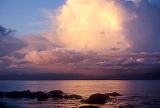
The
Strait of Juan de Fuca (called
Juan de Fuca Strait in Canada) is a large body of water about 95 miles (152.9 km) long that is the
Salish SeaThe name Salish Sea was coined only in the late 20th century, and was officially recognized by the United States in 2009 and by Canada in 2010, to describe the coastal waterways surrounding southern Vancouver Island and Puget Sound between Canada and the United States of America...
outlet to the
Pacific OceanThe Pacific Ocean is the largest of the Earth's oceanic divisions. It extends from the Arctic in the north to the Southern Ocean in the south, bounded by Asia and Australia in the west, and the Americas in the east.At 165.2 million square kilometres in area, this largest division of the World...
. The international boundary between the
United StatesThe United States of America is a federal constitutional republic comprising fifty states and a federal district...
and
CanadaCanada is a North American country consisting of ten provinces and three territories. Located in the northern part of the continent, it extends from the Atlantic Ocean in the east to the Pacific Ocean in the west, and northward into the Arctic Ocean...
runs down the center of the Strait.
It was named in 1787 by the
maritime fur tradeThe Maritime Fur Trade was a ship-based fur trade system that focused on acquiring furs of sea otters and other animals from the indigenous peoples of the Pacific Northwest Coast and natives of Alaska. The furs were mostly sold in China in exchange for tea, silks, porcelain, and other Chinese...
r
Charles William BarkleyCharles William Barkley was a ship captain and maritime fur trader. He was born in Hertford, England, son of Charles Barkley....
, captain of the
Imperial EagleThe Imperial Eagle was a 400 ton burthen British merchant ship that sailed on maritime fur trading ventures in the late 1780s. It was under the command of Captain Charles William Barkley until confiscated in India. The ship, Loudoun, was a decommissioned East Indiaman...
, for
Juan de FucaIoánnis Fokás , better known by the Spanish transcription of his name, Juan de Fuca , was a Greek-born maritime pilot in the service of the king of Spain, Philip II...
, the Greek navigator who sailed in a Spanish expedition in 1592 to seek the fabled Strait of Anián. Barkley was the first non-indigenous person to find the strait, unless Juan de Fuca's dubious story was true. The strait was explored in detail between 1789 and 1791 by
Manuel QuimperManuel Quimper Benítez del Pino was a Spanish Peruvian explorer, cartographer, naval officer, and colonial official. He participated in charting the Strait of Juan de Fuca and the Sandwich Islands in the late 18th century. He was later appointed a colonial governor in his native Peru at the...
,
José María NarváezJosé María Narváez was a Spanish naval officer, explorer, and navigator notable for his work in the Pacific Northwest of present-day Canada. In 1791, as commander of the schooner Santa Saturnina, he led the first European exploration of the Strait of Georgia, including a landing on present-day...
,
Juan CarrascoJuan Carrasco was a Spanish naval officer, explorer, and navigator. He is remembered mainly for his work in the Pacific Northwest during the late 18th century. He was second in command of the 1791 voyage of José María Narváez, the first European exploration of the Strait of Georgia.Many details...
,
Gonzalo López de HaroGonzalo López de Haro was a Spanish explorer, notable for his expeditions in the Pacific Northwest in the late 18th century....
, and
Francisco de ElizaFrancisco de Eliza y Reventa was a Spanish naval officer, navigator, and explorer. He is remembered mainly for his work in the Pacific Northwest...
.
Definition
The
USGSThe United States Geological Survey is a scientific agency of the United States government. The scientists of the USGS study the landscape of the United States, its natural resources, and the natural hazards that threaten it. The organization has four major science disciplines, concerning biology,...
defines the Strait of Juan de Fuca as a
channelIn physical geography, a channel is the physical confine of a river, slough or ocean strait consisting of a bed and banks.A channel is also the natural or human-made deeper course through a reef, sand bar, bay, or any shallow body of water...
. It extends east from the Pacific Ocean between
Vancouver IslandVancouver Island is a large island in British Columbia, Canada. It is one of several North American locations named after George Vancouver, the British Royal Navy officer who explored the Pacific Northwest coast of North America between 1791 and 1794...
,
British ColumbiaBritish Columbia is the westernmost of Canada's provinces and is known for its natural beauty, as reflected in its Latin motto, Splendor sine occasu . Its name was chosen by Queen Victoria in 1858...
, and the
Olympic PeninsulaThe Olympic Peninsula is the large arm of land in western Washington state of the USA, that lies across Puget Sound from Seattle. It is bounded on the west by the Pacific Ocean, the north by the Strait of Juan de Fuca, and the east by Puget Sound. Cape Alava, the westernmost point in the contiguous...
, Washington, to
Haro StraitHaro Strait, often referred to as the Haro Straits because it is really a series of straits, is one of the main channels connecting the Strait of Georgia to the Strait of Juan de Fuca, separating Vancouver Island and the Gulf Islands in British Columbia, Canada from the San Juan Islands of...
, San Juan Channel,
Rosario StraitRosario Strait is a strait in northern Washington state, separating Island and San Juan Counties. It extends from the Strait of Juan de Fuca about north to the Strait of Georgia...
, and
Puget SoundPuget Sound is a sound in the U.S. state of Washington. It is a complex estuarine system of interconnected marine waterways and basins, with one major and one minor connection to the Strait of Juan de Fuca and the Pacific Ocean — Admiralty Inlet being the major connection and...
. The Pacific Ocean boundary is formed by a line between Cape Flattery and Tatoosh Island, Washington, and Carmanah Point (Vancouver Island), British Columbia. Its northern boundary follows the shoreline of Vancouver Island from Carmanah Point to Gonzales Point, then follows a continuous line east to Seabird Point (Discovery Island), British Columbia, Cattle Point (
San Juan IslandSan Juan Island is the second-largest and most populous of the San Juan Islands in northwestern Washington, United States. It has a land area of 142.59 km² and a population of 6,822 as of the 2000 census....
), Washington,
Iceberg PointIceberg Point is a prominent point 8 miles west-southwest of Ryswyck Point, on the east side of Anvers Island, in the Palmer Archipelago. The point was first mapped by the Belgian Antarctic Expedition, 1897-99. The name appears on a chart based upon a 1927 survey by DI personnel on the Discovery,...
(
Lopez IslandLopez Island is the third largest of the U.S. San Juan Islands. Lopez Island is in land area. The 2000 census population was 2,177.-History:...
), Point Colville (Lopez Island), and then to Rosario Head (
Fidalgo IslandFidalgo Island is an island in Skagit County, Washington, located about north of Seattle. To the east, it is separated from the mainland by the Swinomish Channel, and from Whidbey Island to the south by Deception Pass...
). The eastern boundary runs south from Rosario Head across
Deception PassDeception Pass is a strait separating Whidbey Island from Fidalgo Island, in the northwest part of the U.S. state of Washington. It connects Skagit Bay, part of Puget Sound, with the Strait of Juan de Fuca.-History:...
to
Whidbey IslandWhidbey Island is one of nine islands located in Island County, Washington, in the United States. Whidbey is located about north of Seattle, and lies between the Olympic Peninsula and the I-5 corridor of western Washington...
, then along the western coast of Whidbey Island to
Point PartridgePoint Partridge is the most westerly point of Whidbey Island, the largest island in Puget Sound. The point lies north of the Fort Ebey military reservation and south of West Beach. The primary importance of Point Partridge is as the northern and eastern reference point for the dividing line...
, then across
Admiralty InletAdmiralty Inlet is a strait in the U.S. state of Washington connecting the eastern end of the Strait of Juan de Fuca to Puget Sound. It lies between Whidbey Island and the northeastern part of the Olympic Peninsula....
to
Point WilsonPoint Wilson is at the end of the Quimper Peninsula, a northeast extension of the Olympic Peninsula and the northeastern most point of Jefferson County, Washington, United States, approximately two miles north of the Port Townsend business district....
(
Quimper PeninsulaThe Quimper Peninsula is a narrow peninsula forming the most northeastern extent of the Olympic Peninsula of Washington state in the northwestern United States of America....
). The northern coast of the
Olympic PeninsulaThe Olympic Peninsula is the large arm of land in western Washington state of the USA, that lies across Puget Sound from Seattle. It is bounded on the west by the Pacific Ocean, the north by the Strait of Juan de Fuca, and the east by Puget Sound. Cape Alava, the westernmost point in the contiguous...
forms the southern boundary of the strait. In the eastern entrance to the Strait, the Race Rocks Archipelago is located in the high current zone half way between Port Angeles Washington State, and Victoria, BC. Live video images of the Strait of Juan de Fuca may be seen on the cameras located at http://www.racerocks.com from the
Race Rocks Marine Protected AreaRace Rocks is a marine ecological reserve in the eastern entrance of the Strait of Juan de Fuca. The reserve served as a Marine Protected Area pilot project and is now seeking Marine Protected Area designation after the first bid in 2000 was derailed in Ottawa. Started in 1978 as a marine science...
.
Weather
Because it is exposed to the generally westerly winds and waves of the Pacific, seas and weather in Juan de Fuca Strait are, on average, rougher than in the more protected waters inland, thereby resulting in a number of small craft advisories. A weather station provides live data from Race Rocks at http://racerocks.ca/racerock/data/weatherlink/Current_Vantage_Pro.htm
Ferries
An international vehicle ferry crosses the Strait from
Port Angeles, WashingtonPort Angeles is a city in and the county seat of Clallam County, Washington, United States. The population was 19,038 at the 2010 census. The area's harbor was dubbed Puerto de Nuestra Señora de los Ángeles by Spanish explorer Francisco de Eliza in 1791, but by the mid-19th century the name had...
to
Victoria, British ColumbiaVictoria is the capital city of British Columbia, Canada and is located on the southern tip of Vancouver Island off Canada's Pacific coast. The city has a population of about 78,000 within the metropolitan area of Greater Victoria, which has a population of 360,063, the 15th most populous Canadian...
several times each day, as do passenger ferries of the Washington State Ferry system, a seasonal
private ferryVictoria Express, also known as Victoria Rapid Transit, was the name of a private, seasonal ferry operation based in Port Angeles, Washington. They operated two passenger-only ferries, on routes between Port Angeles and Victoria, British Columbia and Friday Harbor, Washington during the summer,...
connecting Port Angeles with Victoria and a private high-speed ferry between Victoria and
SeattleSeattle is the county seat of King County, Washington. With 608,660 residents as of the 2010 Census, Seattle is the largest city in the Northwestern United States. The Seattle metropolitan area of about 3.4 million inhabitants is the 15th largest metropolitan area in the country...
.
Boundary dispute
This strait remains the subject of a maritime boundary dispute between Canada and the United States. The dispute is only over the seaward boundary extending 200 miles (321.9 km) west from the mouth of the strait. The maritime boundary within the strait is not in dispute. Both governments have proposed a boundary based on the
principle of equidistanceThe equidistance principle or principle of equidistance is a legal concept introduced in maritime boundary claims.The phrase denotes a concept of political geography and international law — that a nation's maritime boundaries should conform to a median line equidistant from the shores of...
, but with different basepoint selections, resulting in small differences in the line. Resolution of the issue should be simple, but has been hindered because it might influence other unresolved maritime boundary issues between Canada and the US. In addition, the government of British Columbia has rejected both equidistant proposals, instead arguing that the Juan de Fuca
submarine canyonA submarine canyon is a steep-sided valley on the sea floor of the continental slope. Many submarine canyons are found as extensions to large rivers; however there are some that have no such association. Canyons cutting the continental slopes have been found at depths greater than 2 km below sea...
is the appropriate "geomorphic and physiogeographic boundary." The proposed equidistant boundary currently marks the northern boundary of the
Olympic Coast National Marine SanctuaryThe Olympic Coast National Marine Sanctuary is one of 14 marine sanctuaries administered by the National Oceanic and Atmospheric Administration , an agency of the U.S. Department of Commerce. It is located along the Olympic Peninsula of Washington state...
. British Columbia's position is based on the principle of natural prolongation which developed in
international lawPublic international law concerns the structure and conduct of sovereign states; analogous entities, such as the Holy See; and intergovernmental organizations. To a lesser degree, international law also may affect multinational corporations and individuals, an impact increasingly evolving beyond...
. It poses a dilemma for the federal government of Canada. If Canada holds that the principle of natural prolongation applies to the Juan de Fuca Canyon on its
Pacific OceanThe Pacific Ocean is the largest of the Earth's oceanic divisions. It extends from the Arctic in the north to the Southern Ocean in the south, bounded by Asia and Australia in the west, and the Americas in the east.At 165.2 million square kilometres in area, this largest division of the World...
coast, the assertion could undermine Canada's argument in the
Gulf of Maine boundary dispute. In this
Atlantic OceanThe Atlantic Ocean is the second-largest of the world's oceanic divisions. With a total area of about , it covers approximately 20% of the Earth's surface and about 26% of its water surface area...
context, Canada favors an outcome based on the principle of equidistance.
Salish Sea
In March 2008, the
Chemainus First NationThe Stz'uminus First Nation is a First Nations government located in southeastern Vancouver Island, British Columbia, Canada, near the town of Ladysmith, British Columbia. Stz'uminus First Nation is a member government of the Naut'sa mawt Tribal Council...
proposed renaming the strait the "
Salish SeaThe name Salish Sea was coined only in the late 20th century, and was officially recognized by the United States in 2009 and by Canada in 2010, to describe the coastal waterways surrounding southern Vancouver Island and Puget Sound between Canada and the United States of America...
", an idea that reportedly met with approval by B.C.'s Aboriginal Relations Minister
Mike de JongMike de Jong, Q.C. is a politician from British Columbia, Canada.-Politics and career:He was appointed Minister of Health Mike de Jong on March 14, 2011. He has previously held the post of Attorney General and Government House Leader, Minister of Public Safety and Solicitor General and Minister of...
, who pledged to put it before the
B.C. cabinetThe Executive Council of British Columbia is the cabinet of that Canadian province....
for discussion. Making the name "Salish Sea" official required a formal application to the
Geographical Names Board of CanadaGeographical Names Board of Canada is a national committee of the Canadian Government Department of Natural Resources which authorizes the names used on official federal government maps of Canada since 1897. The board consists of 27 members including one from each of the provinces and territories...
. A parallel American movement promoting the name had a different definition, combining of the Strait of Juan de Fuca and
Puget SoundPuget Sound is a sound in the U.S. state of Washington. It is a complex estuarine system of interconnected marine waterways and basins, with one major and one minor connection to the Strait of Juan de Fuca and the Pacific Ocean — Admiralty Inlet being the major connection and...
as well as the Strait of Georgia and related waters under the name Salish Sea. This latter definition was made official in 2009 by geographic boards of Canada and the United States.
In October 2009, the Washington state Board of Geographic Names approved the Salish Sea toponym, not to replace the names of the Strait of Georgia, Puget Sound, and Strait of Juan de Fuca, but instead as a collective term for all three. The British Columbia Geographical Names Office passed a resolution only recommending that the name be adopted by the
Geographical Names Board of CanadaGeographical Names Board of Canada is a national committee of the Canadian Government Department of Natural Resources which authorizes the names used on official federal government maps of Canada since 1897. The board consists of 27 members including one from each of the provinces and territories...
, should its US counterpart approve the name-change. The
United States Board on Geographic NamesThe United States Board on Geographic Names is a United States federal body whose purpose is to establish and maintain uniform usage of geographic names throughout the U.S. government.-Overview:...
approved the name on November 12, 2009.
Counties and regional districts
Counties along the Strait of Juan de Fuca:
- Clallam County, Washington
- Jefferson County, Washington
Jefferson County is a county located in the U.S. state of Washington, named after Thomas Jefferson. As of 2010, the population was 29,872. The county seat is at Port Townsend, which is also the county's only incorporated city....
- Island County, Washington
Island County is a county located in the U.S. state of Washington. In 2010 census, its population was 78,506. Its county seat is Coupeville, while its largest city is Oak Harbor....
- San Juan County, Washington
Regional districts along the Strait of Juan de Fuca:
- Capital Regional District, British Columbia
The Capital Regional District is a local government administrative district encompassing the southern tip of Vancouver Island and the southern Gulf Islands in the Canadian province of British Columbia...
Fauna
Certain groups of seabirds called Common Murre migrate north by swimming. Some Pacific Coast Murres paddle north to the sheltered bays of the Strait of Juan de Fuca to feed on herring and other small fish.
See also
- Graveyard of the Pacific
The Graveyard of the Pacific is a nickname for a stretch of the coastal region in the Pacific Northwest, from Tillamook Bay on the Oregon Coast northward to the tip of Vancouver Island...
- List of areas disputed by the United States and Canada
- Oregon boundary dispute
The Oregon boundary dispute, or the Oregon Question, arose as a result of competing British and American claims to the Pacific Northwest of North America in the first half of the 19th century. Both the United Kingdom and the United States had territorial and commercial aspirations in the region...
- Race Rocks Marine Protected Area
Race Rocks is a marine ecological reserve in the eastern entrance of the Strait of Juan de Fuca. The reserve served as a Marine Protected Area pilot project and is now seeking Marine Protected Area designation after the first bid in 2000 was derailed in Ottawa. Started in 1978 as a marine science...
External links