

United Nations list of Non-Self-Governing Territories

Encyclopedia
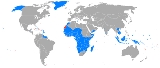
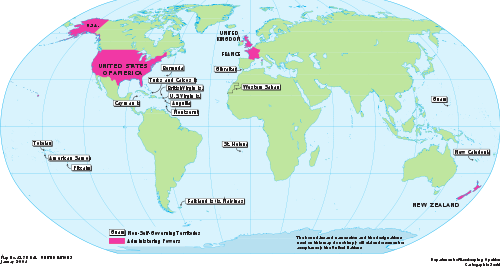
The United Nations list of Non-Self-Governing Territories is a list of countries that, according to the United Nations
, are non-decolonized
. The list was initially prepared in 1946 pursuant to Chapter XI
of the United Nations Charter
, and has been updated by the General Assembly
on recommendation of the Special Committee on Decolonization
and its predecessors. Only permanently inhabited territories are considered for inclusion in this list, excluding many remote atoll
s (e.g., Clipperton Island
and Kingman Reef
) and Southern Ocean
territories (e.g., French Southern and Antarctic Lands and Heard Island and McDonald Islands
). The list currently contains 16 entries.
, Greenland
, the Netherlands Antilles
, and Suriname
).
The list draws its origins from the period of colonialism
and the Charter's concept of non-self-governing territories
. As an increasing number of formerly colonized countries became UN members, the General Assembly increasingly asserted its authority to place additional territories on the List and repeatedly declared that only the General Assembly had the authority to authorize a territory's being removed from the list upon attainment of any status other than full independence. For example, when Portugal
joined the United Nations, it contended that it controlled no non-self-governing territories (because areas such as Angola
and Mozambique
were purported to be an integral part of the Portuguese state), but the General Assembly rejected this position. Similarly, Western Sahara
was added in 1963 when it was a Spanish
colony. The same can be said about the situation of Namibia
(removed upon its independence in 1990), which was seen, due to its former status as a mandate territory
, as a vestige of German colonial legacy
in Africa. A set of criteria for determining whether a territory is to be considered "non-self-governing" was established in General Assembly Resolution 1541 (XV) of 1960.
Also in 1960, the General Assembly adopted Resolution 1514 (XV), promulgating the "Declaration on the Granting of Independence to Colonial Countries and Peoples", which declared that all remaining non-self-governing territories and trust territories
were entitled to self-determination
and independence
. The following year, the General Assembly established the Special Committee on the Situation with Regard to the Implementation of the Declaration on the Granting of Independence to Colonial Countries and Peoples (sometimes referred to as the Special Committee on Decolonization, or the "Committee of 24" because for much of its history the committee was composed of 24 members), which reviews the situation in non-self-governing territories each year and reports to the General Assembly.
 The list remains controversial for various reasons.
, but there is insufficient voter participation). Other non-self-determining areas are excluded.
Another example is Tokelau
. In response to attempts at decolonizing Tokelau, New Zealand
journalist Michael Field wrote in 2004: "The UN [...] is anxious to rid the world of the last remaining vestiges of colonialism by the end of the decade. It has a list of 16 territories around the world, virtually none of which wants to be independent to any degree". Tokelau is seen by some as a case in point. Field further notes that Patuki Isaako
, who was head of Tokelau's government at the time of a UN seminar on decolonization in 2004, informed the United Nations that his country had no wish to be decolonized, and that Tokelauans had opposed the idea of decolonization ever since the first visit by UN officials in 1976. In 2006, a UN-supervised referendum on decolonization was held in Tokelau, where voters rejected the offer of self-government. When the first referendum failed, a second was held in 2007
, and Tokelauans rejected it again. This led New Zealand politician and former diplomat John Hayes
, on behalf of the National Party
, to state that "Tokelau did the right thing to resist pressure from [the New Zealand government] and the United Nations to pursue self-government". The United Nations most likely supported there being a referendum because clear majorities of Tokelauans support self-government in association with New Zealand. This was reinforced by the results of the referendum, which show that over 60% (60.07% in the first referendum, and 64.40% in the second) voted for self-government. However, the terms of the referendum required a two-thirds majority to vote in favor of self-government. On the second occasion, the proposition failed by just 16 votes. In May 2008, the United Nations' Secretary General Ban Ki-moon
urged colonial powers "to complete the decolonization process in every one of the remaining 16 Non-Self-Governing Territories". This led the New Zealand Herald
to comment that the United Nations was "apparently frustrated by two failed attempts to get Tokelau to vote for independence from New Zealand".
Gibraltar
is another prime example of resident desires to remain with the status quo
. Gibraltar, a largely self-governing British territory on the tip of the Iberian Peninsula
whose territory is claimed by Spain
, has twice held referenda to resolve their status. In the first referendum, held in 1967, the choices in the ballot were either to retain their current status or to become part of Spain. The status quo was favoured by 12,138 votes to 44. In the second referendum, held in 2002, a proposal for a joint Anglo-Spanish administration of the territory was proposed, and was voted down by 17,900 votes to 187 - the "no" vote accounting for more than 85% of Gibraltar's entire voting population.
Population (or lack thereof) is also an issue regarding at least one territory included on the list: the British colony Pitcairn Islands
, with a total population of 48 (many of whom are related), has simply too small a population base (and habitable landmass for expansion), to be realistically viable as an independent state.
 Another criticism is that a number of the listed territories, such as Bermuda
, consider themselves completely autonomous and self-governing, with the "administering power" retaining limited oversight over matters such as defence and diplomacy. In past years, there were ongoing disputes between some administering powers and the Decolonization Committee over whether territories such as pre-independence Brunei
and the West Indies Associated States
should still be considered "non-self-governing," particularly in instances where the administering country was prepared to grant full independence whenever the territory requested it. These disputes became redundant as those territories eventually received full independence.
, the Netherlands Antilles
, and the Cook Islands
— have been removed from the list by vote of the General Assembly, often under pressure of the colonizing power or similar circumstances. In 1972, for example, Hong Kong
(then administered by the United Kingdom) and Macau
(then administered by Portugal) were removed from the list at the request of the People's Republic of China
, which had just been recognized as holding China's seat at the United Nations.
Some territories that have been annexed
and incorporated into the legal framework of the controlling state (such as the overseas departments of France) are considered by the UN to have been decolonized, since they then no longer constitute "non-self-governing" entities; their populations are assumed to have agreed to merge
with the former parent state. However, in 1961, the General Assembly voted to end this treatment for the then-"overseas provinces" of Portugal such as Angola
and Mozambique
, which were active foci of United Nations attention until they attained independence in the mid-1970s.
, then an overseas territory, was reinstated on the list of non-self-governing territories, an action that France protested. New Caledonia is the only French-administered territory now on the list; it has enjoyed the status of a collectivité sui generis, or a one-of-a-kind community, since 1999. Under the 1998 Nouméa Accord
, its Territorial Congress has the right to call for a referendum on independence after 2014.
, namely Australia
, Belgium
, Denmark
, France
, Italy
, Netherlands
, New Zealand
, Portugal
, South Africa
, Spain
, United Kingdom
, and United States
. This list of administering states wasn't expanded afterwards.
Nevertheless some of the 111 members who joined the UN after 1960 gained independence from countries not covered by Resolution 1541 and were themselves not classified as "Non-Self-Governing Territories" by the UN. Of these that joined the UN between 1960 and 2008, 11 were independent before 1960 and 71 were included on the list (some as a group). Out of the other 29, seven (mostly Arab
) were colonies or protectorates of the "Western" countries, six were part of Yugoslavia
, two were part of Czechoslovakia
, 12 were part of the Soviet Union
(Russia, Ukraine, and Belarus already had UN seats before the dissolution of the USSR) and one each was part of Ethiopia
and Pakistan
.
The Spanish colony of the Spanish Sahara
up to 1976, 85% of the territory of Western Sahara is now occupied
and administered by Morocco
. The rest of the territory
is under the control
of the Polisario Front
and administered by the Sahrawi Arab Democratic Republic
. The UN however still considers Spain as administrating country of the whole territory
, awaiting the outcome of the ongoing Manhasset negotiations
and resulting election to be overseen by the United Nations Mission for the Referendum in Western Sahara
.
United Nations
The United Nations is an international organization whose stated aims are facilitating cooperation in international law, international security, economic development, social progress, human rights, and achievement of world peace...
, are non-decolonized
Decolonization
Decolonization refers to the undoing of colonialism, the unequal relation of polities whereby one people or nation establishes and maintains dependent Territory over another...
. The list was initially prepared in 1946 pursuant to Chapter XI
Chapter XI of the United Nations Charter
Chapter XI of the United Nations Charter deals with non-self-governing territories. The reference to "territories whose peoples have not yet attained a full measure of self-government" reflects the growing sense of inevitability with which the political independence of these countries was coming to...
of the United Nations Charter
United Nations Charter
The Charter of the United Nations is the foundational treaty of the international organization called the United Nations. It was signed at the San Francisco War Memorial and Performing Arts Center in San Francisco, United States, on 26 June 1945, by 50 of the 51 original member countries...
, and has been updated by the General Assembly
United Nations General Assembly
For two articles dealing with membership in the General Assembly, see:* General Assembly members* General Assembly observersThe United Nations General Assembly is one of the five principal organs of the United Nations and the only one in which all member nations have equal representation...
on recommendation of the Special Committee on Decolonization
Special Committee on Decolonization
The Special Committee on Decolonization was created in 1961 by the General Assembly of the United Nations with the purpose of monitoring implementation of the Declaration on the Granting of Independence to Colonial Countries and Peoples...
and its predecessors. Only permanently inhabited territories are considered for inclusion in this list, excluding many remote atoll
Atoll
An atoll is a coral island that encircles a lagoon partially or completely.- Usage :The word atoll comes from the Dhivehi word atholhu OED...
s (e.g., Clipperton Island
Clipperton Island
Clipperton Island is an uninhabited nine-square-kilometre coral atoll in the eastern Pacific Ocean, southwest of Mexico and west of Central America, at...
and Kingman Reef
Kingman Reef
Kingman Reef is a largely submerged, uninhabited triangular shaped reef, east-west and north-south, located in the North Pacific Ocean, roughly half way between the Hawaiian Islands and American Samoa at...
) and Southern Ocean
Southern Ocean
The Southern Ocean comprises the southernmost waters of the World Ocean, generally taken to be south of 60°S latitude and encircling Antarctica. It is usually regarded as the fourth-largest of the five principal oceanic divisions...
territories (e.g., French Southern and Antarctic Lands and Heard Island and McDonald Islands
Heard Island and McDonald Islands
The Heard Island and McDonald Islands are an Australian external territory and volcanic group of barren Antarctic islands, about two-thirds of the way from Madagascar to Antarctica. The group's overall size is in area and it has of coastline...
). The list currently contains 16 entries.
History
The United Nations Charter contains a Declaration Concerning Non-Self-Governing Territories. In Article 73e of the Charter, member States agree to report to the United Nations annually on the development of non-self-governing territories under their control. The initial List of Non-Self-Governing Territories was created by compiling lists of dependent territories submitted by the administering States themselves. In several instances, administering States were allowed to remove dependent territories from the list, either unilaterally (as in the case of many French overseas departments and territories), or by vote of the General Assembly (as in the cases of Puerto RicoPuerto Rico
Puerto Rico , officially the Commonwealth of Puerto Rico , is an unincorporated territory of the United States, located in the northeastern Caribbean, east of the Dominican Republic and west of both the United States Virgin Islands and the British Virgin Islands.Puerto Rico comprises an...
, Greenland
Greenland
Greenland is an autonomous country within the Kingdom of Denmark, located between the Arctic and Atlantic Oceans, east of the Canadian Arctic Archipelago. Though physiographically a part of the continent of North America, Greenland has been politically and culturally associated with Europe for...
, the Netherlands Antilles
Netherlands Antilles
The Netherlands Antilles , also referred to informally as the Dutch Antilles, was an autonomous Caribbean country within the Kingdom of the Netherlands, consisting of two groups of islands in the Lesser Antilles: Aruba, Bonaire and Curaçao , in Leeward Antilles just off the Venezuelan coast; and Sint...
, and Suriname
Suriname
Suriname , officially the Republic of Suriname , is a country in northern South America. It borders French Guiana to the east, Guyana to the west, Brazil to the south, and on the north by the Atlantic Ocean. Suriname was a former colony of the British and of the Dutch, and was previously known as...
).
The list draws its origins from the period of colonialism
Colonialism
Colonialism is the establishment, maintenance, acquisition and expansion of colonies in one territory by people from another territory. It is a process whereby the metropole claims sovereignty over the colony and the social structure, government, and economics of the colony are changed by...
and the Charter's concept of non-self-governing territories
Chapter XI of the United Nations Charter
Chapter XI of the United Nations Charter deals with non-self-governing territories. The reference to "territories whose peoples have not yet attained a full measure of self-government" reflects the growing sense of inevitability with which the political independence of these countries was coming to...
. As an increasing number of formerly colonized countries became UN members, the General Assembly increasingly asserted its authority to place additional territories on the List and repeatedly declared that only the General Assembly had the authority to authorize a territory's being removed from the list upon attainment of any status other than full independence. For example, when Portugal
Portugal
Portugal , officially the Portuguese Republic is a country situated in southwestern Europe on the Iberian Peninsula. Portugal is the westernmost country of Europe, and is bordered by the Atlantic Ocean to the West and South and by Spain to the North and East. The Atlantic archipelagos of the...
joined the United Nations, it contended that it controlled no non-self-governing territories (because areas such as Angola
Angola
Angola, officially the Republic of Angola , is a country in south-central Africa bordered by Namibia on the south, the Democratic Republic of the Congo on the north, and Zambia on the east; its west coast is on the Atlantic Ocean with Luanda as its capital city...
and Mozambique
Mozambique
Mozambique, officially the Republic of Mozambique , is a country in southeastern Africa bordered by the Indian Ocean to the east, Tanzania to the north, Malawi and Zambia to the northwest, Zimbabwe to the west and Swaziland and South Africa to the southwest...
were purported to be an integral part of the Portuguese state), but the General Assembly rejected this position. Similarly, Western Sahara
Western Sahara
Western Sahara is a disputed territory in North Africa, bordered by Morocco to the north, Algeria to the northeast, Mauritania to the east and south, and the Atlantic Ocean to the west. Its surface area amounts to . It is one of the most sparsely populated territories in the world, mainly...
was added in 1963 when it was a Spanish
Spanish Empire
The Spanish Empire comprised territories and colonies administered directly by Spain in Europe, in America, Africa, Asia and Oceania. It originated during the Age of Exploration and was therefore one of the first global empires. At the time of Habsburgs, Spain reached the peak of its world power....
colony. The same can be said about the situation of Namibia
Namibia
Namibia, officially the Republic of Namibia , is a country in southern Africa whose western border is the Atlantic Ocean. It shares land borders with Angola and Zambia to the north, Botswana to the east and South Africa to the south and east. It gained independence from South Africa on 21 March...
(removed upon its independence in 1990), which was seen, due to its former status as a mandate territory
League of Nations mandate
A League of Nations mandate was a legal status for certain territories transferred from the control of one country to another following World War I, or the legal instruments that contained the internationally agreed-upon terms for administering the territory on behalf of the League...
, as a vestige of German colonial legacy
German colonial empire
The German colonial empire was an overseas domain formed in the late 19th century as part of the German Empire. Short-lived colonial efforts by individual German states had occurred in preceding centuries, but Imperial Germany's colonial efforts began in 1884...
in Africa. A set of criteria for determining whether a territory is to be considered "non-self-governing" was established in General Assembly Resolution 1541 (XV) of 1960.
Also in 1960, the General Assembly adopted Resolution 1514 (XV), promulgating the "Declaration on the Granting of Independence to Colonial Countries and Peoples", which declared that all remaining non-self-governing territories and trust territories
United Nations Trust Territories
United Nations trust territories were the successors of the remaining League of Nations mandates and came into being when the League of Nations ceased to exist in 1946. All of the trust territories were administered through the UN Trusteeship Council...
were entitled to self-determination
Self-determination
Self-determination is the principle in international law that nations have the right to freely choose their sovereignty and international political status with no external compulsion or external interference...
and independence
Independence
Independence is a condition of a nation, country, or state in which its residents and population, or some portion thereof, exercise self-government, and usually sovereignty, over its territory....
. The following year, the General Assembly established the Special Committee on the Situation with Regard to the Implementation of the Declaration on the Granting of Independence to Colonial Countries and Peoples (sometimes referred to as the Special Committee on Decolonization, or the "Committee of 24" because for much of its history the committee was composed of 24 members), which reviews the situation in non-self-governing territories each year and reports to the General Assembly.
Criticism
Choosing to remain a territory
One reason for the remaining controversy is the fact that the list includes many dependencies that have democratically chosen to maintain their territorial status, and rejected independence (or in some cases the territory periodically organizes referenda, as in the United States Virgin IslandsUnited States Virgin Islands
The Virgin Islands of the United States are a group of islands in the Caribbean that are an insular area of the United States. The islands are geographically part of the Virgin Islands archipelago and are located in the Leeward Islands of the Lesser Antilles.The U.S...
, but there is insufficient voter participation). Other non-self-determining areas are excluded.
Another example is Tokelau
Tokelau
Tokelau is a territory of New Zealand in the South Pacific Ocean that consists of three tropical coral atolls with a combined land area of 10 km2 and a population of approximately 1,400...
. In response to attempts at decolonizing Tokelau, New Zealand
New Zealand
New Zealand is an island country in the south-western Pacific Ocean comprising two main landmasses and numerous smaller islands. The country is situated some east of Australia across the Tasman Sea, and roughly south of the Pacific island nations of New Caledonia, Fiji, and Tonga...
journalist Michael Field wrote in 2004: "The UN [...] is anxious to rid the world of the last remaining vestiges of colonialism by the end of the decade. It has a list of 16 territories around the world, virtually none of which wants to be independent to any degree". Tokelau is seen by some as a case in point. Field further notes that Patuki Isaako
Patuki Isaako
-Background and political role:Isaako is from Atafu. He was the head of government of Tokelau from February 2004 to February 2005.-Issues:...
, who was head of Tokelau's government at the time of a UN seminar on decolonization in 2004, informed the United Nations that his country had no wish to be decolonized, and that Tokelauans had opposed the idea of decolonization ever since the first visit by UN officials in 1976. In 2006, a UN-supervised referendum on decolonization was held in Tokelau, where voters rejected the offer of self-government. When the first referendum failed, a second was held in 2007
Tokelauan self-determination referendum, 2007
A referendum on self-determination was held in Tokelau on 20 October and on 22–24 October 2007, with the result being that self-governance was rejected. Had it been successful, the referendum would have changed Tokelau's status from an unincorporated New Zealand territory to a self-governing state...
, and Tokelauans rejected it again. This led New Zealand politician and former diplomat John Hayes
John Hayes (NZ politician)
John Bernard Hayes, ONZM is a New Zealand politician and diplomat. He became a MP in 2005, representing the electorate of Wairarapa for the National Party.- Career :...
, on behalf of the National Party
New Zealand National Party
The New Zealand National Party is the largest party in the New Zealand House of Representatives and in November 2008 formed a minority government with support from three minor parties.-Policies:...
, to state that "Tokelau did the right thing to resist pressure from [the New Zealand government] and the United Nations to pursue self-government". The United Nations most likely supported there being a referendum because clear majorities of Tokelauans support self-government in association with New Zealand. This was reinforced by the results of the referendum, which show that over 60% (60.07% in the first referendum, and 64.40% in the second) voted for self-government. However, the terms of the referendum required a two-thirds majority to vote in favor of self-government. On the second occasion, the proposition failed by just 16 votes. In May 2008, the United Nations' Secretary General Ban Ki-moon
Ban Ki-moon
Ban Ki-moon is the eighth and current Secretary-General of the United Nations, after succeeding Kofi Annan in 2007. Before going on to be Secretary-General, Ban was a career diplomat in South Korea's Ministry of Foreign Affairs and in the United Nations. He entered diplomatic service the year he...
urged colonial powers "to complete the decolonization process in every one of the remaining 16 Non-Self-Governing Territories". This led the New Zealand Herald
The New Zealand Herald
- External links :* * *...
to comment that the United Nations was "apparently frustrated by two failed attempts to get Tokelau to vote for independence from New Zealand".
Gibraltar
Gibraltar
Gibraltar is a British overseas territory located on the southern end of the Iberian Peninsula at the entrance of the Mediterranean. A peninsula with an area of , it has a northern border with Andalusia, Spain. The Rock of Gibraltar is the major landmark of the region...
is another prime example of resident desires to remain with the status quo
Status quo
Statu quo, a commonly used form of the original Latin "statu quo" – literally "the state in which" – is a Latin term meaning the current or existing state of affairs. To maintain the status quo is to keep the things the way they presently are...
. Gibraltar, a largely self-governing British territory on the tip of the Iberian Peninsula
Iberian Peninsula
The Iberian Peninsula , sometimes called Iberia, is located in the extreme southwest of Europe and includes the modern-day sovereign states of Spain, Portugal and Andorra, as well as the British Overseas Territory of Gibraltar...
whose territory is claimed by Spain
Spain
Spain , officially the Kingdom of Spain languages]] under the European Charter for Regional or Minority Languages. In each of these, Spain's official name is as follows:;;;;;;), is a country and member state of the European Union located in southwestern Europe on the Iberian Peninsula...
, has twice held referenda to resolve their status. In the first referendum, held in 1967, the choices in the ballot were either to retain their current status or to become part of Spain. The status quo was favoured by 12,138 votes to 44. In the second referendum, held in 2002, a proposal for a joint Anglo-Spanish administration of the territory was proposed, and was voted down by 17,900 votes to 187 - the "no" vote accounting for more than 85% of Gibraltar's entire voting population.
Population (or lack thereof) is also an issue regarding at least one territory included on the list: the British colony Pitcairn Islands
Pitcairn Islands
The Pitcairn Islands , officially named the Pitcairn, Henderson, Ducie and Oeno Islands, form a group of four volcanic islands in the southern Pacific Ocean. The islands are a British Overseas Territory and overseas territory of the European Union in the Pacific...
, with a total population of 48 (many of whom are related), has simply too small a population base (and habitable landmass for expansion), to be realistically viable as an independent state.
Completely autonomous dependencies
Bermuda
Bermuda is a British overseas territory in the North Atlantic Ocean. Located off the east coast of the United States, its nearest landmass is Cape Hatteras, North Carolina, about to the west-northwest. It is about south of Halifax, Nova Scotia, Canada, and northeast of Miami, Florida...
, consider themselves completely autonomous and self-governing, with the "administering power" retaining limited oversight over matters such as defence and diplomacy. In past years, there were ongoing disputes between some administering powers and the Decolonization Committee over whether territories such as pre-independence Brunei
Brunei
Brunei , officially the State of Brunei Darussalam or the Nation of Brunei, the Abode of Peace , is a sovereign state located on the north coast of the island of Borneo, in Southeast Asia...
and the West Indies Associated States
West Indies Associated States
The West Indies Associated States was the collective name for a number of islands in the Eastern Caribbean whose status changed from being British colonies to states in free association with the United Kingdom in 1967...
should still be considered "non-self-governing," particularly in instances where the administering country was prepared to grant full independence whenever the territory requested it. These disputes became redundant as those territories eventually received full independence.
Removed under other circumstances
Territories that have achieved a status described by the administering countries ("the colonizing power") as internally self-governing — such as Puerto RicoPuerto Rico
Puerto Rico , officially the Commonwealth of Puerto Rico , is an unincorporated territory of the United States, located in the northeastern Caribbean, east of the Dominican Republic and west of both the United States Virgin Islands and the British Virgin Islands.Puerto Rico comprises an...
, the Netherlands Antilles
Netherlands Antilles
The Netherlands Antilles , also referred to informally as the Dutch Antilles, was an autonomous Caribbean country within the Kingdom of the Netherlands, consisting of two groups of islands in the Lesser Antilles: Aruba, Bonaire and Curaçao , in Leeward Antilles just off the Venezuelan coast; and Sint...
, and the Cook Islands
Cook Islands
The Cook Islands is a self-governing parliamentary democracy in the South Pacific Ocean in free association with New Zealand...
— have been removed from the list by vote of the General Assembly, often under pressure of the colonizing power or similar circumstances. In 1972, for example, Hong Kong
Hong Kong
Hong Kong is one of two Special Administrative Regions of the People's Republic of China , the other being Macau. A city-state situated on China's south coast and enclosed by the Pearl River Delta and South China Sea, it is renowned for its expansive skyline and deep natural harbour...
(then administered by the United Kingdom) and Macau
Macau
Macau , also spelled Macao , is, along with Hong Kong, one of the two special administrative regions of the People's Republic of China...
(then administered by Portugal) were removed from the list at the request of the People's Republic of China
People's Republic of China
China , officially the People's Republic of China , is the most populous country in the world, with over 1.3 billion citizens. Located in East Asia, the country covers approximately 9.6 million square kilometres...
, which had just been recognized as holding China's seat at the United Nations.
Some territories that have been annexed
Annexation
Annexation is the de jure incorporation of some territory into another geo-political entity . Usually, it is implied that the territory and population being annexed is the smaller, more peripheral, and weaker of the two merging entities, barring physical size...
and incorporated into the legal framework of the controlling state (such as the overseas departments of France) are considered by the UN to have been decolonized, since they then no longer constitute "non-self-governing" entities; their populations are assumed to have agreed to merge
Political union
A political union is a type of state which is composed of or created out of smaller states. Unlike a personal union, the individual states share a common government and the union is recognized internationally as a single political entity...
with the former parent state. However, in 1961, the General Assembly voted to end this treatment for the then-"overseas provinces" of Portugal such as Angola
Angola
Angola, officially the Republic of Angola , is a country in south-central Africa bordered by Namibia on the south, the Democratic Republic of the Congo on the north, and Zambia on the east; its west coast is on the Atlantic Ocean with Luanda as its capital city...
and Mozambique
Mozambique
Mozambique, officially the Republic of Mozambique , is a country in southeastern Africa bordered by the Indian Ocean to the east, Tanzania to the north, Malawi and Zambia to the northwest, Zimbabwe to the west and Swaziland and South Africa to the southwest...
, which were active foci of United Nations attention until they attained independence in the mid-1970s.
Status revocation
On December 2, 1986, New CaledoniaNew Caledonia
New Caledonia is a special collectivity of France located in the southwest Pacific Ocean, east of Australia and about from Metropolitan France. The archipelago, part of the Melanesia subregion, includes the main island of Grande Terre, the Loyalty Islands, the Belep archipelago, the Isle of...
, then an overseas territory, was reinstated on the list of non-self-governing territories, an action that France protested. New Caledonia is the only French-administered territory now on the list; it has enjoyed the status of a collectivité sui generis, or a one-of-a-kind community, since 1999. Under the 1998 Nouméa Accord
Nouméa Accord
The Nouméa Accord of 1998 promises to grant political power to New Caledonia and its original population, the Kanaks, until the territory decides whether to remain within the French Republic or become an independent state in a referendum to be held between 2014 and 2019...
, its Territorial Congress has the right to call for a referendum on independence after 2014.
List not complete
Another point of controversy is the criteria set down in 1960 by General Assembly Resolution 1541 (XV), 4 Principle 12 of the Annex, which only focused on colonies of the Western WorldWestern world
The Western world, also known as the West and the Occident , is a term referring to the countries of Western Europe , the countries of the Americas, as well all countries of Northern and Central Europe, Australia and New Zealand...
, namely Australia
Australia
Australia , officially the Commonwealth of Australia, is a country in the Southern Hemisphere comprising the mainland of the Australian continent, the island of Tasmania, and numerous smaller islands in the Indian and Pacific Oceans. It is the world's sixth-largest country by total area...
, Belgium
Belgium
Belgium , officially the Kingdom of Belgium, is a federal state in Western Europe. It is a founding member of the European Union and hosts the EU's headquarters, and those of several other major international organisations such as NATO.Belgium is also a member of, or affiliated to, many...
, Denmark
Denmark
Denmark is a Scandinavian country in Northern Europe. The countries of Denmark and Greenland, as well as the Faroe Islands, constitute the Kingdom of Denmark . It is the southernmost of the Nordic countries, southwest of Sweden and south of Norway, and bordered to the south by Germany. Denmark...
, France
France
The French Republic , The French Republic , The French Republic , (commonly known as France , is a unitary semi-presidential republic in Western Europe with several overseas territories and islands located on other continents and in the Indian, Pacific, and Atlantic oceans. Metropolitan France...
, Italy
Italy
Italy , officially the Italian Republic languages]] under the European Charter for Regional or Minority Languages. In each of these, Italy's official name is as follows:;;;;;;;;), is a unitary parliamentary republic in South-Central Europe. To the north it borders France, Switzerland, Austria and...
, Netherlands
Netherlands
The Netherlands is a constituent country of the Kingdom of the Netherlands, located mainly in North-West Europe and with several islands in the Caribbean. Mainland Netherlands borders the North Sea to the north and west, Belgium to the south, and Germany to the east, and shares maritime borders...
, New Zealand
New Zealand
New Zealand is an island country in the south-western Pacific Ocean comprising two main landmasses and numerous smaller islands. The country is situated some east of Australia across the Tasman Sea, and roughly south of the Pacific island nations of New Caledonia, Fiji, and Tonga...
, Portugal
Portugal
Portugal , officially the Portuguese Republic is a country situated in southwestern Europe on the Iberian Peninsula. Portugal is the westernmost country of Europe, and is bordered by the Atlantic Ocean to the West and South and by Spain to the North and East. The Atlantic archipelagos of the...
, South Africa
South Africa
The Republic of South Africa is a country in southern Africa. Located at the southern tip of Africa, it is divided into nine provinces, with of coastline on the Atlantic and Indian oceans...
, Spain
Spain
Spain , officially the Kingdom of Spain languages]] under the European Charter for Regional or Minority Languages. In each of these, Spain's official name is as follows:;;;;;;), is a country and member state of the European Union located in southwestern Europe on the Iberian Peninsula...
, United Kingdom
United Kingdom
The United Kingdom of Great Britain and Northern IrelandIn the United Kingdom and Dependencies, other languages have been officially recognised as legitimate autochthonous languages under the European Charter for Regional or Minority Languages...
, and United States
United States
The United States of America is a federal constitutional republic comprising fifty states and a federal district...
. This list of administering states wasn't expanded afterwards.
Nevertheless some of the 111 members who joined the UN after 1960 gained independence from countries not covered by Resolution 1541 and were themselves not classified as "Non-Self-Governing Territories" by the UN. Of these that joined the UN between 1960 and 2008, 11 were independent before 1960 and 71 were included on the list (some as a group). Out of the other 29, seven (mostly Arab
Arab
Arab people, also known as Arabs , are a panethnicity primarily living in the Arab world, which is located in Western Asia and North Africa. They are identified as such on one or more of genealogical, linguistic, or cultural grounds, with tribal affiliations, and intra-tribal relationships playing...
) were colonies or protectorates of the "Western" countries, six were part of Yugoslavia
Yugoslavia
Yugoslavia refers to three political entities that existed successively on the western part of the Balkans during most of the 20th century....
, two were part of Czechoslovakia
Czechoslovakia
Czechoslovakia or Czecho-Slovakia was a sovereign state in Central Europe which existed from October 1918, when it declared its independence from the Austro-Hungarian Empire, until 1992...
, 12 were part of the Soviet Union
Soviet Union
The Soviet Union , officially the Union of Soviet Socialist Republics , was a constitutionally socialist state that existed in Eurasia between 1922 and 1991....
(Russia, Ukraine, and Belarus already had UN seats before the dissolution of the USSR) and one each was part of Ethiopia
Ethiopia
Ethiopia , officially known as the Federal Democratic Republic of Ethiopia, is a country located in the Horn of Africa. It is the second-most populous nation in Africa, with over 82 million inhabitants, and the tenth-largest by area, occupying 1,100,000 km2...
and Pakistan
Pakistan
Pakistan , officially the Islamic Republic of Pakistan is a sovereign state in South Asia. It has a coastline along the Arabian Sea and the Gulf of Oman in the south and is bordered by Afghanistan and Iran in the west, India in the east and China in the far northeast. In the north, Tajikistan...
.
Current entries
| Location | Name | Administering state | Status | Other claimants | Population | Area / km2 | Area / mi2 | See also |
|---|---|---|---|---|---|---|---|---|
| Africa | Western Sahara Western Sahara Western Sahara is a disputed territory in North Africa, bordered by Morocco to the north, Algeria to the northeast, Mauritania to the east and south, and the Atlantic Ocean to the west. Its surface area amounts to . It is one of the most sparsely populated territories in the world, mainly... |
 Spain Spain |
See note |  Morocco Morocco Sahrawi Arab Democratic Republic Sahrawi Arab Democratic Republic |
393,831 | 266,000 | 102,700 | Legal status of Western Sahara |
| Atlantic and Caribbean |  Saint Helena, Ascension and Tristan da Cunha Saint Helena, Ascension and Tristan da Cunha |
 United Kingdom United Kingdom |
Overseas territory | None | 7,601 | 413 | 159.5 | Politics of Saint Helena Politics of Saint Helena Politics of Saint Helena takes place in a framework of limited self-government as a dependent territory of the United Kingdom, whereby the Governor is the head of government. Saint Helena, an island in the southern Atlantic Ocean, is a part of the British overseas territory of Saint Helena,... |
| Atlantic and Caribbean |  Bermuda Bermuda |
United Kingdom |
Overseas territory | None | 67,837 (listed as 6,997) | 53.3 | 20.6 | Politics of Bermuda Politics of Bermuda Bermuda is a parliamentary representative democratic dependency. The Premier is the head of government, and there is a multi-party system.Bermuda is the oldest self-governing British Overseas Territory and has a great degree of internal autonomy. Its parliament held its first session in 1620,... |
| Atlantic and Caribbean |  Falkland Islands Falkland Islands |
United Kingdom |
Overseas territory |  Argentina Argentina |
3,140 | 12,200 | 4,700 | Sovereignty of the Falkland Islands Sovereignty of the Falkland Islands Sovereignty over the Falkland Islands is disputed between Argentina and the United Kingdom.The British claim to de jure sovereignty dates from 1690, and the United Kingdom has exercised de facto sovereignty over the archipelago almost constantly since 1833... |
| Atlantic and Caribbean |  Anguilla Anguilla |
United Kingdom |
Overseas territory | None | 14,108 | 102 | 39.4 | Politics of Anguilla Politics of Anguilla Politics of Anguilla takes place in a framework of a parliamentary representative democratic dependency, whereby the Chief Minister is the head of government, and of a multi-party system. Anguilla, the most northerly of the Leeward Islands in the Lesser Antilles, is an internally self-governing... |
| Atlantic and Caribbean |  British Virgin Islands British Virgin Islands |
United Kingdom |
Overseas territory | None | 24,041 | 153 | 59.1 | Politics of the British Virgin Islands Politics of the British Virgin Islands Politics of the British Virgin Islands takes place in a framework of a parliamentary representative democratic dependency, whereby the Premier is the head of government, and of a multi-party system. The British Virgin Islands are an internally self-governing overseas territory of the United Kingdom... |
| Atlantic and Caribbean |  Cayman Islands Cayman Islands |
United Kingdom |
Overseas territory | None | 47,862 | 262 | 101.2 | Foreign relations of the Cayman Islands Foreign relations of the Cayman Islands The foreign relations of the Cayman Islands are largely managed from the United Kingdom, as the islands remain an overseas territory of the UK. However, the Government of the Cayman Islands often resolves important issues with foreign governments alone, without intervention from Britain... |
| Atlantic and Caribbean |  Montserrat Montserrat |
United Kingdom |
Overseas territory | None | 5,079 | 102 | 39.4 | Government of Montserrat |
| Atlantic and Caribbean |  Turks and Caicos Islands Turks and Caicos Islands |
United Kingdom |
Overseas territory | None | 22,352 | 430 | 166.0 | Politics of the Turks and Caicos Islands Politics of the Turks and Caicos Islands Politics of the Turks and Caicos Islands takes place in a framework of a parliamentary representative democratic dependency, whereby as of August 9, 2006 the Premier is the head of government, and of a multi-party system. The islands are an internally self-governing overseas territory of the... |
| Atlantic and Caribbean |  United States Virgin Islands United States Virgin Islands |
 United States United States |
Unincorporated organized territory | None | 109,840 | 346.36 | 133.730 | Politics of the United States Virgin Islands Politics of the United States Virgin Islands Politics of the United States Virgin Islands takes place in a framework of a presidential representative democratic dependency, whereby the Governor is the head of the local government, and of a multi-party system... |
| Europe |  Gibraltar Gibraltar |
United Kingdom |
Overseas territory | Spain |
28,002 | 6.5 | 2.5 | Disputed status of Gibraltar Disputed status of Gibraltar Gibraltar is a British overseas territory, near the southernmost tip of the Iberian peninsula, which is the subject of a disputed irredentist claim by Spain.... |
| Asia and Pacific |  American Samoa American Samoa |
United States |
Unincorporated unorganized territory | None | 64,827 | 199 | 76.8 | Politics of American Samoa Politics of American Samoa Politics of American Samoa takes place in a framework of a presidential representative democratic dependency, whereby the Governor is the head of government, and of a pluriform multi-party system. American Samoa is an unincorporated and unorganized territory of the United States, administered by... |
| Asia and Pacific |  Guam Guam |
United States |
Unincorporated organized territory | None | 175,877 | 541.3 | 209.0 | Politics of Guam Politics of Guam Politics of Guam takes place in a framework of a presidential representative democratic system, whereby the Governor is head of government, and of a multi-party system... |
| Asia and Pacific |  New Caledonia New Caledonia |
 Early Modern France Early Modern France |
Sui Generis Collectivity | None | 224,824 | 19,060 | 7,359 | Politics of New Caledonia Politics of New Caledonia New Caledonia is an French overseas country with a system of government based on parliamentarism and representative democracy. The President of the Government is the head of government, and there is a multi-party system, with Executive power being exercised by the government. Legislative power is... |
| Asia and Pacific |  Pitcairn Islands Pitcairn Islands |
United Kingdom |
Overseas territory | None | 50 | 47 | 18.1 | Politics of the Pitcairn Islands Politics of the Pitcairn Islands Politics of the Pitcairn Islands takes place in a framework of a parliamentary representative democratic dependency, whereby the Mayor is the head of government. The territories constitution is the Local Government Ordinance of 1964. In terms of population, the Pitcairn Islands is the smallest... |
| Asia and Pacific |  Tokelau Tokelau |
 New Zealand New Zealand |
Territory | None | 1,433 | 10. | 3.9 | Politics of Tokelau Politics of Tokelau Politics of Tokelau takes place within a framework of a parliamentary representative democratic dependency. The head of state is Queen Elizabeth in right of her Commonwealth realm of New Zealand, who is represented by an Administrator... |
The Spanish colony of the Spanish Sahara
Spanish Sahara
Spanish Sahara was the name used for the modern territory of Western Sahara when it was ruled as a territory by Spain between 1884 and 1975...
up to 1976, 85% of the territory of Western Sahara is now occupied
Military occupation
Military occupation occurs when the control and authority over a territory passes to a hostile army. The territory then becomes occupied territory.-Military occupation and the laws of war:...
and administered by Morocco
Morocco
Morocco , officially the Kingdom of Morocco , is a country located in North Africa. It has a population of more than 32 million and an area of 710,850 km², and also primarily administers the disputed region of the Western Sahara...
. The rest of the territory
Free Zone (region)
The Free Zone or Liberated Territories is a term used by the Polisario Front to describe the part of Western Sahara that lies to the east of the Moroccan Berm and west and north of the borders with Algeria and Mauritania, respectively...
is under the control
Military occupation
Military occupation occurs when the control and authority over a territory passes to a hostile army. The territory then becomes occupied territory.-Military occupation and the laws of war:...
of the Polisario Front
Polisario Front
The POLISARIO, Polisario Front, or Frente Polisario, from the Spanish abbreviation of Frente Popular de Liberación de Saguía el Hamra y Río de Oro is a Sahrawi rebel national liberation movement working for the independence of Western Sahara from Morocco...
and administered by the Sahrawi Arab Democratic Republic
Sahrawi Arab Democratic Republic
The Sahrawi Arab Democratic Republic is a partially recognised state that claims sovereignty over the entire territory of Western Sahara, a former Spanish colony. SADR was proclaimed by the Polisario Front on February 27, 1976, in Bir Lehlu, Western Sahara. The SADR government controls about...
. The UN however still considers Spain as administrating country of the whole territory
Spanish Sahara
Spanish Sahara was the name used for the modern territory of Western Sahara when it was ruled as a territory by Spain between 1884 and 1975...
, awaiting the outcome of the ongoing Manhasset negotiations
Manhasset negotiations
The Manhasset negotiations were a series of talks that took place in four rounds in 2007-2008 at Manhasset, New York between the Moroccan government and the representatives of the Saharawi liberation movement, the Polisario Front to resolve the Western Sahara conflict...
and resulting election to be overseen by the United Nations Mission for the Referendum in Western Sahara
United Nations Mission for the Referendum in Western Sahara
MINURSO is the United Nations peacekeeping mission in Western Sahara. The name is a French acronym for "Mission des Nations Unies pour l'Organisation d'un Référendum au Sahara Occidental" — United Nations Mission for the organization of a Referendum in Western Sahara.-Purpose of the mission:MINURSO...
.
Former entries
The following Territories were once listed by the General Assembly as Non-Self-Governing. Dates show the year of independence or other change in a Territory's status that resulted in its removal from the listRemoved due to a status other than independence
| Continent | Name | Status | Current status | Administering state | Population | Area / km2 | Area / mi2 | Year of removal | See also |
|---|---|---|---|---|---|---|---|---|---|
| Africa |  Ifni IfniIfni Ifni was a Spanish province on the Atlantic coast of Morocco, south of Agadir and across from the Canary Islands.It had a total area of 1,502 km² , and a population of 51,517 in 1964. The main industry was fishing.... |
Change in Status (Integrated into Morocco Morocco Morocco , officially the Kingdom of Morocco , is a country located in North Africa. It has a population of more than 32 million and an area of 710,850 km², and also primarily administers the disputed region of the Western Sahara... ) |
Tiznit Province, Souss-Massa-Draâ Souss-Massa-Draâ Souss-Massa-Draâ is one of the sixteen regions of Morocco. It is situated in central Morocco. It covers an area of 70,880 km² and has a population of 3,113,653 . The capital is Agadir... region Regions of Morocco Regions of Morocco As part of a 1997 decentralization/regionalization law passed by the legislature 16 new regions were created. It is the current highest administrative division of Morocco. The regions are subdivided into a total of 61 second-order administrative divisions, which are prefectures... , Morocco Morocco Morocco , officially the Kingdom of Morocco , is a country located in North Africa. It has a population of more than 32 million and an area of 710,850 km², and also primarily administers the disputed region of the Western Sahara... |
Spain |
51,517 | 1,502 | 580 | 1969 | Politics of Morocco Politics of Morocco Politics of Morocco take place in a framework of a parliamentary constitutional monarchy, whereby the Prime Minister of Morocco is the head of government, and of a multi-party system. Executive power is exercised by the government... |
| Africa |  São João Batista de Ajuda São João Batista de Ajuda |
Change in Status (Integrated into Benin Benin Benin , officially the Republic of Benin, is a country in West Africa. It borders Togo to the west, Nigeria to the east and Burkina Faso and Niger to the north. Its small southern coastline on the Bight of Benin is where a majority of the population is located... ) |
Ouidah Ouidah Ouidah , also Whydah or Juda, is a city on the Atlantic coast of Benin.The commune covers an area of 364 square kilometres and as of 2002 had a population of 76,555 people.-History:... commune Communes of Benin The departments of Benin are subdivided into 77 communes, which in turn are divided into arrondissements and finally into villages or city districts. Prior to 1999 provinces were broken down into 84 districts, titled either urban or rural... , Atlantique Atlantique Department Atlantique is one of the twelve departments of Benin.Atlantique is divided into the communes of Abomey-Calavi, Allada, Kpomassè, Ouidah, Sô-Ava, Toffo, Tori-Bossito, and Zè.In 1999 the Littoral Department was split off from Atlantique.... department Departments of Benin ||Benin is divided into 12 departments , and subdivided into 77 communes . In 1999, the previous six departments were each split into two halves, forming the current 12... , Benin Benin Benin , officially the Republic of Benin, is a country in West Africa. It borders Togo to the west, Nigeria to the east and Burkina Faso and Niger to the north. Its small southern coastline on the Bight of Benin is where a majority of the population is located... |
Portugal |
1961 | Politics of Benin Politics of Benin Politics of Benin takes place in a framework of a presidential representative democratic republic, whereby the President of Benin is both head of state and head of government, and of a multi-party system. Executive power is exercised by the government. Legislative power is vested in both the... |
|||
| North America |  Greenland Greenland |
Change in Status | Gained home rule, Country within the Kingdom of Denmark Rigsfællesskabet Rigsfællesskabet is a semi-official Danish term for the relations between continental Denmark and its two self-governing insular regions, the Faroe Islands and Greenland, which collectively make up the Kingdom of Denmark.-Legal status:Both the Faroe Islands and Greenland enjoy far-reaching home... |
 Denmark Denmark |
57,564 | 2,166,086 | 836,330.5 | 1954 | Politics of Greenland Politics of Greenland Politics of Greenland takes place in a framework of a parliamentary representative democratic Danish dependency, whereby the Prime Minister is the head of government, and of a multi-party system. Greenland is a self-governing overseas administrative division of Denmark since 1979. Executive power... |
| Asia | French Establishments in India |
Change in Status (Annexed by India India India , officially the Republic of India , is a country in South Asia. It is the seventh-largest country by geographical area, the second-most populous country with over 1.2 billion people, and the most populous democracy in the world... ) |
Pondicherry union territory Union Territory A Union Territory is a sub-national administrative division of India, in the federal framework of governance. Unlike the states of India, which have their own elected governments, union territories are ruled directly by the federal government; the President of India appoints an Administrator or... and part of West Bengal West Bengal West Bengal is a state in the eastern region of India and is the nation's fourth-most populous. It is also the seventh-most populous sub-national entity in the world, with over 91 million inhabitants. A major agricultural producer, West Bengal is the sixth-largest contributor to India's GDP... state of India India India , officially the Republic of India , is a country in South Asia. It is the seventh-largest country by geographical area, the second-most populous country with over 1.2 billion people, and the most populous democracy in the world... |
Early Modern France |
973,829 | 492 | 190.0 | 1947 | Pondicherry Legislative Assembly |
| Asia | Goa Goa Goa , a former Portuguese colony, is India's smallest state by area and the fourth smallest by population. Located in South West India in the region known as the Konkan, it is bounded by the state of Maharashtra to the north, and by Karnataka to the east and south, while the Arabian Sea forms its... and Dependencies |
Change in Status (Annexed by India) | Goa Goa Goa , a former Portuguese colony, is India's smallest state by area and the fourth smallest by population. Located in South West India in the region known as the Konkan, it is bounded by the state of Maharashtra to the north, and by Karnataka to the east and south, while the Arabian Sea forms its... state and Dadra and Nagar Haveli and Daman and Diu union territories Union Territory A Union Territory is a sub-national administrative division of India, in the federal framework of governance. Unlike the states of India, which have their own elected governments, union territories are ruled directly by the federal government; the President of India appoints an Administrator or... of India India India , officially the Republic of India , is a country in South Asia. It is the seventh-largest country by geographical area, the second-most populous country with over 1.2 billion people, and the most populous democracy in the world... |
Portugal |
1961 | ||||
| Asia |  Hong Kong Hong Kong |
Change in Status (Removed from the list on request of the People's Republic of China China Chinese civilization may refer to:* China for more general discussion of the country.* Chinese culture* Greater China, the transnational community of ethnic Chinese.* History of China* Sinosphere, the area historically affected by Chinese culture... ) |
Hong Kong Special Administrative Region of the PRC | United Kingdom |
7,018,636 | 1,092 | 421.6 | 1972 | Politics of Hong Kong Politics of Hong Kong Politics of Hong Kong takes place in a framework of a political system dominated by its constitutional document, the Basic Law of Hong Kong, its own legislature, the Chief Executive as the head of government, and of a multi-party system... |
| Asia | .svg.png) Macau Macau , also spelled Macao , is, along with Hong Kong, one of the two special administrative regions of the People's Republic of China... |
Change in Status (Removed from the list on request of the People's Republic of China China Chinese civilization may refer to:* China for more general discussion of the country.* Chinese culture* Greater China, the transnational community of ethnic Chinese.* History of China* Sinosphere, the area historically affected by Chinese culture... ) |
Macao Special Administrative Region of the PRC | Portugal |
545,674 | 28.2 | 10.89 | 1972 | Politics of Macau Politics of Macau Politics of Macau takes place in a framework of a political system dominated by the People's Republic of China, an own legislature, the Chief Executive as the head of government, and of a multi-party system... |
| North America |  Saint-Pierre and Miquelon Saint-Pierre and Miquelon |
Change in Status | Overseas collectivity of France France The French Republic , The French Republic , The French Republic , (commonly known as France , is a unitary semi-presidential republic in Western Europe with several overseas territories and islands located on other continents and in the Indian, Pacific, and Atlantic oceans. Metropolitan France... |
Early Modern France |
7,044 | 242 | 93.4 | 1947 | Politics of Saint Pierre and Miquelon |
| North America |  Guadeloupe and Dependencies Guadeloupe and Dependencies |
Change in Status | Overseas department of Guadeloupe Guadeloupe Guadeloupe is an archipelago located in the Leeward Islands, in the Lesser Antilles, with a land area of 1,628 square kilometres and a population of 400,000. It is the first overseas region of France, consisting of a single overseas department. As with the other overseas departments, Guadeloupe... and overseas collectivities of Saint-Barthelemy and Saint-Martin, France France The French Republic , The French Republic , The French Republic , (commonly known as France , is a unitary semi-presidential republic in Western Europe with several overseas territories and islands located on other continents and in the Indian, Pacific, and Atlantic oceans. Metropolitan France... |
Early Modern France |
408,000 | 1,628 | 628.6 | 1947 | Politics of Guadeloupe Politics of Guadeloupe Guadeloupe sends four deputies to the French National Assembly and three senators to the French Senate. One of the four National Assembly constituencies still includes Saint-Martin and Saint-Barthélemy even though they seceded from Guadeloupe in 2007... |
| North America |  Martinique Martinique |
Change in Status | Overseas department of France France The French Republic , The French Republic , The French Republic , (commonly known as France , is a unitary semi-presidential republic in Western Europe with several overseas territories and islands located on other continents and in the Indian, Pacific, and Atlantic oceans. Metropolitan France... |
Early Modern France |
401,000 | 1,128 | 435.5 | 1947 | Politics of Martinique Politics of Martinique Martinique is both an overseas region and overseas department of France, with the same government institutions as areas on the French mainland. The administrative center of Martinique is located in Fort-de-France, and the Prefect of Martinique is Ange Mancini .... |
| North/South America |  Netherlands Antilles Netherlands Antilles |
Change in Status | Aruba Aruba Aruba is a 33 km-long island of the Lesser Antilles in the southern Caribbean Sea, located 27 km north of the coast of Venezuela and 130 km east of Guajira Peninsula... , Curaçao Curaçao Curaçao is an island in the southern Caribbean Sea, off the Venezuelan coast. The Country of Curaçao , which includes the main island plus the small, uninhabited island of Klein Curaçao , is a constituent country of the Kingdom of the Netherlands... and Sint-Maarten are constituent countries of the Kingdom of the Netherlands Kingdom of the Netherlands The Kingdom of the Netherlands is a sovereign state and constitutional monarchy with territory in Western Europe and in the Caribbean. The four parts of the Kingdom—Aruba, Curaçao, the Netherlands, and Sint Maarten—are referred to as "countries", and participate on a basis of equality... , the other remaining islands BES islands The Caribbean Netherlands collectively refers to the three special municipalities of the Netherlands that are located overseas, in the Caribbean: Bonaire, Sint Eustatius and Saba... are special municipalities of the Netherlands Netherlands The Netherlands is a constituent country of the Kingdom of the Netherlands, located mainly in North-West Europe and with several islands in the Caribbean. Mainland Netherlands borders the North Sea to the north and west, Belgium to the south, and Germany to the east, and shares maritime borders... . |
 Netherlands Netherlands |
225,369 | 960 | 371 | 1951 | Politics of the Netherlands Antilles Politics of the Netherlands Antilles The politics of the Netherlands Antilles, a former constituent country of the Kingdom of the Netherlands, existed in a framework of a parliamentary representative democratic country, in which the prime minister was the head of government, and of a multi-party system. Executive power was exercised... |
| North America |  Puerto Rico Puerto Rico |
Change in Status | Gained self-rule, Unincorporated organized commonwealth Commonwealth (United States insular area) In the terminology of the United States insular areas, a Commonwealth is a type of organized but unincorporated dependent territory.The definition of "Commonwealth" according to current U.S. State Department policy reads: "The term 'Commonwealth' does not describe or provide for any specific... of the United States United States The United States of America is a federal constitutional republic comprising fifty states and a federal district... |
United States |
3,958,128 | 8,870 | 3,420 | 1952 | Political status of Puerto Rico Political status of Puerto Rico The current political status of Puerto Rico is the result of various political activities both within the United States and Puerto Rican governments. The basic question regarding this issue is whether Puerto Rico should remain a U.S. territory, become a U.S... |
| Asia |  Cocos (Keeling) Islands Cocos (Keeling) Islands |
Change in Status | Gained self-rule, External territory States and territories of Australia The Commonwealth of Australia is a union of six states and various territories. The Australian mainland is made up of five states and three territories, with the sixth state of Tasmania being made up of islands. In addition there are six island territories, known as external territories, and a... of Australia Australia Australia , officially the Commonwealth of Australia, is a country in the Southern Hemisphere comprising the mainland of the Australian continent, the island of Tasmania, and numerous smaller islands in the Indian and Pacific Oceans. It is the world's sixth-largest country by total area... |
 Australia Australia |
596 | 14 | 5.4 | 1984 | Shire of Cocos Shire of Cocos The Shire of Cocos is a Local Government Area which manages local affairs on the Australian external territory of Cocos Islands . The island is grouped with Western Australia but is administered by Attorney-General's Department and an Administrator.... |
| Africa |  Réunion Réunion |
Change in Status | Overseas department of France France The French Republic , The French Republic , The French Republic , (commonly known as France , is a unitary semi-presidential republic in Western Europe with several overseas territories and islands located on other continents and in the Indian, Pacific, and Atlantic oceans. Metropolitan France... |
Early Modern France |
793,000 | 2,512 | 969.9 | 1947 | Politics of Réunion Politics of Réunion This article concerns the politics of Réunion, an overseas département of France.The island's conventional name is the Department of Réunion, or Réunion. It is also locally referred to as Île de la Réunion. The French flag is used on the island... |
| North America |  Alaska Alaska |
Change in Status | U.S. state U.S. state A U.S. state is any one of the 50 federated states of the United States of America that share sovereignty with the federal government. Because of this shared sovereignty, an American is a citizen both of the federal entity and of his or her state of domicile. Four states use the official title of... , United States of America |
United States |
683,478 | 1,700,130. | 656,424 | 1959 | Legal status of Alaska Legal status of Alaska The legal status of Alaska is the standing of Alaska as a political entity. Generally, the debate has primarily surrounded the legal status of Alaska relative to the United States of America. Alaska is considered to be a sovereign state of the United States of America... |
| North America |  Panama Canal Zone Panama Canal Zone |
Change in Status (Removed from the list on request of Panama Panama Panama , officially the Republic of Panama , is the southernmost country of Central America. Situated on the isthmus connecting North and South America, it is bordered by Costa Rica to the northwest, Colombia to the southeast, the Caribbean Sea to the north and the Pacific Ocean to the south. The... ) |
Part of Colón Colón Province Colón is a province of Panama. The capital is the city of Colón.This province has traditionally been focused in commerce , but also has natural resources that are being developed as tourist attraction, such as coral reefs and rainforests... and Panama Panamá Province Panamá is a major province of the country of Panama, containing the capital city, Panama City. The governor of the province is Mayin Correa, a former mayor of Panama City and elected by President Martinelli after being sworn in on July 1, 2009.-Districts:... provinces of Panama Panama Panama , officially the Republic of Panama , is the southernmost country of Central America. Situated on the isthmus connecting North and South America, it is bordered by Costa Rica to the northwest, Colombia to the southeast, the Caribbean Sea to the north and the Pacific Ocean to the south. The... |
United States |
1947 | Politics of Panama Politics of Panama Politics of Panama takes place in a framework of a presidential representative democratic republic, whereby the President of Panama is both head of state and head of government, and of a multi-party system. Executive power is exercised by the government. Legislative power is vested in both the... |
|||
| Oceania |  Cook Islands Cook Islands |
Change in Status | Gained self-rule, Free association Associated state An associated state is the minor partner in a formal, free relationship between a political territory with a degree of statehood and a nation, for which no other specific term, such as protectorate, is adopted... with New Zealand New Zealand New Zealand is an island country in the south-western Pacific Ocean comprising two main landmasses and numerous smaller islands. The country is situated some east of Australia across the Tasman Sea, and roughly south of the Pacific island nations of New Caledonia, Fiji, and Tonga... |
New Zealand |
12,271 | 236.7 | 93.39 | 1965 | Politics of the Cook Islands Politics of the Cook Islands The politics of the Cook Islands, an associated state, takes place in a framework of a parliamentary representative democracy within a constitutional monarchy. The Queen of New Zealand, represented in the Cook Islands by the Queen's Representative, is the Head of State; the Chief Minister is the... |
| Oceania |  French Establishments in Oceania French Establishments in Oceania |
Change in Status | French Polynesia French Polynesia French Polynesia is an overseas country of the French Republic . It is made up of several groups of Polynesian islands, the most famous island being Tahiti in the Society Islands group, which is also the most populous island and the seat of the capital of the territory... and Wallis and Futuna Wallis and Futuna Wallis and Futuna, officially the Territory of the Wallis and Futuna Islands , is a Polynesian French island territory in the South Pacific between Tuvalu to the northwest, Rotuma of Fiji to the west, the main part of Fiji to the southwest, Tonga to the southeast,... overseas collectivities of France France The French Republic , The French Republic , The French Republic , (commonly known as France , is a unitary semi-presidential republic in Western Europe with several overseas territories and islands located on other continents and in the Indian, Pacific, and Atlantic oceans. Metropolitan France... |
Early Modern France |
298,256 | 4,441 | 1,714.7 | 1947 | Politics of French Polynesia Politics of French Polynesia Politics of French Polynesia takes place in a framework of a parliamentary representative democratic French overseas collectivity, whereby the President of French Polynesia is the head of government, and of a multi-party system. Executive power is exercised by the government... and Wallis and Futuna Politics of Wallis and Futuna Politics of Wallis and Futuna takes place in a framework of a parliamentary representative democratic French overseas collectivity, whereby the President of the Territorial Assembly is the head of government, and of a multi-party system... |
| Oceania |  Hawaii Hawaii |
Change in Status | Became United States state U.S. state A U.S. state is any one of the 50 federated states of the United States of America that share sovereignty with the federal government. Because of this shared sovereignty, an American is a citizen both of the federal entity and of his or her state of domicile. Four states use the official title of... |
United States |
1,283,388 | 28,311 | 10,930.9 | 1959 | Legal status of Hawaii Legal status of Hawaii The legal status of Hawaii is the standing of Hawaii as a political entity relative to the United States of America. Locally, nationally and internationally, Hawaii is accepted as a state under the sovereignty of the United States of America... |
| Oceania |  Trust Territory of the Pacific Islands Trust Territory of the Pacific Islands |
Change in Status |  Marshall Islands Marshall Islands |
United States |
1990 | ||||
| Change in Status |  Federated States of Micronesia Federated States of Micronesia |
United States |
1990 | ||||||
| Change in Status |  Northern Mariana Islands Northern Mariana Islands |
United States |
1990 | ||||||
| Change in Status |  Palau (separated from Federated States of Micronesia) Palau (separated from Federated States of Micronesia) |
United States |
1994 | ||||||
| Oceania | New Caledonia and Dependencies |
Change in Status | Sui Generis Collectivity of France France The French Republic , The French Republic , The French Republic , (commonly known as France , is a unitary semi-presidential republic in Western Europe with several overseas territories and islands located on other continents and in the Indian, Pacific, and Atlantic oceans. Metropolitan France... The General Assembly added it back on the list |
Early Modern France |
224,824 | 19,060 | 7,359 | 1947 1986 |
Politics of New Caledonia Politics of New Caledonia New Caledonia is an French overseas country with a system of government based on parliamentarism and representative democracy. The President of the Government is the head of government, and there is a multi-party system, with Executive power being exercised by the government. Legislative power is... |
| Oceania |  Niue Island Niue Island |
Change in Status | Free association Associated state An associated state is the minor partner in a formal, free relationship between a political territory with a degree of statehood and a nation, for which no other specific term, such as protectorate, is adopted... with New Zealand New Zealand New Zealand is an island country in the south-western Pacific Ocean comprising two main landmasses and numerous smaller islands. The country is situated some east of Australia across the Tasman Sea, and roughly south of the Pacific island nations of New Caledonia, Fiji, and Tonga... |
New Zealand |
1,444 | 260 | 100.4 | 1974 | Politics of Niue Politics of Niue Politics of Niue takes place in a framework of a parliamentary representative democratic dependency, whereby the Chief Minister is the head of government, and of a multi-party system. Niue is self-governing in free association with New Zealand and is fully responsible for internal affairs. New... |
| Asia | Change in Status (Joined Malaya Federation of Malaya The Federation of Malaya is the name given to a federation of 11 states that existed from 31 January 1948 until 16 September 1963. The Federation became independent on 31 August 1957... to form Malaysia) |
Malaysian state of Sarawak Sarawak Sarawak is one of two Malaysian states on the island of Borneo. Known as Bumi Kenyalang , Sarawak is situated on the north-west of the island. It is the largest state in Malaysia followed by Sabah, the second largest state located to the North- East.The administrative capital is Kuching, which... |
United Kingdom |
124,450 | 48,050 | 1963 | |||
| Asia |  North Borneo North Borneo |
Change in Status (Joined Malaya Federation of Malaya The Federation of Malaya is the name given to a federation of 11 states that existed from 31 January 1948 until 16 September 1963. The Federation became independent on 31 August 1957... to form Malaysia) |
Malaysian state of Sabah Sabah Sabah is one of 13 member states of Malaysia. It is located on the northern portion of the island of Borneo. It is the second largest state in the country after Sarawak, which it borders on its southwest. It also shares a border with the province of East Kalimantan of Indonesia in the south... |
United Kingdom |
285,000 | 76,115 | 29,388 | 1963 | |
| South America |  French Guiana French Guiana |
Change in Status | Overseas department of France France The French Republic , The French Republic , The French Republic , (commonly known as France , is a unitary semi-presidential republic in Western Europe with several overseas territories and islands located on other continents and in the Indian, Pacific, and Atlantic oceans. Metropolitan France... , French Republic |
Early Modern France |
209,000 | 83,534 | 32,253 | 1947 | Politics of French Guiana Politics of French Guiana French Guiana is not a separate territory but both an overseas Région and overseas department of France, with the same government institutions as areas on the French mainland.The administrive centre is Cayenne.... |
Territories that joined another state
| Continent | Non-Self-Governing Territory | Status | Current status | Administering state | Population | Area / km2 | Area / mi2 | Year of removal | See also |
|---|---|---|---|---|---|---|---|---|---|
| Africa | Cameroons Cameroons British Cameroons was a British Mandate territory in West Africa, now divided between Nigeria and Cameroon.The area of present-day Cameroon was claimed by Germany as a protectorate during the "Scramble for Africa" at the end of the 19th century... Trust Territory |
Northern Cameroons joined with Nigeria Nigeria Nigeria , officially the Federal Republic of Nigeria, is a federal constitutional republic comprising 36 states and its Federal Capital Territory, Abuja. The country is located in West Africa and shares land borders with the Republic of Benin in the west, Chad and Cameroon in the east, and Niger in... Southern Cameroons Southern Cameroons Southern Cameroons was the southern part of the British Mandate territory of Cameroons in West Africa. Since 1961 it is part of the Republic of Cameroon, where it makes up the Northwest Province and Southwest Province... joined with Cameroon Cameroon Cameroon, officially the Republic of Cameroon , is a country in west Central Africa. It is bordered by Nigeria to the west; Chad to the northeast; the Central African Republic to the east; and Equatorial Guinea, Gabon, and the Republic of the Congo to the south. Cameroon's coastline lies on the... |
Adamawa Adamawa State Adamawa is a state in northeastern Nigeria, with its capital at Yola. It was formed in 1991 from part of Gongola State with four administrative divisions namely: Adamawa, Ganye, Mubi and Numan. It is one of the thirty-six States which constitute the Federal Republic of Nigeria.-Geography:Adamawa... and Taraba Taraba State Taraba State is a state of Nigeria, named after the Taraba River which traverses the southern part of the state. Taraba's capital is Jalingo.-History:... states States of Nigeria Nigeria is currently divided into 36 states and Abuja, the federal capital territory. The states are further divided into 774 Local Government Areas.... of Nigeria Nigeria Nigeria , officially the Federal Republic of Nigeria, is a federal constitutional republic comprising 36 states and its Federal Capital Territory, Abuja. The country is located in West Africa and shares land borders with the Republic of Benin in the west, Chad and Cameroon in the east, and Niger in... , Northwest and Southwest provinces Provinces of Cameroon The Republic of Cameroon is divided into ten regions:In 2008, the President of the Republic of Cameroon, President Paul Biya signed decrees abolishing "Provinces" and replacing them with "Regions". Hence, all of the country's ten provinces are now known as Regions.Most of these provinces were... of Cameroon Cameroon Cameroon, officially the Republic of Cameroon , is a country in west Central Africa. It is bordered by Nigeria to the west; Chad to the northeast; the Central African Republic to the east; and Equatorial Guinea, Gabon, and the Republic of the Congo to the south. Cameroon's coastline lies on the... |
United Kingdom |
1961 | Politics of Nigeria Politics of Nigeria Nigeria is a Federal Republic modeled after the United States, with executive power exercised by the president and with influences from the Westminster System model in the composition and management of the upper and lower houses of the bicameral legislature. However, the President of Nigeria is... Politics of Cameroon Politics of Cameroon Politics of Cameroon takes place in a framework of a unitary presidential republic, whereby the President of Cameroon is both head of state and head of government, and of a multi-party system. Executive power is exercised by the government... |
|||
| Africa |  British Togoland British TogolandBritish Togoland British Togoland was a League of Nations Class B mandate in West Africa, under the mandatory power of the United Kingdom. It was effectively formed in 1916 by the splitting of the occupied German protectorate of Togoland into two territories, French Togoland and British Togoland, during the First... Trust Territory |
Joined British Gold Coast Gold Coast (British colony) The Gold Coast was a British colony on the Gulf of Guinea in west Africa that became the independent nation of Ghana in 1957.-Overview:The first Europeans to arrive at the coast were the Portuguese in 1471. They encountered a variety of African kingdoms, some of which controlled substantial... to form Ghana Ghana Ghana , officially the Republic of Ghana, is a country located in West Africa. It is bordered by Côte d'Ivoire to the west, Burkina Faso to the north, Togo to the east, and the Gulf of Guinea to the south... |
Volta Volta Region Volta Region is one of Ghana's ten administrative regions. It is to the east of Lake Volta. Its capital is Ho.-List of districts:The region has 18 districts consisting of 3 municipal and 15 ordinary districts:-Background:... , Northern Northern Region (Ghana) The Northern Region is the largest area of Ghana. As of 2009, it is divided into 20 districts. The region's capital is Tamale. Climatically, religiously, linguistically, and culturally, the region differs greatly from the politically and economically dominating regions of central and southern... and Upper East Region Upper East Region The Upper East Region is the smallest of 10 administrative regions in Ghana, occupying a total land surface of 8,842 square kilometers or 2.7 per cent of the total land area of Ghana. In terms of population, it is the ninth most populated region with a population of 920,089 in 2000, accounting for... of Ghana Ghana Ghana , officially the Republic of Ghana, is a country located in West Africa. It is bordered by Côte d'Ivoire to the west, Burkina Faso to the north, Togo to the east, and the Gulf of Guinea to the south... |
United Kingdom |
1957 | Foreign relations of Ghana Foreign relations of Ghana Ghana is active in the United Nations and many of its specialized agencies, the World Trade Organization, the Non-Aligned Movement, the Organization of African Unity , what is now is the African Union and the Economic Community of West African States... |
|||
| Asia | Netherlands New Guinea Netherlands New Guinea Netherlands New Guinea refers to the West Papua region while it was an overseas territory of the Kingdom of the Netherlands from 1949 to 1962. Until 1949 it was a part of the Netherlands Indies. It was commonly known as Dutch New Guinea... |
Joined with Indonesia Indonesia Indonesia , officially the Republic of Indonesia , is a country in Southeast Asia and Oceania. Indonesia is an archipelago comprising approximately 13,000 islands. It has 33 provinces with over 238 million people, and is the world's fourth most populous country. Indonesia is a republic, with an... as Irian Jaya |
Papua and West Papua provinces of Indonesia Provinces of Indonesia The province is the highest tier of local government subnational entity in Indonesia. Each province has its own local government, headed by a governor, and has its own legislative body... |
Netherlands |
420,540 | 162,371 | 1963 | Act of Free Choice Act of Free Choice Act of Free Choice was an event in July to August 1969 by which Indonesia asserts that the Western New Guinea population decided to relinquish their sovereignty in favor of Indonesian citizenship... |
Territories that have become independent
| Continent | Non-Self-Governing Territory | Status (Independent as) |
Administering state | Population | Area / km2 | Area / mi2 | Year of removal | See also |
|---|---|---|---|---|---|---|---|---|
| Asia | and Protectorate Aden Protectorate The Aden Protectorate was a British protectorate in southern Arabia which evolved in the hinterland of Aden following the acquisition of that port by Britain in 1839 as an anti-piracy station, and it continued until the 1960s. For administrative purposes it was divided into the Western... |
 South Yemen (now part of Yemen South Yemen (now part of YemenYemen The Republic of Yemen , commonly known as Yemen , is a country located in the Middle East, occupying the southwestern to southern end of the Arabian Peninsula. It is bordered by Saudi Arabia to the north, the Red Sea to the west, and Oman to the east.... ) |
United Kingdom |
285,192 | 111,013 | 1967 | ||
| Asia |  French Indochina French Indochina |
 Vietnam VietnamState of Vietnam The State of Vietnam was a state that claimed authority over all of Vietnam during the First Indochina War, and replaced the Provisional Central Government of Vietnam . The provisional government was a brief transitional administration between colonial Cochinchina and an independent state... |
Early Modern France |
1945 | ||||
 Laos LaosKingdom of Laos The Kingdom of Laos was a sovereign state from 1953 until December 1975, when Pathet Lao overthrew the government and created the Lao People's Democratic Republic. Given self-rule in 1949 as part of a federation with the rest of French Indochina, the 1953 Franco-Lao Treaty finally established a... |
Early Modern France |
1949 | ||||||
 Cambodia Cambodia |
Early Modern France |
1953 | ||||||
| Africa | Portuguese Angola Angola (Portugal) Angola is the common name by which the Portuguese colony in southwestern Africa was known across different periods of time... including the enclave of Cabinda |
 Angola AngolaPeople's Republic of Angola The People's Republic of Angola was a self-declared socialist state that was established in 1975 after it was granted independence from Portugal, akin to the situation in Mozambique. The newly-founded nation enjoyed friendly relations with the Soviet Union, Cuba, and the People's Republic of... |
Portugal |
1,246,700 | 481,354 | 1975 | ||
| Africa | Basutoland Basutoland Basutoland or officially the Territory of Basutoland, was a British Crown colony established in 1884 after the Cape Colony's inability to control the territory... |
 Lesotho Lesotho |
United Kingdom |
30,355 | 12,727 | 1966 | ||
| Africa | Bechuanaland Protectorate |  Botswana Botswana |
United Kingdom |
1966 | ||||
| Africa |  Belgian Congo Belgian Congo |
 Congo Léopoldville Congo LéopoldvilleRepublic of the Congo (Léopoldville) The Republic of the Congo was an independent republic established following the independence granted to the former colony of the Belgian Congo in 1960... |
 Belgium Belgium |
16,610,000 | 2,344,858 | 905,355 | 1960 | |
| Africa |  British Somaliland British Somaliland |
State of Somaliland State of Somaliland The State of Somaliland was a short-lived independent state in the territory of modern-day Somalia.-History:In May 1960, the British Government stated that it would be prepared to grant independence to the then protectorate of British Somaliland, with the intention that the territory would unite... (Joined  Somalia within a week. The unrecognised Somaliland Somalia within a week. The unrecognised SomalilandSomaliland Somaliland is an unrecognised self-declared sovereign state that is internationally recognised as an autonomous region of Somalia. The government of Somaliland regards itself as the successor state to the British Somaliland protectorate, which was independent for a few days in 1960 as the State of... claims succession to British Somaliland.) |
United Kingdom |
1960 | ||||
| Africa | Fernando Póo and Río Muni Spanish Guinea Spanish Guinea was an African colony of Spain that became the independent nation of Equatorial Guinea.-History:The Portuguese explorer, Fernão do Pó, seeking a route to India, is credited with having discovered the island of Bioko in 1472. He called it Formosa , but it quickly took on the name of... |
 Equatorial Guinea Equatorial Guinea |
Spain |
28,051 | 10,828 | 1968 | ||
| Africa |  Cameroons Trust Territory Cameroons Trust Territory |
 Cameroon Cameroon |
Early Modern France |
1960 | ||||
| Africa |  French Togoland French TogolandFrench Togoland French Togoland was a France Mandate territory in West Africa, which later became the Togolese Republic.-Mandate territory:... Trust Territory |
 Togo Togo |
Early Modern France |
1960 | ||||
| Africa |  The Gambia The Gambia |
 The Gambia The Gambia |
United Kingdom |
10,380 | 4,007 | 1965 | ||
| Africa |  Ghana Ghana |
United Kingdom |
1957 | |||||
| Africa |  French Equatorial Africa French Equatorial AfricaFrench Equatorial Africa French Equatorial Africa or the AEF was the federation of French colonial possessions in Middle Africa, extending northwards from the Congo River to the Sahara Desert.-History:... |
 Chad Chad |
Early Modern France |
1960 | ||||
 Gabon Gabon |
Early Modern France |
1960 | ||||||
| (Middle Congo) | Early Modern France |
1960 | ||||||
| (Ubangi Shari) |  Central African Republic Central African Republic |
Early Modern France |
1960 | |||||
| Africa |  Italian Somaliland Italian SomalilandItalian Somaliland Italian Somaliland , also known as Italian Somalia, was a colony of the Kingdom of Italy from the 1880s until 1936 in the region of modern-day Somalia. Ruled in the 19th century by the Somali Sultanate of Hobyo and the Majeerteen Sultanate, the territory was later acquired by Italy through various... Trust Territory |
Somalia |
 Italy Italy |
1960 | ||||
| Africa |  Colony and Protectorate of Kenya Colony and Protectorate of Kenya |
 Kenya Kenya |
United Kingdom |
1963 | ||||
| Africa | French protectorate of Morocco |
Morocco |
Early Modern France |
1956 | ||||
| Africa | Portuguese Mozambique |
 Mozambique Mozambique |
Portugal |
7,300,000 | 784,955 | 303,073 | 1975 | |
| Africa |  British Nigeria British Nigeria |
 Nigeria Nigeria |
United Kingdom |
1960 | ||||
| Africa |  Northern Rhodesia Northern Rhodesia |
 Zambia Zambia |
United Kingdom |
3,545,200 | 752,618 | 290,587 | 1964 | |
| Africa |  Nyasaland Nyasaland |
 Malawi Malawi |
United Kingdom |
752,618 | 290,587 | 1964 | ||
| Africa | Portuguese Guinea Portuguese Guinea Portuguese Guinea was the name for what is today Guinea-Bissau from 1446 to September 10, 1974.-History:... |
 Guinea-Bissau Guinea-Bissau |
Portugal |
36,125 | 13,948 | 1974 | ||
| Africa | Ruanda-Urundi Ruanda-Urundi Ruanda-Urundi was a Belgian suzerainty from 1916 to 1924, a League of Nations Class B Mandate from 1924 to 1945 and then a United Nations trust territory until 1962, when it became the independent states of Rwanda and Burundi.- Overview :... Trust Territory |
 Rwanda Rwanda Burundi Burundi |
Belgium |
1962 | ||||
| Africa | São Tomé and Príncipe São Tomé and Príncipe São Tomé and Príncipe, officially the Democratic Republic of São Tomé and Príncipe, is a Portuguese-speaking island nation in the Gulf of Guinea, off the western equatorial coast of Central Africa. It consists of two islands: São Tomé and Príncipe, located about apart and about , respectively, off... |
 São Tomé and Príncipe São Tomé and Príncipe |
Portugal |
1,001 | 372 | 1975 | ||
| Africa | Sierra Leone Sierra Leone Sierra Leone , officially the Republic of Sierra Leone, is a country in West Africa. It is bordered by Guinea to the north and east, Liberia to the southeast, and the Atlantic Ocean to the west and southwest. Sierra Leone covers a total area of and has an estimated population between 5.4 and 6.4... |
 Sierra Leone Sierra Leone |
United Kingdom |
71,740 | 27,69 | 1961 | ||
| Africa | French Somaliland French Somaliland French Somaliland was a French colony in the Horn of Africa. Established after the French signed various treaties between 1883 and 1887 with the then ruling Somali Sultans, the colony lasted from 1896 until 1946, when it became an overseas territory of France.... |
 Djibouti Djibouti |
Early Modern France |
200,000 | 23,200 | 8,958 | 1977 | |
| Africa |  Southern Rhodesia Southern Rhodesia |
 Zimbabwe Zimbabwe |
United Kingdom |
6,930,000 | 390,580 | 150,804 | 1980 | |
| Africa | Swaziland Swaziland Swaziland, officially the Kingdom of Swaziland , and sometimes called Ngwane or Swatini, is a landlocked country in Southern Africa, bordered to the north, south and west by South Africa, and to the east by Mozambique... |
 Swaziland Swaziland |
United Kingdom |
17,364 | 6,70 | 1968 | ||
| Africa | United Kingdom |
1963 | ||||||
| Africa | French Tunisia |  Tunisia Tunisia |
Early Modern France |
163,610 | 63,170 | 1956 | ||
| Africa |  Uganda Protectorate Uganda Protectorate |
 Uganda Uganda |
United Kingdom |
1962 | ||||
| Africa | French West Africa French West Africa French West Africa was a federation of eight French colonial territories in Africa: Mauritania, Senegal, French Sudan , French Guinea , Côte d'Ivoire , Upper Volta , Dahomey and Niger... |
 Benin Benin(  Republic of Dahomey) Republic of Dahomey) |
Early Modern France |
1960 | ||||
| ( French Guinea French Guinea French Guinea was a French colonial possession in West Africa. Its borders, while changed over time, were in 1958 those of the independent nation of Guinea.... ) |
 Guinea Guinea |
Early Modern France |
1958 | |||||
( French Sudan) French Sudan) |
 Mali Mali |
Early Modern France |
1960 | |||||
 Côte d'Ivoire Côte d'Ivoire |
Early Modern France |
1960 | ||||||
 Mauritania Mauritania |
Early Modern France |
1960 | ||||||
| ( Niger colony) |
 Burkina Faso Burkina Faso(  Republic of Upper Volta) Republic of Upper Volta) |
Early Modern France |
1960 | |||||
 Niger Niger |
Early Modern France |
1960 | ||||||
 Senegal Senegal |
Early Modern France |
1960 | ||||||
| Africa |  South West Africa South West AfricaSouth West Africa South-West Africa was the name that was used for the modern day Republic of Namibia during the earlier eras when the territory was controlled by the German Empire and later by South Africa.... |
Mandate terminated Independence as Namibia Namibia Namibia, officially the Republic of Namibia , is a country in southern Africa whose western border is the Atlantic Ocean. It shares land borders with Angola and Zambia to the north, Botswana to the east and South Africa to the south and east. It gained independence from South Africa on 21 March... |
South Africa |
2,088,669 | 825,418 | 318,696 | 1966 1990 |
Foreign relations of Namibia Foreign relations of Namibia Namibia follows a largely independent foreign policy, with strong affiliations with states that aided the independence struggle, including Libya and Cuba.... |
| Africa |  Zanzibar Zanzibar |
United Kingdom |
2,643 | 1,020.5 | 1963 | |||
| Atlantic Ocean |  The Bahamas The Bahamas |
 The Bahamas The Bahamas |
United Kingdom |
13,878 | 5,358 | 1973 | ||
| Atlantic Ocean | Cape Verde Archipelago Cape Verde The Republic of Cape Verde is an island country, spanning an archipelago of 10 islands located in the central Atlantic Ocean, 570 kilometres off the coast of Western Africa... |
 Cape Verde Cape Verde |
Portugal |
4,033 | 1,557 | 1975 | ||
| Middle East Middle East The Middle East is a region that encompasses Western Asia and Northern Africa. It is often used as a synonym for Near East, in opposition to Far East... |
 Cyprus Cyprus |
United Kingdom |
9,251 | 3,572 | 1960 | |||
| Europe |  Malta Malta |
 Malta Malta |
United Kingdom |
316 | 121 | 1964 | ||
| Caribbean |  Barbados Barbados |
 Barbados Barbados |
United Kingdom |
431 | 167 | 1966 | ||
| Caribbean | British Leeward Islands British Leeward Islands The British Leeward Islands was a British colony existing between 1833 and 1960, and consisting of Antigua, Barbuda, the British Virgin Islands, Montserrat, Saint Kitts, Nevis, Anguilla and Dominica.... (Antigua) |
 Antigua and Barbuda Antigua and Barbuda |
United Kingdom |
1981 | ||||
| (St. Kitts- Nevis-Anguilla) | (separated from Anguilla Non-self-governing Territory) |
United Kingdom |
1983 | |||||
| Caribbean |  Jamaica Jamaica |
 Jamaica Jamaica |
United Kingdom |
11,100 | 4,444 | 1962 | ||
| Caribbean |  Trinidad and Tobago Trinidad and Tobago |
 Trinidad and Tobago Trinidad and Tobago |
United Kingdom |
5,128 | 1,978 | 1962 | ||
| Caribbean | British Windward Islands British Windward Islands The British Windward Islands was a British colony existing between 1833 and 1960 and consisting of the islands of Grenada, St Lucia, Saint Vincent, the Grenadines, Barbados , Tobago , and Dominica, previously included in the... (Dominica) |
 Dominica Dominica |
United Kingdom |
1978 | ||||
| (Grenada) |  Grenada Grenada |
United Kingdom |
1974 | |||||
| (St. Lucia) | United Kingdom |
1979 | ||||||
| (St. Vincent) | United Kingdom |
1979 | ||||||
| North America |  British Honduras British Honduras |
 Belize Belize |
United Kingdom |
145,000 | 22,966 | 8,867 | 1981 | |
| Indian Ocean Indian Ocean The Indian Ocean is the third largest of the world's oceanic divisions, covering approximately 20% of the water on the Earth's surface. It is bounded on the north by the Indian Subcontinent and Arabian Peninsula ; on the west by eastern Africa; on the east by Indochina, the Sunda Islands, and... |
East Timor Portuguese Timor Portuguese Timor was the name of East Timor when it was under Portuguese control. During this period, Portugal shared the island of Timor with the Netherlands East Indies, and later with Indonesia.... |
 East Timor East Timor |
Portugal ( –1975) Indonesia (1975–1999) Indonesia (1975–1999) United Nations (1999–2002) United Nations (1999–2002) |
688,711 | 15,007 | 5,794.2 | 2002 | Politics of East Timor Politics of East Timor Politics of East Timor takes place in a framework of a parliamentary representative democratic republic, whereby the Prime Minister of East Timor is the head of government, and of a multi-party system. Executive power is exercised by the government. Legislative power is vested in both the... |
| Indian Ocean |  Madagascar Madagascar |
Early Modern France |
1960 | |||||
 Comoros Comoros |
Early Modern France |
1975 | ||||||
| Indian Ocean Indian Ocean The Indian Ocean is the third largest of the world's oceanic divisions, covering approximately 20% of the water on the Earth's surface. It is bounded on the north by the Indian Subcontinent and Arabian Peninsula ; on the west by eastern Africa; on the east by Indochina, the Sunda Islands, and... |
 Mauritius Mauritius |
 Mauritius Mauritius |
United Kingdom |
2,040 | 787 | 1968 | ||
| Indian Ocean Indian Ocean The Indian Ocean is the third largest of the world's oceanic divisions, covering approximately 20% of the water on the Earth's surface. It is bounded on the north by the Indian Subcontinent and Arabian Peninsula ; on the west by eastern Africa; on the east by Indochina, the Sunda Islands, and... |
Netherlands Indies |
Indonesia |
Netherlands |
1949 | ||||
| Indian Ocean Indian Ocean The Indian Ocean is the third largest of the world's oceanic divisions, covering approximately 20% of the water on the Earth's surface. It is bounded on the north by the Indian Subcontinent and Arabian Peninsula ; on the west by eastern Africa; on the east by Indochina, the Sunda Islands, and... |
 Seychelles Seychelles |
 Seychelles Seychelles |
United Kingdom |
451 | 174 | 1976 | ||
| Asia |  Singapore SingaporeSingapore in the Straits Settlements Singapore in the Straits Settlements refers to a period in the history of Singapore from 1826 to 1942, during which Singapore was part of the Straits Settlements together with Penang and Malacca. From 1830 to 1867 the Straits Settlements was a residency, or subdivision, of the Presidency of Bengal,... |
 Singapore Singapore |
United Kingdom Malaysia Malaysia |
4,608,167 | 692.7 | 267.5 | 1965 | Foreign relations of Singapore Foreign relations of Singapore Singapore maintains diplomatic relations with 175 countries although it does not maintain a high commission or embassy in many of those countries. It is a member of the United Nations, the Commonwealth, ASEAN and the Non-Aligned Movement.... |
| Asia |  Brunei Brunei |
Brunei |
United Kingdom |
5,765 | 2,226 | 1984 | ||
| Pacific Ocean | Trust Territory of New Guinea Territory of New Guinea The Territory of New Guinea was the Australia-controlled, League of Nations-mandated territory in the north eastern part of the island of New Guinea, and surrounding islands, between 1920 and 1949... |
 Papua New Guinea Papua New Guinea |
Australia |
1975 | ||||
| Pacific Ocean |  Fiji Islands Fiji IslandsColonial Fiji The United Kingdom declined its first opportunity to annex Fiji in 1852. Ratu Seru Epenisa Cakobau had offered to cede the islands, subject to being allowed to retain his Tui Viti title, a condition unacceptable to both the British and to many of his fellow chiefs, who regarded him only as first... |
 Fiji Fiji |
United Kingdom |
1970 | ||||
| Pacific Ocean |  Gilbert and Ellice Islands Gilbert and Ellice Islands |
 Kiribati Kiribati |
United Kingdom |
1978 | ||||
 Tuvalu Tuvalu |
United Kingdom |
1979 | ||||||
| Asia | Malayan Union Malayan Union The Malayan Union was a federation of the Malay states and the Straits Settlements of Penang and Malacca. It was the successor to British Malaya and was conceived to unify the Malay Peninsula under a single government so as to simplify administration. The Malayan Union later became the independent... |
became |
United Kingdom |
132,364 | 51,106 | 1957 1963 |
||
| Pacific Ocean |  Nauru Trust Territory Nauru Trust Territory |
Nauru |
Australia |
21 | 8.1 | 1968 | ||
| Pacific Ocean | New Hebrides New Hebrides New Hebrides was the colonial name for an island group in the South Pacific that now forms the nation of Vanuatu. The New Hebrides were colonized by both the British and French in the 18th century shortly after Captain James Cook visited the islands... |
 Vanuatu Vanuatu |
Anglo-French Condominium Condominium (international law) In international law, a condominium is a political territory in or over which two or more sovereign powers formally agree to share equally dominium and exercise their rights jointly, without dividing it up into 'national' zones.Although a condominium has always been... |
100,000 | 12,189 | 4,706 | 1980 | |
| Pacific Ocean | Territory of Papua | Papua New Guinea |
Australia |
1975 | ||||
| Pacific Ocean |  Solomon Islands Solomon Islands |
United Kingdom |
28,896 | 11,157 | 1978 | |||
| South America |  Suriname Suriname |
Netherlands |
475,996 | 163,270 | 63,038.9 | 1951 | Politics of Suriname Politics of Suriname Politics of Suriname takes place in a framework of a parliamentary representative democratic republic, whereby the President of Suriname is the head of government, and of a pluriform multi-party system. Executive power is exercised by the government. Legislative power is vested in both the... |
|
| Pacific Ocean |  Samoa Trust Territory Samoa Trust Territory |
New Zealand |
1962 | |||||
| South America |  British Guiana British Guiana |
 Guyana Guyana |
United Kingdom |
1966 |
See also
- Unrepresented Nations and Peoples OrganizationUnrepresented Nations and Peoples OrganizationThe Unrepresented Nations and Peoples Organization , formed in 11 February 1991, in The Hague, is an international organization of political organisations and governments representing self-proclaimed "indigenous peoples, minorities, and unrecognised or occupied territories". The organization...
- List of active autonomist and secessionist movements
- List of dependent territories
- List of sovereign states
- List of states with limited recognition
- List of national liberation movements recognized by intergovernmental organizations
External links
- United Nations General Assembly Resolutions
- United Nations and Decolonization homepage
- United Nations Trusteeship Council
- United Nations International Trusteeship System
- Non-Self-Governing Territories (1945-2002) listed by United Nations
- Trust Territories that have achieved self-determination listed by United Nations
- United Nations and Decolonization - Committee of 24 - Resumed session, Monday, 13 June 2011