


Nearchus

Encyclopedia
Nearchus was one of the officers, a navarch
, in the army of Alexander the Great. His celebrated voyage from India
to Susa
after Alexander's expedition in India
is preserved in Arrian
's account, the Indica
.
A native of Lato
in Crete
, his family settled at Amphipolis
in Macedon
ia at some point during Philip II’s
reign (we must assume after Philip took the city in 357 BC
), at which point Nearchus was probably a young boy. He was almost certainly older than Alexander, as were Ptolemy, Erigyius
, and the others of the ‘boyhood friends’ ; so depending on when Androtimus came to Macedonia Nearchus was quite possibly born on Crete.
Nearchus, along with Ptolemy
, Erigyius
and Laomedon
, and Harpalus
, was one of Alexander’s ‘mentors’ – and he was exiled by Philip as a result of the Pixodarus
affair (A 3.6.5; P 10.4). It is not known where the exiles went, but they were recalled only after Philip’s death, on Alexander’s accession.
After their recall, these men were held in the highest honour. Nearchus was appointed as satrap
of Lycia
and Pamphylia
in 334/3 BC (A 3.3.6), one of the earliest of Alexander's satrapal appointments. In 328 BC
he was relieved of his post and rejoined Alexander in Bactria
, bringing with him reinforcements (A 4.7.2; C 7.10.4, but does not mention Nearchus himself). After the siege of Aornus Nearchus was sent at the head of a reconnaissance mission – especially to find out about elephants (A 4.30.5-6).
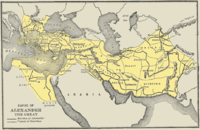 In 326 BC, Nearchus was made admiral of the fleet that Alexander had built at the Hydaspes (A 6.2.3; Indica
18.10). However, his trierarchy was a financial responsibility – that is, Nearchus put up the money for the boats (Heckel, p.229); and there were plenty of other trierarchs in the Indus
fleet who were not natural born sailors.
During the voyage some of the ships were damaged, and Nearchus was instructed to remain behind to oversee repairs, before continuing down the river. This perhaps indicates some knowledge of shipbuilding, but he could hardly have been the only one qualified.
However, he remained in command of the fleet for the voyage from the Indus to the Persian Gulf
, which he recorded in detail (and which was used extensively for Arrian
’s Indica
). Again, although he was the admiral, in command of the fleet, great seamanship was not required – the naval responsibilities were Onesicritus’
. During the voyage, Nearchus was reputedly the first Greek commander to visit Bahrain
, which was called Tylos
by the Greeks. His visit marked the start of Bahrain's inclusion within the Hellenic world, which culminated in the worship of Zeus (as the Arab sun god, Shams) and Greek being spoken as the language of the upper classes.
After many adventures, Nearchus arrived in Carmania
, meeting up with Alexander after the latter’s crossing of the Gedrosia
n desert. Alexander sent him off to complete his voyage – he went as far as the Euphrates
before turning back to rejoin Alexander at Susa
, in early 324 BC
.
Nearchus married the daughter of Barsine
and Mentor
(A 7.4.6), and received a crown as recognition of his exertions (A 7.5.6). He then took the fleet up to Babylon
, where he gave Alexander the Chaldea
ns’ warning not to enter the city (P 73.1-2).
Nearchus had a place in Alexander’s final plans, as he was to be the admiral of the Arabian invasion fleet; but the plans were cut short by the king’s death.
In the initial arguments over the rule of the empire Nearchus supported Heracles
, Alexander’s son by Barsine
– the king’s mistress was now his mother-in-law. Once order broke down he joined Antigonus’
camp. His last mention is as an adviser to Demetrius
in 313/2 BC (D 19.69.1); what happened after that is not known, although he probably retired to write his history.
Ancient authorities: Arrian, Anabasis Alexandri
, vi. 19, 21; vii. 4, 19, 20, 25: Plutarch
, Life of Alexander, 10, 68, 75: Strabo
, xv. pp. 721, 725; Diodorus Siculus
, xvii. 104: Justin
, xiii. 4.
Navarch
Navarch is a Greek word meaning "leader of the ships", which in some states became the title of an office equivalent to that of a modern admiral.- Historical usage :...
, in the army of Alexander the Great. His celebrated voyage from India
India
India , officially the Republic of India , is a country in South Asia. It is the seventh-largest country by geographical area, the second-most populous country with over 1.2 billion people, and the most populous democracy in the world...
to Susa
Susa
Susa was an ancient city of the Elamite, Persian and Parthian empires of Iran. It is located in the lower Zagros Mountains about east of the Tigris River, between the Karkheh and Dez Rivers....
after Alexander's expedition in India
India
India , officially the Republic of India , is a country in South Asia. It is the seventh-largest country by geographical area, the second-most populous country with over 1.2 billion people, and the most populous democracy in the world...
is preserved in Arrian
Arrian
Lucius Flavius Arrianus 'Xenophon , known in English as Arrian , and Arrian of Nicomedia, was a Roman historian, public servant, a military commander and a philosopher of the 2nd-century Roman period...
's account, the Indica
Indica (Arrian)
Indica is the name of an ancient book about India written by Arrian, one of the main ancient historians of Alexander the Great. The book mainly tells the story of Alexander's officer Nearchus’ voyage from India to the Persian Gulf after Alexander the Great’s conquest of the Indus Valley...
.
A native of Lato
Lato
Lato was an ancient city of Crete, the ruins of which are located approximately 3 km from the small town of Kritsa. The Dorian city-state was built in a defensible position overlooking Mirabello Bay between two peaks, both of which became acropolises to the city...
in Crete
Crete
Crete is the largest and most populous of the Greek islands, the fifth largest island in the Mediterranean Sea, and one of the thirteen administrative regions of Greece. It forms a significant part of the economy and cultural heritage of Greece while retaining its own local cultural traits...
, his family settled at Amphipolis
Amphipolis
Amphipolis was an ancient Greek city in the region once inhabited by the Edoni people in the present-day region of Central Macedonia. It was built on a raised plateau overlooking the east bank of the river Strymon where it emerged from Lake Cercinitis, about 3 m. from the Aegean Sea. Founded in...
in Macedon
Macedon
Macedonia or Macedon was an ancient kingdom, centered in the northeastern part of the Greek peninsula, bordered by Epirus to the west, Paeonia to the north, the region of Thrace to the east and Thessaly to the south....
ia at some point during Philip II’s
Philip II of Macedon
Philip II of Macedon "friend" + ἵππος "horse" — transliterated ; 382 – 336 BC), was a king of Macedon from 359 BC until his assassination in 336 BC. He was the father of Alexander the Great and Philip III.-Biography:...
reign (we must assume after Philip took the city in 357 BC
357 BC
Year 357 BC was a year of the pre-Julian Roman calendar. At the time, it was known as the Year of the Consulship of Rutilus and Imperiosus...
), at which point Nearchus was probably a young boy. He was almost certainly older than Alexander, as were Ptolemy, Erigyius
Erigyius
Erigyius , a Mytilenaean, son of Larichus, was an officer in Alexander the Great's army. He had been driven into banishment by Philip II, king of Macedon, because of his faithful attachment to Alexander, and returned when the latter came to the throne in 336 BC...
, and the others of the ‘boyhood friends’ ; so depending on when Androtimus came to Macedonia Nearchus was quite possibly born on Crete.
Nearchus, along with Ptolemy
Ptolemy I Soter
Ptolemy I Soter I , also known as Ptolemy Lagides, c. 367 BC – c. 283 BC, was a Macedonian general under Alexander the Great, who became ruler of Egypt and founder of both the Ptolemaic Kingdom and the Ptolemaic Dynasty...
, Erigyius
Erigyius
Erigyius , a Mytilenaean, son of Larichus, was an officer in Alexander the Great's army. He had been driven into banishment by Philip II, king of Macedon, because of his faithful attachment to Alexander, and returned when the latter came to the throne in 336 BC...
and Laomedon
Laomedon of Mytilene
Laomedon , native of Mytilene and son of Larichus, was one of Alexander the Great's generals, and appears to have enjoyed a high place in his confidence even before the death of Philip II, as he was one of those banished by that monarch for taking part in the intrigues of the...
, and Harpalus
Harpalus
For other uses, see Harpalus Harpalus son of Machatas was an aristocrat of Macedon and boyhood friend of Alexander the Great in the 4th century BC. Being lame in a leg, and therefore exempt from military service, Harpalus did not follow Alexander in his advance within the Persian Empire but...
, was one of Alexander’s ‘mentors’ – and he was exiled by Philip as a result of the Pixodarus
Pixodarus of Caria
Pixodarus was a prince or king of Caria.-Biography:He was the youngest of the three sons of Hecatomnus, all of whom successively held the sovereignty of their native country...
affair (A 3.6.5; P 10.4). It is not known where the exiles went, but they were recalled only after Philip’s death, on Alexander’s accession.
After their recall, these men were held in the highest honour. Nearchus was appointed as satrap
Satrap
Satrap was the name given to the governors of the provinces of the ancient Median and Achaemenid Empires and in several of their successors, such as the Sassanid Empire and the Hellenistic empires....
of Lycia
Lycia
Lycia Lycian: Trm̃mis; ) was a region in Anatolia in what are now the provinces of Antalya and Muğla on the southern coast of Turkey. It was a federation of ancient cities in the region and later a province of the Roman Empire...
and Pamphylia
Pamphylia
In ancient geography, Pamphylia was the region in the south of Asia Minor, between Lycia and Cilicia, extending from the Mediterranean to Mount Taurus . It was bounded on the north by Pisidia and was therefore a country of small extent, having a coast-line of only about 75 miles with a breadth of...
in 334/3 BC (A 3.3.6), one of the earliest of Alexander's satrapal appointments. In 328 BC
328 BC
Year 328 BC was a year of the pre-Julian Roman calendar. At the time, it was known as the Year of the Consulship of Proculus and Scapula or Decianus and Barbatus...
he was relieved of his post and rejoined Alexander in Bactria
Bactria
Bactria and also appears in the Zend Avesta as Bukhdi. It is the ancient name of a historical region located between south of the Amu Darya and west of the Indus River...
, bringing with him reinforcements (A 4.7.2; C 7.10.4, but does not mention Nearchus himself). After the siege of Aornus Nearchus was sent at the head of a reconnaissance mission – especially to find out about elephants (A 4.30.5-6).
Indica (Arrian)
Indica is the name of an ancient book about India written by Arrian, one of the main ancient historians of Alexander the Great. The book mainly tells the story of Alexander's officer Nearchus’ voyage from India to the Persian Gulf after Alexander the Great’s conquest of the Indus Valley...
18.10). However, his trierarchy was a financial responsibility – that is, Nearchus put up the money for the boats (Heckel, p.229); and there were plenty of other trierarchs in the Indus
Indus River
The Indus River is a major river which flows through Pakistan. It also has courses through China and India.Originating in the Tibetan plateau of western China in the vicinity of Lake Mansarovar in Tibet Autonomous Region, the river runs a course through the Ladakh district of Jammu and Kashmir and...
fleet who were not natural born sailors.
During the voyage some of the ships were damaged, and Nearchus was instructed to remain behind to oversee repairs, before continuing down the river. This perhaps indicates some knowledge of shipbuilding, but he could hardly have been the only one qualified.
However, he remained in command of the fleet for the voyage from the Indus to the Persian Gulf
Persian Gulf
The Persian Gulf, in Southwest Asia, is an extension of the Indian Ocean located between Iran and the Arabian Peninsula.The Persian Gulf was the focus of the 1980–1988 Iran-Iraq War, in which each side attacked the other's oil tankers...
, which he recorded in detail (and which was used extensively for Arrian
Arrian
Lucius Flavius Arrianus 'Xenophon , known in English as Arrian , and Arrian of Nicomedia, was a Roman historian, public servant, a military commander and a philosopher of the 2nd-century Roman period...
’s Indica
Indica (Arrian)
Indica is the name of an ancient book about India written by Arrian, one of the main ancient historians of Alexander the Great. The book mainly tells the story of Alexander's officer Nearchus’ voyage from India to the Persian Gulf after Alexander the Great’s conquest of the Indus Valley...
). Again, although he was the admiral, in command of the fleet, great seamanship was not required – the naval responsibilities were Onesicritus’
Onesicritus
Onesicritus , a Greek historical writer, who accompanied Alexander on his campaigns in Asia. He claimed to have been the commander of Alexander's fleet but was actually only a helmsman; Arrian and Nearchus often criticize him for this. When he returned home, he wrote a history of Alexander's...
. During the voyage, Nearchus was reputedly the first Greek commander to visit Bahrain
Bahrain
' , officially the Kingdom of Bahrain , is a small island state near the western shores of the Persian Gulf. It is ruled by the Al Khalifa royal family. The population in 2010 stood at 1,214,705, including 235,108 non-nationals. Formerly an emirate, Bahrain was declared a kingdom in 2002.Bahrain is...
, which was called Tylos
Tylos
Bahrain was referred to by the Greeks as Tylos, the centre of pearl trading, when Nearchus came to discover it serving under Alexander the Great. From the 6th to 3rd century BC Bahrain was included in Persian Empire by Achaemenians, an Iranian dynasty...
by the Greeks. His visit marked the start of Bahrain's inclusion within the Hellenic world, which culminated in the worship of Zeus (as the Arab sun god, Shams) and Greek being spoken as the language of the upper classes.
After many adventures, Nearchus arrived in Carmania
Carmania
Carmania may refer to* Carmania, ancient satrapy of the Achaemenid Persian empire.* Carmania - a diecast model producer.* Kermān Province in the south-east of Iran.* RMS Carmania , a Cunard liner built 1905...
, meeting up with Alexander after the latter’s crossing of the Gedrosia
Gedrosia
Gedrosia from Pashto Gwadar-khua is the hellenized name of an area that corresponds to today's Balochistan. Eastern Balochistan is southwestern province of Pakistan and parts of southwestern and south-central Afghanistan and western Balochistan is divided between Iranian provinces of Hormozgan and...
n desert. Alexander sent him off to complete his voyage – he went as far as the Euphrates
Euphrates
The Euphrates is the longest and one of the most historically important rivers of Western Asia. Together with the Tigris, it is one of the two defining rivers of Mesopotamia...
before turning back to rejoin Alexander at Susa
Susa
Susa was an ancient city of the Elamite, Persian and Parthian empires of Iran. It is located in the lower Zagros Mountains about east of the Tigris River, between the Karkheh and Dez Rivers....
, in early 324 BC
324 BC
Year 324 BC was a year of the pre-Julian Roman calendar. At the time, it was known as the Year of the Dictatorship of Cursor...
.
Nearchus married the daughter of Barsine
Barsine
Barsine was daughter of Artabazus, satrap of Hellespontine Phrygia, and wife of Mentor of Rhodes and after his death, Mentor's brother, Memnon...
and Mentor
Mentor of Rhodes
Mentor of Rhodes was a Greek mercenary who fought both for and against Artaxerxes III of Persia. He is also known as the first husband of Barsine, who later became mistress to Alexander the Great....
(A 7.4.6), and received a crown as recognition of his exertions (A 7.5.6). He then took the fleet up to Babylon
Babylon
Babylon was an Akkadian city-state of ancient Mesopotamia, the remains of which are found in present-day Al Hillah, Babil Province, Iraq, about 85 kilometers south of Baghdad...
, where he gave Alexander the Chaldea
Chaldea
Chaldea or Chaldaea , from Greek , Chaldaia; Akkadian ; Hebrew כשדים, Kaśdim; Aramaic: ܟܐܠܕܘ, Kaldo) was a marshy land located in modern-day southern Iraq which came to briefly rule Babylon...
ns’ warning not to enter the city (P 73.1-2).
Nearchus had a place in Alexander’s final plans, as he was to be the admiral of the Arabian invasion fleet; but the plans were cut short by the king’s death.
In the initial arguments over the rule of the empire Nearchus supported Heracles
Heracles (Macedon)
Heracles of Macedon was a reputed illegitimate son of Alexander the Great of Macedon by Barsine, daughter of Satrap Artabazus of Phrygia. Heracles was named after the Greek mythological hero of the same name, from whom the Argeads claimed descent.It cannot be established definitively whether...
, Alexander’s son by Barsine
Barsine
Barsine was daughter of Artabazus, satrap of Hellespontine Phrygia, and wife of Mentor of Rhodes and after his death, Mentor's brother, Memnon...
– the king’s mistress was now his mother-in-law. Once order broke down he joined Antigonus’
Antigonus I Monophthalmus
Antigonus I Monophthalmus , son of Philip from Elimeia, was a Macedonian nobleman, general, and satrap under Alexander the Great. During his early life he served under Philip II, and he was a major figure in the Wars of the Diadochi after Alexander's death, declaring himself king in 306 BC and...
camp. His last mention is as an adviser to Demetrius
Demetrius I of Macedon
Demetrius I , called Poliorcetes , son of Antigonus I Monophthalmus and Stratonice, was a king of Macedon...
in 313/2 BC (D 19.69.1); what happened after that is not known, although he probably retired to write his history.
Ancient authorities: Arrian, Anabasis Alexandri
Anabasis Alexandri
Anabasis Alexandri , the Campaigns of Alexander by Arrian, is the most important source on Alexander the Great.The Greek term anabasis referred to an expedition from a coastline into the interior of a country. The term katabasis referred to a trip from the interior to the coast...
, vi. 19, 21; vii. 4, 19, 20, 25: Plutarch
Plutarch
Plutarch then named, on his becoming a Roman citizen, Lucius Mestrius Plutarchus , c. 46 – 120 AD, was a Greek historian, biographer, essayist, and Middle Platonist known primarily for his Parallel Lives and Moralia...
, Life of Alexander, 10, 68, 75: Strabo
Strabo
Strabo, also written Strabon was a Greek historian, geographer and philosopher.-Life:Strabo was born to an affluent family from Amaseia in Pontus , a city which he said was situated the approximate equivalent of 75 km from the Black Sea...
, xv. pp. 721, 725; Diodorus Siculus
Diodorus Siculus
Diodorus Siculus was a Greek historian who flourished between 60 and 30 BC. According to Diodorus' own work, he was born at Agyrium in Sicily . With one exception, antiquity affords no further information about Diodorus' life and doings beyond what is to be found in his own work, Bibliotheca...
, xvii. 104: Justin
Junianus Justinus
Justin was a Latin historian who lived under the Roman Empire. His name is mentioned only in the title of his own history, and there it is in the genitive, which would be M. Juniani Justini no matter which nomen he bore.Of his personal history nothing is known...
, xiii. 4.
External links
- Arrian, The Indica translated by E. Iliff Robson.
- Pothos.org:Nearchus by Marcus Pailing
- Livius, Nearchus by Jona Lendering
- The Trierarchs of Nearchus by livius.org
- Nearchus the Cretan and the Foundation of Cretopolishttp://www.google.com/search?hl=el&q=NEARCHUS+CRETOPOLIS&btnG=%CE%91%CE%BD%CE%B1%CE%B6%CE%AE%CF%84%CE%B7%CF%83%CE%B7&lr=