


Garde du Corps (France)

Encyclopedia
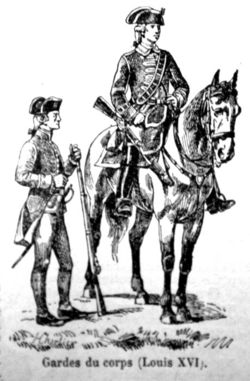
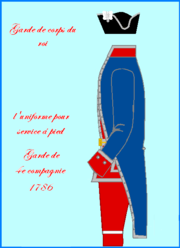
Maison du Roi
The Maison du Roi was the name of the military, domestic and religious entourage around the royal family in France during the Ancien Régime and Bourbon Restoration; the exact composition and duties of its various divisions changed constantly over the Early Modern period...
.
History
The oldest company in the Garde du Corps was the Company of Scottish Archers, later just the 1st Scottish Company or Garde ÉcossaiseGarde Écossaise
The Garde Écossaise was an elite Scottish military unit founded in 1418 by the Valois Charles VII of France, to be personal bodyguards to the French monarchy. They were assimilated into the Maison du Roi and later formed the first Company of the Garde du Corps du Roi...
, formed in 1419 from Scots
Scottish people
The Scottish people , or Scots, are a nation and ethnic group native to Scotland. Historically they emerged from an amalgamation of the Picts and Gaels, incorporating neighbouring Britons to the south as well as invading Germanic peoples such as the Anglo-Saxons and the Norse.In modern use,...
that fought for the French during Hundred Years' War
Hundred Years' War
The Hundred Years' War was a series of separate wars waged from 1337 to 1453 by the House of Valois and the House of Plantagenet, also known as the House of Anjou, for the French throne, which had become vacant upon the extinction of the senior Capetian line of French kings...
.
In the Battle of Fornovo
Battle of Fornovo
The Battle of Fornovo took place 30 km southwest of the city of Parma on 6 July 1495. The League of Venice was able to temporarily expel the French from the Italian Peninsula. It was the first major battle of the Italian Wars.-Antecedents:...
during the Italian Wars
Italian Wars
The Italian Wars, often referred to as the Great Italian Wars or the Great Wars of Italy and sometimes as the Habsburg–Valois Wars, were a series of conflicts from 1494 to 1559 that involved, at various times, most of the city-states of Italy, the Papal States, most of the major states of Western...
the Garde du Corps saved king Charles VIII
Charles VIII of France
Charles VIII, called the Affable, , was King of France from 1483 to his death in 1498. Charles was a member of the House of Valois...
from being captured by enemy forces. Later in the Italian Wars they failed to save Francis I
Francis I of France
Francis I was King of France from 1515 until his death. During his reign, huge cultural changes took place in France and he has been called France's original Renaissance monarch...
from being captured in the Battle of Pavia
Battle of Pavia
The Battle of Pavia, fought on the morning of 24 February 1525, was the decisive engagement of the Italian War of 1521–26.A Spanish-Imperial army under the nominal command of Charles de Lannoy attacked the French army under the personal command of Francis I of France in the great hunting preserve...
.
The last time the Garde du Corps campaigned was during the War of the Austrian Succession
War of the Austrian Succession
The War of the Austrian Succession – including King George's War in North America, the Anglo-Spanish War of Jenkins' Ear, and two of the three Silesian wars – involved most of the powers of Europe over the question of Maria Theresa's succession to the realms of the House of Habsburg.The...
because it only went on campaign when the king was present. The last battle in which the Garde du Corps was present was Lauffeld
Battle of Lauffeld
The Battle of Lauffeld, also known as the Battle of Lafelt or Battle of Maastricht, also Battle of Val, took place on 2 July 1747, during the French invasion of the Netherlands. It was part of the War of the Austrian Succession...
on 1 July 1747.
Revolution and Restoration
The Garde du Corps featured conspicuously in several incidents in the opening stages of the French RevolutionFrench Revolution
The French Revolution , sometimes distinguished as the 'Great French Revolution' , was a period of radical social and political upheaval in France and Europe. The absolute monarchy that had ruled France for centuries collapsed in three years...
. On 1 October 1789 the officers of the Garde hosted a banquet to welcome their colleagues of a line infantry regiment of the Royal Army which had been brought to Versailles to replace the disbanded French Guards (Gardes Francais). The latter regiment had joined in the attack on the Bastille
Bastille
The Bastille was a fortress in Paris, known formally as the Bastille Saint-Antoine. It played an important role in the internal conflicts of France and for most of its history was used as a state prison by the kings of France. The Bastille was built in response to the English threat to the city of...
six weeks before. The banquet was reported in Paris as a royalist provocation and an angry crowd marched on Versailles. During the night of 5 October about 500 members of the crowd broke into the Palace killing several of the Gardes du Corps on duty. Other Gardes du Corps held the doors to the royal apartments until grenadiers of the National Guard - mostly former Gardes Francais - restored order. The Garde du Corps narrowly escaped massacre and, disarmed, was obliged to accompany the Royal Family to Paris. Most of this aristocratic regiment then dispersed to their estates or into exile.
The Garde du Corps was formally dissolved in 1791 along with all of the Maison du Roi, except for the ill fated Swiss Guard
Swiss Guard
Swiss Guards or Schweizergarde is the name given to the Swiss soldiers who have served as bodyguards, ceremonial guards, and palace guards at foreign European courts since the late 15th century. They have had a high reputation for discipline, as well as loyalty to their employers...
. After the abdication of Napoleon I
Napoleon I of France
Napoleon Bonaparte was a French military and political leader during the latter stages of the French Revolution.As Napoleon I, he was Emperor of the French from 1804 to 1815...
in April 1814 and the Bourbon Restoration
Bourbon Restoration
The Bourbon Restoration is the name given to the period following the successive events of the French Revolution , the end of the First Republic , and then the forcible end of the First French Empire under Napoleon – when a coalition of European powers restored by arms the monarchy to the...
, Louis XVIII
Louis XVIII of France
Louis XVIII , known as "the Unavoidable", was King of France and of Navarre from 1814 to 1824, omitting the Hundred Days in 1815...
recreated the Garde du Corps with the rest of the Maison du Roi. These units disappeared during Napoleon's return, at the start of the Hundred Days
Hundred Days
The Hundred Days, sometimes known as the Hundred Days of Napoleon or Napoleon's Hundred Days for specificity, marked the period between Emperor Napoleon I of France's return from exile on Elba to Paris on 20 March 1815 and the second restoration of King Louis XVIII on 8 July 1815...
.
After Waterloo
Battle of Waterloo
The Battle of Waterloo was fought on Sunday 18 June 1815 near Waterloo in present-day Belgium, then part of the United Kingdom of the Netherlands...
and the return of the Bourbons
House of Bourbon
The House of Bourbon is a European royal house, a branch of the Capetian dynasty . Bourbon kings first ruled Navarre and France in the 16th century. By the 18th century, members of the Bourbon dynasty also held thrones in Spain, Naples, Sicily, and Parma...
the Garde du Corps was recreated again, almost the only unit of the old Maison du Roi to be given a further chance after the disappointing performance of these expensive and militarily obsolete regiments in 1815. The Garde du Corps was however reorganised, reduced in numbers to about 1,500 and integrated more closely with the regular army. The reconstituted Garde du Corps served the returned Bourbons loyally until being finally abolished, along with all Guard units, by Louis-Philippe
Louis-Philippe of France
Louis Philippe I was King of the French from 1830 to 1848 in what was known as the July Monarchy. His father was a duke who supported the French Revolution but was nevertheless guillotined. Louis Philippe fled France as a young man and spent 21 years in exile, including considerable time in the...
in 1830 after the July Revolution
July Revolution
The French Revolution of 1830, also known as the July Revolution or in French, saw the overthrow of King Charles X of France, the French Bourbon monarch, and the ascent of his cousin Louis-Philippe, Duke of Orléans, who himself, after 18 precarious years on the throne, would in turn be overthrown...
.
Motto
The original motto of the Garde du Corps was Erit haec quoque cognita monstris (They will be recognized, them also, with their brilliant deeds), but during the reign of Louis XIVLouis XIV of France
Louis XIV , known as Louis the Great or the Sun King , was a Bourbon monarch who ruled as King of France and Navarre. His reign, from 1643 to his death in 1715, began at the age of four and lasted seventy-two years, three months, and eighteen days...
it changed to Nec pluribus impar (No unequal match for many (suns)), which also was Louis XIV's personal motto.
The sword
Sword
A sword is a bladed weapon used primarily for cutting or thrusting. The precise definition of the term varies with the historical epoch or the geographical region under consideration...
s of the guardsmen was inscribed with Vive le Roi (Long live the king).
Composition
- 1st Scottish Company - formed in 1440 by Charles VIICharles VII of FranceCharles VII , called the Victorious or the Well-Served , was King of France from 1422 to his death, though he was initially opposed by Henry VI of England, whose Regent, the Duke of Bedford, ruled much of France including the capital, Paris...
. Despite the name, by the 16th century the company has ceased to be purely Scottish. Little by little the Scottish Company became only Scottish in name. - 1st French Company - formed in 1475 by Louis XILouis XI of FranceLouis XI , called the Prudent , was the King of France from 1461 to 1483. He was the son of Charles VII of France and Mary of Anjou, a member of the House of Valois....
. - 2nd French Company - formed in 1479 by Louis XILouis XI of FranceLouis XI , called the Prudent , was the King of France from 1461 to 1483. He was the son of Charles VII of France and Mary of Anjou, a member of the House of Valois....
. - 3rd French Company - formed in 1516 by Francis IFrancis I of FranceFrancis I was King of France from 1515 until his death. During his reign, huge cultural changes took place in France and he has been called France's original Renaissance monarch...
.
Gardes de la Manche
The Gardes de la Manche (Guards of the Sleeve) was an elite detachment formed as the king's personal guard by Charles VIICharles VII of France
Charles VII , called the Victorious or the Well-Served , was King of France from 1422 to his death, though he was initially opposed by Henry VI of England, whose Regent, the Duke of Bedford, ruled much of France including the capital, Paris...
with men from the Company of Scottish Archers. They were the 24 oldest men of the 1st Scottish Company. The name came from the fact that they stood so close to the king as to be brushed by his sleeves. In 1775 this guard was reduced to 18 men. The captain of the Garde de La Marche was called the First Man-at-arms
Man-at-arms
Man-at-arms was a term used from the High Medieval to Renaissance periods to describe a soldier, almost always a professional warrior in the sense of being well-trained in the use of arms, who served as a fully armoured heavy cavalryman...
of France.
A later, less successful, bodyguard was The Forty-Five
The forty-five guards
The Forty-five guards were forty-five guards recruited by the Duke of Épernon to provide Henri III of France with trusted protection in the midst of the War of the Three Henrys....
, recruited by the Duke of Épernon
Jean Louis de Nogaret de La Valette
Jean Louis de Nogaret de La Valette , created Duke of Épernon, was a powerful member of the French nobility at the turn of the 17th century. He was deeply involved in plots and politics throughout his life....
to provide Henry III of France
Henry III of France
Henry III was King of France from 1574 to 1589. As Henry of Valois, he was the first elected monarch of the Polish-Lithuanian Commonwealth with the dual titles of King of Poland and Grand Duke of Lithuania from 1573 to 1575.-Childhood:Henry was born at the Royal Château de Fontainebleau,...
with protection in the midst of the War of the Three Henrys. They served Henry III and Henry IV of France
Henry IV of France
Henry IV , Henri-Quatre, was King of France from 1589 to 1610 and King of Navarre from 1572 to 1610. He was the first monarch of the Bourbon branch of the Capetian dynasty in France....
, but were unable to prevent both monarchs being assassinated.