


Republic of Singapore Navy

Encyclopedia
The Republic of Singapore Navy (Abbreviation
: RSN; ; ; ) is the naval component
of the Singapore Armed Forces
(SAF), responsible for the defence of Singapore against sea-borne threats and protection of its sea lines of communication
s. Operating within the crowded littoral
waters of the Singapore Strait
, the RSN is regarded as one of the best in the region. All commissioned ships of the RSN have the prefix RSS (Republic of Singapore Ship).
in the 1930s with only two patrol craft. The Straits Settlements
Royal Navy Volunteer Reserve was established on 20 April 1934 and in 1941 became the Singaporean division of the Malayan Volunteer Reserve during World War II
.
In 1948, the Malayan Force was raised by the Singapore government and was later granted the title of the Royal Malayan Navy in 1952 in recognition of its services in action during the Malayan Emergency
.
On 16 September 1963, Singapore was admitted as a state of Malaysia under the terms of confederation and the Royal Malayan Navy was renamed the Royal Malaysian Navy
(RMN). The Singapore division of the Malayan Royal Navy Volunteer Reserve was formally transferred from the command of the Royal Navy to the RMN on 22 September 1963, becoming the Singapore Volunteer Force (SVF).
On 9 August 1965, Singapore seceded from Malaysia to form an independent and sovereign nation within the Commonwealth of Nations
. The fledging navy had only two wooden ships then, namely RSS Panglima and RSS Singapura. On 22 January 1966, the SVF was renamed the Singapore Naval Volunteer Force (SNVF).
On 5 May 1967, the SNVF ensign
was hoisted for the first time. A few months later in September, the SNVF was renamed the People's Defence Force (Sea) under the Sea Defence Command (SDC).
The SDC was renamed the Maritime Command (MC) in 1968, which is the predecessor of the RSN. The MC then went on an expansion program to carry out its seaward defence more effectively. The RSN came into being on 1 April 1975, when the SAF established its component forces into three distinct services. Its first commander was Colonel James Aeria.
(two-star) Ng Chee Peng and he is responsible for the RSN's overall operational capabilities and administration. His deputy is the Chief of Staff - Naval Staff, Rear Admiral (one-star) Tan Wee Beng. The Commander Maritime Security Task Force
is Rear Admiral (one-star) Harris Chan, while the Fleet Commander is Rear Admiral (one-star) Lai Chung Han. The Master Chief Navy is Military Expert
5 Phui Peng Sim. The organisation chart below shows the peacetime administrative chain of command with five formations: the Fleet, Maritime Security Task Force, Naval Diving Unit
, Naval Logistics Command and Training Command.
) submarine
from the Swedish Navy
and another three in 1997, making them Singapore's first underwater platforms. As the submarines were designed by the Swedish for operations in the Baltic Sea, various modifications were required to suit them to tropical waters. A comprehensive tropicalisation programme was carried out for all four submarines, which involved installing air conditioning, marine growth protection systems and corrosion-resistant piping. It is believed that the Challenger class were purchased to develop the required submarine operations expertise before selecting a modern class of submarines to replace them, since all the boats are over 40 years old. The four submarines form the 171 Squadron of the RSN.
Singapore's Ministry of Defence
(MINDEF) signed an agreement with Kockums
for the supply of two Archer
class (formerly known as Västergötland class
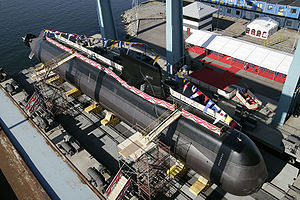
) submarines to the RSN on 4 November 2005. More than 20 years old and previously in reserve with the Swedish Navy, the submarines will be transferred to the RSN on completion of the modernisation and conversion for operation in tropical waters. RSS Archer was launched on 16 June 2009. The Archer class submarines are equipped with an air independent propulsion system. This enables the submarines to have longer submerged endurance and lower noise signature, enhancing the stealth capability of the submarines. The advanced sonar system allows the submarines to detect contacts at a further distance, while the torpedo system has a better target acquisition capability, which allows the submarines to engage contacts at a further range. The Archer class submarines are expected to enter service from 2010 and may replace some of the Challenger class submarines.
MV Swift Rescue, a submarine support and rescue ship
was launched 29 Nov 2008. She carries the deep submergence rescue vehicle
Deep Search and Rescue Six (DSAR-6).
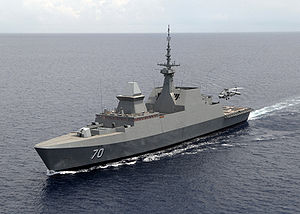
class multi-role stealth frigates are the latest platforms to enter into service with the RSN, and are multi-mission derivatives of the French Navy
’s La Fayette class frigate
. The frigates are key information nodes and fighting units, and are “by far the most advanced surface combatants in Southeast Asia".
The frigates will be equipped with Sikorsky S-70
B naval helicopters, an international derivative of the United States Navy
SH-60B Seahawk. MINDEF signed a contract with Sikorsky Aircraft Corporation in January 2005 to acquire six of these helicopters, which will be organic to the frigates. These naval helicopters are equipped with anti-surface and anti-submarine combat systems, extending the ship’s own surveillance and over-the-horizon targeting and anti-submarine warfare capabilities. The naval helicopters will be raised as a squadron in the Republic of Singapore Air Force and piloted by air force pilots, but the system operators will be from the RSN.
The frigates have a special surface-to-air missile
configuration, combining the Thales Herakles
radar with the Sylver
A50 launcher and a mix of MBDA Aster
15 and 30 missiles.
The lead ship of the class, RSS Formidable was commissioned on 5 May 2007, marking the 40th year of the RSN. The six frigates form the 185 Squadron of the RSN.
class corvettes from Friedrich Lürssen Werft
of Germany
. The first corvette was built in Germany while the remaining five were built locally by ST Marine. The corvettes were also the first class of ships in the RSN to have an anti-submarine capability. The corvettes are noted for being the fastest ships in the fleet, and for their tall mast, making them top-heavy compared to ships of similar class. However, this is suitable within the fairly calm Singapore waters. The six corvettes form the 188 Squadron of the RSN.
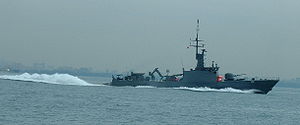
class patrol vessels were built locally by ST Marine to replace the older coastal patrol crafts, which were transferred to the Police Coast Guard. The first six vessels of the class are armed for anti-submarine warfare
missions, and were placed under the command of the Fleet as 189 Squadron upon commission. In January 2003, RSS Courageous
was badly damaged in a collision with a container ship in the Singapore Strait. In January 2005, 189 Squadron was transferred to the then-Coastal Command from the Fleet, and the twelve ships now form the 182/189 Squadron.
are the biggest class of ships in the RSN. They were designed and built locally by ST Marine to replace the old County class tank landing ship
s (LST). Each ship is fitted with a well dock which can accommodate four landing crafts, as well as a flight deck which can accommodate two medium lift helicopters. While the RSN describes the Endurance class as LSTs, they lack the beaching capability traditionally associated with LSTs and their well docks and flight decks qualifies the Endurance class more as amphibious transport docks.
The ships provide sea transportation for personnel and equipment for SAF's overseas training, as well as a training platform for RSN's midshipmen. RSS Endurance became the first RSN ship to circumnavigate the globe when it participated in the 2000 International Naval Review in New York City
. The ships are also actively involved in humanitarian and disaster relief operations, notably in East Timor, the Persian Gulf and the tsunami
-hit Indonesian province of Aceh. The four ships form the 191 Squadron of the RSN.
These two ships were eventually replaced by the Bedok class mine countermeasures vessel
s. The first ship, RSS Bedok, was built by Karlskronavarvet in Sweden based on the Landsort
class design. The remaining three ships were prefabricated in Sweden and transferred to Singapore for final assembly by ST Marine. The ships are constructed of glass reinforced plastic to maintain low magnetic and acoustic signatures, and are fitted with Voith Schneider Propellers, giving it the highest manoeuvrability in the navy. The ships form the 194 Squadron of the RSN.
operations in 2005, where they performed surveillance and reconnaissance, as well as force protection duties for more than eight hours at a go.
, while the remaining four were constructed locally by ST Marine (then known as Singapore Shipbuilding and Engineering).
As new technology became available, these gunboats underwent a number of upgrading programmes in the 1980s and 1990s to increase their strike capability and sophistication. These gunboats became the first missile-armed naval vessles in Southeast Asia
when they were upgraded to launch Boeing Harpoon
(SSM) surface-to-surface missiles. On 13 May 2008, all six gunboats were retired at a sunset decommissioning ceremony held at Changi Naval Base following 33 years of service.
(TNB) is the second naval base in the RSN's history. Located at the western tip of Singapore, it occupies 0.28 km² (0.11 mi²) of land. It was officially opened on 2 September 1994 by the second prime minister Goh Chok Tong
.
For about two decades, Brani Naval Base was the RSN's only base. An expansion of the fleet in the early 1980s meant that more space was needed for the fleet and its shore infrastructure. However, this was not possible as the land around Brani was reserved for use by the port authority to develop container facilities. As a result, Tuas was selected as the site for a second naval base.
Better utilisation of space at TNB resulted in two and a half times more berthing space than Brani, even though TNB only has a shoreline of 850 m (0.5 mi). Provision was also made for recreational facilities. Automation was incorporated into the design of TNB to reduce manpower requirements, such as mechanical ramps for the loading and unloading of vehicles and an automatic storage and retrieval system. It also has a floating dock which can lift 600 tonnes and transfer a ship from sea to land to facilitate repairs and maintenance.
Currently, the missile corvettes, patrol vessels and mine counter-measures vessels are based at TNB.
(CNB) is the latest naval facility of the RSN and was built to replace Brani Naval Base. Located on 1.28 km² (0.50 mi²) of reclaimed land at the eastern tip of Singapore, it was officially opened on 21 May 2004 by Goh Chok Tong.
Its 6.2 km (3.9 mi) berthing space can accommodate an aircraft carrier and is often used by visiting ships of the USN.
Automation was incorporated into the design of CNB to reduce manpower requirements. It has an automated underground ammunition depot that allows ammunition to be loaded onto the ships and an automated warehouse system to store items. The base has a fibre optic broadband network for information management. The base was also designed to be environment-friendly, with small-scale wind turbines powering the lights along the breakwaters at night. Conventional roof construction materials were substituted by thin film solar panels and the solar energy generated lights the base. In addition, seawater is used in the air-conditioning system.
Currently, the submarines, frigates and amphibious transport docks are based at CNB. Co-located in CNB is the Changi Naval Training Base, also known as RSS Panglima - named in honour of the first ship of the navy.
Abbreviation
An abbreviation is a shortened form of a word or phrase. Usually, but not always, it consists of a letter or group of letters taken from the word or phrase...
: RSN; ; ; ) is the naval component
Navy
A navy is the branch of a nation's armed forces principally designated for naval and amphibious warfare; namely, lake- or ocean-borne combat operations and related functions...
of the Singapore Armed Forces
Singapore Armed Forces
The Singapore Armed Forces is the military arm of the Total Defence of the Republic of Singapore; as well as the military component of the Ministry of Defence. The SAF comprises three branches: the Singapore Army, the Republic of Singapore Air Force and the Republic of Singapore Navy...
(SAF), responsible for the defence of Singapore against sea-borne threats and protection of its sea lines of communication
Sea lines of communication
Sea lines of communication is a term describing the primary maritime routes between ports, used for trade, logistics and naval forces...
s. Operating within the crowded littoral
Littoral
The littoral zone is that part of a sea, lake or river that is close to the shore. In coastal environments the littoral zone extends from the high water mark, which is rarely inundated, to shoreline areas that are permanently submerged. It always includes this intertidal zone and is often used to...
waters of the Singapore Strait
Singapore Strait
The Singapore Strait is a 105-kilometer long, 16-kilometer wide strait between the Strait of Malacca in the west and the South China Sea in the east. Singapore is on the north of the channel and the Riau Islands are on the south...
, the RSN is regarded as one of the best in the region. All commissioned ships of the RSN have the prefix RSS (Republic of Singapore Ship).
History
The RSN traces its origins to the Royal NavyRoyal Navy
The Royal Navy is the naval warfare service branch of the British Armed Forces. Founded in the 16th century, it is the oldest service branch and is known as the Senior Service...
in the 1930s with only two patrol craft. The Straits Settlements
Straits Settlements
The Straits Settlements were a group of British territories located in Southeast Asia.Originally established in 1826 as part of the territories controlled by the British East India Company, the Straits Settlements came under direct British control as a crown colony on 1 April 1867...
Royal Navy Volunteer Reserve was established on 20 April 1934 and in 1941 became the Singaporean division of the Malayan Volunteer Reserve during World War II
World War II
World War II, or the Second World War , was a global conflict lasting from 1939 to 1945, involving most of the world's nations—including all of the great powers—eventually forming two opposing military alliances: the Allies and the Axis...
.
In 1948, the Malayan Force was raised by the Singapore government and was later granted the title of the Royal Malayan Navy in 1952 in recognition of its services in action during the Malayan Emergency
Malayan Emergency
The Malayan Emergency was a guerrilla war fought between Commonwealth armed forces and the Malayan National Liberation Army , the military arm of the Malayan Communist Party, from 1948 to 1960....
.
On 16 September 1963, Singapore was admitted as a state of Malaysia under the terms of confederation and the Royal Malayan Navy was renamed the Royal Malaysian Navy
Royal Malaysian Navy
The Royal Malaysian Navy is the naval arm of Malaysian Armed Forces. All commissioned ships of the RMN have the prefix KD , which means Royal Ship.-Straits Settlement Naval Volunteer Reserve:...
(RMN). The Singapore division of the Malayan Royal Navy Volunteer Reserve was formally transferred from the command of the Royal Navy to the RMN on 22 September 1963, becoming the Singapore Volunteer Force (SVF).
On 9 August 1965, Singapore seceded from Malaysia to form an independent and sovereign nation within the Commonwealth of Nations
Commonwealth of Nations
The Commonwealth of Nations, normally referred to as the Commonwealth and formerly known as the British Commonwealth, is an intergovernmental organisation of fifty-four independent member states...
. The fledging navy had only two wooden ships then, namely RSS Panglima and RSS Singapura. On 22 January 1966, the SVF was renamed the Singapore Naval Volunteer Force (SNVF).
On 5 May 1967, the SNVF ensign
Ensign
An ensign is a national flag when used at sea, in vexillology, or a distinguishing token, emblem, or badge, such as a symbol of office in heraldry...
was hoisted for the first time. A few months later in September, the SNVF was renamed the People's Defence Force (Sea) under the Sea Defence Command (SDC).
The SDC was renamed the Maritime Command (MC) in 1968, which is the predecessor of the RSN. The MC then went on an expansion program to carry out its seaward defence more effectively. The RSN came into being on 1 April 1975, when the SAF established its component forces into three distinct services. Its first commander was Colonel James Aeria.
Organisation
The RSN is led by the Chief of Navy (CNV), and he reports directly to the Chief of Defence Force (CDF). The current CNV is Rear AdmiralRear Admiral
Rear admiral is a naval commissioned officer rank above that of a commodore and captain, and below that of a vice admiral. It is generally regarded as the lowest of the "admiral" ranks, which are also sometimes referred to as "flag officers" or "flag ranks"...
(two-star) Ng Chee Peng and he is responsible for the RSN's overall operational capabilities and administration. His deputy is the Chief of Staff - Naval Staff, Rear Admiral (one-star) Tan Wee Beng. The Commander Maritime Security Task Force
Maritime Security Task Force
The Maritime Security Task Force is a Singapore Armed Forces-level task force, formed as a result of the restructuring of the Republic of Singapore Navy's Coastal Command on 19 January 2009. Its role is to ensure Singapore's maritime security and act as a co-ordinating agency for all national...
is Rear Admiral (one-star) Harris Chan, while the Fleet Commander is Rear Admiral (one-star) Lai Chung Han. The Master Chief Navy is Military Expert
Singapore Armed Forces ranks
The Singapore Armed Forces has two rank structures.One rank structure is similar to that of other military in other country. One major difference is that the SAF uses a unified rank structure, with identical rank names and insignia throughout the Army, Navy, and Air Force. For example, traditional...
5 Phui Peng Sim. The organisation chart below shows the peacetime administrative chain of command with five formations: the Fleet, Maritime Security Task Force, Naval Diving Unit
Naval Diving Unit (Singapore)
The Naval Diving Unit is a Special Forces unit of the Republic of Singapore Navy, and is regularly tasked in salvage operations, underwater mine demolition and commando-type warfare.-Recruitment:...
, Naval Logistics Command and Training Command.
Submarines
In 1995, the RSN acquired a Challenger class (formerly known as Sjöormen classSjöormen class submarine
The Sjöormen class were a group of submarines built for the Swedish Navy in the late 1960s. They had a teardrop shape and were capable of diving to 150m. At the time of their deployment they were regarded as one of the most advanced non-nuclear submarine-classes in the world, incorporating many new...
) submarine
Submarine
A submarine is a watercraft capable of independent operation below the surface of the water. It differs from a submersible, which has more limited underwater capability...
from the Swedish Navy
Swedish Navy
The Royal Swedish Navy is the naval branch of the Swedish Armed Forces. It is composed of surface and submarine naval units – the Fleet – as well as marine units, the so-called Amphibious Corps .In Swedish, vessels of the Swedish Navy are given the prefix "HMS," short for Hans/Hennes...
and another three in 1997, making them Singapore's first underwater platforms. As the submarines were designed by the Swedish for operations in the Baltic Sea, various modifications were required to suit them to tropical waters. A comprehensive tropicalisation programme was carried out for all four submarines, which involved installing air conditioning, marine growth protection systems and corrosion-resistant piping. It is believed that the Challenger class were purchased to develop the required submarine operations expertise before selecting a modern class of submarines to replace them, since all the boats are over 40 years old. The four submarines form the 171 Squadron of the RSN.
| Boats |
|
|
| Length | 51 metres | |
| Beam | 6.1 metres | |
| Displacement | 1,130 tonnes surfaced, 1,200 tonnes submerged | |
| Crew | 28 | |
| Speed | 10 knots (19 km/h) surfaced, 16 knots (30 km/h) submerged | |
| Weapons | torpedoes launched from four torpedo tubes |
Singapore's Ministry of Defence
Ministry of Defence (Singapore)
The Ministry of Defence is a ministry of the Government of Singapore entrusted with overseeing the national defence needs of the Republic of Singapore. It is the headquarters of the Singapore Armed Forces...
(MINDEF) signed an agreement with Kockums
Kockums
Kockums AB is a shipyard in Malmö, Sweden owned by the German shipyard Howaldtswerke-Deutsche Werft in Kiel. HDW itself is a subsidiary of the German ThyssenKrupp Marine Systems....
for the supply of two Archer
Archer class submarine
The Archer class submarines are the newest class of diesel-electric submarines in active service with the Republic of Singapore Navy . Originally launched as the Swedish Navy Västergötland class submarines HMS Hälsingland and HMS Västergötland in 1986 and 1987, the two submarines were sold to...
class (formerly known as Västergötland class
Västergötland class submarine
The Västergötland class of diesel-electric submarines was introduced in 1987 by the Swedish Navy. The original four ships of her class, HMS Västergötland, HMS Hälsingland, HMS Södermanland and HMS Östergötland, were built between 1983 and 1988 by Kockums AB...
) submarines to the RSN on 4 November 2005. More than 20 years old and previously in reserve with the Swedish Navy, the submarines will be transferred to the RSN on completion of the modernisation and conversion for operation in tropical waters. RSS Archer was launched on 16 June 2009. The Archer class submarines are equipped with an air independent propulsion system. This enables the submarines to have longer submerged endurance and lower noise signature, enhancing the stealth capability of the submarines. The advanced sonar system allows the submarines to detect contacts at a further distance, while the torpedo system has a better target acquisition capability, which allows the submarines to engage contacts at a further range. The Archer class submarines are expected to enter service from 2010 and may replace some of the Challenger class submarines.
| Boats |
|
 |
| Length | 60.5 metres | |
| Beam | 6.1 metres | |
| Displacement | 1,400 tonnes surfaced, 1,500 tonnes submerged | |
| Crew | 28 | |
| Speed | 8 knots (15 km/h) surfaced, >15 knots (28 km/h) submerged | |
| Weapons | torpedoes launched from nine torpedo tubes |
MV Swift Rescue, a submarine support and rescue ship
Submarine rescue ship
A Submarine rescue ship serves as a surface support ship for submarine rescue and deep-sea salvage operations. Methods employed are the McCann Rescue Chamber, Deep Submergence Rescue Vehicles and deep sea diving operations....
was launched 29 Nov 2008. She carries the deep submergence rescue vehicle
Deep Submergence Rescue Vehicle
A Deep Submergence Rescue Vehicle is a type of Deep Submergence Vehicle used for rescue of downed submarines and clandestine missions. While DSRV is the term most often used by the United States Navy other nations have different designations for their vehicles.- Chinese models :The People's...
Deep Search and Rescue Six (DSAR-6).
| Ships |
|
|
| Length | 85 metres | |
| Beam | 18 metres | |
| Displacement | unknown | |
| Crew | unknown | |
| Speed | unknown | |
| Weapons | none |
Frigates
The FormidableFormidable class frigate
The Formidable class multi-role stealth frigates are the latest surface platforms to enter into service with the Republic of Singapore Navy, and are multi-mission derivatives of the French Navy’s La Fayette class frigate. The frigates are key information nodes and fighting units, and are described...
class multi-role stealth frigates are the latest platforms to enter into service with the RSN, and are multi-mission derivatives of the French Navy
French Navy
The French Navy, officially the Marine nationale and often called La Royale is the maritime arm of the French military. It includes a full range of fighting vessels, from patrol boats to a nuclear powered aircraft carrier and 10 nuclear-powered submarines, four of which are capable of launching...
’s La Fayette class frigate
La Fayette class frigate
The La Fayette class units are light multi-mission frigates built by DCN and operated by French Marine Nationale...
. The frigates are key information nodes and fighting units, and are “by far the most advanced surface combatants in Southeast Asia".
The frigates will be equipped with Sikorsky S-70
Sikorsky S-70
The Sikorsky S-70 is a medium transport/utility helicopter family manufactured by Sikorsky Aircraft. It was developed for the U.S. Army in the 1970s, winning a competition to be designated the UH-60 Blackhawk and spawning a large family in U.S. military service...
B naval helicopters, an international derivative of the United States Navy
United States Navy
The United States Navy is the naval warfare service branch of the United States Armed Forces and one of the seven uniformed services of the United States. The U.S. Navy is the largest in the world; its battle fleet tonnage is greater than that of the next 13 largest navies combined. The U.S...
SH-60B Seahawk. MINDEF signed a contract with Sikorsky Aircraft Corporation in January 2005 to acquire six of these helicopters, which will be organic to the frigates. These naval helicopters are equipped with anti-surface and anti-submarine combat systems, extending the ship’s own surveillance and over-the-horizon targeting and anti-submarine warfare capabilities. The naval helicopters will be raised as a squadron in the Republic of Singapore Air Force and piloted by air force pilots, but the system operators will be from the RSN.
The frigates have a special surface-to-air missile
Surface-to-air missile
A surface-to-air missile or ground-to-air missile is a missile designed to be launched from the ground to destroy aircraft or other missiles...
configuration, combining the Thales Herakles
Thales Group
The Thales Group is a French electronics company delivering information systems and services for the aerospace, defense, transportation and security markets...
radar with the Sylver
SYLVER launcher
The Sylver is a vertical missile launcher designed by DCNS. The launcher comes in several variants, each distinguished by their height...
A50 launcher and a mix of MBDA Aster
MBDA Aster
Aster is a family of surface-to-air missiles manufactured by Eurosam, a European consortium consisting of MBDA France, MBDA Italy and the Thales Group .-Overview:The Aster family was developed to perform three distinct missions:...
15 and 30 missiles.
The lead ship of the class, RSS Formidable was commissioned on 5 May 2007, marking the 40th year of the RSN. The six frigates form the 185 Squadron of the RSN.
| Ships |
|
 |
| Length | 114.8 metres | |
| Beam | 16.3 metres | |
| Displacement | 3,200 tonnes | |
| Crew | 70, excluding air attachment of about 15 | |
| Speed | 27 knots (50 km/h) | |
| Weapons |
Boeing Harpoon The Harpoon is an all-weather, over-the-horizon, anti-ship missile system, developed and manufactured by McDonnell Douglas . In 2004, Boeing delivered the 7,000th Harpoon unit since the weapon's introduction in 1977... anti-ship missiles MBDA Aster Aster is a family of surface-to-air missiles manufactured by Eurosam, a European consortium consisting of MBDA France, MBDA Italy and the Thales Group .-Overview:The Aster family was developed to perform three distinct missions:... surface-to-air missiles Otobreda 76 mm The Otobreda 76 mm gun is a naval artillery piece built by the Italian defence conglomerate Otobreda. It is based on the Oto Melara 76mm/L62 Allargato, which was bigger and heavier... A244-S The A244-s is a lightweight, fire-and-forget torpedo employed for anti-submarine warfare. They can be deployed from the surface or by aircraft, and locate the target by means of an acoustic seeker... Mod 3 torpedoes CIS 50MG The CIS 50MG is a gas-operated, air-cooled, belt-fed heavy machine gun developed and manufactured by Chartered Industries of Singapore in the late 1980s, in response to a request by the Singaporean Defence Ministry to replace the venerable 12.7mm Browning M2HB machine guns then in ubiquitous... s |
Corvettes
In 1983, the RSN ordered six VictoryVictory class corvette
The Victory class missile corvettes are multi-purpose ships based on the MGB 62 design by Germany's Lürssen shipyard for the Republic of Singapore Navy . The six ships were commissioned between 1990 and 1991 and form the 188 Squadron of the RSN....
class corvettes from Friedrich Lürssen Werft
Lürssen
Lürssen is a German shipbuilding company based in Bremen-Vegesack.Lürssen designs and constructs yachts, naval ships and special vessels...
of Germany
Germany
Germany , officially the Federal Republic of Germany , is a federal parliamentary republic in Europe. The country consists of 16 states while the capital and largest city is Berlin. Germany covers an area of 357,021 km2 and has a largely temperate seasonal climate...
. The first corvette was built in Germany while the remaining five were built locally by ST Marine. The corvettes were also the first class of ships in the RSN to have an anti-submarine capability. The corvettes are noted for being the fastest ships in the fleet, and for their tall mast, making them top-heavy compared to ships of similar class. However, this is suitable within the fairly calm Singapore waters. The six corvettes form the 188 Squadron of the RSN.
| Ships |
|
|
| Length | 62 metres | |
| Beam | 8.5 metres | |
| Displacement | 600 tonnes | |
| Crew | 46 | |
| Speed | 30 knots (56 km/h) | |
| Weapons |
Boeing Harpoon The Harpoon is an all-weather, over-the-horizon, anti-ship missile system, developed and manufactured by McDonnell Douglas . In 2004, Boeing delivered the 7,000th Harpoon unit since the weapon's introduction in 1977... anti-ship missiles Barak SAM Barak is an Israeli surface-to-air missile designed to be used as a point-defense missile system on warships, defending against aircraft, anti-ship missiles, and UAVs.-Barak I:... Otobreda 76 mm The Otobreda 76 mm gun is a naval artillery piece built by the Italian defence conglomerate Otobreda. It is based on the Oto Melara 76mm/L62 Allargato, which was bigger and heavier... A244-S The A244-s is a lightweight, fire-and-forget torpedo employed for anti-submarine warfare. They can be deployed from the surface or by aircraft, and locate the target by means of an acoustic seeker... Mod 3 torpedoes CIS 50MG The CIS 50MG is a gas-operated, air-cooled, belt-fed heavy machine gun developed and manufactured by Chartered Industries of Singapore in the late 1980s, in response to a request by the Singaporean Defence Ministry to replace the venerable 12.7mm Browning M2HB machine guns then in ubiquitous... s |
Patrol vessels
The FearlessFearless class patrol vessel
The Fearless class patrol vessels were built by Singapore Technologies Marine for the Republic of Singapore Navy in the 1990s. Together, the ships formed the 182 and 189 Squadron.-History:...
class patrol vessels were built locally by ST Marine to replace the older coastal patrol crafts, which were transferred to the Police Coast Guard. The first six vessels of the class are armed for anti-submarine warfare
Anti-submarine warfare
Anti-submarine warfare is a branch of naval warfare that uses surface warships, aircraft, or other submarines to find, track and deter, damage or destroy enemy submarines....
missions, and were placed under the command of the Fleet as 189 Squadron upon commission. In January 2003, RSS Courageous
RSS Courageous
RSS Courageous was a Fearless class patrol vessel of the Republic of Singapore Navy . The ship was commissioned in 1996. She was involved in a collision on 3 January 2003 with a merchant vessel ANL Indonesia off Horsburgh Lighthouse which resulted in the death of four female RSN sailors.-Synopsis...
was badly damaged in a collision with a container ship in the Singapore Strait. In January 2005, 189 Squadron was transferred to the then-Coastal Command from the Fleet, and the twelve ships now form the 182/189 Squadron.
| Ships |
|
  |
| Length | 55 metres | |
| Beam | 8.6 metres | |
| Displacement | 500 tonnes | |
| Crew | 30 | |
| Speed | 20 knots (37 km/h) | |
| Weapons |
|
Amphibious transport docks
The Endurance class amphibious transport docksEndurance class landing platform dock ship
The Endurance class landing platform dock ships are the largest class of ships in the Republic of Singapore Navy . They were designed and built locally by Singapore Technologies Marine to replace the old County class tank landing ships...
are the biggest class of ships in the RSN. They were designed and built locally by ST Marine to replace the old County class tank landing ship
Tank landing ship
Landing Ship, Tank was the military designation for naval vessels created during World War II to support amphibious operations by carrying significant quantities of vehicles, cargo, and landing troops directly onto an unimproved shore....
s (LST). Each ship is fitted with a well dock which can accommodate four landing crafts, as well as a flight deck which can accommodate two medium lift helicopters. While the RSN describes the Endurance class as LSTs, they lack the beaching capability traditionally associated with LSTs and their well docks and flight decks qualifies the Endurance class more as amphibious transport docks.
The ships provide sea transportation for personnel and equipment for SAF's overseas training, as well as a training platform for RSN's midshipmen. RSS Endurance became the first RSN ship to circumnavigate the globe when it participated in the 2000 International Naval Review in New York City
New York City
New York is the most populous city in the United States and the center of the New York Metropolitan Area, one of the most populous metropolitan areas in the world. New York exerts a significant impact upon global commerce, finance, media, art, fashion, research, technology, education, and...
. The ships are also actively involved in humanitarian and disaster relief operations, notably in East Timor, the Persian Gulf and the tsunami
2004 Indian Ocean earthquake
The 2004 Indian Ocean earthquake was an undersea megathrust earthquake that occurred at 00:58:53 UTC on Sunday, December 26, 2004, with an epicentre off the west coast of Sumatra, Indonesia. The quake itself is known by the scientific community as the Sumatra-Andaman earthquake...
-hit Indonesian province of Aceh. The four ships form the 191 Squadron of the RSN.
| Ships |
|
|
| Length | 141 metres | |
| Beam | 21 metres | |
| Displacement | 6,000 tonnes | |
| Crew | 65 | |
| Speed | 15 to 20 knots (28 to 37 km/h) | |
| Weapons |
Mistral missile Mistral is an infrared homing surface-to-air missile manufactured by the European multinational company MBDA missile systems . Based on the French SATCP , the portable missile later to become the Mistral began development in 1974... surface-to-air missiles Otobreda 76 mm The Otobreda 76 mm gun is a naval artillery piece built by the Italian defence conglomerate Otobreda. It is based on the Oto Melara 76mm/L62 Allargato, which was bigger and heavier... CIS 50MG The CIS 50MG is a gas-operated, air-cooled, belt-fed heavy machine gun developed and manufactured by Chartered Industries of Singapore in the late 1980s, in response to a request by the Singaporean Defence Ministry to replace the venerable 12.7mm Browning M2HB machine guns then in ubiquitous... s |
Mine countermeasures vessels
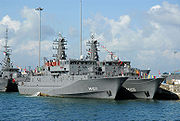
The RSN acquired mine countermeasure capabilities as early as 1975, when the USN's USS Thrasher and USS Whippoorwill were reactivated by the RSN's engineers and technicians in California. The Redwing class coastal minesweepers were commissioned as RSS Jupiter and RSS Mercury.These two ships were eventually replaced by the Bedok class mine countermeasures vessel
Bedok class mine countermeasures vessel
The Bedok class are mine countermeasures vessels of the Republic of Singapore Navy . They play an important role in the maritime security of Singapore, ensuring that the Singapore Strait and the sea lanes surrounding Singapore remain mine-free and open to international shipping...
s. The first ship, RSS Bedok, was built by Karlskronavarvet in Sweden based on the Landsort
Landsort class mine countermeasures vessel
The Landsort class mine countermeasures vessel is built by Swedish shipbuilding company, Kockums for the Swedish Navy and the Republic of Singapore Navy .-Design:...
class design. The remaining three ships were prefabricated in Sweden and transferred to Singapore for final assembly by ST Marine. The ships are constructed of glass reinforced plastic to maintain low magnetic and acoustic signatures, and are fitted with Voith Schneider Propellers, giving it the highest manoeuvrability in the navy. The ships form the 194 Squadron of the RSN.
| Ships |
|
 |
| Length | 47.5 metres | |
| Beam | 9.6 metres | |
| Displacement | 360 tonnes | |
| Crew | 28 | |
| Speed | 15 knots (28 km/h) | |
| Weapons |
CIS 50MG The CIS 50MG is a gas-operated, air-cooled, belt-fed heavy machine gun developed and manufactured by Chartered Industries of Singapore in the late 1980s, in response to a request by the Singaporean Defence Ministry to replace the venerable 12.7mm Browning M2HB machine guns then in ubiquitous... s |
Others
The RSN operates the Protector unmanned surface vehicles. They were deployed together with the Endurance class landing platform dock ships to the North Persian Gulf for peacekeepingPeacekeeping
Peacekeeping is an activity that aims to create the conditions for lasting peace. It is distinguished from both peacebuilding and peacemaking....
operations in 2005, where they performed surveillance and reconnaissance, as well as force protection duties for more than eight hours at a go.
| Ships | (2) Protector USV | |
| Length | 9 metres | |
| Beam | N/A | |
| Displacement | N/A | |
| Crew | none | |
| Speed | 40 knots | |
| Weapons | Typhoon Weapon System Typhoon Weapon System The Typhoon is a type of remote weapon station manufactured by Rafael Advanced Defense Systems of Israel, and it shares similar design principles and common technologies with Samson Remote Controlled Weapon Station , a land-based system manufactured by the same developer... with the CIS 50 12.7 mm machine gun CIS 50MG The CIS 50MG is a gas-operated, air-cooled, belt-fed heavy machine gun developed and manufactured by Chartered Industries of Singapore in the late 1980s, in response to a request by the Singaporean Defence Ministry to replace the venerable 12.7mm Browning M2HB machine guns then in ubiquitous... |
Missile gunboats
The Sea Wolf class missile gunboats were acquired in 1968, based on the TNC 45 design from Fredrich Lürssen Werft. The first two gunboats were constructed in GermanyGermany
Germany , officially the Federal Republic of Germany , is a federal parliamentary republic in Europe. The country consists of 16 states while the capital and largest city is Berlin. Germany covers an area of 357,021 km2 and has a largely temperate seasonal climate...
, while the remaining four were constructed locally by ST Marine (then known as Singapore Shipbuilding and Engineering).
As new technology became available, these gunboats underwent a number of upgrading programmes in the 1980s and 1990s to increase their strike capability and sophistication. These gunboats became the first missile-armed naval vessles in Southeast Asia
Southeast Asia
Southeast Asia, South-East Asia, South East Asia or Southeastern Asia is a subregion of Asia, consisting of the countries that are geographically south of China, east of India, west of New Guinea and north of Australia. The region lies on the intersection of geological plates, with heavy seismic...
when they were upgraded to launch Boeing Harpoon
Boeing Harpoon
The Harpoon is an all-weather, over-the-horizon, anti-ship missile system, developed and manufactured by McDonnell Douglas . In 2004, Boeing delivered the 7,000th Harpoon unit since the weapon's introduction in 1977...
(SSM) surface-to-surface missiles. On 13 May 2008, all six gunboats were retired at a sunset decommissioning ceremony held at Changi Naval Base following 33 years of service.
| Ships |
|
 |
| Length | 45 metres | |
| Beam | 6.5 metres | |
| Displacement | 270 tonnes | |
| Crew | 40 | |
| Speed | 30 knots (56 km/h) | |
| Weapons |
Mistral missile Mistral is an infrared homing surface-to-air missile manufactured by the European multinational company MBDA missile systems . Based on the French SATCP , the portable missile later to become the Mistral began development in 1974... surface-to-air missiles (replaced the Bofors 40 mm gun after refit) CIS 50MG The CIS 50MG is a gas-operated, air-cooled, belt-fed heavy machine gun developed and manufactured by Chartered Industries of Singapore in the late 1980s, in response to a request by the Singaporean Defence Ministry to replace the venerable 12.7mm Browning M2HB machine guns then in ubiquitous... s |
Tuas Naval Base
Tuas Naval BaseTuas Naval Base
Tuas Naval Base is the second naval base in the history of the Republic of Singapore Navy . Located at the western tip of Singapore, it occupies 0.28 km² of land. It was officially opened on 2 September 1994 by Goh Chok Tong, the second prime minister of Singapore.For about two decades,...
(TNB) is the second naval base in the RSN's history. Located at the western tip of Singapore, it occupies 0.28 km² (0.11 mi²) of land. It was officially opened on 2 September 1994 by the second prime minister Goh Chok Tong
Goh Chok Tong
Goh Chok Tong is the Senior Minister of Singapore and the chairman of the central bank of Singapore, the Monetary Authority of Singapore. He also served as the second Prime Minister of the Republic of Singapore from 28 November 1990 to 12 August 2004, succeeding Lee Kuan Yew, the former Prime...
.
For about two decades, Brani Naval Base was the RSN's only base. An expansion of the fleet in the early 1980s meant that more space was needed for the fleet and its shore infrastructure. However, this was not possible as the land around Brani was reserved for use by the port authority to develop container facilities. As a result, Tuas was selected as the site for a second naval base.
Better utilisation of space at TNB resulted in two and a half times more berthing space than Brani, even though TNB only has a shoreline of 850 m (0.5 mi). Provision was also made for recreational facilities. Automation was incorporated into the design of TNB to reduce manpower requirements, such as mechanical ramps for the loading and unloading of vehicles and an automatic storage and retrieval system. It also has a floating dock which can lift 600 tonnes and transfer a ship from sea to land to facilitate repairs and maintenance.
Currently, the missile corvettes, patrol vessels and mine counter-measures vessels are based at TNB.
Changi Naval Base
Changi Naval BaseChangi Naval Base
Changi Naval Base is the latest naval facility of the Republic of Singapore Navy and was built to replace Brani Naval Base. Located about 1.5 kilometres east of Changi Air Base and 3.5 kilometres east of Singapore Changi Airport, the base was built on 1.28 km² of reclaimed land, it was...
(CNB) is the latest naval facility of the RSN and was built to replace Brani Naval Base. Located on 1.28 km² (0.50 mi²) of reclaimed land at the eastern tip of Singapore, it was officially opened on 21 May 2004 by Goh Chok Tong.
Its 6.2 km (3.9 mi) berthing space can accommodate an aircraft carrier and is often used by visiting ships of the USN.
Automation was incorporated into the design of CNB to reduce manpower requirements. It has an automated underground ammunition depot that allows ammunition to be loaded onto the ships and an automated warehouse system to store items. The base has a fibre optic broadband network for information management. The base was also designed to be environment-friendly, with small-scale wind turbines powering the lights along the breakwaters at night. Conventional roof construction materials were substituted by thin film solar panels and the solar energy generated lights the base. In addition, seawater is used in the air-conditioning system.
Currently, the submarines, frigates and amphibious transport docks are based at CNB. Co-located in CNB is the Changi Naval Training Base, also known as RSS Panglima - named in honour of the first ship of the navy.
In popular culture
Television programs- Navy, first telecast 17 July 1990
- Be Somebody, first telecast 25 May 2004
External links
- Navy News - official bi-monthly publication of the RSN