

Marginal utility

Encyclopedia
In economics
, the marginal utility of a good or service is the utility
gained (or lost) from an increase (or decrease) in the consumption
of that good or service. Economists sometimes speak of a law of diminishing marginal utility, meaning that the first unit
of consumption of a good or service yields more utility than the second and subsequent units.
The concept of marginal utility played a crucial role in the marginal revolution
of the late 19th century, and led to the replacement of the labor theory of value
by neoclassical
value theory
in which the relative prices of goods and services are simultaneously determined by marginal rates of substitution
in consumption and marginal rates of transformation in production, which are equal in economic equilibrium
.
explained the term,
Frequently the marginal change is assumed to start from the endowment, meaning the total resources available for consumption (see Budget constraint
). This endowment is determined by many things including physical laws (which constrain how forms of energy and matter may be transformed), accidents of nature (which determine the presence of natural resources), and the outcomes of past decisions made both by others and by the individual himself or herself.
For reasons of tractability, it is often assumed in neoclassical analysis
that goods and services are continuously divisible
. Under this assumption, marginal concepts, including marginal utility may be expressed in terms of differential calculus
.
Marginal utility can be defined as a measure of relative satisfaction gained or lost from an increase or decrease in the consumption of that good or service.
However, strictly speaking, the smallest relevant division may be quite large. Frequently, economic analysis concerns the marginal values associated with a change of one unit of a discrete good or service, such as a motor vehicle or a haircut.
Contemporary mainstream economic theory frequently defers metaphysical questions, and merely notes or assumes that preference structures conforming to certain rules can be usefully proxied by associating goods, services, or uses thereof with quantities, and defines “utility” as such a quantification.
Another conception is Benthamite philosophy
, which equated usefulness with the production of pleasure and avoidance of pain, assumed subject to arithmetic operation. British economists, under the influence of this philosophy (especially by way of John Stuart Mill
), viewed utility as “the feelings of pleasure and pain” and further as a “quantity of feeling” (emphasis added).
Though generally pursued outside of the mainstream methods, there are conceptions of utility that do not rely on quantification.
For example, the Austrian school
generally attributes value to the satisfaction of needs, and sometimes rejects even the possibility of quantification.
It has been argued that the Austrian framework makes it possible to consider rational preferences that would otherwise be excluded.
In any standard framework, the same object may have different marginal utilities for different people, reflecting different preferences or individual circumstances.
"The law of diminishing marginal utility is at the heart of the explanation of numerous economic phenomena, including time preference
and the value of goods
. . . . The law says, first, that the marginal utility of each (homogenous) unit decreases as the supply of units increases (and vice versa); second, that the marginal utility of a larger-sized unit is greater than the marginal utility of a smaller-sized unit (and vice versa). The first law denotes the law of diminishing marginal utility, the second law the law of increasing total utility."
An individual will typically be able to partially order
the potential uses of a good or service. For example, a ration of water might be used to sustain oneself, a dog, or a rose bush. Say that a given person gives her own sustenance highest priority, that of the dog next highest priority, and lowest priority to the rose bush. In that case, if the individual has two rations of water, then the marginal utility of either of those rations is that of sustaining the dog. The marginal utility of a third unit would be that of watering the roses.
(The diminishing of marginal utility should not necessarily be taken to be itself an arithmetic
subtraction
. It may be no more than a purely ordinal
change.)
The notion that marginal utilities are diminishing across the ranges relevant to decision-making is called “the law of diminishing marginal utility” (and also known as a “Gossen
's First Law”). However, it will not always hold. The case of the person, dog, and roses is one in which potential uses operate independently—there is no complementarity across the three uses. Sometimes an amount added brings things past a desired tipping point
, or an amount subtracted causes them to fall short. In such cases, the marginal utility of a good or service might actually be increasing. For example:
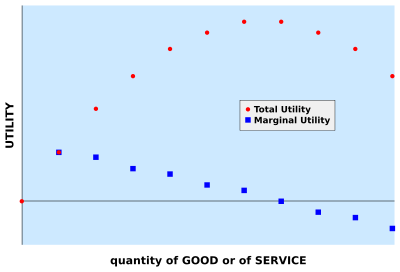
The fact that a tipping point may be reached does not imply that marginal utility will continue to increase indefinitely thereafter. For example, beyond some point, further doses of antibiotics would kill no pathogens at all, and might even become harmful to the body. Simply put, as the rate of commodity consumption increases, marginal utility decreases. If commodity consumption continues to rise, marginal utility at some point falls to zero, reaching maximum total utility. Further increase in consumption of units of commodities causes marginal utility to become negative; this signifies dissatisfaction.
, the concept and logic of marginal utility are independent of the presumption that people pursue self-interest. For example, a different person might give highest priority to the rose bush, next highest to the dog, and last to himself. In that case, if the individual has three rations of water, then the marginal utility of any one of those rations is that of watering the person. With just two rations, the person is left unwatered and the marginal utility of either ration is that of watering the dog. Likewise, a person could give highest priority to the needs of one of her neighbors, next to another, and so forth, placing her own welfare last; the concept of diminishing marginal utility would still apply.
explains choice with the hypothesis that people decide whether to effect any given change based on the marginal utility of that change, with rival alternatives being chosen based upon which has the greatest marginal utility.
In an economy with money
, the marginal utility of a quantity is simply that of the best good or service that it could purchase.
Hence, the “law” of diminishing marginal utility provides an explanation for diminishing marginal rates of substitution
and thus for the “laws” of supply and demand
, as well as essential aspects of models of “imperfect” competition
.
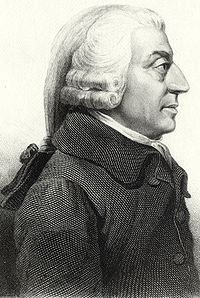
(though recognized by earlier thinkers). Human beings cannot even survive without water, whereas diamonds are mere ornamentation or engraving bits. Yet water had a very low price, and diamonds a very high price, by any normal measure. Marginalists explained that it is the marginal usefulness of any given quantity that determines its price, rather than the usefulness of a class or of a totality. For most people, water was sufficiently abundant that the loss or gain of a gallon would withdraw or add only some very minor use if any; whereas diamonds were in much more restricted supply, so that the lost or gained use would be much greater.
That is not to say that the price of any good or service is simply a function of the marginal utility that it has for any one individual nor for some ostensibly typical individual. Rather, individuals are willing to trade based upon the respective marginal utilities of the goods that they have or desire (with these marginal utilities being distinct for each potential trader), and prices thus develop constrained by these marginal utilities.
The “law” does not tell us such things as why diamonds are naturally less abundant on the earth than is water, but helps us to understand how this affects the value imputed to a given diamond and the price of diamonds in a market.
in which usefulness can be quantified, the change in utility of moving from state to state
  is
is
Moreover, if and
and  are distinguishable by values of just one variable
  which is itself quantified, then it becomes possible to speak of the ratio of the marginal utility of the change in
  to the size of that change:

(where “c.p.
” indicates that the only independent variable
to change is ).
).
Mainstream neoclassical economics will typically assume that
is well defined, and use “marginal utility” to refer to a partial derivative

and diminishing marginal utility is similarly taken to correspond to
economist Friedrich von Wieser
by Alfred Marshall
, was a translation of Wieser's term “Grenznutzen” (border-use).Wieser, Friedrich von; Der natürliche Werth[ Natural Value] (1889), Bk I Ch V “Marginal Utility” (HTML).
's Politics
, wherein he writes (There has been marked disagreement about the development and role of marginal considerations in Aristotle's value theory.)
A great variety of economists concluded that there was some sort of inter-relationship between utility and rarity that effected economic decisions, and in turn informed the determination of prices.
Eighteenth-century Italian mercantilist
s, such as Antonio Genovesi
, Giammaria Ortes
, Pietro Verri
, Marchese Cesare di Beccaria
, and Count Giovanni Rinaldo Carli
, held that value was explained in terms of the general utility and of scarcity, though they did not typically work-out a theory of how these interacted. In Della moneta (1751), Abbé Ferdinando Galiani
, a pupil of Genovesi, attempted to explain value as a ratio of two ratios, utility and scarcity, with the latter component ratio being the ratio of quantity to use.
 Anne Robert Jacques Turgot, in Réflexions sur la formation et la distribution de richesse (1769), held that value derived from the general utility of the class to which a good belonged, from comparison of present and future wants, and from anticipated difficulties in procurement.
Like the Italian mercantists, Étienne Bonnot, Abbé de Condillac
, saw value as determined by utility associated with the class to which the good belong, and by estimated scarcity. In De commerce et le gouvernement (1776), Condillac emphasized that value is not based upon cost but that costs were paid because of value.
This last point was famously restated by the Nineteenth Century proto-marginalist, Richard Whately
, who in Introductory Lectures on Political Economy (1832) wrote (Whatley's student Senior
is noted below as an early marginalist.)
, in “Specimen theoriae novae de mensura sortis”. This paper appeared in 1738, but a draft had been written in 1731 or in 1732. In 1728, Gabriel Cramer
had produced fundamentally the same theory in a private letter. Each had sought to resolve the St. Petersburg paradox
, and had concluded that the marginal desirability of money decreased as it was accumulated, more specifically such that the desirability of a sum were the natural logarithm
(Bernoulli) or square root
(Cramer) thereof. However, the more general implications of this hypothesis were not explicated, and the work fell into obscurity.
In “A Lecture on the Notion of Value as Distinguished Not Only from Utility, but also from Value in Exchange”, delivered in 1833 and included in Lectures on Population, Value, Poor Laws and Rent (1837), William Forster Lloyd
explicitly offered a general marginal utility theory, but did not offer its derivation nor elaborate its implications. The importance of his statement seems to have been lost on everyone (including Lloyd) until the early 20th century, by which time others had independently developed and popularized the same insight.
In An Outline of the Science of Political Economy (1836), Nassau William Senior
asserted that marginal utilities were the ultimate determinant of demand, yet apparently did not pursue implications, though some interpret his work as indeed doing just that.
In “De la mesure de l’utilité des travaux publics” (1844), Jules Dupuit
applied a conception of marginal utility to the problem of determining bridge tolls.
In 1854, Hermann Heinrich Gossen
published Die Entwicklung der Gesetze des menschlichen Verkehrs und der daraus fließenden Regeln für menschliches Handeln, which presented a marginal utility theory and to a very large extent worked-out its implications for the behavior of a market economy. However, Gossen's work was not well received in the Germany of his time, most copies were destroyed unsold, and he was virtually forgotten until rediscovered after the so-called Marginal Revolution.
Marginalism eventually found a foot-hold by way of the work of three economists, Jevons
in England, Menger
in Austria, and Walras
in Switzerland.
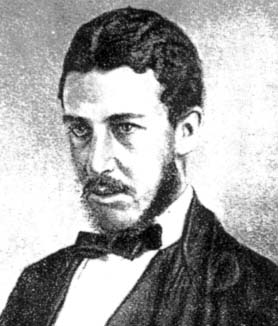 William Stanley Jevons
first proposed the theory in “A General Mathematical Theory of Political Economy” (PDF), a paper presented in 1862 and published in 1863, followed by a series of works culminating in his book The Theory of Political Economy in 1871 that established his reputation as a leading political economist and logician of the time. Jevons' conception of utility was in the utilitarian
tradition of Jeremy Bentham
and of John Stuart Mill
, but he differed from his classical
predecessors in emphasizing that "value depends entirely upon utility", in particular, on "final utility upon which the theory of Economics will be found to turn." He later qualified this in deriving the result that in a model of exchange equilibrium, price ratios would be proportional to not only to ratios of "final degrees of utility" but costs of production.
Carl Menger
presented the theory in Grundsätze der Volkswirtschaftslehre (translated as Principles of Economics) in 1871. Menger's presentation is peculiarly notable on two points. First, he took special pains to explain why individuals should be expected to rank possible uses and then to use marginal utility to decide amongst trade-offs. (For this reason, Menger and his followers are sometimes called “the Psychological School”, though they are more frequently known as “the Austrian School
” or as “the Vienna School”.) Second, while his illustrative examples present utility as quantified, his essential assumptions do not. (Menger in fact crossed-out the numerical tables in his own copy of the published Grundsätze.) Menger also developed the law of diminishing marginal utility. Menger's work found a significant and appreciative audience.
Marie-Esprit-Léon Walras
introduced the theory in Éléments d'économie politique pure, the first part of which was published in 1874 in a relatively mathematical exposition. Walras's work found relatively few readers at the time but was recognized and incorporated two decades later in the work of Pareto
and Barone
.
An American, John Bates Clark
, is sometimes also mentioned. But, while Clark independently arrived at a marginal utility theory, he did little to advance it until it was clear that the followers of Jevons, Menger, and Walras were revolutionizing economics. Nonetheless, his contributions thereafter were profound.
 Although the Marginal Revolution flowed from the work of Jevons, Menger, and Walras, their work might have failed to enter the mainstream were it not for a second generation of economists. In England, the second generation were exemplified by Philip Henry Wicksteed
, by William Smart
, and by Alfred Marshall
; in Austria by Eugen von Böhm-Bawerk
and by Friedrich von Wieser
; in Switzerland by Vilfredo Pareto
; and in America by Herbert Joseph Davenport and by Frank A. Fetter
.
There were significant, distinguishing features amongst the approaches of Jevons, Menger, and Walras, but the second generation did not maintain distinctions along national or linguistic lines. The work of von Wieser was heavily influenced by that of Walras. Wicksteed was heavily influenced by Menger. Fetter referred to himself and Davenport as part of “the American Psychological School”, named in imitation of the Austrian “Psychological School”. (And Clark's work from this period onward similarly shows heavy influence by Menger.) William Smart began as a conveyor of Austrian School theory to English-language readers, though he fell increasingly under the influence of Marshall.
Böhm-Bawerk was perhaps the most able expositor of Menger's conception. He was further noted for producing a theory of interest and of profit in equilibrium based upon the interaction of diminishing marginal utility with diminishing marginal product
ivity of time and with time preference
. (This theory was adopted in full and then further developed by Knut Wicksell
and, with modifications including formal disregard for time-preference, by Wicksell's American rival Irving Fisher
.)
Marshall was the second-generation marginalist whose work on marginal utility came most to inform the mainstream of neoclassical economics, especially by way of his Principles of Economics, the first volume of which was published in 1890. Marshall constructed the demand curve with the aid of assumptions that utility was quantified, and that the marginal utility of money was constant (or nearly so). Like Jevons, Marshall did not see an explanation for supply in the theory of marginal utility, so he synthesized an explanation of demand thus explained with supply explained in a more classical
manner, determined by costs which were taken to be objectively determined. (Marshall later actively mischaracterized the criticism that these costs were themselves ultimately determined by marginal utilities.)
acknowledged that “nothing can have value, without being an object of utility”, but, in his analysis, “use-value as such lies outside the sphere of investigation of political economy”, with labor being the principal measure of value under capitalism.
The doctrines of marginalism and the Marginal Revolution are often interpreted as somehow a response to Marxist economics
. In fact, the first volume of Das Kapital
was not published until July 1867, after the works of Jevons, Menger, and Walras were written or well under way; and Marx was still a relatively obscure figure when these works were completed. It is unlikely that any of them knew anything of him. (On the other hand, Hayek
or Bartley
has suggested that Marx
, voraciously reading at the British Museum
, may have come across the works of one or more of these figures, and that his inability to formulate a viable critique may account for his failure to complete any further volumes of Kapital before his death.)
Nonetheless, it is not unreasonable to suggest that part of what contributed to the success of the generation who followed the preceptors of the Revolution was their ability to formulate straight-forward responses to Marxist economic theory. The most famous of these was that of Böhm-Bawerk, “Zum Abschluss des Marxschen Systems” (1896), but the first was Wicksteed's “The Marxian Theory of Value. Das Kapital: a criticism” (1884, followed by “The Jevonian criticism of Marx: a rejoinder” in 1885). Only a few Marxist replies were initially made to marginalism, of which the most famous were Rudolf Hilferding
's Böhm-Bawerks Marx-Kritik (1904) and Политической экономии рантье (1914) by Никола́й Ива́нович Буха́рин (Nikolai Bukharin)
. However, over the course of the 20th century a considerable literature developed on the conflict between marginalism and the labour theory of value, with the work of the neo-Ricardian economist Piero Sraffa
providing an important critique of marginalism.
(It might also be noted that some followers of Henry George
similarly consider marginalism and neoclassical economics a reaction to Progress and Poverty
, which was published in 1879.)
presented the indifference curve
, deriving its properties from marginalist theory which assumed utility to be a differentiable function of quantified goods and services. Later work attempted to generalize to the indifference-curve formulations of utility and marginal utility in avoiding unobservable measures of utility.
In 1915, Евгений Евгениевич Слуцкий (Eugen Slutsky)
derived a theory of consumer choice solely from properties of indifference curves. Because of the World War
, the Bolshevik Revolution
, and his own subsequent loss of interest, Slutsky's work drew almost no notice, but similar work in 1934 by John Richard Hicks
and R. G. D. Allen
derived much the same results and found a significant audience. (Allen subsequently drew attention to Slutsky's earlier accomplishment.)
Although some of the third generation of Austrian School economists had by 1911 rejected the quantification of utility while continuing to think in terms of marginal utility, most economists presumed that utility must be a sort of quantity. Indifference curve analysis seemed to represent a way of dispensing with presumptions of quantification, albeït that a seemingly arbitrary assumption (admitted by Hicks to be a “rabbit out of a hat”) about decreasing marginal rates of substitution would then have to be introduced to have convexity of indifference curves.
For those who accepted that indifference-curve analysis superseded earlier marginal-utility analysis, the latter became at best perhaps pedagogically useful, but “old fashioned” and observationally unnecessary.
 When Cramer and Bernoulli introduced the notion of diminishing marginal utility, it had been to address a paradox of gambling
, rather than the paradox of value
. The marginalists of the revolution, however, had been formally concerned with problems in which there was neither risk
nor uncertainty
. So too with the indifference curve analysis of Slutsky, Hicks, and Allen.
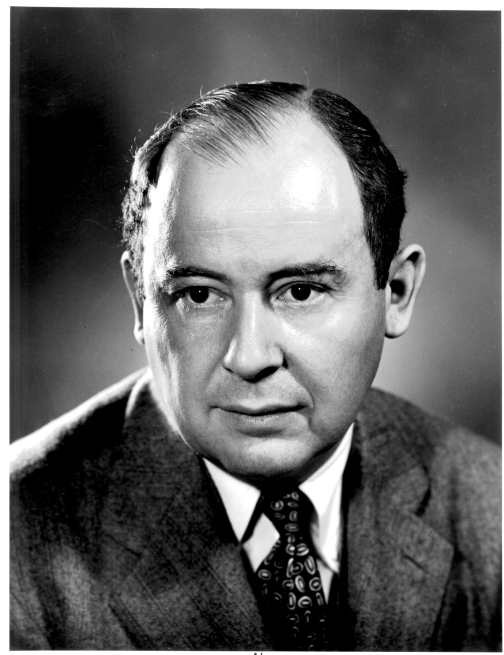
The expected utility hypothesis
of Bernoulli et alii was revived by various 20th century thinkers, with early contributions by Ramsey
(1926), v. Neumann
and Morgenstern
(1944), and Savage
(1954). Although this hypothesis remains controversial, it not only brings utility, but a quantified conception of utility, back into the mainstream of economic thought.
A major reason why quantified models of utility are influential today is that risk and uncertainty have been recognized as central topics in contemporary economic theory. Quantified utility models simplify the analysis of risky decisions because, under quantified utility, diminishing marginal utility implies “risk aversion
”. In fact, many contemporary analyses of saving and portfolio choice require stronger assumptions than diminishing marginal utility, such as the assumption of “prudence”, which means convex
marginal utility.
Meanwhile, the Austrian School continued to develop its ordinalist notions of marginal utility analysis, formally demonstrating that from them proceed the decreasing marginal rates of substitution of indifference curves.
Economics
Economics is the social science that analyzes the production, distribution, and consumption of goods and services. The term economics comes from the Ancient Greek from + , hence "rules of the house"...
, the marginal utility of a good or service is the utility
Utility
In economics, utility is a measure of customer satisfaction, referring to the total satisfaction received by a consumer from consuming a good or service....
gained (or lost) from an increase (or decrease) in the consumption
Consumption (economics)
Consumption is a common concept in economics, and gives rise to derived concepts such as consumer debt. Generally, consumption is defined in part by comparison to production. But the precise definition can vary because different schools of economists define production quite differently...
of that good or service. Economists sometimes speak of a law of diminishing marginal utility, meaning that the first unit
Units of measurement
A unit of measurement is a definite magnitude of a physical quantity, defined and adopted by convention and/or by law, that is used as a standard for measurement of the same physical quantity. Any other value of the physical quantity can be expressed as a simple multiple of the unit of...
of consumption of a good or service yields more utility than the second and subsequent units.
The concept of marginal utility played a crucial role in the marginal revolution
Marginal Revolution
Marginal Revolution is a blog focused on economics run by economists Tyler Cowen and Alex Tabarrok, both of whom teach at George Mason University. The blog's slogan is "Small steps toward a much better world." The site is updated daily and focuses on current events and newly released reports or books...
of the late 19th century, and led to the replacement of the labor theory of value
Labor theory of value
The labor theories of value are heterodox economic theories of value which argue that the value of a commodity is related to the labor needed to produce or obtain that commodity. The concept is most often associated with Marxian economics...
by neoclassical
Neoclassical economics
Neoclassical economics is a term variously used for approaches to economics focusing on the determination of prices, outputs, and income distributions in markets through supply and demand, often mediated through a hypothesized maximization of utility by income-constrained individuals and of profits...
value theory
Value theory
Value theory encompasses a range of approaches to understanding how, why and to what degree people should value things; whether the thing is a person, idea, object, or anything else. This investigation began in ancient philosophy, where it is called axiology or ethics. Early philosophical...
in which the relative prices of goods and services are simultaneously determined by marginal rates of substitution
Marginal rate of substitution
In economics, the marginal rate of substitution is the rate at which a consumer is ready to give up one good in exchange for another good while maintaining the same level of utility.-Marginal rate of substitution as the slope of indifference curve:...
in consumption and marginal rates of transformation in production, which are equal in economic equilibrium
Economic equilibrium
In economics, economic equilibrium is a state of the world where economic forces are balanced and in the absence of external influences the values of economic variables will not change. It is the point at which quantity demanded and quantity supplied are equal...
.
Marginality
The term marginal refers to a small change, starting from some baseline level. As Philip WicksteedPhilip Wicksteed
Philip Henry Wicksteed is known primarily as an economist. He was also an English Unitarian theologian , classicist, medievalist, and literary critic....
explained the term,
- "Marginal considerations are considerations which concern a slight increase or diminution of the stock of anything which we possess or are considering"
Frequently the marginal change is assumed to start from the endowment, meaning the total resources available for consumption (see Budget constraint
Budget constraint
A budget constraint represents the combinations of goods and services that a consumer can purchase given current prices with his or her income. Consumer theory uses the concepts of a budget constraint and a preference map to analyze consumer choices...
). This endowment is determined by many things including physical laws (which constrain how forms of energy and matter may be transformed), accidents of nature (which determine the presence of natural resources), and the outcomes of past decisions made both by others and by the individual himself or herself.
For reasons of tractability, it is often assumed in neoclassical analysis
Neoclassical economics
Neoclassical economics is a term variously used for approaches to economics focusing on the determination of prices, outputs, and income distributions in markets through supply and demand, often mediated through a hypothesized maximization of utility by income-constrained individuals and of profits...
that goods and services are continuously divisible
Continuum (theory)
Continuum theories or models explain variation as involving a gradual quantitative transition without abrupt changes or discontinuities. It can be contrasted with 'categorical' models which propose qualitatively different states.-In physics:...
. Under this assumption, marginal concepts, including marginal utility may be expressed in terms of differential calculus
Differential calculus
In mathematics, differential calculus is a subfield of calculus concerned with the study of the rates at which quantities change. It is one of the two traditional divisions of calculus, the other being integral calculus....
.
Marginal utility can be defined as a measure of relative satisfaction gained or lost from an increase or decrease in the consumption of that good or service.
However, strictly speaking, the smallest relevant division may be quite large. Frequently, economic analysis concerns the marginal values associated with a change of one unit of a discrete good or service, such as a motor vehicle or a haircut.
Utility
Different concepts of utility underlie different theories in which marginal utility plays a role. It has been common among economists to describe utility as if it were quantifiable, that is, as if different levels of utility could be compared along a numerical scale. This has significantly affected the development and reception of theories of marginal utility. Concepts of utility that entail quantification allow familiar arithmetic operations, and further assumptions of continuity and differentiability greatly increase tractability.Contemporary mainstream economic theory frequently defers metaphysical questions, and merely notes or assumes that preference structures conforming to certain rules can be usefully proxied by associating goods, services, or uses thereof with quantities, and defines “utility” as such a quantification.
Another conception is Benthamite philosophy
Utilitarianism
Utilitarianism is an ethical theory holding that the proper course of action is the one that maximizes the overall "happiness", by whatever means necessary. It is thus a form of consequentialism, meaning that the moral worth of an action is determined only by its resulting outcome, and that one can...
, which equated usefulness with the production of pleasure and avoidance of pain, assumed subject to arithmetic operation. British economists, under the influence of this philosophy (especially by way of John Stuart Mill
John Stuart Mill
John Stuart Mill was a British philosopher, economist and civil servant. An influential contributor to social theory, political theory, and political economy, his conception of liberty justified the freedom of the individual in opposition to unlimited state control. He was a proponent of...
), viewed utility as “the feelings of pleasure and pain” and further as a “quantity of feeling” (emphasis added).
Though generally pursued outside of the mainstream methods, there are conceptions of utility that do not rely on quantification.
For example, the Austrian school
Austrian School
The Austrian School of economics is a heterodox school of economic thought. It advocates methodological individualism in interpreting economic developments , the theory that money is non-neutral, the theory that the capital structure of economies consists of heterogeneous goods that have...
generally attributes value to the satisfaction of needs, and sometimes rejects even the possibility of quantification.
It has been argued that the Austrian framework makes it possible to consider rational preferences that would otherwise be excluded.
In any standard framework, the same object may have different marginal utilities for different people, reflecting different preferences or individual circumstances.
Diminishing marginal utility
the utility which a person receives with the increase in the stock that he already had"The law of diminishing marginal utility is at the heart of the explanation of numerous economic phenomena, including time preference
Time preference
In economics, time preference pertains to how large a premium a consumer places on enjoyment nearer in time over more remote enjoyment....
and the value of goods
Value (economics)
An economic value is the worth of a good or service as determined by the market.The economic value of a good or service has puzzled economists since the beginning of the discipline. First, economists tried to estimate the value of a good to an individual alone, and extend that definition to goods...
. . . . The law says, first, that the marginal utility of each (homogenous) unit decreases as the supply of units increases (and vice versa); second, that the marginal utility of a larger-sized unit is greater than the marginal utility of a smaller-sized unit (and vice versa). The first law denotes the law of diminishing marginal utility, the second law the law of increasing total utility."
An individual will typically be able to partially order
Partially ordered set
In mathematics, especially order theory, a partially ordered set formalizes and generalizes the intuitive concept of an ordering, sequencing, or arrangement of the elements of a set. A poset consists of a set together with a binary relation that indicates that, for certain pairs of elements in the...
the potential uses of a good or service. For example, a ration of water might be used to sustain oneself, a dog, or a rose bush. Say that a given person gives her own sustenance highest priority, that of the dog next highest priority, and lowest priority to the rose bush. In that case, if the individual has two rations of water, then the marginal utility of either of those rations is that of sustaining the dog. The marginal utility of a third unit would be that of watering the roses.
(The diminishing of marginal utility should not necessarily be taken to be itself an arithmetic
Elementary arithmetic
Elementary arithmetic is the simplified portion of arithmetic which is considered necessary and appropriate during primary education. It includes the operations of addition, subtraction, multiplication, and division. It is taught in elementary school....
subtraction
Subtraction
In arithmetic, subtraction is one of the four basic binary operations; it is the inverse of addition, meaning that if we start with any number and add any number and then subtract the same number we added, we return to the number we started with...
. It may be no more than a purely ordinal
Ranking
A ranking is a relationship between a set of items such that, for any two items, the first is either 'ranked higher than', 'ranked lower than' or 'ranked equal to' the second....
change.)
The notion that marginal utilities are diminishing across the ranges relevant to decision-making is called “the law of diminishing marginal utility” (and also known as a “Gossen
Hermann Heinrich Gossen
Hermann Heinrich Gossen was a Prussian economist who is often regarded as the first to elaborate a general theory of marginal utility.-Life and work:...
's First Law”). However, it will not always hold. The case of the person, dog, and roses is one in which potential uses operate independently—there is no complementarity across the three uses. Sometimes an amount added brings things past a desired tipping point
Tipping point
In sociology, a tipping point is the event of a previously rare phenomenon becoming rapidly and dramatically more common. The phrase was coined in its sociological use by Morton Grodzins, by analogy with the fact in physics that adding a small amount of weight to a balanced object can cause it to...
, or an amount subtracted causes them to fall short. In such cases, the marginal utility of a good or service might actually be increasing. For example:
- bed sheets, which up to some number may only provide warmth, but after that point may allow one to effect an escape by being tied together into a rope;
- tickets, for travel or theatre, where a second ticket might allow one to take a date on an otherwise uninteresting outing;
- dosages of antibiotics, where having too few pills would leave bacteria with greater resistance, but a full supply could effect a cure.
The fact that a tipping point may be reached does not imply that marginal utility will continue to increase indefinitely thereafter. For example, beyond some point, further doses of antibiotics would kill no pathogens at all, and might even become harmful to the body. Simply put, as the rate of commodity consumption increases, marginal utility decreases. If commodity consumption continues to rise, marginal utility at some point falls to zero, reaching maximum total utility. Further increase in consumption of units of commodities causes marginal utility to become negative; this signifies dissatisfaction.
Independence from presumptions of self-interested behavior
While the above example of water rations conforms to ordinary notions of self-interested behaviorSelfishness
Selfishness denotes an excessive or exclusive concern with oneself, and as such it exceeds mere self interest or self concern. Insofar as a decision maker knowingly burdens or harms others for personal gain, the decision is selfish. In contrast, self-interest is more general...
, the concept and logic of marginal utility are independent of the presumption that people pursue self-interest. For example, a different person might give highest priority to the rose bush, next highest to the dog, and last to himself. In that case, if the individual has three rations of water, then the marginal utility of any one of those rations is that of watering the person. With just two rations, the person is left unwatered and the marginal utility of either ration is that of watering the dog. Likewise, a person could give highest priority to the needs of one of her neighbors, next to another, and so forth, placing her own welfare last; the concept of diminishing marginal utility would still apply.
Marginalist theory
MarginalismMarginalism
Marginalism refers to the use of marginal concepts in economic theory. Marginalism is associated with arguments concerning changes in the quantity used of a good or service, as opposed to some notion of the over-all significance of that class of good or service, or of some total quantity...
explains choice with the hypothesis that people decide whether to effect any given change based on the marginal utility of that change, with rival alternatives being chosen based upon which has the greatest marginal utility.
Market price and diminishing marginal utility
If an individual has a stock or flow of a good or service whose marginal utility is less than would be that of some other good or service for which he or she could trade, then it is in his or her interest to effect that trade. Of course, as one thing is traded-away and another is acquired, the respective marginal gains or losses from further trades are now changed. On the assumption that the marginal utility of one is diminishing, and the other is not increasing, all else being equal, an individual will demand an increasing ratio of that which is acquired to that which is sacrificed. (One important way in which all else might not be equal is when the use of the one good or service complements that of the other. In such cases, exchange ratios might be constant.) If any trader can better his or her own marginal position by offering a trade more favorable to complementary traders, then he or she will do so.In an economy with money
Money
Money is any object or record that is generally accepted as payment for goods and services and repayment of debts in a given country or socio-economic context. The main functions of money are distinguished as: a medium of exchange; a unit of account; a store of value; and, occasionally in the past,...
, the marginal utility of a quantity is simply that of the best good or service that it could purchase.
Hence, the “law” of diminishing marginal utility provides an explanation for diminishing marginal rates of substitution
Marginal rate of substitution
In economics, the marginal rate of substitution is the rate at which a consumer is ready to give up one good in exchange for another good while maintaining the same level of utility.-Marginal rate of substitution as the slope of indifference curve:...
and thus for the “laws” of supply and demand
Supply and demand
Supply and demand is an economic model of price determination in a market. It concludes that in a competitive market, the unit price for a particular good will vary until it settles at a point where the quantity demanded by consumers will equal the quantity supplied by producers , resulting in an...
, as well as essential aspects of models of “imperfect” competition
Imperfect competition
In economic theory, imperfect competition is the competitive situation in any market where the conditions necessary for perfect competition are not satisfied...
.
The paradox of water and diamonds
The “law” of diminishing marginal utility is said to explain the “paradox of water and diamonds”, most commonly associated with Adam SmithAdam Smith
Adam Smith was a Scottish social philosopher and a pioneer of political economy. One of the key figures of the Scottish Enlightenment, Smith is the author of The Theory of Moral Sentiments and An Inquiry into the Nature and Causes of the Wealth of Nations...
(though recognized by earlier thinkers). Human beings cannot even survive without water, whereas diamonds are mere ornamentation or engraving bits. Yet water had a very low price, and diamonds a very high price, by any normal measure. Marginalists explained that it is the marginal usefulness of any given quantity that determines its price, rather than the usefulness of a class or of a totality. For most people, water was sufficiently abundant that the loss or gain of a gallon would withdraw or add only some very minor use if any; whereas diamonds were in much more restricted supply, so that the lost or gained use would be much greater.
That is not to say that the price of any good or service is simply a function of the marginal utility that it has for any one individual nor for some ostensibly typical individual. Rather, individuals are willing to trade based upon the respective marginal utilities of the goods that they have or desire (with these marginal utilities being distinct for each potential trader), and prices thus develop constrained by these marginal utilities.
The “law” does not tell us such things as why diamonds are naturally less abundant on the earth than is water, but helps us to understand how this affects the value imputed to a given diamond and the price of diamonds in a market.
Quantified marginal utility
Under the special caseSpecial case
In logic, especially as applied in mathematics, concept A is a special case or specialization of concept B precisely if every instance of A is also an instance of B, or equivalently, B is a generalization of A. For example, all circles are ellipses ; therefore the circle is a special case of the...
in which usefulness can be quantified, the change in utility of moving from state
to state isMoreover, if
and are distinguishable by values of just one variable which is itself quantified, then it becomes possible to speak of the ratio of the marginal utility of the change in to the size of that change:(where “c.p.
Ceteris paribus
or is a Latin phrase, literally translated as "with other things the same," or "all other things being equal or held constant." It is an example of an ablative absolute and is commonly rendered in English as "all other things being equal." A prediction, or a statement about causal or logical...
” indicates that the only independent variable
Dependent and independent variables
The terms "dependent variable" and "independent variable" are used in similar but subtly different ways in mathematics and statistics as part of the standard terminology in those subjects...
to change is
).Mainstream neoclassical economics will typically assume that
is well defined, and use “marginal utility” to refer to a partial derivative
Partial derivative
In mathematics, a partial derivative of a function of several variables is its derivative with respect to one of those variables, with the others held constant...
and diminishing marginal utility is similarly taken to correspond to
History
The concept of marginal utility grew out of attempts by economists to explain the determination of price. The term “marginal utility”, credited to the AustrianAustrian School
The Austrian School of economics is a heterodox school of economic thought. It advocates methodological individualism in interpreting economic developments , the theory that money is non-neutral, the theory that the capital structure of economies consists of heterogeneous goods that have...
economist Friedrich von Wieser
Friedrich von Wieser
Friedrich Freiherr von Wieser was an early member of the Austrian School of economics. Born in Vienna, the son of Privy Councillor Leopold von Wieser, a high official in the war ministry he first trained in sociology and law...
by Alfred Marshall
Alfred Marshall
Alfred Marshall was an Englishman and one of the most influential economists of his time. His book, Principles of Economics , was the dominant economic textbook in England for many years...
, was a translation of Wieser's term “Grenznutzen” (border-use).Wieser, Friedrich von; Der natürliche Werth
Proto-marginalist approaches
Perhaps the essence of a notion of diminishing marginal utility can be found in AristotleAristotle
Aristotle was a Greek philosopher and polymath, a student of Plato and teacher of Alexander the Great. His writings cover many subjects, including physics, metaphysics, poetry, theater, music, logic, rhetoric, linguistics, politics, government, ethics, biology, and zoology...
's Politics
Politics (Aristotle)
Aristotle's Politics is a work of political philosophy. The end of the Nicomachean Ethics declared that the inquiry into ethics necessarily follows into politics, and the two works are frequently considered to be parts of a larger treatise, or perhaps connected lectures, dealing with the...
, wherein he writes (There has been marked disagreement about the development and role of marginal considerations in Aristotle's value theory.)
A great variety of economists concluded that there was some sort of inter-relationship between utility and rarity that effected economic decisions, and in turn informed the determination of prices.
Eighteenth-century Italian mercantilist
Mercantilism
Mercantilism is the economic doctrine in which government control of foreign trade is of paramount importance for ensuring the prosperity and security of the state. In particular, it demands a positive balance of trade. Mercantilism dominated Western European economic policy and discourse from...
s, such as Antonio Genovesi
Antonio Genovesi
Antonio Genovesi was an Italian writer on philosophy and political economy.-Biography:Genovesi was born at Castiglione, near Salerno....
, Giammaria Ortes
Giammaria Ortes
Abbé Giovanni Maria Ortes was a Venetian composer, economist, mathematician, Camaldolese monk, and philosopher.- Works :* Della economia nazionale * Sulla religione e sul governo dei popoli...
, Pietro Verri
Pietro Verri
Pietro Verri was an Italian philosopher, economist, historian and writer.-Biography:Born in Milan, then under Austrian rule, to a conservative noble family, he received a strongly religious education, from which he began to rebel when he reached his twenties...
, Marchese Cesare di Beccaria
Cesare, Marquis of Beccaria
Cesare, Marquis of Beccaria-Bonesana was an Italian jurist, philosopher and politician best known for his treatise On Crimes and Punishments , which condemned torture and the death penalty, and was a founding work in the field of penology.-Birth and education:Beccaria was born in Milan on March...
, and Count Giovanni Rinaldo Carli
Giovanni Rinaldo
Giovanni Rinaldo, Count of Carli-Rubbi was an Italian economist and antiquarian.- Biography :Rinaldo was born at Capo d'Istria, then part of the Republic of Venice....
, held that value was explained in terms of the general utility and of scarcity, though they did not typically work-out a theory of how these interacted. In Della moneta (1751), Abbé Ferdinando Galiani
Ferdinando Galiani
Ferdinando Galiani was an Italian economist, a leading Italian figure of the Enlightenment. Friedrich Nietzsche called him the "most fastidious and refined intelligence" of the 18th century....
, a pupil of Genovesi, attempted to explain value as a ratio of two ratios, utility and scarcity, with the latter component ratio being the ratio of quantity to use.
Like the Italian mercantists, Étienne Bonnot, Abbé de Condillac
Étienne Bonnot de Condillac
Étienne Bonnot de Condillac was a French philosopher and epistemologist who studied in such areas as psychology and the philosophy of the mind.-Biography:...
, saw value as determined by utility associated with the class to which the good belong, and by estimated scarcity. In De commerce et le gouvernement (1776), Condillac emphasized that value is not based upon cost but that costs were paid because of value.
This last point was famously restated by the Nineteenth Century proto-marginalist, Richard Whately
Richard Whately
Richard Whately was an English rhetorician, logician, economist, and theologian who also served as the Church of Ireland Archbishop of Dublin.-Life and times:...
, who in Introductory Lectures on Political Economy (1832) wrote (Whatley's student Senior
Nassau William Senior
Nassau William Senior , English economist, was born at Compton, Berkshire, the eldest son of the Rev. JR Senior, vicar of Durnford, Wiltshire.-Biography:...
is noted below as an early marginalist.)
Marginalists before the Revolution
The first unambiguous published statement of any sort of theory of marginal utility was by Daniel BernoulliDaniel Bernoulli
Daniel Bernoulli was a Dutch-Swiss mathematician and was one of the many prominent mathematicians in the Bernoulli family. He is particularly remembered for his applications of mathematics to mechanics, especially fluid mechanics, and for his pioneering work in probability and statistics...
, in “Specimen theoriae novae de mensura sortis”. This paper appeared in 1738, but a draft had been written in 1731 or in 1732. In 1728, Gabriel Cramer
Gabriel Cramer
Gabriel Cramer was a Swiss mathematician, born in Geneva. He showed promise in mathematics from an early age. At 18 he received his doctorate and at 20 he was co-chair of mathematics.In 1728 he proposed a solution to the St...
had produced fundamentally the same theory in a private letter. Each had sought to resolve the St. Petersburg paradox
St. Petersburg paradox
In economics, the St. Petersburg paradox is a paradox related to probability theory and decision theory. It is based on a particular lottery game that leads to a random variable with infinite expected value, i.e., infinite expected payoff, but would nevertheless be considered to be worth only a...
, and had concluded that the marginal desirability of money decreased as it was accumulated, more specifically such that the desirability of a sum were the natural logarithm
Natural logarithm
The natural logarithm is the logarithm to the base e, where e is an irrational and transcendental constant approximately equal to 2.718281828...
(Bernoulli) or square root
Square root
In mathematics, a square root of a number x is a number r such that r2 = x, or, in other words, a number r whose square is x...
(Cramer) thereof. However, the more general implications of this hypothesis were not explicated, and the work fell into obscurity.
In “A Lecture on the Notion of Value as Distinguished Not Only from Utility, but also from Value in Exchange”, delivered in 1833 and included in Lectures on Population, Value, Poor Laws and Rent (1837), William Forster Lloyd
William Forster Lloyd
William Forster Lloyd FRS was a British writer on economics.He was educated at Westminster School and Christ Church, Oxford, graduating BA in 1815 and MA in 1818....
explicitly offered a general marginal utility theory, but did not offer its derivation nor elaborate its implications. The importance of his statement seems to have been lost on everyone (including Lloyd) until the early 20th century, by which time others had independently developed and popularized the same insight.
In An Outline of the Science of Political Economy (1836), Nassau William Senior
Nassau William Senior
Nassau William Senior , English economist, was born at Compton, Berkshire, the eldest son of the Rev. JR Senior, vicar of Durnford, Wiltshire.-Biography:...
asserted that marginal utilities were the ultimate determinant of demand, yet apparently did not pursue implications, though some interpret his work as indeed doing just that.
In “De la mesure de l’utilité des travaux publics” (1844), Jules Dupuit
Jules Dupuit
Jules Dupuit was an Italian-born French civil engineer and economist.He was born in Fossano, Italy then under the rule of Napoleon Bonaparte. At the age of ten he emigrated to France with his family where he studied in Versailles — winning a Physics prize at graduation. He then studied in the...
applied a conception of marginal utility to the problem of determining bridge tolls.
In 1854, Hermann Heinrich Gossen
Hermann Heinrich Gossen
Hermann Heinrich Gossen was a Prussian economist who is often regarded as the first to elaborate a general theory of marginal utility.-Life and work:...
published Die Entwicklung der Gesetze des menschlichen Verkehrs und der daraus fließenden Regeln für menschliches Handeln, which presented a marginal utility theory and to a very large extent worked-out its implications for the behavior of a market economy. However, Gossen's work was not well received in the Germany of his time, most copies were destroyed unsold, and he was virtually forgotten until rediscovered after the so-called Marginal Revolution.
The Marginal Revolution
- “Marginal revolution” redirects here. For the economics weblog, see Marginal Revolution (blog).
Marginalism eventually found a foot-hold by way of the work of three economists, Jevons
William Stanley Jevons
William Stanley Jevons was a British economist and logician.Irving Fisher described his book The Theory of Political Economy as beginning the mathematical method in economics. It made the case that economics as a science concerned with quantities is necessarily mathematical...
in England, Menger
Carl Menger
Carl Menger was the founder of the Austrian School of economics, famous for contributing to the development of the theory of marginal utility, which contested the cost-of-production theories of value, developed by the classical economists such as Adam Smith and David Ricardo.- Biography :Menger...
in Austria, and Walras
Léon Walras
Marie-Esprit-Léon Walras was a French mathematical economist associated with the creation of the general equilibrium theory.-Life and career:...
in Switzerland.
William Stanley Jevons
William Stanley Jevons was a British economist and logician.Irving Fisher described his book The Theory of Political Economy as beginning the mathematical method in economics. It made the case that economics as a science concerned with quantities is necessarily mathematical...
first proposed the theory in “A General Mathematical Theory of Political Economy” (PDF), a paper presented in 1862 and published in 1863, followed by a series of works culminating in his book The Theory of Political Economy in 1871 that established his reputation as a leading political economist and logician of the time. Jevons' conception of utility was in the utilitarian
Utilitarianism
Utilitarianism is an ethical theory holding that the proper course of action is the one that maximizes the overall "happiness", by whatever means necessary. It is thus a form of consequentialism, meaning that the moral worth of an action is determined only by its resulting outcome, and that one can...
tradition of Jeremy Bentham
Jeremy Bentham
Jeremy Bentham was an English jurist, philosopher, and legal and social reformer. He became a leading theorist in Anglo-American philosophy of law, and a political radical whose ideas influenced the development of welfarism...
and of John Stuart Mill
John Stuart Mill
John Stuart Mill was a British philosopher, economist and civil servant. An influential contributor to social theory, political theory, and political economy, his conception of liberty justified the freedom of the individual in opposition to unlimited state control. He was a proponent of...
, but he differed from his classical
Classical economics
Classical economics is widely regarded as the first modern school of economic thought. Its major developers include Adam Smith, Jean-Baptiste Say, David Ricardo, Thomas Malthus and John Stuart Mill....
predecessors in emphasizing that "value depends entirely upon utility", in particular, on "final utility upon which the theory of Economics will be found to turn." He later qualified this in deriving the result that in a model of exchange equilibrium, price ratios would be proportional to not only to ratios of "final degrees of utility" but costs of production.
Carl Menger
Carl Menger
Carl Menger was the founder of the Austrian School of economics, famous for contributing to the development of the theory of marginal utility, which contested the cost-of-production theories of value, developed by the classical economists such as Adam Smith and David Ricardo.- Biography :Menger...
presented the theory in Grundsätze der Volkswirtschaftslehre (translated as Principles of Economics) in 1871. Menger's presentation is peculiarly notable on two points. First, he took special pains to explain why individuals should be expected to rank possible uses and then to use marginal utility to decide amongst trade-offs. (For this reason, Menger and his followers are sometimes called “the Psychological School”, though they are more frequently known as “the Austrian School
Austrian School
The Austrian School of economics is a heterodox school of economic thought. It advocates methodological individualism in interpreting economic developments , the theory that money is non-neutral, the theory that the capital structure of economies consists of heterogeneous goods that have...
” or as “the Vienna School”.) Second, while his illustrative examples present utility as quantified, his essential assumptions do not. (Menger in fact crossed-out the numerical tables in his own copy of the published Grundsätze.) Menger also developed the law of diminishing marginal utility. Menger's work found a significant and appreciative audience.
Marie-Esprit-Léon Walras
Léon Walras
Marie-Esprit-Léon Walras was a French mathematical economist associated with the creation of the general equilibrium theory.-Life and career:...
introduced the theory in Éléments d'économie politique pure, the first part of which was published in 1874 in a relatively mathematical exposition. Walras's work found relatively few readers at the time but was recognized and incorporated two decades later in the work of Pareto
Vilfredo Pareto
Vilfredo Federico Damaso Pareto , born Wilfried Fritz Pareto, was an Italian engineer, sociologist, economist, political scientist and philosopher. He made several important contributions to economics, particularly in the study of income distribution and in the analysis of individuals' choices....
and Barone
Enrico Barone
Enrico Barone was a soldier, military historian, and economist.Barone studied the classics and mathematics before becoming an army officer. He taught military history for eight years from 1894 at the Officers' Training School. There he wrote a series of influential historical military works...
.
An American, John Bates Clark
John Bates Clark
John Bates Clark was an American neoclassical economist. He was one of the pioneers of the marginalist revolution and opponent to the Institutionalist school of economics, and spent most of his career teaching at Columbia University.-Biography:Clark was born and raised in Providence, Rhode...
, is sometimes also mentioned. But, while Clark independently arrived at a marginal utility theory, he did little to advance it until it was clear that the followers of Jevons, Menger, and Walras were revolutionizing economics. Nonetheless, his contributions thereafter were profound.
The second generation
Philip Wicksteed
Philip Henry Wicksteed is known primarily as an economist. He was also an English Unitarian theologian , classicist, medievalist, and literary critic....
, by William Smart
William Smart
William Smart was a British economist. Originally a conveyor of the thought of the Austrian School, Smart was increasingly won-over to the neoclassicalism of Alfred Marshall....
, and by Alfred Marshall
Alfred Marshall
Alfred Marshall was an Englishman and one of the most influential economists of his time. His book, Principles of Economics , was the dominant economic textbook in England for many years...
; in Austria by Eugen von Böhm-Bawerk
Eugen von Böhm-Bawerk
Eugen Ritter von Böhm-Bawerk was an Austrian economist who made important contributions to the development of the Austrian School of economics.-Biography:...
and by Friedrich von Wieser
Friedrich von Wieser
Friedrich Freiherr von Wieser was an early member of the Austrian School of economics. Born in Vienna, the son of Privy Councillor Leopold von Wieser, a high official in the war ministry he first trained in sociology and law...
; in Switzerland by Vilfredo Pareto
Vilfredo Pareto
Vilfredo Federico Damaso Pareto , born Wilfried Fritz Pareto, was an Italian engineer, sociologist, economist, political scientist and philosopher. He made several important contributions to economics, particularly in the study of income distribution and in the analysis of individuals' choices....
; and in America by Herbert Joseph Davenport and by Frank A. Fetter
Frank Fetter
Frank Albert Fetter was an American economist of the Austrian School. Fetter's treatise, The Principles of Economics, contributed to an increased American interest in the Austrian School, including the theories of Eugen von Böhm-Bawerk, Friedrich von Wieser, Ludwig von Mises and Friedrich...
.
There were significant, distinguishing features amongst the approaches of Jevons, Menger, and Walras, but the second generation did not maintain distinctions along national or linguistic lines. The work of von Wieser was heavily influenced by that of Walras. Wicksteed was heavily influenced by Menger. Fetter referred to himself and Davenport as part of “the American Psychological School”, named in imitation of the Austrian “Psychological School”. (And Clark's work from this period onward similarly shows heavy influence by Menger.) William Smart began as a conveyor of Austrian School theory to English-language readers, though he fell increasingly under the influence of Marshall.
Böhm-Bawerk was perhaps the most able expositor of Menger's conception. He was further noted for producing a theory of interest and of profit in equilibrium based upon the interaction of diminishing marginal utility with diminishing marginal product
Marginal product
In economics and in particular neoclassical economics, the marginal product or marginal physical product of an input is the extra output that can be produced by using one more unit of the input , assuming that the quantities of no other inputs to production...
ivity of time and with time preference
Time preference
In economics, time preference pertains to how large a premium a consumer places on enjoyment nearer in time over more remote enjoyment....
. (This theory was adopted in full and then further developed by Knut Wicksell
Knut Wicksell
Johan Gustaf Knut Wicksell was a leading Swedish economist of the Stockholm school. His economic contributions would influence both the Keynesian and Austrian schools of economic thought....
and, with modifications including formal disregard for time-preference, by Wicksell's American rival Irving Fisher
Irving Fisher
Irving Fisher was an American economist, inventor, and health campaigner, and one of the earliest American neoclassical economists, though his later work on debt deflation often regarded as belonging instead to the Post-Keynesian school.Fisher made important contributions to utility theory and...
.)
Marshall was the second-generation marginalist whose work on marginal utility came most to inform the mainstream of neoclassical economics, especially by way of his Principles of Economics, the first volume of which was published in 1890. Marshall constructed the demand curve with the aid of assumptions that utility was quantified, and that the marginal utility of money was constant (or nearly so). Like Jevons, Marshall did not see an explanation for supply in the theory of marginal utility, so he synthesized an explanation of demand thus explained with supply explained in a more classical
Classical economics
Classical economics is widely regarded as the first modern school of economic thought. Its major developers include Adam Smith, Jean-Baptiste Say, David Ricardo, Thomas Malthus and John Stuart Mill....
manner, determined by costs which were taken to be objectively determined. (Marshall later actively mischaracterized the criticism that these costs were themselves ultimately determined by marginal utilities.)
The Marginal Revolution and Marxism
Karl MarxKarl Marx
Karl Heinrich Marx was a German philosopher, economist, sociologist, historian, journalist, and revolutionary socialist. His ideas played a significant role in the development of social science and the socialist political movement...
acknowledged that “nothing can have value, without being an object of utility”, but, in his analysis, “use-value as such lies outside the sphere of investigation of political economy”, with labor being the principal measure of value under capitalism.
The doctrines of marginalism and the Marginal Revolution are often interpreted as somehow a response to Marxist economics
Marxism
Marxism is an economic and sociopolitical worldview and method of socioeconomic inquiry that centers upon a materialist interpretation of history, a dialectical view of social change, and an analysis and critique of the development of capitalism. Marxism was pioneered in the early to mid 19th...
. In fact, the first volume of Das Kapital
Das Kapital
Das Kapital, Kritik der politischen Ökonomie , by Karl Marx, is a critical analysis of capitalism as political economy, meant to reveal the economic laws of the capitalist mode of production, and how it was the precursor of the socialist mode of production.- Themes :In Capital: Critique of...
was not published until July 1867, after the works of Jevons, Menger, and Walras were written or well under way; and Marx was still a relatively obscure figure when these works were completed. It is unlikely that any of them knew anything of him. (On the other hand, Hayek
Friedrich Hayek
Friedrich August Hayek CH , born in Austria-Hungary as Friedrich August von Hayek, was an economist and philosopher best known for his defense of classical liberalism and free-market capitalism against socialist and collectivist thought...
or Bartley
William Warren Bartley
William Warren Bartley, III, was an American philosopher and Professor of Philosophy at Stanford University.-Life:...
has suggested that Marx
Karl Marx
Karl Heinrich Marx was a German philosopher, economist, sociologist, historian, journalist, and revolutionary socialist. His ideas played a significant role in the development of social science and the socialist political movement...
, voraciously reading at the British Museum
British Museum
The British Museum is a museum of human history and culture in London. Its collections, which number more than seven million objects, are amongst the largest and most comprehensive in the world and originate from all continents, illustrating and documenting the story of human culture from its...
, may have come across the works of one or more of these figures, and that his inability to formulate a viable critique may account for his failure to complete any further volumes of Kapital before his death.)
Nonetheless, it is not unreasonable to suggest that part of what contributed to the success of the generation who followed the preceptors of the Revolution was their ability to formulate straight-forward responses to Marxist economic theory. The most famous of these was that of Böhm-Bawerk, “Zum Abschluss des Marxschen Systems” (1896), but the first was Wicksteed's “The Marxian Theory of Value. Das Kapital: a criticism” (1884, followed by “The Jevonian criticism of Marx: a rejoinder” in 1885). Only a few Marxist replies were initially made to marginalism, of which the most famous were Rudolf Hilferding
Rudolf Hilferding
Rudolf Hilferding was an Austrian-born Marxist economist, leading socialist theorist, politician and chief theoretician for the Social Democratic Party of Germany during the Weimar Republic, almost universally recognized as the SPD's foremost theoretician of his century, and a...
's Böhm-Bawerks Marx-Kritik (1904) and Политической экономии рантье (1914) by Никола́й Ива́нович Буха́рин (Nikolai Bukharin)
Nikolai Bukharin
Nikolai Ivanovich Bukharin , was a Russian Marxist, Bolshevik revolutionary, and Soviet politician. He was a member of the Politburo and Central Committee , chairman of the Communist International , and the editor in chief of Pravda , the journal Bolshevik , Izvestia , and the Great Soviet...
. However, over the course of the 20th century a considerable literature developed on the conflict between marginalism and the labour theory of value, with the work of the neo-Ricardian economist Piero Sraffa
Piero Sraffa
Piero Sraffa was an influential Italian economist whose book Production of Commodities by Means of Commodities is taken as founding the Neo-Ricardian school of Economics.- Early life :...
providing an important critique of marginalism.
(It might also be noted that some followers of Henry George
Henry George
Henry George was an American writer, politician and political economist, who was the most influential proponent of the land value tax, also known as the "single tax" on land...
similarly consider marginalism and neoclassical economics a reaction to Progress and Poverty
Progress and Poverty
Progress and Poverty: An Inquiry into the Cause of Industrial Depressions and of Increase of Want with Increase of Wealth: The Remedy was written by Henry George in 1879...
, which was published in 1879.)
Reformulation
In his 1881 work Mathematical Psychics, Francis Ysidro EdgeworthFrancis Ysidro Edgeworth
Francis Ysidro Edgeworth FBA was an Irish philosopher and political economist who made significant contributions to the methods of statistics during the 1880s...
presented the indifference curve
Indifference curve
In microeconomic theory, an indifference curve is a graph showing different bundles of goods between which a consumer is indifferent. That is, at each point on the curve, the consumer has no preference for one bundle over another. One can equivalently refer to each point on the indifference curve...
, deriving its properties from marginalist theory which assumed utility to be a differentiable function of quantified goods and services. Later work attempted to generalize to the indifference-curve formulations of utility and marginal utility in avoiding unobservable measures of utility.
In 1915, Евгений Евгениевич Слуцкий (Eugen Slutsky)
Eugen Slutsky
Evgeny "Eugen" Evgenievich Slutsky was a Russian/Soviet mathematical statistician, economist and political economist.-Slutsky's work in economics:...
derived a theory of consumer choice solely from properties of indifference curves. Because of the World War
World War I
World War I , which was predominantly called the World War or the Great War from its occurrence until 1939, and the First World War or World War I thereafter, was a major war centred in Europe that began on 28 July 1914 and lasted until 11 November 1918...
, the Bolshevik Revolution
October Revolution
The October Revolution , also known as the Great October Socialist Revolution , Red October, the October Uprising or the Bolshevik Revolution, was a political revolution and a part of the Russian Revolution of 1917...
, and his own subsequent loss of interest, Slutsky's work drew almost no notice, but similar work in 1934 by John Richard Hicks
John Hicks
Sir John Richard Hicks was a British economist and one of the most important and influential economists of the twentieth century. The most familiar of his many contributions in the field of economics were his statement of consumer demand theory in microeconomics, and the IS/LM model , which...
and R. G. D. Allen
R. G. D. Allen
Sir Roy George Douglas Allen, CBE, FBA was an English economist, mathematician and statistician.Allen was born in Worcester and educated at the Royal Grammar School Worcester, from which he won a scholarship to Sidney Sussex College, Cambridge...
derived much the same results and found a significant audience. (Allen subsequently drew attention to Slutsky's earlier accomplishment.)
Although some of the third generation of Austrian School economists had by 1911 rejected the quantification of utility while continuing to think in terms of marginal utility, most economists presumed that utility must be a sort of quantity. Indifference curve analysis seemed to represent a way of dispensing with presumptions of quantification, albeït that a seemingly arbitrary assumption (admitted by Hicks to be a “rabbit out of a hat”) about decreasing marginal rates of substitution would then have to be introduced to have convexity of indifference curves.
For those who accepted that indifference-curve analysis superseded earlier marginal-utility analysis, the latter became at best perhaps pedagogically useful, but “old fashioned” and observationally unnecessary.
Revival
St. Petersburg paradox
In economics, the St. Petersburg paradox is a paradox related to probability theory and decision theory. It is based on a particular lottery game that leads to a random variable with infinite expected value, i.e., infinite expected payoff, but would nevertheless be considered to be worth only a...
, rather than the paradox of value
Paradox of value
The paradox of value is the apparent contradiction that, although water is on the whole more useful, in terms of survival, than diamonds, diamonds command a higher price in the market. The philosopher Adam Smith is often considered to be the classic presenter of this paradox...
. The marginalists of the revolution, however, had been formally concerned with problems in which there was neither risk
Risk
Risk is the potential that a chosen action or activity will lead to a loss . The notion implies that a choice having an influence on the outcome exists . Potential losses themselves may also be called "risks"...
nor uncertainty
Uncertainty
Uncertainty is a term used in subtly different ways in a number of fields, including physics, philosophy, statistics, economics, finance, insurance, psychology, sociology, engineering, and information science...
. So too with the indifference curve analysis of Slutsky, Hicks, and Allen.
The expected utility hypothesis
Expected utility hypothesis
In economics, game theory, and decision theory the expected utility hypothesis is a theory of utility in which "betting preferences" of people with regard to uncertain outcomes are represented by a function of the payouts , the probabilities of occurrence, risk aversion, and the different utility...
of Bernoulli et alii was revived by various 20th century thinkers, with early contributions by Ramsey
Frank P. Ramsey
Frank Plumpton Ramsey was a British mathematician who, in addition to mathematics, made significant and precocious contributions in philosophy and economics before his death at the age of 26...
(1926), v. Neumann
John von Neumann
John von Neumann was a Hungarian-American mathematician and polymath who made major contributions to a vast number of fields, including set theory, functional analysis, quantum mechanics, ergodic theory, geometry, fluid dynamics, economics and game theory, computer science, numerical analysis,...
and Morgenstern
Oskar Morgenstern
Oskar Morgenstern was a German-born Austrian-School economist. He, along with John von Neumann, helped found the mathematical field of game theory ....
(1944), and Savage
Leonard Jimmie Savage
Leonard Jimmie Savage was an American mathematician and statistician. Nobel Prize-winning economist Milton Friedman said Savage was "one of the few people I have met whom I would unhesitatingly call a genius."...
(1954). Although this hypothesis remains controversial, it not only brings utility, but a quantified conception of utility, back into the mainstream of economic thought.
A major reason why quantified models of utility are influential today is that risk and uncertainty have been recognized as central topics in contemporary economic theory. Quantified utility models simplify the analysis of risky decisions because, under quantified utility, diminishing marginal utility implies “risk aversion
Risk aversion
Risk aversion is a concept in psychology, economics, and finance, based on the behavior of humans while exposed to uncertainty....
”. In fact, many contemporary analyses of saving and portfolio choice require stronger assumptions than diminishing marginal utility, such as the assumption of “prudence”, which means convex
Convex function
In mathematics, a real-valued function f defined on an interval is called convex if the graph of the function lies below the line segment joining any two points of the graph. Equivalently, a function is convex if its epigraph is a convex set...
marginal utility.
Meanwhile, the Austrian School continued to develop its ordinalist notions of marginal utility analysis, formally demonstrating that from them proceed the decreasing marginal rates of substitution of indifference curves.
See also
- Economic subjectivism
- MarginalismMarginalismMarginalism refers to the use of marginal concepts in economic theory. Marginalism is associated with arguments concerning changes in the quantity used of a good or service, as opposed to some notion of the over-all significance of that class of good or service, or of some total quantity...
- MicroeconomicsMicroeconomicsMicroeconomics is a branch of economics that studies the behavior of how the individual modern household and firms make decisions to allocate limited resources. Typically, it applies to markets where goods or services are being bought and sold...
- Theory of value (economics)Theory of value (economics)"Theory of value" is a generic term which encompasses all the theories within economics that attempt to explain the exchange value or price of goods and services...
- UtilityUtilityIn economics, utility is a measure of customer satisfaction, referring to the total satisfaction received by a consumer from consuming a good or service....