

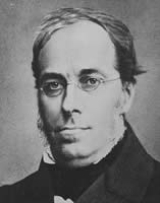
Jules Dupuit

Encyclopedia
Jules Dupuit was an Italian
-born French
civil engineer
and economist
.
He was born in Fossano
, Italy
then under the rule of Napoleon Bonaparte. At the age of ten he emigrated to France with his family where he studied in Versailles — winning a Physics prize at graduation. He then studied in the Ecole Polytechnique
as a civil engineer. He gradually took on more responsibility in various regional posts. He received a Légion d'honneur
in 1843 for his work on the French road system, and shortly after moved to Paris. He also studied flood
management in 1848 and supervised the construction of the Paris sewer system
. He died in Paris
.
Engineering questions led to his interest in economics, a subject in which he was self-taught. His 1844 article was concerned with deciding the optimum toll
for a bridge. It was here that he introduced his curve of diminishing marginal utility. As the quantity of a good consumed rises, the marginal utility
of the good declines for the user. So the lower the toll (lower marginal utility), the more people who would use the bridge (higher consumption). Conversely as the quantity rises (people allowed on the bridge), the willingness of a person to pay for that good (the price) declines.
Thus, the concept of diminishing marginal utility should translate itself into a downward-sloping demand function. In this way he identified the demand curve as the marginal utility curve. This was the first time an economist had put forward a theory of demand derived from marginal utility. Although not the first time that the demand curve had been drawn, it was the first time that it had been proved rather than asserted. Dupuit, however, did not include a supply curve in his theory.
Dupuit went on to define "relative
utility
" as the area under the demand/marginal utility curve above the price and used it as a measure of the welfare effects of different prices – concluding that public welfare is maximized when the price (or bridge toll) is zero. This was later known as Marshall's
"consumer surplus".
Dupuit's reputation as an economist does not rest on his advocacy of laissez-faire
economics (he wrote "Commercial Freedom" in 1861) but on frequent contributions to periodicals. Wanting to evaluate the net economic benefit of public services
, Dupuit analysed capacities for economic development, and attempted to construct a framework for utility theory
and measuring the prosperity derived with public works. He also wrote on monopoly
and price discrimination
.
Dupuit also considered the groundwater flow equation
, which governs the flow of groundwater
. He assumed that the equation could be simplified for analytical solutions by assuming that groundwater is hydrostatic and flows horizontally. This assumption is regularly used today, and is known by hydrogeologists as the Dupuit assumption
.
Italy
Italy , officially the Italian Republic languages]] under the European Charter for Regional or Minority Languages. In each of these, Italy's official name is as follows:;;;;;;;;), is a unitary parliamentary republic in South-Central Europe. To the north it borders France, Switzerland, Austria and...
-born French
France
The French Republic , The French Republic , The French Republic , (commonly known as France , is a unitary semi-presidential republic in Western Europe with several overseas territories and islands located on other continents and in the Indian, Pacific, and Atlantic oceans. Metropolitan France...
civil engineer
Civil engineer
A civil engineer is a person who practices civil engineering; the application of planning, designing, constructing, maintaining, and operating infrastructures while protecting the public and environmental health, as well as improving existing infrastructures that have been neglected.Originally, a...
and economist
Economist
An economist is a professional in the social science discipline of economics. The individual may also study, develop, and apply theories and concepts from economics and write about economic policy...
.
He was born in Fossano
Fossano
Fossano is a town and comune of Piedmont, Italy, in the province of Cuneo. It is the fourth largest town of the Province of Cuneo, after Cuneo, Alba and Bra....
, Italy
Italy
Italy , officially the Italian Republic languages]] under the European Charter for Regional or Minority Languages. In each of these, Italy's official name is as follows:;;;;;;;;), is a unitary parliamentary republic in South-Central Europe. To the north it borders France, Switzerland, Austria and...
then under the rule of Napoleon Bonaparte. At the age of ten he emigrated to France with his family where he studied in Versailles — winning a Physics prize at graduation. He then studied in the Ecole Polytechnique
École Polytechnique
The École Polytechnique is a state-run institution of higher education and research in Palaiseau, Essonne, France, near Paris. Polytechnique is renowned for its four year undergraduate/graduate Master's program...
as a civil engineer. He gradually took on more responsibility in various regional posts. He received a Légion d'honneur
Légion d'honneur
The Legion of Honour, or in full the National Order of the Legion of Honour is a French order established by Napoleon Bonaparte, First Consul of the Consulat which succeeded to the First Republic, on 19 May 1802...
in 1843 for his work on the French road system, and shortly after moved to Paris. He also studied flood
Flood
A flood is an overflow of an expanse of water that submerges land. The EU Floods directive defines a flood as a temporary covering by water of land not normally covered by water...
management in 1848 and supervised the construction of the Paris sewer system
Sanitary sewer
A sanitary sewer is a separate underground carriage system specifically for transporting sewage from houses and commercial buildings to treatment or disposal. Sanitary sewers serving industrial areas also carry industrial wastewater...
. He died in Paris
Paris
Paris is the capital and largest city in France, situated on the river Seine, in northern France, at the heart of the Île-de-France region...
.
Engineering questions led to his interest in economics, a subject in which he was self-taught. His 1844 article was concerned with deciding the optimum toll
Toll bridge
A toll bridge is a bridge over which traffic may pass upon payment of a toll, or fee.- History :The practice of collecting tolls on bridges probably harks back to the days of ferry crossings where people paid a fee to be ferried across stretches of water. As boats became impractical to carry large...
for a bridge. It was here that he introduced his curve of diminishing marginal utility. As the quantity of a good consumed rises, the marginal utility
Marginal utility
In economics, the marginal utility of a good or service is the utility gained from an increase in the consumption of that good or service...
of the good declines for the user. So the lower the toll (lower marginal utility), the more people who would use the bridge (higher consumption). Conversely as the quantity rises (people allowed on the bridge), the willingness of a person to pay for that good (the price) declines.
Thus, the concept of diminishing marginal utility should translate itself into a downward-sloping demand function. In this way he identified the demand curve as the marginal utility curve. This was the first time an economist had put forward a theory of demand derived from marginal utility. Although not the first time that the demand curve had been drawn, it was the first time that it had been proved rather than asserted. Dupuit, however, did not include a supply curve in his theory.
Dupuit went on to define "relative
Relative
-General use:*Kinship, the principle binding the most basic social units society. If two people are connected by circumstances of birth, they are said to be relatives-Philosophy:...
utility
Utility
In economics, utility is a measure of customer satisfaction, referring to the total satisfaction received by a consumer from consuming a good or service....
" as the area under the demand/marginal utility curve above the price and used it as a measure of the welfare effects of different prices – concluding that public welfare is maximized when the price (or bridge toll) is zero. This was later known as Marshall's
Alfred Marshall
Alfred Marshall was an Englishman and one of the most influential economists of his time. His book, Principles of Economics , was the dominant economic textbook in England for many years...
"consumer surplus".
Dupuit's reputation as an economist does not rest on his advocacy of laissez-faire
Laissez-faire
In economics, laissez-faire describes an environment in which transactions between private parties are free from state intervention, including restrictive regulations, taxes, tariffs and enforced monopolies....
economics (he wrote "Commercial Freedom" in 1861) but on frequent contributions to periodicals. Wanting to evaluate the net economic benefit of public services
Public services
Public services is a term usually used to mean services provided by government to its citizens, either directly or by financing private provision of services. The term is associated with a social consensus that certain services should be available to all, regardless of income...
, Dupuit analysed capacities for economic development, and attempted to construct a framework for utility theory
Marginal utility
In economics, the marginal utility of a good or service is the utility gained from an increase in the consumption of that good or service...
and measuring the prosperity derived with public works. He also wrote on monopoly
Monopoly
A monopoly exists when a specific person or enterprise is the only supplier of a particular commodity...
and price discrimination
Price discrimination
Price discrimination or price differentiation exists when sales of identical goods or services are transacted at different prices from the same provider...
.
Dupuit also considered the groundwater flow equation
Groundwater flow equation
Used in hydrogeology, the groundwater flow equation is the mathematical relationship which is used to describe the flow of groundwater through an aquifer. The transient flow of groundwater is described by a form of the diffusion equation, similar to that used in heat transfer to describe the flow...
, which governs the flow of groundwater
Groundwater
Groundwater is water located beneath the ground surface in soil pore spaces and in the fractures of rock formations. A unit of rock or an unconsolidated deposit is called an aquifer when it can yield a usable quantity of water. The depth at which soil pore spaces or fractures and voids in rock...
. He assumed that the equation could be simplified for analytical solutions by assuming that groundwater is hydrostatic and flows horizontally. This assumption is regularly used today, and is known by hydrogeologists as the Dupuit assumption
Dupuit assumption
The Dupuit assumption holds that groundwater moves horizontally in an unconfined aquifer, and that the groundwater discharge is proportional to the saturated aquifer thickness...
.
See also
- Robert EkelundRobert EkelundRobert Burton Ekelund, Jr. is an American economist.-Education:Originally from Galveston, Texas, Ekelund attended St. Mary's University in San Antonio, Texas, earning his B.B.A. in economics in 1962 and his M.A. in economics and history the next year...