


Budget constraint

Encyclopedia
A budget constraint represents the combinations of goods and services that a consumer can purchase given current prices with his or her income. Consumer theory uses the concepts of a budget
constraint
and a preference map to analyze consumer choices. Both concepts have a ready graphical representation
in the two-good case.
should choose to consume goods at the point where the most preferred available indifference curve
on their preference map is tangent
to their budget constraint. That is, the indifference curve tangent to the budget constraint represents the maximum utility obtained utilizing the entire budget of the consumer. The tangent point (the xy coordinate) represents the amount of goods x and y the consumer should purchase to fully utilize their budget to obtain maximum utility. A line connecting all points of tangency between the indifference curve and the budget constraint is called the expansion path
.
All two dimensional budget constraints are generalized into the equation:

Where:
The equation can be rearranged to represent the shape of the curve on a graph:
 , where
  is the y-intercept and
  is the slope, representing a downward sloping budget line.
The factors that can shift the budget line are a change in income (m), a change in the price of a specific good ( ), or a change in the price of all other goods (
 ).
).
. Under autarky
this is also the limitation of consumption by individuals in the country. However, the benefits of international trade
are generally demonstrated through allowance of a shift in the consumption-possibility frontier
s of each trade partner which allows access to a more appealing indifference curve.
On "toolbox", Hecksher-Ohlin and Krugman models of international trade, the budget constraint of the economy (its CPF) is determined by the terms-of-trade (TOT) as a downward-sloped line with slope equal to those TOTs of the economy (The TOTs are given by the price ratio Px/Py, where x is the exportable commodity and y is the importable).
In such a case, assuming there are goods, called
  for
for  , that the price of good
  is denoted by
  , and if
  is the total amount that may be spent, then the budget constraint is: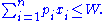
Further, if the consumer spends his income entirely, the budget constraint binds: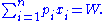
In this case, the consumer cannot obtain an additional unit of good without giving up some other good. For example, he could purchase an additional unit of good
  by giving up
  units of good
Budget
A budget is a financial plan and a list of all planned expenses and revenues. It is a plan for saving, borrowing and spending. A budget is an important concept in microeconomics, which uses a budget line to illustrate the trade-offs between two or more goods...
constraint
Constraint (mathematics)
In mathematics, a constraint is a condition that a solution to an optimization problem must satisfy. There are two types of constraints: equality constraints and inequality constraints...
and a preference map to analyze consumer choices. Both concepts have a ready graphical representation
Consumer theory
Consumer choice is a theory of microeconomics that relates preferences for consumption goods and services to consumption expenditures and ultimately to consumer demand curves. The link between personal preferences, consumption, and the demand curve is one of the most closely studied relations in...
in the two-good case.
Individual choice
An individual consumerConsumer
Consumer is a broad label for any individuals or households that use goods generated within the economy. The concept of a consumer occurs in different contexts, so that the usage and significance of the term may vary.-Economics and marketing:...
should choose to consume goods at the point where the most preferred available indifference curve
Indifference curve
In microeconomic theory, an indifference curve is a graph showing different bundles of goods between which a consumer is indifferent. That is, at each point on the curve, the consumer has no preference for one bundle over another. One can equivalently refer to each point on the indifference curve...
on their preference map is tangent
Tangent
In geometry, the tangent line to a plane curve at a given point is the straight line that "just touches" the curve at that point. More precisely, a straight line is said to be a tangent of a curve at a point on the curve if the line passes through the point on the curve and has slope where f...
to their budget constraint. That is, the indifference curve tangent to the budget constraint represents the maximum utility obtained utilizing the entire budget of the consumer. The tangent point (the xy coordinate) represents the amount of goods x and y the consumer should purchase to fully utilize their budget to obtain maximum utility. A line connecting all points of tangency between the indifference curve and the budget constraint is called the expansion path
Expansion path
In economics, an expansion path is a line connecting optimal input combinations as the scale of production expands...
.
All two dimensional budget constraints are generalized into the equation:
Where:
-
 money income allocated to consumption (after saving and borrowing)
 -
 the price of a specific good
 -
 the price of all other goods
 -
 amount purchased of a specific good
 -
 amount purchased of all other goods
The equation can be rearranged to represent the shape of the curve on a graph:
, where is the y-intercept and is the slope, representing a downward sloping budget line.The factors that can shift the budget line are a change in income (m), a change in the price of a specific good (
), or a change in the price of all other goods ().International economics
A production-possibility frontier is a budget constraint presented by the limitation of available factors of productionFactors of production
In economics, factors of production means inputs and finished goods means output. Input determines the quantity of output i.e. output depends upon input. Input is the starting point and output is the end point of production process and such input-output relationship is called a production function...
. Under autarky
Autarky
Autarky is the quality of being self-sufficient. Usually the term is applied to political states or their economic policies. Autarky exists whenever an entity can survive or continue its activities without external assistance. Autarky is not necessarily economic. For example, a military autarky...
this is also the limitation of consumption by individuals in the country. However, the benefits of international trade
International trade
International trade is the exchange of capital, goods, and services across international borders or territories. In most countries, such trade represents a significant share of gross domestic product...
are generally demonstrated through allowance of a shift in the consumption-possibility frontier
Consumption-possibility frontier
The CPF, or consumption–possibility frontier, is the budget constraint where participants in international trade can consume. Under autarky this constraint is identical to the production–possibility frontier....
s of each trade partner which allows access to a more appealing indifference curve.
On "toolbox", Hecksher-Ohlin and Krugman models of international trade, the budget constraint of the economy (its CPF) is determined by the terms-of-trade (TOT) as a downward-sloped line with slope equal to those TOTs of the economy (The TOTs are given by the price ratio Px/Py, where x is the exportable commodity and y is the importable).
Many goods
While low level demonstrations of budget constraints are often limited to two good situations which provide easy graphical representation, it is possible to demonstrate the relationship between multiple goods through a budget constraint.In such a case, assuming there are
goods, called for , that the price of good is denoted by , and if is the total amount that may be spent, then the budget constraint is:Further, if the consumer spends his income entirely, the budget constraint binds:
In this case, the consumer cannot obtain an additional unit of good
without giving up some other good. For example, he could purchase an additional unit of good by giving up units of good