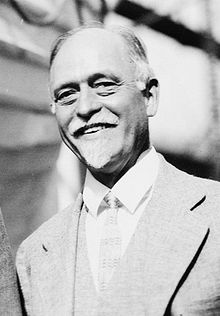
Irving Fisher

Encyclopedia
Irving Fisher was an American
economist
, inventor, and health campaigner, and one of the earliest American neoclassical economists
, though his later work on debt deflation
often regarded as belonging instead to the Post-Keynesian
school.
Fisher made important contributions to utility theory
and general equilibrium. His work on the quantity theory of money
inaugurated the school of economic thought known as "monetarism
." Both Milton Friedman
and James Tobin
called Fisher "the greatest economist the United States has ever produced." Some concepts named after Fisher include the Fisher equation
, the Fisher hypothesis
, the international Fisher effect
, and the Fisher separation theorem
.
Fisher was perhaps the first celebrity economist, but his reputation during his lifetime was irreparably harmed by his public statements, just prior to the Wall Street Crash of 1929
, claiming that the stock market had reached "a permanently high plateau." His subsequent theory of debt deflation as an explanation of the Great Depression
was largely ignored in favor of the work of John Maynard Keynes
. His reputation has since recovered in neoclassical economics, particularly after his work was revived in the late 1950s and more widely due to an increased interest in debt deflation in the Late-2000s recession.
Fisher produced various inventions during his lifetime, the most notable of which was an "index visible filing system" which he patented in 1913 and sold to Kardex Rand (later Remington Rand
) in 1925. This, and his subsequent stock investments, made him a wealthy man until his personal finances were badly hit by the Crash of 1929. He was also an active social and health campaigner, as well as an advocate of vegetarianism
, Prohibition
, and eugenics
.
. His father was a teacher and Congregational minister, who raised his son to believe he must be a useful member of society. As a child, he had remarkable mathematical ability and a flair for invention. A week after he was admitted to Yale College
, his father died at age 53. Irving then supported his mother, brother, and himself, mainly by tutoring. He graduated first in his class with a B.A degree in 1888, having also been elected as a member of the Skull and Bones
society.
. Fisher was not initially aware of the work of Léon Walras
and his continental European disciples in mathematical economics. Nevertheless, his thesis made a contribution to the theory of general equilibrium that European masters such as Francis Edgeworth recognized as first rate. To illustrate and complement the arguments in his thesis, Fisher constructed a hydraulic machine of pumps and levers. While his books and articles on economic topics exhibited an unusual degree of mathematical sophistication for the time, Fisher always wished to bring his analysis to life and to present his theories as lucidly as possible. After graduating from Yale, Fisher studied in Berlin and Paris. From 1890 onward he remained at Yale, first as a tutor, then after 1898 as a professor of political economy, and after 1935 as professor emeritus.
Fisher edited the Yale Review from 1896 to 1910 and was active in many learned societies, institutes, and welfare organizations. He was president of the American Economic Association
in 1918. A leading early proponent of econometrics
, in 1930 he founded, with Ragnar Frisch and Charles F. Roos the Econometric Society
, of which he was the first president.
Among his special interests were temperance, eugenics, public health, and world peace. He won a New York Medical Society prize for the invention of a tent for the treatment of tuberculosis
victims. He strongly supported Prohibition in the 1920s.
there emerged
Fisher's research into basic theory did not touch the great social issues of the day. Monetary economics did and this became the main focus of Fisher’s work. Fisher's Appreciation and interest was an abstract analysis of the behavior of interest rate
s when the price level
is changing. It emphasized the distinction between real and monetary rates of interest which is fundamental to the modern analysis of inflation. However Fisher believed that investors and savers —people in general— were afflicted in varying degrees by "money illusion
"; they could not see past the money to the goods the money could buy. In an ideal world, changes in the price level would have no effect on production or employment. In the actual world with money illusion, inflation
(and deflation) did serious harm.
. Let M=stock of money, P=price level, T=amount of transactions carried out using money, and V= the velocity of circulation of money. Fisher then proposed that these variables are interrelated by the Equation of exchange
:

Later economists replaced the amorphous T with real output Y or "Q", usually quantified by real GDP.
Fisher was also the first economist to distinguish clearly between real
and nominal interest rate
s:

where is the real interest rate,
  is the nominal interest rate, and the inflation
  is a measure of the increase in the price level. When inflation is sufficiently low, the real interest rate can be approximated as the nominal interest rate minus the expected inflation rate
. The resulting equation is known as the Fisher equation
in his honor.
For more than forty years, Fisher elaborated his vision of the damaging “dance of the dollar” and devised schemes to “stabilize” money, i.e. to stabilize the price level. He was one of the first to subject macroeconomic data, including the money stock, interest rates, and the price level, to statistical analysis. In the 1920s, he introduced the technique later called distributed lag
s. In 1973, the Journal of Political Economy reprinted his 1926 paper on the statistical relation between unemployment
and inflation
, retitling it as "I discovered the Phillips curve
". Index numbers
played an important role in his monetary theory, and his book The Making of Index Numbers has remained influential down to the present day.
, investment
, and interest rates, first exposited in his The Nature of Capital and Income (1906) and elaborated on in The Rate of Interest (1907). His 1930 treatise, The Theory of Interest, summed up a lifetime's work on capital
, capital budgeting
, credit markets, and the determinants of interest rate
s, including the rate of inflation
.
Fisher saw that subjective economic value is not only a function of the amount of goods and services owned or exchanged but also of the moment in time when they are purchased. A good available now has a different value than the same good available at a later date; value has a time as well as a quantity dimension. The relative price
of goods available at a future date, in terms of goods sacrificed now, is measured by the interest rate
. Fisher made free use of the standard diagrams used to teach undergraduate economics, but labeled the axes "consumption now" and "consumption next period" instead of, e.g., "apples" and "oranges." The resulting theory, one of considerable power and insight, was exposited in considerable detail in The Theory of Interest; for a concise exposition, click here.
This theory, since generalized to the case of K goods and N periods (including the case of infinitely many periods) has become a standard theory of capital and interest, which is described in Gravelle and Rees, and Aliprantis, Brown, and Burkinshaw. This theoretical advance was explained in Hirshleifer.
, Fisher developed a theory of economic crises called debt-deflation, which attributed crises to the bursting of a credit bubble.
According to the debt deflation theory, a sequence of effects of the debt bubble bursting occurs:
This theory was ignored in favor of Keynesian economics
, partly due to the damage to Fisher's reputation from his sanguine attitude prior to the crash, but has experienced a revival of mainstream interest since the 1980s, particularly since the Late-2000s recession, and is now a main theory with which he is popularly associated.
cost Fisher much of his personal wealth and academic reputation. He famously predicted, three days before the crash, "Stock prices have reached what looks like a permanently high plateau." Irving Fisher stated on October 21 that the market was "only shaking out of the lunatic fringe" and went on to explain why he felt the prices still had not caught up with their real value and should go much higher. On Wednesday, October 23, he announced in a banker’s meeting "security values in most instances were not inflated." For months after the Crash, he continued to assure investors that a recovery was just around the corner. Once the Great Depression
was in full force, he did warn that the ongoing drastic deflation
was the cause of the disastrous cascading insolvencies then plaguing the American economy because deflation increased the real value of debts fixed in dollar terms. Fisher was so discredited by his 1929 pronouncements and by the failure of a firm he had started that few people took notice of his "debt-deflation" analysis of the Depression. People instead eagerly turned to the ideas of Keynes
. Fisher's debt-deflation scenario has made something of a comeback since 1980 or so.
Fisher's 1942 book with the concept behind the Unlimited Savings Accumulation Tax
, a reform introduced in the United States Senate in 1995 by Senator Pete Domenici (R-New Mexico), former Senator Sam Nunn (D-Georgia), and Senator Bob Kerrey (D-Nebraska). The concept was that unnecessary spending (which is hard to define in a law) can be taxed by taxing income minus all net investments and savings, and minus an allowance for essential purchases, thus making funds available for investment.
, the disease that killed his father. After three years in sanatoria, Fisher returned to work with even greater energy and with a second vocation as a health campaigner. He advocated vegetarianism
, avoiding red meat, and exercise, writing How to Live: Rules for Healthful Living Based on Modern Science, a USA best seller.
In 1912 he also became a member of the scientific advisory to the Eugenics Record Office
and served as the secretary of the American Eugenics Society
.
Fisher was also a strong believer in the now-discredited "focal sepsis
" theory of physician Henry Cotton
, who believed that mental illness
was attributable to infectious material residing in the roots of the teeth, recesses in the bowels, and other places in the human body, and that surgical removal of this infectious material would cure the patient's mental disorder. Fisher believed in these theories so thoroughly that when his daughter Margaret Fisher was diagnosed with schizophrenia
, Fisher had numerous sections of her bowel and colon
removed at Dr. Cotton's hospital, eventually resulting in his daughter's death.
Fisher was also an ardent supporter of the Prohibition
of alcohol
in the United States, and wrote three short books arguing that Prohibition was justified on the grounds of both public health and hygiene, as well as economic productivity and efficiency, and should therefore be strictly enforced by the United States government.
United States
The United States of America is a federal constitutional republic comprising fifty states and a federal district...
economist
Economics
Economics is the social science that analyzes the production, distribution, and consumption of goods and services. The term economics comes from the Ancient Greek from + , hence "rules of the house"...
, inventor, and health campaigner, and one of the earliest American neoclassical economists
Neoclassical economics
Neoclassical economics is a term variously used for approaches to economics focusing on the determination of prices, outputs, and income distributions in markets through supply and demand, often mediated through a hypothesized maximization of utility by income-constrained individuals and of profits...
, though his later work on debt deflation
Debt deflation
Debt deflation is a theory of economic cycles, which holds that recessions and depressions are due to the overall level of debt shrinking : the credit cycle is the cause of the economic cycle....
often regarded as belonging instead to the Post-Keynesian
Post-Keynesian economics
Post Keynesian economics is a school of economic thought with its origins in The General Theory of John Maynard Keynes, although its subsequent development was influenced to a large degree by Michał Kalecki, Joan Robinson, Nicholas Kaldor and Paul Davidson...
school.
Fisher made important contributions to utility theory
Utility
In economics, utility is a measure of customer satisfaction, referring to the total satisfaction received by a consumer from consuming a good or service....
and general equilibrium. His work on the quantity theory of money
Quantity theory of money
In monetary economics, the quantity theory of money is the theory that money supply has a direct, proportional relationship with the price level....
inaugurated the school of economic thought known as "monetarism
Monetarism
Monetarism is a tendency in economic thought that emphasizes the role of governments in controlling the amount of money in circulation. It is the view within monetary economics that variation in the money supply has major influences on national output in the short run and the price level over...
." Both Milton Friedman
Milton Friedman
Milton Friedman was an American economist, statistician, academic, and author who taught at the University of Chicago for more than three decades...
and James Tobin
James Tobin
James Tobin was an American economist who, in his lifetime, served on the Council of Economic Advisors and the Board of Governors of the Federal Reserve System, and taught at Harvard and Yale Universities. He developed the ideas of Keynesian economics, and advocated government intervention to...
called Fisher "the greatest economist the United States has ever produced." Some concepts named after Fisher include the Fisher equation
Fisher equation
The Fisher equation in financial mathematics and economics estimates the relationship between nominal and real interest rates under inflation....
, the Fisher hypothesis
Fisher hypothesis
In economics, the Fisher hypothesis is the proposition by Irving Fisher that the real interest rate is independent of monetary measures, especially the nominal interest rate. The Fisher equation isr_r = r_n - \pi^e....
, the international Fisher effect
International fisher effect
The International Fisher effect is a hypothesis in international finance that says that the difference in the nominal interest rates between two countries determines the movement of the nominal exchange rate between their currencies, with the value of the currency of the country with the lower...
, and the Fisher separation theorem
Fisher separation theorem
In economics, the Fisher separation theorem asserts that the objective of a corporation will be the maximization of its present value, regardless of the preferences of its shareholders. The theorem therefore separates management's "productive opportunities" from the entrepreneur's "market...
.
Fisher was perhaps the first celebrity economist, but his reputation during his lifetime was irreparably harmed by his public statements, just prior to the Wall Street Crash of 1929
Wall Street Crash of 1929
The Wall Street Crash of 1929 , also known as the Great Crash, and the Stock Market Crash of 1929, was the most devastating stock market crash in the history of the United States, taking into consideration the full extent and duration of its fallout...
, claiming that the stock market had reached "a permanently high plateau." His subsequent theory of debt deflation as an explanation of the Great Depression
Great Depression
The Great Depression was a severe worldwide economic depression in the decade preceding World War II. The timing of the Great Depression varied across nations, but in most countries it started in about 1929 and lasted until the late 1930s or early 1940s...
was largely ignored in favor of the work of John Maynard Keynes
John Maynard Keynes
John Maynard Keynes, Baron Keynes of Tilton, CB FBA , was a British economist whose ideas have profoundly affected the theory and practice of modern macroeconomics, as well as the economic policies of governments...
. His reputation has since recovered in neoclassical economics, particularly after his work was revived in the late 1950s and more widely due to an increased interest in debt deflation in the Late-2000s recession.
Fisher produced various inventions during his lifetime, the most notable of which was an "index visible filing system" which he patented in 1913 and sold to Kardex Rand (later Remington Rand
Remington Rand
Remington Rand was an early American business machines manufacturer, best known originally as a typewriter manufacturer and in a later incarnation as the manufacturer of the UNIVAC line of mainframe computers but with antecedents in Remington Arms in the early nineteenth century. For a time, the...
) in 1925. This, and his subsequent stock investments, made him a wealthy man until his personal finances were badly hit by the Crash of 1929. He was also an active social and health campaigner, as well as an advocate of vegetarianism
Vegetarianism
Vegetarianism encompasses the practice of following plant-based diets , with or without the inclusion of dairy products or eggs, and with the exclusion of meat...
, Prohibition
Prohibition
Prohibition of alcohol, often referred to simply as prohibition, is the practice of prohibiting the manufacture, transportation, import, export, sale, and consumption of alcohol and alcoholic beverages. The term can also apply to the periods in the histories of the countries during which the...
, and eugenics
Eugenics
Eugenics is the "applied science or the bio-social movement which advocates the use of practices aimed at improving the genetic composition of a population", usually referring to human populations. The origins of the concept of eugenics began with certain interpretations of Mendelian inheritance,...
.
Early adulthood
Fisher was born in Saugerties, New YorkSaugerties (village), New York
Saugerties is a village in Ulster County, New York, USA. The population was 4,955 at the 2000 census.The Village of Saugerties is a Town in the eastern part of the Town of Saugerties. U.S. Route 9W passes through the village...
. His father was a teacher and Congregational minister, who raised his son to believe he must be a useful member of society. As a child, he had remarkable mathematical ability and a flair for invention. A week after he was admitted to Yale College
Yale University
Yale University is a private, Ivy League university located in New Haven, Connecticut, United States. Founded in 1701 in the Colony of Connecticut, the university is the third-oldest institution of higher education in the United States...
, his father died at age 53. Irving then supported his mother, brother, and himself, mainly by tutoring. He graduated first in his class with a B.A degree in 1888, having also been elected as a member of the Skull and Bones
Skull and Bones
Skull and Bones is an undergraduate senior or secret society at Yale University, New Haven, Connecticut. It is a traditional peer society to Scroll and Key and Wolf's Head, as the three senior class 'landed societies' at Yale....
society.
Career
Fisher's best subject was mathematics, but economics better matched his social concerns. He went on to write a doctoral thesis combining both subjects, on mathematical economics. Irving was granted the first Yale Ph.D. in economics, in 1891. His advisers were the physicist Willard Gibbs and the economist William Graham SumnerWilliam Graham Sumner
William Graham Sumner was an American academic and "held the first professorship in sociology" at Yale College. For many years he had a reputation as one of the most influential teachers there. He was a polymath with numerous books and essays on American history, economic history, political...
. Fisher was not initially aware of the work of Léon Walras
Léon Walras
Marie-Esprit-Léon Walras was a French mathematical economist associated with the creation of the general equilibrium theory.-Life and career:...
and his continental European disciples in mathematical economics. Nevertheless, his thesis made a contribution to the theory of general equilibrium that European masters such as Francis Edgeworth recognized as first rate. To illustrate and complement the arguments in his thesis, Fisher constructed a hydraulic machine of pumps and levers. While his books and articles on economic topics exhibited an unusual degree of mathematical sophistication for the time, Fisher always wished to bring his analysis to life and to present his theories as lucidly as possible. After graduating from Yale, Fisher studied in Berlin and Paris. From 1890 onward he remained at Yale, first as a tutor, then after 1898 as a professor of political economy, and after 1935 as professor emeritus.
Fisher edited the Yale Review from 1896 to 1910 and was active in many learned societies, institutes, and welfare organizations. He was president of the American Economic Association
American Economic Association
The American Economic Association, or AEA, is a learned society in the field of economics, headquartered in Nashville, Tennessee. It publishes one of the most prestigious academic journals in economics: the American Economic Review...
in 1918. A leading early proponent of econometrics
Econometrics
Econometrics has been defined as "the application of mathematics and statistical methods to economic data" and described as the branch of economics "that aims to give empirical content to economic relations." More precisely, it is "the quantitative analysis of actual economic phenomena based on...
, in 1930 he founded, with Ragnar Frisch and Charles F. Roos the Econometric Society
Econometric Society
The Econometric Society is an international society for the advancement of economic theory in its relation with statistics and mathematics. It was founded on December 29, 1930 at the Stalton Hotel in Cleveland, Ohio....
, of which he was the first president.
Among his special interests were temperance, eugenics, public health, and world peace. He won a New York Medical Society prize for the invention of a tent for the treatment of tuberculosis
Tuberculosis
Tuberculosis, MTB, or TB is a common, and in many cases lethal, infectious disease caused by various strains of mycobacteria, usually Mycobacterium tuberculosis. Tuberculosis usually attacks the lungs but can also affect other parts of the body...
victims. He strongly supported Prohibition in the 1920s.
Theory
James Tobin argues that the intellectual breakthroughs that mark the neoclassical revolution in economic analysis occurred in Europe around 1870. The next two decades witnessed lively debates in which the new theory more or less absorbed or was absorbed in the classical tradition that preceded it. In the 1890s, according to Joseph A. SchumpeterJoseph Schumpeter
Joseph Alois Schumpeter was an Austrian-Hungarian-American economist and political scientist. He popularized the term "creative destruction" in economics.-Life:...
there emerged
Fisher's research into basic theory did not touch the great social issues of the day. Monetary economics did and this became the main focus of Fisher’s work. Fisher's Appreciation and interest was an abstract analysis of the behavior of interest rate
Interest rate
An interest rate is the rate at which interest is paid by a borrower for the use of money that they borrow from a lender. For example, a small company borrows capital from a bank to buy new assets for their business, and in return the lender receives interest at a predetermined interest rate for...
s when the price level
Price level
A price level is a hypothetical measure of overall prices for some set of goods and services, in a given region during a given interval, normalized relative to some base set...
is changing. It emphasized the distinction between real and monetary rates of interest which is fundamental to the modern analysis of inflation. However Fisher believed that investors and savers —people in general— were afflicted in varying degrees by "money illusion
Money illusion
In economics, money illusion refers to the tendency of people to think of currency in nominal, rather than real, terms. In other words, the numerical/face value of money is mistaken for its purchasing power...
"; they could not see past the money to the goods the money could buy. In an ideal world, changes in the price level would have no effect on production or employment. In the actual world with money illusion, inflation
Inflation
In economics, inflation is a rise in the general level of prices of goods and services in an economy over a period of time.When the general price level rises, each unit of currency buys fewer goods and services. Consequently, inflation also reflects an erosion in the purchasing power of money – a...
(and deflation) did serious harm.
Later life
Fisher was a prolific writer, producing journalism, as well as technical books and articles, addressing the problems of the First World War, the prosperous 1920s and the depressed 1930s. He died in New York City in 1947, at the age of 80.Money and the price level
Fisher's theory of the price level was the following variant of the quantity theory of moneyQuantity theory of money
In monetary economics, the quantity theory of money is the theory that money supply has a direct, proportional relationship with the price level....
. Let M=stock of money, P=price level, T=amount of transactions carried out using money, and V= the velocity of circulation of money. Fisher then proposed that these variables are interrelated by the Equation of exchange
Equation of exchange
In economics, the equation of exchange is the relation:M\cdot V = P\cdot Qwhere, for a given period,M\, is the total nominal amount of money in circulation on average in an economy.V\, is the velocity of money, that is the average frequency with which a unit of money is spent.P\, is the price...
:
Later economists replaced the amorphous T with real output Y or "Q", usually quantified by real GDP.
Fisher was also the first economist to distinguish clearly between real
Real interest rate
The "real interest rate" is the rate of interest an investor expects to receive after allowing for inflation. It can be described more formally by the Fisher equation, which states that the real interest rate is approximately the nominal interest rate minus the inflation rate...
and nominal interest rate
Nominal interest rate
In finance and economics nominal interest rate or nominal rate of interest refers to the rate of interest before adjustment for inflation ; or, for interest rates "as stated" without adjustment for the full effect of compounding...
s:
where
is the real interest rate, is the nominal interest rate, and the inflation is a measure of the increase in the price level. When inflation is sufficiently low, the real interest rate can be approximated as the nominal interest rate minus the expected inflation rateInflation rate
In economics, the inflation rate is a measure of inflation, the rate of increase of a price index . It is the percentage rate of change in price level over time. The rate of decrease in the purchasing power of money is approximately equal.The inflation rate is used to calculate the real interest...
. The resulting equation is known as the Fisher equation
Fisher equation
The Fisher equation in financial mathematics and economics estimates the relationship between nominal and real interest rates under inflation....
in his honor.
For more than forty years, Fisher elaborated his vision of the damaging “dance of the dollar” and devised schemes to “stabilize” money, i.e. to stabilize the price level. He was one of the first to subject macroeconomic data, including the money stock, interest rates, and the price level, to statistical analysis. In the 1920s, he introduced the technique later called distributed lag
Distributed lag
In statistics and econometrics, a distributed lag model is a model for time series data in which a regression equation is used to predict current values of a dependent variable based on both the current values of an explanatory variable and the lagged values of this explanatory variable.The...
s. In 1973, the Journal of Political Economy reprinted his 1926 paper on the statistical relation between unemployment
Unemployment
Unemployment , as defined by the International Labour Organization, occurs when people are without jobs and they have actively sought work within the past four weeks...
and inflation
Inflation
In economics, inflation is a rise in the general level of prices of goods and services in an economy over a period of time.When the general price level rises, each unit of currency buys fewer goods and services. Consequently, inflation also reflects an erosion in the purchasing power of money – a...
, retitling it as "I discovered the Phillips curve
Phillips curve
In economics, the Phillips curve is a historical inverse relationship between the rate of unemployment and the rate of inflation in an economy. Stated simply, the lower the unemployment in an economy, the higher the rate of inflation...
". Index numbers
Price index
A price index is a normalized average of prices for a given class of goods or services in a given region, during a given interval of time...
played an important role in his monetary theory, and his book The Making of Index Numbers has remained influential down to the present day.
The theory of interest and capital
While most of Fisher's energy went into social causes and business ventures, and the better part of his scientific effort was devoted to monetary economics, he is best remembered today in neoclassical economics for his theory of interest and capital, studies of an ideal world from which the real world deviated at its peril. His most enduring intellectual work has been his theory of capitalCapital (economics)
In economics, capital, capital goods, or real capital refers to already-produced durable goods used in production of goods or services. The capital goods are not significantly consumed, though they may depreciate in the production process...
, investment
Investment
Investment has different meanings in finance and economics. Finance investment is putting money into something with the expectation of gain, that upon thorough analysis, has a high degree of security for the principal amount, as well as security of return, within an expected period of time...
, and interest rates, first exposited in his The Nature of Capital and Income (1906) and elaborated on in The Rate of Interest (1907). His 1930 treatise, The Theory of Interest, summed up a lifetime's work on capital
Capital (economics)
In economics, capital, capital goods, or real capital refers to already-produced durable goods used in production of goods or services. The capital goods are not significantly consumed, though they may depreciate in the production process...
, capital budgeting
Capital budgeting
Capital budgeting is the planning process used to determine whether an organization's long term investments such as new machinery, replacement machinery, new plants, new products, and research development projects are worth pursuing...
, credit markets, and the determinants of interest rate
Interest rate
An interest rate is the rate at which interest is paid by a borrower for the use of money that they borrow from a lender. For example, a small company borrows capital from a bank to buy new assets for their business, and in return the lender receives interest at a predetermined interest rate for...
s, including the rate of inflation
Inflation
In economics, inflation is a rise in the general level of prices of goods and services in an economy over a period of time.When the general price level rises, each unit of currency buys fewer goods and services. Consequently, inflation also reflects an erosion in the purchasing power of money – a...
.
Fisher saw that subjective economic value is not only a function of the amount of goods and services owned or exchanged but also of the moment in time when they are purchased. A good available now has a different value than the same good available at a later date; value has a time as well as a quantity dimension. The relative price
Relative price
A relative price is the price of a commodity such as a good or service in terms of another; i.e., the ratio of two prices. A relative price may be expressed in terms of a ratio between any two prices or the ratio between the price of one particular good and a weighted average of all other goods...
of goods available at a future date, in terms of goods sacrificed now, is measured by the interest rate
Interest rate
An interest rate is the rate at which interest is paid by a borrower for the use of money that they borrow from a lender. For example, a small company borrows capital from a bank to buy new assets for their business, and in return the lender receives interest at a predetermined interest rate for...
. Fisher made free use of the standard diagrams used to teach undergraduate economics, but labeled the axes "consumption now" and "consumption next period" instead of, e.g., "apples" and "oranges." The resulting theory, one of considerable power and insight, was exposited in considerable detail in The Theory of Interest; for a concise exposition, click here.
This theory, since generalized to the case of K goods and N periods (including the case of infinitely many periods) has become a standard theory of capital and interest, which is described in Gravelle and Rees, and Aliprantis, Brown, and Burkinshaw. This theoretical advance was explained in Hirshleifer.
Debt-Deflation
Following the stock market crash of 1929 and the ensuing Great DepressionGreat Depression
The Great Depression was a severe worldwide economic depression in the decade preceding World War II. The timing of the Great Depression varied across nations, but in most countries it started in about 1929 and lasted until the late 1930s or early 1940s...
, Fisher developed a theory of economic crises called debt-deflation, which attributed crises to the bursting of a credit bubble.
According to the debt deflation theory, a sequence of effects of the debt bubble bursting occurs:
- Debt liquidation and distress selling.
- Contraction of the money supply as bank loans are paid off.
- A fall in the level of asset prices.
- A still greater fall in the net worth of businesses, precipitating bankruptcies.
- A fall in profits.
- A reduction in output, in trade and in employment.
- Pessimism and loss of confidence.
- Hoarding of money.
- A fall in nominal interest rates and a rise in deflation adjusted interest rates.
This theory was ignored in favor of Keynesian economics
Keynesian economics
Keynesian economics is a school of macroeconomic thought based on the ideas of 20th-century English economist John Maynard Keynes.Keynesian economics argues that private sector decisions sometimes lead to inefficient macroeconomic outcomes and, therefore, advocates active policy responses by the...
, partly due to the damage to Fisher's reputation from his sanguine attitude prior to the crash, but has experienced a revival of mainstream interest since the 1980s, particularly since the Late-2000s recession, and is now a main theory with which he is popularly associated.
Stock market crash of 1929
The stock market crash of 1929 and the subsequent Great DepressionGreat Depression
The Great Depression was a severe worldwide economic depression in the decade preceding World War II. The timing of the Great Depression varied across nations, but in most countries it started in about 1929 and lasted until the late 1930s or early 1940s...
cost Fisher much of his personal wealth and academic reputation. He famously predicted, three days before the crash, "Stock prices have reached what looks like a permanently high plateau." Irving Fisher stated on October 21 that the market was "only shaking out of the lunatic fringe" and went on to explain why he felt the prices still had not caught up with their real value and should go much higher. On Wednesday, October 23, he announced in a banker’s meeting "security values in most instances were not inflated." For months after the Crash, he continued to assure investors that a recovery was just around the corner. Once the Great Depression
Great Depression
The Great Depression was a severe worldwide economic depression in the decade preceding World War II. The timing of the Great Depression varied across nations, but in most countries it started in about 1929 and lasted until the late 1930s or early 1940s...
was in full force, he did warn that the ongoing drastic deflation
Deflation (economics)
In economics, deflation is a decrease in the general price level of goods and services. Deflation occurs when the inflation rate falls below 0% . This should not be confused with disinflation, a slow-down in the inflation rate...
was the cause of the disastrous cascading insolvencies then plaguing the American economy because deflation increased the real value of debts fixed in dollar terms. Fisher was so discredited by his 1929 pronouncements and by the failure of a firm he had started that few people took notice of his "debt-deflation" analysis of the Depression. People instead eagerly turned to the ideas of Keynes
John Maynard Keynes
John Maynard Keynes, Baron Keynes of Tilton, CB FBA , was a British economist whose ideas have profoundly affected the theory and practice of modern macroeconomics, as well as the economic policies of governments...
. Fisher's debt-deflation scenario has made something of a comeback since 1980 or so.
Constructive Income Taxation
Lawrence Lokken, the University of Miami School of Law professor of economics, creditsFisher's 1942 book with the concept behind the Unlimited Savings Accumulation Tax
USA Tax
The USA Tax Act , short for "Unlimited Savings Allowance", was a bill in the United States Congress for changing tax laws to replace the federal income taxes with a progressive consumption tax on households and a value-added tax on businesses...
, a reform introduced in the United States Senate in 1995 by Senator Pete Domenici (R-New Mexico), former Senator Sam Nunn (D-Georgia), and Senator Bob Kerrey (D-Nebraska). The concept was that unnecessary spending (which is hard to define in a law) can be taxed by taxing income minus all net investments and savings, and minus an allowance for essential purchases, thus making funds available for investment.
Personal ideals
The lay public perhaps knew Fisher best as a health campaigner and eugenicist. In 1898 he found that he had tuberculosisTuberculosis
Tuberculosis, MTB, or TB is a common, and in many cases lethal, infectious disease caused by various strains of mycobacteria, usually Mycobacterium tuberculosis. Tuberculosis usually attacks the lungs but can also affect other parts of the body...
, the disease that killed his father. After three years in sanatoria, Fisher returned to work with even greater energy and with a second vocation as a health campaigner. He advocated vegetarianism
Vegetarianism
Vegetarianism encompasses the practice of following plant-based diets , with or without the inclusion of dairy products or eggs, and with the exclusion of meat...
, avoiding red meat, and exercise, writing How to Live: Rules for Healthful Living Based on Modern Science, a USA best seller.
In 1912 he also became a member of the scientific advisory to the Eugenics Record Office
Eugenics Record Office
The Eugenics Record Office at Cold Spring Harbor Laboratory in Cold Spring Harbor, New York, United States was a center for eugenics and human heredity research in the first half of the twentieth century. Both its founder, Charles Benedict Davenport, and its director, Harry H...
and served as the secretary of the American Eugenics Society
American Eugenics Society
The American Eugenics Society was a society established in 1922 to promote eugenics in the United States.It was the result of the Second International Conference on Eugenics . The founders included Madison Grant, Harry H. Laughlin, Irving Fisher, Henry Fairfield Osborn, and Henry Crampton...
.
Fisher was also a strong believer in the now-discredited "focal sepsis
Sepsis
Sepsis is a potentially deadly medical condition that is characterized by a whole-body inflammatory state and the presence of a known or suspected infection. The body may develop this inflammatory response by the immune system to microbes in the blood, urine, lungs, skin, or other tissues...
" theory of physician Henry Cotton
Henry Cotton (doctor)
Henry Andrews Cotton, MD was an American psychiatrist and the medical director of New Jersey State Hospital at Trenton in Trenton, New Jersey between 1907 and 1930...
, who believed that mental illness
Mental illness
A mental disorder or mental illness is a psychological or behavioral pattern generally associated with subjective distress or disability that occurs in an individual, and which is not a part of normal development or culture. Such a disorder may consist of a combination of affective, behavioural,...
was attributable to infectious material residing in the roots of the teeth, recesses in the bowels, and other places in the human body, and that surgical removal of this infectious material would cure the patient's mental disorder. Fisher believed in these theories so thoroughly that when his daughter Margaret Fisher was diagnosed with schizophrenia
Schizophrenia
Schizophrenia is a mental disorder characterized by a disintegration of thought processes and of emotional responsiveness. It most commonly manifests itself as auditory hallucinations, paranoid or bizarre delusions, or disorganized speech and thinking, and it is accompanied by significant social...
, Fisher had numerous sections of her bowel and colon
Colon (anatomy)
The colon is the last part of the digestive system in most vertebrates; it extracts water and salt from solid wastes before they are eliminated from the body, and is the site in which flora-aided fermentation of unabsorbed material occurs. Unlike the small intestine, the colon does not play a...
removed at Dr. Cotton's hospital, eventually resulting in his daughter's death.
Fisher was also an ardent supporter of the Prohibition
Prohibition
Prohibition of alcohol, often referred to simply as prohibition, is the practice of prohibiting the manufacture, transportation, import, export, sale, and consumption of alcohol and alcoholic beverages. The term can also apply to the periods in the histories of the countries during which the...
of alcohol
Alcohol
In chemistry, an alcohol is an organic compound in which the hydroxy functional group is bound to a carbon atom. In particular, this carbon center should be saturated, having single bonds to three other atoms....
in the United States, and wrote three short books arguing that Prohibition was justified on the grounds of both public health and hygiene, as well as economic productivity and efficiency, and should therefore be strictly enforced by the United States government.
See also
- A Program for Monetary ReformA Program for Monetary ReformA Program for Monetary Reform is a July 1939 first draft proposal to repair and rebuild the American economic system following the Great Depression which began with the sudden, devastating collapse of US stock market prices on October 29, 1929, known as Black Tuesday and after apparent recovery in...
(1939) - MarginalismMarginalismMarginalism refers to the use of marginal concepts in economic theory. Marginalism is associated with arguments concerning changes in the quantity used of a good or service, as opposed to some notion of the over-all significance of that class of good or service, or of some total quantity...
- Eugenics in the United States
- Library of Economics and LibertyLibrary of Economics and LibertyThe Library of Economics and Liberty is a free online library of economics books and articles from a libertarian view and is sponsored by the private Liberty Fund.-Content:...
- Ham and Eggs MovementHam and Eggs MovementThe Ham and Eggs movement was an old-age pension movement in California during the 1930s. It was originally founded by Robert Noble, a controversial radio personality, and William Allen. It grew out of a pension movement similar to the one advocated by Francis Townsend. The Ham and Eggs lobby...
, California pension reform plan, 1938–40
Selected publications
Fisher, Irving Norton, 1961. A Bibliography of the Writings of Irving Fisher (1961). Compiled by Fisher's son; contains 2425 entries.- Primary
- 1892. Mathematical Investigations in the Theory of Value and Prices. Scroll to chapter links.
- 1896. Appreciation and Interest. Link.
- 1906. The Nature of Capital and Income. Scroll to chapter links.
- 1907. The Rate of Interest. Extracts from Preface and Appendix to ch. VII.
- 1910, 1914. Introduction to Economic Science. Section links.
- 1911a, 1922, 2nd ed. The Purchasing Power of Money: Its Determination and Relation to Credit, Interest, and Crises. Scroll to chapter links from Library of Economics and LibertyLibrary of Economics and LibertyThe Library of Economics and Liberty is a free online library of economics books and articles from a libertarian view and is sponsored by the private Liberty Fund.-Content:...
(LE&L). - 1911b, 1913. Elementary Principles of Economics. Scroll to chapter links.
- 1915. How to Live: Rules for Healthful Living Based on Modern Science (with Eugene Lyon Fisk). Link.
- 1918, "Is 'Utility' the Most Suitable Term for the Concept It is Used to Denote?" American Economic Review, p[p. 335]-37. Reprint.
- 1921a. "Dollar Stabilization," Encyclopædia Britannica 12th ed.. XXX, pp. 852–853. Reprint page links from LE&L.
- 1921b, The Best Form of Index Number, American Statistical Association Quarterly. 17(133), p p. 533-537.
- 1922. The Making of Index Numbers: A Study of Their Varieties, Tests, and Reliability. Scroll to chapter links,
- 1923, "The Business Cycle Largely a 'Dance of the Dollar'," Journal of the American Association, 18, pp. 1024–28.
- 1926, "A Statistical Relation between Unemployment and Price Changes," International Labour Review, 13(6), p p. 785-92. Reprinted as 1973, "I Discovered the Phillips Curve: A Statistical Relation between Unemployment and Price Changes'," Journal of Political Economy, 81(2, Part 1), p p. 496-502.
- 1927, "A Statistical Method for Measuring 'Marginal Utility' and Testing the Justice of a Progressive Income Tax" in Economic Essays Contributed in Honor of John Bates Clark .
- 1928, The Money Illusion, New York: Adelphi Company. Scroll to chapter-preview links.
- 1930a. The Stock Market Crash and After.
- 1930b. The Theory of Interest. Chapter I. Chapter links, each numbered by paragraph via LE&L.
- 1932. Booms and Depressions: Some First Principles. Description and links (press +) via Federal Reserve Bank of St LouisFederal Reserve Bank of St LouisThe Federal Reserve Bank of St. Louis is one of 12 regional Reserve Banks that, along with the Board of Governors in Washington, D.C., make up the nation's central bank. Missouri is the only state to have two Federal Reserve Banks . The St...
. - 1933a. "The Debt-Deflation Theory of Great Depressions," Econometrica, 1(4), pp. 337-357 (press +) from FRBSL.
- 1933b. Stamp Scrip. full text online
- 1935. 100% Money.
- 1942. "Constructive Income Taxation: A Proposal for Reform." New York: Harper & Brothers.
- 1996. The Works of Irving Fisher. edited by William J. Barber et al. 14 volumes London : Pickering & Chatto.
- Fisher, Irving. (1892). Mathematical Investigations
Further reading
- Allen, Robert Loring. Irving Fisher: A Biography (1993) online excerpt
- Dimand, Robert W. (2003). "Irving Fisher on the International Transmission of Booms and Depressions through Monetary Standards." Journal of Money, Credit & Banking. Vol: 35#1 pp 49+. online edition
- Dimand, Robert W. (1993)."The Dance of the Dollar: Irving Fisher's Monetary Theory of Economic Fluctuations," History of Economics Review 20:161-172.
- Dimand, Robert W. (1994)."Irving Fisher's Debt-Deflation Theory of Great Depressions," Review of Social Economy 52:92-107
- Dimand, Robert W. (1998). "The Fall and Rise of Irving Fisher's Macroeconomics," Journal of the History of Economic Thought 20:191-201.
- Dimand, Robert W., and Geanakoplos, John. 2005. "Celebrating Irving Fisher: The Legacy of a Great Economist" American Journal of Economics & Sociology, Jan 2005, Vol. 64 Issue 1, pp 3–18
- Dorfman, Joseph. (1958) The Economic Mind in American Civilization vol 3.
- Fellner, William, ed. (1967). Ten Economic Studies in the Tradition of Irving Fisher
- Fisher, Irving Norton, 1956. My Father Irving Fisher.
- Sasuly, Max, 1947, "Irving Fisher and Social Science," Econometrica 15: 255-78.
- Joseph SchumpeterJoseph SchumpeterJoseph Alois Schumpeter was an Austrian-Hungarian-American economist and political scientist. He popularized the term "creative destruction" in economics.-Life:...
, 1951. Ten Great Economists: 222-38. - Joseph SchumpeterJoseph SchumpeterJoseph Alois Schumpeter was an Austrian-Hungarian-American economist and political scientist. He popularized the term "creative destruction" in economics.-Life:...
. 1954 A History of Economic Analysis (1954) - Thaler, Richard, 1999, "Irving Fisher: Behavioral Economist," American Economic Review.
- Tobin, JamesJames TobinJames Tobin was an American economist who, in his lifetime, served on the Council of Economic Advisors and the Board of Governors of the Federal Reserve System, and taught at Harvard and Yale Universities. He developed the ideas of Keynesian economics, and advocated government intervention to...
, 1987, "Fisher, Irving," The New Palgrave: A Dictionary of Economics, Vol. 2: 369-76. Reprinted in American Journal of Economics and Sociology, Jan, 2005, 17 pages. - Tobin, JamesJames TobinJames Tobin was an American economist who, in his lifetime, served on the Council of Economic Advisors and the Board of Governors of the Federal Reserve System, and taught at Harvard and Yale Universities. He developed the ideas of Keynesian economics, and advocated government intervention to...
, 1985 "Neoclassical Theory in America: J. B. Clark and Fisher" American Economic Review (Dec 1985) vol 75#6 pp 28–38 in JSTOR
External links
- Archive for the History of Economic Thought at McMaster UniversityMcMaster UniversityMcMaster University is a public research university whose main campus is located in Hamilton, Ontario, Canada. The main campus is located on of land in the residential neighbourhood of Westdale, adjacent to Hamilton's Royal Botanical Gardens...
: - New School for Social Research website:
- Irving Fisher, 1867-1947. Includes a photograph of the young Fisher. For a photograph of the older man, see Irving Fisher on the Portraits of Statisticians page.
- Irving Fisher's Theory of Investment.
- Yale Manuscripts and Archives -- Collections -- Irving Fisher
- Herbert Scarf, William C.Brainard, "How to Compute Equilibrium Prices in 1891". Cowles Foundation Discussion Paper 1272, August 2000 - for the description of Fisher's hydraulic apparatus.