
|
|
|
|
Convex function
|
| |
|
| |
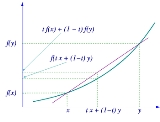
In mathematics, a real-valued function f defined on an interval (or on any convex subset of some vector space) is called convex, concave upwards, concave up or convex cup, if for any two points x and y in its domain C and any t in [0,1], we have
In other words, a function is convex if and only if its epigraph (the set of points lying on or above the graph) is a convex set.
Pictorially, a function is called 'convex' if the function lies below the straight line segment connecting two points, for any two points in the interval.
A function is called strictly convex if
for any t in (0,1) and
A function is said to be concave if is convex.
nvex function f defined on some open interval C is continuous on C and differentiable at all but at most countably many points.

Discussion
Ask a question about 'Convex function'
Start a new discussion about 'Convex function'
Answer questions from other users
|
Recent Posts

Encyclopedia
In mathematics, a real-valued function f defined on an interval (or on any convex subset of some vector space) is called convex, concave upwards, concave up or convex cup, if for any two points x and y in its domain C and any t in [0,1], we have
In other words, a function is convex if and only if its epigraph (the set of points lying on or above the graph) is a convex set.
Pictorially, a function is called 'convex' if the function lies below the straight line segment connecting two points, for any two points in the interval.
A function is called strictly convex if
for any t in (0,1) and
A function is said to be concave if is convex.
Properties
A convex function f defined on some open interval C is continuous on C and differentiable at all but at most countably many points. If C is closed, then f may fail to be continuous at the endpoints of C.
A function is midpoint convex on an interval C if
for all x and y in C. This condition is only slightly weaker than convexity. For example, a real valued Lebesgue measurable function that is midpoint convex will be convex . In particular, a continuous function that is midpoint convex will be convex.
A differentiable function of one variable is convex on an interval if and only if its derivative is monotonically non-decreasing on that interval.
A continuously differentiable function of one variable is convex on an interval if and only if the function lies above all of its tangents: f(y) = f(x) + f '(x) (y − x) for all x and y in the interval. In particular, if f '(c) = 0, then c is a global minimum of f(x).
A twice differentiable function of one variable is convex on an interval if and only if its second derivative is non-negative there; this gives a practical test for convexity.
If its second derivative is positive then it is strictly convex, but the converse does not hold. For example, the second derivative of f(x) = x4 is f "(x) = 12 x2, which is zero for x = 0, but x4 is strictly convex.
More generally, a continuous, twice differentiable function of several variables is convex on a convex set if and only if its Hessian matrix is positive semidefinite on the interior of the convex set.
Any local minimum of a convex function is also a global minimum. A strictly convex function will have at most one global minimum.
For a convex function f, the sublevel sets and with a ? R are convex sets. However, a function whose sublevel sets are convex sets may fail to be a convex function; such a function is called a quasiconvex function.
Jensen's inequality applies to every convex function f. If is a random variable taking values in the domain of f, then (Here denotes the mathematical expectation.)
Convex function calculus
- If and are convex functions, then so are and
- If and are convex functions and if is increasing, then is convex.
- Convexity is invariant under affine maps: that is, if is convex with , then so is , where
- If is convex in and is a convex nonempty set, then is convex in provided for some
Examples
- The function has at all points, so f is a (strictly) convex function.
- The absolute value function is convex, even though it does not have a derivative at the point x = 0.
- The function for 1 = p is convex.
- The exponential function is convex. More generally, the function is logarithmically convex if f is a convex function.
- The function f with domain [0,1] defined by f(0)=f(1)=1, f(x)=0 for 0<x<1 is convex; it is continuous on the open interval (0,1), but not continuous at 0 and 1.
- The function x3 has second derivative 6x; thus it is convex on the set where x = 0 and concave on the set where x = 0.
- Every linear transformation taking values in is convex but not strictly convex, since if f is linear, then This statement also holds if we replace "convex" by "concave".
- Every affine function taking values in , i.e., each function of the form , is simultaneously convex and concave.
- Every norm is a convex function, by the triangle inequality.
- If is convex, the perspective function is convex for
- Examples of functions that are monotonically increasing but not convex include and
- Examples of functions that are convex but not monotonically increasing include and .
- The function f(x) = 1/x2, with f(0)=+8, is convex on the interval (0,+8) and convex on the interval (-8,0), but not convex on the interval (-8,+8), because of the singularity at x = 0.
See also
External links
- Stephen Boyd and Lieven Vandenberghe, (PDF)
- Jon Dattorro, (book pdf)
|
| |
|
|