

William Stanley Jevons

Encyclopedia
William Stanley Jevons (1 September 1835 – 13 August 1882) was a British
economist
and logician.
Irving Fisher
described his book The Theory of Political Economy (1871) as beginning the mathematical method in economics. It made the case that economics as a science concerned with quantities is necessarily mathematical. In so doing, it expounded upon the "final" (marginal) utility theory of value. Jevons' work, along with similar discoveries made by Carl Menger
in Vienna (1871) and by Léon Walras
in Switzerland
(1874), marked the opening of a new period in the history of economic thought. Jevons' contribution to the marginal revolution
in economics in the late 19th century established his reputation as a leading political economist and logician of the time.
Jevons broke off his studies of the natural sciences in London in 1854 to work as an assayer
in Sydney
, where he acquired an interest in political economy
. Returning to the UK in 1859, he published General Mathematical Theory of Political Economy in 1862, outlining the marginal utility theory of value, and A Serious Fall in the Value of Gold in 1863. For Jevons, the utility or value to a consumer of an additional unit of a product is inversely related to the number of units of that product he already owns, at least beyond some critical quantity.
It was for The Coal Question
(1865), in which he called attention to the gradual exhaustion of the UK's coal
supplies, that he received public recognition. The most important of his works on logic
and scientific method
s is his Principles of Science (1874), as well as The Theory of Political Economy (1871) and The State in Relation to Labour (1882).
. At the age of fifteen he was sent to London to attend University College School
. He appears at this time to have already formed the belief that important achievements as a thinker were possible to him, and at more than one critical period in his career this belief was the decisive factor in determining his conduct. Towards the end of 1853, after having spent two years at University College, where his favourite subjects were chemistry
and botany
, he unexpectedly received the offer of the assayership to the new mint in Australia
. The idea of leaving the UK was distasteful, but pecuniary considerations had, in consequence of the failure of his father's firm in 1847, become of vital importance, and he accepted the post.
He left the UK for Sydney
in June 1854, and remained there for five years. At the end of that period he resigned his appointment, and in the autumn of 1859 entered again as a student at University College London
, proceeding in due course to the B.A. and M.A. degrees of the University of London
. He now gave his principal attention to the moral sciences, but his interest in natural science was by no means exhausted: throughout his life he continued to write occasional papers on scientific subjects, and his intimate knowledge of the physical sciences greatly contributed to the success of his chief logical work, The Principles of Science. Not long after taking his M.A. degree Jevons obtained a post as tutor at Owens College
, Manchester.
In 1866 he was elected professor of logic and mental and moral philosophy and Cobden professor of political economy in Owens college. Next year he married Harriet Ann Taylor, whose father, John Edward Taylor
, had been the founder and proprietor of the Manchester Guardian. Jevons suffered a good deal from ill health and sleeplessness, and found the delivery of lectures covering so wide a range of subjects very burdensome. In 1876 he was glad to exchange the Owens professorship for the professorship of political economy
in University College, London. Travelling and music were the principal recreations of his life; but his health continued to be bad, and he suffered from depression. He found his professorial duties increasingly irksome, and feeling that the pressure of literary work left him no spare energy, he decided in 1880 to resign the post. On the 13 August 1882 he was drowned whilst bathing near Hastings
.
Throughout his life he had pursued with devotion and industry the ideals with which he had set out, and his journal and letters display a noble simplicity of disposition and an unswerving honesty of purpose. He was a prolific writer, and at the time of his death he occupied the foremost position in the UK both as a logician and as an economist. Alfred Marshall
said of his work in economics that it "will probably be found to have more constructive force than any, save that of Ricardo
, that has been done during the last hundred years." At the time of his death he was engaged upon an economic work that promised to be at least as important as any that he had previously undertaken. It would be difficult to exaggerate the loss which logic and political economy sustained through the accident by which his life was prematurely cut short.
Stanley Jevons was raised a Christian
Unitarian
, and exercepts from this journals indicate he remained committed to his Christian beliefs until death. After dying in 1882 from accidental drowning, he was buried in the Hampstead Cemetery
.
above referred to, namely, that the degree of utility of a commodity is some continuous mathematical function of the quantity of the commodity available, together with the implied doctrine that economics is essentially a mathematical science, took more definite form in a paper on "A General Mathematical Theory of Political Economy," written for the British Association in 1862. This paper does not appear to have attracted much attention either in 1862 or on its publication four years later in the Journal of the Statistical Society; and it was not till 1871, when the Theory of Political Economy appeared, that Jevons set forth his doctrines in a fully developed form.
It was not till after the publication of this work that Jevons became acquainted with the applications of mathematics to political economy made by earlier writers, notably Antoine Augustin Cournot
and HH Gossen
. The theory of utility was at about 1870 being independently developed on somewhat similar lines by Carl Menger
in Austria
and Leon Walras
in Switzerland
. As regards the discovery of the connection between value in exchange and final (or marginal) utility, the priority belongs to Gossen, but this in no way detracts from the great importance of the service which Jevons rendered to British economics by his fresh discovery of the principle, and by the way in which he ultimately forced it into notice. In his reaction from the prevailing view he sometimes expressed himself without due qualification: the declaration, for instance, made at the commencement of the Theory of Political Economy, that value depends entirely upon utility, lent itself to misinterpretation. But a certain exaggeration of emphasis may be pardoned in a writer seeking to attract the attention of an indifferent public. The Neoclassical Revolution, which would reshape economics, had been started.
Jevons did not explicitly distinguish between the concepts of ordinal and cardinal utility. Cardinal utility
allows the relative magnitude of utilities to be discussed, while ordinal utility
only implies that goods can be compared and ranked according to which good provided the most utility. Although Jevons predated the debate about ordinality or cardinality of utility, his mathematics required the use of cardinal utility functions. For example, in The Theory of Political Economy, Chapter II, the subsection on "Theory of Dimensions of Economic Quantities," Jevons makes the statement that "In the first place, pleasure and pain must be regarded as measured upon the same scale, and as having, therefore, the same dimensions, being quantities of the same kind, which can be added and subtraced...." Speaking of measurement, addition, and subtraction requires cardinality, as does Jevons' heavy use of integral calculus. Note that cardinality does NOT imply direct measurability, in which Jevons did not believe.
(1865) placed him in the front rank as a writer on applied economics and statistics; and he would be remembered as one of the leading economists of the 19th century even had his Theory of Political Economy never been written. Amongst his economic works may be mentioned Money and the Mechanism of Exchange (1875), written in a popular style, and descriptive rather than theoretical, but wonderfully fresh and original in treatment and full of suggestiveness, a Primer on Political Economy (1878), The State in Relation to Labour (1882), and two works published after his death, namely, Methods of Social Reform and Investigations in Currency and Finance, containing papers that had appeared separately during his lifetime. The last-named volume contains Jevons's speculations on the connection between commercial crises and sunspots. He was engaged at the time of his death upon the preparation of a large treatise on economics and had drawn up a table of contents and completed some chapters and parts of chapters. This fragment was published in 1905 under the title of The Principles of Economics: a fragment of a treatise on the industrial mechanism of society, and other papers.
In The Coal Question, Jevons covered a breadth of concepts on energy depletion that have recently been revisited by writers covering the subject of peak oil
. For example, Jevons explained that improving energy efficiency typically reduced energy costs and thereby increased rather than decreased energy use, an effect now known as the Jevons paradox
. The Coal Question remains a paradigmatic study of resource depletion theory. Jevons's son, H. Stanley Jevons, published an 800-page follow-up study in 1915 in which the difficulties of estimating recoverable reserves of a theoretically finite resource are discussed in detail.
In a relatively minor work, “Commercial Crises and Sun-Spots”, Jevons analyzed business cycles, proposing that crises in the economy might not be random events, but might be based on discernible prior causes. To clarify the concept, he presented a statistical study relating business cycles with sunspots
. His reasoning was that sunspots affected the weather, which, in turn, affected crops. Crops changes could then be expected to cause economic changes.
 Jevons' work in logic went on pari passu
with his work in political economy. In 1864 he published a small volume, entitled Pure Logic; or, the Logic of Quality apart from Quantity, which was based on Boole
's system of logic, but freed from what he considered the false mathematical dress of that system. In the years immediately following he devoted considerable attention to the construction of a logical machine, exhibited before the Royal Society
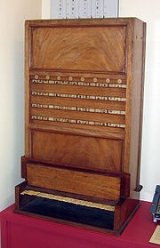
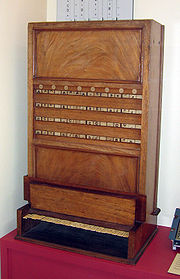
in 1870, by means of which the conclusion derivable from any given set of premisses could be mechanically obtained. In 1866 what he regarded as the great and universal principle of all reasoning dawned upon him; and in 1869 he published a sketch of this fundamental doctrine under the title of The Substitution of Similars. He expressed the principle in its simplest form as follows: "Whatever is true of a thing is true of its like," and he worked out in detail its various applications including the "Logic Piano", a mechanical computer he designed and had built in 1869.
In the following year appeared the Elementary Lessons on Logic, which soon became the most widely read elementary textbook on logic in the English language. In the meantime he was engaged upon a much more important logical treatise, which appeared in 1874 under the title of The Principles of Science. In this work Jevons embodied the substance of his earlier works on pure logic and the substitution of similars; he also enunciated and developed the view that induction
is simply an inverse employment of deduction; he treated in a luminous manner the general theory of probability
, and the relation between probability and induction; and his knowledge of the various natural sciences enabled him throughout to relieve the abstract character of logical doctrine by concrete scientific illustrations, often worked out in great detail. An example is his discussion of the use of one-way function
s in cryptography, including remarks on the integer factorization
problem that foreshadowed its use in public key cryptography. Jevons' general theory of induction was a revival of the theory laid down by Whewell
and criticized by John Stuart Mill
; but it was put in a new form, and was free from some of the non-essential adjuncts which rendered Whewell's exposition open to attack. The work as a whole was one of the most notable contributions to logical doctrine that appeared in the UK in the 19th century. His Studies in Deductive Logic, consisting mainly of exercises and problems for the use of students, was published in 1880. In 1877 and the following years Jevons contributed to the Contemporary Review some articles on Mill, which he had intended to supplement by further articles, and eventually publish in a volume as a criticism of Mill's philosophy. These articles and one other were republished after Jevons' death, together with his earlier logical treatises, in a volume, entitled Pure Logic, and other Minor Works. The criticisms on Mill contain much that is ingenious and much that is forcible, but on the whole they cannot be regarded as taking rank with Jevons's other work. His strength lay in his power as an original thinker rather than as a critic; and he will be remembered by his constructive work as logician, economist and statistician
.
On Jevons as logician, see Grattan-Guinness (2000).
in 1903 and later on a pocket calculator by Solomon W. Golomb
.
Works available online:
United Kingdom
The United Kingdom of Great Britain and Northern IrelandIn the United Kingdom and Dependencies, other languages have been officially recognised as legitimate autochthonous languages under the European Charter for Regional or Minority Languages...
economist
Economist
An economist is a professional in the social science discipline of economics. The individual may also study, develop, and apply theories and concepts from economics and write about economic policy...
and logician.
Irving Fisher
Irving Fisher
Irving Fisher was an American economist, inventor, and health campaigner, and one of the earliest American neoclassical economists, though his later work on debt deflation often regarded as belonging instead to the Post-Keynesian school.Fisher made important contributions to utility theory and...
described his book The Theory of Political Economy (1871) as beginning the mathematical method in economics. It made the case that economics as a science concerned with quantities is necessarily mathematical. In so doing, it expounded upon the "final" (marginal) utility theory of value. Jevons' work, along with similar discoveries made by Carl Menger
Carl Menger
Carl Menger was the founder of the Austrian School of economics, famous for contributing to the development of the theory of marginal utility, which contested the cost-of-production theories of value, developed by the classical economists such as Adam Smith and David Ricardo.- Biography :Menger...
in Vienna (1871) and by Léon Walras
Léon Walras
Marie-Esprit-Léon Walras was a French mathematical economist associated with the creation of the general equilibrium theory.-Life and career:...
in Switzerland
Switzerland
Switzerland name of one of the Swiss cantons. ; ; ; or ), in its full name the Swiss Confederation , is a federal republic consisting of 26 cantons, with Bern as the seat of the federal authorities. The country is situated in Western Europe,Or Central Europe depending on the definition....
(1874), marked the opening of a new period in the history of economic thought. Jevons' contribution to the marginal revolution
Marginal Revolution
Marginal Revolution is a blog focused on economics run by economists Tyler Cowen and Alex Tabarrok, both of whom teach at George Mason University. The blog's slogan is "Small steps toward a much better world." The site is updated daily and focuses on current events and newly released reports or books...
in economics in the late 19th century established his reputation as a leading political economist and logician of the time.
Jevons broke off his studies of the natural sciences in London in 1854 to work as an assayer
Assayer
An assayer is a person who tests ores and minerals and analyzes them to determine their composition and value. They may use spectrographic analysis, chemical solutions, and chemical or laboratory equipment, such as furnaces, beakers, graduates, pipettes, and crucibles.An assayer separates metals...
in Sydney
Sydney
Sydney is the most populous city in Australia and the state capital of New South Wales. Sydney is located on Australia's south-east coast of the Tasman Sea. As of June 2010, the greater metropolitan area had an approximate population of 4.6 million people...
, where he acquired an interest in political economy
Political economy
Political economy originally was the term for studying production, buying, and selling, and their relations with law, custom, and government, as well as with the distribution of national income and wealth, including through the budget process. Political economy originated in moral philosophy...
. Returning to the UK in 1859, he published General Mathematical Theory of Political Economy in 1862, outlining the marginal utility theory of value, and A Serious Fall in the Value of Gold in 1863. For Jevons, the utility or value to a consumer of an additional unit of a product is inversely related to the number of units of that product he already owns, at least beyond some critical quantity.
It was for The Coal Question
The Coal Question
The Coal Question; An Inquiry Concerning the Progress of the Nation, and the Probable Exhaustion of Our Coal Mines was a book by economist William Stanley Jevons that explored the implications of Britain's reliance on coal. Given that coal was a finite, non-renewable energy resource, Jevons raised...
(1865), in which he called attention to the gradual exhaustion of the UK's coal
Coal
Coal is a combustible black or brownish-black sedimentary rock usually occurring in rock strata in layers or veins called coal beds or coal seams. The harder forms, such as anthracite coal, can be regarded as metamorphic rock because of later exposure to elevated temperature and pressure...
supplies, that he received public recognition. The most important of his works on logic
Logic
In philosophy, Logic is the formal systematic study of the principles of valid inference and correct reasoning. Logic is used in most intellectual activities, but is studied primarily in the disciplines of philosophy, mathematics, semantics, and computer science...
and scientific method
Scientific method
Scientific method refers to a body of techniques for investigating phenomena, acquiring new knowledge, or correcting and integrating previous knowledge. To be termed scientific, a method of inquiry must be based on gathering empirical and measurable evidence subject to specific principles of...
s is his Principles of Science (1874), as well as The Theory of Political Economy (1871) and The State in Relation to Labour (1882).
Background
Jevons was born in Liverpool, in the UK. His father, Thomas Jevons, a man of strong scientific tastes and a writer on legal and economic subjects, was an iron merchant. His mother Mary Anne Jevons was the daughter of William RoscoeWilliam Roscoe
William Roscoe , was an English historian and miscellaneous writer.-Life:He was born in Liverpool, where his father, a market gardener, kept a public house called the Bowling Green at Mount Pleasant. Roscoe left school at the age of twelve, having learned all that his schoolmaster could teach...
. At the age of fifteen he was sent to London to attend University College School
University College School
University College School, generally known as UCS, is an Independent school charity situated in Hampstead, north west London, England. The school was founded in 1830 by University College London and inherited many of that institution's progressive and secular views...
. He appears at this time to have already formed the belief that important achievements as a thinker were possible to him, and at more than one critical period in his career this belief was the decisive factor in determining his conduct. Towards the end of 1853, after having spent two years at University College, where his favourite subjects were chemistry
Chemistry
Chemistry is the science of matter, especially its chemical reactions, but also its composition, structure and properties. Chemistry is concerned with atoms and their interactions with other atoms, and particularly with the properties of chemical bonds....
and botany
Botany
Botany, plant science, or plant biology is a branch of biology that involves the scientific study of plant life. Traditionally, botany also included the study of fungi, algae and viruses...
, he unexpectedly received the offer of the assayership to the new mint in Australia
Australia
Australia , officially the Commonwealth of Australia, is a country in the Southern Hemisphere comprising the mainland of the Australian continent, the island of Tasmania, and numerous smaller islands in the Indian and Pacific Oceans. It is the world's sixth-largest country by total area...
. The idea of leaving the UK was distasteful, but pecuniary considerations had, in consequence of the failure of his father's firm in 1847, become of vital importance, and he accepted the post.
He left the UK for Sydney
Sydney
Sydney is the most populous city in Australia and the state capital of New South Wales. Sydney is located on Australia's south-east coast of the Tasman Sea. As of June 2010, the greater metropolitan area had an approximate population of 4.6 million people...
in June 1854, and remained there for five years. At the end of that period he resigned his appointment, and in the autumn of 1859 entered again as a student at University College London
University College London
University College London is a public research university located in London, United Kingdom and the oldest and largest constituent college of the federal University of London...
, proceeding in due course to the B.A. and M.A. degrees of the University of London
University of London
-20th century:Shortly after 6 Burlington Gardens was vacated, the University went through a period of rapid expansion. Bedford College, Royal Holloway and the London School of Economics all joined in 1900, Regent's Park College, which had affiliated in 1841 became an official divinity school of the...
. He now gave his principal attention to the moral sciences, but his interest in natural science was by no means exhausted: throughout his life he continued to write occasional papers on scientific subjects, and his intimate knowledge of the physical sciences greatly contributed to the success of his chief logical work, The Principles of Science. Not long after taking his M.A. degree Jevons obtained a post as tutor at Owens College
Victoria University of Manchester
The Victoria University of Manchester was a university in Manchester, England. On 1 October 2004 it merged with the University of Manchester Institute of Science and Technology to form a new entity, "The University of Manchester".-1851 - 1951:The University was founded in 1851 as Owens College,...
, Manchester.
In 1866 he was elected professor of logic and mental and moral philosophy and Cobden professor of political economy in Owens college. Next year he married Harriet Ann Taylor, whose father, John Edward Taylor
John Edward Taylor
John Edward Taylor was the founder of the Manchester Guardian newspaper, later to become The Guardian.-Biography:...
, had been the founder and proprietor of the Manchester Guardian. Jevons suffered a good deal from ill health and sleeplessness, and found the delivery of lectures covering so wide a range of subjects very burdensome. In 1876 he was glad to exchange the Owens professorship for the professorship of political economy
Political economy
Political economy originally was the term for studying production, buying, and selling, and their relations with law, custom, and government, as well as with the distribution of national income and wealth, including through the budget process. Political economy originated in moral philosophy...
in University College, London. Travelling and music were the principal recreations of his life; but his health continued to be bad, and he suffered from depression. He found his professorial duties increasingly irksome, and feeling that the pressure of literary work left him no spare energy, he decided in 1880 to resign the post. On the 13 August 1882 he was drowned whilst bathing near Hastings
Hastings
Hastings is a town and borough in the county of East Sussex on the south coast of England. The town is located east of the county town of Lewes and south east of London, and has an estimated population of 86,900....
.
Throughout his life he had pursued with devotion and industry the ideals with which he had set out, and his journal and letters display a noble simplicity of disposition and an unswerving honesty of purpose. He was a prolific writer, and at the time of his death he occupied the foremost position in the UK both as a logician and as an economist. Alfred Marshall
Alfred Marshall
Alfred Marshall was an Englishman and one of the most influential economists of his time. His book, Principles of Economics , was the dominant economic textbook in England for many years...
said of his work in economics that it "will probably be found to have more constructive force than any, save that of Ricardo
David Ricardo
David Ricardo was an English political economist, often credited with systematising economics, and was one of the most influential of the classical economists, along with Thomas Malthus, Adam Smith, and John Stuart Mill. He was also a member of Parliament, businessman, financier and speculator,...
, that has been done during the last hundred years." At the time of his death he was engaged upon an economic work that promised to be at least as important as any that he had previously undertaken. It would be difficult to exaggerate the loss which logic and political economy sustained through the accident by which his life was prematurely cut short.
Stanley Jevons was raised a Christian
Christian
A Christian is a person who adheres to Christianity, an Abrahamic, monotheistic religion based on the life and teachings of Jesus of Nazareth as recorded in the Canonical gospels and the letters of the New Testament...
Unitarian
Unitarianism
Unitarianism is a Christian theological movement, named for its understanding of God as one person, in direct contrast to Trinitarianism which defines God as three persons coexisting consubstantially as one in being....
, and exercepts from this journals indicate he remained committed to his Christian beliefs until death. After dying in 1882 from accidental drowning, he was buried in the Hampstead Cemetery
Hampstead Cemetery
Hampstead Cemetery is a historic cemetery in West Hampstead, London, located at the upper extremity of the NW6 district. Despite the name, the cemetery is three-quarters of a mile from Hampstead Village, and bears a different postcode...
.
Theory of utility
Jevons arrived quite early in his career at the doctrines that constituted his most characteristic and original contributions to economics and logic. The theory of utility, which became the keynote of his general theory of political economy, was practically formulated in a letter written in 1860; and the germ of his logical principles of the substitution of similars may be found in the view which he propounded in another letter written in 1861, that "philosophy would be found to consist solely in pointing out the likeness of things." The theory of utilityUtility
In economics, utility is a measure of customer satisfaction, referring to the total satisfaction received by a consumer from consuming a good or service....
above referred to, namely, that the degree of utility of a commodity is some continuous mathematical function of the quantity of the commodity available, together with the implied doctrine that economics is essentially a mathematical science, took more definite form in a paper on "A General Mathematical Theory of Political Economy," written for the British Association in 1862. This paper does not appear to have attracted much attention either in 1862 or on its publication four years later in the Journal of the Statistical Society; and it was not till 1871, when the Theory of Political Economy appeared, that Jevons set forth his doctrines in a fully developed form.
It was not till after the publication of this work that Jevons became acquainted with the applications of mathematics to political economy made by earlier writers, notably Antoine Augustin Cournot
Antoine Augustin Cournot
Antoine Augustin Cournot was a French philosopher and mathematician.Antoine Augustin Cournot was born at Gray, Haute-Saone. In 1821 he entered one of the most prestigious Grande École, the École Normale Supérieure, and in 1829 he had earned a doctoral degree in mathematics, with mechanics as his...
and HH Gossen
Hermann Heinrich Gossen
Hermann Heinrich Gossen was a Prussian economist who is often regarded as the first to elaborate a general theory of marginal utility.-Life and work:...
. The theory of utility was at about 1870 being independently developed on somewhat similar lines by Carl Menger
Carl Menger
Carl Menger was the founder of the Austrian School of economics, famous for contributing to the development of the theory of marginal utility, which contested the cost-of-production theories of value, developed by the classical economists such as Adam Smith and David Ricardo.- Biography :Menger...
in Austria
Austrian School
The Austrian School of economics is a heterodox school of economic thought. It advocates methodological individualism in interpreting economic developments , the theory that money is non-neutral, the theory that the capital structure of economies consists of heterogeneous goods that have...
and Leon Walras
Léon Walras
Marie-Esprit-Léon Walras was a French mathematical economist associated with the creation of the general equilibrium theory.-Life and career:...
in Switzerland
Lausanne School
The Lausanne School of economics, sometimes referred to as the Mathematical School, refers to the neoclassical economics school of thought surrounding Léon Walras and Vilfredo Pareto. The central feature of the Lausanne School was its development of general equilibrium theory...
. As regards the discovery of the connection between value in exchange and final (or marginal) utility, the priority belongs to Gossen, but this in no way detracts from the great importance of the service which Jevons rendered to British economics by his fresh discovery of the principle, and by the way in which he ultimately forced it into notice. In his reaction from the prevailing view he sometimes expressed himself without due qualification: the declaration, for instance, made at the commencement of the Theory of Political Economy, that value depends entirely upon utility, lent itself to misinterpretation. But a certain exaggeration of emphasis may be pardoned in a writer seeking to attract the attention of an indifferent public. The Neoclassical Revolution, which would reshape economics, had been started.
Jevons did not explicitly distinguish between the concepts of ordinal and cardinal utility. Cardinal utility
Cardinal utility
In economics, cardinal utility refers to a property of mathematical indices that preserve preference orderings uniquely up to positive linear transformations...
allows the relative magnitude of utilities to be discussed, while ordinal utility
Ordinal utility
Ordinal utility theory states that while the utility of a particular good or service cannot be measured using a numerical scale bearing economic meaning in and of itself, pairs of alternative bundles of goods can be ordered such that one is considered by an individual to be worse than, equal to,...
only implies that goods can be compared and ranked according to which good provided the most utility. Although Jevons predated the debate about ordinality or cardinality of utility, his mathematics required the use of cardinal utility functions. For example, in The Theory of Political Economy, Chapter II, the subsection on "Theory of Dimensions of Economic Quantities," Jevons makes the statement that "In the first place, pleasure and pain must be regarded as measured upon the same scale, and as having, therefore, the same dimensions, being quantities of the same kind, which can be added and subtraced...." Speaking of measurement, addition, and subtraction requires cardinality, as does Jevons' heavy use of integral calculus. Note that cardinality does NOT imply direct measurability, in which Jevons did not believe.
Practical economics
It was not, however, as a theorist dealing with the fundamental data of economic science, but as a brilliant writer on practical economic questions, that Jevons first received general recognition. A Serious Fall in the Value of Gold (1863) and The Coal QuestionThe Coal Question
The Coal Question; An Inquiry Concerning the Progress of the Nation, and the Probable Exhaustion of Our Coal Mines was a book by economist William Stanley Jevons that explored the implications of Britain's reliance on coal. Given that coal was a finite, non-renewable energy resource, Jevons raised...
(1865) placed him in the front rank as a writer on applied economics and statistics; and he would be remembered as one of the leading economists of the 19th century even had his Theory of Political Economy never been written. Amongst his economic works may be mentioned Money and the Mechanism of Exchange (1875), written in a popular style, and descriptive rather than theoretical, but wonderfully fresh and original in treatment and full of suggestiveness, a Primer on Political Economy (1878), The State in Relation to Labour (1882), and two works published after his death, namely, Methods of Social Reform and Investigations in Currency and Finance, containing papers that had appeared separately during his lifetime. The last-named volume contains Jevons's speculations on the connection between commercial crises and sunspots. He was engaged at the time of his death upon the preparation of a large treatise on economics and had drawn up a table of contents and completed some chapters and parts of chapters. This fragment was published in 1905 under the title of The Principles of Economics: a fragment of a treatise on the industrial mechanism of society, and other papers.
In The Coal Question, Jevons covered a breadth of concepts on energy depletion that have recently been revisited by writers covering the subject of peak oil
Peak oil
Peak oil is the point in time when the maximum rate of global petroleum extraction is reached, after which the rate of production enters terminal decline. This concept is based on the observed production rates of individual oil wells, projected reserves and the combined production rate of a field...
. For example, Jevons explained that improving energy efficiency typically reduced energy costs and thereby increased rather than decreased energy use, an effect now known as the Jevons paradox
Jevons paradox
In economics, the Jevons paradox is the proposition that technological progress that increases the efficiency with which a resource is used, tends to increase the rate of consumption of that resource...
. The Coal Question remains a paradigmatic study of resource depletion theory. Jevons's son, H. Stanley Jevons, published an 800-page follow-up study in 1915 in which the difficulties of estimating recoverable reserves of a theoretically finite resource are discussed in detail.
In a relatively minor work, “Commercial Crises and Sun-Spots”, Jevons analyzed business cycles, proposing that crises in the economy might not be random events, but might be based on discernible prior causes. To clarify the concept, he presented a statistical study relating business cycles with sunspots
Sunspots (economics)
In economics, the term sunspots usually refers to an extrinsic random variable, that is, a random variable that does not directly affect economic fundamentals...
. His reasoning was that sunspots affected the weather, which, in turn, affected crops. Crops changes could then be expected to cause economic changes.
Logic
Pari passu
Pari passu is a Latin phrase that literally means "with an equal step" or "on equal footing." It is sometimes translated as "ranking equally", "hand-in-hand," "with equal force," or "moving together," and by extension, "fairly," "without partiality."...
with his work in political economy. In 1864 he published a small volume, entitled Pure Logic; or, the Logic of Quality apart from Quantity, which was based on Boole
George Boole
George Boole was an English mathematician and philosopher.As the inventor of Boolean logic—the basis of modern digital computer logic—Boole is regarded in hindsight as a founder of the field of computer science. Boole said,...
's system of logic, but freed from what he considered the false mathematical dress of that system. In the years immediately following he devoted considerable attention to the construction of a logical machine, exhibited before the Royal Society
Royal Society
The Royal Society of London for Improving Natural Knowledge, known simply as the Royal Society, is a learned society for science, and is possibly the oldest such society in existence. Founded in November 1660, it was granted a Royal Charter by King Charles II as the "Royal Society of London"...
in 1870, by means of which the conclusion derivable from any given set of premisses could be mechanically obtained. In 1866 what he regarded as the great and universal principle of all reasoning dawned upon him; and in 1869 he published a sketch of this fundamental doctrine under the title of The Substitution of Similars. He expressed the principle in its simplest form as follows: "Whatever is true of a thing is true of its like," and he worked out in detail its various applications including the "Logic Piano", a mechanical computer he designed and had built in 1869.
In the following year appeared the Elementary Lessons on Logic, which soon became the most widely read elementary textbook on logic in the English language. In the meantime he was engaged upon a much more important logical treatise, which appeared in 1874 under the title of The Principles of Science. In this work Jevons embodied the substance of his earlier works on pure logic and the substitution of similars; he also enunciated and developed the view that induction
Inductive reasoning
Inductive reasoning, also known as induction or inductive logic, is a kind of reasoning that constructs or evaluates propositions that are abstractions of observations. It is commonly construed as a form of reasoning that makes generalizations based on individual instances...
is simply an inverse employment of deduction; he treated in a luminous manner the general theory of probability
Probability
Probability is ordinarily used to describe an attitude of mind towards some proposition of whose truth we arenot certain. The proposition of interest is usually of the form "Will a specific event occur?" The attitude of mind is of the form "How certain are we that the event will occur?" The...
, and the relation between probability and induction; and his knowledge of the various natural sciences enabled him throughout to relieve the abstract character of logical doctrine by concrete scientific illustrations, often worked out in great detail. An example is his discussion of the use of one-way function
One-way function
In computer science, a one-way function is a function that is easy to compute on every input, but hard to invert given the image of a random input. Here "easy" and "hard" are to be understood in the sense of computational complexity theory, specifically the theory of polynomial time problems...
s in cryptography, including remarks on the integer factorization
Integer factorization
In number theory, integer factorization or prime factorization is the decomposition of a composite number into smaller non-trivial divisors, which when multiplied together equal the original integer....
problem that foreshadowed its use in public key cryptography. Jevons' general theory of induction was a revival of the theory laid down by Whewell
William Whewell
William Whewell was an English polymath, scientist, Anglican priest, philosopher, theologian, and historian of science. He was Master of Trinity College, Cambridge.-Life and career:Whewell was born in Lancaster...
and criticized by John Stuart Mill
John Stuart Mill
John Stuart Mill was a British philosopher, economist and civil servant. An influential contributor to social theory, political theory, and political economy, his conception of liberty justified the freedom of the individual in opposition to unlimited state control. He was a proponent of...
; but it was put in a new form, and was free from some of the non-essential adjuncts which rendered Whewell's exposition open to attack. The work as a whole was one of the most notable contributions to logical doctrine that appeared in the UK in the 19th century. His Studies in Deductive Logic, consisting mainly of exercises and problems for the use of students, was published in 1880. In 1877 and the following years Jevons contributed to the Contemporary Review some articles on Mill, which he had intended to supplement by further articles, and eventually publish in a volume as a criticism of Mill's philosophy. These articles and one other were republished after Jevons' death, together with his earlier logical treatises, in a volume, entitled Pure Logic, and other Minor Works. The criticisms on Mill contain much that is ingenious and much that is forcible, but on the whole they cannot be regarded as taking rank with Jevons's other work. His strength lay in his power as an original thinker rather than as a critic; and he will be remembered by his constructive work as logician, economist and statistician
Statistician
A statistician is someone who works with theoretical or applied statistics. The profession exists in both the private and public sectors. The core of that work is to measure, interpret, and describe the world and human activity patterns within it...
.
On Jevons as logician, see Grattan-Guinness (2000).
Number Theory
Jevons had written in his Principles of Science, p. 123, "Can the reader say what two numbers multiplied together will produce the number 8616460799 ? I think it unlikely that anyone but myself will ever know." This became known as Jevons' Number and was factored by Derrick Norman LehmerDerrick Norman Lehmer
Derrick Norman Lehmer was an American mathematician and number theorist....
in 1903 and later on a pocket calculator by Solomon W. Golomb
Solomon W. Golomb
Solomon Wolf Golomb is an American mathematician and engineer and a professor of electrical engineering at the University of Southern California, best known to the general public and fans of mathematical games as the inventor of polyominoes, the inspiration for the computer game Tetris...
.
Works
- 1859 General Mathematical Theory of Political Economy
- 1863 A Serious Fall in the Value of Gold
- 1864 Pure Logic; or, the Logic of Quality apart from Quantity
- 1865 The Coal Question
- 1869 The Substitution of Similars, The True Principle of Reasoning
- 1870 Elementary Lessons on Logic
- 1871 The Theory of Political Economy
- 1874 Principles of Science
- 1875 Money and the Mechanism of Exchange
- 1878 A Primer on Political Economy
- 1880 Studies in Deductive Logic
- 1882 The State in Relation to Labour
External links
- New School: William Stanley Jevons
- Royal Society certificate of election 1872
- Jevons and the Logic 'Piano' at The Rutherford JournalThe Rutherford JournalThe Rutherford Journal is a peer-reviewed academic journal that covers the history and philosophy of science and technology.It publishes invited articles and is edited by Jack Copeland . The journal is published annually, starting from December 2005...
- The Coal Question -- Encyclopedia of Earth
- Letters and Journal of W. Stanley Jevons, edited by his wife (1886). This work contains a bibliography of Jevons' writings.
Works available online:
- The Coal Question (also available here)
- The Theory of Political Economy
- Money and the Mechanism of Exchange
- Richard Cantillon and the Nationality of Political Economy
- Elementary Lessons in Logic
- Money and the Mechanism of Exchange
- The Theory of Political Economy
- William Stanley Jevons
- From Google.com books via Contents tab or [page] box at top or scroll:
- The Principles of Political Economy, 1871,
- The Theory of Political Economy, 1879, 2nd ed.
- The Theory of Political Economy, 1888, 3rd ed. (1879 ed. + 3rd Preface by Harriet A. Jevons & adds to bibliographic 1st Appendix).