


Main sequence

Encyclopedia

Star
A star is a massive, luminous sphere of plasma held together by gravity. At the end of its lifetime, a star can also contain a proportion of degenerate matter. The nearest star to Earth is the Sun, which is the source of most of the energy on Earth...
s that appears on plots of stellar color
Color index
In astronomy, the color index is a simple numerical expression that determines the color of an object, which in the case of a star gives its temperature...
versus brightness
Absolute magnitude
Absolute magnitude is the measure of a celestial object's intrinsic brightness. it is also the apparent magnitude a star would have if it were 32.6 light years away from Earth...
. These color-magnitude plots are known as Hertzsprung–Russell diagram
Hertzsprung–Russell diagram
The Hertzsprung–Russell diagram is a scatter graph of stars showing the relationship between the stars' absolute magnitudes or luminosities versus their spectral types or classifications and effective temperatures. Hertzsprung–Russell diagrams are not pictures or maps of the locations of the stars...
s after their co-developers, Ejnar Hertzsprung
Ejnar Hertzsprung
Ejnar Hertzsprung was a Danish chemist and astronomer.Hertzsprung was born in Copenhagen. In the period 1911–1913, together with Henry Norris Russell, he developed the Hertzsprung–Russell diagram....
and Henry Norris Russell
Henry Norris Russell
Henry Norris Russell was an American astronomer who, along with Ejnar Hertzsprung, developed the Hertzsprung–Russell diagram . In 1923, working with Frederick Saunders, he developed Russell–Saunders coupling which is also known as LS coupling.-Biography:Russell was born in 1877 in Oyster Bay, New...
. Stars on this band are known as main-sequence stars or "dwarf" stars.
After a star has formed, it creates energy at the hot, dense core region through the nuclear fusion
Nuclear fusion
Nuclear fusion is the process by which two or more atomic nuclei join together, or "fuse", to form a single heavier nucleus. This is usually accompanied by the release or absorption of large quantities of energy...
of hydrogen
Hydrogen
Hydrogen is the chemical element with atomic number 1. It is represented by the symbol H. With an average atomic weight of , hydrogen is the lightest and most abundant chemical element, constituting roughly 75% of the Universe's chemical elemental mass. Stars in the main sequence are mainly...
atoms into helium
Helium
Helium is the chemical element with atomic number 2 and an atomic weight of 4.002602, which is represented by the symbol He. It is a colorless, odorless, tasteless, non-toxic, inert, monatomic gas that heads the noble gas group in the periodic table...
. During this stage of the star's lifetime, it is located along the main sequence at a position determined primarily by its mass, but also based upon its chemical composition and other factors. All main-sequence stars are in hydrostatic equilibrium
Hydrostatic equilibrium
Hydrostatic equilibrium or hydrostatic balance is the condition in fluid mechanics where a volume of a fluid is at rest or at constant velocity. This occurs when compression due to gravity is balanced by a pressure gradient force...
, where outward thermal pressure from the hot core is balanced by the inward gravitational pressure from the overlying layers. The strong dependence of the rate of energy generation in the core on the temperature and pressure helps to sustain this balance. Energy generated at the core makes its way to the surface and is radiated away at the photosphere
Photosphere
The photosphere of an astronomical object is the region from which externally received light originates. The term itself is derived from Ancient Greek roots, φῶς, φωτός/phos, photos meaning "light" and σφαῖρα/sphaira meaning "sphere", in reference to the fact that it is a spheric surface perceived...
. The energy is carried by either radiation
Radiation
In physics, radiation is a process in which energetic particles or energetic waves travel through a medium or space. There are two distinct types of radiation; ionizing and non-ionizing...
or convection
Convection
Convection is the movement of molecules within fluids and rheids. It cannot take place in solids, since neither bulk current flows nor significant diffusion can take place in solids....
, with the latter occurring in regions with steeper temperature gradients, higher opacity or both.
The main sequence is sometimes divided into upper and lower parts, based on the dominant process that a star uses to generate energy. Stars below about 1.5 times the mass of the Sun
Solar mass
The solar mass , , is a standard unit of mass in astronomy, used to indicate the masses of other stars and galaxies...
(or 1.5 solar masses) primarily fuse hydrogen atoms together in a series of stages to form helium, a sequence called the proton-proton chain. Above this mass, in the upper main sequence, the nuclear fusion process mainly uses atoms of carbon
Carbon
Carbon is the chemical element with symbol C and atomic number 6. As a member of group 14 on the periodic table, it is nonmetallic and tetravalent—making four electrons available to form covalent chemical bonds...
, nitrogen
Nitrogen
Nitrogen is a chemical element that has the symbol N, atomic number of 7 and atomic mass 14.00674 u. Elemental nitrogen is a colorless, odorless, tasteless, and mostly inert diatomic gas at standard conditions, constituting 78.08% by volume of Earth's atmosphere...
and oxygen
Oxygen
Oxygen is the element with atomic number 8 and represented by the symbol O. Its name derives from the Greek roots ὀξύς and -γενής , because at the time of naming, it was mistakenly thought that all acids required oxygen in their composition...
as intermediaries in the CNO cycle
CNO cycle
The CNO cycle is one of two sets of fusion reactions by which stars convert hydrogen to helium, the other being the proton–proton chain. Unlike the proton–proton chain reaction, the CNO cycle is a catalytic cycle. Theoretical models show that the CNO cycle is the dominant source of energy in stars...
that produces helium from hydrogen atoms. Main-sequence stars with more than ten solar masses undergo convection in the core region, which acts to stir up the newly created helium and maintain the proportion of fuel needed for fusion to occur. When core convection does not occur, a helium-rich core develops surrounded by an outer layer of hydrogen. For stars with lower masses, this convective core is progressively smaller until it disappears at about 2 solar masses. Below this mass, stars have cores that are radiative but are convective near the surface. With decreasing stellar mass the convective envelope increases, and main-sequence stars below 0.4 solar masses undergo convection throughout their mass.
In general, the more massive the star the shorter its lifespan on the main sequence. After the hydrogen fuel at the core has been consumed, the star evolves
Stellar evolution
Stellar evolution is the process by which a star undergoes a sequence of radical changes during its lifetime. Depending on the mass of the star, this lifetime ranges from only a few million years to trillions of years .Stellar evolution is not studied by observing the life of a single...
away from the main sequence on the HR diagram. The behavior of a star now depends on its mass, with stars below 0.23 solar mass
Solar mass
The solar mass , , is a standard unit of mass in astronomy, used to indicate the masses of other stars and galaxies...
es becoming white dwarf
White dwarf
A white dwarf, also called a degenerate dwarf, is a small star composed mostly of electron-degenerate matter. They are very dense; a white dwarf's mass is comparable to that of the Sun and its volume is comparable to that of the Earth. Its faint luminosity comes from the emission of stored...
s directly, while stars with up to ten solar masses pass through a red giant
Red giant
A red giant is a luminous giant star of low or intermediate mass in a late phase of stellar evolution. The outer atmosphere is inflated and tenuous, making the radius immense and the surface temperature low, somewhere from 5,000 K and lower...
stage. More massive stars can explode as a supernova
Supernova
A supernova is a stellar explosion that is more energetic than a nova. It is pronounced with the plural supernovae or supernovas. Supernovae are extremely luminous and cause a burst of radiation that often briefly outshines an entire galaxy, before fading from view over several weeks or months...
, or collapse directly into a black hole
Black hole
A black hole is a region of spacetime from which nothing, not even light, can escape. The theory of general relativity predicts that a sufficiently compact mass will deform spacetime to form a black hole. Around a black hole there is a mathematically defined surface called an event horizon that...
.
History
In the early part of the 20th century, information about the types and distances of starStar
A star is a massive, luminous sphere of plasma held together by gravity. At the end of its lifetime, a star can also contain a proportion of degenerate matter. The nearest star to Earth is the Sun, which is the source of most of the energy on Earth...
s became more readily available. The spectra
Spectrum
A spectrum is a condition that is not limited to a specific set of values but can vary infinitely within a continuum. The word saw its first scientific use within the field of optics to describe the rainbow of colors in visible light when separated using a prism; it has since been applied by...
of stars were shown to have distinctive features, which allowed them to be categorized. Annie Jump Cannon
Annie Jump Cannon
Annie Jump Cannon was an American astronomer whose cataloging work was instrumental in the development of contemporary stellar classification. With Edward C...
and Edward C. Pickering at Harvard College Observatory
Harvard College Observatory
The Harvard College Observatory is an institution managing a complex of buildings and multiple instruments used for astronomical research by the Harvard University Department of Astronomy. It is located in Cambridge, Massachusetts, USA, and was founded in 1839...
developed a method of categorization that became known as the Harvard Classification Scheme
Stellar classification
In astronomy, stellar classification is a classification of stars based on their spectral characteristics. The spectral class of a star is a designated class of a star describing the ionization of its chromosphere, what atomic excitations are most prominent in the light, giving an objective measure...
, published in the Harvard Annals in 1901.
In Potsdam
Potsdam
Potsdam is the capital city of the German federal state of Brandenburg and part of the Berlin/Brandenburg Metropolitan Region. It is situated on the River Havel, southwest of Berlin city centre....
in 1906, the Danish astronomer Ejnar Hertzsprung
Ejnar Hertzsprung
Ejnar Hertzsprung was a Danish chemist and astronomer.Hertzsprung was born in Copenhagen. In the period 1911–1913, together with Henry Norris Russell, he developed the Hertzsprung–Russell diagram....
noticed that the reddest stars—classified as K and M in the Harvard scheme—could be divided into two distinct groups. These stars are either much brighter than the Sun, or much fainter. To distinguish these groups, he called them "giant" and "dwarf" stars. The following year he began studying star cluster
Star cluster
Star clusters or star clouds are groups of stars. Two types of star clusters can be distinguished: globular clusters are tight groups of hundreds of thousands of very old stars which are gravitationally bound, while open clusters, more loosely clustered groups of stars, generally contain less than...
s; large groupings of stars that are co-located at approximately the same distance. He published the first plots of color versus luminosity
Luminosity
Luminosity is a measurement of brightness.-In photometry and color imaging:In photometry, luminosity is sometimes incorrectly used to refer to luminance, which is the density of luminous intensity in a given direction. The SI unit for luminance is candela per square metre.The luminosity function...
for these stars. These plots showed a prominent and continuous sequence of stars, which he named the Main Sequence.
At Princeton University
Princeton University
Princeton University is a private research university located in Princeton, New Jersey, United States. The school is one of the eight universities of the Ivy League, and is one of the nine Colonial Colleges founded before the American Revolution....
, Henry Norris Russell
Henry Norris Russell
Henry Norris Russell was an American astronomer who, along with Ejnar Hertzsprung, developed the Hertzsprung–Russell diagram . In 1923, working with Frederick Saunders, he developed Russell–Saunders coupling which is also known as LS coupling.-Biography:Russell was born in 1877 in Oyster Bay, New...
was following a similar course of research. He was studying the relationship between the spectral classification of stars and their actual brightness as corrected for distance—their absolute magnitude
Absolute magnitude
Absolute magnitude is the measure of a celestial object's intrinsic brightness. it is also the apparent magnitude a star would have if it were 32.6 light years away from Earth...
. For this purpose he used a set of stars that had reliable parallax
Parallax
Parallax is a displacement or difference in the apparent position of an object viewed along two different lines of sight, and is measured by the angle or semi-angle of inclination between those two lines. The term is derived from the Greek παράλλαξις , meaning "alteration"...
es and many of which had been categorized at Harvard. When he plotted the spectral types of these stars against their absolute magnitude, he found that dwarf stars followed a distinct relationship. This allowed the real brightness of a dwarf star to be predicted with reasonable accuracy.
Of the red stars observed by Hertzsprung, the dwarf stars also followed the spectra-luminosity relationship discovered by Russell. However, the giant stars are much brighter than dwarfs and so, do not follow the same relationship. Russell proposed that the "giant stars must have low density or great surface-brightness, and the reverse is true of dwarf stars". The same curve also showed that there were very few faint white stars.
In 1933, Bengt Strömgren
Bengt Strömgren
Bengt Georg Daniel Strömgren was a Danish astronomer and astrophysicist.Bengt Strömgren was born in Gothenburg. His parents were Hedvig Strömgren and Svante Elis Strömgren, who was professor of astronomy at the University of Copenhagen and director of the University Observatory in Copenhagen...
introduced the term Hertzsprung-Russell diagram to denote a luminosity-spectral class diagram. This name reflected the parallel development of this technique by both Hertzsprung and Russell earlier in the century.
As evolutionary models of stars were developed during the 1930s, it was shown that, for stars of a uniform chemical composition, a relationship exists between a star's mass and its luminosity and radius. That is, for a given mass and composition, there is a unique solution for determining the star's radius and luminosity. This became known as the Vogt-Russell theorem
Vogt-Russell theorem
The Vogt-Russell theorem, named after Heinrich Vogt and Henry Norris Russell, states that:The mass and the composition structure throughout a star uniquely determine its radius, luminosity, and internal structure, as well as its subsequent evolution....
; named after Heinrich Vogt and Henry Norris Russell. By this theorem, once a star's chemical composition and its position on the main sequence is known, so too is the star's mass and radius. (However, it was subsequently discovered that the theorem breaks down somewhat for stars of non-uniform composition.)
A refined scheme for stellar classification
Stellar classification
In astronomy, stellar classification is a classification of stars based on their spectral characteristics. The spectral class of a star is a designated class of a star describing the ionization of its chromosphere, what atomic excitations are most prominent in the light, giving an objective measure...
was published in 1943 by W. W. Morgan and P. C. Keenan. The MK classification assigned each star a spectral type—based on the Harvard classification—and a luminosity class. The Harvard classification had been developed by assigning a different letter to each star based on the strength of the hydrogen spectra line, before the relationship between spectra and temperature was known. When ordered by temperature and when duplicate classes were removed, the spectral types of stars followed, in order of decreasing temperature with colors ranging from blue to red, the sequence O, B, A, F, G, K and M. (A popular mnemonic
Mnemonic
A mnemonic , or mnemonic device, is any learning technique that aids memory. To improve long term memory, mnemonic systems are used to make memorization easier. Commonly encountered mnemonics are often verbal, such as a very short poem or a special word used to help a person remember something,...
for memorizing this sequence of stellar classes is "Oh Be A Fine Girl/Guy, Kiss Me".) The luminosity class ranged from I to V, in order of decreasing luminosity. Stars of luminosity class V belonged to the main sequence.
Formation
When a protostarProtostar
A protostar is a large mass that forms by contraction out of the gas of a giant molecular cloud in the interstellar medium. The protostellar phase is an early stage in the process of star formation. For a one solar-mass star it lasts about 100,000 years...
is formed from the collapse
Jeans instability
In physics, the Jeans instability causes the collapse of interstellar gas clouds and subsequent star formation. It occurs when the internal gas pressure is not strong enough to prevent gravitational collapse of a region filled with matter...
of a giant molecular cloud of gas and dust in the local interstellar medium
Interstellar medium
In astronomy, the interstellar medium is the matter that exists in the space between the star systems in a galaxy. This matter includes gas in ionic, atomic, and molecular form, dust, and cosmic rays. It fills interstellar space and blends smoothly into the surrounding intergalactic space...
, the initial composition is homogeneous throughout, consisting of about 70% hydrogen, 28% helium and trace amounts of other elements, by mass. The initial mass of the star depends on the local conditions within the cloud. (The mass distribution of newly formed stars is described empirically by the initial mass function
Initial mass function
The initial mass function is an empirical function that describes the mass distribution of a population of stars in terms of their theoretical initial mass...
.) During the initial collapse, this pre-main-sequence star generates energy through gravitational contraction. Upon reaching a suitable density, energy generation is begun at the core using an exothermic
Exothermic
In thermodynamics, the term exothermic describes a process or reaction that releases energy from the system, usually in the form of heat, but also in the form of light , electricity , or sound...
nuclear fusion
Nuclear fusion
Nuclear fusion is the process by which two or more atomic nuclei join together, or "fuse", to form a single heavier nucleus. This is usually accompanied by the release or absorption of large quantities of energy...
process that converts hydrogen into helium.
Once nuclear fusion of hydrogen becomes the dominant energy production process and the excess energy gained from gravitational contraction has been lost, the star lies along a curve
Curve
In mathematics, a curve is, generally speaking, an object similar to a line but which is not required to be straight...
on the Hertzsprung-Russell diagram (or HR diagram) called the standard main sequence. Astronomers will sometimes refer to this stage as "zero age main sequence", or ZAMS. The ZAMS curve can be calculated using computer models of stellar properties at the point when stars begin hydrogen fusion. From this point, the brightness and surface temperature of stars typically increase with age.
A star remains near its initial position on the main sequence until a significant amount of hydrogen in the core has been consumed, then begins to evolve into a more luminous star. (On the HR diagram, the evolving star moves up and to the right of the main sequence.) Thus the main sequence represents the primary hydrogen-burning stage of a star's lifetime.
Properties
The majority of stars on a typical HR diagram lie along the main sequence curve. This line is pronounced because both the spectral typeStellar classification
In astronomy, stellar classification is a classification of stars based on their spectral characteristics. The spectral class of a star is a designated class of a star describing the ionization of its chromosphere, what atomic excitations are most prominent in the light, giving an objective measure...
and the luminosity
Luminosity
Luminosity is a measurement of brightness.-In photometry and color imaging:In photometry, luminosity is sometimes incorrectly used to refer to luminance, which is the density of luminous intensity in a given direction. The SI unit for luminance is candela per square metre.The luminosity function...
depend only on a star's mass, at least to zeroth order approximation, as long as it is fusing hydrogen at its core—and that is what almost all stars spend most of their "active" lives doing.
The temperature of a star determines its spectral type via its effect on the physical properties of plasma
Plasma (physics)
In physics and chemistry, plasma is a state of matter similar to gas in which a certain portion of the particles are ionized. Heating a gas may ionize its molecules or atoms , thus turning it into a plasma, which contains charged particles: positive ions and negative electrons or ions...
in its photosphere
Photosphere
The photosphere of an astronomical object is the region from which externally received light originates. The term itself is derived from Ancient Greek roots, φῶς, φωτός/phos, photos meaning "light" and σφαῖρα/sphaira meaning "sphere", in reference to the fact that it is a spheric surface perceived...
. A star's energy emission as a function of wavelength is influenced by both its temperature and composition. A key indicator of this energy distribution is given by the color index
Color index
In astronomy, the color index is a simple numerical expression that determines the color of an object, which in the case of a star gives its temperature...
, B − V, which measures the star's magnitude
Apparent magnitude
The apparent magnitude of a celestial body is a measure of its brightness as seen by an observer on Earth, adjusted to the value it would have in the absence of the atmosphere...
in blue (B) and green-yellow (V) light by means of filters.By measuring the difference between these values, this eliminates the need to correct the magnitudes for distance. However, see extinction
Extinction (astronomy)
Extinction is a term used in astronomy to describe the absorption and scattering of electromagnetic radiation by matter between an emitting astronomical object and the observer. Interstellar extinction—also called Galactic extinction, when it occurs in the Milky Way—was first...
. This difference in magnitude provides a measure of a star's temperature.
Dwarf terminology
Main-sequence stars are called dwarf stars, but this terminology is partly historical and can be somewhat confusing. For the cooler stars, dwarfs such as red dwarfRed dwarf
According to the Hertzsprung-Russell diagram, a red dwarf star is a small and relatively cool star, of the main sequence, either late K or M spectral type....
s, orange dwarf
Orange dwarf
A K-type main-sequence star , also referred to orange dwarf, are main-sequence stars of spectral type K and luminosity class V. These stars are intermediate in size between red M-type main-sequence stars and yellow G-type main-sequence stars...
s, and yellow dwarf
Yellow dwarf
A G-type main-sequence star , often called a yellow dwarf, is a main-sequence star of spectral type G and luminosity class V. Such a star has about 0.8 to 1.2 solar masses and surface temperature of between 5,300 and 6,000 K., Tables VII, VIII...
s are indeed much smaller and dimmer than other stars of those colors. However, for hotter blue and white stars, the size and brightness difference between so-called dwarf stars that are on the main sequence and the so-called giant stars that are not becomes smaller; for the hottest stars it is not directly observable. For those stars the terms dwarf and giant refer to differences in spectral line
Spectral line
A spectral line is a dark or bright line in an otherwise uniform and continuous spectrum, resulting from a deficiency or excess of photons in a narrow frequency range, compared with the nearby frequencies.- Types of line spectra :...
s which indicate if a star is on the main sequence or off it. Nevertheless, very hot main-sequence stars are still sometimes called dwarfs, even though they have roughly the same size and brightness as the "giant" stars of that temperature.
The common use of dwarf to mean main sequence is confusing in another way, because there are dwarf stars which are not main-sequence stars. For example, white dwarf
White dwarf
A white dwarf, also called a degenerate dwarf, is a small star composed mostly of electron-degenerate matter. They are very dense; a white dwarf's mass is comparable to that of the Sun and its volume is comparable to that of the Earth. Its faint luminosity comes from the emission of stored...
s are a different kind of star that is much smaller than main-sequence stars—being roughly the size of the Earth
Earth
Earth is the third planet from the Sun, and the densest and fifth-largest of the eight planets in the Solar System. It is also the largest of the Solar System's four terrestrial planets...
. These represent the final evolutionary stage of many main-sequence stars.
Parameters
By treating the star as an idealized energy radiator known as a black bodyBlack body
A black body is an idealized physical body that absorbs all incident electromagnetic radiation. Because of this perfect absorptivity at all wavelengths, a black body is also the best possible emitter of thermal radiation, which it radiates incandescently in a characteristic, continuous spectrum...
, the luminosity L and radius R can be related to the effective temperature
Effective temperature
The effective temperature of a body such as a star or planet is the temperature of a black body that would emit the same total amount of electromagnetic radiation...
 by the Stefan–Boltzmann law:
- L = 4πσR2Teff4
where σ is the Stefan–Boltzmann constant. As the position of a star on the HR diagram shows its approximate luminosity, this relation can be used to estimate its radius.
The mass, radius and luminosity of a star are closely interlinked, and their respective values can be approximated by three relations. First is the Stefan–Boltzmann law, which relates the luminosity L, the radius R and the surface temperature Teff. Second is the mass–luminosity relation, which relates the luminosity L and the mass M. Finally, the relationship between M and R is close to linear. The ratio of M to R increases by a factor of only three over 2.5 orders of magnitude of M. This relation is roughly proportional to the star's inner temperature TI, and its extremely slow increase reflects the fact that the rate of energy generation in the core strongly depends on this temperature, while it has to fit the mass–luminosity relation. Thus, a too high or too low temperature will result in stellar instability.
A better approximation is to take
 , the energy generation rate per unit mass, as ε is proportional to TI15, where TI is the core temperature. This is suitable for stars at least as massive as the Sun, exhibiting the CNO cycle
CNO cycle
The CNO cycle is one of two sets of fusion reactions by which stars convert hydrogen to helium, the other being the proton–proton chain. Unlike the proton–proton chain reaction, the CNO cycle is a catalytic cycle. Theoretical models show that the CNO cycle is the dominant source of energy in stars...
, and gives the better fit R ∝ M0.78.
Sample parameters
The table below shows typical values for stars along the main sequence. The values of luminosityLuminosity
Luminosity is a measurement of brightness.-In photometry and color imaging:In photometry, luminosity is sometimes incorrectly used to refer to luminance, which is the density of luminous intensity in a given direction. The SI unit for luminance is candela per square metre.The luminosity function...
(L), radius
Radius
In classical geometry, a radius of a circle or sphere is any line segment from its center to its perimeter. By extension, the radius of a circle or sphere is the length of any such segment, which is half the diameter. If the object does not have an obvious center, the term may refer to its...
(R) and mass
Mass
Mass can be defined as a quantitive measure of the resistance an object has to change in its velocity.In physics, mass commonly refers to any of the following three properties of matter, which have been shown experimentally to be equivalent:...
(M) are relative to the Sun—a dwarf star with a spectral classification of G2 V. The actual values for a star may vary by as much as 20–30% from the values listed below.
| Stellar Class Stellar classification In astronomy, stellar classification is a classification of stars based on their spectral characteristics. The spectral class of a star is a designated class of a star describing the ionization of its chromosphere, what atomic excitations are most prominent in the light, giving an objective measure... |
Radius Radius In classical geometry, a radius of a circle or sphere is any line segment from its center to its perimeter. By extension, the radius of a circle or sphere is the length of any such segment, which is half the diameter. If the object does not have an obvious center, the term may refer to its... |
Mass | Luminosity | Temperature | Examples |
|---|---|---|---|---|---|
| R/R☉ | M/M☉ Solar mass The solar mass , , is a standard unit of mass in astronomy, used to indicate the masses of other stars and galaxies... |
L/L☉ | K Kelvin The kelvin is a unit of measurement for temperature. It is one of the seven base units in the International System of Units and is assigned the unit symbol K. The Kelvin scale is an absolute, thermodynamic temperature scale using as its null point absolute zero, the temperature at which all... |
||
| O5 | 18 | 40 | 500,000 | 38,000 | Zeta Puppis Zeta Puppis Zeta Puppis is a star in the constellation of Puppis. It is also known by the traditional names Naos and Suhail Hadar in Arabic.... |
| B0 | 7.4 | 18 | 20,000 | 30,000 | Phi1 Orionis Phi Orionis The Bayer designation Phi Orionis is shared by two star systems, φ¹ Orionis and φ² Orionis, in the constellation Orion. The two stars are separated by approximately 0.71° in the sky.-φ¹ Orionis:... |
| B5 | 3.8 | 6.5 | 800 | 16,400 | Pi Andromedae A Pi Andromedae Pi Andromedae is a spectroscopic binary in the constellation Andromeda. It is approximately 660 light years from Earth.... |
| A0 | 2.5 | 3.2 | 80 | 10,800 | Alpha Coronae Borealis A |
| A5 | 1.7 | 2.1 | 20 | 8,620 | Beta Pictoris Beta Pictoris Beta Pictoris is the second brightest star in the constellation Pictor. It is located 63.4 light years from our solar system, and is 1.75 times as massive and 8.7 times as luminous as the Sun. The Beta Pictoris system is very young, only 8–20 million years old, although it is already in the main... |
| F0 | 1.4 | 1.7 | 6 | 7,240 | Gamma Virginis Gamma Virginis Gamma Virginis is a star in the constellation Virgo. It has the traditional names Porrima, Postvarta and Arich.... |
| F5 | 1.2 | 1.29 | 2.5 | 6,540 | Eta Arietis Eta Arietis Eta Arietis is a star in the constellation Aries.Eta Arietis is a white F-type main sequence dwarf with an apparent magnitude of +5.23. It is approximately 98.3 light years from Earth.-External links:***... |
| G0 | 1.05 | 1.10 | 1.26 | 6,000 | Beta Comae Berenices Beta Comae Berenices Beta Comae Berenices is a main sequence dwarf star in the constellation of Coma Berenices. It is located at a distance of about 30 light years. The Greek letter beta usually indicates that the star has the second highest visual magnitude in the constellation... |
| G2 | 1.00 | 1.00 | 1.00 | 5,920 | Sun Sun The Sun is the star at the center of the Solar System. It is almost perfectly spherical and consists of hot plasma interwoven with magnetic fields... |
| G5 | 0.93 | 0.93 | 0.79 | 5,610 | Alpha Mensae Alpha Mensae Alpha Mensae is the brightest star in the constellation Mensa. At a magnitude of 5.09, it is the dimmest lucida in all the heavens. It is a main sequence dwarf star only slightly smaller and cooler in temperature than the Sun... |
| K0 | 0.85 | 0.78 | 0.40 | 5,150 | 70 Ophiuchi A 70 Ophiuchi 70 Ophiuchi a binary star system located 16.6 light years away from the Earth. It is in the constellation Ophiuchus. At magnitude 4 it is a typical less bright star usually visible to the unaided eye away from city lights.-Binary star:... |
| K5 | 0.74 | 0.69 | 0.16 | 4,640 | 61 Cygni A 61 Cygni 61 Cygni,Not to be confused with 16 Cygni, a more distant system containing two G-type stars harboring the gas giant planet 16 Cygni Bb. sometimes called Bessel's Star or Piazzi's Flying Star, is a binary star system in the constellation Cygnus... |
| M0 | 0.63 | 0.47 | 0.063 | 3,920 | Gliese 185 Gliese 185 Gliese 185 is a red dwarf star in the constellation Lepus. It is located about 28 light years from the Solar System. This star will make its closest approach to the Sun in roughly 350,000 years, when it comes within .... |
| M5 | 0.32 | 0.21 | 0.0079 | 3,120 | EZ Aquarii A EZ Aquarii EZ Aquarii is a triple star system approximately from the Sun in the constellation Aquarius. It is also known as Luyten 789-6 and Gliese 866 and all three components are M-type red dwarfs. The pair EZ Aquarii AC form a spectroscopic binary with a 3.8 day orbit and a 0.03 AU separation. This... |
| M8 | 0.13 | 0.10 | 0.0008 | — | Van Biesbroeck's star VB 10 VB 10, also referred to as Van Biesbroeck's star, is a very small and very dim M-type red dwarf star located in the constellation Aquila... |
Energy generation
All main-sequence stars have a core region where energy is generated by nuclear fusion. The temperature and density of this core are at the levels necessary to sustain the energy production that will support the remainder of the star. A reduction of energy production would cause the overlaying mass to compress the core, resulting in an increase in the fusion rate because of higher temperature and pressure. Likewise an increase in energy production would cause the star to expand, lowering the pressure at the core. Thus the star forms a self-regulating system in hydrostatic equilibriumHydrostatic equilibrium
Hydrostatic equilibrium or hydrostatic balance is the condition in fluid mechanics where a volume of a fluid is at rest or at constant velocity. This occurs when compression due to gravity is balanced by a pressure gradient force...
that is stable over the course of its main sequence lifetime.
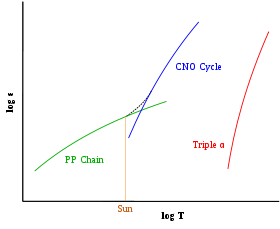
CNO cycle
The CNO cycle is one of two sets of fusion reactions by which stars convert hydrogen to helium, the other being the proton–proton chain. Unlike the proton–proton chain reaction, the CNO cycle is a catalytic cycle. Theoretical models show that the CNO cycle is the dominant source of energy in stars...
. (See the chart.) This process uses atoms of carbon
Carbon
Carbon is the chemical element with symbol C and atomic number 6. As a member of group 14 on the periodic table, it is nonmetallic and tetravalent—making four electrons available to form covalent chemical bonds...
, nitrogen
Nitrogen
Nitrogen is a chemical element that has the symbol N, atomic number of 7 and atomic mass 14.00674 u. Elemental nitrogen is a colorless, odorless, tasteless, and mostly inert diatomic gas at standard conditions, constituting 78.08% by volume of Earth's atmosphere...
and oxygen
Oxygen
Oxygen is the element with atomic number 8 and represented by the symbol O. Its name derives from the Greek roots ὀξύς and -γενής , because at the time of naming, it was mistakenly thought that all acids required oxygen in their composition...
as intermediaries in the process of fusing hydrogen into helium.
At a stellar core temperature of 18 million kelvin
Kelvin
The kelvin is a unit of measurement for temperature. It is one of the seven base units in the International System of Units and is assigned the unit symbol K. The Kelvin scale is an absolute, thermodynamic temperature scale using as its null point absolute zero, the temperature at which all...
s, the PP process and CNO cycle are equally efficient, and each type generates half of the star's net luminosity. As this is the core temperature of a star with about 1.5 solar mass
Solar mass
The solar mass , , is a standard unit of mass in astronomy, used to indicate the masses of other stars and galaxies...
es, the upper main sequence consists of stars above this mass. Thus, roughly speaking, stars of spectral class F or cooler belong to the lower main sequence, while class A stars or hotter are upper main-sequence stars. The transition in primary energy production from one form to the other spans a range difference of less than a single solar mass. In the Sun, a one solar mass star, only 1.5% of the energy is generated by the CNO cycle. By contrast, stars with 1.8 solar masses or above generate almost their entire energy output through the CNO cycle.
The observed upper limit for a main-sequence star is 120–200 solar masses. The theoretical explanation for this limit is that stars above this mass can not radiate energy fast enough to remain stable, so any additional mass will be ejected in a series of pulsations until the star reaches a stable limit. The lower limit for sustained proton-proton nuclear fusion is about 0.08 solar masses. Below this threshold are sub-stellar objects that can not sustain hydrogen fusion, known as brown dwarf
Brown dwarf
Brown dwarfs are sub-stellar objects which are too low in mass to sustain hydrogen-1 fusion reactions in their cores, which is characteristic of stars on the main sequence. Brown dwarfs have fully convective surfaces and interiors, with no chemical differentiation by depth...
s.
Structure
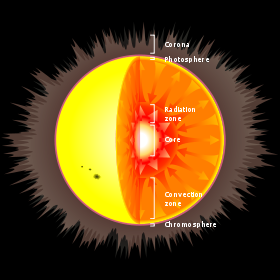
Photosphere
The photosphere of an astronomical object is the region from which externally received light originates. The term itself is derived from Ancient Greek roots, φῶς, φωτός/phos, photos meaning "light" and σφαῖρα/sphaira meaning "sphere", in reference to the fact that it is a spheric surface perceived...
, energy is transported outward. The two modes for transporting this energy are radiation
Radiation
In physics, radiation is a process in which energetic particles or energetic waves travel through a medium or space. There are two distinct types of radiation; ionizing and non-ionizing...
and convection
Convection
Convection is the movement of molecules within fluids and rheids. It cannot take place in solids, since neither bulk current flows nor significant diffusion can take place in solids....
. A radiation zone
Radiation zone
The radiation zone is the middle zone in the Sun's interior. Energy travels out of the core into the radiation zone. Energy that travels through the radiation zone is in the form of electromagnetic radiation. The radiation zone is so dense that the waves bounce around...
, where energy is transported by radiation
Radiation
In physics, radiation is a process in which energetic particles or energetic waves travel through a medium or space. There are two distinct types of radiation; ionizing and non-ionizing...
, is stable against convection and there is very little mixing of the plasma. By contrast, in a convection zone
Convection zone
The convection zone of a star is the range of radii in which energy is transported primarily by convection. In the radiation zone, energy is transported by radiation...
the energy is transported by bulk movement of plasma, with hotter material rising and cooler material descending. Convection is a more efficient mode for carrying energy than radiation, but it will only occur under conditions that create a steep temperature gradient.
In massive stars (above 10 solar masses) the rate of energy generation by the CNO cycle is very sensitive to temperature, so the fusion is highly concentrated at the core. Consequently, there is a high temperature gradient in the core region, which results in a convection zone for more efficient energy transport. This mixing of material around the core removes the helium ash from the hydrogen-burning region, allowing more of the hydrogen in the star to be consumed during the main-sequence lifetime. The outer regions of a massive star transport energy by radiation, with little or no convection.
Intermediate mass stars such as Sirius
Sirius
Sirius is the brightest star in the night sky. With a visual apparent magnitude of −1.46, it is almost twice as bright as Canopus, the next brightest star. The name "Sirius" is derived from the Ancient Greek: Seirios . The star has the Bayer designation Alpha Canis Majoris...
may transport energy primarily by radiation, with a small core convection region. Medium-sized, low mass stars like the Sun have a core region that is stable against convection, with a convection zone near the surface that mixes the outer layers. This results in a steady buildup of a helium-rich core, surrounded by a hydrogen-rich outer region. By contrast, cool, very low-mass stars (below 0.4 solar masses) are convective throughout. Thus the helium produced at the core is distributed across the star, producing a relatively uniform atmosphere and a proportionately longer main sequence lifespan.
Luminosity-color variation
As non-fusing helium ash accumulates in the core of a main-sequence star, the reduction in the abundance of hydrogen per unit mass results in a gradual lowering of the fusion rate within that mass. To compensate, the core temperature and pressure slowly increase, which causes a net increase in the overall fusion rate (to support the greater density of the inner star). This produces a steady increase in the luminosity and radius of the star over time. Thus, for example, the luminosity of the early Sun was only about 70% of its current value. As a star ages this luminosity increase changes its position on the HR diagram. This effect results in a broadening of the main sequence band because stars are observed at random stages in their lifetime. That is, the main sequence band develops a thickness on the HR diagram; it is not simply a narrow line.Other factors that broaden the main sequence band on the HR diagram include uncertainty in the distance to stars and the presence of unresolved binary star
Binary star
A binary star is a star system consisting of two stars orbiting around their common center of mass. The brighter star is called the primary and the other is its companion star, comes, or secondary...
s that can alter the observed stellar parameters. However, even perfect observation would show a fuzzy main sequence because mass is not the only parameter that affects a star's color and luminosity. In addition to variations in chemical composition
Metallicity
In astronomy and physical cosmology, the metallicity of an object is the proportion of its matter made up of chemical elements other than hydrogen and helium...
—both because of the initial abundances and the star's evolutionary status
Stellar evolution
Stellar evolution is the process by which a star undergoes a sequence of radical changes during its lifetime. Depending on the mass of the star, this lifetime ranges from only a few million years to trillions of years .Stellar evolution is not studied by observing the life of a single...
, interaction with a close companion
Binary star
A binary star is a star system consisting of two stars orbiting around their common center of mass. The brighter star is called the primary and the other is its companion star, comes, or secondary...
, rapid rotation
Stellar rotation
Stellar rotation is the angular motion of a star about its axis. The rate of rotation can be measured from the spectrum of the star, or by timing the movements of active features on the surface....
, or a magnetic field
Stellar magnetic field
A stellar magnetic field is a magnetic field generated by the motion of conductive plasma inside a star. This motion is created through convection, which is a form of energy transport involving the physical movement of material. A localized magnetic field exerts a force on the plasma, effectively...
can also change a main-sequence star's position slightly on the HR diagram, to name just a few factors. As an example, there are stars that have a very low abundance of elements with higher atomic numbers than helium—known as metal-poor stars—that lie just below the main sequence. Known as subdwarfs, these stars are also fusing hydrogen in their core and so they mark the lower edge of the main sequence's fuzziness resulting from chemical composition.
A nearly vertical region of the HR diagram, known as the instability strip
Instability strip
The Instability strip is a nearly vertical region in the Hertzsprung–Russell diagram which is occupied by pulsating variable stars .The instability strip intersects the main sequence in the region of A...
, is occupied by pulsating variable star
Variable star
A star is classified as variable if its apparent magnitude as seen from Earth changes over time, whether the changes are due to variations in the star's actual luminosity, or to variations in the amount of the star's light that is blocked from reaching Earth...
s known as Cepheid variable
Cepheid variable
A Cepheid is a member of a class of very luminous variable stars. The strong direct relationship between a Cepheid variable's luminosity and pulsation period, secures for Cepheids their status as important standard candles for establishing the Galactic and extragalactic distance scales.Cepheid...
s. These stars vary in magnitude at regular intervals, giving them a pulsating appearance. The strip intersects the upper part of the main sequence in the region of class A and F stars, which are between one and two solar masses. Pulsating stars in this part of the instability strip that intersects the upper part of the main sequence are called Delta Scuti variable
Delta Scuti variable
A Delta Scuti variable is a variable star which exhibits variations in its luminosity due to both radial and non-radial pulsations of the star's surface. Typical brightness fluctuations are from 0.003 to 0.9 magnitudes in V over a period of a few hours, although the amplitude and period of the...
s. Main-sequence stars in this region experience only small changes in magnitude and so this variation is difficult to detect. Other classes of unstable main-sequence stars, like beta Cephei variable
Beta Cephei variable
Beta Cephei variables are variable stars which exhibit variations in their brightness due to pulsations of the stars' surfaces. The point of maximum brightness roughly corresponds to the maximum contraction of the star. Typically, Beta Cephei variables change in brightness by 0.01 to 0.3...
s, are unrelated to this instability strip.
Lifetime
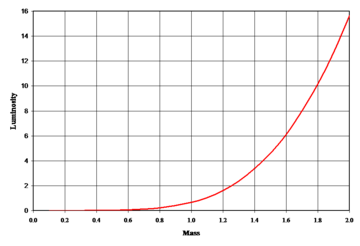
Orders of approximation
In science, engineering, and other quantitative disciplines, orders of approximation refer to formal or informal terms for how precise an approximation is, and to indicate progressively more refined approximations: in increasing order of precision, a zeroth order approximation, a first order...
, as the total energy produced divided by the star's luminosity.
For a star with at least 0.5 solar masses, once the hydrogen supply in its core is exhausted and it expands to become a red giant
Red giant
A red giant is a luminous giant star of low or intermediate mass in a late phase of stellar evolution. The outer atmosphere is inflated and tenuous, making the radius immense and the surface temperature low, somewhere from 5,000 K and lower...
, it can start to fuse helium
Helium
Helium is the chemical element with atomic number 2 and an atomic weight of 4.002602, which is represented by the symbol He. It is a colorless, odorless, tasteless, non-toxic, inert, monatomic gas that heads the noble gas group in the periodic table...
atoms to form carbon
Carbon
Carbon is the chemical element with symbol C and atomic number 6. As a member of group 14 on the periodic table, it is nonmetallic and tetravalent—making four electrons available to form covalent chemical bonds...
. The energy output of the helium fusion process per unit mass is only about a tenth the energy output of the hydrogen process, and the luminosity of the star increases. This results in a much shorter length of time in this stage compared to the main sequence lifetime. (For example, the Sun is predicted to spend burning helium, compared to about 12 billion years burning hydrogen.) Thus, about 90% of the observed stars above 0.5 solar masses will be on the main sequence. On average, main-sequence stars are known to follow an empirical mass-luminosity relationship. The luminosity (L) of the star is roughly proportional to the total mass (M) as the following power law
Power law
A power law is a special kind of mathematical relationship between two quantities. When the frequency of an event varies as a power of some attribute of that event , the frequency is said to follow a power law. For instance, the number of cities having a certain population size is found to vary...
:

This relationship applies to main-sequence stars in the range 0.1–50 solar masses.
The amount of fuel available for nuclear fusion is proportional to the mass of the star. Thus, the lifetime of a star on the main sequence can be estimated by comparing it to solar evolutionary models. The Sun
Sun
The Sun is the star at the center of the Solar System. It is almost perfectly spherical and consists of hot plasma interwoven with magnetic fields...
has been a main-sequence star for about 4.5 billion years and it will become a red giant in 6.5 billion years, for a total main sequence lifetime of roughly 1010 years. Hence:

where M and L are the mass and luminosity of the star, respectively,
 is a solar mass,
  is the solar luminosity and
  is the star's estimated main sequence lifetime.
Although more massive stars have more fuel to burn and might be expected to last longer, they also must radiate a proportionately greater amount with increased mass. Thus, the most massive stars may remain on the main sequence for only a few million years, while stars with less than a tenth of a solar mass may last for over a trillion years.
The exact mass-luminosity relationship depends on how efficiently energy can be transported from the core to the surface. A higher opacity
Opacity (optics)
Opacity is the measure of impenetrability to electromagnetic or other kinds of radiation, especially visible light. In radiative transfer, it describes the absorption and scattering of radiation in a medium, such as a plasma, dielectric, shielding material, glass, etc...
has an insulating effect that retains more energy at the core, so the star does not need to produce as much energy to remain in hydrostatic equilibrium
Hydrostatic equilibrium
Hydrostatic equilibrium or hydrostatic balance is the condition in fluid mechanics where a volume of a fluid is at rest or at constant velocity. This occurs when compression due to gravity is balanced by a pressure gradient force...
. By contrast, a lower opacity means energy escapes more rapidly and the star must burn more fuel to remain in equilibrium. Note, however, that a sufficiently high opacity can result in energy transport via convection
Convection
Convection is the movement of molecules within fluids and rheids. It cannot take place in solids, since neither bulk current flows nor significant diffusion can take place in solids....
, which changes the conditions needed to remain in equilibrium.
In high-mass main-sequence stars, the opacity is dominated by electron scattering
Electron scattering
Electron scattering is the process whereby an electron is deflected from its original trajectory. As they are charged particles, they are subject to electromagnetic forces.-Phenomena:...
, which is nearly constant with increasing temperature. Thus the luminosity only increases as the cube of the star's mass. For stars below 10 times the solar mass, the opacity becomes dependent on temperature, resulting in the luminosity varying approximately as the fourth power of the star's mass. For very low mass stars, molecules in the atmosphere also contribute to the opacity. Below about 0.5 solar masses, the luminosity of the star varies as the mass to the power of 2.3, producing a flattening of the slope on a graph of mass versus luminosity. Even these refinements are only an approximation, however, and the mass-luminosity relation can vary depending on a star's composition.
Evolutionary tracks
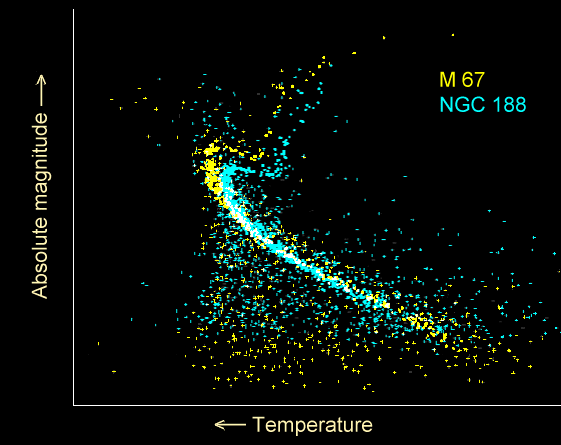
White dwarf
A white dwarf, also called a degenerate dwarf, is a small star composed mostly of electron-degenerate matter. They are very dense; a white dwarf's mass is comparable to that of the Sun and its volume is comparable to that of the Earth. Its faint luminosity comes from the emission of stored...
s once energy generation by nuclear fusion of hydrogen at the core comes to a halt. For stars above this threshold with up to 10 solar masses, the hydrogen surrounding the helium core reaches sufficient temperature and pressure to undergo fusion, forming a hydrogen-burning shell. In consequence of this change, the outer envelope of the star expands and decreases in temperature, turning it into a red giant
Red giant
A red giant is a luminous giant star of low or intermediate mass in a late phase of stellar evolution. The outer atmosphere is inflated and tenuous, making the radius immense and the surface temperature low, somewhere from 5,000 K and lower...
. At this point the star is evolving off the main sequence and entering the giant branch. The path the star now follows across the HR diagram, to the upper right of the main sequence, is called an evolutionary track.
The helium core of a red giant continues to collapse until it is entirely supported by electron degeneracy pressure
Electron degeneracy pressure
Electron degeneracy pressure is a particular manifestation of the more general phenomenon of quantum degeneracy pressure. The Pauli Exclusion Principle disallows two half integer spin particles from occupying the same quantum state at a given time. The resulting emergent repulsive force is...
—a quantum mechanical
Quantum mechanics
Quantum mechanics, also known as quantum physics or quantum theory, is a branch of physics providing a mathematical description of much of the dual particle-like and wave-like behavior and interactions of energy and matter. It departs from classical mechanics primarily at the atomic and subatomic...
effect that restricts how closely matter can be compacted. For stars of more than about 0.5 solar masses, the core can reach a temperature where it becomes hot enough to burn helium into carbon via the triple alpha process. Stars with more than 5–7.5 solar masses can also fuse elements with higher atomic numbers. For stars with ten or more solar masses, this process can lead to an increasingly dense core that finally collapses, ejecting the star's overlying layers in a Type II supernova
Type II supernova
A Type II supernova results from the rapid collapse and violent explosion of a massive star. A star must have at least 9 times, and no more than 40–50 times the mass of the Sun for this type of explosion. It is distinguished from other types of supernova by the presence of hydrogen in its spectrum...
explosion, Type Ib supernova or Type Ic supernova.
When a cluster of stars
Star cluster
Star clusters or star clouds are groups of stars. Two types of star clusters can be distinguished: globular clusters are tight groups of hundreds of thousands of very old stars which are gravitationally bound, while open clusters, more loosely clustered groups of stars, generally contain less than...
is formed at about the same time, the life span of these stars will depend on their individual masses. The most massive stars will leave the main sequence first, followed steadily in sequence by stars of ever lower masses. Thus the stars will evolve in order of their position on the main sequence, proceeding from the most massive at the left toward the right of the HR diagram. The current position where stars in this cluster are leaving the main sequence is known as the turn-off point. By knowing the main sequence lifespan of stars at this point, it becomes possible to estimate the age of the cluster.