

Stellar evolution

Encyclopedia
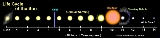
Stellar evolution is the process by which a star
undergoes a sequence of radical changes during its lifetime. Depending on the mass of the star, this lifetime ranges from only a few million years (for the most massive) to trillions of years (for the least massive, which is considerably more than the age of the universe
).
Stellar evolution is not studied by observing the life of a single star, as most stellar changes occur too slowly to be detected, even over many centuries. Instead, astrophysicists
come to understand how stars evolve by observing numerous stars at the various points in their life, and by simulating stellar structure
with computer models.
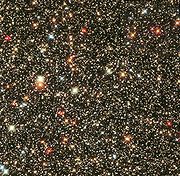
of a giant molecular cloud (GMC). Typical GMCs are roughly 100 ly across and contain up to 6000000 solar mass. As it collapses, a GMC breaks into smaller and smaller pieces. In each of these fragments, the collapsing gas releases gravitational potential energy
as heat. As its temperature and pressure increase, a fragment condenses into a rotating sphere of superhot gas known as a protostar
.
The further development heavily depends on the mass of the evolving protostar; in the following, the protostar mass is compared to the solar mass: 1 solar mass means 1 solar mass.
of hydrogen to begin. These are known as brown dwarf
s. Brown dwarfs heavier than 13 Jupiter
masses (2.5 × 1028 kg) or 0.0125 solar mass fuse deuterium
, and some astronomers prefer to call only these objects brown dwarfs, classifying anything larger than a planet but smaller than this a sub-stellar object. Both types, deuterium-burning or not, shine dimly and die away slowly, cooling gradually over hundreds of millions of years.
s, initiating the proton-proton chain reaction
and allowing hydrogen
to fuse, first to deuterium and then to helium
. In stars of slightly over 1 solar mass, the CNO cycle
contributes a considerable portion of the energy generation. The onset of nuclear fusion leads relatively quickly to a hydrostatic equilibrium
in which energy released by the core exerts a "radiation pressure" balancing the weight of the star's matter, preventing further gravitational collapse. The star thus evolves rapidly to a stable state, beginning the main sequence
phase of its evolution.
A new star will fall at a specific point on the main sequence
of the Hertzsprung-Russell diagram, with the main sequence spectral type depending upon the mass of the star. Small, relatively cold, low mass red dwarf
s burn hydrogen slowly and will remain on the main sequence for hundreds of billions of years, while massive, hot supergiant
s will leave the main sequence after just a few million years. A mid-sized star like the Sun will remain on the main sequence for about 10 billion years. The Sun is thought to be in the middle of its lifespan; thus, it is on the main sequence.
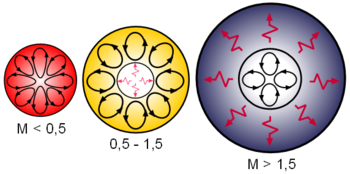
(if it was there at all). Without the outward pressure generated by the fusion of hydrogen to counteract the force of gravity, it contracts until either electron degeneracy
becomes sufficient to oppose gravity or the core becomes hot enough (around 100 megakelvins) for helium fusion
to begin. Which of these happens first depends upon the star's mass.
is thought to be around 13.7 billion years old, which is less time (by several orders of magnitude, in some cases) than it takes for the fusion to cease in such stars. Current theory is based on computer modelling done by astronomers such as Don VandenBerg
.
Some stars may fuse helium in core hot-spots, causing an unstable and uneven reaction as well as a heavy solar wind
. In this case, the star will form no planetary nebula
but simply evaporate, leaving little more than a brown dwarf
.
A star of less than about 0.5 solar mass will never be able to fuse helium even after the core ceases hydrogen fusion. There simply is not a stellar envelope massive enough to exert enough pressure on the core. These are the red dwarf
s, such as Proxima Centauri
, some of which will live thousands of times longer than the Sun. Recent astrophysical models suggest that red dwarfs of 0.1 solar mass may stay on the main sequence for almost six trillion years, and take several hundred billion more to slowly collapse into a white dwarf
. If a star's core becomes stagnant (as is thought will be the case for the Sun), it will still be surrounded by layers of hydrogen which the star may subsequently draw upon. However, if the star is fully convective (as thought to be the case for the lowest-mass stars), it will not have such surrounding layers. If it does, it will develop into a red giant
as described for mid-sized stars below, but never fuse helium as they do; otherwise, it will simply contract until electron degeneracy pressure halts its collapse, thus directly turning into a white dwarf.
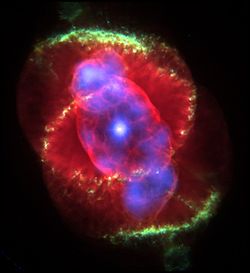 Stars of roughly 0.5–10 solar masses become red giant
s of two types. Red giant branch stars (RGB stars) whose shells are still fusing hydrogen into helium, while the core is inactive helium. They have reached hydrostatic equilibrium, where electron degeneracy pressure is sufficient to balance gravitational pressure. Asymptotic giant branch
have a core undergoing helium fusion
, producing carbon. In either case, the accelerated fusion in the hydrogen-containing layer immediately over the core causes the star to expand. This lifts the outer layers away from the core, reducing the gravitational pull on them, and they expand faster than the energy production increases. This causes them to cool, which causes the star to become redder than when it was on the main sequence.
According to the Hertzsprung-Russell diagram, a red giant
is a large non-main sequence
star
of stellar classification
K or M. Examples include Aldebaran
in the constellation Taurus
and Arcturus in the constellation of Boötes
.
A star of up to a few solar masses will develop a helium
core supported by electron degeneracy pressure, surrounded by layers which still contain hydrogen. Its gravity compresses the hydrogen in the layer immediately above it, causing it to fuse faster than hydrogen would fuse in a main-sequence star of the same mass. This in turn causes the star to become more luminous (from 1,000–10,000 times brighter) and expand; the degree of expansion outstrips the increase in luminosity, causing the effective temperature
to decrease.
The expanding outer layers of the star are convective
, with the material being mixed by turbulence from near the fusing regions up to the surface of the star. For all but the lowest-mass stars, the fused material has remained deep in the stellar interior prior to this point, so the convecting envelope makes fusion products visible at the star's surface for the first time. At this stage of evolution, the results are subtle, with the largest effects, alterations to the isotopes of hydrogen and helium, being unobservable. The effects of the CNO cycle
appear at the surface, with lower 12C/13C ratios and altered proportions of carbon and nitrogen. These are detectable with spectroscopy
and have been measured for many evolved stars.
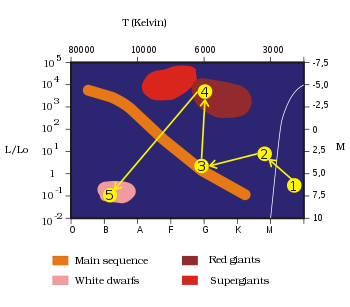 As the hydrogen around the core is consumed, the core absorbs the resulting helium, causing it to contract further, which in turn causes the remaining hydrogen to fuse even faster. This eventually leads to ignition of helium fusion
(which includes the triple-alpha process
) in the core. In stars of more than approximately 0.5 solar masses, electron degeneracy pressure may delay helium fusion for millions or tens of millions of years; in more massive stars, the combined weight of the helium core and the overlying layers means that such pressure is not sufficient to delay the process significantly.
When the temperature and pressure in the core become sufficient to ignite helium fusion in the core, a helium flash
will occur if the core is largely supported by electron degeneracy pressure (stars under 1.4 solar masses). In more massive stars, whose core is not overwhelmingly supported by electron degeneracy pressure, the ignition of helium fusion occurs relatively quietly. Even if a helium flash does occur, the time of very rapid energy release (on the order of 108 Suns) is brief, so that the visible outer layers of the star are relatively undisturbed. The energy released by helium fusion causes the core to expand, so that hydrogen fusion in the overlying layers slows and total energy generation decreases. The star contracts, although not all the way to the main sequence, and it migrates to the horizontal branch
on the HR-diagram, gradually shrinking in radius and increasing its surface temperature.
After the star has consumed the helium at the core, fusion continues in a shell around a hot core of carbon and oxygen. The star follows the Asymptotic Giant Branch
on the HR-diagram, paralleling the original red giant evolution, but with even faster energy generation (which lasts for a shorter time).
Changes in the energy output cause the star to change in size and temperature for certain periods. The energy output itself is shifted to lower frequency emission. This is accompanied by increased mass loss through powerful stellar winds and violent pulsations. Stars in this phase of life are called Late type stars, OH-IR stars or Mira-type
stars, depending on their exact characteristics. The expelled gas is relatively rich in heavy elements created within the star and may be particularly oxygen
or carbon
enriched, depending on the type of the star. The gas builds up in an expanding shell called a circumstellar envelope
and cools as it moves away from the star, allowing dust particles and molecules to form. With the high infrared energy input from the central star, ideal conditions are formed in these circumstellar envelopes for maser
excitation.
Helium burning reactions are extremely sensitive to temperature, which causes great instability. Huge pulsations build up and eventually give the outer layers of the star enough kinetic energy
to be ejected, potentially forming a planetary nebula
. At the center of the nebula remains the core of the star, which cools down to become a small but dense white dwarf
.
 In massive stars, the core is already large enough at the onset of hydrogen burning shell that helium ignition will occur before electron degeneracy pressure has a chance to become prevalent. Thus, when these stars expand and cool, they do not brighten as much as lower mass stars; however, they were much brighter than lower mass stars to begin with, and are thus still brighter than the red giants formed from less massive stars. These stars are unlikely to survive as red supergiant
s; instead they will destroy themselves as type II supernovas
.
Extremely massive stars (more than approximately 40 solar masses), which are very luminous and thus have very rapid stellar winds, lose mass so rapidly due to radiation pressure that they tend to strip off their own envelopes before they can expand to become red supergiants, and thus retain extremely high surface temperatures (and blue-white color) from their main sequence time onwards. Stars cannot be more than about 120 solar masses because the outer layers would be expelled by the extreme radiation. Although lower mass stars normally do not burn off their outer layers so rapidly, they can likewise avoid becoming red giants or red supergiants if they are in binary systems close enough so that the companion star strips off the envelope as it expands, or if they rotate rapidly enough so that convection extends all the way from the core to the surface, resulting in the absence of a separate core and envelope due to thorough mixing.
The core grows hotter and denser as it gains material from fusion of hydrogen at the base of the envelope. In all massive stars, electron degeneracy pressure is insufficient to halt collapse by itself, so as each major element is consumed in the center, progressively heavier elements ignite, temporarily halting collapse. If the core of the star is not too massive (less than approximately 1.4 solar masses, taking into account mass loss that has occurred by this time), it may then form a white dwarf (possibly surrounded by a planetary nebula) as described above for less massive stars, with the difference that the white dwarf is composed chiefly of oxygen, neon, and magnesium.
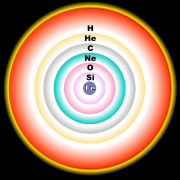 Above a certain mass (estimated at approximately 2.5 solar masses and whose star's progenitor was around 10 solar masses), the core will reach the temperature (approximately 1.1 gigakelvins) at which neon partially breaks down
to form oxygen and helium, the latter of which immediately fuses with some of the remaining neon to form magnesium; then oxygen fuses
to form sulfur, silicon, and smaller amounts of other elements. Finally, the temperature gets high enough that any nucleus can be partially broken down, most commonly releasing an alpha particle (helium nucleus) which immediately fuses with another nucleus, so that several nuclei are effectively rearranged into a smaller number of heavier nuclei, with net release of energy because the addition of fragments to nuclei exceeds the energy required to break them off the parent nuclei.
A star with a core mass too great to form a white dwarf but insufficient to achieve sustained conversion of neon to oxygen and magnesium, will undergo core collapse (due to electron capture
) before achieving fusion of the heavier elements. Both heating and cooling caused by electron capture onto minor constituent elements (such as aluminum and sodium) prior to collapse may have a significant impact on total energy generation within the star shortly before collapse. This may produce a noticeable effect on the abundance of elements and isotopes ejected in the subsequent supernova
.
Once the nucleosynthesis
process arrives at iron-56
, the continuation of this process consumes energy (the addition of fragments to nuclei releases less energy than required to break them off the parent nuclei). If the mass of the core exceeds the Chandrasekhar limit
, electron degeneracy pressure
will be unable to support its weight against the force of gravity, and the core will undergo sudden, catastrophic collapse to form a neutron star
or (in the case of cores that exceed the Tolman-Oppenheimer-Volkoff limit
), a black hole
. Through a process that is not completely understood, some of the gravitational potential energy released by this core collapse is converted into a Type Ib, Type Ic, or Type II supernova
. It is known that the core collapse produces a massive surge of neutrino
s, as observed with supernova SN 1987A
. The extremely energetic neutrinos fragment some nuclei; some of their energy is consumed in releasing nucleons, including neutrons, and some of their energy is transformed into heat and kinetic energy, thus augmenting the shock wave
started by rebound of some of the infalling material from the collapse of the core. Electron capture in very dense parts of the infalling matter may produce additional neutrons. As some of the rebounding matter is bombarded by the neutrons, some of its nuclei capture them, creating a spectrum of heavier-than-iron material including the radioactive elements up to (and likely beyond) uranium
. Although non-exploding red giant stars can produce significant quantities of elements heavier than iron using neutrons released in side reactions of earlier nuclear reactions, the abundance of elements heavier than iron (and in particular, of certain isotopes of elements that have multiple stable or long-lived isotopes) produced in such reactions is quite different from that produced in a supernova. Neither abundance alone matches that found in the Solar System
, so both supernovae and ejection of elements from red giant stars are required to explain the observed abundance of heavy elements and isotopes thereof.
The energy transferred from collapse of the core to rebounding material not only generates heavy elements, but (by a mechanism which is not fully understood) provides for their acceleration well beyond escape velocity
, thus causing a Type Ib, Type Ic, or Type II supernova. Note that current understanding of this energy transfer is still not satisfactory; although current computer models of Type Ib, Type Ic, and Type II supernovae account for part of the energy transfer, they are not able to account for enough energy transfer to produce the observed ejection of material. Some evidence gained from analysis of the mass and orbital parameters of binary neutron stars (which require two such supernovae) hints that the collapse of an oxygen-neon-magnesium core may produce a supernova that differs observably (in ways other than size) from a supernova produced by the collapse of an iron core.
The most massive stars may be completely destroyed by a supernova with an energy greatly exceeding its gravitational binding energy
. This rare event, caused by pair-instability
, leaves behind no black hole remnant.
.) Electron degeneracy pressure provides a rather soft limit against further compression; therefore, for a given chemical composition, white dwarfs of higher mass have a smaller volume. With no fuel left to burn, the star radiates its remaining heat into space for billions of years.
A white dwarf is initially very hot when it first forms, more than 100,000 degrees K at the surface and even hotter in its interior. It is so hot that a lot of its energy is lost in the form of neutrinos for the first 10 million years of its existence, but will have lost most of its energy after a billion years.
The chemical composition of the white dwarf depends upon its mass. A star of a few solar masses will ignite carbon fusion
to form magnesium, neon, and smaller amounts of other elements, resulting in a white dwarf composed chiefly of oxygen, neon, and magnesium, provided that it can lose enough mass to get below the Chandrasekhar limit
(see below), and provided that the ignition of carbon is not so violent as to blow the star apart in a supernova. A star of mass on the order of magnitude of the Sun will be unable to ignite carbon fusion, and will produce a white dwarf composed chiefly of carbon and oxygen, and of mass too low to collapse unless matter is added to it later (see below). A star of less than about half the mass of the Sun will be unable to ignite helium fusion (as noted earlier), and will produce a white dwarf composed chiefly of helium.
In the end, all that remains is a cold dark mass sometimes called a black dwarf
. However, the universe is not old enough for any black dwarf stars to exist yet.
If the white dwarf's mass increases above the Chandrasekhar limit
, which is 1.4 solar masses for a white dwarf composed chiefly of carbon, oxygen, neon, and/or magnesium, then electron degeneracy pressure fails due to electron capture
and the star collapses. Depending upon the chemical composition and pre-collapse temperature in the center, this will lead either to collapse into a neutron star
or runaway ignition of carbon and oxygen. Heavier elements favor continued core collapse, because they require a higher temperature to ignite, because electron capture onto these elements and their fusion products is easier; higher core temperatures favor runaway nuclear reaction, which halts core collapse and leads to a Type Ia supernova
. These supernovae may be many times brighter than the Type II supernova marking the death of a massive star, even though the latter has the greater total energy release. This inability to collapse means that no white dwarf more massive than approximately 1.4 solar masses can exist (with a possible minor exception for very rapidly spinning white dwarfs, whose centrifugal force
due to rotation partially counteracts the weight of their matter). Mass transfer in a binary system
may cause an initially stable white dwarf to surpass the Chandrasekhar limit.
If a white dwarf forms a close binary system with another star, hydrogen from the larger companion may accrete around and onto a white dwarf until it gets hot enough to fuse in a runaway reaction at its surface, although the white dwarf remains below the Chandrasekhar limit. Such an explosion is termed a nova
.
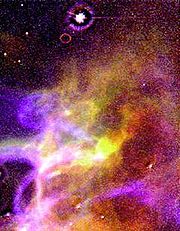 When a stellar core collapses, the pressure causes electron capture, thus converting the great majority of the proton
s into neutron
s. The electromagnetic forces keeping separate nuclei apart are gone (proportionally, if nuclei were the size of dust mites, atoms would be as large as football stadiums), and most of the core of the star becomes a dense ball of contiguous neutrons (in some ways like a giant atomic nucleus), with a thin overlying layer of degenerate matter (chiefly iron unless matter of different composition is added later). The neutrons resist further compression by the Pauli Exclusion Principle, in a way analogous to electron degeneracy pressure, but stronger.
These stars, known as neutron stars, are extremely small--on the order of radius 10 km, no bigger than the size of a large city--and are phenomenally dense. Their period of revolution shortens dramatically as the star shrinks (due to conservation of angular momentum); some spin at over 600 revolutions per second. When these rapidly rotating stars' magnetic poles are aligned with the Earth, we detect a pulse of radiation each revolution. Such neutron stars are called pulsar
s, and were the first neutron stars to be discovered.
. The stellar remnant thus becomes a black hole. The mass at which this occurs is not known with certainty, but is currently estimated at between 2 and 3 solar masses.
Black holes are predicted by the theory of general relativity
. According to classical general relativity, no matter or information can flow from the interior of a black hole to an outside observer, although quantum effect
s may allow deviations from this strict rule. The existence of black holes in the universe is well supported, both theoretically and by astronomical observation.
Since the core-collapse supernova mechanism itself is imperfectly understood, it is still not known whether it is possible for a star to collapse directly to a black hole without producing a visible supernova, or whether some supernovae initially form unstable neutron stars which then collapse into black holes; the exact relation between the initial mass of the star and the final remnant is also not completely certain. Resolution of these uncertainties requires the analysis of more supernovae and supernova remnants.
that can be used to compute the evolutionary phases of a star from its formation until it becomes a remnant. The mass and chemical composition of the star are used as the inputs, and the luminosity and surface temperature are the only constraints. The model formulae are based upon the physical understanding of the star, usually under the assumption of hydrostatic equilibrium. Extensive computer calculations are then run to determine the changing state of the star over time, yielding a table of data that can be used to determine the evolutionary track of the star across the HR diagram, along with other evolving properties. Accurate models can be used to estimate the current age of a star by comparing its physical properties with those of stars along a matching evolutionary track.
Star
A star is a massive, luminous sphere of plasma held together by gravity. At the end of its lifetime, a star can also contain a proportion of degenerate matter. The nearest star to Earth is the Sun, which is the source of most of the energy on Earth...
undergoes a sequence of radical changes during its lifetime. Depending on the mass of the star, this lifetime ranges from only a few million years (for the most massive) to trillions of years (for the least massive, which is considerably more than the age of the universe
Age of the universe
The age of the universe is the time elapsed since the Big Bang posited by the most widely accepted scientific model of cosmology. The best current estimate of the age of the universe is 13.75 ± 0.13 billion years within the Lambda-CDM concordance model...
).
Stellar evolution is not studied by observing the life of a single star, as most stellar changes occur too slowly to be detected, even over many centuries. Instead, astrophysicists
Astrophysics
Astrophysics is the branch of astronomy that deals with the physics of the universe, including the physical properties of celestial objects, as well as their interactions and behavior...
come to understand how stars evolve by observing numerous stars at the various points in their life, and by simulating stellar structure
Stellar structure
Stars of different mass and age have varying internal structures. Stellar structure models describe the internal structure of a star in detail and make detailed predictions about the luminosity, the color and the future evolution of the star....
with computer models.
Birth of a star
Protostar
Stellar evolution begins with the gravitational collapseGravitational collapse
Gravitational collapse is the inward fall of a body due to the influence of its own gravity. In any stable body, this gravitational force is counterbalanced by the internal pressure of the body, in the opposite direction to the force of gravity...
of a giant molecular cloud (GMC). Typical GMCs are roughly 100 ly across and contain up to 6000000 solar mass. As it collapses, a GMC breaks into smaller and smaller pieces. In each of these fragments, the collapsing gas releases gravitational potential energy
Potential energy
In physics, potential energy is the energy stored in a body or in a system due to its position in a force field or due to its configuration. The SI unit of measure for energy and work is the Joule...
as heat. As its temperature and pressure increase, a fragment condenses into a rotating sphere of superhot gas known as a protostar
Protostar
A protostar is a large mass that forms by contraction out of the gas of a giant molecular cloud in the interstellar medium. The protostellar phase is an early stage in the process of star formation. For a one solar-mass star it lasts about 100,000 years...
.
The further development heavily depends on the mass of the evolving protostar; in the following, the protostar mass is compared to the solar mass: 1 solar mass means 1 solar mass.
Brown dwarfs and sub-stellar objects
Protostars with masses less than roughly 0.08 solar mass never reach temperatures high enough for nuclear fusionNuclear fusion
Nuclear fusion is the process by which two or more atomic nuclei join together, or "fuse", to form a single heavier nucleus. This is usually accompanied by the release or absorption of large quantities of energy...
of hydrogen to begin. These are known as brown dwarf
Brown dwarf
Brown dwarfs are sub-stellar objects which are too low in mass to sustain hydrogen-1 fusion reactions in their cores, which is characteristic of stars on the main sequence. Brown dwarfs have fully convective surfaces and interiors, with no chemical differentiation by depth...
s. Brown dwarfs heavier than 13 Jupiter
Jupiter
Jupiter is the fifth planet from the Sun and the largest planet within the Solar System. It is a gas giant with mass one-thousandth that of the Sun but is two and a half times the mass of all the other planets in our Solar System combined. Jupiter is classified as a gas giant along with Saturn,...
masses (2.5 × 1028 kg) or 0.0125 solar mass fuse deuterium
Deuterium burning
Deuterium burning is a nuclear fusion reaction that occurs in stars and some substellar objects, in which a deuterium nucleus and a proton combine to form a helium-3 nucleus...
, and some astronomers prefer to call only these objects brown dwarfs, classifying anything larger than a planet but smaller than this a sub-stellar object. Both types, deuterium-burning or not, shine dimly and die away slowly, cooling gradually over hundreds of millions of years.
Hydrogen fusion
For a more massive protostar, the core temperature will eventually reach 10 million kelvinKelvin
The kelvin is a unit of measurement for temperature. It is one of the seven base units in the International System of Units and is assigned the unit symbol K. The Kelvin scale is an absolute, thermodynamic temperature scale using as its null point absolute zero, the temperature at which all...
s, initiating the proton-proton chain reaction
Proton-proton chain reaction
The proton–proton chain reaction is one of several fusion reactions by which stars convert hydrogen to helium, the primary alternative being the CNO cycle. The proton–proton chain dominates in stars the size of the Sun or smaller....
and allowing hydrogen
Hydrogen
Hydrogen is the chemical element with atomic number 1. It is represented by the symbol H. With an average atomic weight of , hydrogen is the lightest and most abundant chemical element, constituting roughly 75% of the Universe's chemical elemental mass. Stars in the main sequence are mainly...
to fuse, first to deuterium and then to helium
Helium
Helium is the chemical element with atomic number 2 and an atomic weight of 4.002602, which is represented by the symbol He. It is a colorless, odorless, tasteless, non-toxic, inert, monatomic gas that heads the noble gas group in the periodic table...
. In stars of slightly over 1 solar mass, the CNO cycle
CNO cycle
The CNO cycle is one of two sets of fusion reactions by which stars convert hydrogen to helium, the other being the proton–proton chain. Unlike the proton–proton chain reaction, the CNO cycle is a catalytic cycle. Theoretical models show that the CNO cycle is the dominant source of energy in stars...
contributes a considerable portion of the energy generation. The onset of nuclear fusion leads relatively quickly to a hydrostatic equilibrium
Hydrostatic equilibrium
Hydrostatic equilibrium or hydrostatic balance is the condition in fluid mechanics where a volume of a fluid is at rest or at constant velocity. This occurs when compression due to gravity is balanced by a pressure gradient force...
in which energy released by the core exerts a "radiation pressure" balancing the weight of the star's matter, preventing further gravitational collapse. The star thus evolves rapidly to a stable state, beginning the main sequence
Main sequence
The main sequence is a continuous and distinctive band of stars that appears on plots of stellar color versus brightness. These color-magnitude plots are known as Hertzsprung–Russell diagrams after their co-developers, Ejnar Hertzsprung and Henry Norris Russell...
phase of its evolution.
A new star will fall at a specific point on the main sequence
Main sequence
The main sequence is a continuous and distinctive band of stars that appears on plots of stellar color versus brightness. These color-magnitude plots are known as Hertzsprung–Russell diagrams after their co-developers, Ejnar Hertzsprung and Henry Norris Russell...
of the Hertzsprung-Russell diagram, with the main sequence spectral type depending upon the mass of the star. Small, relatively cold, low mass red dwarf
Red dwarf
According to the Hertzsprung-Russell diagram, a red dwarf star is a small and relatively cool star, of the main sequence, either late K or M spectral type....
s burn hydrogen slowly and will remain on the main sequence for hundreds of billions of years, while massive, hot supergiant
Supergiant
Supergiants are among the most massive stars. They occupy the top region of the Hertzsprung-Russell diagram. In the Yerkes spectral classification, supergiants are class Ia or Ib . They typically have bolometric absolute magnitudes between -5 and -12...
s will leave the main sequence after just a few million years. A mid-sized star like the Sun will remain on the main sequence for about 10 billion years. The Sun is thought to be in the middle of its lifespan; thus, it is on the main sequence.
Maturity of a star
A mid-sized star like the Sun will remain on the main sequence for about 10 billion years. Eventually, the core exhausts its supply of hydrogen, and moves off the main sequenceMain sequence
The main sequence is a continuous and distinctive band of stars that appears on plots of stellar color versus brightness. These color-magnitude plots are known as Hertzsprung–Russell diagrams after their co-developers, Ejnar Hertzsprung and Henry Norris Russell...
(if it was there at all). Without the outward pressure generated by the fusion of hydrogen to counteract the force of gravity, it contracts until either electron degeneracy
Electron degeneracy pressure
Electron degeneracy pressure is a particular manifestation of the more general phenomenon of quantum degeneracy pressure. The Pauli Exclusion Principle disallows two half integer spin particles from occupying the same quantum state at a given time. The resulting emergent repulsive force is...
becomes sufficient to oppose gravity or the core becomes hot enough (around 100 megakelvins) for helium fusion
Helium fusion
Helium fusion is a kind of nuclear fusion, with the nuclei involved being helium.The fusion of helium-4 nuclei is known as the triple-alpha process, because fusion of just two helium nuclei only produces beryllium-8, which is unstable and breaks back down to two helium nuclei with a half-life of...
to begin. Which of these happens first depends upon the star's mass.
Low-mass stars
What happens after a low-mass star ceases to produce energy through fusion is not directly known: the universeUniverse
The Universe is commonly defined as the totality of everything that exists, including all matter and energy, the planets, stars, galaxies, and the contents of intergalactic space. Definitions and usage vary and similar terms include the cosmos, the world and nature...
is thought to be around 13.7 billion years old, which is less time (by several orders of magnitude, in some cases) than it takes for the fusion to cease in such stars. Current theory is based on computer modelling done by astronomers such as Don VandenBerg
Don VandenBerg
Don VandenBerg is a professor of Astronomy at the department of Physics and Astronomy at the University of Victoria, British Columbia, Canada. Dr. VandenBerg is internationally acclaimed for his work on modelling stars of different size and composition.Using basic input physics , Dr...
.
Some stars may fuse helium in core hot-spots, causing an unstable and uneven reaction as well as a heavy solar wind
Solar wind
The solar wind is a stream of charged particles ejected from the upper atmosphere of the Sun. It mostly consists of electrons and protons with energies usually between 1.5 and 10 keV. The stream of particles varies in temperature and speed over time...
. In this case, the star will form no planetary nebula
Planetary nebula
A planetary nebula is an emission nebula consisting of an expanding glowing shell of ionized gas ejected during the asymptotic giant branch phase of certain types of stars late in their life...
but simply evaporate, leaving little more than a brown dwarf
Brown dwarf
Brown dwarfs are sub-stellar objects which are too low in mass to sustain hydrogen-1 fusion reactions in their cores, which is characteristic of stars on the main sequence. Brown dwarfs have fully convective surfaces and interiors, with no chemical differentiation by depth...
.
A star of less than about 0.5 solar mass will never be able to fuse helium even after the core ceases hydrogen fusion. There simply is not a stellar envelope massive enough to exert enough pressure on the core. These are the red dwarf
Red dwarf
According to the Hertzsprung-Russell diagram, a red dwarf star is a small and relatively cool star, of the main sequence, either late K or M spectral type....
s, such as Proxima Centauri
Proxima Centauri
Proxima Centauri is a red dwarf star about 4.2 light-years distant in the constellation of Centaurus. It was discovered in 1915 by Robert Innes, the Director of the Union Observatory in South Africa, and is the nearest known star to the Sun, although it is too faint to be seen with the naked eye...
, some of which will live thousands of times longer than the Sun. Recent astrophysical models suggest that red dwarfs of 0.1 solar mass may stay on the main sequence for almost six trillion years, and take several hundred billion more to slowly collapse into a white dwarf
White dwarf
A white dwarf, also called a degenerate dwarf, is a small star composed mostly of electron-degenerate matter. They are very dense; a white dwarf's mass is comparable to that of the Sun and its volume is comparable to that of the Earth. Its faint luminosity comes from the emission of stored...
. If a star's core becomes stagnant (as is thought will be the case for the Sun), it will still be surrounded by layers of hydrogen which the star may subsequently draw upon. However, if the star is fully convective (as thought to be the case for the lowest-mass stars), it will not have such surrounding layers. If it does, it will develop into a red giant
Red giant
A red giant is a luminous giant star of low or intermediate mass in a late phase of stellar evolution. The outer atmosphere is inflated and tenuous, making the radius immense and the surface temperature low, somewhere from 5,000 K and lower...
as described for mid-sized stars below, but never fuse helium as they do; otherwise, it will simply contract until electron degeneracy pressure halts its collapse, thus directly turning into a white dwarf.
Mid-sized stars
Red giant
A red giant is a luminous giant star of low or intermediate mass in a late phase of stellar evolution. The outer atmosphere is inflated and tenuous, making the radius immense and the surface temperature low, somewhere from 5,000 K and lower...
s of two types. Red giant branch stars (RGB stars) whose shells are still fusing hydrogen into helium, while the core is inactive helium. They have reached hydrostatic equilibrium, where electron degeneracy pressure is sufficient to balance gravitational pressure. Asymptotic giant branch
Asymptotic Giant Branch
The asymptotic giant branch is the region of the Hertzsprung-Russell diagram populated by evolving low to medium-mass stars. This is a period of stellar evolution undertaken by all low to intermediate mass stars late in their lives....
have a core undergoing helium fusion
Helium fusion
Helium fusion is a kind of nuclear fusion, with the nuclei involved being helium.The fusion of helium-4 nuclei is known as the triple-alpha process, because fusion of just two helium nuclei only produces beryllium-8, which is unstable and breaks back down to two helium nuclei with a half-life of...
, producing carbon. In either case, the accelerated fusion in the hydrogen-containing layer immediately over the core causes the star to expand. This lifts the outer layers away from the core, reducing the gravitational pull on them, and they expand faster than the energy production increases. This causes them to cool, which causes the star to become redder than when it was on the main sequence.
According to the Hertzsprung-Russell diagram, a red giant
Red giant
A red giant is a luminous giant star of low or intermediate mass in a late phase of stellar evolution. The outer atmosphere is inflated and tenuous, making the radius immense and the surface temperature low, somewhere from 5,000 K and lower...
is a large non-main sequence
Main sequence
The main sequence is a continuous and distinctive band of stars that appears on plots of stellar color versus brightness. These color-magnitude plots are known as Hertzsprung–Russell diagrams after their co-developers, Ejnar Hertzsprung and Henry Norris Russell...
star
Star
A star is a massive, luminous sphere of plasma held together by gravity. At the end of its lifetime, a star can also contain a proportion of degenerate matter. The nearest star to Earth is the Sun, which is the source of most of the energy on Earth...
of stellar classification
Stellar classification
In astronomy, stellar classification is a classification of stars based on their spectral characteristics. The spectral class of a star is a designated class of a star describing the ionization of its chromosphere, what atomic excitations are most prominent in the light, giving an objective measure...
K or M. Examples include Aldebaran
Aldebaran
Aldebaran is a red giant star located about 65 light years away in the zodiac constellation of Taurus. With an average apparent magnitude of 0.87 it is the brightest star in the constellation and is one of the brightest stars in the nighttime sky...
in the constellation Taurus
Taurus (constellation)
Taurus is one of the constellations of the zodiac. Its name is a Latin word meaning 'bull', and its astrological symbol is a stylized bull's head:...
and Arcturus in the constellation of Boötes
Boötes
Boötes is a constellation in the northern sky, located between 0° and +60° declination, and 13 and 16 hours of right ascension on the celestial sphere. The name comes from the Greek Βοώτης, Boōtēs, meaning herdsman or plowman...
.
A star of up to a few solar masses will develop a helium
Helium
Helium is the chemical element with atomic number 2 and an atomic weight of 4.002602, which is represented by the symbol He. It is a colorless, odorless, tasteless, non-toxic, inert, monatomic gas that heads the noble gas group in the periodic table...
core supported by electron degeneracy pressure, surrounded by layers which still contain hydrogen. Its gravity compresses the hydrogen in the layer immediately above it, causing it to fuse faster than hydrogen would fuse in a main-sequence star of the same mass. This in turn causes the star to become more luminous (from 1,000–10,000 times brighter) and expand; the degree of expansion outstrips the increase in luminosity, causing the effective temperature
Effective temperature
The effective temperature of a body such as a star or planet is the temperature of a black body that would emit the same total amount of electromagnetic radiation...
to decrease.
The expanding outer layers of the star are convective
Convection
Convection is the movement of molecules within fluids and rheids. It cannot take place in solids, since neither bulk current flows nor significant diffusion can take place in solids....
, with the material being mixed by turbulence from near the fusing regions up to the surface of the star. For all but the lowest-mass stars, the fused material has remained deep in the stellar interior prior to this point, so the convecting envelope makes fusion products visible at the star's surface for the first time. At this stage of evolution, the results are subtle, with the largest effects, alterations to the isotopes of hydrogen and helium, being unobservable. The effects of the CNO cycle
CNO cycle
The CNO cycle is one of two sets of fusion reactions by which stars convert hydrogen to helium, the other being the proton–proton chain. Unlike the proton–proton chain reaction, the CNO cycle is a catalytic cycle. Theoretical models show that the CNO cycle is the dominant source of energy in stars...
appear at the surface, with lower 12C/13C ratios and altered proportions of carbon and nitrogen. These are detectable with spectroscopy
Spectroscopy
Spectroscopy is the study of the interaction between matter and radiated energy. Historically, spectroscopy originated through the study of visible light dispersed according to its wavelength, e.g., by a prism. Later the concept was expanded greatly to comprise any interaction with radiative...
and have been measured for many evolved stars.
Helium fusion
Helium fusion is a kind of nuclear fusion, with the nuclei involved being helium.The fusion of helium-4 nuclei is known as the triple-alpha process, because fusion of just two helium nuclei only produces beryllium-8, which is unstable and breaks back down to two helium nuclei with a half-life of...
(which includes the triple-alpha process
Triple-alpha process
The triple alpha process is a set of nuclear fusion reactions by which three helium-4 nuclei are transformed into carbon.Older stars start to accumulate helium produced by the proton–proton chain reaction and the carbon–nitrogen–oxygen cycle in their cores...
) in the core. In stars of more than approximately 0.5 solar masses, electron degeneracy pressure may delay helium fusion for millions or tens of millions of years; in more massive stars, the combined weight of the helium core and the overlying layers means that such pressure is not sufficient to delay the process significantly.
When the temperature and pressure in the core become sufficient to ignite helium fusion in the core, a helium flash
Helium flash
A helium flash is the runaway fusion of helium in the core of low mass stars of less than about 2.25 solar masses and greater than about 0.5 solar mass, or on the surface of an accreting white dwarf star. They may also occur in the outer layers of larger stars in shell flashes...
will occur if the core is largely supported by electron degeneracy pressure (stars under 1.4 solar masses). In more massive stars, whose core is not overwhelmingly supported by electron degeneracy pressure, the ignition of helium fusion occurs relatively quietly. Even if a helium flash does occur, the time of very rapid energy release (on the order of 108 Suns) is brief, so that the visible outer layers of the star are relatively undisturbed. The energy released by helium fusion causes the core to expand, so that hydrogen fusion in the overlying layers slows and total energy generation decreases. The star contracts, although not all the way to the main sequence, and it migrates to the horizontal branch
Horizontal branch
The horizontal branch is a stage of stellar evolution which immediately follows the red giant branch in stars whose masses are similar to the Sun's...
on the HR-diagram, gradually shrinking in radius and increasing its surface temperature.
After the star has consumed the helium at the core, fusion continues in a shell around a hot core of carbon and oxygen. The star follows the Asymptotic Giant Branch
Asymptotic Giant Branch
The asymptotic giant branch is the region of the Hertzsprung-Russell diagram populated by evolving low to medium-mass stars. This is a period of stellar evolution undertaken by all low to intermediate mass stars late in their lives....
on the HR-diagram, paralleling the original red giant evolution, but with even faster energy generation (which lasts for a shorter time).
Changes in the energy output cause the star to change in size and temperature for certain periods. The energy output itself is shifted to lower frequency emission. This is accompanied by increased mass loss through powerful stellar winds and violent pulsations. Stars in this phase of life are called Late type stars, OH-IR stars or Mira-type
Mira
Mira also known as Omicron Ceti , is a red giant star estimated 200-400 light years away in the constellation Cetus. Mira is a binary star, consisting of the red giant Mira A along with Mira B. Mira A is also an oscillating variable star and was the first non-supernova variable star discovered,...
stars, depending on their exact characteristics. The expelled gas is relatively rich in heavy elements created within the star and may be particularly oxygen
Oxygen
Oxygen is the element with atomic number 8 and represented by the symbol O. Its name derives from the Greek roots ὀξύς and -γενής , because at the time of naming, it was mistakenly thought that all acids required oxygen in their composition...
or carbon
Carbon
Carbon is the chemical element with symbol C and atomic number 6. As a member of group 14 on the periodic table, it is nonmetallic and tetravalent—making four electrons available to form covalent chemical bonds...
enriched, depending on the type of the star. The gas builds up in an expanding shell called a circumstellar envelope
Circumstellar envelope
Circumstellar envelope is the part of the star,having roughly spherical shape and not gravitationally bound to the star core.Usually circumstellar envelopes are formed from the dense stellar wind or presentbefore formation of the star...
and cools as it moves away from the star, allowing dust particles and molecules to form. With the high infrared energy input from the central star, ideal conditions are formed in these circumstellar envelopes for maser
Astrophysical maser
An astrophysical maser is a naturally occurring source of stimulated spectral line emission, typically in the microwave portion of the electromagnetic spectrum...
excitation.
Helium burning reactions are extremely sensitive to temperature, which causes great instability. Huge pulsations build up and eventually give the outer layers of the star enough kinetic energy
Kinetic energy
The kinetic energy of an object is the energy which it possesses due to its motion.It is defined as the work needed to accelerate a body of a given mass from rest to its stated velocity. Having gained this energy during its acceleration, the body maintains this kinetic energy unless its speed changes...
to be ejected, potentially forming a planetary nebula
Planetary nebula
A planetary nebula is an emission nebula consisting of an expanding glowing shell of ionized gas ejected during the asymptotic giant branch phase of certain types of stars late in their life...
. At the center of the nebula remains the core of the star, which cools down to become a small but dense white dwarf
White dwarf
A white dwarf, also called a degenerate dwarf, is a small star composed mostly of electron-degenerate matter. They are very dense; a white dwarf's mass is comparable to that of the Sun and its volume is comparable to that of the Earth. Its faint luminosity comes from the emission of stored...
.
Massive stars
Supergiant
Supergiants are among the most massive stars. They occupy the top region of the Hertzsprung-Russell diagram. In the Yerkes spectral classification, supergiants are class Ia or Ib . They typically have bolometric absolute magnitudes between -5 and -12...
s; instead they will destroy themselves as type II supernovas
Type II supernova
A Type II supernova results from the rapid collapse and violent explosion of a massive star. A star must have at least 9 times, and no more than 40–50 times the mass of the Sun for this type of explosion. It is distinguished from other types of supernova by the presence of hydrogen in its spectrum...
.
Extremely massive stars (more than approximately 40 solar masses), which are very luminous and thus have very rapid stellar winds, lose mass so rapidly due to radiation pressure that they tend to strip off their own envelopes before they can expand to become red supergiants, and thus retain extremely high surface temperatures (and blue-white color) from their main sequence time onwards. Stars cannot be more than about 120 solar masses because the outer layers would be expelled by the extreme radiation. Although lower mass stars normally do not burn off their outer layers so rapidly, they can likewise avoid becoming red giants or red supergiants if they are in binary systems close enough so that the companion star strips off the envelope as it expands, or if they rotate rapidly enough so that convection extends all the way from the core to the surface, resulting in the absence of a separate core and envelope due to thorough mixing.
The core grows hotter and denser as it gains material from fusion of hydrogen at the base of the envelope. In all massive stars, electron degeneracy pressure is insufficient to halt collapse by itself, so as each major element is consumed in the center, progressively heavier elements ignite, temporarily halting collapse. If the core of the star is not too massive (less than approximately 1.4 solar masses, taking into account mass loss that has occurred by this time), it may then form a white dwarf (possibly surrounded by a planetary nebula) as described above for less massive stars, with the difference that the white dwarf is composed chiefly of oxygen, neon, and magnesium.
Neon burning process
The neon-burning process is a set of nuclear fusion reactions that take place in massive stars . Neon burning requires high temperatures and densities ....
to form oxygen and helium, the latter of which immediately fuses with some of the remaining neon to form magnesium; then oxygen fuses
Oxygen burning process
The oxygen-burning process is a set of nuclear fusion reactions that take place in massive stars that have used up the lighter elements in their cores. It occurs at temperatures around 1.5×10⁹ K / 130 keV and densities of 1010 kg/m3....
to form sulfur, silicon, and smaller amounts of other elements. Finally, the temperature gets high enough that any nucleus can be partially broken down, most commonly releasing an alpha particle (helium nucleus) which immediately fuses with another nucleus, so that several nuclei are effectively rearranged into a smaller number of heavier nuclei, with net release of energy because the addition of fragments to nuclei exceeds the energy required to break them off the parent nuclei.
A star with a core mass too great to form a white dwarf but insufficient to achieve sustained conversion of neon to oxygen and magnesium, will undergo core collapse (due to electron capture
Electron capture
Electron capture is a process in which a proton-rich nuclide absorbs an inner atomic electron and simultaneously emits a neutrino...
) before achieving fusion of the heavier elements. Both heating and cooling caused by electron capture onto minor constituent elements (such as aluminum and sodium) prior to collapse may have a significant impact on total energy generation within the star shortly before collapse. This may produce a noticeable effect on the abundance of elements and isotopes ejected in the subsequent supernova
Supernova
A supernova is a stellar explosion that is more energetic than a nova. It is pronounced with the plural supernovae or supernovas. Supernovae are extremely luminous and cause a burst of radiation that often briefly outshines an entire galaxy, before fading from view over several weeks or months...
.
Once the nucleosynthesis
Stellar nucleosynthesis
Stellar nucleosynthesis is the collective term for the nuclear reactions taking place in stars to build the nuclei of the elements heavier than hydrogen. Some small quantity of these reactions also occur on the stellar surface under various circumstances...
process arrives at iron-56
Iron
Iron is a chemical element with the symbol Fe and atomic number 26. It is a metal in the first transition series. It is the most common element forming the planet Earth as a whole, forming much of Earth's outer and inner core. It is the fourth most common element in the Earth's crust...
, the continuation of this process consumes energy (the addition of fragments to nuclei releases less energy than required to break them off the parent nuclei). If the mass of the core exceeds the Chandrasekhar limit
Chandrasekhar limit
When a star starts running out of fuel, it usually cools off and collapses into one of three compact forms, depending on its total mass:* a White Dwarf, a big lump of Carbon and Oxygen atoms, almost like one huge molecule...
, electron degeneracy pressure
Electron degeneracy pressure
Electron degeneracy pressure is a particular manifestation of the more general phenomenon of quantum degeneracy pressure. The Pauli Exclusion Principle disallows two half integer spin particles from occupying the same quantum state at a given time. The resulting emergent repulsive force is...
will be unable to support its weight against the force of gravity, and the core will undergo sudden, catastrophic collapse to form a neutron star
Neutron star
A neutron star is a type of stellar remnant that can result from the gravitational collapse of a massive star during a Type II, Type Ib or Type Ic supernova event. Such stars are composed almost entirely of neutrons, which are subatomic particles without electrical charge and with a slightly larger...
or (in the case of cores that exceed the Tolman-Oppenheimer-Volkoff limit
Tolman-Oppenheimer-Volkoff limit
The Tolman–Oppenheimer–Volkoff limit is an upper bound to the mass of stars composed of neutron-degenerate matter . The TOV limit is analogous to the Chandrasekhar limit for white dwarf stars.-History:...
), a black hole
Black hole
A black hole is a region of spacetime from which nothing, not even light, can escape. The theory of general relativity predicts that a sufficiently compact mass will deform spacetime to form a black hole. Around a black hole there is a mathematically defined surface called an event horizon that...
. Through a process that is not completely understood, some of the gravitational potential energy released by this core collapse is converted into a Type Ib, Type Ic, or Type II supernova
Supernova
A supernova is a stellar explosion that is more energetic than a nova. It is pronounced with the plural supernovae or supernovas. Supernovae are extremely luminous and cause a burst of radiation that often briefly outshines an entire galaxy, before fading from view over several weeks or months...
. It is known that the core collapse produces a massive surge of neutrino
Neutrino
A neutrino is an electrically neutral, weakly interacting elementary subatomic particle with a half-integer spin, chirality and a disputed but small non-zero mass. It is able to pass through ordinary matter almost unaffected...
s, as observed with supernova SN 1987A
SN 1987A
SN 1987A was a supernova in the outskirts of the Tarantula Nebula in the Large Magellanic Cloud, a nearby dwarf galaxy. It occurred approximately 51.4 kiloparsecs from Earth, approximately 168,000 light-years, close enough that it was visible to the naked eye. It could be seen from the Southern...
. The extremely energetic neutrinos fragment some nuclei; some of their energy is consumed in releasing nucleons, including neutrons, and some of their energy is transformed into heat and kinetic energy, thus augmenting the shock wave
Shock wave
A shock wave is a type of propagating disturbance. Like an ordinary wave, it carries energy and can propagate through a medium or in some cases in the absence of a material medium, through a field such as the electromagnetic field...
started by rebound of some of the infalling material from the collapse of the core. Electron capture in very dense parts of the infalling matter may produce additional neutrons. As some of the rebounding matter is bombarded by the neutrons, some of its nuclei capture them, creating a spectrum of heavier-than-iron material including the radioactive elements up to (and likely beyond) uranium
Uranium
Uranium is a silvery-white metallic chemical element in the actinide series of the periodic table, with atomic number 92. It is assigned the chemical symbol U. A uranium atom has 92 protons and 92 electrons, of which 6 are valence electrons...
. Although non-exploding red giant stars can produce significant quantities of elements heavier than iron using neutrons released in side reactions of earlier nuclear reactions, the abundance of elements heavier than iron (and in particular, of certain isotopes of elements that have multiple stable or long-lived isotopes) produced in such reactions is quite different from that produced in a supernova. Neither abundance alone matches that found in the Solar System
Solar System
The Solar System consists of the Sun and the astronomical objects gravitationally bound in orbit around it, all of which formed from the collapse of a giant molecular cloud approximately 4.6 billion years ago. The vast majority of the system's mass is in the Sun...
, so both supernovae and ejection of elements from red giant stars are required to explain the observed abundance of heavy elements and isotopes thereof.
The energy transferred from collapse of the core to rebounding material not only generates heavy elements, but (by a mechanism which is not fully understood) provides for their acceleration well beyond escape velocity
Escape velocity
In physics, escape velocity is the speed at which the kinetic energy plus the gravitational potential energy of an object is zero gravitational potential energy is negative since gravity is an attractive force and the potential is defined to be zero at infinity...
, thus causing a Type Ib, Type Ic, or Type II supernova. Note that current understanding of this energy transfer is still not satisfactory; although current computer models of Type Ib, Type Ic, and Type II supernovae account for part of the energy transfer, they are not able to account for enough energy transfer to produce the observed ejection of material. Some evidence gained from analysis of the mass and orbital parameters of binary neutron stars (which require two such supernovae) hints that the collapse of an oxygen-neon-magnesium core may produce a supernova that differs observably (in ways other than size) from a supernova produced by the collapse of an iron core.
The most massive stars may be completely destroyed by a supernova with an energy greatly exceeding its gravitational binding energy
Gravitational binding energy
The gravitational binding energy of an object consisting of loose material, held together by gravity alone, is the amount of energy required to pull all of the material apart, to infinity...
. This rare event, caused by pair-instability
Pair-instability supernova
A pair-instability supernova occurs when pair production, the production of free electrons and positrons in the collision between atomic nuclei and energetic gamma rays, reduces thermal pressure inside a supermassive star's core...
, leaves behind no black hole remnant.
Stellar remnants
After a star has burned out its fuel supply, its remnants can take one of three forms, depending on the mass during its lifetime.White and black dwarfs
For a star of 1 solar mass, the resulting white dwarf is of about 0.6 solar mass, compressed into approximately the volume of the Earth. White dwarfs are stable because the inward pull of gravity is balanced by the degeneracy pressure of the star's electrons. (This is a consequence of the Pauli exclusion principlePauli exclusion principle
The Pauli exclusion principle is the quantum mechanical principle that no two identical fermions may occupy the same quantum state simultaneously. A more rigorous statement is that the total wave function for two identical fermions is anti-symmetric with respect to exchange of the particles...
.) Electron degeneracy pressure provides a rather soft limit against further compression; therefore, for a given chemical composition, white dwarfs of higher mass have a smaller volume. With no fuel left to burn, the star radiates its remaining heat into space for billions of years.
A white dwarf is initially very hot when it first forms, more than 100,000 degrees K at the surface and even hotter in its interior. It is so hot that a lot of its energy is lost in the form of neutrinos for the first 10 million years of its existence, but will have lost most of its energy after a billion years.
The chemical composition of the white dwarf depends upon its mass. A star of a few solar masses will ignite carbon fusion
Carbon burning process
The carbon-burning process or carbon fusion is a set of nuclear fusion reactions that take place in massive stars that have used up the lighter elements in their cores...
to form magnesium, neon, and smaller amounts of other elements, resulting in a white dwarf composed chiefly of oxygen, neon, and magnesium, provided that it can lose enough mass to get below the Chandrasekhar limit
Chandrasekhar limit
When a star starts running out of fuel, it usually cools off and collapses into one of three compact forms, depending on its total mass:* a White Dwarf, a big lump of Carbon and Oxygen atoms, almost like one huge molecule...
(see below), and provided that the ignition of carbon is not so violent as to blow the star apart in a supernova. A star of mass on the order of magnitude of the Sun will be unable to ignite carbon fusion, and will produce a white dwarf composed chiefly of carbon and oxygen, and of mass too low to collapse unless matter is added to it later (see below). A star of less than about half the mass of the Sun will be unable to ignite helium fusion (as noted earlier), and will produce a white dwarf composed chiefly of helium.
In the end, all that remains is a cold dark mass sometimes called a black dwarf
Black dwarf
A black dwarf is a hypothetical stellar remnant, created when a white dwarf becomes sufficiently cool to no longer emit significant heat or light...
. However, the universe is not old enough for any black dwarf stars to exist yet.
If the white dwarf's mass increases above the Chandrasekhar limit
Chandrasekhar limit
When a star starts running out of fuel, it usually cools off and collapses into one of three compact forms, depending on its total mass:* a White Dwarf, a big lump of Carbon and Oxygen atoms, almost like one huge molecule...
, which is 1.4 solar masses for a white dwarf composed chiefly of carbon, oxygen, neon, and/or magnesium, then electron degeneracy pressure fails due to electron capture
Electron capture
Electron capture is a process in which a proton-rich nuclide absorbs an inner atomic electron and simultaneously emits a neutrino...
and the star collapses. Depending upon the chemical composition and pre-collapse temperature in the center, this will lead either to collapse into a neutron star
Neutron star
A neutron star is a type of stellar remnant that can result from the gravitational collapse of a massive star during a Type II, Type Ib or Type Ic supernova event. Such stars are composed almost entirely of neutrons, which are subatomic particles without electrical charge and with a slightly larger...
or runaway ignition of carbon and oxygen. Heavier elements favor continued core collapse, because they require a higher temperature to ignite, because electron capture onto these elements and their fusion products is easier; higher core temperatures favor runaway nuclear reaction, which halts core collapse and leads to a Type Ia supernova
Type Ia supernova
A Type Ia supernova is a sub-category of supernovae, which in turn are a sub-category of cataclysmic variable stars, that results from the violent explosion of a white dwarf star. A white dwarf is the remnant of a star that has completed its normal life cycle and has ceased nuclear fusion...
. These supernovae may be many times brighter than the Type II supernova marking the death of a massive star, even though the latter has the greater total energy release. This inability to collapse means that no white dwarf more massive than approximately 1.4 solar masses can exist (with a possible minor exception for very rapidly spinning white dwarfs, whose centrifugal force
Centrifugal force
Centrifugal force can generally be any force directed outward relative to some origin. More particularly, in classical mechanics, the centrifugal force is an outward force which arises when describing the motion of objects in a rotating reference frame...
due to rotation partially counteracts the weight of their matter). Mass transfer in a binary system
Binary system (astronomy)
A binary system is an astronomical term referring to two objects in space which are so close that their gravitational interaction causes them to orbit about a common center of mass. Some definitions A binary system is an astronomical term referring to two objects in space (usually stars, but also...
may cause an initially stable white dwarf to surpass the Chandrasekhar limit.
If a white dwarf forms a close binary system with another star, hydrogen from the larger companion may accrete around and onto a white dwarf until it gets hot enough to fuse in a runaway reaction at its surface, although the white dwarf remains below the Chandrasekhar limit. Such an explosion is termed a nova
Nova
A nova is a cataclysmic nuclear explosion in a star caused by the accretion of hydrogen on to the surface of a white dwarf star, which ignites and starts nuclear fusion in a runaway manner...
.
Neutron stars
Proton
The proton is a subatomic particle with the symbol or and a positive electric charge of 1 elementary charge. One or more protons are present in the nucleus of each atom, along with neutrons. The number of protons in each atom is its atomic number....
s into neutron
Neutron
The neutron is a subatomic hadron particle which has the symbol or , no net electric charge and a mass slightly larger than that of a proton. With the exception of hydrogen, nuclei of atoms consist of protons and neutrons, which are therefore collectively referred to as nucleons. The number of...
s. The electromagnetic forces keeping separate nuclei apart are gone (proportionally, if nuclei were the size of dust mites, atoms would be as large as football stadiums), and most of the core of the star becomes a dense ball of contiguous neutrons (in some ways like a giant atomic nucleus), with a thin overlying layer of degenerate matter (chiefly iron unless matter of different composition is added later). The neutrons resist further compression by the Pauli Exclusion Principle, in a way analogous to electron degeneracy pressure, but stronger.
These stars, known as neutron stars, are extremely small--on the order of radius 10 km, no bigger than the size of a large city--and are phenomenally dense. Their period of revolution shortens dramatically as the star shrinks (due to conservation of angular momentum); some spin at over 600 revolutions per second. When these rapidly rotating stars' magnetic poles are aligned with the Earth, we detect a pulse of radiation each revolution. Such neutron stars are called pulsar
Pulsar
A pulsar is a highly magnetized, rotating neutron star that emits a beam of electromagnetic radiation. The radiation can only be observed when the beam of emission is pointing towards the Earth. This is called the lighthouse effect and gives rise to the pulsed nature that gives pulsars their name...
s, and were the first neutron stars to be discovered.
Black holes
If the mass of the stellar remnant is high enough, the neutron degeneracy pressure will be insufficient to prevent collapse below the Schwarzschild radiusSchwarzschild radius
The Schwarzschild radius is the distance from the center of an object such that, if all the mass of the object were compressed within that sphere, the escape speed from the surface would equal the speed of light...
. The stellar remnant thus becomes a black hole. The mass at which this occurs is not known with certainty, but is currently estimated at between 2 and 3 solar masses.
Black holes are predicted by the theory of general relativity
General relativity
General relativity or the general theory of relativity is the geometric theory of gravitation published by Albert Einstein in 1916. It is the current description of gravitation in modern physics...
. According to classical general relativity, no matter or information can flow from the interior of a black hole to an outside observer, although quantum effect
Quantum mechanics
Quantum mechanics, also known as quantum physics or quantum theory, is a branch of physics providing a mathematical description of much of the dual particle-like and wave-like behavior and interactions of energy and matter. It departs from classical mechanics primarily at the atomic and subatomic...
s may allow deviations from this strict rule. The existence of black holes in the universe is well supported, both theoretically and by astronomical observation.
Since the core-collapse supernova mechanism itself is imperfectly understood, it is still not known whether it is possible for a star to collapse directly to a black hole without producing a visible supernova, or whether some supernovae initially form unstable neutron stars which then collapse into black holes; the exact relation between the initial mass of the star and the final remnant is also not completely certain. Resolution of these uncertainties requires the analysis of more supernovae and supernova remnants.
Models
A stellar evolutionary model is a mathematical modelMathematical model
A mathematical model is a description of a system using mathematical concepts and language. The process of developing a mathematical model is termed mathematical modeling. Mathematical models are used not only in the natural sciences and engineering disciplines A mathematical model is a...
that can be used to compute the evolutionary phases of a star from its formation until it becomes a remnant. The mass and chemical composition of the star are used as the inputs, and the luminosity and surface temperature are the only constraints. The model formulae are based upon the physical understanding of the star, usually under the assumption of hydrostatic equilibrium. Extensive computer calculations are then run to determine the changing state of the star over time, yielding a table of data that can be used to determine the evolutionary track of the star across the HR diagram, along with other evolving properties. Accurate models can be used to estimate the current age of a star by comparing its physical properties with those of stars along a matching evolutionary track.
See also
- Galaxy formation and evolutionGalaxy formation and evolutionThe study of galaxy formation and evolution is concerned with the processes that formed a heterogeneous universe from a homogeneous beginning, the formation of the first galaxies, the way galaxies change over time, and the processes that have generated the variety of structures observed in nearby...
- NucleosynthesisNucleosynthesisNucleosynthesis is the process of creating new atomic nuclei from pre-existing nucleons . It is thought that the primordial nucleons themselves were formed from the quark–gluon plasma from the Big Bang as it cooled below two trillion degrees...
- Standard Solar ModelStandard Solar ModelThe Standard Solar Model refers to a mathematical treatment of the Sun as a spherical ball of gas...
- Timeline of stellar astronomyTimeline of stellar astronomyTimeline of stellar astronomy* 134 BC — Hipparchus creates the magnitude scale of stellar apparent luminosities* 185 AD — Chinese astronomers become the first to observe a supernova, the SN 185...
Further reading
- Astronomy 606 (Stellar Structure and Evolution) lecture notes, Cole Miller, Department of Astronomy, University of MarylandUniversity of Maryland, College ParkThe University of Maryland, College Park is a top-ranked public research university located in the city of College Park in Prince George's County, Maryland, just outside Washington, D.C...
- Astronomy 162, Unit 2 (The Structure & Evolution of Stars) lecture notes, Richard W. Pogge, Department of Astronomy, Ohio State UniversityOhio State UniversityThe Ohio State University, commonly referred to as Ohio State, is a public research university located in Columbus, Ohio. It was originally founded in 1870 as a land-grant university and is currently the third largest university campus in the United States...