
All Topics  
61 Cygni


   Email Print
   Bookmark   Link


61 Cygni


61 Cygni,Not to be confused with 16 Cygni
16 Cygni

16 Cygni is a triple star system approximately 70 light-years away from Earth in the constellation of Cygnus . It consists of two Sun-like yellow dwarf stars and a red dwarf....
, a more distant system containing two G-type
Stellar classification

In astronomy, stellar classification is a classification of stars based on its spectrum characteristics. The spectral class of a star, is a designation of a class to a star describing the ionization of its chromosphere, what atomic excited states are most prominent in the light, giving an objective measure of the temperature in this chr...
 stars harboring the gas giant
Gas giant

A gas giant is a large planet that is not primarily composed of Rock or other solid matter. There are four gas giants in our Solar System: Jupiter, Saturn, Uranus, and Neptune....
 planet 16 Cygni Bb
16 Cygni Bb

16 Cygni Bb is an extrasolar planet approximately 70 light-years away in the constellation of Cygnus . The planet was discovered orbiting the Sun star 16 Cygni, one of two solar-mass components of the triple star system 16 Cygni....
.
sometimes called Bessel's Star or Piazzi's Flying Star, is a binary star
Binary star

A binary star is a star system consisting of two stars orbiting around their common center of mass. The brighter star is called the primary and the other is its companion star or secondary....
 system in the constellation
Constellation

A constellation is a group of stars that appear to have a physical proximity in the sky. The stars in a constellation are often vastly distant from each other, but they appear close to each other from the perspective of Earth....
 Cygnus
Cygnus (constellation)

Cygnus is a northern constellation. Its name is Latin for swan. One of the most recognizable constellations of the northern summer and autumn, it features a prominent asterism known as the Northern Cross ....
. It consists of a pair of K-type
Stellar classification

In astronomy, stellar classification is a classification of stars based on its spectrum characteristics. The spectral class of a star, is a designation of a class to a star describing the ionization of its chromosphere, what atomic excited states are most prominent in the light, giving an objective measure of the temperature in this chr...
 dwarf star
Dwarf star

The term dwarf star refers to a variety of distinct classes of stars.* Dwarf star alone generally refers to any main sequence star, a star of Stellar classification#Yerkes spectral classification V....
s that orbit each other in a period of about 659 years, forming a visual binary. At fifth and sixth apparent magnitude
Apparent magnitude

The apparent magnitude of a celestial body is a measurement of its brightness as seen by an observer on Earth, normalized to the value it would have in the absence of the Earth's atmosphere....
s, they are among the least conspicuous stars visible in the night sky to an observer without an optical instrument
Optical instrument

An optical instrument either processes light waves to enhance an image for viewing, or analyzes light waves to determine one of a number of characteristic properties....
.

61 Cygni first attracted the attention of astronomers because of its large proper motion
Proper motion

The proper motion of a star is its angular change in position over time as seen from the Sun, as inferred after improper motions are accounted for....
.


Discussion
Ask a question about '61 Cygni'
Start a new discussion about '61 Cygni'
Answer questions from other users
Full Discussion Forum


Encyclopedia


61 Cygni,Not to be confused with 16 Cygni
16 Cygni

16 Cygni is a triple star system approximately 70 light-years away from Earth in the constellation of Cygnus . It consists of two Sun-like yellow dwarf stars and a red dwarf....
, a more distant system containing two G-type
Stellar classification

In astronomy, stellar classification is a classification of stars based on its spectrum characteristics. The spectral class of a star, is a designation of a class to a star describing the ionization of its chromosphere, what atomic excited states are most prominent in the light, giving an objective measure of the temperature in this chr...
 stars harboring the gas giant
Gas giant

A gas giant is a large planet that is not primarily composed of Rock or other solid matter. There are four gas giants in our Solar System: Jupiter, Saturn, Uranus, and Neptune....
 planet 16 Cygni Bb
16 Cygni Bb

16 Cygni Bb is an extrasolar planet approximately 70 light-years away in the constellation of Cygnus . The planet was discovered orbiting the Sun star 16 Cygni, one of two solar-mass components of the triple star system 16 Cygni....
.
sometimes called Bessel's Star or Piazzi's Flying Star, is a binary star
Binary star

A binary star is a star system consisting of two stars orbiting around their common center of mass. The brighter star is called the primary and the other is its companion star or secondary....
 system in the constellation
Constellation

A constellation is a group of stars that appear to have a physical proximity in the sky. The stars in a constellation are often vastly distant from each other, but they appear close to each other from the perspective of Earth....
 Cygnus
Cygnus (constellation)

Cygnus is a northern constellation. Its name is Latin for swan. One of the most recognizable constellations of the northern summer and autumn, it features a prominent asterism known as the Northern Cross ....
. It consists of a pair of K-type
Stellar classification

In astronomy, stellar classification is a classification of stars based on its spectrum characteristics. The spectral class of a star, is a designation of a class to a star describing the ionization of its chromosphere, what atomic excited states are most prominent in the light, giving an objective measure of the temperature in this chr...
 dwarf star
Dwarf star

The term dwarf star refers to a variety of distinct classes of stars.* Dwarf star alone generally refers to any main sequence star, a star of Stellar classification#Yerkes spectral classification V....
s that orbit each other in a period of about 659 years, forming a visual binary. At fifth and sixth apparent magnitude
Apparent magnitude

The apparent magnitude of a celestial body is a measurement of its brightness as seen by an observer on Earth, normalized to the value it would have in the absence of the Earth's atmosphere....
s, they are among the least conspicuous stars visible in the night sky to an observer without an optical instrument
Optical instrument

An optical instrument either processes light waves to enhance an image for viewing, or analyzes light waves to determine one of a number of characteristic properties....
.

61 Cygni first attracted the attention of astronomers because of its large proper motion
Proper motion

The proper motion of a star is its angular change in position over time as seen from the Sun, as inferred after improper motions are accounted for....
. In 1838, Friedrich Wilhelm Bessel measured its distance from Earth
Earth

Earth is the third planet from the Sun. Earth is the largest of the terrestrial planets in the Solar System in diameter, mass and density. It is also referred to as the World and Wiktionary:Terra.Note that by International Astronomical Union convention, the term "Terra" is used for naming extensive land masses, rather...
 at about 10.4 light years
Light Years

Light Years is the seventh album by Australian singer Kylie Minogue and was released in 2000. It reached number two in the United Kingdom and one on the Australian album charts....
, very close to the actual value of about 11.4 light years; this was the first distance estimate for any star other than the Sun
Sun

The Sun , a G V star, is the star at the center of the Solar System. The Earth and other matter orbit the Sun, which by itself accounts for about 98.6% of the Solar System's mass....
. Over the course of the twentieth century, several different astronomers reported detections of a massive planet orbiting one of the two stars, but recent high-precision radial velocity
Radial velocity

Radial velocity is the velocity of an object in the direction of the line of sight . The light of an object with a substantial radial velocity will be subject to Doppler effect, so the frequency of the light decreases for receding objects and increases for approaching objects ....
 observations have shown that all such claims were erroneous. To date, no planets have been confirmed in this system.

Observation history


The large proper motion
Proper motion

The proper motion of a star is its angular change in position over time as seen from the Sun, as inferred after improper motions are accounted for....
 of 61 Cygni was first demonstrated by Giuseppe Piazzi
Giuseppe Piazzi

'Giuseppe Piazzi' was an Italy Theatines monk, mathematician, and astronomer. He was born in Ponte in Valtellina, and died in Naples. He established an observatory at Palermo, now the Osservatorio Astronomico di Palermo ? Giuseppe S....
 in 1804, who christened it the "Flying Star". Piazzi's result, however, received little attention at the time due to the relatively short time span of his observations—a mere 10 years. It would take a publication by Friedrich Wilhelm Bessel in 1812 to bring this star to the widespread attention of astronomers.

Friedrich Georg Wilhelm von Struve

Friedrich Georg Wilhelm von Struve was a Baltic-German astronomer from a famous dynasty of astronomers....
 first argued for its status as a binary in 1830. For many years thereafter, however, some uncertainty remained as to whether this pair was a mere juxtaposition of stars or a gravitationally bound system.

The system's large proper motion, the largest known for any star at the time, made 61 Cygni a candidate for the determination of its distance by the method of parallax
Parallax

Parallax is an apparent displacement or difference of orientation of an object viewed along two different lines of sight, and is measured by the angle or semi-angle of inclination between those two lines....
 when the quality of astronomical observations first made this possible. The system therefore has the distinction of being the first star (excluding the Sun) to have its distance from Earth measured. This was accomplished in 1838 by Bessel
Bessel

Bessel may refer to:* Bessel beam* Bessel ellipsoid* Bessel function in mathematics* Bessel's inequality in mathematics* Bessel filter, a linear filter often used in audio crossover systems...
, who arrived at a parallax of 313.6 mas, close to the currently accepted value of 287.18 mas (yielding 11.36 light years).

Only a few years later, however, Groombridge 1830
Groombridge 1830

Groombridge 1830 is a star in the constellation Ursa Major.It is a yellowish Stellar classification subdwarf catalogued by Stephen Groombridge in the 1830s....
 was discovered to have a larger proper motion. 61 Cygni retains the distinction of having the largest proper motion of any star visible to the unaided eye (although Groombridge 1830 at magnitude 6.4 can be seen with the naked eye under exceptionally dark skies). It has the seventh highest proper motion of all stellar systems listed in the Hipparcos Catalogue
Hipparcos Catalogue

The Hipparcos and Tycho Catalogues are the primary products of the European Space Agency's astrometric mission, Hipparcos. The satellite, which operated for four years, returned high quality scientific data from November 1989 to March 1993....
.

By 1911 Bessel's parallax of 0.3136 had only slightly improved to 0.310, and observations at Yerkes Observatory
Yerkes Observatory

Yerkes Observatory, which calls itself "the birthplace of modern astrophysics,", is an Observatory#Astronomical_observatories operated by the University of Chicago in Williams Bay, Wisconsin....
 had measured its radial velocity as 62 km/s which together with its proper motion—transverse to our line of sight—of around 79 km/s yielded a space velocity of about 100 km/s towards a point about 12 degrees west of Orion
Orion (constellation)

Orion , often referred to as "The Hunter," is a prominent constellation ? one of the largest, most conspicuous, and most recognizable in the night sky....
's belt.The space velocity calculated from 1911 data: parallax 310 mas yields 10.5 light years; total proper motion= 5.205 arcsec/year (average by mass) or 79.4 km/s; and radial velocity = -62 km/s.This yields a 1911 space velocity of  km/s. Compare with more accurate 1953, 1997 data: parallax 287.18 yields 11.36 ly and so an increased proper motion velocity of 87km/s; radial velocity -64km/s yields a net space velocity of  km/s.

In 1911, Benjamin Boss
Benjamin Boss

Benjamin Boss was anUnited States astronomer.He was born to Lewis Boss and Helen M. Boss. After attending The Albany Academy, he graduated from Harvard University in 1901 and worked at Dudley Observatory until 1905....
 published data indicating that the 61 Cygni system was a member of a comoving group of stars. This group was later expanded to include 26 potential members. Possible members include Beta Columbae
Beta Columbae

Beta Columbae is a K-type star giant star star and is the second brightest star in the constellation of Columba . It has the traditional name ' or ', from the Arabic language word ??? It has an apparent visual magnitude of approximately 3.12, stellar classification K1IIICN+1, and is approximately from Earth....
, Pi Mensae
Pi Mensae

Pi Mensae is a yellow subgiant star in the constellation of Mensa . This star has a high proper motion. The apparent magnitude is 5.67, which can be visible with the naked eye under exceptionally dark, clear sky....
, 14 Taurus and 68 Virginis. The typical space velocities of this group of stars is 105–114 km/s relative to the Sun.

Because of their wide angular separation (and correspondingly slow orbital motion), it was initially unclear whether the two stars in this system were physically connected. The respective parallax measurements of 0.360″ and 0.288″ gave a separation of more than two light years. However, by 1917 refined measured parallax differences demonstrated that the separation was significantly less.. The binary nature of this system was clear by 1934, and orbital elements
Orbital elements

In celestial mechanics, the elements of an orbit are the parameters needed to specify that orbit uniquely. Orbital elements are generally considered in classical mechanics two-body systems, where a Kepler orbit is used ....
 were published.

Properties


Although it appears to be a single star to the naked eye, 61 Cygni is in fact a widely separated binary system
Binary star

A binary star is a star system consisting of two stars orbiting around their common center of mass. The brighter star is called the primary and the other is its companion star or secondary....
, composed of two K class (orange)
Stellar classification

In astronomy, stellar classification is a classification of stars based on its spectrum characteristics. The spectral class of a star, is a designation of a class to a star describing the ionization of its chromosphere, what atomic excited states are most prominent in the light, giving an objective measure of the temperature in this chr...
 main sequence
Main sequence

The main sequence is a continuous and distinctive band of stars that appear on plots of stellar Color index versus brightness. These color-absolute magnitude plots are known as Hertzsprung-Russell diagrams after their co-developers, Ejnar Hertzsprung and Henry Norris Russell....
 stars, 61 Cygni A and 61 Cygni B. The brighter star 61 Cygni A is of apparent magnitude
Apparent magnitude

The apparent magnitude of a celestial body is a measurement of its brightness as seen by an observer on Earth, normalized to the value it would have in the absence of the Earth's atmosphere....
 5.2, the fainter 61 Cygni B is 6.1. Both appear to be old disk stars, with an estimated age that is older than the Sun. The system has a net space velocity
Space velocity

In chemical reactor design, space velocity represents the relation between volumetric flow and reactor volume . It is often denoted by SV and is related to the residence time in a chemical reactor, t, by the relationship,...
 of 108 km/s relative to the Sun, which results in the high proper motion across the sky. At a distance of just over 11 light years, it is one of the nearest star systems to the Earth. This system will make its closest approach at about 20,000 CE
Common Era

Common Era, abbreviated as CE, is a designation for the calendar system most commonly used in the Western world, and also internationally, for numbering the year part of the calendar date....
, when the separation from the Sun will be about 9 light years.

The two orbit their common barycenter in a period of 659 years, with a mean separation of about 84 A.U.—84 times the separation between the Earth and the Sun. The relatively large orbital eccentricity
Orbital eccentricity

In astrodynamics, under standard assumptions in astrodynamics, any orbit must be of conic section shape. The eccentricity of this conic section, the orbit's eccentricity, is an important parameter of the orbit that defines its absolute shape....
 of 0.48 means that the two stars are separated by about 44 A.U. at periapsis and 124 A.U. at apoapsis.At periapsis:  A.U.
At apoasis:  A.U.


Component A is the slightly more massive of the pair. It has an activity cycle
Stellar magnetic field

A stellar magnetic field is a magnetic field generated by the motion of conductive Plasma inside a main sequence star. This motion is created through convection, which is a form of energy transport involving the physical movement of material....
 that is much more pronounced than the solar sunspot
Sunspot

A sunspot is a region on the Sun's surface that is marked by intense magnetism activity, which inhibits convection, forming areas of reduced surface temperature....
 cycle. This is a complex activity cycle that varies with a period of about 7.5±1.7 years. (An earlier estimate gave a period of 7.3 years.) The combination of starspot activity combined with rotation and chromospheric activity is characteristic of a BY Draconis variable
BY Draconis variable

BY Draconis variables are main sequence variable stars of stellar classification, usually K or M. The name comes from the archetype for this category of variable star system, BY Draconis....
.

Component B displays a more chaotic pattern of variability than A, with significant short-term flares. There is an 11.7 year periodicity to the overall activity cycle of B. Both stars exhibit stellar flare activity, but the chromosphere
Chromosphere

The chromosphere is a thin layer of the Sun's celestial body's atmosphere just above the photosphere, roughly 2,000 kilometers deep. The chromosphere is more visually transparent than the photosphere....
 of component B is 25% more active than for component A.

An observer using 7×50 binoculars
Binoculars

Binocular telescopes, or binoculars , are two identical or mirror-symmetry optical telescopes mounted side-by-side and aligned to point accurately in the same direction, allowing the viewer to use both eyes when viewing distant objects....
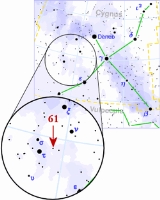
 can find 61 Cygni two binocular fields south-east of the bright star Deneb
Deneb

Deneb is the brightest star in the constellation Cygnus and one of the vertices of the Summer Triangle. It is the 19th list of brightest stars, with an apparent magnitude of 1.25....
. The angular separation of the two stars is slightly greater than the angular size of Saturn
Saturn

Saturn is the sixth planet from the Sun and the second largest planet in the Solar System, after Jupiter. Saturn, along with Jupiter, Uranus and Neptune, is classified as a gas giant....
 (16–20″). So, under ideal seeing conditions, the binary system can be resolved by a telescope with a 6 mm aperture.Per the Rayleigh criterion
Angular resolution

Angular resolution describes the resolving power of any such as an Optical telescope or radio telescope, a microscope, a camera, or an eye....
:  mm.
This is well within the capability of a typical pair of binoculars.

Possible low-mass companions


On several occasions it has been claimed that 61 Cygni has unseen low-mass companions, planets or a brown dwarf
Brown dwarf

Brown dwarfs are sub-star objects with a mass below that necessary to maintain hydrogen-burning nuclear fusion reactions in their cores, as do stars on the main sequence, but which have fully convective surfaces and interiors, with no chemical differentiation by depth....
. Kaj Strand made the first such claim in 1942 using observations to detect tiny but systematic variations in the orbital motions of 61 Cygni A and B. These perturbations suggested that a third body was orbiting 61 Cygni A. In 1957 additional data allowed him to narrow his uncertainties, claiming that the object appeared to have about eight times the mass of Jupiter
Jupiter

Jupiter is the fifth planet from the Sun and the Solar system by size planet within the Solar System. It is two and a half times as massive as all of the other planets in our Solar System combined....
. With a calculated orbital period of 4.8 years, the estimated semi-major axis of 2.4 A.U. In 1977 Soviet astronomers at the Pulkovo Observatory
Pulkovo Observatory

The Pulkovo Astronomical Observatory , the principal astronomical observatory of the Russian Academy of Sciences, located 19 kilometre south of Saint Petersburg on Pulkovo Heights ....
 near Saint Petersburg
Saint Petersburg

Saint Petersburg is a types of inhabited localities in Russia and a federal subjects of Russia of Russia located on the Neva River at the head of the Gulf of Finland on the Baltic Sea....
 suggested that the system included three planets: two giant planets with six and twelve Jupiter masses around 61 Cyg A, and one giant planet with seven Jupiter masses around 61 cygni B. In 1978 Wulff Dieter Heintz suggested these claims were "spurious", having failed to detect any evidence of such motion down to six percent of the Sun's mass—equivalent to about 60 times the mass of Jupiter.

Because of the proximity of this system to the Sun, it is a frequent target of interest for astronomers. Both stars were selected by NASA
NASA

The National Aeronautics and Space Administration is an agency of the Federal government of the United States, responsible for the nation's public list of space agencies....
 as "Tier 1" targets for the proposed optical Space Interferometry Mission
Space Interferometry Mission

The Space Interferometry Mission, also known as SIM PlanetQuest, is a planned Space observatory being developed by the U.S. National Aeronautics and Space Administration , in conjunction with contractor Northrop Grumman....
. This mission is potentially capable of detecting planets with as little as 3 times the mass of the Earth at an orbital distance of 2 A.U. from the star. Measurements of this system have detected an excess of far infrared
Infrared

Infrared radiation is electromagnetic radiation whose wavelength is longer than that of visible light , but shorter than that of terahertz radiation and microwaves ....
 radiation, beyond what is emitted by the stars. Such an excess is sometimes associated with a disk of dust
Debris disk

A debris disk is a ring-shaped circumstellar disk of dust and debris in orbit around a star. Debris disks have been found around both evolved and young stars, as well as at least one debris disk in orbit around a neutron star....
, but in this case it lies sufficiently close to one or both of the stars that it has not yet been resolved with a telescope.

Since no certain planetary object has been detected around both the stars so far, McDonald Observatory
McDonald Observatory

The McDonald Observatory is located near the unincorporated area of Fort Davis, Texas in Jeff Davis County, Texas, Texas, United States. The facility is located on Mount Fowlkes and Mount Locke in the Davis Mountains of West Texas....
 team has set limits to the presence of one or more planets around 61 Cygni A and 61 Cygni B with masses between 0.07 and 2.4 Jupiter masses and average separations spanning between 0.05 and 5.2 A.U.

See also

  • List of nearest stars
    List of nearest stars

    This list of stars nearest to the Earth is ordered by increasing distance out to a maximum of 5 parsecs . Including the Solar System, there are currently 50 stellar systems known which may lie within this distance....
  • 61 Cygni in fiction — Stars and planetary systems in fiction


External links