
All Topics  
Stellar classification


   Email Print
   Bookmark   Link


Stellar classification


In astronomy
Astronomy

Astronomy is the science of Astronomical object and Phenomenon that originate outside the Earth's atmosphere . It is concerned with the evolution, physics, chemistry, meteorology, and motion of celestial objects, as well as the physical cosmology....
, stellar classification is a classification of stars based on its spectral
Spectrum

A spectrum is a condition that is not limited to a specific set of values but can vary infinitely within a Continuum . The word saw its first scientific use within the field of optics to describe the rainbow of colors in visible light when separated using a triangular prism ; it has since been applied by analogy to many fields other than op...
 characteristics. The spectral class of a star
Star

A star is a massive, luminous ball of Plasma that is held together by its own gravity. The nearest star to Earth is the Sun, which is the source of most of the energy on Earth....
, is a designation of a class to a star describing the ion
Ion

An ion is an atom or molecule which has lost or gained one or more electrons, giving it a positive or negative electrical charge. According to the Bohr_model this will be from or in the outer shield 'n'....
ization of its chromosphere
Chromosphere

The chromosphere is a thin layer of the Sun's celestial body's atmosphere just above the photosphere, roughly 2,000 kilometers deep. The chromosphere is more visually transparent than the photosphere....
, what atomic excitation
Excited state

Excitation is an elevation in energy level above an arbitrary baseline energy state. In physics there is a specific technical definition for energy level which is often associated with an atom being excited to an excited state....
s are most prominent in the light, giving an objective measure of the temperature in this chromosphere. Light
Light

Light, or visible light, is electromagnetic radiation of a wavelength that is Visible spectrum to the human eye , or up to 380?750 nm. In the broader field of physics, light is sometimes used to refer to electromagnetic radiation of all wavelengths, whether visible or not....
 from the star is analysed by splitting it up by a diffraction grating
Diffraction grating

In optics, a diffraction grating is an optical component with a regular pattern, which splits light into several beams travelling in different directions....
, subdividing the incoming photon
Photon

In physics, the photon is an elementary particle, the quantum of the electromagnetic field and the basic unit of light and all other forms of electromagnetic radiation....
s into a spectrum
Spectrum

A spectrum is a condition that is not limited to a specific set of values but can vary infinitely within a Continuum . The word saw its first scientific use within the field of optics to describe the rainbow of colors in visible light when separated using a triangular prism ; it has since been applied by analogy to many fields other than op...
 exhibiting a rainbow of colors interspersed by absorption lines
Spectral line

A spectral line is a dark or bright line in an otherwise uniform and continuous optical spectrum, resulting from an excess or deficiency of photons in a narrow frequency range, compared with the nearby frequencies....
, each line indicating a certain ion
Ion

An ion is an atom or molecule which has lost or gained one or more electrons, giving it a positive or negative electrical charge. According to the Bohr_model this will be from or in the outer shield 'n'....
 of a certain chemical element
Chemical element

A chemical element is a type of atom that is distinguished by its atomic number; that is, by the number of protons in its atomic nucleus. The term is also used to refer to a pure chemical Chemical substance composed of atoms with the same number of protons....
.


Discussion
Ask a question about 'Stellar classification'
Start a new discussion about 'Stellar classification'
Answer questions from other users
Full Discussion Forum


Encyclopedia


In astronomy
Astronomy

Astronomy is the science of Astronomical object and Phenomenon that originate outside the Earth's atmosphere . It is concerned with the evolution, physics, chemistry, meteorology, and motion of celestial objects, as well as the physical cosmology....
, stellar classification is a classification of stars based on its spectral
Spectrum

A spectrum is a condition that is not limited to a specific set of values but can vary infinitely within a Continuum . The word saw its first scientific use within the field of optics to describe the rainbow of colors in visible light when separated using a triangular prism ; it has since been applied by analogy to many fields other than op...
 characteristics. The spectral class of a star
Star

A star is a massive, luminous ball of Plasma that is held together by its own gravity. The nearest star to Earth is the Sun, which is the source of most of the energy on Earth....
, is a designation of a class to a star describing the ion
Ion

An ion is an atom or molecule which has lost or gained one or more electrons, giving it a positive or negative electrical charge. According to the Bohr_model this will be from or in the outer shield 'n'....
ization of its chromosphere
Chromosphere

The chromosphere is a thin layer of the Sun's celestial body's atmosphere just above the photosphere, roughly 2,000 kilometers deep. The chromosphere is more visually transparent than the photosphere....
, what atomic excitation
Excited state

Excitation is an elevation in energy level above an arbitrary baseline energy state. In physics there is a specific technical definition for energy level which is often associated with an atom being excited to an excited state....
s are most prominent in the light, giving an objective measure of the temperature in this chromosphere. Light
Light

Light, or visible light, is electromagnetic radiation of a wavelength that is Visible spectrum to the human eye , or up to 380?750 nm. In the broader field of physics, light is sometimes used to refer to electromagnetic radiation of all wavelengths, whether visible or not....
 from the star is analysed by splitting it up by a diffraction grating
Diffraction grating

In optics, a diffraction grating is an optical component with a regular pattern, which splits light into several beams travelling in different directions....
, subdividing the incoming photon
Photon

In physics, the photon is an elementary particle, the quantum of the electromagnetic field and the basic unit of light and all other forms of electromagnetic radiation....
s into a spectrum
Spectrum

A spectrum is a condition that is not limited to a specific set of values but can vary infinitely within a Continuum . The word saw its first scientific use within the field of optics to describe the rainbow of colors in visible light when separated using a triangular prism ; it has since been applied by analogy to many fields other than op...
 exhibiting a rainbow of colors interspersed by absorption lines
Spectral line

A spectral line is a dark or bright line in an otherwise uniform and continuous optical spectrum, resulting from an excess or deficiency of photons in a narrow frequency range, compared with the nearby frequencies....
, each line indicating a certain ion
Ion

An ion is an atom or molecule which has lost or gained one or more electrons, giving it a positive or negative electrical charge. According to the Bohr_model this will be from or in the outer shield 'n'....
 of a certain chemical element
Chemical element

A chemical element is a type of atom that is distinguished by its atomic number; that is, by the number of protons in its atomic nucleus. The term is also used to refer to a pure chemical Chemical substance composed of atoms with the same number of protons....
. The presence of a certain chemical element in such an absorption spectrum primarily indicates that the temperature conditions is suitable for a certain excitation of this element. If the star temperature have been determined by a majority of absorption lines, unusual absences or strengths of lines for a certain element may indicate an unusual chemical composition of the chromosphere.

Most stars are currently classified using the letters O, B, A, F, G, K and M, where O stars are the hottest and the letter sequence indicates successively cooler stars up to the coolest M class. According to an informal tradition, O stars are "blue", A stars "white", G stars "yellow" and M stars "red", even though the actual star colors perceived by an observer may deviate from these colors depending on visual conditions and individual stars observed. This non-alphabetical scheme has been developed from an earlier scheme using all letters from A to O, but the star classes were reordered to the current one when the connection to the stars temperature became clarified, and a few star classes were omitted as duplicate of others. (The mnemonic "Oh, be a fine girl, kiss me" is sometimes used.)

In current star classification system, the Morgan-Keenan-system, the spectrum letter is enhanced by a number from 0 to 9 indicating tenths of the range between two star classes, so that A5 is five tenths between A0 and F0, but A2 is two tenths of the full range from A0 to F0. Another dimension that is included in the Morgan-Keenan-system is the luminosity class expressed by the Roman numbers
Roman numerals

Roman numerals are a numeral system of ancient Rome based on letters of the alphabet, which are combined to signify the sum of their values. The system is decimal but not directly Positional notation and does not include a zero....
 I, II, III, IV and V, expressing the width of certain absorption lines in the star's spectrum. It has been shown that this feature is a general measure of the size of the star, and thus of the total luminosity output from the star. Class I are generally called supergiants, class III simply giants and class V either dwarfs or more properly main sequence stars. For example our Sun
Sun

The Sun , a G V star, is the star at the center of the Solar System. The Earth and other matter orbit the Sun, which by itself accounts for about 98.6% of the Solar System's mass....
 has the spectral type G2V, which might be interpreted as "a 'yellow' two tenths towards 'orange' main sequence star". The apparently brightest star Sirius
Sirius

Sirius is the list of brightest stars in the night sky with a visual apparent magnitude of −1.46, almost twice as bright as Canopus, the next brightest star....
 has type A1V.

Secchi classes

During the 1860s and 1870s, pioneering stellar spectroscopist Father Angelo Secchi
Angelo Secchi

Father Pietro Angelo Secchi Society of Jesus was an Italy astronomy. He was Director of the Observatory at the Pontifical Gregorian University for 28 years....
 created the Secchi classes in order to classify observed spectra. By 1866, he had developed three classes of stellar spectra:
  • Class I: white and blue stars with broad heavy hydrogen line
    Hydrogen line

    The hydrogen line, 21 centimeter line or HI line refers to the spectral line created by changes in the energy state of neutral hydrogen and occurs at a frequency of 1420.40575 Megahertz, equivalent to a Wavelength#In_non-vacuum_media of around 21 centimetre....
    s, such as Vega
    Vega

    Vega is the brightest star in the constellation Lyra, the list of brightest stars in the night sky and the second brightest star in the northern Celestial sphere, after Arcturus....
     and Altair
    Altair

    Altair is the brightest star in the constellation Aquila and the list of brightest stars in the night sky. It is an Stellar classification#Class A main sequence star with an apparent visual magnitude of 0.77 and is one of the vertices of the Summer Triangle; the other two are Deneb and Vega....
    . This includes the modern class A and early class F.
    Class I, Orion subtype: a subtype of class I with narrow lines in place of wide bands, such as Rigel
    Rigel

    Rigel is the brightest star in the constellation Orion and the list of brightest stars in the sky, with visual magnitude 0.18. Although it has the Bayer designation "beta", it is almost always brighter than Alpha Orionis ....
     and ? Orionis. In modern terms, this corresponds to early B-type stars.
  • Class II: yellow stars—hydrogen less strong, but evident metallic lines, such as the Sun
    Sun

    The Sun , a G V star, is the star at the center of the Solar System. The Earth and other matter orbit the Sun, which by itself accounts for about 98.6% of the Solar System's mass....
    , Arcturus
    Arcturus

    |- bgcolor="#FFFAFA"| note : || H and K emission vary.Arcturus is the brightest star in the constellation Bo?tes. With a visual magnitude of -0.05, it is also the list of brightest stars in the night sky, after Sirius and Canopus ....
     and Capella
    Capella (star)

    Capella is the brightest star in the constellation Auriga , the list of brightest stars in the night sky and the third brightest star in the northern Celestial sphere, after Arcturus and Vega....
    . This includes the modern classes G and K as well as late class F.
  • Class III: orange to red stars with complex band spectra, such as Betelgeuse
    Betelgeuse

    Betelgeuse is a semiregular variable star located approximately 600 light-years away from Earth. It is the second brightest star in the constellation Orion and the ninth list of brightest stars in the night sky....
     and Antares
    Antares

    Antares is a red supergiant star in the Milky Way galaxy and list of brightest stars in the nighttime sky . Along with Aldebaran, Spica, and Regulus it is one of the four brightest stars near the ecliptic....
    . This corresponds to the modern class M.
In 1868, he discovered carbon star
Carbon star

A carbon star is a late type giant star similar to a red giant whose atmosphere contains more carbon than oxygen; the two elements combine in the upper layers of the star, forming carbon monoxide, which consumes all the oxygen in the atmosphere, leaving carbon atoms free to form other carbon compounds, giving the star a "sooty" atmosphere an...
s, which he put into a distinct group:
  • Class IV: red stars with significant carbon
    Carbon

    Carbon is a chemical element with chemical symbol C and atomic number 6. As a member of group 14 on the periodic table, it is nonmetallic and tetravalence?making four electrons available to form covalent bond chemical bonds....
     bands and lines (carbon stars.)
In 1877, he added a fifth class:
  • Class V: emission-line stars, such as ? Cassiopeiae and ß Lyrae.
In the late 1890s, this classification began to be superseded by the Harvard classification, which is discussed in the remainder of this article.

Harvard spectral classification

The Harvard classification system is a one-dimensional classification scheme. Physically, the classes indicate the temperature of the star's atmosphere and are normally listed from hottest to coldest, as is done in the following table:
Class Temperature
(Kelvin
Kelvin

The kelvin is a Units of measurement of temperature and is one of the seven SI base units. The Kelvin scale is a Thermodynamic temperature scale where absolute zero, the theoretical absence of all thermal energy, is zero ....
)
Conventional color Apparent color Mass
(solar masses)
Radius
(solar radii)
Luminosity
(bolometric)
Hydrogen
lines
Fraction of all
main sequence stars
O = 30,000 K blue blue = 16 M
Solar mass

The solar mass is a standard way to express mass in astronomy, used to describe the masses of other stars and galaxy. It is equal to the mass of the Sun, about two Names of large numbers kilograms or about 332,950 times the mass of the Earth, or 1,048 times the mass of Jupiter....
= 6.6 R
Solar radius

In astronomy, the solar radius is a unit of length used to express the size of stars. It is equal to the current radius of the Sun. Its value is:...
= 30,000 L
Solar luminosity

The solar luminosity, , is a unit of luminosity conventionally used by astronomers to give the luminosities of stars.It is equal to the current accepted luminosity of the Sun, which is 3.839 × 1026 Watt, or 3.839 × 1033erg/s....
Weak ~0.00003%
B 10,000–30,000 K blue to blue white blue white 2.1–16 M
Solar mass

The solar mass is a standard way to express mass in astronomy, used to describe the masses of other stars and galaxy. It is equal to the mass of the Sun, about two Names of large numbers kilograms or about 332,950 times the mass of the Earth, or 1,048 times the mass of Jupiter....
1.8–6.6 R
Solar radius

In astronomy, the solar radius is a unit of length used to express the size of stars. It is equal to the current radius of the Sun. Its value is:...
25–30,000 L
Solar luminosity

The solar luminosity, , is a unit of luminosity conventionally used by astronomers to give the luminosities of stars.It is equal to the current accepted luminosity of the Sun, which is 3.839 × 1026 Watt, or 3.839 × 1033erg/s....
Medium 0.13%
A 7,500–10,000 K white white to blue white 1.4–2.1 M
Solar mass

The solar mass is a standard way to express mass in astronomy, used to describe the masses of other stars and galaxy. It is equal to the mass of the Sun, about two Names of large numbers kilograms or about 332,950 times the mass of the Earth, or 1,048 times the mass of Jupiter....
1.4–1.8 R
Solar radius

In astronomy, the solar radius is a unit of length used to express the size of stars. It is equal to the current radius of the Sun. Its value is:...
5–25 L
Solar luminosity

The solar luminosity, , is a unit of luminosity conventionally used by astronomers to give the luminosities of stars.It is equal to the current accepted luminosity of the Sun, which is 3.839 × 1026 Watt, or 3.839 × 1033erg/s....
Strong
Strong (relative detectability)

In the contexts of signal and perception in science and technology, but also more generally, strong means intense, either relative to other signals of similar kind, or relative to the detection threshold of the measuring or observing system....
0.6%
F 6,000–7,500 K yellowish white white 1.04–1.4 M
Solar mass

The solar mass is a standard way to express mass in astronomy, used to describe the masses of other stars and galaxy. It is equal to the mass of the Sun, about two Names of large numbers kilograms or about 332,950 times the mass of the Earth, or 1,048 times the mass of Jupiter....
1.15–1.4 R
Solar radius

In astronomy, the solar radius is a unit of length used to express the size of stars. It is equal to the current radius of the Sun. Its value is:...
1.5–5 L
Solar luminosity

The solar luminosity, , is a unit of luminosity conventionally used by astronomers to give the luminosities of stars.It is equal to the current accepted luminosity of the Sun, which is 3.839 × 1026 Watt, or 3.839 × 1033erg/s....
Medium 3%
G 5,200–6,000 K yellow yellowish white 0.8–1.04 M
Solar mass

The solar mass is a standard way to express mass in astronomy, used to describe the masses of other stars and galaxy. It is equal to the mass of the Sun, about two Names of large numbers kilograms or about 332,950 times the mass of the Earth, or 1,048 times the mass of Jupiter....
0.96–1.15 R
Solar radius

In astronomy, the solar radius is a unit of length used to express the size of stars. It is equal to the current radius of the Sun. Its value is:...
0.6–1.5 L
Solar luminosity

The solar luminosity, , is a unit of luminosity conventionally used by astronomers to give the luminosities of stars.It is equal to the current accepted luminosity of the Sun, which is 3.839 × 1026 Watt, or 3.839 × 1033erg/s....
Weak 7.6%
K 3,700–5,200 K orange yellow orange 0.45–0.8 M
Solar mass

The solar mass is a standard way to express mass in astronomy, used to describe the masses of other stars and galaxy. It is equal to the mass of the Sun, about two Names of large numbers kilograms or about 332,950 times the mass of the Earth, or 1,048 times the mass of Jupiter....
0.7–0.96 R
Solar radius

In astronomy, the solar radius is a unit of length used to express the size of stars. It is equal to the current radius of the Sun. Its value is:...
0.08–0.6 L
Solar luminosity

The solar luminosity, , is a unit of luminosity conventionally used by astronomers to give the luminosities of stars.It is equal to the current accepted luminosity of the Sun, which is 3.839 × 1026 Watt, or 3.839 × 1033erg/s....
Very weak 12.1%
M = 3,700 K red orange red = 0.45 M
Solar mass

The solar mass is a standard way to express mass in astronomy, used to describe the masses of other stars and galaxy. It is equal to the mass of the Sun, about two Names of large numbers kilograms or about 332,950 times the mass of the Earth, or 1,048 times the mass of Jupiter....
= 0.7 R
Solar radius

In astronomy, the solar radius is a unit of length used to express the size of stars. It is equal to the current radius of the Sun. Its value is:...
= 0.08 L
Solar luminosity

The solar luminosity, , is a unit of luminosity conventionally used by astronomers to give the luminosities of stars.It is equal to the current accepted luminosity of the Sun, which is 3.839 × 1026 Watt, or 3.839 × 1033erg/s....
Very weak 76.45%


The mass, radius, and luminosity listed for each class are appropriate only for stars on the main sequence
Main sequence

The main sequence is a continuous and distinctive band of stars that appear on plots of stellar Color index versus brightness. These color-absolute magnitude plots are known as Hertzsprung-Russell diagrams after their co-developers, Ejnar Hertzsprung and Henry Norris Russell....
 portion of their lives and so are not appropriate for red giants. A popular mnemonic
Mnemonic

A mnemonic device is a memory aid. Commonly met mnemonics are often verbal, something such as a very short poem or a special word used to help a person remember something, particularly lists, but may be visual, kinesthetic or auditory....
 for remembering the order is "Oh Be A Fine Girl/Guy, Kiss Me" (there are many variants of this mnemonic). The spectral classes O through M are subdivided by Arabic numerals
Arabic numerals

The 'arabic numerals', or 'Hindu numerals' are the ten digits , which?along with Decimal Number System by which a sequence was read as a number?were originally defined by Indian mathematics, later modified and transferred to North African Islamic mathematics and transmitted to Europe in the Middle Ages, whence they spread around the wo...
 (0–9). For example, A0 denotes the hottest stars in the A class and A9 denotes the coolest ones. The Sun is classified as G2.

Classifications in the Draper Catalogue of Stellar Spectra
Secchi Draper Comment
I A, B, C, D Hydrogen lines dominant.
II E, F, G, H, I, K, L
III M
IV N Did not appear in the catalogue.
  O Wolf-Rayet spectra with bright lines.
  P Planetary nebulae.
  Q Other spectra.
The reason for the odd arrangement of letters is historical. An early classification of spectra by Angelo Secchi in the 1860s divided stars into those with prominent lines from the hydrogen
Hydrogen

Hydrogen is the chemical element with atomic number 1. It is represented by the chemical symbol H. At standard temperature and pressure, hydrogen is a colorless, odorless, nonmetallic, tasteless, highly combustion and explosive Diatomic molecule gas with the molecular formula H2....
 Balmer series
Balmer series

The Balmer series or Balmer lines in atomic physics, is the designation of one of a set of six different named series describing the spectral line emissions of the hydrogen atom....
 (group I, with a subtype representing many of the stars in Orion
Orion (constellation)

Orion , often referred to as "The Hunter," is a prominent constellation ? one of the largest, most conspicuous, and most recognizable in the night sky....
); those with spectra which, like the Sun, showed calcium
Calcium

Calcium is the chemical element with the symbol Ca and atomic number 20. It has an atomic mass of 40.078 amu. Calcium is a soft grey alkaline earth metal, and is the fifth most abundant element by mass in the earth's Crust ....
 and sodium
Sodium

Sodium is an element which has the symbol Na , atomic number 11, atomic mass 23 amu , and a common oxidation number +1. Sodium is a soft, silvery white, highly reactive element and is a member of the alkali metals within "group 1" ....
 lines (group II); colored stars whose spectra showed wide bands (group III); and carbon stars (group IV). In the 1880s, the astronomer Edward C. Pickering began to make a survey of stellar spectra at the Harvard College Observatory
Harvard College Observatory

The Harvard College Observatory is an institution managing a complex of buildings and multiple instruments used for astronomy research by the Harvard University Department of Astronomy....
, using the objective-prism method. A first result of this work was the Draper Catalogue of Stellar Spectra, published in 1890. Williamina Fleming
Williamina Fleming

Williamina Paton Stevens Fleming , astronomer, was born in Dundee, Scotland, to Robert Stevens and Mary Walker Stevens. She attended public schools in Dundee, and at the age of 14, she became a pupil-teacher....
 classified most of the spectra in this catalogue. It used a scheme in which the previously used Secchi classes (I to IV) were divided into more specific classes, given letters from A to N. Also, the letters O, P and Q were used, O for stars whose spectra consisted mainly of bright lines, P for planetary nebulae, and Q for stars not fitting into any other class.

In 1897, another worker at Harvard, Antonia Maury
Antonia Maury

Antonia Caetana de Paiva Pereira Maury was an United States astronomer who published an important early catalog of stellar spectra....
, placed the Orion subtype of Secchi class I ahead of the remainder of Secchi class I, thus placing the modern type B ahead of the modern type A. She was the first to do so, although she did not use lettered spectral types, but rather a series of 22 types numbered from I to XXII. In 1901, Annie Jump Cannon
Annie Jump Cannon

Annie Jump Cannon was an United States astronomer whose cataloging work was instrumental in the development of contemporary stellar classification....
 returned to the lettered types, but dropped all letters except O, B, A, F, G, K, and M, used in that order, as well as P for planetary nebulae and Q for some peculiar spectra. She also used types such as B5A for stars halfway between types B and A, F2G for stars one-fifth of the way from F to G, and so forth. Finally, by 1912, Cannon had changed the types B, A, B5A, F2G, etc. to B0, A0, B5, F2, etc. This is essentially the modern form of the Harvard classification system.

The fact that the Harvard classification of a star indicated its surface temperature
Temperature

In physics, temperature is a physical property of a Physical system that underlies the common notions of hot and cold; something that feels hotter generally has the greater temperature....
 was not fully understood until after its development. In the 1920s, the Indian physicist Megh Nad Saha derived a theory of ionization by extending well-known ideas in physical chemistry pertaining to the dissociation of molecules to the ionization of atoms. First applied to the solar chromosphere, he then applied it to stellar spectra. The Harvard astronomer Cecilia Helena Payne (later to become Cecilia Payne-Gaposchkin
Cecilia Payne-Gaposchkin

Cecilia Payne-Gaposchkin was an England-United States astronomer who in 1925 was first to show that the Sun is mainly composed of hydrogen, contradicting accepted wisdom at the time....
) then demonstrated that the OBAFGKM spectral sequence is actually a sequence in temperature. Because the classification sequence predates our understanding that it is a temperature sequence, the placement of a spectrum into a given subtype, such as B3 or A7, depends upon (largely subjective) estimates of the strengths of absorption features in stellar spectra. As a result, these subtypes are not evenly divided into any sort of mathematically representable intervals.

O, B, and A stars are sometimes misleadingly called "early type", while K and M stars are said to be "late type". This stems from a early 20th century model of stellar evolution in which stars were powered by gravitational contraction via the Kelvin–Helmholtz mechanism in which stars start their lives as very hot "early type" stars, and then gradually cool down, thereby evolving into "late type" stars. This mechanism provided ages of the sun that were much smaller than what is observed, and was rendered obsolete by the discovery that stars are powered by nuclear fusion
Nuclear fusion

In nuclear physics and nuclear chemistry, nuclear fusion is the process by which multiple like-charged atomic nuclei join together to form a heavier nucleus....
. However, brown dwarfs, whose energy comes from gravitational attraction alone, cool as they age and so progress to later spectral types. The highest mass brown dwarfs start their lives with M-type spectra and will cool through the L, T, and Y spectral classes.

Conventional and apparent colors

The conventional color descriptions are traditional in astronomy, and represent colors relative to the mean color of an A class star which is considered to be white. The Apparent color descriptions is what the observer would see if trying to describe the stars under a dark sky without aid to the eye, or with binoculars. The table colors used are D65 standard colors, which is what you would see if the star light would be intensely magnified and projected onto a white paper, then observed in ordinary daylight. Most stars in the sky, except the brightest ones, appear white or bluish white to the unaided eye because they are too dim for color vision to work.

Our Sun itself is white. It is sometimes called a yellow star (spectroscopically, relative to Vega), and may appear yellow or red (viewed through the atmosphere), or appear white (viewed when too bright for the eye to see any color). Astronomy images often use a variety of exaggerated colors (partially founded in faint light conditions observations, partially in conventions). But the Sun's own intrinsic color is white (aside from sunspots), with no trace of color, and closely approximates a black body
Black body

In physics, a black body is an Physical body that absorbs all electromagnetic radiation that falls on it. No electromagnetic radiation passes through it and none is Reflection ....
 of 5780 K
Kelvin

The kelvin is a Units of measurement of temperature and is one of the seven SI base units. The Kelvin scale is a Thermodynamic temperature scale where absolute zero, the theoretical absence of all thermal energy, is zero ....
 (see color temperature
Color temperature

Color temperature is a characteristic of visible light that has important applications in lighting, photography, videography, publishing, and other fields....
). This is a natural consequence of the evolution of our optical senses: the response curve that maximizes the overall efficiency against solar illumination will by definition perceive the Sun as white. The sun is known as a G type star.

Yerkes spectral classification


The Yerkes spectral classification, also called the MKK system from the authors' initials, is a system of stellar spectral classification introduced in 1943 by William Wilson Morgan
William Wilson Morgan

William Wilson Morgan was an United States astronomer.The principal theme in Morgan's work was the study of stellar and galaxy Categorization....
, Phillip C. Keenan and Edith Kellman from Yerkes Observatory
Yerkes Observatory

Yerkes Observatory, which calls itself "the birthplace of modern astrophysics,", is an Observatory#Astronomical_observatories operated by the University of Chicago in Williams Bay, Wisconsin....
. This two-dimensional (temperature
Temperature

In physics, temperature is a physical property of a Physical system that underlies the common notions of hot and cold; something that feels hotter generally has the greater temperature....
 and luminosity
Luminosity

Luminosity has different meanings in several different fields of science....
) classification scheme is based on spectral line
Spectral line

A spectral line is a dark or bright line in an otherwise uniform and continuous optical spectrum, resulting from an excess or deficiency of photons in a narrow frequency range, compared with the nearby frequencies....
s sensitive to stellar temperature and surface gravity which is related to luminosity (whilst the Harvard classification is based on surface temperature only!). Later, in 1953, after some revisions of list of standard stars and classification criteria, the scheme was named MK (by William Wilson Morgan and Phillip C. Keenan initials).

Since the radius of a giant star
Giant star

A giant star is a star with substantially larger radius and luminosity than a main sequence star of the same effective temperature. Typically, giant stars have radii between 10 and 100 solar radii and luminosities between 10 and 1,000 times that of the Sun....
 is much larger than a dwarf star
Dwarf star

The term dwarf star refers to a variety of distinct classes of stars.* Dwarf star alone generally refers to any main sequence star, a star of Stellar classification#Yerkes spectral classification V....
 while their masses are roughly comparable, the gravity and thus the gas density and pressure on the surface of a giant star are much lower than for a dwarf. These differences manifest themselves in the form of luminosity effects which affect both the width and the intensity of spectral lines which can then be measured. Denser stars with higher surface gravity will exhibit greater pressure broadening of spectral lines.

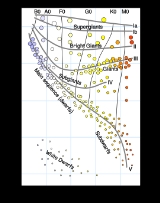
A number of different luminosity classes are distinguished:
  • I supergiant
    Supergiant

    Supergiants are among the most massive stars. In the Hertzsprung-Russell diagram they occupy the top region of the diagram. In the spectral classification supergiants are class Ia or Ib ....
    s
    • Ia-0 (hypergiant
      Hypergiant

      A hypergiant is a star with a tremendous mass and luminosity, showing signs of a very high rate of mass loss....
      s or extremely luminous supergiant
      Supergiant

      Supergiants are among the most massive stars. In the Hertzsprung-Russell diagram they occupy the top region of the diagram. In the spectral classification supergiants are class Ia or Ib ....
      s (later addition)), Example: Eta Carinae
      Eta Carinae

      Eta Carinae is a hypergiant luminous blue variable star in the Carina . Its luminosity is about four million times that of the Sun and, with an estimated mass of between 100 and 150 solar masses, it is one of the most massive stars yet discovered....
       (spectrum-peculiar)
    • Ia (luminous supergiants), Example: Deneb
      Deneb

      Deneb is the brightest star in the constellation Cygnus and one of the vertices of the Summer Triangle. It is the 19th list of brightest stars, with an apparent magnitude of 1.25....
       (spectrum is A2Ia)
    • Iab (intermediate luminous supergiants)
    • Ib (less luminous supergiants), Example: Betelgeuse
      Betelgeuse

      Betelgeuse is a semiregular variable star located approximately 600 light-years away from Earth. It is the second brightest star in the constellation Orion and the ninth list of brightest stars in the night sky....
       (spectrum is M2Ib)
  • II bright giant
    Bright giant

    The luminosity class II in the Spectral classification#Yerkes spectral classification is given to bright giants. These are stars which straddle the boundary between giant star and supergiants, and the classification is in general given to giant stars with exceptionally high luminosity, but which are not sufficiently bright or massive t...
    s
    • IIa, Example: ß Scuti
      Beta Scuti

      Beta Scuti is a binary star in the constellation Scutum. It is approximately 690 light years from Earth.The primary component, Beta Scuti is a yellow stellar classification bright giant with an apparent magnitude of +4.22....
       (HD 173764) (spectrum is G4 IIa)
    • IIab Example: HR 8752 (spectrum is G0Iab:)
    • IIb, Example: HR 6902 (spectrum is G9 IIb)
  • III normal giant
    Giant star

    A giant star is a star with substantially larger radius and luminosity than a main sequence star of the same effective temperature. Typically, giant stars have radii between 10 and 100 solar radii and luminosities between 10 and 1,000 times that of the Sun....
    s
    • IIIa, Example: ? Persei
      Rho Persei

      Rho Persei is a star in the constellation Perseus . It also has the traditional name Gorgonea Tertia.Rho Persei is a semiregular variable star of the Mu Cephei type, whose apparent magnitude varies between 3.3 and 4.0 with periods of 50 days and 1100 days....
       (spectrum is M4 IIIa)
    • IIIab Example: d Reticuli (spectrum is M2 IIIab)
    • IIIb, Example: Pollux (spectrum is K2 IIIb)
  • IV subgiant
    Subgiant star

    Subgiant star is a spectral classification of stars that are slightly brighter than normal main sequence stars of the same spectral class, but not as bright as true giant stars....
    s
    • IVa, Example: e Reticuli
      Epsilon Reticuli

      Epsilon Reticuli is a binary star approximately 59 light-years away in the constellation of Reticulum. The primary star is an subgiant star, while the secondary star is a white dwarf star....
       (spectrum is K1-2 IVa-III)
    • IVb, Example: HR 672 A (spectrum is G0.5 IVb)
  • V main sequence
    Main sequence

    The main sequence is a continuous and distinctive band of stars that appear on plots of stellar Color index versus brightness. These color-absolute magnitude plots are known as Hertzsprung-Russell diagrams after their co-developers, Ejnar Hertzsprung and Henry Norris Russell....
     stars (dwarfs)
    • Va, Example: AD Leonis (spectrum M4Vae)
    • Vb, Example: 85 Pegasi A (spectrum G5 Vb)
  • VI subdwarf
    Subdwarf star

    A subdwarf star, sometimes denoted by "sd", is luminosity class VI under the stellar classification#Yerkes spectral classification system. They are defined as stars with luminosity 1.5 to 2 Absolute magnitude lower than that of main-sequence stars of the same spectral type....
    s (rarely used)
  • VII white dwarf
    White dwarf

    A white dwarf, also called a degenerate dwarf, is a small star composed mostly of electron-degenerate matter. Because a white dwarf's mass is comparable to that of the Sun and its volume is comparable to that of the Earth, it is very density....
    s (rarely used)


Marginal cases are allowed; for instance a star classified as Ia0-Ia would be a very luminous supergiant, verging on hypergiant. Examples are below. The spectral type of the star is not a factor.

Marginal Symbols Example Explanation
-G2 I-IIThe star is between super giant and bright giant.
+O9.5 Ia+The star is a hypergiant star.
/M2 IV/VThe star is either a subgiant or a dwarf star.


Spectral types

The following illustration represents star classes with the colors very close to those actually perceived by the human eye. The relative sizes are for main sequence
Main sequence

The main sequence is a continuous and distinctive band of stars that appear on plots of stellar Color index versus brightness. These color-absolute magnitude plots are known as Hertzsprung-Russell diagrams after their co-developers, Ejnar Hertzsprung and Henry Norris Russell....
 or "dwarf" stars.
Morgan Keenan Spectral Classification

Class O

Class O stars are very hot and very luminous, being bluish in color; in fact, most of their output is in the ultraviolet
Ultraviolet

Ultraviolet light is electromagnetic radiation with a wavelength shorter than that of visible light, but longer than x-rays, in the range 400 nanometer to 10 nm, and energies from 3 Electron volt to 124 eV....
 range. These are the rarest of all main sequence stars. About 1 in 3,000,000 of the main sequence stars in the solar neighborhood are Class O stars.These proportions are fractions of stars brighter than absolute magnitude 16; lowering this limit will render earlier types even rarer while generally adding only to the M class. Some of the most massive stars
List of most massive stars

This is a list of the most massive stars. The list is ordered by solar mass .Stellar mass is an important attribute of a star. Combined with chemical compositions, mass determines a star?s luminosity, its physical size, and its ultimate fate....
 lie within this spectral class. Type-O stars are so hot as to have complicated surroundings which make measurement of their spectra difficult.

O-stars shine with a power over a million times our Sun's output. These stars have dominant lines of absorption and sometimes emission for He
Helium

Helium is a colorless, odorless, tasteless, non-toxic, inert monatomic chemical element that heads the noble gas group in the periodic table and whose atomic number is 2....
 II lines, prominent ionized (Si
Silicon

Silicon is the most common metalloid. It is a chemical element, which has the symbol Si and atomic number 14. The atomic mass is 28.0855....
 IV, O
Oxygen

Oxygen no O2 produced; 2) O2 produced, but absorbed in oceans & seabed rock; 3) O2 starts to gas out of the oceans, but is absorbed by land surfaces and formation of ozone layer; 4-5) O2 sinks filled and the gas accumulates]]...
 III, N
Nitrogen

Nitrogen is a chemical element that has the symbol N and atomic number 7 and atomic mass 14.00674?. Elemental nitrogen is a colorless, odorless, tasteless and mostly inert diatomic gas at standard conditions, constituting 78% by volume of Earth's atmosphere....
 III, and C
Carbon

Carbon is a chemical element with chemical symbol C and atomic number 6. As a member of group 14 on the periodic table, it is nonmetallic and tetravalence?making four electrons available to form covalent bond chemical bonds....
 III) and neutral helium
Helium

Helium is a colorless, odorless, tasteless, non-toxic, inert monatomic chemical element that heads the noble gas group in the periodic table and whose atomic number is 2....
 lines, strengthening from O5 to O9, and prominent hydrogen Balmer lines, although not as strong as in later types. Because they are so massive, class O stars have very hot cores, thus burn through their hydrogen fuel very quickly, and so are the first stars to leave the main sequence
Main sequence

The main sequence is a continuous and distinctive band of stars that appear on plots of stellar Color index versus brightness. These color-absolute magnitude plots are known as Hertzsprung-Russell diagrams after their co-developers, Ejnar Hertzsprung and Henry Norris Russell....
. Recent observations by the Spitzer Space Telescope
Spitzer Space Telescope

The Spitzer Space Telescope is an infrared space observatory. It is the fourth and final of NASA's Great Observatories program.The planned nominal mission period was to be 2.5 years with a pre-launch expectation that the mission could extend to five or slightly more years until the onboard liquid helium supply was exhausted....
 indicate that planetary formation does not occur around other stars in the vicinity of an O class star due to the photoevaporation effect.

When the MKK classification scheme was first described in 1943, the only subtypes of class O used were O5 to O9.5. The MKK scheme was extended to O4 in 1978, and new classification schemes have subsequently been introduced which add types O2, O3 and O3.5.

Examples: Zeta Orionis
Zeta Orionis

Zeta Orionis , traditionally known as Alnitak , is a Multiple star some 800 light years distant in the constellation Orion . Together with Delta Orionis and Epsilon Orionis , the three stars make up the belt of Orion, known by many names across many ancient cultures....
, Zeta Puppis
Zeta Puppis

Zeta Puppis is a star in the constellation of Puppis. It is also known by the traditional names Naos and Suhail Hadar, "bright star of the ground" in Arabic....
, Lambda Orionis
Lambda Orionis

Lambda Orionis is a star in the constellation Orion . It also has the traditional names Meissa or Heka. "Meissa" derives from the Arabic, "Al-Maisan" which means "The Shining One"....
, Delta Orionis
Delta Orionis

Delta Orionis , traditionally known as Mintaka , is a star some 900 light years distant in the constellation Orion . Together with Zeta Orionis and Epsilon Orionis , the three stars make up the belt of Orion, known by many names across many ancient cultures....


Class B

Pleiades Lanoue
Class B stars are extremely luminous and blue. Their spectra have neutral helium, which are most prominent at the B2 subclass, and moderate hydrogen lines. Ionized metal lines include Mg
Magnesium

Magnesium is a chemical element with the symbol Mg, atomic number 12, atomic weight 24.3050 and common oxidation number +2.Magnesium, an alkaline earth metal, is the ninth most abundance of the chemical elements in the universe by mass....
 II and Si
Silicon

Silicon is the most common metalloid. It is a chemical element, which has the symbol Si and atomic number 14. The atomic mass is 28.0855....
 II. As O and B stars
OB star

OB stars are hot, massive stars of spectral types Stellar classification#Class O or Stellar classification#Class B which form in loosely organized groups called OB associations....
 are so powerful, they only live for a very short time, and thus they do not stray far from the area in which they were formed. These stars tend to cluster together in what are called OB associations, which are associated with giant molecular cloud
Molecular cloud

A molecular cloud, sometimes called a stellar nursery if star formation is occurring within, is a type of interstellar cloud whose density and size permits the formation of molecules, most commonly molecular hydrogen ....
s. The Orion OB1 association occupies a large portion of a spiral arm of our galaxy
Milky Way

The Milky Way, sometimes called simply the Galaxy, is the galaxy in which the Solar System is located. It is a barred spiral galaxy that is part of the Local Group of galaxies....
 and contains many of the brighter stars of the constellation Orion. About 1 in 800 of the main sequence stars in the solar neighborhood are Class B stars..

Examples: Rigel
Rigel

Rigel is the brightest star in the constellation Orion and the list of brightest stars in the sky, with visual magnitude 0.18. Although it has the Bayer designation "beta", it is almost always brighter than Alpha Orionis ....
, Spica
Spica

Spica is the brightest star in the constellation Virgo , and the list of brightest stars in the nighttime sky. It is 260 light years distant from Earth....
, the brighter Pleiades
Pleiades (star cluster)

File:Pleiades Lanoue.pngIn astronomy, the Pleiades are an open star cluster in the constellation of Taurus . It is among the nearest star clusters to Earth, and Randall Munroe's favorite astronomical object....


Class A

Class A stars are amongst the more common naked eye stars, and are white or bluish-white. They have strong hydrogen lines, at a maximum by A0, and also lines of ionized metals (Fe
Iron

Iron is a chemical element with the symbol Fe and atomic number 26. Iron is a Group 8 element and period 4 element. Iron is lustrous and silvery in color....
 II, Mg
Magnesium

Magnesium is a chemical element with the symbol Mg, atomic number 12, atomic weight 24.3050 and common oxidation number +2.Magnesium, an alkaline earth metal, is the ninth most abundance of the chemical elements in the universe by mass....
 II, Si
Silicon

Silicon is the most common metalloid. It is a chemical element, which has the symbol Si and atomic number 14. The atomic mass is 28.0855....
 II) at a maximum at A5. The presence of Ca
Calcium

Calcium is the chemical element with the symbol Ca and atomic number 20. It has an atomic mass of 40.078 amu. Calcium is a soft grey alkaline earth metal, and is the fifth most abundant element by mass in the earth's Crust ....
 II lines is notably strengthening by this point. About 1 in 160 of the main sequence stars in the solar neighborhood are Class A stars.

Examples: Vega
Vega

Vega is the brightest star in the constellation Lyra, the list of brightest stars in the night sky and the second brightest star in the northern Celestial sphere, after Arcturus....
, Sirius
Sirius

Sirius is the list of brightest stars in the night sky with a visual apparent magnitude of −1.46, almost twice as bright as Canopus, the next brightest star....
, Deneb
Deneb

Deneb is the brightest star in the constellation Cygnus and one of the vertices of the Summer Triangle. It is the 19th list of brightest stars, with an apparent magnitude of 1.25....


Class F

Class F stars have strengthening H and K lines of Ca
Calcium

Calcium is the chemical element with the symbol Ca and atomic number 20. It has an atomic mass of 40.078 amu. Calcium is a soft grey alkaline earth metal, and is the fifth most abundant element by mass in the earth's Crust ....
 II. Neutral metals (Fe
Iron

Iron is a chemical element with the symbol Fe and atomic number 26. Iron is a Group 8 element and period 4 element. Iron is lustrous and silvery in color....
 I, Cr
Chromium

Chromium is a chemical element which has the symbol Cr and atomic number 24. It is a steely-gray, Lustre , hard metal that takes a high polish and has a high melting point....
 I) beginning to gain on ionized metal lines by late F. Their spectra are characterized by the weaker hydrogen lines and ionized metals. Their color is white. About 1 in 33 of the main sequence stars in the solar neighborhood are Class F stars.

Examples: Arrakis
Mu Draconis

Mu Draconis is a binary star in the constellation Draco . It is sometimes known by the traditional name Arrakis.Each component is of stellar classification F7V and visual magnitude 5.8....
, Canopus
Canopus

Canopus is the brightest star in the southern constellation of Carina , and the list of brightest stars in the night-time sky, after Sirius. Canopus's visual magnitude is −0.72, and it has an absolute magnitude of −5.53....
, Procyon
Procyon

Procyon is the brightest star in the constellation Canis Minor. To the naked eye, it appears to be a single star, the list of brightest stars in the night sky with a visual apparent magnitude of 0.34....


Class G

Sun920607
Class G stars are probably the best known, if only for the reason that our Sun
Sun

The Sun , a G V star, is the star at the center of the Solar System. The Earth and other matter orbit the Sun, which by itself accounts for about 98.6% of the Solar System's mass....
 is of this class. About 1 in 13 of the main sequence stars in the solar neighborhood are Class G stars.

Most notable are the H and K lines of Ca
Calcium

Calcium is the chemical element with the symbol Ca and atomic number 20. It has an atomic mass of 40.078 amu. Calcium is a soft grey alkaline earth metal, and is the fifth most abundant element by mass in the earth's Crust ....
 II, which are most prominent at G2. They have even weaker hydrogen lines than F, but along with the ionized metals, they have neutral metals. There is a prominent spike in the G band of CH molecules. G is host to the "Yellow Evolutionary Void". Supergiant stars often swing between O or B (blue) and K or M (red). While they do this, they do not stay for long in the G classification as this is an extremely unstable place for a supergiant to be.

Examples: The Sun
Sun

The Sun , a G V star, is the star at the center of the Solar System. The Earth and other matter orbit the Sun, which by itself accounts for about 98.6% of the Solar System's mass....
, Alpha Centauri A, Capella
Capella (star)

Capella is the brightest star in the constellation Auriga , the list of brightest stars in the night sky and the third brightest star in the northern Celestial sphere, after Arcturus and Vega....
, Tau Ceti
Tau Ceti

Tau Ceti is a star in the constellation Cetus that is similar to the Sun in mass and Stellar classification. At just under 12 light years' distance from the Solar System, it is a relatively close star....


Class K

Class K are orangish stars which are slightly cooler than our Sun. Some K stars are giants and supergiants, such as Arcturus
Arcturus

|- bgcolor="#FFFAFA"| note : || H and K emission vary.Arcturus is the brightest star in the constellation Bo?tes. With a visual magnitude of -0.05, it is also the list of brightest stars in the night sky, after Sirius and Canopus ....
, while others, like Alpha Centauri
Alpha Centauri

Alpha Centauri ; is the brightest star in the southern constellation of Centaurus and an established binary star system, Alpha Centauri AB ....
 B, are main sequence stars. They have extremely weak hydrogen lines, if they are present at all, and mostly neutral metals (Mn
Manganese

Manganese is a chemical element, designated by the symbol Mn. It has the atomic number 25. It is found as a Oxidation state in nature , and in many minerals....
 I, Fe
Iron

Iron is a chemical element with the symbol Fe and atomic number 26. Iron is a Group 8 element and period 4 element. Iron is lustrous and silvery in color....
 I, Si
Silicon

Silicon is the most common metalloid. It is a chemical element, which has the symbol Si and atomic number 14. The atomic mass is 28.0855....
 I). By late K, molecular bands of titanium oxide
Titanium oxide

Titanium oxide may refer to:* Titanium dioxide , TiO2* Titanium oxide , TiO, a non-stoichiometric oxide* Titanium oxide, Ti2O3...
 become present. About 1 in 8 of the main sequence stars in the solar neighborhood are Class K stars.

Examples: Alpha Centauri B, Epsilon Eridani
Epsilon Eridani

Epsilon Eridani is a main sequence star of stellar classification K2. Only 10.5 light years away, it is the closest star in the constellation Eridanus , as well as the third List of nearest stars visible to the naked eye....
, Arcturus
Arcturus

|- bgcolor="#FFFAFA"| note : || H and K emission vary.Arcturus is the brightest star in the constellation Bo?tes. With a visual magnitude of -0.05, it is also the list of brightest stars in the night sky, after Sirius and Canopus ....
, Aldebaran
Aldebaran

Aldebaran is the brightest star in the constellation Taurus and list of brightest stars in the nighttime sky. Because of its location in the head of Taurus, it has historically been called the Bull's Eye....


Class M

Betelgeuse Star (hubble)
Class M is by far the most common class. About 1 in 1.32 of the main sequence stars in the solar neighborhood are Class M stars. This rises to 78.6% if we include all stars. (See the above note.) Thus about 76% of the main sequence stars in the solar neighborhood are these Class M red dwarf
Red Dwarf

Red Dwarf is a United Kingdom science fiction television situation comedy Media franchise, primarily comprising eight series of a television sitcom that ran on BBC Two between 1988 and 1999 and gained a cult following....
 stars.

Class M is host to most giants and some supergiants such as Antares
Antares

Antares is a red supergiant star in the Milky Way galaxy and list of brightest stars in the nighttime sky . Along with Aldebaran, Spica, and Regulus it is one of the four brightest stars near the ecliptic....
 and Betelgeuse
Betelgeuse

Betelgeuse is a semiregular variable star located approximately 600 light-years away from Earth. It is the second brightest star in the constellation Orion and the ninth list of brightest stars in the night sky....
, as well as Mira
Mira

Mira, , also known as Omicron Ceti , is a red giant star estimated 200-400 light years away in the constellation Cetus. Mira is a binary star, consisting of the red giant Mira A along with Mira B....
 variables
Variable star

A star is classified as variable if its apparent magnitude as seen from Earth changes over time, whether the changes are due to variations in the star's actual luminosity, or to variations in the amount of the star's light that is blocked from reaching Earth....
. The late-M group holds hotter brown dwarf
Brown dwarf

Brown dwarfs are sub-star objects with a mass below that necessary to maintain hydrogen-burning nuclear fusion reactions in their cores, as do stars on the main sequence, but which have fully convective surfaces and interiors, with no chemical differentiation by depth....
s that are above the L spectrum. This is usually in the range of M6.5 to M9.5. The spectrum of an M star shows lines belonging to molecule
Molecule

In chemistry, a molecule is defined as a sufficiently stable, electric charge neutral group of at least two atoms in a definite arrangement held together by very strong chemical bonds....
s and all neutral metals but hydrogen lines are usually absent. Titanium oxide
Titanium oxide

Titanium oxide may refer to:* Titanium dioxide , TiO2* Titanium oxide , TiO, a non-stoichiometric oxide* Titanium oxide, Ti2O3...
 can be strong in M stars, usually dominating by about M5. Vanadium oxide
Vanadium oxide

Vanadium oxide may refer to:* Vanadium oxide , VO* Vanadium oxide , V2O3* Vanadium oxide , VO2* Vanadium oxide , V2O5...
 bands become present by late M.

Example: Betelgeuse
Betelgeuse

Betelgeuse is a semiregular variable star located approximately 600 light-years away from Earth. It is the second brightest star in the constellation Orion and the ninth list of brightest stars in the night sky....
 (supergiant
Supergiant

Supergiants are among the most massive stars. In the Hertzsprung-Russell diagram they occupy the top region of the diagram. In the spectral classification supergiants are class Ia or Ib ....
)
Examples: Proxima Centauri
Proxima Centauri

Proxima Centauri is a red dwarf star approximately 4.2 light-years distant in the constellation of Centaurus. It was discovered in 1915 by Robert Innes, the Director of the Union Observatory in South Africa....
, Barnard's star
Barnard's star

Barnard's Star , also known occasionally as Barnard's "Runaway" Star, is a very low-mass red dwarf star approximately 6 light-years away from Earth in the constellation of Ophiuchus ....
, Gliese 581
Gliese 581

Gliese 581 is a red dwarf star with stellar classification M3V, located 20.3 light years away from Earth. Its mass is estimated to be approximately a third that of the Sun, and it is the 87th closest known star system to the Sun....
 (red dwarf)
Example: LEHPM 2-59 (subdwarf)
Examples: Teide 1
Teide 1

Teide 1 was the first brown dwarf to be verified in 1995. This brown dwarf is located in Pleiades open star cluster located approximately 400 light years from Earth....
 (field brown dwarf), GSC 08047-00232 B (companion brown dwarf)


Extended spectral types

A number of new spectral types have been taken into use from newly discovered types of stars.

Hot blue emission star classes

Spectra of some very hot and bluish stars exhibit marked emission lines from carbon or nitrogen, or sometimes oxygen.

Class W: Wolf-Rayet

Wolf Rayet
Class W or WR represents the superluminous Wolf-Rayet stars, notably unusual since they have mostly helium in their atmospheres instead of hydrogen. They are thought to be dying supergiants with their hydrogen layer blown away by hot stellar wind
Stellar wind

A stellar wind is a flow of neutral or charged gas ejected from the celestial body atmosphere of a star. It is distinguished from the bipolar outflows characteristic of young stars by being less collimated, although stellar winds are not generally spherically symmetric....
s caused by their high temperatures, thereby directly exposing their hot helium shell. Class W is subdivided into subclasses WC (WCE early-type, WCL late-type), WN (WNE early-type, WNL late-type), and WO according to the dominance of carbon, nitrogen, or oxygen emission in their spectra (and outer layers).

  • W: Up to 70,000 K
Example: Gamma Velorum A
Gamma Velorum

Gamma Velorum is a star system in the constellation Vela . At apparent magnitude +1.7, it is list of brightest stars in the nighttime sky. It has the traditional names Suhail or Al Suhail al-Muhlif ....
 (WC)
Example: WR124 (WN)
Example: WR93B (WO)


Classes OC, ON, BC, BN: Wolf-Rayet related O and B stars
Intermediary between the genuine Wolf-Rayets and ordinary hot stars of classes O and early B, there are OC, ON, BC and BN stars. They seem to constitute a short continuum from the Wolf-Rayets into the ordinary OBs.

Example: HD 152249 (OC)
Example: HD 105056 (ON)
Example: HD 2905 (BC)
Example: HD 163181 (BN)


The "class" OB
In lists of spectra, the "spectrum OB" may occur. This is in fact not a spectrum, but a marker which means that "the spectrum of this star is unknown, but it belongs to an OB association
Stellar association

A stellar association is a very loose star cluster, looser than both open clusters and globular clusters. Stellar associations will normally contain from 10 to 100 or more stars....
, so probably either a class O or class B star, or perhaps a fairly hot class A star."


Cool red and brown dwarf classes

The novel spectral types L and T were created to classify infrared spectra of cool stars. This included both red dwarf
Red Dwarf

Red Dwarf is a United Kingdom science fiction television situation comedy Media franchise, primarily comprising eight series of a television sitcom that ran on BBC Two between 1988 and 1999 and gained a cult following....
s and brown dwarf
Brown dwarf

Brown dwarfs are sub-star objects with a mass below that necessary to maintain hydrogen-burning nuclear fusion reactions in their cores, as do stars on the main sequence, but which have fully convective surfaces and interiors, with no chemical differentiation by depth....
s which are very faint in the visual spectrum. The hypothetical spectral type Y has been reserved for objects cooler than T dwarfs which have spectra that are qualitatively distinct from T dwarfs.

Class L
Class L dwarfs get their designation because they are cooler than M stars and L is the remaining letter alphabetically closest to M. L does not mean lithium dwarf; a large fraction of these stars do not have lithium
Lithium

Lithium is a chemical element with the symbol Li and atomic number 3. It is a soft alkali metal with a silver-white color. Under standard conditions for temperature and pressure, it is the lightest metal and the least dense solid element....
 in their spectra. Some of these objects have mass large enough to support hydrogen fusion, but some are of substellar
Substellar object

A substellar object, sometimes called a substar, is an astronomical object whose mass is smaller than the smallest mass, approximately 0.08 solar masses, at which a star can sustain hydrogen fusion....
 mass and do not, so collectively these objects should be referred to as L dwarfs, not L stars. They are a very dark red in color and brightest in infrared
Infrared

Infrared radiation is electromagnetic radiation whose wavelength is longer than that of visible light , but shorter than that of terahertz radiation and microwaves ....
. Their atmosphere
Atmosphere

An atmosphere is a layer of gases that may surround a material body of sufficient mass, by the gravity of the body, and are retained for a longer duration if gravity is high and the atmosphere's temperature is low....
 is cool enough to allow metal hydrides and alkali metal
Alkali metal

The alkali metals are a chemical series of chemical elements comprising Periodic table group of the periodic table: lithium , sodium , potassium , rubidium , caesium , and francium ....
s to be prominent in their spectra. Due to low gravities in giant stars, TiO- and VO-bearing condensates never form. Thus, larger L-type stars can never form in an isolated environment. It may be possible for these L-type supergiants to form through stellar collisions, however, an example of which is V838 Monocerotis
V838 Monocerotis

V838 Monocerotis is a variable star star in the constellation Monoceros about 20,000 light years from the Sun. The star experienced a major outburst that was observed in early 2002....
.

  • L: 1,300–2,000 K, dwarfs (some stellar, some substellar) with metal hydrides and alkali metal
    Alkali metal

    The alkali metals are a chemical series of chemical elements comprising Periodic table group of the periodic table: lithium , sodium , potassium , rubidium , caesium , and francium ....
    s prominent in their spectra.
Example: VW Hyi
Example: 2MASSW J0746425+2000321 binary
Component A is an L dwarf star Component B is an L brown dwarf
Example: V838 Monocerotis
V838 Monocerotis

V838 Monocerotis is a variable star star in the constellation Monoceros about 20,000 light years from the Sun. The star experienced a major outburst that was observed in early 2002....
 (supergiants)


Class T: methane dwarfs
Class T dwarfs are cool brown dwarfs with surface temperatures of between approximately 700 and 1,300 K. Their emission peaks in the infrared
Infrared

Infrared radiation is electromagnetic radiation whose wavelength is longer than that of visible light , but shorter than that of terahertz radiation and microwaves ....
. Methane
Methane

Methane is a chemical compound with the molecular formula . It is the simplest alkane, and the principal component of natural gas. Methane's bond angles are 109.5 degrees....
 is prominent in their spectra.

  • T: ~700-1,300 K, cooler brown dwarf
    Brown dwarf

    Brown dwarfs are sub-star objects with a mass below that necessary to maintain hydrogen-burning nuclear fusion reactions in their cores, as do stars on the main sequence, but which have fully convective surfaces and interiors, with no chemical differentiation by depth....
    s with methane
    Methane

    Methane is a chemical compound with the molecular formula . It is the simplest alkane, and the principal component of natural gas. Methane's bond angles are 109.5 degrees....
     in the spectrum
Examples: SIMP 0136 (the brightest T dwarf discovered in northern hemisphere)
Examples: Epsilon Indi
Epsilon Indi

Epsilon Indi is an orange dwarf star approximately 12 light-years away in the constellation of Indus . As seen from Epsilon Indi, the Sun is a 2nd magnitude star in Ursa Major, near the bowl of the Big Dipper.From Epsilon Indi the Sun would appear on the diametrically opposite side of the sky at the coordinates RA=, Dec=...
 Ba & Epsilon Indi Bb


Class T and L could be more common than all the other classes combined if recent research is accurate. From studying the number of proplyd
Protoplanetary disk

A protoplanetary disk is a rotating circumstellar disk of dense gas surrounding a young newly formed star, a T Tauri star or Herbig Ae/Be stars....
s (protoplanetary discs, clumps of gas in nebula
Nebula

A nebula is an interstellar cloud of cosmic dust, hydrogen gas and Plasma . Originally nebula was a general name for any extended astronomy astronomical object, including galaxy beyond the Milky Way ....
e from which stars and solar systems are formed) then the number of stars in the galaxy
Galaxy

A galaxy is a massive, gravitation system that consists of stars and stellar remnants, an interstellar medium of gas and cosmic dust, and an important but poorly-understood component tentatively dubbed dark matter....
 should be several orders of magnitude
Order of magnitude

An order of magnitude is the class of scale or magnitude of any amount, where each class contains values of a fixed Geometric progression to the class preceding it....
 higher than what we know about. It is theorized that these proplyds are in a race with each other. The first one to form will become a proto-star, which are very violent objects and will disrupt other proplyds in the vicinity, stripping them of their gas. The victim proplyds will then probably go on to become main sequence stars or brown dwarf stars of the L and T classes, but quite invisible to us. Since they live so long, these smaller stars will accumulate over time.

Class Y
Class Y dwarfs are expected to be much cooler than T-dwarfs. Although they have been modelled, there is no well-defined spectral sequence yet with prototypes. In March 2008, a 620 kelvin brown dwarf named CFBDS J005910.90-011401.3 was discovered, displaying wide ammonia absorption in the near-infrared. It is believed to be the first prototype of a Y0 dwarf.

In June 2008, the star ULAS J133553.45+113005.2 was discovered, with a temperature around 550-600°K
Kelvin

The kelvin is a Units of measurement of temperature and is one of the seven SI base units. The Kelvin scale is a Thermodynamic temperature scale where absolute zero, the theoretical absence of all thermal energy, is zero ....
, at a distance of 26-40 light-years. The star's mass is estimated at 15-31 jupiter mass
Jupiter mass

Jupiter mass is the unit of mass equal to the total mass of the planet Jupiter . Jupiter mass is used to describe masses of the gas giants, such as the outer planets and extrasolar planets....
es. ULAS1335 was first identified in the UK InfraRed Telescope UKIRT Infrared Deep Sky Survey UKIDSS Large Area Survey (LAS). It was then imaged using the UFTI camera at UKIRT on Mauna Kea
Mauna Kea

Mauna Kea is a volcano#volcanic activity in the U.S. state of Hawaii, one of five volcanoes which together form the Hawaii . Mauna kea means "white mountain" in the Hawaiian language, a reference to its summit being regularly covered by snow in winter....
, Hawaii
Hawaii

File:Pahoehoe and Aa flows at Hawaii.jpgThe State of Hawaii is a U.S. state in the United States, located on an archipelago in the central Pacific Ocean southwest of the continental United States, southeast of Japan, and northeast of Australia....
 to confirm its photometric
Photometry

Photometry can refer to:*Photometry , the science of measurement of visible light in terms of its perceived brightness to human vision*Photometry , the measurement of the flux or intensity of an astronomical object's electromagnetic radiation...
 properties and location. It was spectroscopically
Spectroscopy

Spectroscopy was originally the study of the interaction between radiation and matter as a function of wavelength . In fact, historically, spectroscopy referred to the use of visible light dispersed according to its wavelength, e.g....
 confirmed as a T9 dwarf using the Gemini North telescope
Gemini Observatory

The Gemini Observatory is an astronomical observatory consisting of two telescopes at different sites. The Northern Operations Center is located in Hilo, Hawaii, and the Southern Operations Center is in La Serena, Chile....
, also at Mauna Kea, and was imaged using IRAC on the Spitzer Space Telescope
Spitzer Space Telescope

The Spitzer Space Telescope is an infrared space observatory. It is the fourth and final of NASA's Great Observatories program.The planned nominal mission period was to be 2.5 years with a pre-launch expectation that the mission could extend to five or slightly more years until the onboard liquid helium supply was exhausted....
. The IRAC imaging confirmed it as the reddest (in near-to-mid infrared colours) T dwarf yet discovered, and by inference the coolest. Since this temperature estimate is based on model comparisons, it should be treated with caution until the parallax
Parallax

Parallax is an apparent displacement or difference of orientation of an object viewed along two different lines of sight, and is measured by the angle or semi-angle of inclination between those two lines....
 of this object has been measured .

  • Y: < 700 K, ultra-cool brown dwarf
    Brown dwarf

    Brown dwarfs are sub-star objects with a mass below that necessary to maintain hydrogen-burning nuclear fusion reactions in their cores, as do stars on the main sequence, but which have fully convective surfaces and interiors, with no chemical differentiation by depth....
    s (theoretical)


Carbon related late giant star classes

Carbon related stars are stars whose spectra indicate production of carbon by helium triple-alpha
Triple-alpha process

The triple alpha process is a set of nuclear fusion reactions by which three helium nuclei are transformed into carbon.Older stars start to accumulate helium produced by the proton-proton chain reaction and the CNO cycle in their cores....
 fusion. With increased carbon abundance, and some parallel s-process
S-process

The S-process or slow neutron-capture-process is a nucleosynthesis process that occurs at relatively low neutron density and intermediate temperature conditions in stars....
 heavy element production, the spectra of these stars are becoming increasingly deviant from the usual late spectral classes G, K and M. The giants among those stars are presumed to produce this carbon themselves, but not too few of this class of stars are believed to be double stars whose odd atmosphere once was transferred from a former carbon star companion that is now a white dwarf.

Class C: carbon stars

Originally classified as R and N stars, these are also known as 'carbon stars'. These are red giants, near the end of their lives, in which there is an excess of carbon in the atmosphere. The old R and N classes ran parallel to the normal classification system from roughly mid G to late M. These have more recently been remapped into a unified carbon classifier C, with N0 starting at roughly C6. Another subset of cool carbon stars are the J-type stars, which are characterized by the strong presence of molecules of 13CN in addition to those of 12CN. A few dwarf (that is, main sequence) carbon stars are known, but the overwhelming majority of known carbon stars are giants or supergiants.

  • C: Carbon stars, e.g. R CMi
    • C-R: Formerly a class on its own representing the carbon star equivalent of late G to early K stars. Example: S Camelopardalis
    • C-N: Formerly a class on its own representing the carbon star equivalent of late K to M stars. Example: R Leporis
      R Leporis

      R Leporis, sometimes called Hind's Crimson Star, is a well-known variable star, in the constellation Lepus , near the border with Eridanus ....
    • C-J: A subtype of cool C stars with a high content of 13C. Example: Y Canum Venaticorum
      La Superba

      La Superba is a star in the constellation Canes Venatici, well-known for its strikingly red appearance....
    • C-H: Population II analogues of the C-R stars. Examples: V Ari, TT CVn
    • C-Hd: Hydrogen-Deficient Carbon Stars, similar to late G supergiants with CH and C2 bands added. Example: HD 137613


Class S
Class S stars have zirconium oxide lines in addition to (or, rarely, instead of) those of titanium oxide
Titanium oxide

Titanium oxide may refer to:* Titanium dioxide , TiO2* Titanium oxide , TiO, a non-stoichiometric oxide* Titanium oxide, Ti2O3...
, and are in between the Class M stars and the carbon stars. S stars have excess amounts of zirconium
Zirconium

Zirconium is a chemical element with the symbol Zr and atomic number 40. It is a lustrous, gray-white, strong transition metal that resembles titanium....
 and other elements produced by the s-process
S-process

The S-process or slow neutron-capture-process is a nucleosynthesis process that occurs at relatively low neutron density and intermediate temperature conditions in stars....
, and have their carbon and oxygen abundances closer to equal than is the case for M stars. The latter condition results in both carbon
Carbon

Carbon is a chemical element with chemical symbol C and atomic number 6. As a member of group 14 on the periodic table, it is nonmetallic and tetravalence?making four electrons available to form covalent bond chemical bonds....
 and oxygen
Oxygen

Oxygen no O2 produced; 2) O2 produced, but absorbed in oceans & seabed rock; 3) O2 starts to gas out of the oceans, but is absorbed by land surfaces and formation of ozone layer; 4-5) O2 sinks filled and the gas accumulates]]...
 being locked up almost entirely in carbon monoxide
Carbon monoxide

Carbon monoxide, with the chemical formula CO, is a colorless and odorless, tasteless, yet highly toxic gas. Its molecules consist of one carbon atom covalent bond to one oxygen atom....
 molecules. For stars cool enough for carbon monoxide to form that molecule tends to "eat up" all of whichever element is less abundant, resulting in "leftover oxygen" (which becomes available to form titanium oxide) in stars of normal composition, "leftover carbon" (which becomes available to form the diatomic carbon
Diatomic carbon

Diatomic carbon is a diatomic molecule of carbon , which occurs when in an electric arc , in comets, and in the blue light we see inflames....
 molecules) in carbon stars, and "leftover nothing" in the S stars. The relation between these stars and the ordinary M stars indicates a continuum of carbon abundance. Like carbon stars, nearly all known S stars are giants or supergiants.

Examples: S Ursae Majoris, HR 1105


Classes MS and SC: intermediary carbon related classes
In between the M class and the S class, border cases are named MS stars. In a similar way border cases between the S class and the C-N class are named SC or CS. The sequence M ? MS ? S ? SC ? C-N is believed to be a sequence of increased carbon abundance with age for carbon stars in the asymptotic giant branch
Asymptotic Giant Branch

The asymptotic giant branch is the region of the Hertzsprung-Russell diagram populated by evolving low to medium-mass stars. This is a period of stellar evolution undertaken by all low to intermediate mass stars late in their life....
.

Examples: R Serpentis, ST Monocerotis (MS)
Examples: CY Cygni, BH Crucis (SC)


White dwarf classifications


Sirius A and B Hubble Photo
The class D is the modern classification used for white dwarfs, low-mass stars that are no longer undergoing nuclear fusion
Nuclear fusion

In nuclear physics and nuclear chemistry, nuclear fusion is the process by which multiple like-charged atomic nuclei join together to form a heavier nucleus....
 and have shrunk to planetary size, slowly cooling down. Class D is further divided into spectral types DA, DB, DC, DO, DQ, DX, and DZ. The letters are not related to the letters used in the classification of other stars, but instead indicate the composition of the white dwarf's visible outer layer or atmosphere.
Examples: Sirius B (DA2), Procyon B (DA4), Van Maanen's star
Van Maanen's star

Van Maanen's star is a white dwarf star. Out of the white dwarfs known, it is the third closest to the Sun, after Sirius B and Procyon B, in that order, and the closest known solitary white dwarf....
 (DZ7), Table 1


The white dwarf types are as follows:
  • DA: a hydrogen
    Hydrogen

    Hydrogen is the chemical element with atomic number 1. It is represented by the chemical symbol H. At standard temperature and pressure, hydrogen is a colorless, odorless, nonmetallic, tasteless, highly combustion and explosive Diatomic molecule gas with the molecular formula H2....
    -rich atmosphere or outer layer, indicated by strong Balmer hydrogen spectral lines.
  • DB: a helium
    Helium

    Helium is a colorless, odorless, tasteless, non-toxic, inert monatomic chemical element that heads the noble gas group in the periodic table and whose atomic number is 2....
    -rich atmosphere, indicated by neutral helium, He I
    Spectroscopic notation

    Spectroscopic notation provides various ways to specify atomic ion, as well as atomic orbital and molecular orbitals....
    , spectral lines.
  • DO: a helium-rich atmosphere, indicated by ionized helium, He II
    Spectroscopic notation

    Spectroscopic notation provides various ways to specify atomic ion, as well as atomic orbital and molecular orbitals....
    , spectral lines.
  • DQ: a carbon
    Carbon

    Carbon is a chemical element with chemical symbol C and atomic number 6. As a member of group 14 on the periodic table, it is nonmetallic and tetravalence?making four electrons available to form covalent bond chemical bonds....
    -rich atmosphere, indicated by atomic or molecular carbon lines.
  • DZ: a metal-rich atmosphere, indicated by metal spectral lines (a merger of the obsolete white dwarf spectral types, DG, DK and DM).
  • DC: no strong spectral lines indicating one of the above categories.
  • DX: spectral lines are insufficiently clear to classify into one of the above categories.


The type is followed by a number giving the white dwarf's surface temperature. This number is a rounded form of 50400/Teff, where Teff is the effective surface temperature
Effective temperature

The effective temperature of a body such as a star or planet is the temperature of a black body that would emit the same total amount of electromagnetic radiation....
, measured in kelvins. Originally, this number was rounded to one of the digits 1 through 9, but more recently fractional values have started to be used, as well as values below 1 and above 9.

Two or more of the type letters may be used to indicate a white dwarf which displays more than one of the spectral features above. Also, the letter V is used to indicate a variable white dwarf
Pulsating white dwarf

A pulsating white dwarf is a white dwarf star whose luminosity variable star due to non-radial gravity wave pulsations within itself. Known types of pulsating white dwarfs include DAV, or ZZ Ceti, stars, with hydrogen-dominated atmospheres and the spectral type DA, pp....
.

Extended white dwarf spectral types:
  • DAB: a hydrogen- and helium-rich white dwarf displaying neutral helium lines.
  • DAO: a hydrogen- and helium-rich white dwarf displaying ionized helium lines.
  • DAZ: a hydrogen-rich metallic white dwarf.
  • DBZ: a helium-rich metallic white dwarf.


Variable star designations:
  • DAV or ZZ Ceti: a hydrogen-rich pulsating white dwarf
    Pulsating white dwarf

    A pulsating white dwarf is a white dwarf star whose luminosity variable star due to non-radial gravity wave pulsations within itself. Known types of pulsating white dwarfs include DAV, or ZZ Ceti, stars, with hydrogen-dominated atmospheres and the spectral type DA, pp....
    ., pp. 891, 895
  • DBV or V777 Her: a helium-rich pulsating white dwarf., p. 3525
  • GW Vir, DOV or PNNV: a hot helium-rich pulsating white dwarf (or pre-white dwarf.), §1.1, 1.2;


Non-stellar spectral types: Class P & Q

Finally, the classes P and Q are occasionally used for certain non-stellar objects. Type P objects are planetary nebula
Planetary nebula

A planetary nebula is an emission nebula consisting of a glowing shell of gas and Plasma formed by certain types of stars when they die. The name originated in the 18th century because of their similarity in appearance to gas giants when viewed through small optical telescopes, and is unrelated to the planets of the solar system....
e and type Q objects are nova
Nova

A nova is a cataclysmic nuclear explosion caused by the Accretion of hydrogen onto the surface of a white dwarf star. Novae are not to be confused with Type Ia supernovae, or another form of stellar explosion first announced by Caltech in May 2007, Luminous Red Novae....
e.

Spectral peculiarities

Additional nomenclature, in the form of lower-case letters, can follow the spectral type to indicate peculiar features of the spectrum.

Code Spectral peculiarities for stars
: Blending and/or uncertain spectral value
Undescribed spectral peculiarities exist
! Special peculiarity
comp Composite spectrum
e Emission lines present
[e] "Forbidden" emission lines present
er "Reversed" center of emission lines weaker than edges
ep Emission lines with peculiarity
eq Emission lines with P Cygni
P Cygni

P Cygni is a variable star in the constellation Cygnus . It is a hypergiant luminous blue variable star of stellar classification B1Ia+ that is one of the most luminous stars in the Milky Way galaxy....
 profile
ev Spectral emission that exhibits variability
f NIII and HeII emission (for element
Chemical element

A chemical element is a type of atom that is distinguished by its atomic number; that is, by the number of protons in its atomic nucleus. The term is also used to refer to a pure chemical Chemical substance composed of atoms with the same number of protons....
 name followed by roman numeral see spectral line
Spectral line

A spectral line is a dark or bright line in an otherwise uniform and continuous optical spectrum, resulting from an excess or deficiency of photons in a narrow frequency range, compared with the nearby frequencies....
)
f+ SiIV emission in addition to HeII and NIII emission
f* NIV emission stronger than NIII emission
(f) Weak emission lines of He
((f)) Displays strong HeII absorption accompanied by weak NIII emissions
((f*)) ???
He wk Weak He lines
k Spectra with interstellar absorption features
m Enhanced metal features
n Broad ("nebulous") absorption due to spinning
nn Very broad absorption features due to spinning very fast
neb A nebula's spectrum mixed in
p Unspecified peculiarity, peculiar star
Peculiar star

In astrophysics, peculiar stars have distinctly unusual metal abundances, at least in their surface layers.Chemically peculiar stars are common among hot main sequence stars....
.
pq Peculiar spectrum, similar to the spectra of novae
q Red & blue shifts line present
s Narrowly "sharp" absorption lines
ss Very narrow lines
sh Shell star
Shell star

A shell star is a star having a spectrum that exhibits features indicating a circumstellar disc of gas surrounding the star at the equator. The shell stars are fast rotators, giving a partial explanation on the mechanism, but shell stars are still considered enigmatic....
 features
v Variable spectral feature (also "var")
w Weak lines (also "wl" & "wk")
d Del Type A and F giants with weak calcium H and K lines, as in prototype Delta Delphini
d Sct Type A and F stars with spectra similar to that of short-period variable Delta Scuti
Delta Scuti

Delta Scuti is a triple star system in the constellation Scutum. It is approximately 187 light years from Earth.Delta Scuti is also the prototype of the Delta Scuti variable variable stars....
Code If spectrum shows enhanced metal features
Ba Abnormally strong Barium
Barium

Barium is a chemical element. It has the symbol Ba, and atomic number 56. Barium is a soft silvery metallic alkaline earth metal. It is never found in nature in its pure form due to its reactivity with Earth's atmosphere....
Ca Abnormally strong Calcium
Calcium

Calcium is the chemical element with the symbol Ca and atomic number 20. It has an atomic mass of 40.078 amu. Calcium is a soft grey alkaline earth metal, and is the fifth most abundant element by mass in the earth's Crust ....
Cr Abnormally strong Chromium
Chromium

Chromium is a chemical element which has the symbol Cr and atomic number 24. It is a steely-gray, Lustre , hard metal that takes a high polish and has a high melting point....
Eu Abnormally strong Europium
Europium

Europium is a chemical element with the symbol Eu and atomic number 63. It was named after the continent Europe.Characteristics ...
He Abnormally strong Helium
Helium

Helium is a colorless, odorless, tasteless, non-toxic, inert monatomic chemical element that heads the noble gas group in the periodic table and whose atomic number is 2....
Hg Abnormally strong Mercury
Mercury (element)

Mercury , also called quicksilver or hydrargyrum , is a chemical element with the symbol Hg and atomic number 80. A heavy, silvery d-block metal, mercury is one of six elements that are liquid at or near room temperature and pressure....
Mn Abnormally strong Manganese
Manganese

Manganese is a chemical element, designated by the symbol Mn. It has the atomic number 25. It is found as a Oxidation state in nature , and in many minerals....
Si Abnormally strong Silicon
Silicon

Silicon is the most common metalloid. It is a chemical element, which has the symbol Si and atomic number 14. The atomic mass is 28.0855....
Sr Abnormally strong Strontium
Strontium

Strontium is a chemical element with the symbol Sr and the atomic number 38. An alkaline earth metal, strontium is a soft silver-white or yellowish metallic element that is highly reactive chemically....
Tc Abnormally strong Technetium
Technetium

Technetium is the lightest chemical element with no stable isotope. It is a synthetic element with the atomic number 43 and is given the symbol Tc....
Code Spectral peculiarities for white dwarfs
: Uncertain assigned classification
P Magnetic white dwarf with detectable polarization
E Emission lines present
H Magnetic white dwarf without detectable polarization
V Variable
PEC Spectral peculiarities exist


For example, Epsilon Ursae Majoris
Epsilon Ursae Majoris

Epsilon Ursae Majoris is the brightest star in the constellation Ursa Major , and at apparent magnitude 1.76 is the list of brightest stars in the sky....
 is listed as spectral type A0pCr, indicating general classification A0 with strong emission lines of the element chromium
Chromium

Chromium is a chemical element which has the symbol Cr and atomic number 24. It is a steely-gray, Lustre , hard metal that takes a high polish and has a high melting point....
. There are several common classes of chemically peculiar star
Peculiar star

In astrophysics, peculiar stars have distinctly unusual metal abundances, at least in their surface layers.Chemically peculiar stars are common among hot main sequence stars....
s, where the spectral lines of a number of elements appear abnormally strong.

Photometric classification

Stars can also be classified using photometric data from any photometric system
Photometric system

In astronomy, a Photometric system is a set of well-defined passbands , with a known sensitivity to incident radiation. The sensitivity usually depends on the optical system, detectors and filters used....
. For example, we can calibrate color index
Color index

In astronomy, the color index is a simple numerical expression that determines the color of an object, which in the case of a star gives its temperature....
 diagrams of U-B and B-V in the UBV system according to spectral and luminosity classes. Nevertheless, this calibration is not straightforward, because many effects are superimposed in such diagrams: interstellar reddening
Interstellar reddening

In astronomy, interstellar reddening is a phenomenon associated with extinction where the astronomical spectroscopy of electromagnetic radiation from a astronomical object changes characteristics from that which was emission....
, color changes due to metallicity
Metallicity

In astronomy and physical cosmology, the metallicity of an object is the proportion of its matter made up of chemical elements other than hydrogen and helium....
, and the blending of light from binary
Binary star

A binary star is a star system consisting of two stars orbiting around their common center of mass. The brighter star is called the primary and the other is its companion star or secondary....
 and multiple
Multiple star

A multiple star consists of three or more stars which appear from the Earth to be close to one another in the sky. This may result from the stars being physically close and gravity bound to each other, in which case it is physical, or this closeness may be merely apparent, in which case the multiple star is optical....
 stars.

Photometric systems with more colors and narrower passbands allow a star's class, and hence physical parameters, to be determined more precisely. The most accurate determination comes of course from spectral measurements, but there is not always enough time to get qualitative spectra with high signal-to-noise ratio
Signal-to-noise ratio

Signal-to-noise ratio is an electrical engineering measurement, also used in other fields , defined as the ratio of a signal power to the noise power corrupting the signal....
.

See also

  • Stellar evolution
    Stellar evolution

    Stellar evolution is the process by which a star undergoes a sequence of radical changes during its lifetime. Depending on the mass of the star, this lifetime ranges from only few millions of years to trillions of years , considerably more than the age of the universe....
  • Stellar association
    Stellar association

    A stellar association is a very loose star cluster, looser than both open clusters and globular clusters. Stellar associations will normally contain from 10 to 100 or more stars....
    s
  • Metallicity
    Metallicity

    In astronomy and physical cosmology, the metallicity of an object is the proportion of its matter made up of chemical elements other than hydrogen and helium....
  • Astrograph
    Astrograph

    An astrograph is a telescope designed for the sole purpose of astrophotography. Astrographs are usually used in wide field surveys of the night sky as well as detection of objects such as asteroids, meteors, and comets....
  • H-R diagram


External links

  • , has the DAV, DBV, & DOV explanation.
  • DAO type White Dwarf.
  • , has DAZ and DBZ spectrums
  • , has WC, WN, and WO spectrums
  • , has WO spectrum ranging from WO1 to WO5
  • , has the luminous subclasses.
  • , J. Davy Kirkpatrick et al.