
Home      Discussion      Topics      Dictionary      Almanac
Signup       Login
Protostar

Protostar

Overview

Discussion
Ask a question about 'Protostar'
Start a new discussion about 'Protostar'
Answer questions from other users
Full Discussion Forum
 
Unanswered Questions
Encyclopedia

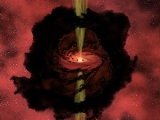
A protostar is a large mass that forms by contraction out of the gas of a giant molecular cloud in the interstellar medium
Interstellar medium
In astronomy, the interstellar medium is the matter that exists in the space between the star systems in a galaxy. This matter includes gas in ionic, atomic, and molecular form, dust, and cosmic rays. It fills interstellar space and blends smoothly into the surrounding intergalactic space...

. The protostellar phase is an early stage in the process of star formation. For a one solar-mass star it lasts about 100,000 years. It starts with a core of increased density in a molecular cloud and ends with the formation of a T Tauri star
T Tauri star
T Tauri stars are a class of variable stars named after their prototype – T Tauri. They are found near molecular clouds and identified by their optical variability and strong chromospheric lines.-Characteristics:...

, which then develops into a main sequence star. This is heralded by the T Tauri wind
T Tauri wind
The T Tauri wind — so named because of the young star currently in this stage—is a phenomenon indicative of the phase of stellar development between the accretion of material from the slowing rotating material of a solar nebula and the ignition of the hydrogen that has agglomerated into...

, a type of super solar wind
Solar wind
The solar wind is a stream of charged particles ejected from the upper atmosphere of the Sun. It mostly consists of electrons and protons with energies usually between 1.5 and 10 keV. The stream of particles varies in temperature and speed over time...

 that marks the change from the star accreting mass into radiating energy.

Observations have revealed that giant molecular clouds are approximately in a state of virial equilibrium—on the whole, the gravitational binding energy
Gravitational binding energy
The gravitational binding energy of an object consisting of loose material, held together by gravity alone, is the amount of energy required to pull all of the material apart, to infinity...

 of the cloud is balanced by the thermal pressure of the cloud's constituent molecule
Molecule
A molecule is an electrically neutral group of at least two atoms held together by covalent chemical bonds. Molecules are distinguished from ions by their electrical charge...

s and dust particles. Although thermal pressure is likely the dominant effect in counteracting gravitational collapse of protostellar cores, magnetic pressure, turbulence and rotation can also play a role (Larson, 2003). Any disturbance to the cloud may upset its state of equilibrium. Examples of disturbances are shock waves from supernova
Supernova
A supernova is a stellar explosion that is more energetic than a nova. It is pronounced with the plural supernovae or supernovas. Supernovae are extremely luminous and cause a burst of radiation that often briefly outshines an entire galaxy, before fading from view over several weeks or months...

e; spiral density waves within galaxies
Galaxy
A galaxy is a massive, gravitationally bound system that consists of stars and stellar remnants, an interstellar medium of gas and dust, and an important but poorly understood component tentatively dubbed dark matter. The word galaxy is derived from the Greek galaxias , literally "milky", a...

 and the close approach or collision of another cloud. If the disturbance is sufficiently large, it may lead to gravitational instability and subsequent collapse
Gravitational collapse
Gravitational collapse is the inward fall of a body due to the influence of its own gravity. In any stable body, this gravitational force is counterbalanced by the internal pressure of the body, in the opposite direction to the force of gravity...

 of a particular region of the cloud.

The British physicist Sir James Jeans considered the above phenomenon in detail. He was able to show that, under appropriate conditions, a cloud, or part of one, would start to contract very swiftly as described above. He derived a formula for calculating the mass
Mass
Mass can be defined as a quantitive measure of the resistance an object has to change in its velocity.In physics, mass commonly refers to any of the following three properties of matter, which have been shown experimentally to be equivalent:...

 and size that a cloud would have to reach as a function of its density
Density
The mass density or density of a material is defined as its mass per unit volume. The symbol most often used for density is ρ . In some cases , density is also defined as its weight per unit volume; although, this quantity is more properly called specific weight...

 and temperature
Temperature
Temperature is a physical property of matter that quantitatively expresses the common notions of hot and cold. Objects of low temperature are cold, while various degrees of higher temperatures are referred to as warm or hot...

 before gravitational contraction would begin. This critical mass is known as the Jeans mass. It is given by the following formula:


where n is the particle number density, m is the mass of the 'average' gas particle in the cloud, T is the gas temperature, and the "k" is the Boltzmanns constant.

History


The existence of 'protostars' was first proposed and postulated by Soviet-Armenian scientist, Viktor Ambartsumian.

The results of Ambartsumian’s research were in the so called continuous emission, observed in the spectras of the young stars of the TAU Taurus type and their satellite non-stationary stars. This research led to important conclusions as regards the nature of the stellar energy sources. Amabartsumian proposed a principally new concept of p-star matter. As opposed to the classical hypotheses suggesting that the stars have been formed as a result of condensation of diffuse matter, the new hypothesis postulated the existence of massive bodies, the “proto-stars”. The process of disintegration of proto-stars is responsible for the formation of the stars in the associations.

Fragmentation


Stars are often found in groups known as clusters which appear to have formed at around the same time. This can be explained if it is assumed that as a cloud contracts it does not do so uniformly. In fact, as first pointed out by Richard Larson, the giant molecular clouds in which stars are formed are universally observed to have turbulent velocities imposed on all scales within the cloud. These turbulent velocities compress the gas in shock
Shock wave
A shock wave is a type of propagating disturbance. Like an ordinary wave, it carries energy and can propagate through a medium or in some cases in the absence of a material medium, through a field such as the electromagnetic field...

s, which generate filaments and clumpy structures within the giant molecular cloud over a wide range of sizes and densities. This process is referred to as turbulent fragmentation. Some clumpy structures will exceed their Jeans mass and become gravitationally unstable, and may again fragment to form a single or multiple star system.

Whatever the reason, the cloud breaks up into smaller, denser areas which may again break into still smaller areas - the outcome being a cluster of protostars. This certainly agrees with the observation that star cluster
Star cluster
Star clusters or star clouds are groups of stars. Two types of star clusters can be distinguished: globular clusters are tight groups of hundreds of thousands of very old stars which are gravitationally bound, while open clusters, more loosely clustered groups of stars, generally contain less than...

s are common, but not always huge.

Heating due to gravitational energy


As the cloud continues to contract it begins to increase in temperature.
This is not caused by nuclear reactions but by the conversion of gravitational energy
Gravitational binding energy
The gravitational binding energy of an object consisting of loose material, held together by gravity alone, is the amount of energy required to pull all of the material apart, to infinity...

 to thermal kinetic energy. As a particle (atom or molecule) decreases its distance from the centre of the contracting fragment this will result in a decrease in its gravitational energy. The total energy of the particle must remain constant so the reduction in gravitational energy must be accompanied by an increase in the particle's kinetic energy. This can be expressed as an increase in the thermal kinetic energy, or temperature
Temperature
Temperature is a physical property of matter that quantitatively expresses the common notions of hot and cold. Objects of low temperature are cold, while various degrees of higher temperatures are referred to as warm or hot...

, of the cloud. The more the cloud contracts the more the temperature increases.

Collisions between molecules often leave them in excited states which can emit radiation
Radiation
In physics, radiation is a process in which energetic particles or energetic waves travel through a medium or space. There are two distinct types of radiation; ionizing and non-ionizing...

 as those states decay. The radiation is often of a characteristic frequency. At these temperatures (10 to 20 kelvin
Kelvin
The kelvin is a unit of measurement for temperature. It is one of the seven base units in the International System of Units and is assigned the unit symbol K. The Kelvin scale is an absolute, thermodynamic temperature scale using as its null point absolute zero, the temperature at which all...

s) the radiation is in the microwave
Microwave
Microwaves, a subset of radio waves, have wavelengths ranging from as long as one meter to as short as one millimeter, or equivalently, with frequencies between 300 MHz and 300 GHz. This broad definition includes both UHF and EHF , and various sources use different boundaries...

 or infrared
Infrared
Infrared light is electromagnetic radiation with a wavelength longer than that of visible light, measured from the nominal edge of visible red light at 0.74 micrometres , and extending conventionally to 300 µm...

 range of the spectrum. Most of this radiation will escape, preventing the rapid rise in temperature of the cloud.

As the cloud contracts the number density of the molecules increases.
This will eventually make it more difficult for the emitted radiation to escape. In effect, the gas becomes opaque to the radiation and the temperature within the cloud will begin to rise more rapidly.

The fact that the cloud becomes opaque to radiation in the infrared makes it difficult for us to observe directly what is happening. We must look to longer wavelength radio
Radio
Radio is the transmission of signals through free space by modulation of electromagnetic waves with frequencies below those of visible light. Electromagnetic radiation travels by means of oscillating electromagnetic fields that pass through the air and the vacuum of space...

 radiation which does escape even the densest clouds. In addition, theory and computer modelling are necessary to understand this phase.

As long as the surrounding matter is falling onto the central condensation, it is considered to be in protostar stage. When the surrounding gas/dust envelope disperses and the accretion process stops, the star is considered a pre–main sequence star. In the Hertzsprung–Russell diagram
Hertzsprung–Russell diagram
The Hertzsprung–Russell diagram is a scatter graph of stars showing the relationship between the stars' absolute magnitudes or luminosities versus their spectral types or classifications and effective temperatures. Hertzsprung–Russell diagrams are not pictures or maps of the locations of the stars...

, the star would then appear on the stellar birthline
Stellar birthline
The stellar birthline is a predicted line on the Hertzsprung–Russell diagram that relates the colour and luminosity of protostars at the end of the initial phase of accretion onto them. Prior to this point, the protostar is deeply embedded in the cloud of dust and gas from which it formed, and so...

.

See also


  • Herbig-Haro object
    Herbig-Haro object
    Herbig–Haro objects are small patches of nebulosity associated with newly born stars, and are formed when gas ejected by young stars collides with clouds of gas and dust nearby at speeds of several hundred kilometres per second...

  • Pre–main sequence star
  • Protoplanetary disk
    Protoplanetary disk
    A protoplanetary disk is a rotating circumstellar disk of dense gas surrounding a young newly formed star, a T Tauri star, or Herbig Ae/Be star...

  • NGC 7538
    NGC 7538
    NGC 7538, near the more famous Bubble Nebula, is located in the constellation Cepheus. It is located about 9,100 light years away from earth. It is home to the biggest yet discovered protostar which is about 300 times the size of our Solar System. It is located in the Perseus Spiral Arm of the...

    , home of the largest discovered protostar which is about 300 times the size of our Solar System
    Solar System
    The Solar System consists of the Sun and the astronomical objects gravitationally bound in orbit around it, all of which formed from the collapse of a giant molecular cloud approximately 4.6 billion years ago. The vast majority of the system's mass is in the Sun...

    .

External links