


Lawrence v. Texas

Encyclopedia
Lawrence v. Texas, 539 U.S. 558
(2003), is a landmark United States Supreme Court
case. In the 6-3 ruling, the Court struck down the sodomy law
in Texas
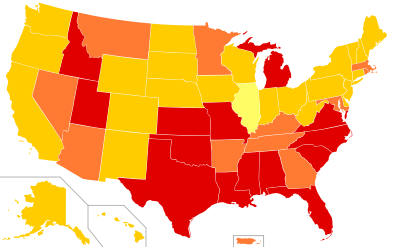
and, by proxy, invalidated sodomy laws in the thirteen other states where they remained in existence
, thereby making same-sex sexual activity legal in every state and territory of the nation. The court had previously addressed the same issue in 1986 in Bowers v. Hardwick
, where it upheld a challenged Georgia
statute, not finding a constitutional
protection of sexual privacy.
Lawrence explicitly overruled Bowers, holding that it had viewed the liberty interest too narrowly. The majority held that intimate consensual sexual conduct was part of the liberty protected by substantive due process
under the Fourteenth Amendment
. Lawrence has the effect of invalidating similar laws throughout the United States that purport to criminalize sodomy between consent
ing same-sex adult
s acting in private. It also invalidated the application of sodomy law
s to heterosexual sex.
The case attracted much public attention, and a large number of amici curiae ("friends of the court") briefs
were filed. Its outcome was celebrated by gay rights
advocates, who hoped that further legal advances might result as a consequence.
, the existence of rights of sexual partners was recognized through the marriage contract. That is, in common law there was no stand-alone right to engage in sexual activity, be they male or female, adult or minor. However, it is a basic legal principle under common and statutory law that everything that is not forbidden by the common and statutory law is allowed
. As sexual acts usually take place in private, few cases involving engagement in sodomy and fornication came before the courts, and no precedent was established under the common law forbidding fornication; with sodomy, the common law was mixed.
The common law came from Great Britain with the British colonists, and after the American Revolution
became the law of the United States, except where contradicted by statute, or the Constitution. Several U.S. jurisdictions passed statutes forbidding fornication
and sodomy
, often motivated by and citing religious strictures.
The precise legal definition of state law prohibiting sodomy or "crimes against nature" or "unnatural acts" was a frequent subject of legal dispute in the United States as early as the early 19th century. Some state courts ruled that the law only applied to anal sex, while other state courts ruled that their sodomy prohibition also included oral sex.
Legal punishments often included heavy fines and/or life prison sentences, with some states (Illinois being the first in 1827) specifically denying other rights, such as suffrage
, to anyone convicted of the crime of sodomy. In the late 19th century and early 20th century, several states imposed various eugenics laws against anyone deemed to be a "sexual pervert". As late as 1970, Connecticut denied a driver's license to a man for being an "admitted homosexual".
An organized American gay rights movement emerged in the early 20th century and sought to change, among other things, the criminal laws used against gay Americans. Sex researcher Alfred Kinsey
was an early, well known, post-war proponent of reforming these criminal laws, yet few lawyers or judges expressed much public support.
In 1961, the American Law Institute's Model Penal Code advocated repealing sodomy laws as they applied to private, adult, consensual behavior. A few years later the American Civil Liberties Union
(ACLU) took its first major case in opposition to these laws. Most judges were largely unsympathetic to the substantive due process
claims raised.
In 1964, Indiana Supreme Court Justice Amos Jackson became the first appointed State Judge to write a dissent criticizing sodomy laws, and he continued to oppose the laws in his dissents until he retired in 1970.
By the 1960s, attitudes towards sexual relations, marriage, sexual orientation, and the role of women began to change. This was sped along with the advent of safe and effective birth control devices and medicines. Attitudes strongly discouraging premarital sex decreased in intensity. "No-fault" divorce laws made getting divorces easier, and the frequency of unmarried partners living together (a type of relationship formerly frowned upon) soared. As part of this change in societal norms, the acceptance of same-sex relationships and the number of people openly seeking such relationships increased, to the point that many states repealed their sodomy laws
in the 1970s. Also at this time, Great Britain's 1957 Wolfenden Report
recommended the repeal of British sodomy laws. Ten years later, Britain's Sexual Offences Act 1967
did liberalize British sex crime laws, though it was not a total equalization between gay and straight couples.
In Griswold v. Connecticut
(1965), the Supreme Court struck down a law barring the use of contraceptives by married couples. Griswold was the first Supreme Court case to recognize a right to privacy, which was based not on any specific guarantee in the Bill of Rights, but was part of "penumbras, formed by emanations from those guarantees that help give them life and substance", established through case law. Such guarantees include those of the Fourth Amendment
, which protects private homes from searches and seizures without a warrant based on probable cause; of the Fifth Amendment
, which prohibits the deprivation of liberty without due process of law; and the Ninth Amendment
, which specifies that the enumerated rights in the Bill of Rights
cannot be construed as being an exhaustive list of rights. The Court limited its recognition of this right to married couples. Eisenstadt v. Baird
, decided in 1972, potentially expanded the scope of sexual privacy rights by holding in dicta
that if the "right to privacy means anything, it is the right of the individual, married or single, to be free from unwarranted governmental intrusion into matters so fundamentally affecting a person as the decision whether to bear or beget a child." This gave constitutional protection to unmarried persons using and purchasing birth control. In 1973, the choice whether to have an abortion was found to be protected by the Constitution in the extraordinarily controversial Roe v. Wade
.
In Bowers v. Hardwick
(1986), the Supreme Court heard a constitutional challenge to sodomy laws brought by a man who had been arrested, but was not prosecuted, for engaging in oral sex with another man in his home. The Court rejected this challenge by a vote of 5 to 4. Justice Byron White
's majority opinion emphasized that Eisenstadt and Roe had only recognized a right to engage in procreative sexual activity, and that longstanding moral antipathy toward homosexual sodomy was enough to argue against the notion that the Framers of the Constitution would have envisioned a "right" to sodomy
. If the court were to hold otherwise, Justice White argued, the Court would be substituting its own moral judgments for those of the people's elected representatives.
Justice Blackmun
wrote a dissent in Bowers, in which he argued that the majority's conception of liberty was too narrow. He used the Court's recent precedents on freedom of intimate association, such as Roberts v. U.S. Jaycees (1984), to advocate for a more open-ended balancing test in such cases.
Justice Stevens also said he believed that the majority had defined the right at stake too narrowly. He issued a dissent, based not on the Court's intimate-association cases, but on a thorough analysis of the Court's substantive Due Process liberty cases. Justice Stevens interpreted Eisenstadt as fundamentally affecting the scope and nature of substantive Due Process liberty rights, based on the idea that the Constitution protects people as individuals, not as family units. He summarized the Court's then-existing substantive Due Process liberty right as such: "[I]ndividual decisions by married persons, concerning the intimacies of their physical relationship, even when not intended to produce offspring, are a form of 'liberty' protected by the Due Process Clause of the Fourteenth Amendment. Moreover, this protection extends to intimate choices by unmarried as well as married persons." He then reasoned that because state intrusions are equally burdensome on an individual's personal life regardless of his marital status or sexual orientation, then there is no reason to treat the rights of citizens in same-sex couples any differently. Thus, Justice Stevens would have applied the substantive Due Process liberty protection equally, "regardless of whether the parties who engage in it are married or unmarried, or are of the same or different sexes." In 2003, the Lawrence majority relied heavily on Justice Stevens' Bowers dissent, and ultimately decided that "Justice Stevens' analysis, in our view, should have been controlling in Bowers and should control here. Bowers was not correct when it was decided, and it is not correct today."
The Kentucky Supreme Court
declined to follow the Court's analysis in Kentucky v. Wasson
(1992), striking down its state's sodomy law on the basis of its state constitution
. In the 1996 case Romer v. Evans
, the U.S. Supreme Court struck down a Colorado constitutional provision repealing local antidiscrimination ordinances involving sexual orientation.
in Lawrence's apartment in the outskirts of Houston between 10:30 and 11 p.m. on September 17, 1998, when a Harris County
sheriff's deputy entered the unlocked apartment, with his weapon drawn, arresting the two.
The arrests had stemmed from a false report of a "weapons disturbance" in their home — that because of a domestic disturbance or robbery, there was a man with a gun "going crazy." The person who filed the report, neighbor Robert Royce Eubanks, then 40, had earlier been accused of harassing the plaintiffs. Despite the false report, probable cause
to enter the home was not at issue in the case. Eubanks, with whom Garner was romantically involved at the time of the arrest, later admitted that he was lying, pleaded no contest
to charges of filing a false police report, and served 15 days in jail.
Lawrence and Garner were arrested, held overnight in jail, and charged with violating Texas's anti-sodomy
statute, the Texas "Homosexual Conduct" law. The law, Chapter 21, Sec. 21.06 of the Texas Penal Code, designated it as a Class C misdemeanor
when someone "engages in deviant sexual intercourse with another individual of the same sex," prohibiting anal
and oral sex
between members of the same sex. They later posted $200 bail
.
On November 20, Lawrence and Garner pleaded no contest to the charges. They were convicted by Justice of the Peace
Mike Parrott, but exercised their right to a new trial before a Texas Criminal Court, where they asked the court to dismiss the charges against them on Fourteenth Amendment equal protection grounds, claiming that the law was unconstitutional since it prohibits sodomy between same-sex couples, but not between heterosexual couples, and also on right to privacy grounds. After the Criminal Court rejected this request, they pleaded no contest, reserving their right to file an appeal
, and were fined $200 each (out of a maximum fine of $500 each), plus $141.25 in court costs.
On November 4, 1999, arguments were presented to a three-judge panel of the Texas Fourteenth Court of Appeals on both equal protection and right to privacy grounds. John S. Anderson and chief justice Paul Murphy ruled in the appellants' favor, finding that the law violated the 1972 Equal Rights Amendment to the Texas Constitution, which bars discrimination
because of sex, race, color, creed, or national origin. J. Harvey Hudson dissented. This 2–1 decision ruled the Texas law was unconstitutional; the full court, however, voted to reconsider its decision, upholding the law's constitutionality 7-2 and denying both the substantive due process and the equal protection arguments. On April 13, 2001, the Texas Court of Criminal Appeals
was petitioned to hear the case; the Court, the highest appellate court in Texas for criminal matters, denied review. The case then arrived at the U.S. Supreme Court, with a petition being filed July 16, 2002.
agreeing to hear the case on December 2, 2002. Thereafter, a wide array of organizations filed amicus curiae
briefs on behalf of the petitioners as well as the respondents.
Paul M. Smith
delivered the oral argument
on behalf of Lawrence on March 26, 2003; the decision was rendered on June 26. The questions before the court were the following:
guarantees, and a sixth justice, Sandra Day O'Connor
, found that it violated equal protection guarantees. The majority opinion, which overrules Bowers v. Hardwick
, covers similar laws in 12 other states. Justice Anthony Kennedy
wrote the majority opinion; Justices John Paul Stevens
, David Souter
, Ruth Bader Ginsburg
and Stephen Breyer
joined.
case Dudgeon v. United Kingdom
, as evidence that the court in Bowers was incorrect in saying that Western civilization condemned homosexuality, since Dudgeon led to the de-criminalization of homosexuality in Northern Ireland
, and it had been decriminalized in the rest of Britain earlier: in England & Wales
in 1967 and in Scotland
in 1980. Chief Justice Burger, concurring in Bowers, had held that "Decisions of individuals relating to homosexual conduct have been subject to state intervention throughout the history of Western civilization". Kennedy's citation of European law was in part a response to this blanket characterization of the values of "Western civilization."
The Court concluded that, "Bowers was not correct when it was decided, and it is not correct today. It ought not to remain binding precedent. Bowers v. Hardwick should be and now is overruled." The majority decision also held that the intimate, adult consensual conduct at issue here was part of the liberty protected by the substantive component of the Fourteenth Amendment's due process protections. Holding that "the Texas statute furthers no legitimate state interest which can justify its intrusion into the personal and private life of the individual," the court struck down the anti-sodomy law as unconstitutional.
Kennedy's opinion grounded the right of consenting adults to have sex on how intimate and personal the conduct was to those involved, not on the conduct being traditionally protected by society (as in Bowers), procreative (as in Eisenstadt and Roe), or conducted by married people (as in Griswold). This opened the door in theory to protection of a whole host of sexual activity between consenting adults not protected by other decisions. Kennedy did not extend the opinion to include governmental recognition of such relationships.
Further, Kennedy limited the unconstitutionality of the sodomy law to the narrow set of consensual adult sexual conduct in a private setting, enumerating areas where sodomy laws could potentially remain in effect.
filed a concurring opinion, agreeing with the invalidation of the Texas anti-sodomy statute, but not with Kennedy's rationale. O'Connor disagreed with both the overturning of Bowers (she had been in the Bowers majority) and with the court's invocation of due process guarantees of liberty in this context. O'Connor instead preferred the equal protection argument which would still strike the law because it was directed against a group rather than an act, but would avoid the inclusion of sexuality under protected liberty.
O'Connor maintained that a sodomy law that was neutral both in effect and application might well be constitutional, but that there was little to fear because "democratic society" would not tolerate it for long. She left the door open for laws which distinguished between homosexuals and heterosexuals on the basis of legitimate state interest, but found that this was not such a law. In some ways, O'Connor's opinion was broader than the majority's, for as Antonin Scalia
noted in dissent it explicitly cast doubt on whether laws limiting marriage to heterosexual couples could pass rational-basis scrutiny
. O'Connor explicitly noted in her opinion that a law limiting marriage to heterosexual couples would pass the rational scrutiny as long as it was designed to "preserv[e] the traditional institution of marriage" and not simply based on the state's dislike of homosexual persons.
wrote a dissent, which Chief Justice
William H. Rehnquist joined. Scalia objected to the Court's decision to revisit Bowers, pointing out that there were many subsequent decisions from lower courts based on Bowers that, with its overturning, might now be open to doubt:
Scalia noted that the same rationale used to overturn Bowers (looking to (1) "whether its foundations have been 'eroded' by subsequent decisions; (2) it has been subject to 'substantial and continuing' criticism; (3) it has not induced 'individual or societal reliance'") could be applied to overturn the Roe v. Wade decision, which the Justices in the majority in Lawrence had just recently upheld in Planned Parenthood v. Casey
.
Scalia also criticized the writers of the opinion for their unwillingness to give the same respect to the decision of stare decisis
that some of them applied in Casey. There, Scalia noted, stare decisis was of the utmost importance because of the divisive nature of the case. The Lawrence decision "do[es] not bother to distinguish—or indeed, even bother to mention—the paean to stare decisis coauthored by three Members of today's majority in Planned Parenthood v. Casey. There, when stare decisis meant preservation of judicially invented abortion rights, the widespread criticism of Roe was strong reason to reaffirm it." He goes on to write "Today, however, the widespread opposition to Bowers, a decision resolving an issue as 'intensely divisive' as the issue in Roe, is offered as a reason in favor of overruling it."
Some federal courts have held that the majority opinion in Lawrence was narrow. Upon rehearing Williams v. Pryor
after Lawrence was decided, the Eleventh Circuit Court of Appeals
concluded: "In short, we decline to extrapolate from Lawrence and its dicta a right to sexual privacy triggering strict scrutiny
. To do so would be to impose a fundamental-rights interpretation on a decision that rested on rational-basis grounds, that never engaged in Glucksberg analysis, and that never invoked strict scrutiny" Williams v. Attorney General of Alabama, 378 F.3d 1232 (11th Cir. 2004). Accordingly, Alabama's ban on the sale of sex toys was upheld.
In contrast, facing identical facts, the Fifth Circuit struck down Texas's sex toy ban holding that "morality is an insufficient justification for a statute" and "interests in 'public morality' cannot constitutionally sustain the statute after Lawrence. Reliable Consultants, Inc., v. Earle, No. 06-51067, 2008 WL 383034 (5th Cir. Feb. 12, 2008).
Scalia also averred that state laws against bigamy
, same-sex marriage
, adult incest
, prostitution
, masturbation
, adultery
, fornication
, bestiality, and obscenity
are likewise sustainable only in light of Bowerss validation of laws based on moral choices.
Portions of Scalia's dissent appeared in Judge Vaughn Walker's ruling in Perry v. Schwarzenegger
filed on August 4, 2010 supporting same-sex marriage and finding California's Proposition 8
unconstitutional:
With this decision, Scalia concluded, the Court "has largely signed on to the so-called homosexual agenda
." While Scalia said that he has "nothing against homosexuals, or any other group, promoting their agenda through normal democratic means," Scalia argued that the Court has an obligation to decide cases neutrally.
's dissent in Griswold v. Connecticut
, but he voted to uphold it as he could find "no general right of privacy" or relevant liberty in the Constitution. He added that if he were a member of the Texas Legislature
he would vote to repeal the law. However, Thomas also did not believe that the plaintiffs in the case had standing to bring this case before the Court.
 Lambda Legal
, which brought the case, hailed the decision as "a legal victory so decisive that it would change the entire landscape for the LGBT
community." Jay Alan Sekulow
of the American Center for Law and Justice
has referred to the decision as having "changed the status of homosexual acts and changed a previous ruling of the Supreme Court... this was a drastic rewrite." The Lambda Legal Defense and Education Fund's lead attorney in the case, Ruth Harlow stated in an interview after the ruling that "the court admitted its mistake in 1986, admitted it had been wrong then...and emphasized today that gay Americans, like all Americans, are entitled to full respect and equal claim to [all] constitutional rights."
These reactions reflect widespread opinion that Lawrence v. Texas may ultimately be one of the Supreme Court's more influential decisions. Prof. Laurence Tribe
has written that Lawrence "may well be remembered as the Brown v. Board of Education
of gay and lesbian America."
Broader implications of this decision have been speculated, including the following:
, which would be appropriate if the Lawrence majority had recognized a full-fledged "fundamental right." Had a fundamental right been present, any burden on that right would only have been held constitutional had it survived strict scrutiny and been found to be narrowly tailored to further a compelling governmental interest. Scalia insists the majority, instead, applied "an unheard-of form of rational basis review
that will have far-reaching implications beyond this case."
Thus, based on the weakness of the justifications presented by Texas, the Court concluded: "The Texas statute furthers no legitimate state interest which can justify its intrusion into the personal and private life of the individual."
Lower courts have made some independent determinations of the scrutiny level afforded in Lawrence. In Lofton v. Secretary of the Department of Children and Family Services
the United States Court of Appeals for the Eleventh Circuit
upheld a state law barring adoption of children by homosexuals, holding explicitly that Lawrence did not apply strict scrutiny
, the most stringent level of judicial review. In Witt v. Department of the Air Force
, the United States Court of Appeals for the Ninth Circuit
analyzed the language of the majority and dissenting opinions along with cases in which Lawrence had been cited as precedent to determine the level of scrutiny applied by the Supreme Court. Witt challenged the constitutionality of 10 U.S.C. § 654, the law which excludes openly homosexual people from serving in the United States military, commonly known as don't ask, don't tell
(DADT). The court held that Lawrence applied intermediate scrutiny
. This decision is binding only on the Ninth Circuit.
Case citation
Case citation is the system used in many countries to identify the decisions in past court cases, either in special series of books called reporters or law reports, or in a 'neutral' form which will identify a decision wherever it was reported...
(2003), is a landmark United States Supreme Court
Supreme Court of the United States
The Supreme Court of the United States is the highest court in the United States. It has ultimate appellate jurisdiction over all state and federal courts, and original jurisdiction over a small range of cases...
case. In the 6-3 ruling, the Court struck down the sodomy law
Sodomy law
A sodomy law is a law that defines certain sexual acts as crimes. The precise sexual acts meant by the term sodomy are rarely spelled out in the law, but are typically understood by courts to include any sexual act deemed unnatural. It also has a range of similar euphemisms...
in Texas
Texas
Texas is the second largest U.S. state by both area and population, and the largest state by area in the contiguous United States.The name, based on the Caddo word "Tejas" meaning "friends" or "allies", was applied by the Spanish to the Caddo themselves and to the region of their settlement in...
and, by proxy, invalidated sodomy laws in the thirteen other states where they remained in existence
Sodomy laws in the United States
Sodomy laws in the United States, which outlawed a variety of sexual acts, were historically universal. While they often targeted sexual acts between persons of the same sex, many statutes employed definitions broad enough to outlaw certain sexual acts between persons of different sexes as well,...
, thereby making same-sex sexual activity legal in every state and territory of the nation. The court had previously addressed the same issue in 1986 in Bowers v. Hardwick
Bowers v. Hardwick
Bowers v. Hardwick, , is a United States Supreme Court decision that upheld, in a 5-4 ruling, the constitutionality of a Georgia sodomy law criminalizing oral and anal sex in private between consenting adults when applied to homosexuals. Seventeen years after Bowers v. Hardwick, the Supreme Court...
, where it upheld a challenged Georgia
Georgia (U.S. state)
Georgia is a state located in the southeastern United States. It was established in 1732, the last of the original Thirteen Colonies. The state is named after King George II of Great Britain. Georgia was the fourth state to ratify the United States Constitution, on January 2, 1788...
statute, not finding a constitutional
United States Constitution
The Constitution of the United States is the supreme law of the United States of America. It is the framework for the organization of the United States government and for the relationship of the federal government with the states, citizens, and all people within the United States.The first three...
protection of sexual privacy.
Lawrence explicitly overruled Bowers, holding that it had viewed the liberty interest too narrowly. The majority held that intimate consensual sexual conduct was part of the liberty protected by substantive due process
Due process
Due process is the legal code that the state must venerate all of the legal rights that are owed to a person under the principle. Due process balances the power of the state law of the land and thus protects individual persons from it...
under the Fourteenth Amendment
Fourteenth Amendment to the United States Constitution
The Fourteenth Amendment to the United States Constitution was adopted on July 9, 1868, as one of the Reconstruction Amendments.Its Citizenship Clause provides a broad definition of citizenship that overruled the Dred Scott v...
. Lawrence has the effect of invalidating similar laws throughout the United States that purport to criminalize sodomy between consent
Consent
Consent refers to the provision of approval or agreement, particularly and especially after thoughtful consideration.- Types of consent :*Implied consent is a controversial form of consent which is not expressly granted by a person, but rather inferred from a person's actions and the facts and...
ing same-sex adult
Adult
An adult is a human being or living organism that is of relatively mature age, typically associated with sexual maturity and the attainment of reproductive age....
s acting in private. It also invalidated the application of sodomy law
Sodomy law
A sodomy law is a law that defines certain sexual acts as crimes. The precise sexual acts meant by the term sodomy are rarely spelled out in the law, but are typically understood by courts to include any sexual act deemed unnatural. It also has a range of similar euphemisms...
s to heterosexual sex.
The case attracted much public attention, and a large number of amici curiae ("friends of the court") briefs
Brief (law)
A brief is a written legal document used in various legal adversarial systems that is presented to a court arguing why the party to the case should prevail....
were filed. Its outcome was celebrated by gay rights
LGBT social movements
Lesbian, gay, bisexual, and transgender social movements share inter-related goals of social acceptance of sexual and gender minorities. Lesbian, gay, bisexual, and transgender people and their allies have a long history of campaigning for what is generally called LGBT rights, also called gay...
advocates, who hoped that further legal advances might result as a consequence.
Prior case law
Under the common lawCommon law
Common law is law developed by judges through decisions of courts and similar tribunals rather than through legislative statutes or executive branch action...
, the existence of rights of sexual partners was recognized through the marriage contract. That is, in common law there was no stand-alone right to engage in sexual activity, be they male or female, adult or minor. However, it is a basic legal principle under common and statutory law that everything that is not forbidden by the common and statutory law is allowed
Everything which is not forbidden is allowed
Everything which is not forbidden is allowed is a constitutional principle of English law — an essential freedom of the ordinary citizen. The converse principle — everything which is not allowed is forbidden — applies to public authorities, whose actions are limited to the powers...
. As sexual acts usually take place in private, few cases involving engagement in sodomy and fornication came before the courts, and no precedent was established under the common law forbidding fornication; with sodomy, the common law was mixed.
The common law came from Great Britain with the British colonists, and after the American Revolution
American Revolution
The American Revolution was the political upheaval during the last half of the 18th century in which thirteen colonies in North America joined together to break free from the British Empire, combining to become the United States of America...
became the law of the United States, except where contradicted by statute, or the Constitution. Several U.S. jurisdictions passed statutes forbidding fornication
Fornication
Fornication typically refers to consensual sexual intercourse between two people not married to each other. For many people, the term carries a moral or religious association, but the significance of sexual acts to which the term is applied varies between religions, societies and cultures. The...
and sodomy
Sodomy
Sodomy is an anal or other copulation-like act, especially between male persons or between a man and animal, and one who practices sodomy is a "sodomite"...
, often motivated by and citing religious strictures.
The precise legal definition of state law prohibiting sodomy or "crimes against nature" or "unnatural acts" was a frequent subject of legal dispute in the United States as early as the early 19th century. Some state courts ruled that the law only applied to anal sex, while other state courts ruled that their sodomy prohibition also included oral sex.
Legal punishments often included heavy fines and/or life prison sentences, with some states (Illinois being the first in 1827) specifically denying other rights, such as suffrage
Suffrage
Suffrage, political franchise, or simply the franchise, distinct from mere voting rights, is the civil right to vote gained through the democratic process...
, to anyone convicted of the crime of sodomy. In the late 19th century and early 20th century, several states imposed various eugenics laws against anyone deemed to be a "sexual pervert". As late as 1970, Connecticut denied a driver's license to a man for being an "admitted homosexual".
An organized American gay rights movement emerged in the early 20th century and sought to change, among other things, the criminal laws used against gay Americans. Sex researcher Alfred Kinsey
Alfred Kinsey
Alfred Charles Kinsey was an American biologist and professor of entomology and zoology, who in 1947 founded the Institute for Sex Research at Indiana University, now known as the Kinsey Institute for Research in Sex, Gender, and Reproduction, as well as producing the Kinsey Reports and the Kinsey...
was an early, well known, post-war proponent of reforming these criminal laws, yet few lawyers or judges expressed much public support.
In 1961, the American Law Institute's Model Penal Code advocated repealing sodomy laws as they applied to private, adult, consensual behavior. A few years later the American Civil Liberties Union
American Civil Liberties Union
The American Civil Liberties Union is a U.S. non-profit organization whose stated mission is "to defend and preserve the individual rights and liberties guaranteed to every person in this country by the Constitution and laws of the United States." It works through litigation, legislation, and...
(ACLU) took its first major case in opposition to these laws. Most judges were largely unsympathetic to the substantive due process
Substantive due process
Substantive due process is one of the theories of law through which courts enforce limits on legislative and executive powers and authority...
claims raised.
In 1964, Indiana Supreme Court Justice Amos Jackson became the first appointed State Judge to write a dissent criticizing sodomy laws, and he continued to oppose the laws in his dissents until he retired in 1970.
By the 1960s, attitudes towards sexual relations, marriage, sexual orientation, and the role of women began to change. This was sped along with the advent of safe and effective birth control devices and medicines. Attitudes strongly discouraging premarital sex decreased in intensity. "No-fault" divorce laws made getting divorces easier, and the frequency of unmarried partners living together (a type of relationship formerly frowned upon) soared. As part of this change in societal norms, the acceptance of same-sex relationships and the number of people openly seeking such relationships increased, to the point that many states repealed their sodomy laws
Sodomy laws in the United States
Sodomy laws in the United States, which outlawed a variety of sexual acts, were historically universal. While they often targeted sexual acts between persons of the same sex, many statutes employed definitions broad enough to outlaw certain sexual acts between persons of different sexes as well,...
in the 1970s. Also at this time, Great Britain's 1957 Wolfenden Report
Wolfenden report
The Report of the Departmental Committee on Homosexual Offences and Prostitution was published in Britain on 4 September 1957 after a succession of well-known men, including Lord Montagu, Michael Pitt-Rivers and Peter Wildeblood, were convicted of homosexual offences.-The committee:The...
recommended the repeal of British sodomy laws. Ten years later, Britain's Sexual Offences Act 1967
Sexual Offences Act 1967
The Sexual Offences Act 1967 is an Act of Parliament in the United Kingdom . It decriminalised homosexual acts in private between two men, both of whom had to have attained the age of 21. The Act applied only to England and Wales and did not cover the Merchant Navy or the Armed Forces...
did liberalize British sex crime laws, though it was not a total equalization between gay and straight couples.
In Griswold v. Connecticut
Griswold v. Connecticut
Griswold v. Connecticut, , was a landmark case in which the Supreme Court of the United States ruled that the Constitution protected a right to privacy. The case involved a Connecticut law that prohibited the use of contraceptives...
(1965), the Supreme Court struck down a law barring the use of contraceptives by married couples. Griswold was the first Supreme Court case to recognize a right to privacy, which was based not on any specific guarantee in the Bill of Rights, but was part of "penumbras, formed by emanations from those guarantees that help give them life and substance", established through case law. Such guarantees include those of the Fourth Amendment
Fourth Amendment to the United States Constitution
The Fourth Amendment to the United States Constitution is the part of the Bill of Rights which guards against unreasonable searches and seizures, along with requiring any warrant to be judicially sanctioned and supported by probable cause...
, which protects private homes from searches and seizures without a warrant based on probable cause; of the Fifth Amendment
Fifth Amendment to the United States Constitution
The Fifth Amendment to the United States Constitution, which is part of the Bill of Rights, protects against abuse of government authority in a legal procedure. Its guarantees stem from English common law which traces back to the Magna Carta in 1215...
, which prohibits the deprivation of liberty without due process of law; and the Ninth Amendment
Ninth Amendment to the United States Constitution
The Ninth Amendment to the United States Constitution, which is part of the Bill of Rights, addresses rights of the people that are not specifically enumerated in the Constitution.-Text:-Adoption:When the U.S...
, which specifies that the enumerated rights in the Bill of Rights
United States Bill of Rights
The Bill of Rights is the collective name for the first ten amendments to the United States Constitution. These limitations serve to protect the natural rights of liberty and property. They guarantee a number of personal freedoms, limit the government's power in judicial and other proceedings, and...
cannot be construed as being an exhaustive list of rights. The Court limited its recognition of this right to married couples. Eisenstadt v. Baird
Eisenstadt v. Baird
Eisenstadt v. Baird, , was an important United States Supreme Court case that established the right of unmarried people to possess contraception on the same basis as married couples and, by implication, the right of unmarried couples to engage in potentially nonprocreative sexual intercourse .The...
, decided in 1972, potentially expanded the scope of sexual privacy rights by holding in dicta
Dictum
In United States legal terminology, a dictum is a statement of opinion or belief considered authoritative though not binding, because of the authority of the person making it....
that if the "right to privacy means anything, it is the right of the individual, married or single, to be free from unwarranted governmental intrusion into matters so fundamentally affecting a person as the decision whether to bear or beget a child." This gave constitutional protection to unmarried persons using and purchasing birth control. In 1973, the choice whether to have an abortion was found to be protected by the Constitution in the extraordinarily controversial Roe v. Wade
Roe v. Wade
Roe v. Wade, , was a controversial landmark decision by the United States Supreme Court on the issue of abortion. The Court decided that a right to privacy under the due process clause in the Fourteenth Amendment to the United States Constitution extends to a woman's decision to have an abortion,...
.
In Bowers v. Hardwick
Bowers v. Hardwick
Bowers v. Hardwick, , is a United States Supreme Court decision that upheld, in a 5-4 ruling, the constitutionality of a Georgia sodomy law criminalizing oral and anal sex in private between consenting adults when applied to homosexuals. Seventeen years after Bowers v. Hardwick, the Supreme Court...
(1986), the Supreme Court heard a constitutional challenge to sodomy laws brought by a man who had been arrested, but was not prosecuted, for engaging in oral sex with another man in his home. The Court rejected this challenge by a vote of 5 to 4. Justice Byron White
Byron White
Byron Raymond "Whizzer" White won fame both as a football halfback and as an associate justice of the Supreme Court of the United States. Appointed to the court by President John F. Kennedy in 1962, he served until his retirement in 1993...
's majority opinion emphasized that Eisenstadt and Roe had only recognized a right to engage in procreative sexual activity, and that longstanding moral antipathy toward homosexual sodomy was enough to argue against the notion that the Framers of the Constitution would have envisioned a "right" to sodomy
Sodomy
Sodomy is an anal or other copulation-like act, especially between male persons or between a man and animal, and one who practices sodomy is a "sodomite"...
. If the court were to hold otherwise, Justice White argued, the Court would be substituting its own moral judgments for those of the people's elected representatives.
Justice Blackmun
Harry Blackmun
Harold Andrew Blackmun was an Associate Justice of the Supreme Court of the United States from 1970 until 1994. He is best known as the author of Roe v. Wade.- Early years and professional career :...
wrote a dissent in Bowers, in which he argued that the majority's conception of liberty was too narrow. He used the Court's recent precedents on freedom of intimate association, such as Roberts v. U.S. Jaycees (1984), to advocate for a more open-ended balancing test in such cases.
Justice Stevens also said he believed that the majority had defined the right at stake too narrowly. He issued a dissent, based not on the Court's intimate-association cases, but on a thorough analysis of the Court's substantive Due Process liberty cases. Justice Stevens interpreted Eisenstadt as fundamentally affecting the scope and nature of substantive Due Process liberty rights, based on the idea that the Constitution protects people as individuals, not as family units. He summarized the Court's then-existing substantive Due Process liberty right as such: "[I]ndividual decisions by married persons, concerning the intimacies of their physical relationship, even when not intended to produce offspring, are a form of 'liberty' protected by the Due Process Clause of the Fourteenth Amendment. Moreover, this protection extends to intimate choices by unmarried as well as married persons." He then reasoned that because state intrusions are equally burdensome on an individual's personal life regardless of his marital status or sexual orientation, then there is no reason to treat the rights of citizens in same-sex couples any differently. Thus, Justice Stevens would have applied the substantive Due Process liberty protection equally, "regardless of whether the parties who engage in it are married or unmarried, or are of the same or different sexes." In 2003, the Lawrence majority relied heavily on Justice Stevens' Bowers dissent, and ultimately decided that "Justice Stevens' analysis, in our view, should have been controlling in Bowers and should control here. Bowers was not correct when it was decided, and it is not correct today."
The Kentucky Supreme Court
Kentucky Supreme Court
The Kentucky Supreme Court was created by a 1975 constitutional amendment and is the state supreme court of the commonwealth of Kentucky. Prior to that the Kentucky Court of Appeals was the only appellate court in Kentucky...
declined to follow the Court's analysis in Kentucky v. Wasson
Kentucky v. Wasson
Kentucky v. Wasson was a 1992 Kentucky Supreme Court decision striking down that state's criminalization of consensual sodomy between same-sex partners, holding that this was a violation of both the equal protection of the laws and the right to privacy...
(1992), striking down its state's sodomy law on the basis of its state constitution
Kentucky Constitution
The Constitution of the Commonwealth of Kentucky is the document that governs the Commonwealth of Kentucky. It was first adopted in 1792 and has since been rewritten three times and amended many more...
. In the 1996 case Romer v. Evans
Romer v. Evans
Romer v. Evans, 517 U.S. 620 , is a landmark United States Supreme Court case dealing with civil rights and state laws. It was the first Supreme Court case to deal with LGBT rights since Bowers v...
, the U.S. Supreme Court struck down a Colorado constitutional provision repealing local antidiscrimination ordinances involving sexual orientation.
Arrest of Lawrence and Garner
The petitioners, John Geddes Lawrence, a medical technologist, then age 55, and Tyron Garner (July 10, 1967 – September 11, 2006), then 31, were alleged to have been engaging in consensual anal sexAnal sex
Anal sex is the sex act in which the penis is inserted into the anus of a sexual partner. The term can also include other sexual acts involving the anus, including pegging, anilingus , fingering, and object insertion.Common misconception describes anal sex as practiced almost exclusively by gay men...
in Lawrence's apartment in the outskirts of Houston between 10:30 and 11 p.m. on September 17, 1998, when a Harris County
Harris County, Texas
As of the 2010 Census, the population of the county was 4,092,459, White Americans made up 56.6% of Harris County's population; non-Hispanic whites represented 33.0% of the population. Black Americans made up 18.9% of the population. Native Americans made up 0.7% of Harris County's population...
sheriff's deputy entered the unlocked apartment, with his weapon drawn, arresting the two.
The arrests had stemmed from a false report of a "weapons disturbance" in their home — that because of a domestic disturbance or robbery, there was a man with a gun "going crazy." The person who filed the report, neighbor Robert Royce Eubanks, then 40, had earlier been accused of harassing the plaintiffs. Despite the false report, probable cause
Probable cause
In United States criminal law, probable cause is the standard by which an officer or agent of the law has the grounds to make an arrest, to conduct a personal or property search, or to obtain a warrant for arrest, etc. when criminal charges are being considered. It is also used to refer to the...
to enter the home was not at issue in the case. Eubanks, with whom Garner was romantically involved at the time of the arrest, later admitted that he was lying, pleaded no contest
Nolo contendere
is a legal term that comes from the Latin for "I do not wish to contend." It is also referred to as a plea of no contest.In criminal trials, and in some common law jurisdictions, it is a plea where the defendant neither admits nor disputes a charge, serving as an alternative to a pleading of...
to charges of filing a false police report, and served 15 days in jail.
Lawrence and Garner were arrested, held overnight in jail, and charged with violating Texas's anti-sodomy
Sodomy
Sodomy is an anal or other copulation-like act, especially between male persons or between a man and animal, and one who practices sodomy is a "sodomite"...
statute, the Texas "Homosexual Conduct" law. The law, Chapter 21, Sec. 21.06 of the Texas Penal Code, designated it as a Class C misdemeanor
Misdemeanor
A misdemeanor is a "lesser" criminal act in many common law legal systems. Misdemeanors are generally punished much less severely than felonies, but theoretically more so than administrative infractions and regulatory offences...
when someone "engages in deviant sexual intercourse with another individual of the same sex," prohibiting anal
Anal sex
Anal sex is the sex act in which the penis is inserted into the anus of a sexual partner. The term can also include other sexual acts involving the anus, including pegging, anilingus , fingering, and object insertion.Common misconception describes anal sex as practiced almost exclusively by gay men...
and oral sex
Oral sex
Oral sex is sexual activity involving the stimulation of the genitalia of a sex partner by the use of the mouth, tongue, teeth or throat. Cunnilingus refers to oral sex performed on females while fellatio refer to oral sex performed on males. Anilingus refers to oral stimulation of a person's anus...
between members of the same sex. They later posted $200 bail
Bail
Traditionally, bail is some form of property deposited or pledged to a court to persuade it to release a suspect from jail, on the understanding that the suspect will return for trial or forfeit the bail...
.
On November 20, Lawrence and Garner pleaded no contest to the charges. They were convicted by Justice of the Peace
Justice of the Peace
A justice of the peace is a puisne judicial officer elected or appointed by means of a commission to keep the peace. Depending on the jurisdiction, they might dispense summary justice or merely deal with local administrative applications in common law jurisdictions...
Mike Parrott, but exercised their right to a new trial before a Texas Criminal Court, where they asked the court to dismiss the charges against them on Fourteenth Amendment equal protection grounds, claiming that the law was unconstitutional since it prohibits sodomy between same-sex couples, but not between heterosexual couples, and also on right to privacy grounds. After the Criminal Court rejected this request, they pleaded no contest, reserving their right to file an appeal
Appeal
An appeal is a petition for review of a case that has been decided by a court of law. The petition is made to a higher court for the purpose of overturning the lower court's decision....
, and were fined $200 each (out of a maximum fine of $500 each), plus $141.25 in court costs.
On November 4, 1999, arguments were presented to a three-judge panel of the Texas Fourteenth Court of Appeals on both equal protection and right to privacy grounds. John S. Anderson and chief justice Paul Murphy ruled in the appellants' favor, finding that the law violated the 1972 Equal Rights Amendment to the Texas Constitution, which bars discrimination
Discrimination
Discrimination is the prejudicial treatment of an individual based on their membership in a certain group or category. It involves the actual behaviors towards groups such as excluding or restricting members of one group from opportunities that are available to another group. The term began to be...
because of sex, race, color, creed, or national origin. J. Harvey Hudson dissented. This 2–1 decision ruled the Texas law was unconstitutional; the full court, however, voted to reconsider its decision, upholding the law's constitutionality 7-2 and denying both the substantive due process and the equal protection arguments. On April 13, 2001, the Texas Court of Criminal Appeals
Texas Court of Criminal Appeals
The Texas Court of Criminal Appeals is the court of last resort for all criminal matters in the State of Texas, United States. The Court, which is based in the Supreme Court Building in Downtown Austin, is composed of a Presiding Judge and eight judges....
was petitioned to hear the case; the Court, the highest appellate court in Texas for criminal matters, denied review. The case then arrived at the U.S. Supreme Court, with a petition being filed July 16, 2002.
Considerations
The Supreme Court granted a writ of certiorariCertiorari
Certiorari is a type of writ seeking judicial review, recognized in U.S., Roman, English, Philippine, and other law. Certiorari is the present passive infinitive of the Latin certiorare...
agreeing to hear the case on December 2, 2002. Thereafter, a wide array of organizations filed amicus curiae
Amicus curiae
An amicus curiae is someone, not a party to a case, who volunteers to offer information to assist a court in deciding a matter before it...
briefs on behalf of the petitioners as well as the respondents.
Paul M. Smith
Paul M. Smith
Paul March Smith is an American attorney who has argued many important cases, most notably Lawrence v. Texas. He is currently a partner at Jenner & Block’s Washington, DC office and is a member of the firm’s Litigation Department.-Education:...
delivered the oral argument
Oral argument
Oral arguments are spoken presentations to a judge or appellate court by a lawyer of the legal reasons why they should prevail. Oral argument at the appellate level accompanies written briefs, which also advance the argument of each party in the legal dispute...
on behalf of Lawrence on March 26, 2003; the decision was rendered on June 26. The questions before the court were the following:
- Whether the petitioners' criminal convictions under the Texas "Homosexual Conduct" law — which criminalizes sexual intimacy by same-sex couples, but not identical behavior by different-sex couples — violate the Fourteenth Amendment guarantee of equal protection of the laws;
- Whether the petitioners' criminal convictions for adult consensual sexual intimacy in their home violate their vital interests in liberty and privacy protected by the Due Process Clause of the Fourteenth Amendment; and
- Whether Bowers v. HardwickBowers v. HardwickBowers v. Hardwick, , is a United States Supreme Court decision that upheld, in a 5-4 ruling, the constitutionality of a Georgia sodomy law criminalizing oral and anal sex in private between consenting adults when applied to homosexuals. Seventeen years after Bowers v. Hardwick, the Supreme Court...
should be overruled.
The ruling
The Supreme Court voted 6–3 to strike down the Texas law, with five of the justices holding that it violated due processDue process
Due process is the legal code that the state must venerate all of the legal rights that are owed to a person under the principle. Due process balances the power of the state law of the land and thus protects individual persons from it...
guarantees, and a sixth justice, Sandra Day O'Connor
Sandra Day O'Connor
Sandra Day O'Connor is an American jurist who was the first female member of the Supreme Court of the United States. She served as an Associate Justice from 1981 until her retirement from the Court in 2006. O'Connor was appointed by President Ronald Reagan in 1981...
, found that it violated equal protection guarantees. The majority opinion, which overrules Bowers v. Hardwick
Bowers v. Hardwick
Bowers v. Hardwick, , is a United States Supreme Court decision that upheld, in a 5-4 ruling, the constitutionality of a Georgia sodomy law criminalizing oral and anal sex in private between consenting adults when applied to homosexuals. Seventeen years after Bowers v. Hardwick, the Supreme Court...
, covers similar laws in 12 other states. Justice Anthony Kennedy
Anthony Kennedy
Anthony McLeod Kennedy is an Associate Justice of the United States Supreme Court, having been appointed by President Ronald Reagan in 1988. Since the retirement of Sandra Day O'Connor, Kennedy has often been the swing vote on many of the Court's politically charged 5–4 decisions...
wrote the majority opinion; Justices John Paul Stevens
John Paul Stevens
John Paul Stevens served as an Associate Justice of the Supreme Court of the United States from December 19, 1975 until his retirement on June 29, 2010. At the time of his retirement, he was the oldest member of the Court and the third-longest serving justice in the Court's history...
, David Souter
David Souter
David Hackett Souter is a former Associate Justice of the Supreme Court of the United States. He served from 1990 until his retirement on June 29, 2009. Appointed by President George H. W. Bush to fill the seat vacated by William J...
, Ruth Bader Ginsburg
Ruth Bader Ginsburg
Ruth Joan Bader Ginsburg is an Associate Justice of the Supreme Court of the United States. Ginsburg was appointed by President Bill Clinton and took the oath of office on August 10, 1993. She is the second female justice and the first Jewish female justice.She is generally viewed as belonging to...
and Stephen Breyer
Stephen Breyer
Stephen Gerald Breyer is an Associate Justice of the U.S. Supreme Court. Appointed by President Bill Clinton in 1994, and known for his pragmatic approach to constitutional law, Breyer is generally associated with the more liberal side of the Court....
joined.
Majority opinion
Kennedy spent most of his opinion casting doubt on the court's finding of fact in Bowers that homosexual sodomy is a widely and historically condemned practice. As an example, Kennedy cited a 1981 European Court of Human RightsEuropean Court of Human Rights
The European Court of Human Rights in Strasbourg is a supra-national court established by the European Convention on Human Rights and hears complaints that a contracting state has violated the human rights enshrined in the Convention and its protocols. Complaints can be brought by individuals or...
case Dudgeon v. United Kingdom
Dudgeon v. United Kingdom
Dudgeon v the United Kingdom was a European Court of Human Rights case, which held that legislation passed in the nineteenth century to criminalise male homosexual acts in England, Wales and Ireland - in 1980, still in force in Northern Ireland - violated the European Convention on Human Rights...
, as evidence that the court in Bowers was incorrect in saying that Western civilization condemned homosexuality, since Dudgeon led to the de-criminalization of homosexuality in Northern Ireland
Northern Ireland
Northern Ireland is one of the four countries of the United Kingdom. Situated in the north-east of the island of Ireland, it shares a border with the Republic of Ireland to the south and west...
, and it had been decriminalized in the rest of Britain earlier: in England & Wales
Wales
Wales is a country that is part of the United Kingdom and the island of Great Britain, bordered by England to its east and the Atlantic Ocean and Irish Sea to its west. It has a population of three million, and a total area of 20,779 km²...
in 1967 and in Scotland
Scotland
Scotland is a country that is part of the United Kingdom. Occupying the northern third of the island of Great Britain, it shares a border with England to the south and is bounded by the North Sea to the east, the Atlantic Ocean to the north and west, and the North Channel and Irish Sea to the...
in 1980. Chief Justice Burger, concurring in Bowers, had held that "Decisions of individuals relating to homosexual conduct have been subject to state intervention throughout the history of Western civilization". Kennedy's citation of European law was in part a response to this blanket characterization of the values of "Western civilization."
The Court concluded that, "Bowers was not correct when it was decided, and it is not correct today. It ought not to remain binding precedent. Bowers v. Hardwick should be and now is overruled." The majority decision also held that the intimate, adult consensual conduct at issue here was part of the liberty protected by the substantive component of the Fourteenth Amendment's due process protections. Holding that "the Texas statute furthers no legitimate state interest which can justify its intrusion into the personal and private life of the individual," the court struck down the anti-sodomy law as unconstitutional.
Kennedy's opinion grounded the right of consenting adults to have sex on how intimate and personal the conduct was to those involved, not on the conduct being traditionally protected by society (as in Bowers), procreative (as in Eisenstadt and Roe), or conducted by married people (as in Griswold). This opened the door in theory to protection of a whole host of sexual activity between consenting adults not protected by other decisions. Kennedy did not extend the opinion to include governmental recognition of such relationships.
Further, Kennedy limited the unconstitutionality of the sodomy law to the narrow set of consensual adult sexual conduct in a private setting, enumerating areas where sodomy laws could potentially remain in effect.
O'Connor's concurrence
Justice Sandra Day O'ConnorSandra Day O'Connor
Sandra Day O'Connor is an American jurist who was the first female member of the Supreme Court of the United States. She served as an Associate Justice from 1981 until her retirement from the Court in 2006. O'Connor was appointed by President Ronald Reagan in 1981...
filed a concurring opinion, agreeing with the invalidation of the Texas anti-sodomy statute, but not with Kennedy's rationale. O'Connor disagreed with both the overturning of Bowers (she had been in the Bowers majority) and with the court's invocation of due process guarantees of liberty in this context. O'Connor instead preferred the equal protection argument which would still strike the law because it was directed against a group rather than an act, but would avoid the inclusion of sexuality under protected liberty.
O'Connor maintained that a sodomy law that was neutral both in effect and application might well be constitutional, but that there was little to fear because "democratic society" would not tolerate it for long. She left the door open for laws which distinguished between homosexuals and heterosexuals on the basis of legitimate state interest, but found that this was not such a law. In some ways, O'Connor's opinion was broader than the majority's, for as Antonin Scalia
Antonin Scalia
Antonin Gregory Scalia is an American jurist who serves as an Associate Justice of the Supreme Court of the United States. As the longest-serving justice on the Court, Scalia is the Senior Associate Justice...
noted in dissent it explicitly cast doubt on whether laws limiting marriage to heterosexual couples could pass rational-basis scrutiny
Rational basis review
Rational basis review, in U.S. constitutional law, refers to a level of scrutiny applied by courts when deciding cases presenting constitutional due process or equal protection issues related to the Fifth Amendment or Fourteenth Amendment. Rational basis is the lowest level of scrutiny that a...
. O'Connor explicitly noted in her opinion that a law limiting marriage to heterosexual couples would pass the rational scrutiny as long as it was designed to "preserv[e] the traditional institution of marriage" and not simply based on the state's dislike of homosexual persons.
Scalia's dissent
Justice Antonin ScaliaAntonin Scalia
Antonin Gregory Scalia is an American jurist who serves as an Associate Justice of the Supreme Court of the United States. As the longest-serving justice on the Court, Scalia is the Senior Associate Justice...
wrote a dissent, which Chief Justice
Chief Justice of the United States
The Chief Justice of the United States is the head of the United States federal court system and the chief judge of the Supreme Court of the United States. The Chief Justice is one of nine Supreme Court justices; the other eight are the Associate Justices of the Supreme Court of the United States...
William H. Rehnquist joined. Scalia objected to the Court's decision to revisit Bowers, pointing out that there were many subsequent decisions from lower courts based on Bowers that, with its overturning, might now be open to doubt:
- Williams v. PryorWilliams v. Pryor-Details:In The Eleventh Circuit Court of AppealsNo. 99-10798D. C. Docket No. 98-01938-CV-S-NESHERRI WILLIAMS, B. J. BAILEY, et al.,Plaintiffs-Appellees,versusBILL PRYOR, in his official capacityas the Attorney General of the State of Alabama,...
, which upheld AlabamaAlabamaAlabama is a state located in the southeastern region of the United States. It is bordered by Tennessee to the north, Georgia to the east, Florida and the Gulf of Mexico to the south, and Mississippi to the west. Alabama ranks 30th in total land area and ranks second in the size of its inland...
's prohibition on the sale of sex toySex toyA sex toy is an object or device that is primarily used to facilitate human sexual pleasure. The most popular sex toys are designed to resemble human genitals and may be vibrating or non-vibrating...
s; - Milner v. Apfel, which asserted that "legislatures are permitted to legislate with regard to morality...rather than confined to preventing demonstrable harms;"
- Holmes v. California Army National Guard, which upheld the federal statute and regulations banning from military service those who engage in homosexual conduct;
- Owens v. State, 352 Md. 663, which held that "a person has no constitutional right to engage in sexual intercourse, at least outside of marriage."
Scalia noted that the same rationale used to overturn Bowers (looking to (1) "whether its foundations have been 'eroded' by subsequent decisions; (2) it has been subject to 'substantial and continuing' criticism; (3) it has not induced 'individual or societal reliance'") could be applied to overturn the Roe v. Wade decision, which the Justices in the majority in Lawrence had just recently upheld in Planned Parenthood v. Casey
Planned Parenthood v. Casey
Planned Parenthood of Southeastern Pennsylvania v. Casey, 505 U.S. 833 was a case decided by the Supreme Court of the United States in which the constitutionality of several Pennsylvania state regulations regarding abortion were challenged...
.
Scalia also criticized the writers of the opinion for their unwillingness to give the same respect to the decision of stare decisis
Stare decisis
Stare decisis is a legal principle by which judges are obliged to respect the precedents established by prior decisions...
that some of them applied in Casey. There, Scalia noted, stare decisis was of the utmost importance because of the divisive nature of the case. The Lawrence decision "do[es] not bother to distinguish—or indeed, even bother to mention—the paean to stare decisis coauthored by three Members of today's majority in Planned Parenthood v. Casey. There, when stare decisis meant preservation of judicially invented abortion rights, the widespread criticism of Roe was strong reason to reaffirm it." He goes on to write "Today, however, the widespread opposition to Bowers, a decision resolving an issue as 'intensely divisive' as the issue in Roe, is offered as a reason in favor of overruling it."
Some federal courts have held that the majority opinion in Lawrence was narrow. Upon rehearing Williams v. Pryor
Williams v. Pryor
-Details:In The Eleventh Circuit Court of AppealsNo. 99-10798D. C. Docket No. 98-01938-CV-S-NESHERRI WILLIAMS, B. J. BAILEY, et al.,Plaintiffs-Appellees,versusBILL PRYOR, in his official capacityas the Attorney General of the State of Alabama,...
after Lawrence was decided, the Eleventh Circuit Court of Appeals
United States Court of Appeals for the Eleventh Circuit
The United States Court of Appeals for the Eleventh Circuit is a federal court with appellate jurisdiction over the district courts in the following districts:* Middle District of Alabama...
concluded: "In short, we decline to extrapolate from Lawrence and its dicta a right to sexual privacy triggering strict scrutiny
Strict scrutiny
Strict scrutiny is the most stringent standard of judicial review used by United States courts. It is part of the hierarchy of standards that courts use to weigh the government's interest against a constitutional right or principle. The lesser standards are rational basis review and exacting or...
. To do so would be to impose a fundamental-rights interpretation on a decision that rested on rational-basis grounds, that never engaged in Glucksberg analysis, and that never invoked strict scrutiny" Williams v. Attorney General of Alabama, 378 F.3d 1232 (11th Cir. 2004). Accordingly, Alabama's ban on the sale of sex toys was upheld.
In contrast, facing identical facts, the Fifth Circuit struck down Texas's sex toy ban holding that "morality is an insufficient justification for a statute" and "interests in 'public morality' cannot constitutionally sustain the statute after Lawrence. Reliable Consultants, Inc., v. Earle, No. 06-51067, 2008 WL 383034 (5th Cir. Feb. 12, 2008).
Scalia also averred that state laws against bigamy
Bigamy
In cultures that practice marital monogamy, bigamy is the act of entering into a marriage with one person while still legally married to another. Bigamy is a crime in most western countries, and when it occurs in this context often neither the first nor second spouse is aware of the other...
, same-sex marriage
Same-sex marriage
Same-sex marriage is marriage between two persons of the same biological sex or social gender. Supporters of legal recognition for same-sex marriage typically refer to such recognition as marriage equality....
, adult incest
Incest
Incest is sexual intercourse between close relatives that is usually illegal in the jurisdiction where it takes place and/or is conventionally considered a taboo. The term may apply to sexual activities between: individuals of close "blood relationship"; members of the same household; step...
, prostitution
Prostitution
Prostitution is the act or practice of providing sexual services to another person in return for payment. The person who receives payment for sexual services is called a prostitute and the person who receives such services is known by a multitude of terms, including a "john". Prostitution is one of...
, masturbation
Masturbation
Masturbation refers to sexual stimulation of a person's own genitals, usually to the point of orgasm. The stimulation can be performed manually, by use of objects or tools, or by some combination of these methods. Masturbation is a common form of autoeroticism...
, adultery
Adultery
Adultery is sexual infidelity to one's spouse, and is a form of extramarital sex. It originally referred only to sex between a woman who was married and a person other than her spouse. Even in cases of separation from one's spouse, an extramarital affair is still considered adultery.Adultery is...
, fornication
Fornication
Fornication typically refers to consensual sexual intercourse between two people not married to each other. For many people, the term carries a moral or religious association, but the significance of sexual acts to which the term is applied varies between religions, societies and cultures. The...
, bestiality, and obscenity
Obscenity
An obscenity is any statement or act which strongly offends the prevalent morality of the time, is a profanity, or is otherwise taboo, indecent, abhorrent, or disgusting, or is especially inauspicious...
are likewise sustainable only in light of Bowerss validation of laws based on moral choices.
Portions of Scalia's dissent appeared in Judge Vaughn Walker's ruling in Perry v. Schwarzenegger
Perry v. Schwarzenegger
Perry v. Schwarzenegger is a federal lawsuit filed in the United States District Court for the Northern District of California challenging the federal constitutionality of Proposition 8, a 2008 ballot initiative that amended the California Constitution to restrict marriage to opposite-sex couples,...
filed on August 4, 2010 supporting same-sex marriage and finding California's Proposition 8
California Proposition 8 (2008)
Proposition 8 was a ballot proposition and constitutional amendment passed in the November 2008 state elections...
unconstitutional:
- If moral disapprobation of homosexual conduct is "no legitimate state interest" for purposes of proscribing that conduct...what justification could there possibly be for denying the benefits of marriage to homosexual couples exercising "the liberty protected by the Constitution"? Surely not the encouragement of procreation, since the sterile and the elderly are allowed to marry.
With this decision, Scalia concluded, the Court "has largely signed on to the so-called homosexual agenda
Homosexual agenda
Homosexual agenda is a pejorative term used by some conservatives in the United States to describe the advocacy of cultural acceptance and normalization of non-heterosexual orientations and relationships...
." While Scalia said that he has "nothing against homosexuals, or any other group, promoting their agenda through normal democratic means," Scalia argued that the Court has an obligation to decide cases neutrally.
Thomas's dissent
Justice Thomas, in a separate short dissenting opinion, wrote that the law which the Court struck down was "uncommonly silly", a phrase he quoted from Justice Potter StewartPotter Stewart
Potter Stewart was an Associate Justice of the United States Supreme Court. During his tenure, he made, among other areas, major contributions to criminal justice reform, civil rights, access to the courts, and Fourth Amendment jurisprudence.-Education:Stewart was born in Jackson, Michigan,...
's dissent in Griswold v. Connecticut
Griswold v. Connecticut
Griswold v. Connecticut, , was a landmark case in which the Supreme Court of the United States ruled that the Constitution protected a right to privacy. The case involved a Connecticut law that prohibited the use of contraceptives...
, but he voted to uphold it as he could find "no general right of privacy" or relevant liberty in the Constitution. He added that if he were a member of the Texas Legislature
Legislature
A legislature is a kind of deliberative assembly with the power to pass, amend, and repeal laws. The law created by a legislature is called legislation or statutory law. In addition to enacting laws, legislatures usually have exclusive authority to raise or lower taxes and adopt the budget and...
he would vote to repeal the law. However, Thomas also did not believe that the plaintiffs in the case had standing to bring this case before the Court.
Broader implications
Lambda Legal
Lambda Legal is an American civil rights organization that focuses on lesbian, gay, bisexual, transgender communities as well as people living with HIV/AIDS through impact litigation, education, and public policy work.Lambda's founder William J. Thom, Esq...
, which brought the case, hailed the decision as "a legal victory so decisive that it would change the entire landscape for the LGBT
LGBT
LGBT is an initialism that collectively refers to "lesbian, gay, bisexual, and transgender" people. In use since the 1990s, the term "LGBT" is an adaptation of the initialism "LGB", which itself started replacing the phrase "gay community" beginning in the mid-to-late 1980s, which many within the...
community." Jay Alan Sekulow
Jay Alan Sekulow
Jay Alan Sekulow is an American attorney and radio talkshow host.-Education:Sekulow graduated cum laude from Mercer University, receiving both a bachelor's degree and a doctor of jurisprudence while serving as an editorial staff member of the Mercer Law Review. He also received a Ph.D...
of the American Center for Law and Justice
American Center for Law and Justice
The American Center for Law & Justice is a conservative Christian, pro-life group that was founded in 1990 by evangelical Pat Robertson.-History:...
has referred to the decision as having "changed the status of homosexual acts and changed a previous ruling of the Supreme Court... this was a drastic rewrite." The Lambda Legal Defense and Education Fund's lead attorney in the case, Ruth Harlow stated in an interview after the ruling that "the court admitted its mistake in 1986, admitted it had been wrong then...and emphasized today that gay Americans, like all Americans, are entitled to full respect and equal claim to [all] constitutional rights."
These reactions reflect widespread opinion that Lawrence v. Texas may ultimately be one of the Supreme Court's more influential decisions. Prof. Laurence Tribe
Laurence Tribe
Laurence Henry Tribe is a professor of constitutional law at Harvard Law School and the Carl M. Loeb University Professor at Harvard University. He also works with the firm Massey & Gail LLP on a variety of matters....
has written that Lawrence "may well be remembered as the Brown v. Board of Education
Brown v. Board of Education
Brown v. Board of Education of Topeka, 347 U.S. 483 , was a landmark decision of the United States Supreme Court that declared state laws establishing separate public schools for black and white students unconstitutional. The decision overturned the Plessy v. Ferguson decision of 1896 which...
of gay and lesbian America."
Broader implications of this decision have been speculated, including the following:
- Even though not decided upon equal protection grounds, sexual liberty supporters still hope that the majority decision will call into question other legal limitations on same-sex sexuality, including the right to state recognition of same-sex marriagesSame-sex marriage in the United StatesThe federal government does not recognize same-sex marriage in the United States, but such marriages are recognized by some individual states. The lack of federal recognition was codified in 1996 by the Defense of Marriage Act, before Massachusetts became the first state to grant marriage licenses...
, and the right to serve openly in the militaryUnited States armed forcesThe United States Armed Forces are the military forces of the United States. They consist of the Army, Navy, Marine Corps, Air Force, and Coast Guard.The United States has a strong tradition of civilian control of the military...
. The latter appears highly unlikely in light of the Supreme Court's recognition that "the military is, by necessity, a specialized society separate from civilian society." The United States Court of Appeals for the Armed Forces, the last court of appeals for Courts-Martial before the Supreme Court, has upheld that Lawrence applies to Article 125 of the UCMJUniform Code of Military JusticeThe Uniform Code of Military Justice , is the foundation of military law in the United States. It is was established by the United States Congress in accordance with the authority given by the United States Constitution in Article I, Section 8, which provides that "The Congress shall have Power . ....
, the article banning Sodomy. However, the court has twice upheld prosecutions under Article 125 (the article prohibiting sodomy), in United States v. MarcumUnited States v. MarcumUnited States of America v. Technical Sergeant Eric P. Marcum, 60 M.J. 198 is a United States Court of Appeals for the Armed Forces decision which, among other issues, upheld Article 125 of the Uniform Code of Military Justice against a facial substantive due process challenge, and ruled that...
and United States v. Stirewalt, finding that the article was "constitutional as applied to Appellant" and when applied as necessary to preserve good order and discipline in the armed forces. The Massachusetts Supreme Judicial Court ruled in Goodridge v. Dept. of Public Health that the Constitution of the Commonwealth of Massachusetts required that same-sex couples be given full marriage rights, and similar decisions have occurred in California, Connecticut, and Iowa which embrace the reasoning used in Lawrence v. Texas in reaching decisions under their own respective state constitutions. Moreover, several federal district and circuit courts that have considered the extent of Lawrence have held that it is a narrow holding (See Wilson v. Ake, 354 F. Supp. 2d 1298 (M.D. Fla. 2005); Lofton v. Sec. of Dep’t of Children & Family Services, 358 F.3d 804 (11th. Cir. 2004); Williams v. Attorney General of Alabama, 378 F.3d 1232 (11th Cir. 2004).) The Supreme Court has not yet accepted any cases that present an opportunity to further define the implications of Lawrence. - An issue central to the case, particularly focused on during oral argument, was whether laws can be justified merely through invocations of morality without the demonstration of any actual harm. This issue was a major concern for Justice Scalia in his dissent. Many laws would likely fail the test that the Texas sodomy statute failed here, including those prohibiting other forms of sexual behavior considered deviant, or bans against obscene materials. At least one commentator has suggested that laws based on popular morality are properly analyzed under the Establishment Clause of the Constitution, rather than substantive due process. (Jeffrey A. Kershaw, "Towards an Establishment Theory of Gay Personhood," 58 Vanderbilt Law Review 555 (2005).)
- This case and its opinions exemplify fundamental debates in constitutional theory. Some argue that the original intent of the Framers of the Constitution should play the central role in constitutional interpretation. Others argue that the courts should have a more active role in expanding concepts of liberty, striking down majoritarian laws when they believe it necessary to protect unpopular minorityMinority groupA minority is a sociological group within a demographic. The demographic could be based on many factors from ethnicity, gender, wealth, power, etc. The term extends to numerous situations, and civilizations within history, despite the misnomer of minorities associated with a numerical statistic...
groups and conduct. Furthermore, there are those who consider the Founding Fathers' intent for the Constitution to be somewhat flexible to accommodate changing culture. The range of general positions have their judicial and scholarly supporters. - Central to the conflict over constitutional interpretation is the doctrine of substantive due process, a doctrine that is supposed to protect rights not explicitly guaranteed in the Constitution but still considered "implicit in ordered liberty." Many of the applications of this doctrine have been the target of criticism that the justices have read their personal views into the Constitution (see, for example, Lochner v. New YorkLochner v. New YorkLochner vs. New York, , was a landmark United States Supreme Court case that held a "liberty of contract" was implicit in the due process clause of the Fourteenth Amendment. The case involved a New York law that limited the number of hours that a baker could work each day to ten, and limited the...
). The right to privacy, particularly in the context of abortionAbortionAbortion is defined as the termination of pregnancy by the removal or expulsion from the uterus of a fetus or embryo prior to viability. An abortion can occur spontaneously, in which case it is usually called a miscarriage, or it can be purposely induced...
, is considered by some contemporary critics to be just such an unwarranted and excessive judicial invention. In light of this, it may be significant that Justice Kennedy's majority opinion focused on liberty rather than privacy. Though both are embraced under substantive due process, the shift might signal a significant change in the theoretical basis of the Court's fundamental rights jurisprudenceJurisprudenceJurisprudence is the theory and philosophy of law. Scholars of jurisprudence, or legal theorists , hope to obtain a deeper understanding of the nature of law, of legal reasoning, legal systems and of legal institutions...
, perhaps in an attempt to skirt the usual criticism over a general privacy right (see due processDue processDue process is the legal code that the state must venerate all of the legal rights that are owed to a person under the principle. Due process balances the power of the state law of the land and thus protects individual persons from it...
). Further, substantive due process is traditionally only to be used to protect what the court finds to be a "fundamental right". Since Kennedy's majority opinion at no time uses the term "fundamental right" to describe the conduct at issue, he leaves open the question of what level of scrutiny should be applied to examine laws abridging the conduct: "rational basis" scrutiny, which gives great deference to the legislature, or so-called "heightened" or "strict" scrutiny, which almost always results in striking down the government's action. Though the Texas statute was struck down here, Kennedy used language similar to "rational basis" cases in the past. This ambiguity creates difficulty for the states in trying to decide what types of laws will not be tolerated under the court's new reasoning. - The Court has not ruled on statutes prohibiting adult incest, adulteryAdulteryAdultery is sexual infidelity to one's spouse, and is a form of extramarital sex. It originally referred only to sex between a woman who was married and a person other than her spouse. Even in cases of separation from one's spouse, an extramarital affair is still considered adultery.Adultery is...
, prostitutionProstitutionProstitution is the act or practice of providing sexual services to another person in return for payment. The person who receives payment for sexual services is called a prostitute and the person who receives such services is known by a multitude of terms, including a "john". Prostitution is one of...
, and other forms of sexual intimacy between consenting adults. Some say that Lawrence may have created a slippery slopeSlippery slopeIn debate or rhetoric, a slippery slope is a classic form of argument, arguably an informal fallacy...
for these laws to eventually fall. Conservative critics argue that the Court's doctrine in areas of sexual intimacy will not be entirely consistent internally until these issues are dealt with explicitly. - Many proponents of same-sex marriageSame-sex marriageSame-sex marriage is marriage between two persons of the same biological sex or social gender. Supporters of legal recognition for same-sex marriage typically refer to such recognition as marriage equality....
draw upon Lawrence in their Constitutional reasoning. The non-binding concurring opinion of Justice O'Connor stated—in refusing to overrule her prior decision in Bowers v. Hardwick, that "preserving the traditional institution of marriage" is indeed a "legitimate state interest" and that "other reasons exist to promote the institution of marriage beyond mere moral disapproval of an excluded group." Lawrence v. Texas, 539 U.S. 558 (2003) (O'Connor, J. concurring). - Peter LaBarberaPeter LaBarberaPeter LaBarbera is the president of Americans For Truth About Homosexuality, an anti-LGBT organization in the United States that is classified as a hate group by the Southern Poverty Law Center....
, a senior policy analyst of the anti-LGBT group Culture and Family Institute, said that the end result of Lawrence v. Texas was "like the Roe v. WadeRoe v. WadeRoe v. Wade, , was a controversial landmark decision by the United States Supreme Court on the issue of abortion. The Court decided that a right to privacy under the due process clause in the Fourteenth Amendment to the United States Constitution extends to a woman's decision to have an abortion,...
of the homosexual issue." LaBarbera is now the president of the anti-LGBT organization Americans for Truth. - Sexual liberty proponents believe that Lawrence explicitly analogized same-sex sodomy and mixed-sex sodomy, and that Lawrence severed the link between constitutional protection of sexual conduct and whether the activity is procreative or takes place within the marital relationship or is traditionally protected by society, the logic of Lawrence casts considerable doubt on laws restricting marriage to opposite-sex couples, notwithstanding the not-so-subtle suggestions in both the majority opinion and in Justice O'Connor's concurrence that the court is not willing to listen to this argument, and that some of the justices (Kennedy and O'Connor specifically) would switch sides to vote with the dissenters in this case if the issue of gay marriage came before them. Lawrence v. Texas, 539 U.S. 558 (2003) (O'Connor, J. concurring).
Impact on subsequent cases
- Lawrence had the additional impact of invalidating age of consentAge of consentWhile the phrase age of consent typically does not appear in legal statutes, when used in relation to sexual activity, the age of consent is the minimum age at which a person is considered to be legally competent to consent to sexual acts. The European Union calls it the legal age for sexual...
laws that differed based on sexual orientation. The day after the Lawrence decision, the Supreme Court ordered the State of Kansas to review its 1999 "Romeo and Juliet" law that reduces the punishment for a teenager under 18 years of age who has consensual sexual relations with a minor no more than four years their junior, but explicitly excludes same-sex conduct from the sentence reduction. In 2004 the Kansas Appeals Court upheld the law as is, but the Kansas Supreme Court unanimously reversed the lower court's ruling on October 21, 2005, in State v. Limon, 280 Kan. 275, 122 P.3d 22 (2005). The United States Supreme Court order for the Kansas court to review the law in light of Lawrence would seem to suggest that the age of consent must be the same for mixed-sex couples and same-sex couples.
- Subsequent federal and state case law has been quite explicit in limiting the scope of Lawrence and upholding traditional state regulations on marriage, expressly allowing a marriage-procreation link. (See Standhardt v. Superior Court ex rel County of Maricopa, 77 P.3d 451 (Ariz. App. 2003); Morrison v. Sadler, 821 N.E.2d 15 (Ind. App. 2005); Hernandez v Robles (7 NY3d 338 2005)).
- Justice Antonin ScaliaAntonin ScaliaAntonin Gregory Scalia is an American jurist who serves as an Associate Justice of the Supreme Court of the United States. As the longest-serving justice on the Court, Scalia is the Senior Associate Justice...
's dissent raises the question of whether other prohibitions on the private sexual behavior of consenting adults are unconstitutional, e.g. cases of incestIncestIncest is sexual intercourse between close relatives that is usually illegal in the jurisdiction where it takes place and/or is conventionally considered a taboo. The term may apply to sexual activities between: individuals of close "blood relationship"; members of the same household; step...
. In Muth v. FrankMuth v. FrankMuth v. Frank, 412 F.3d 808 , was a case in which the United States Court of Appeals for the Seventh Circuit held that the U.S. Supreme Court's decision in Lawrence v. Texas, 539 U.S. 558 , striking down anti-homosexual sodomy laws as unconstitutional did not extend to the conclusion that laws...
, 412 F.3d 808Case citationCase citation is the system used in many countries to identify the decisions in past court cases, either in special series of books called reporters or law reports, or in a 'neutral' form which will identify a decision wherever it was reported...
(7th Cir. 2005), the 7th Circuit declined to extend its reasoning to cases of consensual adult incest, although it did rule that Lawrence v. Texas was "a new substantive rule and [...] thus retroactive". The case was distinguished because parties were not similarly situated since there is in the latter case an enhanced possibility of genetic mutation of a possible offspring.
- In Martin v. ZiherlMartin v. ZiherlMartin v. Ziherl, 607 S.E.2d 367 , was a decision by the Supreme Court of Virginia holding that the Virginia criminal law against fornication was unconstitutional. The court's decision followed the 2003 ruling of the U.S. Supreme Court in Lawrence v...
, the Supreme Court of VirginiaSupreme Court of VirginiaThe Supreme Court of Virginia is the highest court in the Commonwealth of Virginia. It primarily hears appeals from the trial-level city and county Circuit Courts, as well as the criminal law, family law and administrative law cases that go through the Court of Appeals of Virginia. It is one of...
ruled the state's fornication law unconstitutional.
- In the recent Holm case a polygamist attempted to use the Lawrence ruling to overturn Utah's laws banning these polygamous relationships. The Supreme Court refused to hear his plea. (See State v. Holm, 137 P.3d 726, 738–40 (Utah 2006), cert. denied, 127 S.Ct. 1371 (2007)).
- The Connecticut Supreme CourtConnecticut Supreme CourtThe Connecticut Supreme Court, formerly known as the Connecticut Supreme Court of Errors, is the highest court in the U.S. state of Connecticut. It consists of a Chief Justice and six Associate Justices. The seven justices sit in Hartford, across the street from the Connecticut State Capitol...
rejected an argument based on Lawrence that a teacher had a constitutional right to engage in sexual activity with his (female) students.
Narrower interpretation
As Justice Scalia and commentators have noted, the majority did not appear to apply the standard of review, strict scrutinyStrict scrutiny
Strict scrutiny is the most stringent standard of judicial review used by United States courts. It is part of the hierarchy of standards that courts use to weigh the government's interest against a constitutional right or principle. The lesser standards are rational basis review and exacting or...
, which would be appropriate if the Lawrence majority had recognized a full-fledged "fundamental right." Had a fundamental right been present, any burden on that right would only have been held constitutional had it survived strict scrutiny and been found to be narrowly tailored to further a compelling governmental interest. Scalia insists the majority, instead, applied "an unheard-of form of rational basis review
Rational basis review
Rational basis review, in U.S. constitutional law, refers to a level of scrutiny applied by courts when deciding cases presenting constitutional due process or equal protection issues related to the Fifth Amendment or Fourteenth Amendment. Rational basis is the lowest level of scrutiny that a...
that will have far-reaching implications beyond this case."
Broader interpretation
However, Justice Scalia's limited interpretation of Lawrence through the lens of Gluckbergs narrow two-tiered scrutiny fails to reckon with the majority's opinion on its own terms. For example, Nan Hunter has argued that Lawrence used a new method of substantive due process analysis, and that the Court intended to abandon its old method of categorizing due process rights as either "fundamental," or not, as too restrictive. This interpretation is more consistent with the open-ended balancing style that the more liberal justices have consistently advocated. For example, in the very case of Washington v. Glucksberg, cited by Justice Scalia in his Lawrence dissent, Justice Souter argued at length that the role of the Court in all cases, including unenumerated rights cases, is to ensure that the government's action has not been arbitrary. Similarly, Justice Stevens has repeatedly criticised tiered scrutiny, and prefers a more active judicial balancing test based on reasonability. Thus, according to the more liberal wing of the Court, in order to ensure that a government's action is not arbitrary, the government must present some evidence to justify their decisions when they interfere with a person's liberty, which they define more broadly. On oral argument in Lawrence, Justice Breyer found the justifications Texas presented unconvincing:- "All right, so you said, you said procreation, marriage and children, those are your three justifications. Now from what you recently said, I don't see what it has to do with marriage, since, in fact, marriage has nothing to do with the conduct that either this or other statutes do or don't forbid. I don't see what it has to do with children, since, in fact, the gay people can certainly adopt children and they do. And I don't see what it has to do with procreation, because that's the same as the children. All right. So... so what is the justification for this statute, other than, you know, it's not what they say on the other side, is this is simply, I do not like thee, Doctor FellI do not like thee, Doctor FellI do not like thee, Doctor Fell is a nursery rhyme, said to have been written by satirical English poet Tom Brown in 1680.-Origin and basis:The anecdote associated with the origin of the rhyme is that when Brown was a student at the Christ Church, Oxford, he was caught doing mischief...
, the reason why I cannot tell."
Thus, based on the weakness of the justifications presented by Texas, the Court concluded: "The Texas statute furthers no legitimate state interest which can justify its intrusion into the personal and private life of the individual."
Lower courts have made some independent determinations of the scrutiny level afforded in Lawrence. In Lofton v. Secretary of the Department of Children and Family Services
Lofton v. Secretary of the Department of Children and Family Services
Steven Lofton, et. al. v. Secretary of the Department of Children and Family Services, et. al., 358 F.3d 804 , is a decision from the United States Court of Appeals for the Eleventh Circuit upholding Florida's ban of adoption of children by homosexual persons.-Case History:The case arose from the...
the United States Court of Appeals for the Eleventh Circuit
United States Court of Appeals for the Eleventh Circuit
The United States Court of Appeals for the Eleventh Circuit is a federal court with appellate jurisdiction over the district courts in the following districts:* Middle District of Alabama...
upheld a state law barring adoption of children by homosexuals, holding explicitly that Lawrence did not apply strict scrutiny
Strict scrutiny
Strict scrutiny is the most stringent standard of judicial review used by United States courts. It is part of the hierarchy of standards that courts use to weigh the government's interest against a constitutional right or principle. The lesser standards are rational basis review and exacting or...
, the most stringent level of judicial review. In Witt v. Department of the Air Force
Witt v. Department of the Air Force
Witt v. Department of the Air Force, 527 F.3d 806 is a federal lawsuit challenging the constitutionality of , the now repealed law which excluded openly homosexual people from serving in the United States military, commonly known as Don't ask, don't tell . The United States Court of Appeals for...
, the United States Court of Appeals for the Ninth Circuit
United States Court of Appeals for the Ninth Circuit
The United States Court of Appeals for the Ninth Circuit is a U.S. federal court with appellate jurisdiction over the district courts in the following districts:* District of Alaska* District of Arizona...
analyzed the language of the majority and dissenting opinions along with cases in which Lawrence had been cited as precedent to determine the level of scrutiny applied by the Supreme Court. Witt challenged the constitutionality of 10 U.S.C. § 654, the law which excludes openly homosexual people from serving in the United States military, commonly known as don't ask, don't tell
Don't ask, don't tell
"Don't ask, don't tell" was the official United States policy on homosexuals serving in the military from December 21, 1993 to September 20, 2011. The policy prohibited military personnel from discriminating against or harassing closeted homosexual or bisexual service members or applicants, while...
(DADT). The court held that Lawrence applied intermediate scrutiny
Intermediate scrutiny
Intermediate scrutiny, in U.S. constitutional law, is the second level of deciding issues using judicial review. The other levels are typically referred to as rational basis review and strict scrutiny ....
. This decision is binding only on the Ninth Circuit.
See also
- 2003 in LGBT rights
- List of United States Supreme Court cases
- List of United States Supreme Court cases, volume 539
- Baker v. WadeBaker v. WadeBaker v. Wade 563 F.Supp 1121 , rev'd 769 F.2nd 289 cert denied 478 US 1022 is a federal lawsuit challenging the legality of the sodomy law of the state of Texas. Plaintiff Donald Baker contended that the law violated his rights to privacy and equal protection...
- Bowers v. HardwickBowers v. HardwickBowers v. Hardwick, , is a United States Supreme Court decision that upheld, in a 5-4 ruling, the constitutionality of a Georgia sodomy law criminalizing oral and anal sex in private between consenting adults when applied to homosexuals. Seventeen years after Bowers v. Hardwick, the Supreme Court...
- Kentucky v. WassonKentucky v. WassonKentucky v. Wasson was a 1992 Kentucky Supreme Court decision striking down that state's criminalization of consensual sodomy between same-sex partners, holding that this was a violation of both the equal protection of the laws and the right to privacy...
- New York v. OnofreNew York v. OnofreThe People v. Ronald Onofre, 51 N.Y.2d 476, 415 N.E.2d 936, 434 N.Y.S.2d 947 , was a 1981 appeal against New York sodomy laws, decided in the New York Court of Appeals.- Brief summary :...
- List of sex-related court cases in the United States
Further reading
External links
- "Lawrence v. Texas", case summary.
- Sodomylaws.org
- The Invasion of Sexual Privacy