
| |
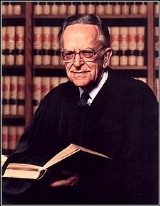
Harold Andrew Blackmun (November 12, 1908 – March 4, 1999) was an Associate Justice of the Supreme Court of the United States from 1970 until 1994. He is best known as the author of Roe v. Wade.
y Blackmun was born in Nashville, Illinois, and grew up in Dayton's Bluff, a working-class neighborhood in Saint Paul, Minnesota. He attended Harvard College on scholarship, earning a bachelor's degree in mathematics summa cum laude Phi Beta Kappa in 1929 . While at Harvard, Blackmun joined Lambda Chi Alpha Fraternity and sang with the Harvard Glee Club.

Discussion
Ask a question about 'Harry Blackmun'
Start a new discussion about 'Harry Blackmun'
Answer questions from other users
|
Quotations
From this day forward, I no longer shall tinker with the machinery of death.
Part of an opinion handed down in the Supreme Court in February 1994, quoted in William J Quirk and R Randall Bridwell Judicial Dictatorship (1995) p. 120

Encyclopedia
Harold Andrew Blackmun (November 12, 1908 – March 4, 1999) was an Associate Justice of the Supreme Court of the United States from 1970 until 1994. He is best known as the author of Roe v. Wade.
Early years and professional career
Harry Blackmun was born in Nashville, Illinois, and grew up in Dayton's Bluff, a working-class neighborhood in Saint Paul, Minnesota. He attended Harvard College on scholarship, earning a bachelor's degree in mathematics summa cum laude Phi Beta Kappa in 1929 . While at Harvard, Blackmun joined Lambda Chi Alpha Fraternity and sang with the Harvard Glee Club. He attended Harvard Law School (among his professors there was Felix Frankfurter), graduating in 1932. He served in a variety of positions including private counsel, law clerk, and adjunct faculty at the University of Minnesota Law School and William Mitchell College of Law (then the St. Paul College of Law). Blackmun's practice as an attorney at the law firm now known as Dorsey & Whitney focused in its early years on taxation, trusts and estates, and civil litigation. He married Dorothy Clark in 1941 and had three daughters with her, Nancy, Sally, and Susan. Between 1950 and 1959, Blackmun served as resident counsel for the Mayo Clinic in Rochester, Minnesota.
Appellate bench
President Dwight David Eisenhower appointed Blackmun to the United States Court of Appeals for the Eighth Circuit on 4 November 1959. He replaced John B. Sanborn, Jr., for whom he had clerked twenty-six years earlier. Blackmun's opinions on the circuit court level were mainly tax-related, although he wrote influential opinions about other matters, including Jackson v. Bishop (1968), one of the first appellate opinion to declare that physical abuse of prisoners was cruel and unusual punishment under the Constitution.
Blackmun's tenure on the Supreme Court
Blackmun was nominated to the Supreme Court by President Richard M. Nixon on April 4, 1970, and was confirmed by the Senate on May 12, 1970, by a 94–0 vote. His confirmation followed contentious battles over two previous, failed nominations forwarded by Nixon in 1969-1970, those of Clement Haynsworth and G. Harrold Carswell.
Early years on the Supreme Court
Blackmun, a lifelong Republican, was expected to adhere to a conservative interpretation of the Constitution. The Court's Chief Justice at the time, Warren Burger, a long-time friend of Blackmun's and at whose wedding Blackmun was best man, had recommended Blackmun for the job to Nixon. The two were often referred to as the "Minnesota Twins" (a reference to the baseball team, the Minnesota Twins) because of their common history in Minnesota and because they so often voted together. Indeed, Blackmun voted with Burger in 87.5% of the closely-divided cases during his first five terms (1970 to 1975), and with Brennan, the Court's leading liberal, in only 13 percent. In 1972 Blackmun joined Burger and the other two Nixon appointees to the Court in dissenting from the Furman v. Georgia decision that invalidated all capital punishment laws then in force in the United States, and in 1976 he voted to reinstate the death penalty in Gregg v. Georgia, even the mandatory death penalty statutes, although in both instances he indicated his personal opinion of its shortcomings as a policy. Blackmun, however, insisted his political opinions should have no bearing on the death penalty's constitutionality.
That began to change, however, between 1975 and 1980, by which time Blackmun was joining Brennan in 54.5 percent of the divided cases, and Burger in 45.5 percent. Shortly after Blackmun dissented in Rizzo v. Goode (1976), William Kunstler embraced him and "welcom[ed] him to the company of the 'liberals and the enlightened.'" During the final five years that Blackmun and Burger served together, Blackmun joined Brennan in 70.6% of the close cases, and Burger in only 32.4%.
Blackmun and abortion
A turning point came in 1973. That year, Blackmun authored the Court's opinion in Roe v. Wade, invalidating a Texas statute making it a felony to administer an abortion in most circumstances. The Court's judgment in the companion case of Doe v. Bolton held a less restrictive Georgia law to be unconstitutional also. Both decisions were based on the right to privacy announced in Griswold v. Connecticut (1965), and remain the primary basis for the constitutional right to abortion in the United States. Roe caused an immediate uproar, and Blackmun's opinion made him a target for criticism by opponents of abortion, receiving voluminous negative mail and death threats over the case.
Blackmun became a passionate advocate for abortion rights, often delivering speeches and lectures promoting Roe v. Wade as essential to women's equality and criticizing Roes critics. On the bench, he always voted to strike down laws interfering with women receiving abortions. Defending abortion, in Thornburgh v. American College of Obstetricians and Gynecologists Blackmun wrote: "Few decisions are more personal and intimate, more properly private, or more basic to individual dignity and autonomy, than a woman's decision - with the guidance of her physician and within the limits specified in Roe - whether to end her pregnancy. A woman's right to make that choice freely is fundamental..." Blackmun filed emotional separate opinions in 1989's Webster v. Reproductive Health Services and 1992's Planned Parenthood v. Casey, warning that Roe was in jeopardy: "I am 83 years old. I cannot remain on this Court forever, and when I do step down, the confirmation process for my successor well may focus on the issue before us today. That, I regret, may be exactly where the choice between the two worlds will be made."
Ancillary to the primary right to abortion, Blackmun extended First Amendment protection to commercial speech in Bigelow v. Commonwealth of Virginia, a case where the Supreme Court overturned the conviction of an editor who ran an advertisement for an abortion referral service.
Transition to the left
The controversy arising from Roe had a profound effect on Blackmun, and afterwards, he gradually began to drift away from the influence of Chief Justice Warren Burger to increasingly side with liberal Justice William J. Brennan in finding constitutional protection for unenumerated individual rights. For example, Blackmun wrote a blistering dissent to the Court's opinion in 1986's Bowers v. Hardwick, denying constitutional protection to homosexual sodomy (Burger wrote a concurring opinion in Bowers in which he said, "To hold that the act of homosexual sodomy is somehow protected as a fundamental right would be to cast aside millennia of moral teaching.") Burger and Blackmun drifted apart, and as the years passed, their lifelong friendship degenerated into a hostile and contentious relationship.
From the 1981 term through the 1985 term, Blackmun voted with Justice Brennan 77.6% of the time, and with Thurgood Marshall 76.1%. From 1986 to 1990, his rate of agreement with the two most liberal justices was 97.1% and 95.8%.
Blackmun's judicial philosophy increasingly seemed guided by Roe, even in areas where Roe was not directly applicable. His concurring opinion in 1981's Michael M. v. Superior Court, a case that upheld statutory rape laws that applied only to men but did not implicate Roe or abortion, nonetheless included extensive citation of the Court's recent abortion cases.
Later years on the bench: Blackmun and the death penalty
Blackmun is widely considered to have moved to the left over the years, but he himself felt that the Court changed around him, growing more conservative with the elevation of William Rehnquist to Chief Justice and the replacement of the last of the Warren Court justices.
Still, Blackmun undoubtedly changed his views on many issues. For example, despite his stated personal 'abhorrence' for the death penalty in Furman v. Georgia, he voted to uphold mandatory death penalty statutes at issue in 1976's Roberts v. Louisiana and Woodson v. North Carolina, even though these laws would have automatically imposed the death penalty on anyone found guilty of first-degree murder. But on February 22, 1994, less than two months before announcing his retirement, Blackmun announced that he now saw the death penalty as always and in all circumstances unconstitutional by issuing a dissent from the Court's refusal to hear a routine death penalty case (Callins v. Collins), declaring that "[f]rom this day forward, I no longer shall tinker with the machinery of death." Subsequently, adopting the practice begun by Justices Brennan and Marshall, he issued a dissent from denial of certiorari in every death penalty case, citing and reiterating his Callins dissent. As Linda Greenhouse and others have reported, Blackmun's law clerks prepared what would become the Callins dissent well in advance of the case coming before the Court; Blackmun's papers indicate that work began on the dissent in the summer of 1993, and in a memo preserved in Blackmun's papers, the clerk writing the dissent wrote Blackmun that "[t]his is a very personal dissent, and I have struggled to adopt your 'voice' to the best of my ability. I have tried to put myself in your shoes and write a dissent that would reflect the wisdom you have gained, and the frustration you have endured, as a result of twenty years of enforcing the death penalty on this Court." Blackmun and his clerks then sought an appropriate case to serve as a "vehicle for [the] dissent," and settled on Callins. (That the case found the dissent, rather than the more traditional relationship of the dissent relating to the case, is underscored by the opinion's almost total omission of reference to the case it ostensibly addressed: Callins is relegated to a supernumerary in his own appeal, being mentioned but five times in a 42-paragraph opinion - three times within the first two paragraphs, and twice in footnote 2.).
In his emotional dissent in 1989's DeShaney v. Winnebago County, rejecting the constitutional liability of the state of Wisconsin for four-year-old Joshua DeShaney, who was beaten until brain-damaged by his abusive father, Blackmun famously opined, "Poor Joshua!" In his dissent in 1993's Herrera v. Collins, where the Court refused to find a constitutional right for convicted prisoners to introduce new evidence of "actual innocence" for purposes of obtaining federal relief, Blackmun argued in a section joined by no other justice that "The execution of a person who can show that he is innocent comes perilously close to simple murder."
Like Justice Byron White, Blackmun was amenable to granting certiorari to most petitions that crossed his desk (indeed, he wrote numerous dissents from denial of cert). At least partially as a result of White and Blackmun's retirements, the number of cases heard each session of the Court declined steeply. In the 1970s and early 1980s, it was not unusual for the Court to decide upwards of 150 cases a term, but by the late 1990s, the Court was typically deciding around 80 cases per term.
Women's rights
After his opinion in Roe v. Wade, Blackmun was seen more and more as a champion of women's rights. In Stanton v. Stanton, a case striking down a state's discriminatory definitions of adulthood (males reaching it at 21, women at 18), Blackmun wrote: "A child, male or female, is still a child... No longer is the female destined solely for the home and the rearing of the family, and only the male for the marketplace and the world of ideas... If a specified age of minority is required for the boy in order to assure him parental support while he attains his education and training, so, too, is it for the girl."
Relationship with other justices
When Blackmun's papers were released at the Library of Congress, his sometimes negative notations regarding fellow Justice Clarence Thomas came to light. However, Thomas spoke positively of Blackmun when he appeared in 2001 at the dedication of the Harry A. Blackmun Rotunda at the St. Louis federal courthouse, mentioning that Blackmun drove a blue Volkswagen Beetle and would tell fast food workers that he was "Harry. I work for the government."
Post-Supreme Court
Blackmun announced his retirement from the Supreme Court in April 1994, four months before he officially left the bench. By then, he had become the court's most liberal justice. In his place, President Bill Clinton nominated Stephen Breyer who was confirmed by the Senate 87-9.
Blackmun is the only Supreme Court justice to have played one in a motion picture. In 1997, he portrayed Justice Joseph Story in the Steven Spielberg film Amistad.
On February 22, 1999, Blackmun fell in his home and broke his hip. The next day, he underwent hip replacement surgery at Arlington Hospital in Arlington, Virginia, but he never fully recovered. Ten days later, on March 4, he died at 1 a.m. from complications following the procedure. He was buried five days later at Arlington National Cemetery. His wife died seven years later on July 13, 2006, at the age of 95 and was buried next to him.
At Blackmun's will, in 2004 (five years after his death) the Library of Congress released his voluminous files. Blackmun had kept all the documents from every case, notes the Justices passed between themselves, ten percent of the mail he received, and numerous other documents. After Blackmun announced his retirement from the Court, he recorded a 38-hour oral history with one of his former law clerks, Yale University dean Harold Koh, which was also released. In it, he discusses his thoughts on everything from his important Court cases to the Supreme Court piano, though some Supreme Court experts such as David Garrow have cast doubt on the accuracy of some of Blackmun's recollections, especially his thoughts on the Court's deliberations on Roe v. Wade.
Based on these papers, Linda Greenhouse of The New York Times wrote Becoming Justice Blackmun.
Further reading
My Life. Vintage. ISBN 1-4000-3003-X.Greenhouse, Linda (2005). Becoming Justice Blackmun. Henry Holt. ISBN 0-8050-8057-0. Woodward, Robert and Armstrong, Scott. The Brethren: Inside the Supreme Court (1979). ISBN 9780380521838; ISBN 0380521830. ISBN 9780671241100; ISBN 0671241109; ISBN 0743274024; ISBN 9780743274029.Wrightsman, Lawrence S., and Justin R. La Mort (2005). . Missouri Law Review 70.Yarbrough, Tinsley. Harry A. Blackmun: The Outsider Justice. Oxford University Press. ISBN 0195141237..
External links
|