

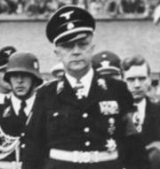
Karl von Eberstein

Encyclopedia
Freiherr
The German titles Freiherr and Freifrau and Freiin are titles of nobility, used preceding a person's given name or, after 1919, before the surname...
Freidrich Karl von Eberstein (14 January 1894 in Halle - 10 February 1979 in Tegernsee
Tegernsee
Tegernsee is a town in the Miesbach district of Bavaria, Germany. It is located on the shore of Tegernsee lake, at an elevation of 747 m above sea level....
) was a member of the German
Germany
Germany , officially the Federal Republic of Germany , is a federal parliamentary republic in Europe. The country consists of 16 states while the capital and largest city is Berlin. Germany covers an area of 357,021 km2 and has a largely temperate seasonal climate...
nobility
Nobility
Nobility is a social class which possesses more acknowledged privileges or eminence than members of most other classes in a society, membership therein typically being hereditary. The privileges associated with nobility may constitute substantial advantages over or relative to non-nobles, or may be...
, early member of the Nazi party, the SA
Sturmabteilung
The Sturmabteilung functioned as a paramilitary organization of the National Socialist German Workers' Party . It played a key role in Adolf Hitler's rise to power in the 1920s and 1930s...
, the SS, Reichstag
Reichstag (Weimar Republic)
The Reichstag was the parliament of Weimar Republic .German constitution commentators consider only the Reichstag and now the Bundestag the German parliament. Another organ deals with legislation too: in 1867-1918 the Bundesrat, in 1919–1933 the Reichsrat and from 1949 on the Bundesrat...
delegate, an HSSPF and SS-Oberabschnitt
SS-Oberabschnitt
Units and commands of the Schutzstaffel were organizational titles used by the SS to describe the many groups, forces, and formations that existed within the SS from its inception in 1923 to the eventual fall of Nazi Germany in 1945....
Führer, head of the Munich
Munich
Munich The city's motto is "" . Before 2006, it was "Weltstadt mit Herz" . Its native name, , is derived from the Old High German Munichen, meaning "by the monks' place". The city's name derives from the monks of the Benedictine order who founded the city; hence the monk depicted on the city's coat...
Police in World War II
World War II
World War II, or the Second World War , was a global conflict lasting from 1939 to 1945, involving most of the world's nations—including all of the great powers—eventually forming two opposing military alliances: the Allies and the Axis...
, introduced Reinhard Heydrich
Reinhard Heydrich
Reinhard Tristan Eugen Heydrich , also known as The Hangman, was a high-ranking German Nazi official.He was SS-Obergruppenführer and General der Polizei, chief of the Reich Main Security Office and Stellvertretender Reichsprotektor of Bohemia and Moravia...
to Heinrich Himmler
Heinrich Himmler
Heinrich Luitpold Himmler was Reichsführer of the SS, a military commander, and a leading member of the Nazi Party. As Chief of the German Police and the Minister of the Interior from 1943, Himmler oversaw all internal and external police and security forces, including the Gestapo...
, and was a witness at the Nuremberg Trials
Nuremberg Trials
The Nuremberg Trials were a series of military tribunals, held by the victorious Allied forces of World War II, most notable for the prosecution of prominent members of the political, military, and economic leadership of the defeated Nazi Germany....
.
Early life and career
Eberstein was born on January 14, 1894 in Halle on the SaaleHalle, Saxony-Anhalt
Halle is the largest city in the German state of Saxony-Anhalt. It is also called Halle an der Saale in order to distinguish it from the town of Halle in North Rhine-Westphalia...
, of the Dillenburger branch of the von Eberstein family. His father was an Army major. He was at Cadet schools until 1912. In World War I
World War I
World War I , which was predominantly called the World War or the Great War from its occurrence until 1939, and the First World War or World War I thereafter, was a major war centred in Europe that began on 28 July 1914 and lasted until 11 November 1918...
he served in the German army with Field Artillery Regiment 17 in Aug 1914. He was also a balloon observer, and later a battery commander in Artillery Regiment 16. He was awarded the Iron Cross
Iron Cross
The Iron Cross is a cross symbol typically in black with a white or silver outline that originated after 1219 when the Kingdom of Jerusalem granted the Teutonic Order the right to combine the Teutonic Black Cross placed above a silver Cross of Jerusalem....
First Class and an Iron Cross
Iron Cross
The Iron Cross is a cross symbol typically in black with a white or silver outline that originated after 1219 when the Kingdom of Jerusalem granted the Teutonic Order the right to combine the Teutonic Black Cross placed above a silver Cross of Jerusalem....
Second Class After World War I, Eberstein fought with Freikorps
Freikorps
Freikorps are German volunteer military or paramilitary units. The term was originally applied to voluntary armies formed in German lands from the middle of the 18th century onwards. Between World War I and World War II the term was also used for the paramilitary organizations that arose during...
in Middle Germany and/or Upper Silesia
Upper Silesia
Upper Silesia is the southeastern part of the historical and geographical region of Silesia. Since the 9th century, Upper Silesia has been part of Greater Moravia, the Duchy of Bohemia, the Piast Kingdom of Poland, again of the Lands of the Bohemian Crown and the Holy Roman Empire, as well as of...
, and also with the Halle "Protection Police". After that, he went into banking.
Eberstein joined the Nazi party in 1922, quit after the Beer Hall Putsch, then came back in 1925. He was on was on Himmler's staff. According to Jonathan Petropolous, Eberstein was part of Himmler's strategy to attract members of the nobility and aristocracy to the SS. He held the very early SS membership number of 1386. He was one of the first officers of the SS, as an SS-Sturmführer on 1929 Apr 1. He also joined the SA in July 1930 but left it later.
He eventually reached the rather high rank of SS Obergruppenfuhrer
Obergruppenführer
Obergruppenführer was a Nazi Party paramilitary rank that was first created in 1932 as a rank of the SA and until 1942 it was the highest SS rank inferior only to Reichsführer-SS...
, held two HSSPF posts, and was the Führer of SS-Oberabschnitt
SS-Oberabschnitt
Units and commands of the Schutzstaffel were organizational titles used by the SS to describe the many groups, forces, and formations that existed within the SS from its inception in 1923 to the eventual fall of Nazi Germany in 1945....
Mitte (and Elbe when Mitte was absorbed), and then later Führer of SS-Oberabschnitt
SS-Oberabschnitt
Units and commands of the Schutzstaffel were organizational titles used by the SS to describe the many groups, forces, and formations that existed within the SS from its inception in 1923 to the eventual fall of Nazi Germany in 1945....
Süd for over 10 years.
Heydrich and Himmler
Eberstein was apparently responsible for the meeting of two of the major leaders of the Holocaust: Reinhard HeydrichReinhard Heydrich
Reinhard Tristan Eugen Heydrich , also known as The Hangman, was a high-ranking German Nazi official.He was SS-Obergruppenführer and General der Polizei, chief of the Reich Main Security Office and Stellvertretender Reichsprotektor of Bohemia and Moravia...
and Heinrich Himmler
Heinrich Himmler
Heinrich Luitpold Himmler was Reichsführer of the SS, a military commander, and a leading member of the Nazi Party. As Chief of the German Police and the Minister of the Interior from 1943, Himmler oversaw all internal and external police and security forces, including the Gestapo...
. Eberstein and Heydrich's families were both from Halle on the Saale
Halle, Saxony-Anhalt
Halle is the largest city in the German state of Saxony-Anhalt. It is also called Halle an der Saale in order to distinguish it from the town of Halle in North Rhine-Westphalia...
. His mother was Heydrich's godmother. He apparently was a friend of Lina Heydrich, Reinhard Heydrich's wife. She was involved in Nazi party activities in Kiel
Kiel
Kiel is the capital and most populous city in the northern German state of Schleswig-Holstein, with a population of 238,049 .Kiel is approximately north of Hamburg. Due to its geographic location in the north of Germany, the southeast of the Jutland peninsula, and the southwestern shore of the...
as was Eberstein.
Role during Kristallnacht
Eberstein was the police president of Munich during KristallnachtKristallnacht
Kristallnacht, also referred to as the Night of Broken Glass, and also Reichskristallnacht, Pogromnacht, and Novemberpogrome, was a pogrom or series of attacks against Jews throughout Nazi Germany and parts of Austria on 9–10 November 1938.Jewish homes were ransacked, as were shops, towns and...
. On November 10, 1938, at 1:20 AM Heydrich sent out a telegram to various police organizations giving orders for police behavior during the riots. At 2:10 Eberstein sent a telegram to the State Police HQ of Augsburg, Nurnburg, Wurzburg, and Neustadt a.d. Weinstrasse, the Regierungsprasident, and the Gauleiter
Gauleiter
A Gauleiter was the party leader of a regional branch of the NSDAP or the head of a Gau or of a Reichsgau.-Creation and Early Usage:...
, with the subject line "Anti-Jewish Measures". It relayed orders 'from the Berlin HQ of the State Police', saying that 'Anti-Jewish demonstrations' would occur, with synagogues and Jewish communal centers as targets, and that the demonstrations were not to be interfered with, except to prevent looting and excesses. The Ordnungspolizei would 'do nothing to hinder the demonstrations', but the Kriminal Polizei and State Police would wear plainclothes. The SS troops could help, but the State Police was supposed to maintain control. Also it said that between 20 and 30,000 Jews would be arrested in Germany. It ended with this: "Every effort will be made to arrest immediately as many Jews as the jails will hold, primarily healthy male and well-to-do adults of not too advanced age" A document from Beutel (probably :de:Lothar Beutel), HQ of State Police Munich, 6 minutes later, said that 'officers of the state and criminal police' would accompany the demonstrators in plain clothes, allow them to destroy Jewish shops and homes, but to prevent looting, after which the Ordnungspolizei would secure the destroyed buildings.
Holocaust Denier David Irving
David Irving
David John Cawdell Irving is an English writer,best known for his denial of the Holocaust, who specialises in the military and political history of World War II, with a focus on Nazi Germany...
claimed that Eberstein was a witness to Hitler's anger on that night, and that Eberstein's testimony at Nuremberg helps prove that Hitler did not approve of Kristallnacht. This claim was refuted at the Irving v. Lipstadt trial. Evans, for the defense, claims that it made no sense for Eberstein to send his telegram of 2.10 AM if he had earlier that night listened to Hitler tirade angrily against the pogrom. The judge at the trial agreed that Irving "seriously misrepresents the available contemporaneous evidence"
Soviet POWs, Stalag VII A Moosburg, and the Gestapo
In late 1941, and early 1942, Eberstein was involved in the case of the Soviet POWs at Stalag VII A, Moosburg, and the conflict between some military officers and the SS over the murder of the POWs.The Gestapo was having problems with certain military officers, especially Major Meinel, who were not cooperating. Meinel was the military man in charge of POWs for the area including Munich and other nearby places. The Gestapo had been 'screening' Soviet POWs in Stalag VII A Moosburg, and then shipping the 'screened out' people to Dachau where they were murdered. Meinel discovered the murders were going on, and neglected to follow orders to send several hundred of the remaining 'screened out' Soviets to Dachau. He also complained to his superiors in the military about what was happening. 'Screened out' people included anyone who was Jewish, any officers, believers in communism, incurably sick people, etc., but the Gestapo told Meinel their methods of screening were not his business.
Eberstein became involved. In the book Nazi Conspiracy and Aggression, several telex / telegrams between the various offices involved have been translated and reproduced. These telegrams say that von Eberstein telephoned the RSHA
RSHA
The RSHA, or Reichssicherheitshauptamt was an organization subordinate to Heinrich Himmler in his dual capacities as Chef der Deutschen Polizei and Reichsführer-SS...
and told them that Meinel's staying in his position was 'intolerable', and would cause problems with the relationship between the military and the SS. He told the RSHA to ask the military's German High Command (the OKW) to get Meinel transferred to another position. After a few meetings, this is exactly what happened. The OKW decreed that the POWs that Meinel had temporarily saved would, after all, be surrendered to the Gestapo and then sent to Buchenwald. Meinel was later sent to Lithuania.
Authority over Dachau concentration camp
On March 12, 1938, Eberstein was appointed Higher SS and Police LeaderSS and Police Leader
SS and Police Leader was a title for senior Nazi officials that commanded large units of the SS, of Gestapo and of the regular German police during and prior to World War II.Three levels of subordination were established for bearers of this title:...
(HSSPF) for military district VII in Munich. In addition, on December 17, 1942 he was appointed HSSPF for the military district XIII in Nuremberg. Dachau concentration camp fell under Eberstein's authority as HSSPF.
Nuremberg testimony
Eberstein was a witness at the Nuremberg TrialsNuremberg Trials
The Nuremberg Trials were a series of military tribunals, held by the victorious Allied forces of World War II, most notable for the prosecution of prominent members of the political, military, and economic leadership of the defeated Nazi Germany....
. He was interviewed by Horst Pelckmann, counsel for the SS, and Major F Elwyn Jones
Elwyn Jones, Baron Elwyn-Jones
Frederick Elwyn Jones, Baron Elwyn-Jones CH, PC was a Welsh barrister and Labour politician.-Background and education:...
, junior counsel for the United Kingdom. In his testimony, Eberstein gave organizational information about the SS, its relationship to the SA, to the German nobility, to the Nazi party, to the SD
Sicherheitsdienst
Sicherheitsdienst , full title Sicherheitsdienst des Reichsführers-SS, or SD, was the intelligence agency of the SS and the Nazi Party in Nazi Germany. The organization was the first Nazi Party intelligence organization to be established and was often considered a "sister organization" with the...
(Security Service) and Gestapo
Gestapo
The Gestapo was the official secret police of Nazi Germany. Beginning on 20 April 1934, it was under the administration of the SS leader Heinrich Himmler in his position as Chief of German Police...
(Secret State Police), how many people were in it, where it started, the 1933-1935 Himmler purges, its changes during the war, and other organizational details. Eberstein also claimed that the SS was not in the view of his peers, a criminal organization, that it was not created for purposes of violence, did not participate in the invasion of Austria, that he knew nothing of SS participations in invasions of France, Belgium, Russia, Poland, etc. Also that "my men" in the General SS on home from "front leave" did not mention atrocities.
As for his personal place in the chain of command, he claimed that as Police President, he had control over 1700 men, in the Protection Police, Order Police, and Criminal Police. This refers to the Schutzpolizei
Schutzpolizei
The Schutzpolizei , or Schupo for short, is a branch of the Landespolizei, the state level police of the German states. Schutzpolizei literally means security or protection police but is best translated as Uniformed Police....
, Ordnungspolizei
Ordnungspolizei
The Ordnungspolizei or Orpo were the uniformed regular police force in Nazi Germany between 1936 and 1945. It was increasingly absorbed into the Nazi police system. Owing to their green uniforms, they were also referred to as Grüne Polizei...
, and Kriminalpolizei
Kriminalpolizei
is the standard term for the criminal investigation agency within the police forces of Germany, Austria and the German-speaking cantons of Switzerland. In Nazi Germany during 1936, the Kripo became the Criminal Police Department for the entire Reich...
. He claimed the "chiefs of police had nothing to do with the Political Police or the Security Service", meaning the Gestapo
Gestapo
The Gestapo was the official secret police of Nazi Germany. Beginning on 20 April 1934, it was under the administration of the SS leader Heinrich Himmler in his position as Chief of German Police...
, and the SD
Sicherheitsdienst
Sicherheitsdienst , full title Sicherheitsdienst des Reichsführers-SS, or SD, was the intelligence agency of the SS and the Nazi Party in Nazi Germany. The organization was the first Nazi Party intelligence organization to be established and was often considered a "sister organization" with the...
. It is unclear from this translation if he mentioned the Sicherheitspolizei
Sicherheitspolizei
The Sicherheitspolizei , often abbreviated as SiPo, was a term used in Nazi Germany to describe the state political and criminal investigation security agencies. It was made up by the combined forces of the Gestapo and the Kripo between 1936 and 1939...
or SiPo.
Eberstein also discussed his perspective on the Night of the Long Knives
Night of the Long Knives
The Night of the Long Knives , sometimes called "Operation Hummingbird " or in Germany the "Röhm-Putsch," was a purge that took place in Nazi Germany between June 30 and July 2, 1934, when the Nazi regime carried out a series of political murders...
and Kristallnacht
Kristallnacht
Kristallnacht, also referred to as the Night of Broken Glass, and also Reichskristallnacht, Pogromnacht, and Novemberpogrome, was a pogrom or series of attacks against Jews throughout Nazi Germany and parts of Austria on 9–10 November 1938.Jewish homes were ransacked, as were shops, towns and...
. In the latter, he claimed that he ordered his police to protect Jewish businesses, claimed 'We in the SS considered this action downright indecent', and blamed the events on a speech by Joseph Goebbels
Joseph Goebbels
Paul Joseph Goebbels was a German politician and Reich Minister of Propaganda in Nazi Germany from 1933 to 1945. As one of Adolf Hitler's closest associates and most devout followers, he was known for his zealous oratory and anti-Semitism...
. (But, see the previous section of this article discussing the telegrams he sent on that night). He also briefly discussed the treatment of downed enemy pilots re the Geneva Convention and Hague Rules on Land Warfare.
Denied involvement in the Dachau concentration camp
The Dachau Concentration Camp complex was only a few kilometers from Munich. The question arose in the Trial as to Eberstein's knowledge of the camp, authority over it, and participation in its activities. Eberstein denied everything. He claimed that the Allgemeine SSAllgemeine SS
The Allgemeine SS was the most numerous branch of the Schutzstaffel paramilitary forces of Nazi Germany. It was managed by the SS-Hauptamt...
(general SS), did not establish concentration camps, instead claiming that the State established them. Also, he claimed that the Higher SS and Police Leaders (HSSPF), and the leaders of the Allgemeine-SS had nothing to do with concentration camps. He claims the camps were under an independent chain of command, blaming the RSHA or Reichssicherheitshauptamt (Reich Main Security Office), the Economic and Administrative Main Office of the SS (SS-WVHA), and it's Amtsgruppe D, Inspectorate of Concentration Camps.
Eberstein also claimed to have given tours of Dachau concentration camp, on orders from Himmler, from 1936 on, including to some Americans. He claimed he had no reason to inspect the camps, and no right to do so either, but that they appeared to be run and during the war inmates looked 'well fed'. In Spring of 1944, he claimed he became aware of abhorrent medical experiments involving Sigmund Rascher
Sigmund Rascher
Sigmund Rascher was a German SS doctor.His deadly experiments on humans, planned and executed in the Nazi concentration camp of Dachau, were judged inhumane and criminal during the Nuremberg Trials.-Early life and career:Rascher was born the third child of Hanns-August Rascher , a...
, that he caused the arrest of Rascher, and that he complained to Himmler, and that Rascher was kept under arrest until 1945, but that he himself had no power over Rascher.
He also claimed that as HSSPF, Police President, nor Oberabschnitt leader, he had no authority over the camp commander, and he didn't know about the numerous executions inside the camp. He claimed he had nothing to do with Adolf Eichmann
Adolf Eichmann
Adolf Otto Eichmann was a German Nazi and SS-Obersturmbannführer and one of the major organizers of the Holocaust...
and never saw him. He claimed the SS troops in Dachau were separate from the rest of the SS and "we met them only occasionally".
POWs, HSSPF, and Waffen-SS. 1944
"In the fall of 1944 Himmler transferred to the Higher SS and Police Leaders the responsibility for safeguarding prisoner-of-war camps against mass escapes and against attempts from the outside to liberate prisoners. For this purpose, the Higher SS and Police Leaders were made senior commanders of the prisoners of war in their defense areas. According to international regulations regarding prisoners of war, police could not be used to guard prisoners of war, so the Higher SS and Police Leaders were taken over into the Waffen-SS and appointed generals of the Waffen-SS." - Eberstein's 1946 Nuremberg explanation for how he came to be in the Waffen-SSWaffen-SSThe Waffen-SS was a multi-ethnic and multi-national military force of the Third Reich. It constituted the armed wing of the Schutzstaffel or SS, an organ of the Nazi Party. The Waffen-SS saw action throughout World War II and grew from three regiments to over 38 divisions, and served alongside...
and to have some authority over POWs
He then claimed he had a dispute with Paul Giesler
Paul Giesler
Paul Giesler was a member of the NSDAP, from 1941 NSDAP Gauleiter of Westphalia-South and as of 1942 also acting Gauleiter of the Gau Munich-Upper Bavaria...
, after Giesler ordered him to kill 25,000 prisoners should the Americans approach, and he refused. He claimed the General SS mostly ceased to exist at the start of the war, and that the 'Gauleiter
Gauleiter
A Gauleiter was the party leader of a regional branch of the NSDAP or the head of a Gau or of a Reichsgau.-Creation and Early Usage:...
s; and 'Reich Defense Commissioners', under Martin Bormann
Martin Bormann
Martin Ludwig Bormann was a prominent Nazi official. He became head of the Party Chancellery and private secretary to Adolf Hitler...
, were to blame. He claimed he knew nothing about the Einsatzgruppen
Einsatzgruppen
Einsatzgruppen were SS paramilitary death squads that were responsible for mass killings, typically by shooting, of Jews in particular, but also significant numbers of other population groups and political categories...
, Einsatzkommandos, Auschwitz, etc. He claimed he was in Munich during the whole war, thought foreign newspaper reports of atrocities were 'enemy propaganda', and said it was impossible to 'penetrate into the secret sphere of these extermination camps'. He further claimed the General SS did not know either. He claimed the mass deaths on Typhus and allied bombing of medicine factories.
He did admit that some members of the Allgemeine-SS became concentration camp guards.
He was dismissed from all posts on April 20, 1945 for "defeatism", by Gauleiter Paul Giesler
Paul Giesler
Paul Giesler was a member of the NSDAP, from 1941 NSDAP Gauleiter of Westphalia-South and as of 1942 also acting Gauleiter of the Gau Munich-Upper Bavaria...
, on orders from Martin Bormann
Martin Bormann
Martin Ludwig Bormann was a prominent Nazi official. He became head of the Party Chancellery and private secretary to Adolf Hitler...
.
Timeline
- 1913 to 1914. University of Halle (Saale)
- 1914 August. Field Artillery Regiment 17
- 1915 Lieutenant in reservers
- 1918-? no later than early 1920s. FreikorpsFreikorpsFreikorps are German volunteer military or paramilitary units. The term was originally applied to voluntary armies formed in German lands from the middle of the 18th century onwards. Between World War I and World War II the term was also used for the paramilitary organizations that arose during...
in Middle Germany and Upper Silesia. - 1920s. Studied banking
- 1928. Independent factory owner in Gotha
- 1930. SS Sturmführer and Standarten-Adjutant
- 1930-1931. City council member, Gotha
- 1930 Jul - Jan 1931. Joined SASturmabteilungThe Sturmabteilung functioned as a paramilitary organization of the National Socialist German Workers' Party . It played a key role in Adolf Hitler's rise to power in the 1920s and 1930s...
. On staff of Gausturms in Weimar. - 1931 Feb 1. SA-Standartenführer
- 1931 Sep 15. SA-Oberführer
- 1931 Nov - 1932 Jul. Gau SA-Sturmführer for Munchen Oberbayern
- 1931 Nov 15 - 1932 Apr 13. SA Gausturm / Untergruppe München
- 1932 July 1 - 1933 Feb 19. Führer for SA Gruppe Hochland
- 1932 Sep 1. SA-Gruppenführer
- 1933 Feb. Leaves SA
- 1933 Feb 21 - 1933 Sept 9. SS-Gruppenführer, and Führer of SS-Abschnitt XVIII (HQ in Weimar)
- 1933 Nov 15 - 1934 May 1. Führer for SS-OberabschnittSS-OberabschnittUnits and commands of the Schutzstaffel were organizational titles used by the SS to describe the many groups, forces, and formations that existed within the SS from its inception in 1923 to the eventual fall of Nazi Germany in 1945....
Mitte (Halle) with 10-15,000 men under command - 1933.
- Located in Weimar, Thuringia.
- In Staatsrat in ThuringiaThuringiaThe Free State of Thuringia is a state of Germany, located in the central part of the country.It has an area of and 2.29 million inhabitants, making it the sixth smallest by area and the fifth smallest by population of Germany's sixteen states....
. - Delegate to the Nazi ReichstagReichstag (Weimar Republic)The Reichstag was the parliament of Weimar Republic .German constitution commentators consider only the Reichstag and now the Bundestag the German parliament. Another organ deals with legislation too: in 1867-1918 the Bundesrat, in 1919–1933 the Reichsrat and from 1949 on the Bundesrat...
for the 8th 'session' (Wahlperiod)
- 1934 May 1 - 1936 Apr 1. Führer for SS-OberabschnittSS-OberabschnittUnits and commands of the Schutzstaffel were organizational titles used by the SS to describe the many groups, forces, and formations that existed within the SS from its inception in 1923 to the eventual fall of Nazi Germany in 1945....
Elbe (which had absorbed Mitte) - 1934 June 30. (Night of the Long KnivesNight of the Long KnivesThe Night of the Long Knives , sometimes called "Operation Hummingbird " or in Germany the "Röhm-Putsch," was a purge that took place in Nazi Germany between June 30 and July 2, 1934, when the Nazi regime carried out a series of political murders...
) - in Dresden - 1934 Dec 15 to 1936 Mar 31. District Governor (Kreishauptmann), Dresden-Bautzen
- 1936. In Munich
- 1936 January 30. Becomes SS-Obergruppenfuhrer
- 1936 April 1. Führer of SS-OberabschnittSS-OberabschnittUnits and commands of the Schutzstaffel were organizational titles used by the SS to describe the many groups, forces, and formations that existed within the SS from its inception in 1923 to the eventual fall of Nazi Germany in 1945....
"Süd". Police president of Munich - 1938 Mar 12 to 1942 Dec 17. HSSPF 'Main' (Benno Martin was de-facto HSSPF)
- 1938 Apr 12 to 1945 Apr 20. HSSPF 'Süd'
- 1938 Nov 9-10.
- In chain of command for orders implementing (KristallnachtKristallnachtKristallnacht, also referred to as the Night of Broken Glass, and also Reichskristallnacht, Pogromnacht, and Novemberpogrome, was a pogrom or series of attacks against Jews throughout Nazi Germany and parts of Austria on 9–10 November 1938.Jewish homes were ransacked, as were shops, towns and...
). - Führer of SS-OberabschnittSS-OberabschnittUnits and commands of the Schutzstaffel were organizational titles used by the SS to describe the many groups, forces, and formations that existed within the SS from its inception in 1923 to the eventual fall of Nazi Germany in 1945....
Süd - Police President of Munich
- In chain of command for orders implementing (Kristallnacht
- 1939 Jun - Jul. Ill
- 1941 Apr 8. General der Polizei
- 1942 Oct - 1945 Apr. Worked in Bavarian State Ministry of the Interior
- 1944 Jul 1. General der Waffen-SS
- 1944 Nov. 1200 SS men left in his Oberabschnitt, none available for SS work
- 1945 early Feb. Dismissed, replaced by Vogler as temporary substitute for HSSPF and Oberabschnitt Führer "Süd"
- 1945 Apr 20. Relieved of all posts for 'defeatism'
- 1946 August 3 & 5. Nuremberg Trial witness, by which time he had been 'under arrest for 15 months'
- 1979 Feb 10. Died in Bavaria.
Denazification
The DenazificationDenazification
Denazification was an Allied initiative to rid German and Austrian society, culture, press, economy, judiciary, and politics of any remnants of the National Socialist ideology. It was carried out specifically by removing those involved from positions of influence and by disbanding or rendering...
of Germany included the classification of ex-Nazis into one of 5 categories. On 15 November 1948 Eberstein was classified by a German Denazification
Denazification
Denazification was an Allied initiative to rid German and Austrian society, culture, press, economy, judiciary, and politics of any remnants of the National Socialist ideology. It was carried out specifically by removing those involved from positions of influence and by disbanding or rendering...
court as a (class III) Nazi and ordered to forfeit of 30% of his wealth. No additional jail time was ordered, because he was given credit for the three and half-years internment under the Allies. After some additional legal procedures, Eberstein was temporarily placed into a more serious category of former Nazi (class II). However on February 19, 1953, he was finally classified in the less-serious category IV of Mitläufer, which can be roughly translated as "follower and sympathizer". Other criminal investigations of Eberstein were without consequences, including preliminary investigations in 1950 and 1961 by prosecuting authorities in Munich of charges that Eberstein had ordered or participated in the murders of prisoners of war.
See also
- Reichstag database, from the Bavarian State Library. Type in Eberstein and hit Enter.
- German Wikipedia entry: Karl von Eberstein
Books
English- Family Association of von Eberstein, descending from the Rhön. Family News, February 1958. Heiligenholz, Bavaria, Germany. (Translation of Geschlechtsverband derer von Eberstein stammend von der Rhön).
German
from
. Pages 36–38, 45, 103-107. Excerpt at http://www.moosburg.org/info/stalag/meinel.html (translate.google.com used)
Web
FromFrom