


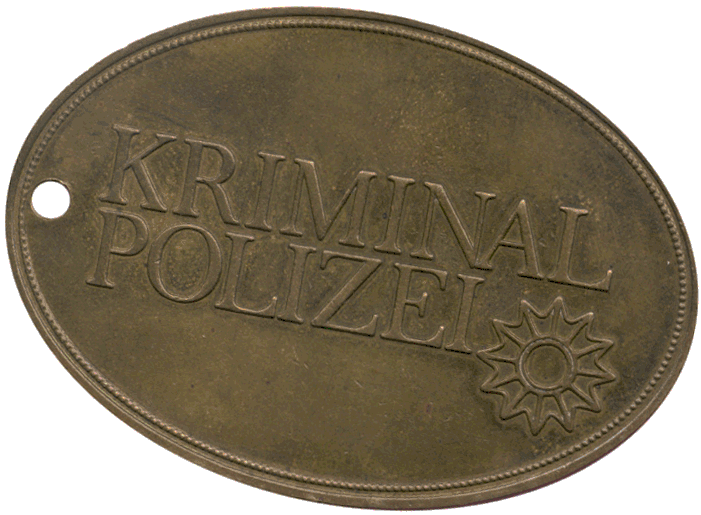
Kriminalpolizei

Encyclopedia
Police
The police is a personification of the state designated to put in practice the enforced law, protect property and reduce civil disorder in civilian matters. Their powers include the legitimized use of force...
forces of Germany
Germany
Germany , officially the Federal Republic of Germany , is a federal parliamentary republic in Europe. The country consists of 16 states while the capital and largest city is Berlin. Germany covers an area of 357,021 km2 and has a largely temperate seasonal climate...
, Austria
Austria
Austria , officially the Republic of Austria , is a landlocked country of roughly 8.4 million people in Central Europe. It is bordered by the Czech Republic and Germany to the north, Slovakia and Hungary to the east, Slovenia and Italy to the south, and Switzerland and Liechtenstein to the...
and the German-speaking cantons of Switzerland
Switzerland
Switzerland name of one of the Swiss cantons. ; ; ; or ), in its full name the Swiss Confederation , is a federal republic consisting of 26 cantons, with Bern as the seat of the federal authorities. The country is situated in Western Europe,Or Central Europe depending on the definition....
. In Nazi Germany
Nazi Germany
Nazi Germany , also known as the Third Reich , but officially called German Reich from 1933 to 1943 and Greater German Reich from 26 June 1943 onward, is the name commonly used to refer to the state of Germany from 1933 to 1945, when it was a totalitarian dictatorship ruled by...
during 1936, the Kripo became the Criminal Police Department for the entire Reich. In September 1939, the Kripo became Amt V (Department V), the Criminal Police in the RSHA
RSHA
The RSHA, or Reichssicherheitshauptamt was an organization subordinate to Heinrich Himmler in his dual capacities as Chef der Deutschen Polizei and Reichsführer-SS...
; which was also known as the Reichskriminalpolizeiamt (Reich Criminal Police Department or RKPA). Today, in the Federal Republic of Germany
Germany
Germany , officially the Federal Republic of Germany , is a federal parliamentary republic in Europe. The country consists of 16 states while the capital and largest city is Berlin. Germany covers an area of 357,021 km2 and has a largely temperate seasonal climate...
, the state police or Landespolizei
Landespolizei
thumb|[[Germany|German]] police officer in [[Hamburg]]The Landespolizei are the main police forces of Germany. They are under the sole jurisdiction, funded and operated by the states of Germany.-History:...
perform the majority of investigations. Its Criminal Investigation Department
Criminal Investigation Department
The Crime Investigation Department is the branch of all Territorial police forces within the British Police and many other Commonwealth police forces, to which plain clothes detectives belong. It is thus distinct from the Uniformed Branch and the Special Branch.The Metropolitan Police Service CID,...
is known as the Kriminalpolizei or, more colloquially, the Kripo.
Foundation
In 1799, six police officers were assigned to the Prussian Kammergericht (superior court of justice) in BerlinBerlin
Berlin is the capital city of Germany and is one of the 16 states of Germany. With a population of 3.45 million people, Berlin is Germany's largest city. It is the second most populous city proper and the seventh most populous urban area in the European Union...
to investigate more prominent crimes. They were given permission to work in plainclothes, when necessary. Their number increased in the following years.
In 1811, their rules of service were written into the Berliner Polizeireglement (Berlin Police Regulations) and in 1820 the rank of Kriminalkommissar was introduced for criminal investigators. In 1872 the new Kriminalpolizei was made a separate branch of police service distinguishing it from the uniformed police called Schutzpolizei
Schutzpolizei
The Schutzpolizei , or Schupo for short, is a branch of the Landespolizei, the state level police of the German states. Schutzpolizei literally means security or protection police but is best translated as Uniformed Police....
.
Based on the experience with this new kind of police force, other German states—such as Bremen
Bremen
The City Municipality of Bremen is a Hanseatic city in northwestern Germany. A commercial and industrial city with a major port on the river Weser, Bremen is part of the Bremen-Oldenburg metropolitan area . Bremen is the second most populous city in North Germany and tenth in Germany.Bremen is...
in 1852—reformed their police forces and by the end of the nineteenth century the Kriminalpolizei had been established nationwide.
During the early part of the 20th century and post-World War I
World War I
World War I , which was predominantly called the World War or the Great War from its occurrence until 1939, and the First World War or World War I thereafter, was a major war centred in Europe that began on 28 July 1914 and lasted until 11 November 1918...
, the Kripo continued to serve as the German state's investigative agency for all criminal activity. However, when Adolf Hitler
Adolf Hitler
Adolf Hitler was an Austrian-born German politician and the leader of the National Socialist German Workers Party , commonly referred to as the Nazi Party). He was Chancellor of Germany from 1933 to 1945, and head of state from 1934 to 1945...
assumed power in 1933, the Kriminalpolizei would be subordinated to the SS
Schutzstaffel
The Schutzstaffel |Sig runes]]) was a major paramilitary organization under Adolf Hitler and the Nazi Party. Built upon the Nazi ideology, the SS under Heinrich Himmler's command was responsible for many of the crimes against humanity during World War II...
.
Nazi Germany
After Hitler took office in January 1933, he soon began a programme of NazificationGleichschaltung
Gleichschaltung , meaning "coordination", "making the same", "bringing into line", is a Nazi term for the process by which the Nazi regime successively established a system of totalitarian control and tight coordination over all aspects of society. The historian Richard J...
of all aspects of German life, in order to consolidate the Nazi party's hold on power. In July 1936, the Kripo became the Criminal Police Department for the entire Reich. It was merged, along with the Gestapo
Gestapo
The Gestapo was the official secret police of Nazi Germany. Beginning on 20 April 1934, it was under the administration of the SS leader Heinrich Himmler in his position as Chief of German Police...
into the Sicherheitspolizei
Sicherheitspolizei
The Sicherheitspolizei , often abbreviated as SiPo, was a term used in Nazi Germany to describe the state political and criminal investigation security agencies. It was made up by the combined forces of the Gestapo and the Kripo between 1936 and 1939...
(SiPo). At that point, Reinhard Heydrich
Reinhard Heydrich
Reinhard Tristan Eugen Heydrich , also known as The Hangman, was a high-ranking German Nazi official.He was SS-Obergruppenführer and General der Polizei, chief of the Reich Main Security Office and Stellvertretender Reichsprotektor of Bohemia and Moravia...
was in overall command of the SiPo (Gestapo and Kripo) and the Sicherheitsdienst (SD)
Sicherheitsdienst
Sicherheitsdienst , full title Sicherheitsdienst des Reichsführers-SS, or SD, was the intelligence agency of the SS and the Nazi Party in Nazi Germany. The organization was the first Nazi Party intelligence organization to be established and was often considered a "sister organization" with the...
. Nebe was appointed head of the Kriminalpolizei (Kripo). As head of the Kripo, Nebe reported to Heydrich.
In September 1939, the Reichssicherheitshauptamt or Reich Main Security Office (RSHA) was created as the command organization for the various state investigation and security agencies. The SiPo was officially abolished and its departments (Gestapo and Kripo) were folded into the RSHA. The Kripo became Amt V (Department V), the Criminal Police in the RSHA; which was also known as the Reichskriminalpolizeiamt (Reich Criminal Police Department or RKPA). It was commanded by Arthur Nebe
Arthur Nebe
SS-Gruppenführer Arthur Nebe was a member of the NSDAP party with card number 574,307. In July 1931, he joined the SS and his membership number was 280,152. His early career included the Berlin position of Police Commissioner in the 1920s...
until 1944, when Nebe was denounced and executed after the failed attempt to kill Adolf Hitler
Adolf Hitler
Adolf Hitler was an Austrian-born German politician and the leader of the National Socialist German Workers Party , commonly referred to as the Nazi Party). He was Chancellor of Germany from 1933 to 1945, and head of state from 1934 to 1945...
in July 1944. In the last year of its existence, Amt V (the Kripo) answered directly to Ernst Kaltenbrunner
Ernst Kaltenbrunner
Ernst Kaltenbrunner was an Austrian-born senior official of Nazi Germany during World War II. Between January 1943 and May 1945, he held the offices of Chief of the Reichssicherheitshauptamt , President of Interpol and, as a Obergruppenführer und General der Polizei und Waffen-SS, he was the...
, the head of the RSHA after Heydrich's assassination in 1942.
The Kriminalpolizei were mostly plain-clothes detectives, worked in conjunction with the Ordnungspolizei
Ordnungspolizei
The Ordnungspolizei or Orpo were the uniformed regular police force in Nazi Germany between 1936 and 1945. It was increasingly absorbed into the Nazi police system. Owing to their green uniforms, they were also referred to as Grüne Polizei...
, the uniformed branch of the police and other agencies such as the Geheime Feldpolizei
Geheime Feldpolizei
The ' or GFP, was the secret military police of the German Wehrmacht until the end of Second World War. These units were used to carry out plain-clothed security work in the field such as counter-espionage, counter sabotage, detection of treasonable activities, counter-propaganda and to provide...
. The policy directives came from the SS-Hauptamt
SS-Hauptamt
The SS-Hauptamt was the central command office of the German Schutzstaffel in Nazi Germany until 1940.-Formation:...
. The Kripo was organized in a hierarchical system, with central offices in all towns and smaller cities. These, in turn, answered to headquarters offices in the larger German cities which answered to the Central Office of the Kriminalpolizei, a department of the RSHA
RSHA
The RSHA, or Reichssicherheitshauptamt was an organization subordinate to Heinrich Himmler in his dual capacities as Chef der Deutschen Polizei and Reichsführer-SS...
.
The Kriminalpolizei was mainly concerned with serious crimes such as rape
Rape
Rape is a type of sexual assault usually involving sexual intercourse, which is initiated by one or more persons against another person without that person's consent. The act may be carried out by physical force, coercion, abuse of authority or with a person who is incapable of valid consent. The...
, murder
Murder
Murder is the unlawful killing, with malice aforethought, of another human being, and generally this state of mind distinguishes murder from other forms of unlawful homicide...
and arson
Arson
Arson is the crime of intentionally or maliciously setting fire to structures or wildland areas. It may be distinguished from other causes such as spontaneous combustion and natural wildfires...
. A main area of the group's focus was also on "blackout burglary
Burglary
Burglary is a crime, the essence of which is illicit entry into a building for the purposes of committing an offense. Usually that offense will be theft, but most jurisdictions specify others which fall within the ambit of burglary...
," considered a serious problem during bombing raids when criminals would raid abandoned homes, shops and factories for any available valuables. The Kripo was also one of the sources of manpower used to fill the ranks of the Einsatzgruppen
Einsatzgruppen
Einsatzgruppen were SS paramilitary death squads that were responsible for mass killings, typically by shooting, of Jews in particular, but also significant numbers of other population groups and political categories...
and several senior Kripo commanders, Artur Nebe among them, were assigned as Einsatzgruppen commanders.
Psychiatrist
A psychiatrist is a physician who specializes in the diagnosis and treatment of mental disorders. All psychiatrists are trained in diagnostic evaluation and in psychotherapy...
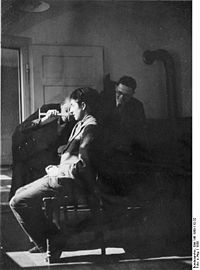
Dr. Robert Ritter
Robert Ritter
Robert Ritter, Ph. D. was a German psychologist and physician best known for his work related to the Roma people, that contributed to repressive measures against them....
, was attached to the Kriminalpolizei. Its role was to create racial profiles of non-aryans, in particular, Roma. Both the Gestapo and the Kripo deferred their policies and guidelines to the Criminal Biological department on how to deal with Gypsies. The Kripo aided in the round ups of Roma and their deportations to concentration camps
Nazi concentration camps
Nazi Germany maintained concentration camps throughout the territories it controlled. The first Nazi concentration camps set up in Germany were greatly expanded after the Reichstag fire of 1933, and were intended to hold political prisoners and opponents of the regime...
and extermination camps.
Post World War II
In 1945, the occupying Allied Powers began their own programe of de-Nazification. It was understood that, in a totalitarian state, few people could participate in public service without being simultaneously members of the Nazi Party. Party membership alone was not viewed as sufficient grounds for dismissal, but allegations of involvement or complicity in Nazi war crimes or crimes against humanity were investigated and any police official convicted was sentenced in the usual way.However the Allied Powers felt the rule of law would be jeopardised by the mass-sacking of police officials who had served the Nazi state and that maintaining the continuity of a civilian and indigenous police force from the outset, together with all its accumulated practical skills and experience, was the most efficient way of restoring democracy to the German people. Thus the Kriminalpolizei adapted once more to the changes in oversight and accountability and, as with other public servants, took the political and economic change of the post-war years in its stride.
Present day
The Federal Republic of GermanyGermany
Germany , officially the Federal Republic of Germany , is a federal parliamentary republic in Europe. The country consists of 16 states while the capital and largest city is Berlin. Germany covers an area of 357,021 km2 and has a largely temperate seasonal climate...
divides police responsibilities between federal and state authorities. The state police or Landespolizei
Landespolizei
thumb|[[Germany|German]] police officer in [[Hamburg]]The Landespolizei are the main police forces of Germany. They are under the sole jurisdiction, funded and operated by the states of Germany.-History:...
of the federal states
States of Germany
Germany is made up of sixteen which are partly sovereign constituent states of the Federal Republic of Germany. Land literally translates as "country", and constitutionally speaking, they are constituent countries...
perform the majority of investigations in Germany.
Within the Landespolizei, the Criminal Investigation Department
Criminal Investigation Department
The Crime Investigation Department is the branch of all Territorial police forces within the British Police and many other Commonwealth police forces, to which plain clothes detectives belong. It is thus distinct from the Uniformed Branch and the Special Branch.The Metropolitan Police Service CID,...
is known as the Kriminalpolizei or Kripo. The various Kriminalpolizei departments are organized according to state law and report, ultimately, to the Interior Ministry of their state. As the vast majority of police work is performed at state level, the Kriminalpolizei conducts most criminal investigations in Germany.
Kriminalpolizei detectives investigate crimes and incidents and work in plainclothes. They collect evidence, interview victims and witnesses and question suspects. Detectives are also involved in the location of missing persons and the recovery of stolen property. Investigators may be assigned to precinct detective squads or one of dozens of specialized investigative units that have borough, citywide or regional jurisdiction.
Kripo candidates are mostly regular state police officers who have done well in police school and in their first years of street duty. After rigorous screening and examination, a small number are chosen to receive a technical education in criminology at a police college. Those completing the course then serve a three-year apprenticeship before attaining full status as an investigator.
Joint investigation teams are often formed with German Federal Police
German Federal Police
The Bundespolizei is a uniformed federal police force in Germany. It is subordinate to the Federal Ministry of the Interior...
and customs
Zollfahndungsamt
The Zollfahndungsamt is a German Customs Investigation Office. They are all directly subordiate to the central Zollkriminalamt which has its headquarters in Cologne....
investigators to combat drug smuggling or organised crime activities. Each state also has a state investigation bureau or Landeskriminalamt
Landeskriminalamt
Landeskriminalamt - is the German term for a State Investigation Bureau in Germany. LKAs are part of the state police which, in turn, is directly subordinate to the respective state ministry of the interior.-Investigations:...
, generally located in the state capital, to assist the Kripo in cases that require specialist forensic or investigative resources.
German police departments have separate Staatsschutz departments within the Kripo to investigate politically motivated crime. German intelligence agencies have no executive police powers. Their operatives are not authorized to carry out arrests, searches of premises, interrogations or confiscations. If they establish that judicial or police measures are required, they hand the matter over to the courts, public prosecutors
Staatsanwaltschaft
The Staatsanwaltschaft or public prosecutor's offices are criminal justice bodies attached to the judiciary but separate from the courts in Germany, Austria and the German-speaking parts of Switzerland...
or Kripo state security (Staatsschutz) officers who decide independently what action is justified.
The Bundeskriminalamt, the German Federal Investigation Bureau, and the federal police, Bundespolizei, have their own investigators but these are not referred to as Kriminalpolizei. It is technically possible to transfer from the federal police to the Kripo, but in practice there is little demand for this.
Switzerland
The responsibility for law and order in Switzerland basically lies with the cantonsCantons of Switzerland
The 26 cantons of Switzerland are the member states of the federal state of Switzerland. Each canton was a fully sovereign state with its own borders, army and currency from the Treaty of Westphalia until the establishment of the Swiss federal state in 1848...
where the cantonal police
Cantonal police
The Cantonal police are the law enforcement agencies for each of the 26 Swiss Cantons. Law enforcement in Switzerland is mainly a responsibility of the 26 cantons of Switzerland, which each operate cantonal police agencies. Some cities also operate municipal police agencies as provided for by...
(Kantonspolizei) are responsible for investigations. The Swiss federal structure is reflected in a number of cantonal police services which are organized in different ways, but in the German-speaking cantons, the criminal investigation departments are generally known as Kriminalpolizei.